v2.webp)
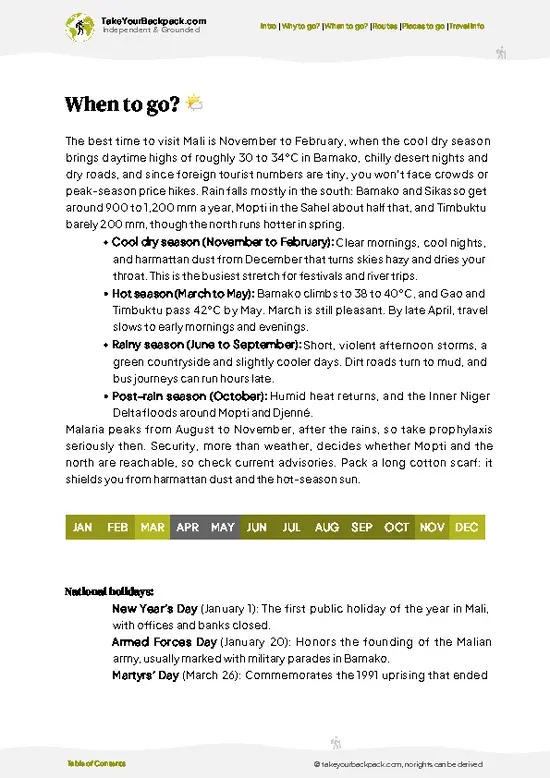
- Tomb of Askia: The tomb of Askia Mohammed, the Songhai ruler, is a stepped mud pyramid about 17 meters tall, bristling with wooden beams, with a mosque and cemetery beside it. Go in the cool of the morning for the best light. Entry is roughly €2 to 4 with a local guide, and a visit takes 1 to 1.5 hours.
- Niger River waterfront: Pirogues load and unload, women wash clothes and fishermen mend nets. It is free, best at dawn or late afternoon, and 1 hour is plenty.
- Gao Grand Market: A dense market of grain, fish, cloth, spices and leather, a good place to see how northern trade works. Mornings are liveliest. Entry is free, and 1 to 1.5 hours works. Ask before taking photos.
- Dune of Gao (Koima dunes): Sand dunes at the edge of town, popular with locals for evening walks and views over the river and
- Tomb of Askia: The tomb of Askia Mohammed, the Songhai ruler, is a stepped mud pyramid about 17 meters tall, bristling with wooden beams, with a mosque and cemetery beside it. Go in the cool of the morning for the best light. Entry is roughly €2 to 4 with a local guide, and a visit takes 1 to 1.5 hours.
- Niger River waterfront: Pirogues load and unload, women wash clothes and fishermen mend nets. It is free, best at dawn or late afternoon, and 1 hour is plenty.
- Gao Grand Market: A dense market of grain, fish, cloth, spices and leather, a good place to see how northern trade works. Mornings are liveliest. Entry is free, and 1 to 1.5 hours works. Ask before taking photos.
- Dune of Gao (Koima dunes): Sand dunes at the edge of town, popular with locals for evening walks and views over the river and rooftops. Free, best late in the day, about 1 hour.
- Gao Museum area and old quarter: The old Songhai neighborhoods and the ancient mosque quarter give context to the city’s past. A walk with a local guide takes 1 to 2 hours and costs roughly €3 to 6 as a guide tip.
Spotted a mistake or missing something? Contact us.

 Best Backpacking
.jpg) Hi, I’m Johan (Netherlands 🇳🇱), the creator of TakeYourBackpack. Over the past 3 decades, I’ve backpacked through 90+ countries across six continents, gaining extensive experience with independent travel, long-term trips, and overland routes.
Hi, I’m Johan (Netherlands 🇳🇱), the creator of TakeYourBackpack. Over the past 3 decades, I’ve backpacked through 90+ countries across six continents, gaining extensive experience with independent travel, long-term trips, and overland routes.