×

Mali🇲🇱 | best townsTop-Rated 10 towns in Mali

Towns in Mali are Sahel and savanna market centers, not resort stops. The south (the Bamako, Ségou and Sikasso belt) is greener, easier to reach and the only part where independent travel is still practical, with paved highways and daily buses. The center and north hold the famous names but sit under severe government warnings, so they are not worth planning a trip around. Expect mud-brick architecture, river and market life, almost no other tourists and simple guesthouses at roughly 10,000 to 25,000 CFA francs (US$17 to 42) a night. Backpacking here suits travelers who value atmosphere over comfort.

By Johan Kruseman 🇳🇱 | Updated October 19, 2026
Explore the best landmarks in Mali

Why go?Why Travelers Love These Spots

Mali’s towns grew along trade and water: the Niger River, the old trans-Saharan caravan routes and the cotton and grain belt of the south. That history produced Sudano-Sahelian mud architecture, weekly markets and a deep musical and craft tradition found in few other West African countries. Towns here are working centers first, so what you see is real daily life rather than staged culture.

The weakness is infrastructure and security. Since the 2010s, conflict has closed most of the north and parts of the center to ordinary tourism, and many governments advise against all or most travel to Mali. Anyone choosing the country for its towns should treat the south and west as the realistic base and drop the northern icons from the plan. Tourist services are thin. There are few formal tours, patchy … read more 👉
Mali’s towns grew along trade and water: the Niger River, the old trans-Saharan caravan routes and the cotton and grain belt of the south. That history produced Sudano-Sahelian mud architecture, weekly markets and a deep musical and craft tradition found in few other West African countries. Towns here are working centers first, so what you see is real daily life rather than staged culture.

The weakness is infrastructure and security. Since the 2010s, conflict has closed most of the north and parts of the center to ordinary tourism, and many governments advise against all or most travel to Mali. Anyone choosing the country for its towns should treat the south and west as the realistic base and drop the northern icons from the plan. Tourist services are thin. There are few formal tours, patchy booking systems and limited English, so French (or Bambara) helps far more than any app.

Expect power cuts, dust and heat as normal, not as exceptions. Cash in CFA francs is the rule, because cards work only in a few Bamako hotels. If you want polished heritage towns with easy transport, Senegal or Morocco serve you better. If you want low prices, almost empty streets and real market culture, southern Mali delivers, provided you check current advisories first.
Our Approach to Ranking
The list of best towns in Mali is created based on charm, local culture, atmosphere, hidden gems, and visitor appeal. If you feel a town is missing in this list, please let us know.

When to go?Best Time to Visit Mali for towns

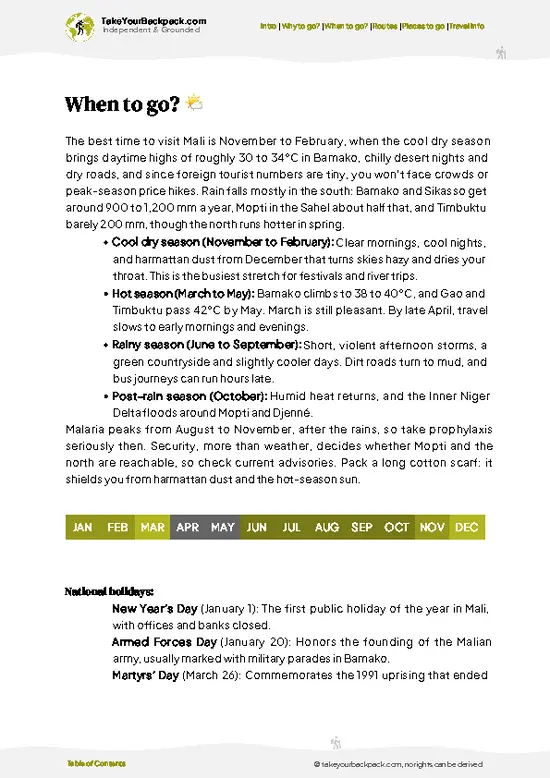
Best months: The best months for Mali’s towns are November to February, when daytime highs sit around 30 to 35°C, nights drop to 16 to 22°C and no rain falls. The Harmattan wind brings dust haze from December to February, which dulls views and irritates lungs, but it is still the most comfortable window.
Shoulder and hot season: March to May is the hot season, with highs of 38 to 44°C in Bamako, Ségou and the Niger valley. Midday sightseeing is pointless then. Plan to move at dawn and rest from 11 am to 4 pm, or skip these months. October and early March are workable shoulders, with lower heat and thinner dust.
Rainy season: The rainy season runs June to September in the south, peaking in July and August. Bamako gets roughly 900 to 1,000 mm a year, and the Sikasso region about 1,100 to 1,300 … read more 👉
Best months: The best months for Mali’s towns are November to February, when daytime highs sit around 30 to 35°C, nights drop to 16 to 22°C and no rain falls. The Harmattan wind brings dust haze from December to February, which dulls views and irritates lungs, but it is still the most comfortable window.
Shoulder and hot season: March to May is the hot season, with highs of 38 to 44°C in Bamako, Ségou and the Niger valley. Midday sightseeing is pointless then. Plan to move at dawn and rest from 11 am to 4 pm, or skip these months. October and early March are workable shoulders, with lower heat and thinner dust.
Rainy season: The rainy season runs June to September in the south, peaking in July and August. Bamako gets roughly 900 to 1,000 mm a year, and the Sikasso region about 1,100 to 1,300 mm, mostly in those months. Dirt roads turn to mud, river crossings slow down and some rural tracks close. The north of the country is far drier but is the part under travel warnings.
Crowds and prices: Tourist numbers are very low all year, so crowds are no factor. Prices barely shift by season, though guesthouses in the capital may cost 10 to 20 percent more around December holidays. Festival and holiday dates move with the Islamic calendar, and Ramadan shortens restaurant hours in daytime. Check dates before booking.

town hoppingHow to Combine towns Into One Trip

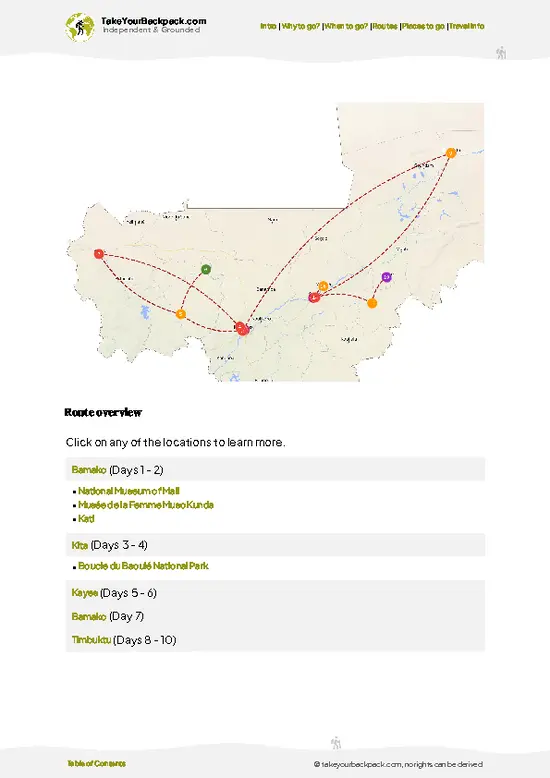
How many days: A trip that links several towns in Mali needs 7 to 12 days, because the distances are long and the roads are slow. This applies to the south and west only, where security and road conditions allow ordinary travel.
Direction and hubs: Bamako is the only real hub, since every bus company and international flight runs through it. Work outward in a loop, for example east and south toward the Ségou and Sikasso regions, then return through the capital. Bamako to Ségou is roughly 3 to 4 hours by road, and Bamako to Sikasso about 5 to 6 hours. Bamako to Kayes in the west takes 8 to 10 hours and rarely repays the effort in a short trip. Use the daytime bus companies rather than shared taxis where possible, since they run to timetables.
Time per stop: Allow 1 to 2 nights in a town and 2 … read more 👉
How many days: A trip that links several towns in Mali needs 7 to 12 days, because the distances are long and the roads are slow. This applies to the south and west only, where security and road conditions allow ordinary travel.
Direction and hubs: Bamako is the only real hub, since every bus company and international flight runs through it. Work outward in a loop, for example east and south toward the Ségou and Sikasso regions, then return through the capital. Bamako to Ségou is roughly 3 to 4 hours by road, and Bamako to Sikasso about 5 to 6 hours. Bamako to Kayes in the west takes 8 to 10 hours and rarely repays the effort in a short trip. Use the daytime bus companies rather than shared taxis where possible, since they run to timetables.
Time per stop: Allow 1 to 2 nights in a town and 2 to 3 in the capital. One night is too short once you count arrival, market hours and a late start, while more than 2 nights in a small town leaves empty hours.
Planning mistakes: The first mistake is packing too many stops. Three or four towns in 10 days is realistic, and six is exhausting. The second is building the route around the north or center because of famous names. Replace it with a southern loop, and take advice from your embassy before leaving. Third, travelers schedule night travel to save a hotel bill. Do not. Leave early, arrive by afternoon and keep a buffer day for breakdowns, which are common. Fourth, they ignore the rainy season, when tracks flood. Stick to paved highways between June and September.

The ListTop towns of Mali

1 Timbuktu

Saharan gateway, ancient manuscripts, mud mosques

Step into a legendary city where centuries-old libraries and earthen mosques recall its role as a center of trans-Saharan learning.

2 Djenné

Great Mosque, mud architecture, island town

Arrive on market day to see the world’s largest mud-brick building and a town shaped by centuries of river island life.

3 Bandiagara

Cliff villages, Dogon culture, escarpment views

Hike near dramatic cliffs and encounter Dogon communities whose architecture and rituals are rooted in the surrounding escarpment.

4 Gao

Saharan edge, Askia Tomb, riverbank villages, desert markets

Travel to a city where the desert meets the river, ancient tombs stand watch, and markets pulse with Saharan trade.

5 Koulikoro

river port, boatyards, cotton warehouses, riverside markets

Watch riverboats load at dawn, wander among cotton bales, and see how trade shapes the rhythms of this working port town.

6 San

Mud-brick mosques, weekly market, Bobo architecture

Wander through a town known for its distinctive mosque, lively market days, and the influence of Bobo artisanship.

7 Bougouni

Bambara heartland, agricultural hub, roadside town

Travel through a crossroads town surrounded by farmland, where local produce and Bambara customs define the atmosphere.

8 Kita

Railway junction, music heritage, mango orchards

Discover a town where music festivals, train tracks, and seasonal mango harvests create a unique rhythm for visitors.

9 Kidal

Sahara outpost, Tuareg culture, remote desert town

Experience a remote desert settlement where Tuareg traditions shape daily life and the vast Sahara frames every horizon.

10 Bla

Transport junction, bus hub, roadside stalls

Stop at a key crossroads where travelers change buses, rest, and refuel at roadside stalls before continuing their journey.

11 Niafunké

Riverbank town, music legacy, rice farming

Explore a riverside settlement famous for its musical heritage and the patchwork of rice fields along the Niger.

12 Markala

River barrage, hydro infrastructure, fishing community

Observe daily life shaped by the river’s flow, with a major barrage supporting both fishing livelihoods and regional water management.

13 Douentza

Hiking base, rocky outcrops, Fulani encampments

Use this town as a base for exploring rocky landscapes and encountering Fulani encampments scattered across the plains.

14 Goundam

Lakeside town, Songhai heritage, seasonal fishing

Visit during the fishing season to see how lakes and Songhai traditions shape the town’s social and economic life.

15 Diré

Niger River port, date palms, riverine trade

Watch boats unload at a river port surrounded by date groves, where commerce and agriculture meet along the Niger.

16 Youwarou

Floodplain village, Bozo fishing, seasonal access

Navigate shifting waterways to reach a settlement where fishing and seasonal rhythms dictate the pace of daily activity.

17 Ténenkou

Delta town, pirogue transport, Fulani villages

Travel by boat through a delta region, passing Fulani hamlets and experiencing a town accessible mainly by water.

18 Koro

Border market, Dogon plateau, craft traditions

Browse a lively market at the edge of the Dogon plateau, where cross-border trade and local crafts are central.

19 Bankass

Market center, Dogon crossroads, millet fields

Experience a bustling market town at the intersection of Dogon villages and agricultural lands, with millet as a staple crop.

20 Tominian

Bwa villages, pottery workshops, crossroads town

Explore a crossroads town known for Bwa cultural traditions and the pottery workshops that supply the region.

21 Barouéli

Cotton farming, rural market, Ségou region

Visit a farming town where cotton fields and a weekly market connect rural producers to the wider Ségou area.

22 Kolokani

Traditional markets, Fulani settlements, rural crossroads

Visit a rural center where Fulani herders and local traders converge, giving the town a distinctly pastoral character.

23 Diéma

Sahelian plains, livestock trading, transit stop

Pause in a town where herders gather for livestock markets and the open Sahel stretches in every direction.

24 Kéniéba

Gold mining, border proximity, hilly terrain

Observe the impact of gold mining in a hilly border region, where prospectors and traders shape the local economy.

25 Yanfolila

Forest edge, artisanal mining, rural villages

Travel through a region where forest meets savanna, and small-scale mining supports a network of rural communities.

26 Macina

Canal network, rice cultivation, delta settlement

See how irrigation canals and rice fields define a settlement at the heart of the Inner Niger Delta’s agricultural zone.

27 Niono

Irrigation canals, rice fields, Office du Niger

See how engineered waterways and expansive rice paddies support a community built around the Office du Niger’s agricultural projects.

28 Bafoulabé

River confluence, colonial relics, ferry crossing

Cross rivers at a historic meeting point, where colonial-era buildings and ferryboats mark the landscape’s changing currents.

29 Gourma-Rharous

Desert edge, nomadic camps, river crossing

Cross the Niger at a desert frontier, where nomadic groups and river travelers intersect in a sparse, open landscape.

Think you know Mali?

Prove you’re a true local — uncover 19 lesser-known towns in Mali that locals tend to keep to themselves.
Loading the map 🌍

Expert viewInsights from Locals and Experts

How many towns to visit: Plan on three or four towns in total, and no more. Roads are long, buses leave when full rather than on schedule, and a single breakdown or checkpoint delay can swallow half a day. A fifth stop usually means rushing everything else, and you pay for it in transport fares and missed mornings. Visa processing and security checks at the Bamako end also eat time, so leave slack in your schedule.

Which kind to prioritize: Pick one or two types and skip the rest. Mali’s towns fall into roughly four kinds: river and trading towns, mud-brick architecture towns, escarpment and village country, and the southern market towns. If you care about architecture and living history, favor the mud-brick towns. They need the least guiding and the least logistics. If hiking is the goal, … read more 👉
How many towns to visit: Plan on three or four towns in total, and no more. Roads are long, buses leave when full rather than on schedule, and a single breakdown or checkpoint delay can swallow half a day. A fifth stop usually means rushing everything else, and you pay for it in transport fares and missed mornings. Visa processing and security checks at the Bamako end also eat time, so leave slack in your schedule.

Which kind to prioritize: Pick one or two types and skip the rest. Mali’s towns fall into roughly four kinds: river and trading towns, mud-brick architecture towns, escarpment and village country, and the southern market towns. If you care about architecture and living history, favor the mud-brick towns. They need the least guiding and the least logistics. If hiking is the goal, choose the escarpment country, but budget for a mandatory local guide and for the transfer, which is the largest single cost. If you want ordinary daily life, music and cheap food, the southern and river towns are easier and cheaper, with fewer touts. Do not spend days on a town purely to tick it off. Many Malian towns are working market centers, not sights, and a night is enough.

What it costs: A realistic budget is CFA 15,000 to 27,000 a day (US$25 to 45), covering a basic room, local meals and shared transport. Rooms in simple guesthouses run CFA 8,000 to 15,000 (US$13 to 25), with air conditioning adding CFA 5,000 to 10,000 on top. Street and canteen meals cost CFA 1,500 to 4,000 (US$2.50 to 7). Intercity buses and shared taxis run CFA 5,000 to 12,000 (US$8 to 20) per leg, and the better companies charge a little more for a reserved seat that is well worth it. Local guides cost CFA 10,000 to 25,000 (US$17 to 42) a day. Village, mosque and community entry fees, plus tourist taxes, are typically CFA 1,000 to 5,000 (US$2 to 8) each, so a day of visits adds up. Carry plenty of cash in small CFA notes, because ATMs outside the capital fail often and change for large bills is scarce. Agree prices for guides, pirogues and bush taxis before you move, and ask whether the quoted figure is per person or per vehicle. That single question prevents the most common overcharge.

Safety and cultural considerations: Security varies sharply by region and changes quickly, so check current conditions with your embassy and a reliable local contact before you commit to any town, and again before each leg. Do not travel at night, and avoid roads where armed groups or banditry have been reported. Expect police and army checkpoints; carry your passport and a few photocopies, and stay patient and polite. Keep valuables out of sight on buses and in crowded markets.

Mali is a mostly Muslim country, and dress and manners matter. Cover your shoulders and knees, and greet people properly before asking for anything, as greetings can run long. Ask before photographing people, and never photograph soldiers or checkpoints. Non-Muslims are often barred from entering mosques, so do not push the point. Tourist visits in the dry season can fall during Ramadan, when daytime food options shrink, and you should eat discreetly. Drink only bottled or treated water, and take malaria prophylaxis, since transmission is year-round.

✈️ The backpacker research shortcutMali Travel Guide

An offline-friendly backpacking guide with optimized travel routes, ranked highlights, transport advice, and the best areas to stay.
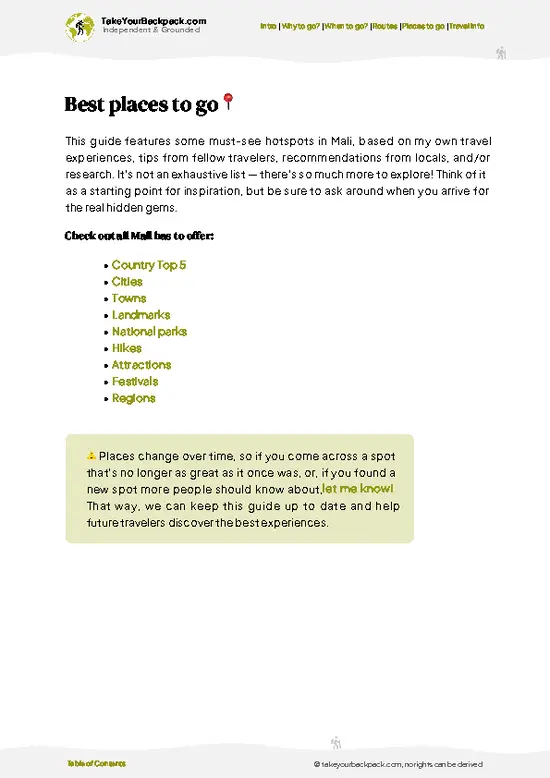
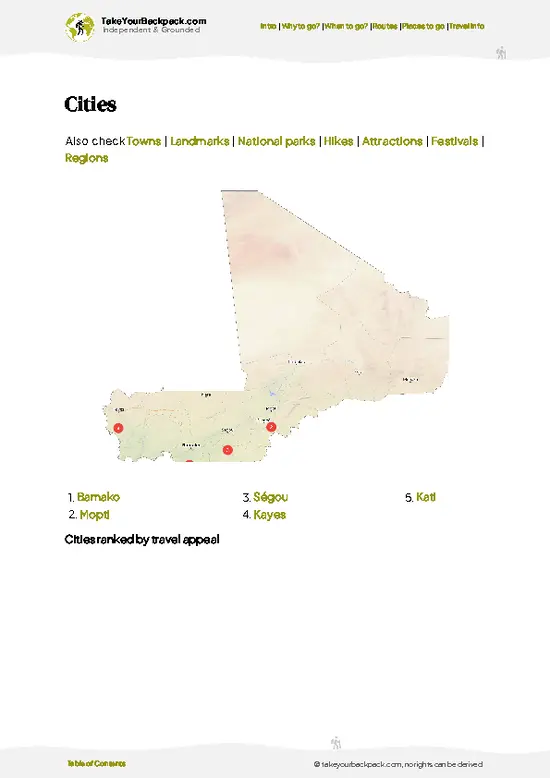
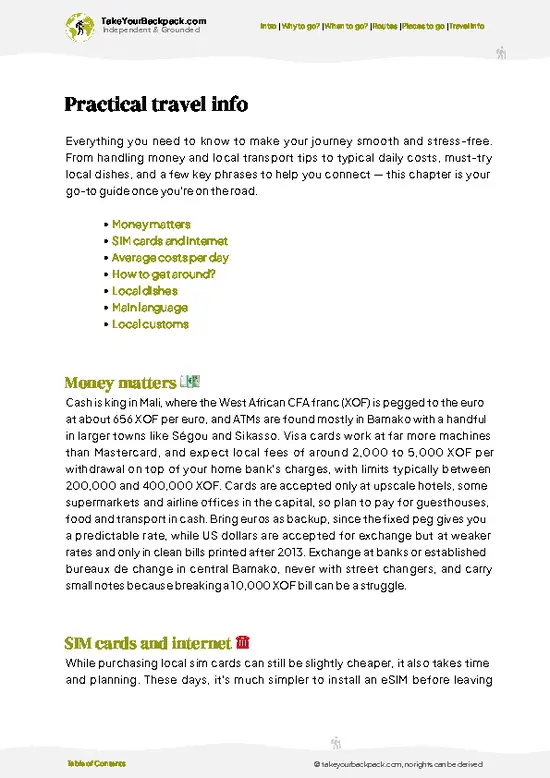
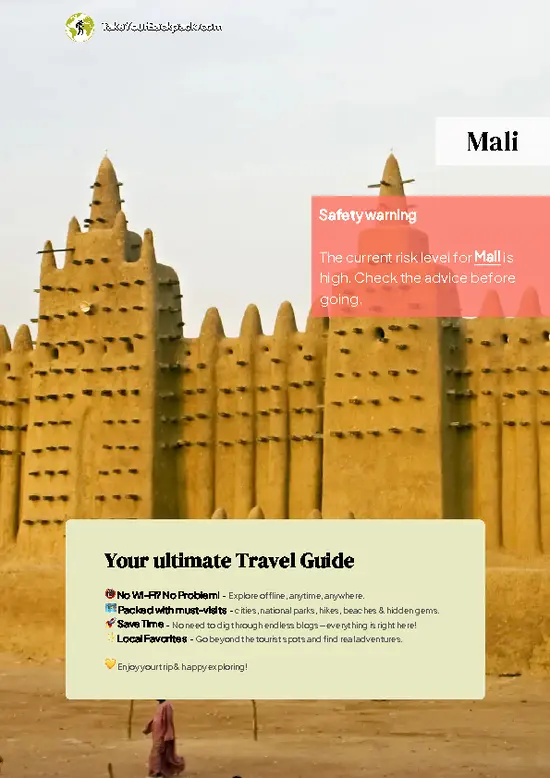
example page 0 from our offline Travel Guide for Mali
example page 1 from our offline Travel Guide for Mali
example page 2 from our offline Travel Guide for Mali
example page 3 from our offline Travel Guide for Mali
example page 4 from our offline Travel Guide for Mali
example page 5 from our offline Travel Guide for Mali
example page 6 from our offline Travel Guide for Mali
example page 7 from our offline Travel Guide for Mali
The digital guide (266 pages) contains:
✅ 61 highlights, ranked by travel appeal
✅ Optimized 5, 10 & 15-day travel routes
✅ Cities, national parks, landmarks, beaches
✅ How to get around
✅ Offline-friendly for travel without Wi-Fi
👉 Click to see all 30+ guide features

📅 Plan smarter in minutes, not weeks
✅ Month by month travel advice
✅ Festivals & national holidays
✅ Budget expectations

🗺️ Go to the right places, skip the overrated ones
✅ Honest pros & cons of destinations
✅ Top hikes, parks & viewpoints
✅ Lesser-known places most travelers miss
✅ Clear “worth it vs skip it” guidance

🛏️ Travel smoothly without rookie mistakes
✅ Best areas to stay
✅ Transport systems explained simply
✅ Common scams & safety advice
✅ SIM cards, money & practical tips

🌍 Understand the country, not just visit it
✅ Culture & traditions
✅ 52 Essential phrases & customs
✅ Festivals worth planning around
✅ Traveler-friendly historical context
✅ Insights that make places more meaningful

📱 Built for real travel conditions
✅ Fully downloadable PDF
✅ Works completely offline
✅ Optimized for phone use
✅ Useful in remote areas & buses
✅ Everything in one place
Stop searching, start planning
Get instant access to your full guide. 30‑day money-back guarantee.
+ Add another guide for just

By proceeding you agree to our terms.
Sent to your inbox immediately after payment • 100% Secure Checkout
Best Backpacking Travel Advisor 2025 tourism awardBest Backpacking
Travel Advisor
2025
What others say about Take Your Backpack Guides:
⭐⭐⭐⭐⭐
Fantastic, amazing amount of information!
⭐⭐⭐⭐⭐
My goodness this is amazing, it's what I've been looking for hats off too you!
⭐⭐⭐⭐⭐
I think this is absolutely BRILLIANT
⭐⭐⭐⭐
Very complete and informative. It's still missing places, but I gotta to commend you
⭐⭐⭐⭐⭐
This is truly amazing, thank you, can't wait to explore it with my kids!
⭐⭐⭐⭐⭐
Awesome resource, thank you!
⭐⭐⭐⭐⭐
This is amazing! Can't wait to explore the ones I haven't seen
⭐⭐⭐⭐
I love this! Well done, great idea.
⭐⭐⭐⭐⭐
Thanks for taking the time to make this gem!
⭐⭐⭐⭐⭐
This might be the best website I've ever seen.
⭐⭐⭐⭐⭐
Congratulations, and thank you so much for your work; it's incredibly valuable.
⭐⭐⭐⭐
In all seriousness I think you did a great job pointing out the important spots
⭐⭐⭐⭐⭐
10/10 very good
⭐⭐⭐⭐⭐
As someone who's only just starting to visit regularly this is awesome, thank you.
⭐⭐⭐⭐
Thank you very much! I'm going to visit my dad, it's going to be very useful!
⭐⭐⭐⭐⭐
This is really cool! We'll be travelling for the first time and this definitely come in handy.
⭐⭐⭐⭐⭐
You are now our minister of culture, congratulations 👨‍💼
⭐⭐⭐⭐⭐
Just wanted to tell you that this is a pearl! Going to follow your recommendations.
⭐⭐⭐⭐⭐
This is so cool. I'll definitely be using the resource for my travels soon.
⭐⭐⭐⭐⭐
This is very impressive! Good work.
⭐⭐⭐⭐⭐
This is an amazing and informative site. Very well done!

🛏️ Where to stay?Where to Stay in Mali

True backpacker hostels with dorms are almost nonexistent in Mali, but Bamako has a decent spread of simple guesthouses, church-run missions and budget hotels, with private rooms usually costing 10,000 to 25,000 CFA (€15 to 38) a night. Hippodrome has the city’s best concentration of bars, live-music spots and cheap eateries, which also means late-night noise, while ACI 2000 is newer, cleaner and better for ATMs and supermarkets but feels spread out and car-dependent. South of the Niger, Badalabougou is quieter and leafier with an easy riverside feel, though you’ll rely on taxis to reach the Quartier du Fleuve and the Grand Marché area, where rooms are central but the streets are hectic and … read more 👉
True backpacker hostels with dorms are almost nonexistent in Mali, but Bamako has a decent spread of simple guesthouses, church-run missions and budget hotels, with private rooms usually costing 10,000 to 25,000 CFA (€15 to 38) a night. Hippodrome has the city’s best concentration of bars, live-music spots and cheap eateries, which also means late-night noise, while ACI 2000 is newer, cleaner and better for ATMs and supermarkets but feels spread out and car-dependent. South of the Niger, Badalabougou is quieter and leafier with an easy riverside feel, though you’ll rely on taxis to reach the Quartier du Fleuve and the Grand Marché area, where rooms are central but the streets are hectic and less comfortable after dark.

If you enjoy meeting fellow travelers, consider choosing hostels with high ratings for atmosphere. On the other hand, if you prefer having your own space, a hotel might be a better option.

MaliMore of Mali

👋 Meet the founderWho’s Behind Take Your Backpack?

Johan, backpacker and founder of TakeYourBackpackHi, I’m Johan (Netherlands 🇳🇱), the creator of TakeYourBackpack. Over the past 3 decades, I’ve backpacked through 90+ countries across six continents, gaining extensive experience with independent travel, long-term trips, and overland routes.

This site is built on a combination of firsthand travel experience and carefully curated insights from other backpackers. Many guides are based on places I’ve personally visited, while others bring together tips, observations, and practical advice shared by trusted travelers I’ve met along the way.

The goal is to provide realistic, experience-driven guidance — not generic itineraries — so you can explore destinations with better context, clearer expectations, and more confidence.