×

Marshall Islands🇲🇭 | regionsRongelap AtollEvacuated village, 1954 fallout, Ailinginae, ocean reef flats | things to do and best time to go

Explore Namu AtollExplore Ailinglaplap Atoll

Backpacking in Rongelap Atoll
👍 Recommendedregion ranked #2
By Johan Kruseman 🇳🇱 | Updated October 15, 2026

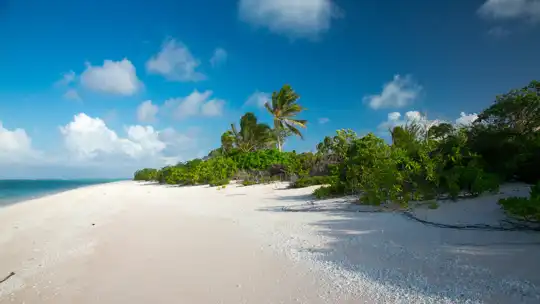
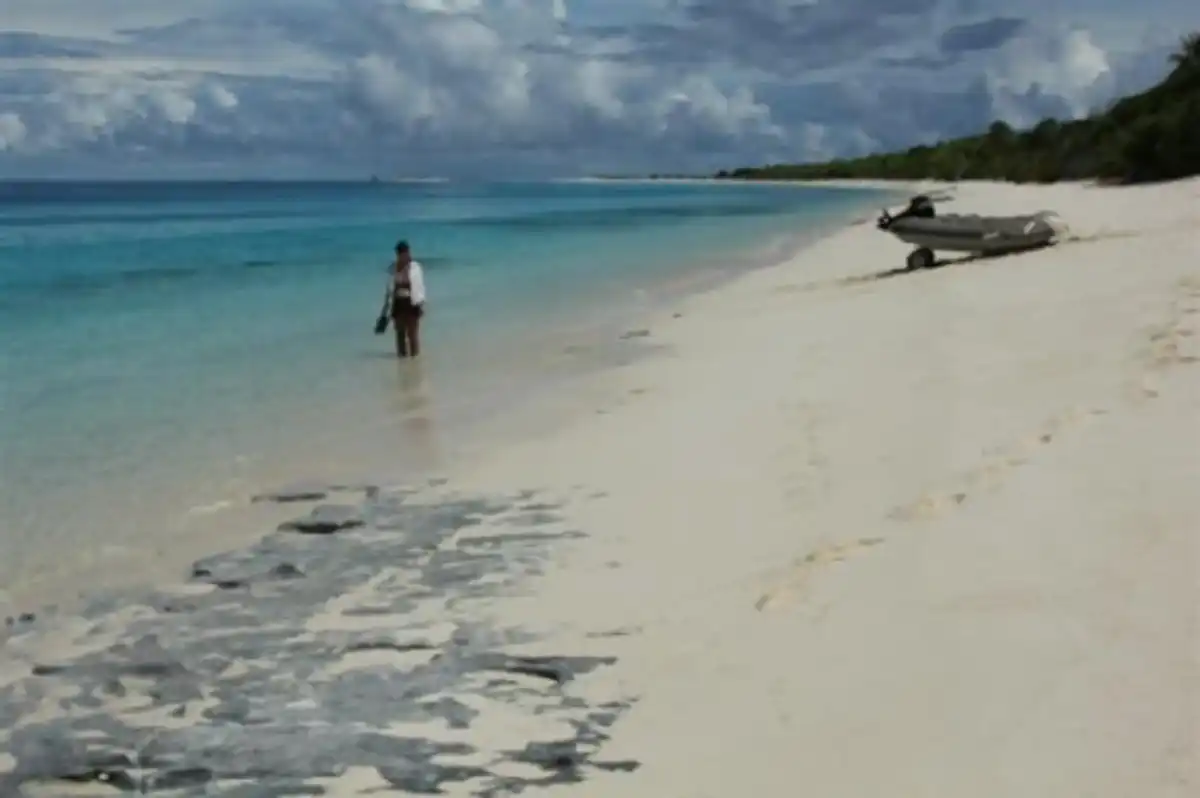
The first thing you notice stepping off the boat is the silence: no engines, no dogs, just wind combing through coconut palms and surf thudding on the reef. The coral rubble underfoot is bone white, the air smells of salt and rotting copra, and the lagoon glows a sheet of impossible turquoise. Rongelap Atoll lies in the northern Marshall Islands, northwest of Majuro, and it is among the most haunted places in the Pacific. The wow-factor is quiet and heavy. Fallout from the 1954 Bravo test, detonated at Bikini, drifted over these islands and set off decades of displacement. Photo potential is huge, but there are no hostels, no regular ferries and no casual walk-ons, so access is the real hurdle. Crowds do not exist. Unlike Bikini Atoll, which has dive operators running trips to the sunken test fleet, Rongelap has no organized visitor program, and what you get is the raw, empty island itself.

Discover everything you want to know in the 📖 Marshall Islands Travel Guide.


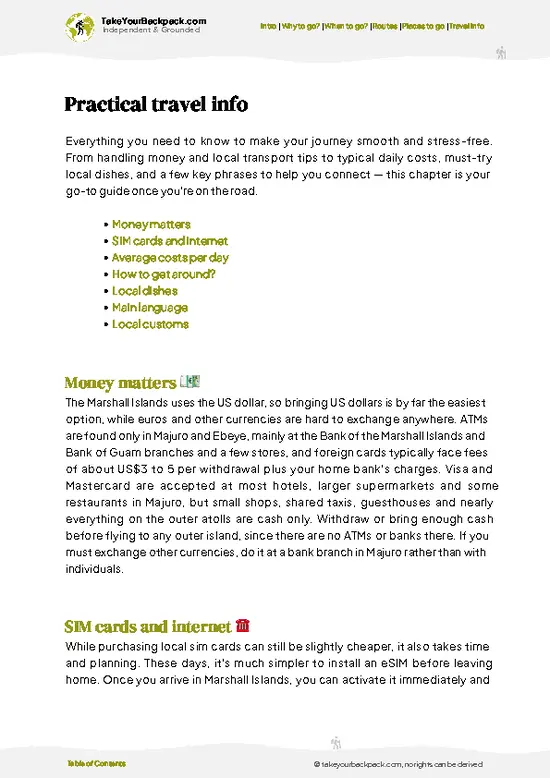
example page 0 from our offline Travel Guide for Marshall Islands
example page 1 from our offline Travel Guide for Marshall Islands
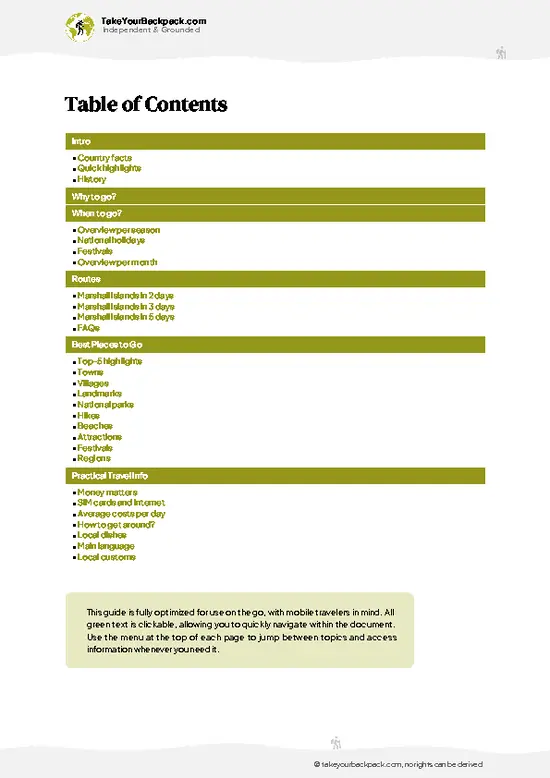
example page 2 from our offline Travel Guide for Marshall Islands
example page 3 from our offline Travel Guide for Marshall Islands
example page 4 from our offline Travel Guide for Marshall Islands
example page 5 from our offline Travel Guide for Marshall Islands
example page 6 from our offline Travel Guide for Marshall Islands
example page 7 from our offline Travel Guide for Marshall Islands
Loading the map 🌍
CLICK TO FILTER
towns
villages
landmarks
national parks
hikes
beaches
attractions
festivals
regions
SHOW COUNTRY’S BESTSHOW ALL

✨ Why go?
Ranked #2 region in Marshall Islands
Reasons people choose to visit here

Go only if history pulls you harder than comfort does. Rongelap is where the human cost of the Cold War nuclear tests becomes physical: you see an island that people were evacuated from in 1954, resettled on in 1957, and left again in 1985 when the Greenpeace ship Rainbow Warrior carried roughly 300 residents to Mejatto. Reading about it is one thing. Standing on a quiet island where houses were built for people still waiting to return is another.
What makes it worth the effort is its uniqueness. Few places in the world let you stand inside a story this recent and this unresolved, and the lagoon of roughly 1,000 square kilometers is among the larger ones in the Marshalls, almost untouched by tourism.
It fits best into a longer Marshall Islands loop rather than standing alone. Pair it with time … read more 👉
Go only if history pulls you harder than comfort does. Rongelap is where the human cost of the Cold War nuclear tests becomes physical: you see an island that people were evacuated from in 1954, resettled on in 1957, and left again in 1985 when the Greenpeace ship Rainbow Warrior carried roughly 300 residents to Mejatto. Reading about it is one thing. Standing on a quiet island where houses were built for people still waiting to return is another.
What makes it worth the effort is its uniqueness. Few places in the world let you stand inside a story this recent and this unresolved, and the lagoon of roughly 1,000 square kilometers is among the larger ones in the Marshalls, almost untouched by tourism.
It fits best into a longer Marshall Islands loop rather than standing alone. Pair it with time in Majuro and, if you can arrange it, other atolls shaped by the nuclear era. Expect to organize everything through local government channels well ahead, and travel with respect for a community whose homeland this still is.

💡 HighlightsKey sights and experiences for travelers

  1. Rongelap Island: The main island and the old village site, and the sight most people mean when they say Rongelap. Overgrown paths, rebuilt housing and the open lagoon shoreline show how an evacuated home looks after decades of waiting.
  2. The Lagoon: One of the biggest lagoons in the Marshalls, with water that shifts from pale green over sand to deep blue over coral heads. Calm mornings give glassy reflections and clear views of the reef edge.
  3. Ailinginae Atoll: The uninhabited neighboring atoll within the same local government area, also touched by the 1954 fallout. Its isolation has left it a refuge for seabirds and marine life, and it is a reminder of how large the affected zone was.
  4. The Outer Reef and Ocean Beaches: Reef flats on the ocean side run for long stretches, with surf breaking over
… read more 👉
  1. Rongelap Island: The main island and the old village site, and the sight most people mean when they say Rongelap. Overgrown paths, rebuilt housing and the open lagoon shoreline show how an evacuated home looks after decades of waiting.
  2. The Lagoon: One of the biggest lagoons in the Marshalls, with water that shifts from pale green over sand to deep blue over coral heads. Calm mornings give glassy reflections and clear views of the reef edge.
  3. Ailinginae Atoll: The uninhabited neighboring atoll within the same local government area, also touched by the 1954 fallout. Its isolation has left it a refuge for seabirds and marine life, and it is a reminder of how large the affected zone was.
  4. The Outer Reef and Ocean Beaches: Reef flats on the ocean side run for long stretches, with surf breaking over coral shelves. Walking them at low tide, you meet hermit crabs, reef herons and bleached coral rubble underfoot.
  5. The Resettlement Landscape: Cleared lots, new foundations and rebuilt structures on the main island tell the unfinished story of the Rongelapese return. It is a sober, instructive look at what repatriation after nuclear contamination involves.
For a first visit, Rongelap Island is the one to prioritize, since it holds the whole story in a single walkable stretch of shore.
Spotted a mistake or missing something? Contact us.
⌛️ 5 daysHow to make the most of Rongelap Atoll

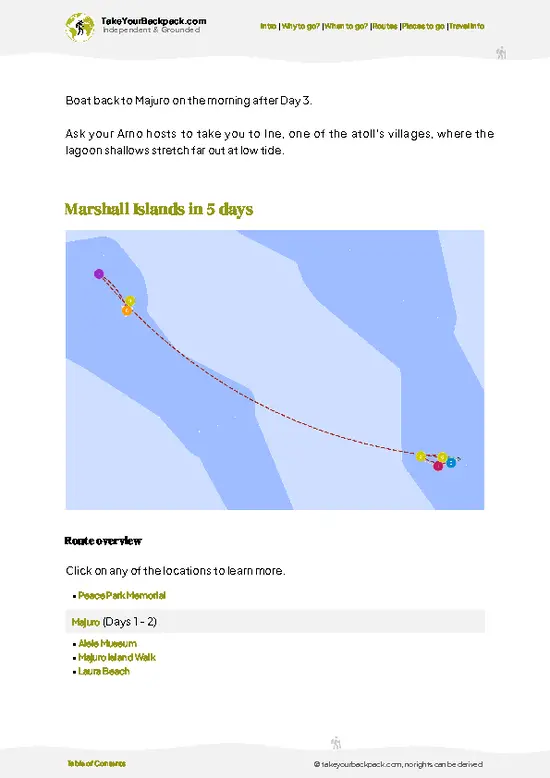
Day 1: Rongelap Island: Start on the main island, the atoll’s only real base, and let the first morning go to walking it with your host. Everything here moves on the rhythm of the boat and the tide, because Rongelap Atoll has no scheduled ferries or public transport. Charter arrangements set your arrival, so you spend the first day getting your bearings and learning what is safe to visit and what is off limits.

Day 2: Rongelap Island: Staying put pays off. The island’s history is the reason to come: the 1954 fallout from the Bravo test, the evacuation, the return and the second departure in 1985. Spend the day on the ground where the resettlement and cleanup work is happening, and talk with the people rebuilding. Follow your host’s guidance on where you may walk, eat and drink. Conversations … read more 👉
Day 1: Rongelap Island: Start on the main island, the atoll’s only real base, and let the first morning go to walking it with your host. Everything here moves on the rhythm of the boat and the tide, because Rongelap Atoll has no scheduled ferries or public transport. Charter arrangements set your arrival, so you spend the first day getting your bearings and learning what is safe to visit and what is off limits.

Day 2: Rongelap Island: Staying put pays off. The island’s history is the reason to come: the 1954 fallout from the Bravo test, the evacuation, the return and the second departure in 1985. Spend the day on the ground where the resettlement and cleanup work is happening, and talk with the people rebuilding. Follow your host’s guidance on where you may walk, eat and drink. Conversations take time here, and a rushed day wastes them.

Day 3: Lagoon crossing: This is the detour. With a skiff and a local guide, cross the lagoon to an outer islet for a day of reef and empty sand. It adds scale, since the lagoon is vast and the islets are thin strips of palm and pandanus. It also adds no complexity, because you return to the same base by evening. Go only when the weather is settled and the boat operator agrees. Calm mornings are the best window.

Day 4: Rongelap Island: Use this day as slack. Weather delays are the norm when boats are the only link, so a spare day protects the rest of the plan. If the sea is calm, snorkel the reef edge near the island. If not, spend the time with families on the island and on the shoreline, where you can see how daily life is being rebuilt.

Day 5: Departure: Pack early and keep the boat’s schedule flexible. Handle your farewells first and leave the logistics to your host.

If you only have one day, make it Day 2. It is the day that explains why Rongelap Atoll matters.

🌤️ When to go?When to go for the best experience

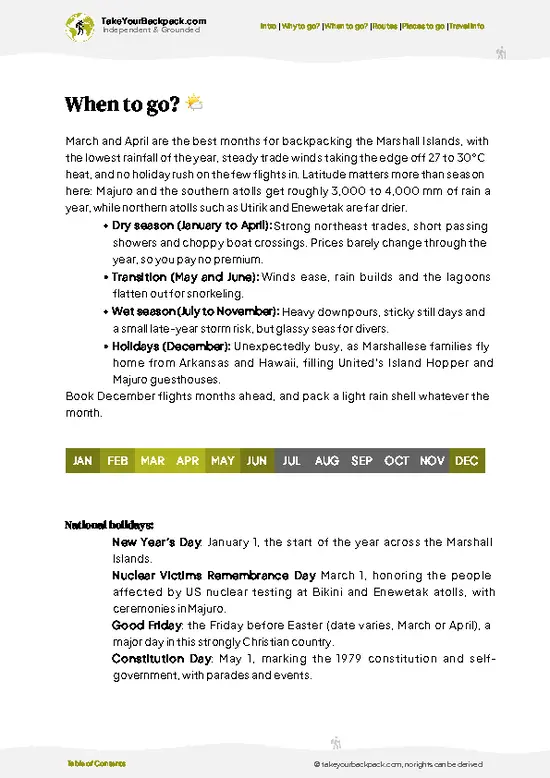
The best window for Rongelap Atoll is January to April, when trade winds blow steadily and rain is lightest, though access depends on charter or government-organized trips rather than the season. Rongelap was heavily contaminated by fallout from the 1954 Bravo nuclear test, and the atoll is not open for casual independent travel. Visits are arranged through Marshall Islands authorities, so dates are set by the arrangement.
  • Dry Season (December to April): Days reach 29 to 31°C (84 to 88°F), nights stay near 26°C (79°F), and the sea is calmer for lagoon crossings. Daylight runs about 11.5 to 12.5 hours.
  • Wet Season (May to November): Expect frequent squalls and humid heat of 28 to 31°C (82 to 88°F), with rougher seas. Typhoon risk is low but not zero, and flight and boat schedules slip.
  • Crowds and
… read more 👉
The best window for Rongelap Atoll is January to April, when trade winds blow steadily and rain is lightest, though access depends on charter or government-organized trips rather than the season. Rongelap was heavily contaminated by fallout from the 1954 Bravo nuclear test, and the atoll is not open for casual independent travel. Visits are arranged through Marshall Islands authorities, so dates are set by the arrangement.
  • Dry Season (December to April): Days reach 29 to 31°C (84 to 88°F), nights stay near 26°C (79°F), and the sea is calmer for lagoon crossings. Daylight runs about 11.5 to 12.5 hours.
  • Wet Season (May to November): Expect frequent squalls and humid heat of 28 to 31°C (82 to 88°F), with rougher seas. Typhoon risk is low but not zero, and flight and boat schedules slip.
  • Crowds and Prices: There are no tourist crowds in any month. Charter and fuel costs vary with availability, not the calendar.
Book transport several months ahead and keep two spare days in your plan for weather delays.


source: climatestotravel.comJANJanuary: excellent for travelingFEBFebruary: excellent for travelingMARMarch: excellent for travelingAPRApril: highly recommended for travelingMAYMay: highly recommended for travelingJUNJune: fair for travelingJULJuly: fair for travelingAUGAugust: fair for travelingSEPSeptember: fair for travelingOCTOctober: fair for travelingNOVNovember: good for travelingDECDecember: excellent for traveling
marshall-islands-region-rongelap-atoll
© Google | Lewis Engel

✈️ The backpacker research shortcutMarshall Islands Travel Guide

An offline-friendly backpacking guide with optimized travel routes, ranked highlights, transport advice, and the best areas to stay.
example page 0 from our offline Travel Guide for Marshall Islands
example page 1 from our offline Travel Guide for Marshall Islands
example page 2 from our offline Travel Guide for Marshall Islands
example page 3 from our offline Travel Guide for Marshall Islands
example page 4 from our offline Travel Guide for Marshall Islands
example page 5 from our offline Travel Guide for Marshall Islands
example page 6 from our offline Travel Guide for Marshall Islands
example page 7 from our offline Travel Guide for Marshall Islands
The digital guide (125 pages) contains:
✅ 27 highlights, ranked by travel appeal
✅ Optimized 2, 3 & 5-day travel routes
✅ Cities, national parks, landmarks, beaches
✅ How to get around
✅ Offline-friendly for travel without Wi-Fi
👉 Click to see all 30+ guide features

📅 Plan smarter in minutes, not weeks
✅ Month by month travel advice
✅ Festivals & national holidays
✅ Budget expectations

🗺️ Go to the right places, skip the overrated ones
✅ Honest pros & cons of destinations
✅ Top hikes, parks & viewpoints
✅ Lesser-known places most travelers miss
✅ Clear “worth it vs skip it” guidance

🛏️ Travel smoothly without rookie mistakes
✅ Best areas to stay
✅ Transport systems explained simply
✅ Common scams & safety advice
✅ SIM cards, money & practical tips

🌍 Understand the country, not just visit it
✅ Culture & traditions
✅ 52 Essential phrases & customs
✅ Festivals worth planning around
✅ Traveler-friendly historical context
✅ Insights that make places more meaningful

📱 Built for real travel conditions
✅ Fully downloadable PDF
✅ Works completely offline
✅ Optimized for phone use
✅ Useful in remote areas & buses
✅ Everything in one place
Stop searching, start planning
Get instant access to your full guide. 30‑day money-back guarantee.
+ Add another guide for just

By proceeding you agree to our terms.
Sent to your inbox immediately after payment • 100% Secure Checkout
Best Backpacking Travel Advisor 2025 tourism awardBest Backpacking
Travel Advisor
2025
What others say about Take Your Backpack Guides:
⭐⭐⭐⭐⭐
Fantastic, amazing amount of information!
⭐⭐⭐⭐⭐
My goodness this is amazing, it's what I've been looking for hats off too you!
⭐⭐⭐⭐⭐
I think this is absolutely BRILLIANT
⭐⭐⭐⭐
Very complete and informative. It's still missing places, but I gotta to commend you
⭐⭐⭐⭐⭐
This is truly amazing, thank you, can't wait to explore it with my kids!
⭐⭐⭐⭐⭐
Awesome resource, thank you!
⭐⭐⭐⭐⭐
This is amazing! Can't wait to explore the ones I haven't seen
⭐⭐⭐⭐
I love this! Well done, great idea.
⭐⭐⭐⭐⭐
Thanks for taking the time to make this gem!
⭐⭐⭐⭐⭐
This might be the best website I've ever seen.
⭐⭐⭐⭐⭐
Congratulations, and thank you so much for your work; it's incredibly valuable.
⭐⭐⭐⭐
In all seriousness I think you did a great job pointing out the important spots
⭐⭐⭐⭐⭐
10/10 very good
⭐⭐⭐⭐⭐
As someone who's only just starting to visit regularly this is awesome, thank you.
⭐⭐⭐⭐
Thank you very much! I'm going to visit my dad, it's going to be very useful!
⭐⭐⭐⭐⭐
This is really cool! We'll be travelling for the first time and this definitely come in handy.
⭐⭐⭐⭐⭐
You are now our minister of culture, congratulations 👨‍💼
⭐⭐⭐⭐⭐
Just wanted to tell you that this is a pearl! Going to follow your recommendations.
⭐⭐⭐⭐⭐
This is so cool. I'll definitely be using the resource for my travels soon.
⭐⭐⭐⭐⭐
This is very impressive! Good work.
⭐⭐⭐⭐⭐
This is an amazing and informative site. Very well done!

🛏️ Where to stay?Best areas and accommodation options

Majuro is the practical place to stay before any Rongelap trip, because it holds the airport, the government offices that handle permissions, and every traveler service in the country. Rongelap itself has no tourist lodging, and the atoll’s main island has had only a small working presence for resettlement and monitoring projects, so you should not plan on turning up and finding a bed.
In Majuro, the Delap-Uliga-Djarrit (D-U-D) strip is the area to choose. Guesthouses and small hotels sit within walking distance of shops, cheap local eateries, the main bank, and the taxi stands that run along the … read more 👉
Majuro is the practical place to stay before any Rongelap trip, because it holds the airport, the government offices that handle permissions, and every traveler service in the country. Rongelap itself has no tourist lodging, and the atoll’s main island has had only a small working presence for resettlement and monitoring projects, so you should not plan on turning up and finding a bed.
In Majuro, the Delap-Uliga-Djarrit (D-U-D) strip is the area to choose. Guesthouses and small hotels sit within walking distance of shops, cheap local eateries, the main bank, and the taxi stands that run along the single road. It is also where dive operators and other travelers tend to meet, so you will find people to swap information with. Taxis are shared and cheap, which makes the strip easy for solo travelers, including at night.
The airport end of the island suits you if your flight leaves early, since the ride is short. Rita, at the far eastern end, is quieter and more residential, with fewer places to eat.
If your trip is organized through a group or the local government, accommodation on the atoll is usually arranged as part of it, so confirm that with the organizers before you leave Majuro.

🚌 Getting aroundGetting around like a local

Showing up in Majuro and assuming you can simply buy a seat to Rongelap Atoll is the error that burns the most days and dollars. Rongelap sits about 400 km (250 miles) northwest of Majuro, and almost nobody lives there permanently. Resettlement is partial, with a small community on Rongelap Island, so there is no scheduled public transport. Trips run on charter flights or on government and resettlement-program vessels, and they move when cargo, funding and weather line up. An experienced traveler arranges the trip weeks ahead through the Rongelap Atoll Local Government office in Majuro, and treats the date as soft.

Once you are there, the atoll is wide, flat and quiet. Coral crunches under flip-flops, the lagoon slaps against hulls, and the air smells of salt, diesel and copra. Everything … read more 👉
Showing up in Majuro and assuming you can simply buy a seat to Rongelap Atoll is the error that burns the most days and dollars. Rongelap sits about 400 km (250 miles) northwest of Majuro, and almost nobody lives there permanently. Resettlement is partial, with a small community on Rongelap Island, so there is no scheduled public transport. Trips run on charter flights or on government and resettlement-program vessels, and they move when cargo, funding and weather line up. An experienced traveler arranges the trip weeks ahead through the Rongelap Atoll Local Government office in Majuro, and treats the date as soft.

Once you are there, the atoll is wide, flat and quiet. Coral crunches under flip-flops, the lagoon slaps against hulls, and the air smells of salt, diesel and copra. Everything is done by foot or small boat.
  • Charter flight from Majuro: Small aircraft are the fastest route, about 1.5 to 2 hours, but a charter costs thousands of US dollars (roughly US$4,000 to 8,000 per flight), so experienced travelers split it with a research or government group instead of booking alone.
  • Field-trip ship: Supply vessels take two to three days from Majuro, with deck space or basic bunks at roughly US$50 to 150 per person. They are slow, hot and loud with engines, but the cheapest way in. Bring your own food, water and a sleeping mat, because the schedule can slip by days.
  • Outboard skiff: Local boats cross the lagoon between islets for fuel money, usually US$10 to 40 a trip depending on distance. Ask the council or your host to arrange the driver, since fuel is scarce and rates are agreed in person.
  • Walking and bicycle: Rongelap Island is small enough to cross on foot in under an hour along sandy tracks. Shade is thin, so go early or late and carry water.
Before leaving Majuro, confirm your return in writing and keep a spare buffer of three to four days in your plans, because the way back is the leg that most often shifts.

👛 Costs (as of 15 October 2026)How expensive it really is

Expect to spend roughly USD 110 to 190 a day in the Marshall Islands, with Rongelap trips costing far more because charters are the only access. The table uses US dollars, the currency in use across the country.
CategoryBudget RangeLocal Reality
Accommodation (high season)USD 60 to 100Basic guesthouse or small hotel in Majuro. Rooms on Rongelap are arranged through organizers.
FoodUSD 20 to 40Rice, fish and chicken plates at local cafes. Imported groceries are pricey.
Local TransportUSD 3 to 10Shared taxis on Majuro charge about USD 1 to 2 per ride.
Permits and FeesUSD 10 to 20Daily average for arrangements with local authorities, varying by trip.
Activities and ExtrasUSD 17 to 20Water, snacks, and small supplies. Guides are usually part of an organized trip.
Total Daily BudgetUSD 110 to 190Excludes
… read more 👉
Expect to spend roughly USD 110 to 190 a day in the Marshall Islands, with Rongelap trips costing far more because charters are the only access. The table uses US dollars, the currency in use across the country.
CategoryBudget RangeLocal Reality
Accommodation (high season)USD 60 to 100Basic guesthouse or small hotel in Majuro. Rooms on Rongelap are arranged through organizers.
FoodUSD 20 to 40Rice, fish and chicken plates at local cafes. Imported groceries are pricey.
Local TransportUSD 3 to 10Shared taxis on Majuro charge about USD 1 to 2 per ride.
Permits and FeesUSD 10 to 20Daily average for arrangements with local authorities, varying by trip.
Activities and ExtrasUSD 17 to 20Water, snacks, and small supplies. Guides are usually part of an organized trip.
Total Daily BudgetUSD 110 to 190Excludes flights to Majuro and the charter or boat to the atoll, which can run into the thousands.


source: doi.gov
⚠️ Prices can change and everyone travels differently, so take this as a rough guide. Hope it helps you plan your adventure!

🍲 FoodWhat to Eat & Drink

Food on Rongelap Atoll is built from what the lagoon and the coconut palms give, plus whatever arrives on the supply ship. The star is fresh reef fish, grilled over coconut husk until the skin blisters and smells faintly of smoke, or eaten raw with lime and salt. Breadfruit appears roasted, boiled or mashed, dense and slightly sweet. Pandanus fruit and coconut crab are prized when in season, and coconut turns up in everything, from creamy rice to the sweet sap-based jekaro, a syrup tapped from the palm. For a drink, a green coconut cracked open with a machete is cold, faintly sweet and free if your host offers one.

There are no cafés, markets or street stalls here. You eat with the community, often at a shared table or on a mat, and it is polite to bring contributions such as rice, flour, … read more 👉
Food on Rongelap Atoll is built from what the lagoon and the coconut palms give, plus whatever arrives on the supply ship. The star is fresh reef fish, grilled over coconut husk until the skin blisters and smells faintly of smoke, or eaten raw with lime and salt. Breadfruit appears roasted, boiled or mashed, dense and slightly sweet. Pandanus fruit and coconut crab are prized when in season, and coconut turns up in everything, from creamy rice to the sweet sap-based jekaro, a syrup tapped from the palm. For a drink, a green coconut cracked open with a machete is cold, faintly sweet and free if your host offers one.

There are no cafés, markets or street stalls here. You eat with the community, often at a shared table or on a mat, and it is polite to bring contributions such as rice, flour, canned goods and coffee from Majuro. Visitors who arrive with nothing add to a thin food supply.

Accept what you are offered and eat a little of everything. Wait to be invited before you start, and share your own snacks. Alcohol is not part of daily life here, so ask before bringing any. Pack drinking water, since rain tanks are precious.

FAQTraveler FAQ

Rongelap Atoll is a remote ring of islands in the northern Marshall Islands, best known for radioactive fallout from the 1954 Castle Bravo nuclear test. Its people were evacuated and later resettled, and the main island has seen only limited return. Access is restricted, so visits are arranged through Marshall Islands authorities rather than independently.
Plan on at least 3 to 5 days for an organized trip, including transit from Majuro and buffer time for weather. The atoll itself can be seen in 1 to 2 days with guides, but boat or charter schedules often push the total longer. Add a night or two in Majuro on either side.
You reach it from Majuro, the national capital, by chartered boat or small aircraft arranged with government or local organizers. There is no regular public service to the atoll, and boat trips take a few days. Start by contacting Marshall Islands authorities in Majuro several months ahead, and expect charters to cost thousands of US dollars.
⚠️ Things can change over time, so always validate details locally before you go.

Other Marshallese regions near Rongelap Atoll

Explore more nearby:

  • Kwajalein Atoll—Prinz Eugen wreck, pale-green lagoon, Ebeye crowds, Roi-Namur bunkers| 247 km away
  • Likiep Atoll—Capelle and de Brum houses, copra yards, village lane, family stays| 301 km away
  • Ailuk Atoll—Islet-to-islet wading, pandanus weavers, milky lagoon shallows, host-family stay| 359 km away

💡 Not sure where to go next?
Create a personalized itinerary for Marshall Islands including Rongelap Atoll and the places that fit your trip.

Generate my itinerary

👉 Discover all regions

Or checkout all Marshall Islands has to offer (think cities, towns, villages, national parks, hikes, beaches, festivals)
Country photo of Marshall Islands

We 💚 feedbackSumming up the experience

Treat Rongelap as the serious chapter of a bigger Marshall Islands route, not a stand-alone beach stop. I would pair it with Majuro, where the Alele Museum and the local community give the story a human voice, and read about the Bravo test before you go. Bring your own water, patience and a lot of respect.

✍️ Help improve this page!
The information on this page is based on in-depth research, insights shared by experienced travelers, and feedback from the local travel community in Marshall Islands. While every effort is made to keep the information accurate and current, conditions can change — so if you spot anything incorrect or outdated, please get in touch.


🙋‍♂️ Give feedback

👋 Meet the founderWho’s Behind Take Your Backpack?

Johan, backpacker and founder of TakeYourBackpackHi, I’m Johan (Netherlands 🇳🇱), the creator of TakeYourBackpack. Over the past 3 decades, I’ve backpacked through 90+ countries across six continents, gaining extensive experience with independent travel, long-term trips, and overland routes.

This site is built on a combination of firsthand travel experience and carefully curated insights from other backpackers. Many guides are based on places I’ve personally visited, while others bring together tips, observations, and practical advice shared by trusted travelers I’ve met along the way.

The goal is to provide realistic, experience-driven guidance — not generic itineraries — so you can explore destinations with better context, clearer expectations, and more confidence.