
×

Marshall Islands🇲🇭 | regionsAiluk AtollIslet-to-islet wading, pandanus weavers, milky lagoon shallows, host-family stay | things to do and best time to go

Explore Arno AtollExplore Mili Atoll

Backpacking in Ailuk Atoll
🌟 Highlightregion ranked #2
By Johan Kruseman 🇳🇱 | Updated October 15, 2026

Warm coral sand crunches under your sandals, the lagoon slaps softly on your left, and a breadfruit-sweet smell drifts from a cookhouse where somebody is already frying fish. That is a normal ten minutes on Ailuk. The atoll sits in the northern Marshall Islands, a ribbon of low islets around a big lagoon, and the hike is really an islet-to-islet wander along beaches, village paths and reef flats timed to the tide. There is no marked trail and no elevation to speak of, so difficulty comes from sun, wind and wading. Scenery is sparse in drama but rich in water color, and the reward is quiet villages and lagoon light you will not share. Getting here is the hard part: a small plane from Majuro lands on the airstrip a few times a week at best, and the supply ship is rare. The one thing to know is that you must arrange a host family before you fly.

Discover everything you want to know in the 📖 Marshall Islands Travel Guide.
Best time to go: December - April
Duration: 2 days
Distance: about 30 kilometers
Total ascent: 10 meters


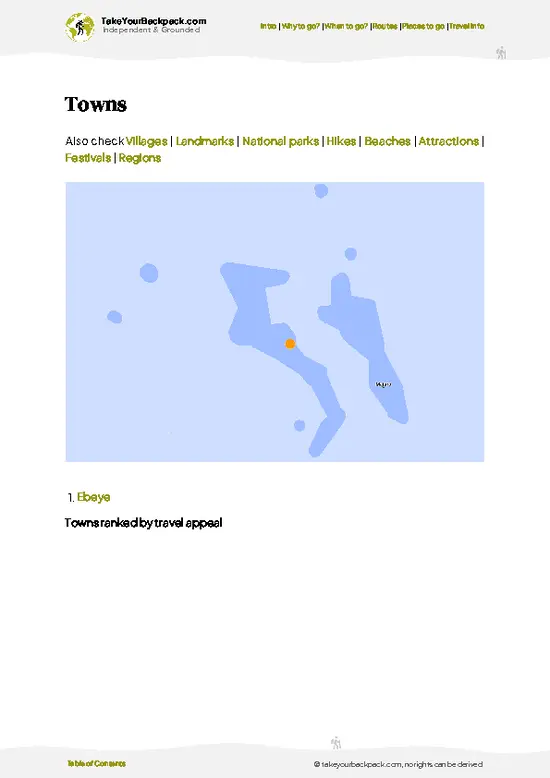
example page 0 from our offline Travel Guide for Marshall Islands
example page 1 from our offline Travel Guide for Marshall Islands
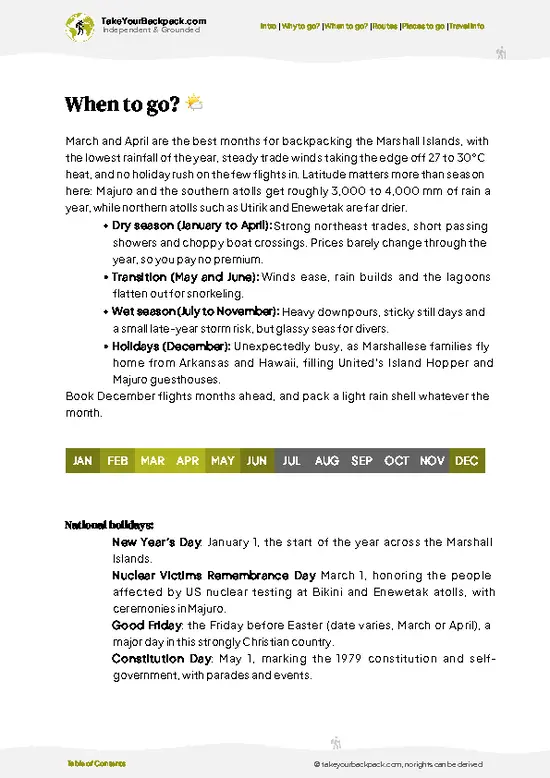
example page 2 from our offline Travel Guide for Marshall Islands
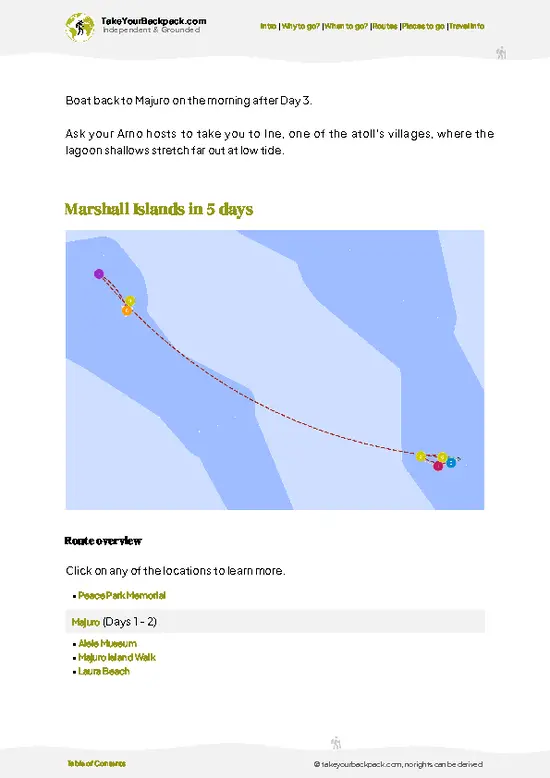
example page 3 from our offline Travel Guide for Marshall Islands
example page 4 from our offline Travel Guide for Marshall Islands
example page 5 from our offline Travel Guide for Marshall Islands
example page 6 from our offline Travel Guide for Marshall Islands
example page 7 from our offline Travel Guide for Marshall Islands
Loading the map 🌍
CLICK TO FILTER
towns
villages
landmarks
national parks
hikes
beaches
attractions
festivals
regions
SHOW COUNTRY’S BESTSHOW ALL

✨ Why go?
Ranked #2 region in Marshall Islands
The unique appeal for travelers

Backpackers who chase Ailuk are after the opposite of a checklist trail. The first draw is the lagoon of more than fifty islets, which lets you stretch a walk from a lazy village loop to a full day of hopping reef flats when the tide drops. You set the distance yourself, and nobody is watching a clock but the ocean. The second is the village of Ailuk Islet, where you will eat what the family catches, sleep in a house rather than a resort, and watch women weave pandanus mats and baskets the atoll is known for. That daily contact is why people come, and it does more for your trip than any summit view. Finally, the airstrip is the doorway to the outer atolls for anyone building a longer Marshall Islands route: fly in, walk, stay a few nights, fly out. The remoteness is the point, and it filters out almost everyone else.

💡 HighlightsThe experiences that define the visit

  1. Ailuk Islet village and airstrip. This is where you arrive and where most of the atoll’s people live. Walk the sandy lanes past thatch-roofed cookhouses, church bells and tidy yards, and you will see island life without a performance put on for visitors.
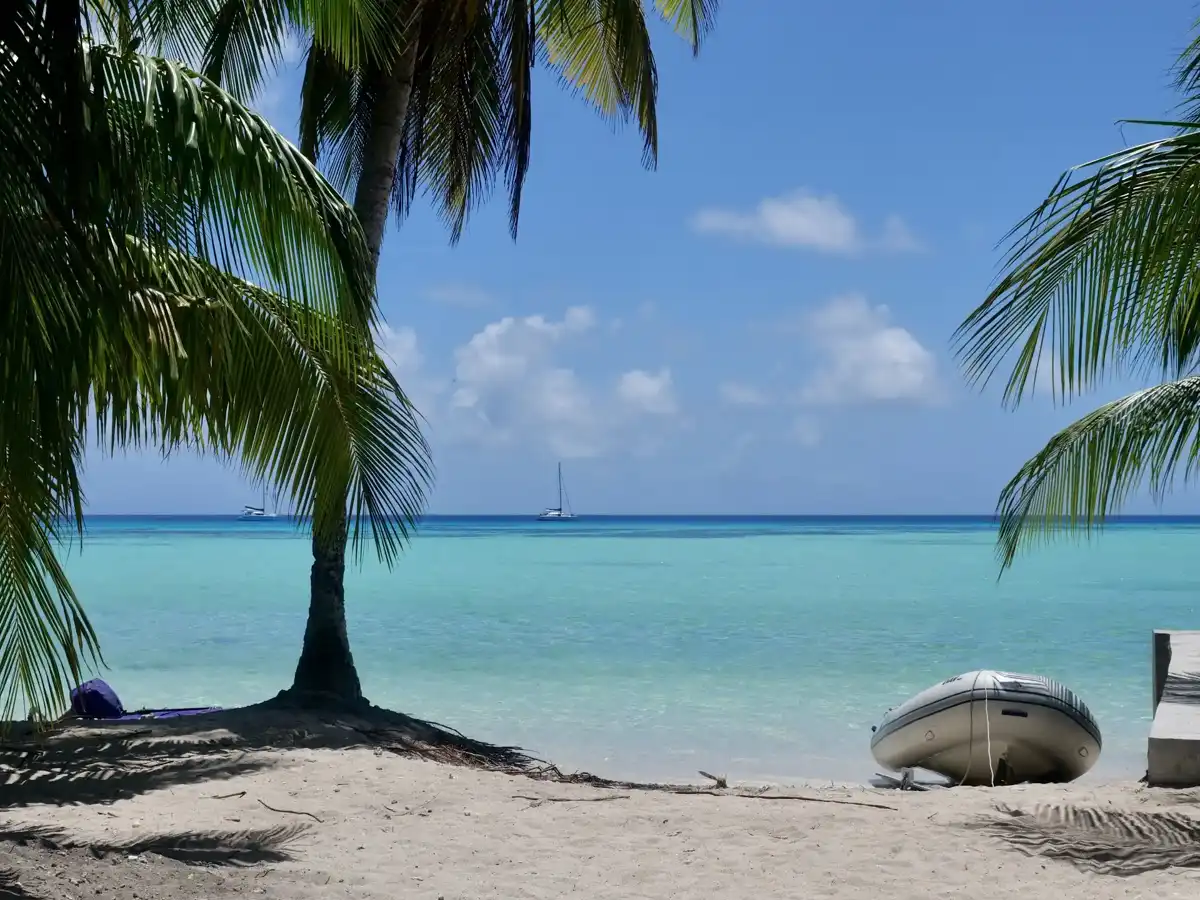
  2. The Ailuk lagoon shoreline. The lagoon side of the islets is calm, shallow and a milky turquoise that deepens to ink near the channels. Walking it at midmorning, with the water barely moving at your ankles, is the signature experience of the hike.
  3. Reef flats between the islets. At low tide the gaps between neighboring islets can become wadeable stretches of sand, coral rubble and tidal pools. You will spot reef fish, small rays and hermit crabs underfoot. Wear reef shoes, because the coral is sharp.
  4. Handicraft weaving. Ailuk is known across the
… read more 👉
  1. Ailuk Islet village and airstrip. This is where you arrive and where most of the atoll’s people live. Walk the sandy lanes past thatch-roofed cookhouses, church bells and tidy yards, and you will see island life without a performance put on for visitors.
  2. The Ailuk lagoon shoreline. The lagoon side of the islets is calm, shallow and a milky turquoise that deepens to ink near the channels. Walking it at midmorning, with the water barely moving at your ankles, is the signature experience of the hike.
  3. Reef flats between the islets. At low tide the gaps between neighboring islets can become wadeable stretches of sand, coral rubble and tidal pools. You will spot reef fish, small rays and hermit crabs underfoot. Wear reef shoes, because the coral is sharp.
  4. Handicraft weaving. Ailuk is known across the Marshalls for woven pandanus mats, baskets and fans. Sit with the weavers, watch the strips of leaf come together, and buy directly from the maker if you want a souvenir that actually came from here.
  5. The ocean-side reef edge. On the windward side of the islets the swell breaks on the outer reef with a steady roar, and the beach is wild with driftwood, shells and coconuts. It is the best place on the atoll to watch frigatebirds and terns working the wind.
The ocean-side reef edge is the one to drop when time is short, since it takes the longest to reach and the lagoon walks deliver the same atoll feel with less effort.
Spotted a mistake or missing something? Contact us.
⌛️ 5 daysSeeing the highlights in 5 days

Day 1: Ailuk Islet: Arrival day is a slow, sandy-footed affair, and the airstrip sets the tone. Flights are scarce, so the schedule belongs to the plane, not to you. Once you land on Ailuk islet, walk into the village, find your host family, and spend the afternoon learning who is related to whom. Pandanus-thatch handicrafts, mats and baskets, are the local specialty, and this is the easiest place to see them being made.
Day 2: Ailuk Islet Lagoon Side: Stay put for a second day. Snorkel the calm lagoon edge, join fishing with local boys, and eat what comes off the reef or out of the breadfruit tree. Staying on one islet keeps the logistics at zero, which matters because there is no road network and no ferry timetable to lean on.
Day 3: Enejelar: Getting to the second village means a ride in … read more 👉
Day 1: Ailuk Islet: Arrival day is a slow, sandy-footed affair, and the airstrip sets the tone. Flights are scarce, so the schedule belongs to the plane, not to you. Once you land on Ailuk islet, walk into the village, find your host family, and spend the afternoon learning who is related to whom. Pandanus-thatch handicrafts, mats and baskets, are the local specialty, and this is the easiest place to see them being made.
Day 2: Ailuk Islet Lagoon Side: Stay put for a second day. Snorkel the calm lagoon edge, join fishing with local boys, and eat what comes off the reef or out of the breadfruit tree. Staying on one islet keeps the logistics at zero, which matters because there is no road network and no ferry timetable to lean on.
Day 3: Enejelar: Getting to the second village means a ride in a small outboard skiff across the lagoon, arranged through your host. Weather and fuel decide the departure, so treat the hour as a suggestion. Enejelar is quieter and smaller, and the pace there is slower still. Meet the families, wander the paths between the coconut palms, and sleep here.
Day 4: Detour to an Uninhabited Islet: Ask your host to take you by boat to one of the many uninhabited islets among the 57 that ring the lagoon. You get empty beach, nesting seabirds and coconut crabs without adding a single extra transfer, since you return to Enejelar by evening. Pack water and food for the day, because nothing is sold out there.
Day 5: Back to Ailuk Islet: Boat back across the lagoon to the airstrip side so you are in position well before the plane. Spend the last hours buying a woven mat directly from the maker and sharing a final meal.
The day that justifies the whole trip is Day 4. Standing alone on an empty islet, with the lagoon in every direction and not another soul around, is what you came this far for.

🌤️ When to go?When to go for the best experience

  • Dry Season (December to April): The best window for Ailuk, with steady northeast trade winds, less rain, and daytime highs of 28 to 31°C (82 to 88°F). Lagoon crossings by boat are calmer and sunsets arrive around 6:30 pm.
  • Wet Season (May to November): Rain showers come most days, humidity is thick, and temperatures stay in the same 26 to 31°C (79 to 88°F) band. Boat trips can be delayed, and the lagoon turns choppy during squalls.
  • Peak Typhoon Risk (August to November): Typhoons are uncommon, although the northern atolls are more exposed than the southern ones, and storms can disrupt flights and supply boats for days.
  • Crowds and Prices: Ailuk sees almost no tourists in any month. Costs hinge on flight seats and field-trip ship schedules, so fares and seat availability tighten around Christmas
… read more 👉
  • Dry Season (December to April): The best window for Ailuk, with steady northeast trade winds, less rain, and daytime highs of 28 to 31°C (82 to 88°F). Lagoon crossings by boat are calmer and sunsets arrive around 6:30 pm.
  • Wet Season (May to November): Rain showers come most days, humidity is thick, and temperatures stay in the same 26 to 31°C (79 to 88°F) band. Boat trips can be delayed, and the lagoon turns choppy during squalls.
  • Peak Typhoon Risk (August to November): Typhoons are uncommon, although the northern atolls are more exposed than the southern ones, and storms can disrupt flights and supply boats for days.
  • Crowds and Prices: Ailuk sees almost no tourists in any month. Costs hinge on flight seats and field-trip ship schedules, so fares and seat availability tighten around Christmas and school holidays.
  • Seasonal Activities: Snorkeling and fishing are clearest from January to April. Local handicraft and breadfruit seasons peak in summer.
Book flights to Majuro and the Ailuk connection early, and pad your trip with two spare days for delays.


source: climatestotravel.comJANJanuary: excellent for travelingFEBFebruary: excellent for travelingMARMarch: highly recommended for travelingAPRApril: highly recommended for travelingMAYMay: fair for travelingJUNJune: fair for travelingJULJuly: fair for travelingAUGAugust: fair for travelingSEPSeptember: fair for travelingOCTOctober: fair for travelingNOVNovember: fair for travelingDECDecember: excellent for traveling
marshall-islands-region-ailuk-atoll
© Google | Rob Birch

✈️ The backpacker research shortcutMarshall Islands Travel Guide

An offline-friendly backpacking guide with optimized travel routes, ranked highlights, transport advice, and the best areas to stay.
example page 0 from our offline Travel Guide for Marshall Islands
example page 1 from our offline Travel Guide for Marshall Islands
example page 2 from our offline Travel Guide for Marshall Islands
example page 3 from our offline Travel Guide for Marshall Islands
example page 4 from our offline Travel Guide for Marshall Islands
example page 5 from our offline Travel Guide for Marshall Islands
example page 6 from our offline Travel Guide for Marshall Islands
example page 7 from our offline Travel Guide for Marshall Islands
The digital guide (125 pages) contains:
✅ 27 highlights, ranked by travel appeal
✅ Optimized 2, 3 & 5-day travel routes
✅ Cities, national parks, landmarks, beaches
✅ How to get around
✅ Offline-friendly for travel without Wi-Fi
👉 Click to see all 30+ guide features

📅 Plan smarter in minutes, not weeks
✅ Month by month travel advice
✅ Festivals & national holidays
✅ Budget expectations

🗺️ Go to the right places, skip the overrated ones
✅ Honest pros & cons of destinations
✅ Top hikes, parks & viewpoints
✅ Lesser-known places most travelers miss
✅ Clear “worth it vs skip it” guidance

🛏️ Travel smoothly without rookie mistakes
✅ Best areas to stay
✅ Transport systems explained simply
✅ Common scams & safety advice
✅ SIM cards, money & practical tips

🌍 Understand the country, not just visit it
✅ Culture & traditions
✅ 52 Essential phrases & customs
✅ Festivals worth planning around
✅ Traveler-friendly historical context
✅ Insights that make places more meaningful

📱 Built for real travel conditions
✅ Fully downloadable PDF
✅ Works completely offline
✅ Optimized for phone use
✅ Useful in remote areas & buses
✅ Everything in one place
Stop searching, start planning
Get instant access to your full guide. 30‑day money-back guarantee.
+ Add another guide for just

By proceeding you agree to our terms.
Sent to your inbox immediately after payment • 100% Secure Checkout
Best Backpacking Travel Advisor 2025 tourism awardBest Backpacking
Travel Advisor
2025
What others say about Take Your Backpack Guides:
⭐⭐⭐⭐⭐
Fantastic, amazing amount of information!
⭐⭐⭐⭐⭐
My goodness this is amazing, it's what I've been looking for hats off too you!
⭐⭐⭐⭐⭐
I think this is absolutely BRILLIANT
⭐⭐⭐⭐
Very complete and informative. It's still missing places, but I gotta to commend you
⭐⭐⭐⭐⭐
This is truly amazing, thank you, can't wait to explore it with my kids!
⭐⭐⭐⭐⭐
Awesome resource, thank you!
⭐⭐⭐⭐⭐
This is amazing! Can't wait to explore the ones I haven't seen
⭐⭐⭐⭐
I love this! Well done, great idea.
⭐⭐⭐⭐⭐
Thanks for taking the time to make this gem!
⭐⭐⭐⭐⭐
This might be the best website I've ever seen.
⭐⭐⭐⭐⭐
Congratulations, and thank you so much for your work; it's incredibly valuable.
⭐⭐⭐⭐
In all seriousness I think you did a great job pointing out the important spots
⭐⭐⭐⭐⭐
10/10 very good
⭐⭐⭐⭐⭐
As someone who's only just starting to visit regularly this is awesome, thank you.
⭐⭐⭐⭐
Thank you very much! I'm going to visit my dad, it's going to be very useful!
⭐⭐⭐⭐⭐
This is really cool! We'll be travelling for the first time and this definitely come in handy.
⭐⭐⭐⭐⭐
You are now our minister of culture, congratulations 👨‍💼
⭐⭐⭐⭐⭐
Just wanted to tell you that this is a pearl! Going to follow your recommendations.
⭐⭐⭐⭐⭐
This is so cool. I'll definitely be using the resource for my travels soon.
⭐⭐⭐⭐⭐
This is very impressive! Good work.
⭐⭐⭐⭐⭐
This is an amazing and informative site. Very well done!

🛏️ Where to stay?Choosing the right base

The best bet is to stay in the two villages, Ailuk and Enejelar, because they are the only places with people, and with about 235 residents in total the atoll is intimate, safe and quiet. There is no hostel scene, nightlife or backpacker circuit. What you get is homestay-style hospitality, usually arranged through the council, a church contact or a family on Majuro before you fly.

Ailuk islet is the practical choice for most visitors. The airstrip is here, so you step off the plane and are already in the community, and the village has the most going on, from church services with full-throated … read more 👉
The best bet is to stay in the two villages, Ailuk and Enejelar, because they are the only places with people, and with about 235 residents in total the atoll is intimate, safe and quiet. There is no hostel scene, nightlife or backpacker circuit. What you get is homestay-style hospitality, usually arranged through the council, a church contact or a family on Majuro before you fly.

Ailuk islet is the practical choice for most visitors. The airstrip is here, so you step off the plane and are already in the community, and the village has the most going on, from church services with full-throated hymns to daily fishing and copra work. Staying here makes arrivals and departures painless, and it is easy to meet people just by walking the path.

Enejelar suits a second night or two if you want a smaller, slower pace. Getting there means a boat crossing across the lagoon, so it works best for travelers with flexible time who want to see how the atoll’s other village lives. Solo travelers will find both places welcoming, and the social side is simple: share meals, join fishing trips, bring small gifts of rice, flour or fuel money, and offer to pay your host a fair daily rate, typically around US$20 to 40 with meals.

🚌 Getting aroundHow to get from A to B

A ride on Ailuk's most common transport, a skiff or small motorboat hop between islets, usually costs nothing fixed: you pay in US dollars (the Marshall Islands uses the US currency), and a typical fuel-share for a short lagoon crossing runs around US$5 to 20 depending on distance. Agree it before you step in, and carry small bills, since nobody has change for a US$50.

There are no roads of any length, no taxis and no buses. Movement here means feet, bicycles on sandy village paths, and boats across a lagoon that can be glassy at dawn and choppy by afternoon. Reliability is low and flexibility is the price of admission.
  • Walking: Free, and the best option on Ailuk islet and Enejelar, where the villages are small enough to cross in 15 to 30 minutes on coral-gravel and packed sand paths. You
… read more 👉
A ride on Ailuk's most common transport, a skiff or small motorboat hop between islets, usually costs nothing fixed: you pay in US dollars (the Marshall Islands uses the US currency), and a typical fuel-share for a short lagoon crossing runs around US$5 to 20 depending on distance. Agree it before you step in, and carry small bills, since nobody has change for a US$50.

There are no roads of any length, no taxis and no buses. Movement here means feet, bicycles on sandy village paths, and boats across a lagoon that can be glassy at dawn and choppy by afternoon. Reliability is low and flexibility is the price of admission.
  • Walking: Free, and the best option on Ailuk islet and Enejelar, where the villages are small enough to cross in 15 to 30 minutes on coral-gravel and packed sand paths. You smell copra drying and breadfruit smoke long before you see the houses, and the heat comes up fast by midmorning, so go early.
  • Local skiffs and motorboats: Roughly US$5 to 20 per trip for short lagoon runs, more for the longer crossings between the two village islands, which can take 1 to 3 hours depending on wind and engine. You sit on a wet fiberglass bench with spray on your arms and the engine whining. Fuel is scarce, so boats go when owners have gas and a reason. This gives a backpacker the most reach for the money, but bring a dry bag and a hat.
  • Bicycles: Occasionally lent or rented by families for a few dollars a day, or free as a favor. They work on the packed sections of the main islets, though loose sand bogs the tires and salt eats the chains. Fine for a village loop, not for distance.
  • Air Marshall Islands flights: The airstrip on Ailuk islet connects the atoll with Majuro, with fares typically in the US$150 to 300 range each way. It is the fastest and most comfortable choice by far, but flights run on a thin schedule and get bumped, so it costs you in flexibility.
  • Field-trip ship: The government supply vessel calls at outer atolls on a long loop, with deck or cabin passage at a fraction of the airfare, though the trip from Majuro takes a day or more. It is the cheapest and slowest way in, with diesel fumes, crowding and sleeping on a mat among cargo.

Book the flight in and out with a buffer of several days on either side, and settle every boat ride with your host the evening before so the owner can sort fuel at first light.

🍲 FoodLocal Cuisine & Drinks

Eating on Ailuk means fresh reef and lagoon fish, grilled over coconut husks or boiled with a squeeze of lime, and the flesh is sweet and firm. Breadfruit is the staple when in season, roasted until the skin blackens, then pulled open to a steaming, starchy middle. Coconut shows up everywhere, as sweet milk, grated flesh, or jaki-edding, the drinking coconut cracked open at your feet. You may also meet pandanus preserves, dense, sticky and caramel-dark, and arrowroot and taro in homestyle puddings.

There are no restaurants or cafés. You eat at your host’s table or on a mat under a thatched roof, with rice, canned meat and fish in the bowl, and a small store in the village sells noodles, tinned goods and soda when the supply ship has been through. Bring snacks, coffee and anything you can’t … read more 👉
Eating on Ailuk means fresh reef and lagoon fish, grilled over coconut husks or boiled with a squeeze of lime, and the flesh is sweet and firm. Breadfruit is the staple when in season, roasted until the skin blackens, then pulled open to a steaming, starchy middle. Coconut shows up everywhere, as sweet milk, grated flesh, or jaki-edding, the drinking coconut cracked open at your feet. You may also meet pandanus preserves, dense, sticky and caramel-dark, and arrowroot and taro in homestyle puddings.

There are no restaurants or cafés. You eat at your host’s table or on a mat under a thatched roof, with rice, canned meat and fish in the bowl, and a small store in the village sells noodles, tinned goods and soda when the supply ship has been through. Bring snacks, coffee and anything you can’t live without from Majuro, since supplies run short.

Customs are simple. Guests are fed first, and refusing food can seem rude, so take a little of everything. Wash hands, eat with your right hand or a spoon, and share what you bring. Drink the rainwater or boiled water your host offers, and expect sweet, milky tea more often than anything alcoholic.

🛡️ SafetyTraveler Safety Guide

Ailuk is a low-risk place for hikers, but the hazards are sun, heat and isolation. The islets are flat, with coral rubble, sand and narrow coconut-shaded paths, so the main challenge is footing on uneven coral and tide-affected shorelines rather than steepness. Wear sturdy sandals or reef shoes, and carry more water than you expect to need, since fresh water is limited and rain catchment belongs to residents. Start early, cover up, and rest through midday heat. Boat transfers across the lagoon are the real exposure: wind and chop can change quickly, so wear a life jacket and keep electronics in dry bags. Reef sharks are present in the lagoon but rarely a problem if you avoid spearfishing areas and murky water at dusk. Medical care is basic and the nearest hospital is in Majuro, so bring a … read more 👉
Ailuk is a low-risk place for hikers, but the hazards are sun, heat and isolation. The islets are flat, with coral rubble, sand and narrow coconut-shaded paths, so the main challenge is footing on uneven coral and tide-affected shorelines rather than steepness. Wear sturdy sandals or reef shoes, and carry more water than you expect to need, since fresh water is limited and rain catchment belongs to residents. Start early, cover up, and rest through midday heat. Boat transfers across the lagoon are the real exposure: wind and chop can change quickly, so wear a life jacket and keep electronics in dry bags. Reef sharks are present in the lagoon but rarely a problem if you avoid spearfishing areas and murky water at dusk. Medical care is basic and the nearest hospital is in Majuro, so bring a full first aid kit and any prescriptions. Ask the mayor or your host before camping or crossing private land.

FAQTraveler FAQ

Plan on 3 to 5 days on the atoll, though hiking itself is only a few hours per islet. Ailuk has about 50 islets, and walking the main inhabited ones, such as Ailuk and Enejelar, takes roughly 2 to 4 hours each on foot. Getting between islets requires local boat transfers, so build in a couple of buffer days for weather and flights.
Easy on foot, but logistics make it moderately demanding. The terrain is flat, with sand and coral paths of 3 to 10 km (2 to 6 miles) per islet, while heat of 28 to 31°C (82 to 88°F) and limited water are the main strain. Boat rides across the lagoon can be rough, and facilities are very basic.
No formal permit is required for hiking, but you should arrange permission and a local host through the Ailuk local government or your guesthouse contact. A local guide or boat operator is strongly advised because land is privately held and lagoon passages need local knowledge. Expect to pay roughly US$20 to 60 per day for boat or guide help, and fly in via Air Marshall Islands from Majuro.
⚠️ Things can change over time, so always validate details locally before you go.

Other Marshallese regions near Ailuk Atoll

Explore more nearby:

  • Likiep Atoll—Capelle and de Brum houses, copra yards, village lane, family stays| 98 km away
  • Maloelap Atoll—Taroa airbase ruins, Zero wreck, lagoon wrecks, reef passes| 218 km away
  • Kwajalein Atoll—Prinz Eugen wreck, pale-green lagoon, Ebeye crowds, Roi-Namur bunkers| 301 km away

💡 Not sure where to go next?
Create a personalized itinerary for Marshall Islands including Ailuk Atoll and the places that fit your trip.

Generate my itinerary

👉 Discover all regions

Or checkout all Marshall Islands has to offer (think cities, towns, villages, national parks, hikes, beaches, festivals)
Country photo of Marshall Islands

We 💚 feedbackIs it worth it?

Travelers often fly in with a tight return flight and try to cover as many islets as possible, then spend the trip racing the tide. I would skip the checklist, ask your host to time a walk around low tide, and carry reef shoes, two liters of water and a hat. Leave a day of slack in your schedule.

✍️ Help improve this page!
The information on this page is based on in-depth research, insights shared by experienced travelers, and feedback from the local travel community in Marshall Islands. While every effort is made to keep the information accurate and current, conditions can change — so if you spot anything incorrect or outdated, please get in touch.


🙋‍♂️ Give feedback

👋 Meet the founderWho’s Behind Take Your Backpack?

Johan, backpacker and founder of TakeYourBackpackHi, I’m Johan (Netherlands 🇳🇱), the creator of TakeYourBackpack. Over the past 3 decades, I’ve backpacked through 90+ countries across six continents, gaining extensive experience with independent travel, long-term trips, and overland routes.

This site is built on a combination of firsthand travel experience and carefully curated insights from other backpackers. Many guides are based on places I’ve personally visited, while others bring together tips, observations, and practical advice shared by trusted travelers I’ve met along the way.

The goal is to provide realistic, experience-driven guidance — not generic itineraries — so you can explore destinations with better context, clearer expectations, and more confidence.