×

Montenegro🇲🇪 | best regionsEssential regions to Explore in Montenegro

Montenegro packs a coast, a mountain interior and a lake basin into a country you can cross by bus in under five hours, yet the regions feel like different worlds. The Bay of Kotor and the Adriatic strip smell of salt, diesel and grilled fish, with stone lanes, cruise-ship crowds and July prices to match. Inland, the northern highlands bring cold river canyons, pine resin and sheep bells, with far fewer people and patchy buses. Independent travelers get the best value in the shoulder zones between, where a room costs half the coastal rate and a local will pour you rakija before asking your name.

By Johan Kruseman 🇳🇱 | Updated October 18, 2026
Explore the best cities in Montenegro

Why go?Understanding Their Importance

Montenegro suits regional travel because so much contrast sits so close together. The Dinaric Alps drop almost straight into the Adriatic, so one morning can start with a swim in warm, clear sea and end on a ridge where snow patches linger into June. That compact geography means distances are short on the map, but the roads are not. Mountain highways twist through tunnels and switchbacks, and a 100 km trip can take two and a half hours behind a truck.

History has layered the country too. Venetian stone, Ottoman minarets, Orthodox monasteries and Yugoslav-era concrete all show up within a short drive, and the call of the muezzin can mix with church bells in the same afternoon. Climate follows the same split: a Mediterranean coast with dry, hot summers and a continental interior with cold winters … read more 👉
Montenegro suits regional travel because so much contrast sits so close together. The Dinaric Alps drop almost straight into the Adriatic, so one morning can start with a swim in warm, clear sea and end on a ridge where snow patches linger into June. That compact geography means distances are short on the map, but the roads are not. Mountain highways twist through tunnels and switchbacks, and a 100 km trip can take two and a half hours behind a truck.

History has layered the country too. Venetian stone, Ottoman minarets, Orthodox monasteries and Yugoslav-era concrete all show up within a short drive, and the call of the muezzin can mix with church bells in the same afternoon. Climate follows the same split: a Mediterranean coast with dry, hot summers and a continental interior with cold winters and heavy snow.

Before choosing Montenegro, know that public transport is thin outside the main corridors. Buses run on a schedule that locals treat as a suggestion, and many rural areas are easier with a rental car or a shared ride. The country is small enough that you will not need many weeks, but seasonality is strong. The coast gets crowded and expensive in summer, while mountain facilities can be closed in winter or shoulder months.
Behind the Scenes of Selection
The list of best regions in Montenegro is created based on landscapes, local culture, attractions, vibes, and overall appeal. If you feel a region is missing in this list, please let us know.

When to go?Best Time to Visit Montenegro for regions

Best months and the seasons around them: The best months for Montenegro’s regions are May, June and September, when coastal sea temperatures reach roughly 18 to 24°C, days are sunny at 22 to 28°C, and the mountains are open without peak-season crowds. Light is long and golden, and the stone towns smell of warm rock and jasmine rather than sunscreen and exhaust.

Peak summer and the shoulder seasons: July and August push the Adriatic coast to 30 to 35°C, with packed beaches, jammed roads and accommodation often 50 to 100 percent above spring rates. A dorm bed that costs about €12 to 15 in June can climb past €25 in August. The northern mountains are the opposite: cooler at 20 to 26°C by day, with cold nights near 5 to 10°C, so summer is good for hiking there.

April and October are quieter, … read more 👉
Best months and the seasons around them: The best months for Montenegro’s regions are May, June and September, when coastal sea temperatures reach roughly 18 to 24°C, days are sunny at 22 to 28°C, and the mountains are open without peak-season crowds. Light is long and golden, and the stone towns smell of warm rock and jasmine rather than sunscreen and exhaust.

Peak summer and the shoulder seasons: July and August push the Adriatic coast to 30 to 35°C, with packed beaches, jammed roads and accommodation often 50 to 100 percent above spring rates. A dorm bed that costs about €12 to 15 in June can climb past €25 in August. The northern mountains are the opposite: cooler at 20 to 26°C by day, with cold nights near 5 to 10°C, so summer is good for hiking there.

April and October are quieter, with coastal temperatures of 15 to 22°C and more rain, particularly in autumn when the coast can see heavy downpours from October to December. Many seaside restaurants and boat operators close or cut hours from November to March.

Winter: From December to March the highlands get deep snow, some mountain roads and passes close, and ski areas such as Kolašin and Žabljak operate. Coastal winters are mild at 8 to 13°C but wet and quiet.

region hoppingTips for Visiting Multiple Destinations

How long to allow: A trip combining several regions of Montenegro needs 7 to 12 days, since slow roads and mountain weather eat time that the small map suggests you have. Plan on 2 to 3 nights per stop; one night in a region mostly gets you a bus window.

Direction and grouping: Coastal areas cluster naturally around Kotor, Budva and Bar, with Podgorica as the central transport hub. A south-to-north loop works well: arrive on the coast, move inland through the capital and the Skadar Lake basin, then climb to the highlands and finish in the mountains, where cooler air is a relief after the heat. Reverse it if you fly into Podgorica or Tivat and want to end on a beach.

Typical travel times run 1 to 2 hours between coastal towns, about 1.5 to 2 hours from the coast to Podgorica, and 2.5 to 4 … read more 👉
How long to allow: A trip combining several regions of Montenegro needs 7 to 12 days, since slow roads and mountain weather eat time that the small map suggests you have. Plan on 2 to 3 nights per stop; one night in a region mostly gets you a bus window.

Direction and grouping: Coastal areas cluster naturally around Kotor, Budva and Bar, with Podgorica as the central transport hub. A south-to-north loop works well: arrive on the coast, move inland through the capital and the Skadar Lake basin, then climb to the highlands and finish in the mountains, where cooler air is a relief after the heat. Reverse it if you fly into Podgorica or Tivat and want to end on a beach.

Typical travel times run 1 to 2 hours between coastal towns, about 1.5 to 2 hours from the coast to Podgorica, and 2.5 to 4 hours from Podgorica to the northern mountains. Buses are cheap, roughly €3 to 12 per leg, but mountain services thin out and are often limited to a few departures a day.

Common planning mistakes: The biggest mistake is trusting map distances. A 70 km mountain leg can take over two hours, so avoid same-day transfers followed by activities. Another is booking tight connections on single-departure routes; check the last bus back before you commit to a day trip. Finally, travelers cram the coast into August traffic. Spread nights across inland stops instead, where lanes empty and prices drop.

The ListTop regions of Montenegro

1 Bay of Kotor

fjord-like coastline, Venetian palaces, Orthodox churches, maritime museums

Trace the winding shoreline where mountain slopes meet the sea, passing through layered towns shaped by centuries of seafaring and shifting borders.

montenegro-region-bay-of-kotor
© Google | Gianni E Tommasina
Loading the map 🌍

Expert viewInsights from Locals and Experts

How many regions to visit: I recommend three regions for a trip of one to two weeks, four at the most if you have ten days or more and a rental car. Montenegro looks tiny on the map, but mountain roads are slow, buses are infrequent and each region needs at least two nights to feel like more than a window view. Three gives you contrast, such as sea, lake and mountains, without spending half your trip on a vehicle seat.

Which kind suits your style: If you are on a tight budget and want ease, the coast gives you the most convenience: frequent buses, hostels, restaurants and swimming. It costs more in time because of summer traffic, and more in money from July onward. If you want quiet, trekking and low prices, the mountain interior gives a backpacker the most for the money, with cooler air, … read more 👉
How many regions to visit: I recommend three regions for a trip of one to two weeks, four at the most if you have ten days or more and a rental car. Montenegro looks tiny on the map, but mountain roads are slow, buses are infrequent and each region needs at least two nights to feel like more than a window view. Three gives you contrast, such as sea, lake and mountains, without spending half your trip on a vehicle seat.

Which kind suits your style: If you are on a tight budget and want ease, the coast gives you the most convenience: frequent buses, hostels, restaurants and swimming. It costs more in time because of summer traffic, and more in money from July onward. If you want quiet, trekking and low prices, the mountain interior gives a backpacker the most for the money, with cooler air, pine-and-woodsmoke evenings and guesthouse meals that arrive in heaps. The compromise is comfort. Transport is slower, signs are scarce and you may wait an hour for a bus. The lake and river lowlands sit between the two in price and effort, and suit travelers who like birdlife, wine and slow afternoons.

What it costs: Budget about US$35 to 55 a day on the coast in shoulder season and US$60 to 90 in July and August, covering a dorm bed or simple room, one restaurant meal, transport and snacks. In the mountains, expect US$30 to 45 a day, since guesthouses with dinner often cost €20 to 30 per person. Entry fees are modest: national park tickets are about €3 to 5, and old-town fortress walls and museums usually charge €2 to 15. A local mountain guide for a day costs roughly €60 to 120 for a group, which is good value on technical or poorly marked routes. Boat trips on the bay or lake run about €15 to 30. Intercity buses are typically €3 to 12, but renting a car at €30 to 70 a day can save hours.

Safety and cultural notes: Montenegro is generally safe, with low violent crime and friendly strangers. The main hazards are on the road: narrow, curved highways, aggressive overtaking and few guardrails, so avoid driving at night in the mountains. In summer, wildfires can affect forested areas, and at altitude weather turns fast, so carry a rain layer even in July. Sea swimming is safe, though rocky entries and sea urchins call for water shoes.

Culturally, the country mixes Orthodox, Catholic and Muslim communities. Dress covered at monasteries and mosques, and ask before photographing people. Coffee is a slow ritual, so accept it. Tipping of about 10 percent is appreciated, and cash is still often needed in rural places and small guesthouses.

✈️ The backpacker research shortcutMontenegro Travel Guide

An offline-friendly backpacking guide with optimized travel routes, ranked highlights, transport advice, and the best areas to stay.
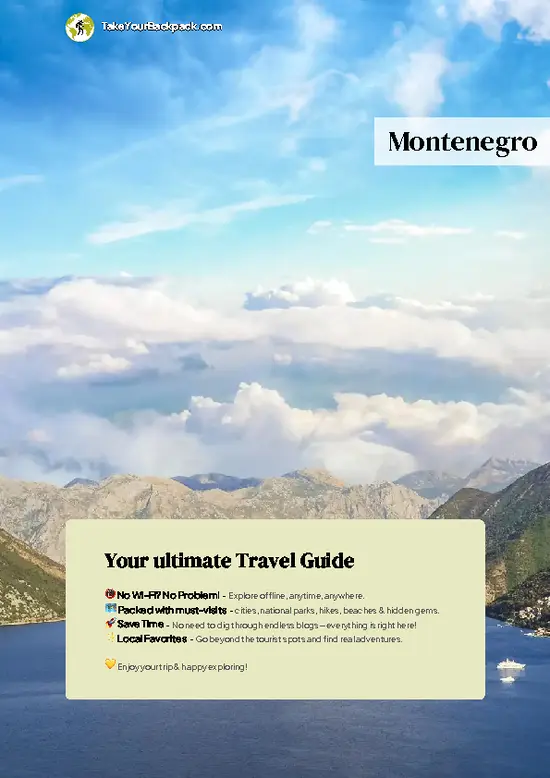
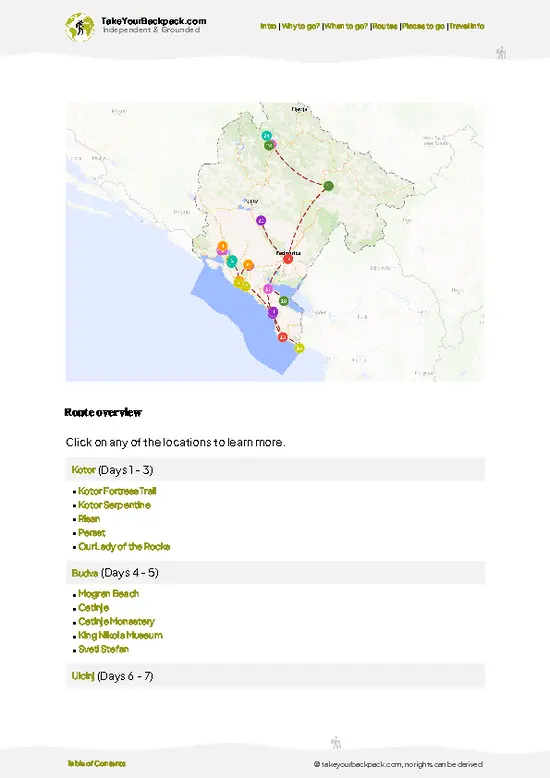
example page 0 from our offline Travel Guide for Montenegro
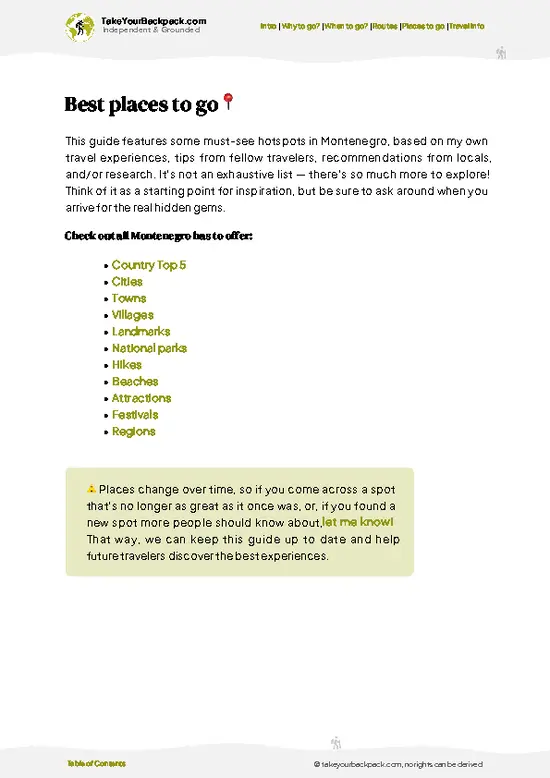
example page 1 from our offline Travel Guide for Montenegro
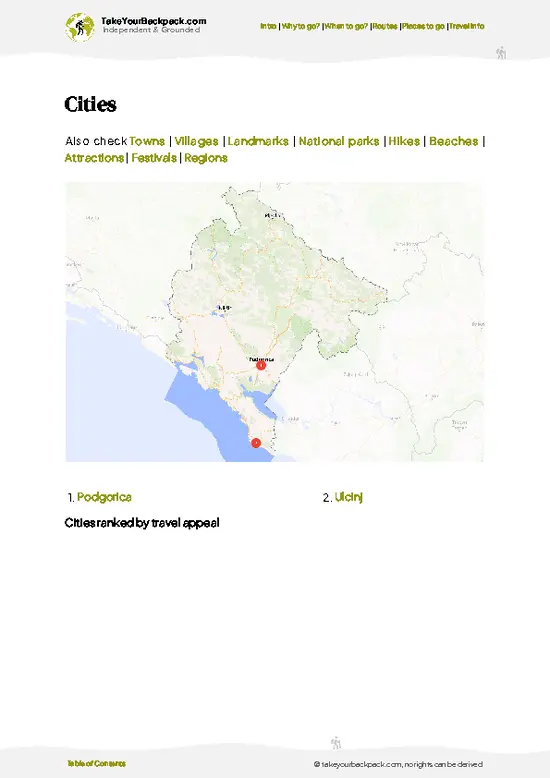
example page 2 from our offline Travel Guide for Montenegro
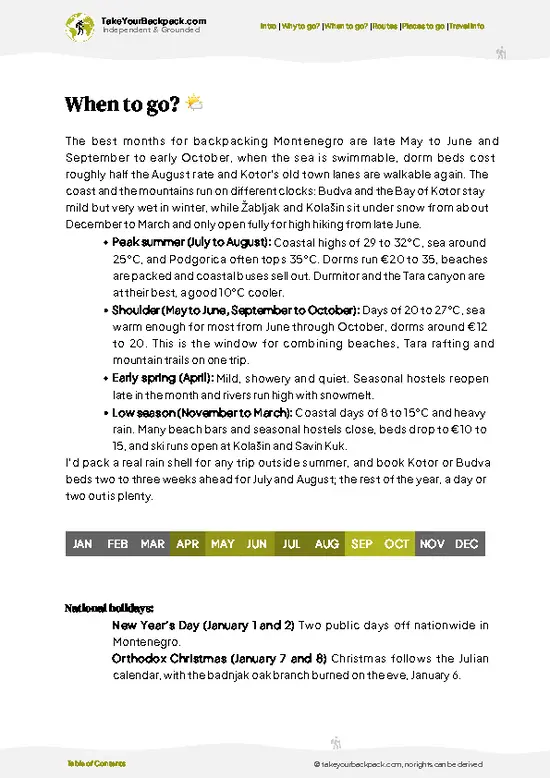
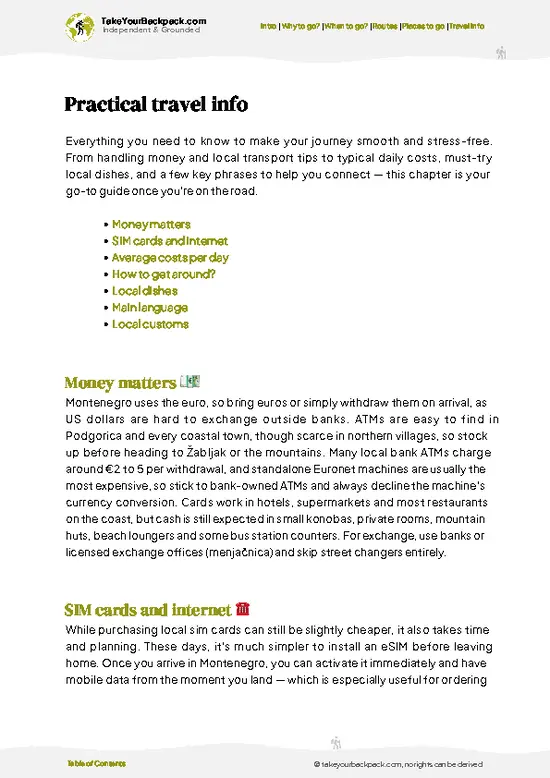
example page 3 from our offline Travel Guide for Montenegro
example page 4 from our offline Travel Guide for Montenegro
example page 5 from our offline Travel Guide for Montenegro
example page 6 from our offline Travel Guide for Montenegro
example page 7 from our offline Travel Guide for Montenegro
The digital guide (241 pages) contains:
✅ 62 highlights, ranked by travel appeal
✅ Optimized 5, 10 & 15-day travel routes
✅ Cities, national parks, landmarks, beaches
✅ How to get around
✅ Offline-friendly for travel without Wi-Fi
👉 Click to see all 30+ guide features

📅 Plan smarter in minutes, not weeks
✅ Month by month travel advice
✅ Festivals & national holidays
✅ Budget expectations

🗺️ Go to the right places, skip the overrated ones
✅ Honest pros & cons of destinations
✅ Top hikes, parks & viewpoints
✅ Lesser-known places most travelers miss
✅ Clear “worth it vs skip it” guidance

🛏️ Travel smoothly without rookie mistakes
✅ Best areas to stay
✅ Transport systems explained simply
✅ Common scams & safety advice
✅ SIM cards, money & practical tips

🌍 Understand the country, not just visit it
✅ Culture & traditions
✅ 52 Essential phrases & customs
✅ Festivals worth planning around
✅ Traveler-friendly historical context
✅ Insights that make places more meaningful

📱 Built for real travel conditions
✅ Fully downloadable PDF
✅ Works completely offline
✅ Optimized for phone use
✅ Useful in remote areas & buses
✅ Everything in one place
Stop searching, start planning
Get instant access to your full guide. 30‑day money-back guarantee.
+ Add another guide for just

By proceeding you agree to our terms.
Sent to your inbox immediately after payment • 100% Secure Checkout
Best Backpacking Travel Advisor 2025 tourism awardBest Backpacking
Travel Advisor
2025
What others say about Take Your Backpack Guides:
⭐⭐⭐⭐⭐
Fantastic, amazing amount of information!
⭐⭐⭐⭐⭐
My goodness this is amazing, it's what I've been looking for hats off too you!
⭐⭐⭐⭐⭐
I think this is absolutely BRILLIANT
⭐⭐⭐⭐
Very complete and informative. It's still missing places, but I gotta to commend you
⭐⭐⭐⭐⭐
This is truly amazing, thank you, can't wait to explore it with my kids!
⭐⭐⭐⭐⭐
Awesome resource, thank you!
⭐⭐⭐⭐⭐
This is amazing! Can't wait to explore the ones I haven't seen
⭐⭐⭐⭐
I love this! Well done, great idea.
⭐⭐⭐⭐⭐
Thanks for taking the time to make this gem!
⭐⭐⭐⭐⭐
This might be the best website I've ever seen.
⭐⭐⭐⭐⭐
Congratulations, and thank you so much for your work; it's incredibly valuable.
⭐⭐⭐⭐
In all seriousness I think you did a great job pointing out the important spots
⭐⭐⭐⭐⭐
10/10 very good
⭐⭐⭐⭐⭐
As someone who's only just starting to visit regularly this is awesome, thank you.
⭐⭐⭐⭐
Thank you very much! I'm going to visit my dad, it's going to be very useful!
⭐⭐⭐⭐⭐
This is really cool! We'll be travelling for the first time and this definitely come in handy.
⭐⭐⭐⭐⭐
You are now our minister of culture, congratulations 👨‍💼
⭐⭐⭐⭐⭐
Just wanted to tell you that this is a pearl! Going to follow your recommendations.
⭐⭐⭐⭐⭐
This is so cool. I'll definitely be using the resource for my travels soon.
⭐⭐⭐⭐⭐
This is very impressive! Good work.
⭐⭐⭐⭐⭐
This is an amazing and informative site. Very well done!

🛏️ Where to stay?Best Places to Stay in Montenegro

Montenegro has plenty of hostels and guesthouses, with dorm beds typically running €12 to 25 a night in summer and private rooms in family-run apartments (“sobe”) from about €25 to 45. In Kotor, the Old Town puts you inside the walls next to the fortress climb but gets loud and packed on cruise-ship days, while Dobrota just north is quieter and cheaper; Budva around the Old Town and Slovenska Plaža has the most party hostels and late bars, which is great for nightlife and bad for sleep. For mountains and lower prices, Žabljak is the base for Durmitor, and central Podgorica near the bus and train stations has cheap, safe, if unexciting beds that work well for onward connections.

If you enjoy meeting … read more 👉
Montenegro has plenty of hostels and guesthouses, with dorm beds typically running €12 to 25 a night in summer and private rooms in family-run apartments (“sobe”) from about €25 to 45. In Kotor, the Old Town puts you inside the walls next to the fortress climb but gets loud and packed on cruise-ship days, while Dobrota just north is quieter and cheaper; Budva around the Old Town and Slovenska Plaža has the most party hostels and late bars, which is great for nightlife and bad for sleep. For mountains and lower prices, Žabljak is the base for Durmitor, and central Podgorica near the bus and train stations has cheap, safe, if unexciting beds that work well for onward connections.

If you enjoy meeting fellow travelers, consider choosing hostels with high ratings for atmosphere. On the other hand, if you prefer having your own space, a hotel might be a better option.

MontenegroExplore Montenegro

👋 Meet the founderWho’s Behind Take Your Backpack?

Johan, backpacker and founder of TakeYourBackpackHi, I’m Johan (Netherlands 🇳🇱), the creator of TakeYourBackpack. Over the past 3 decades, I’ve backpacked through 90+ countries across six continents, gaining extensive experience with independent travel, long-term trips, and overland routes.

This site is built on a combination of firsthand travel experience and carefully curated insights from other backpackers. Many guides are based on places I’ve personally visited, while others bring together tips, observations, and practical advice shared by trusted travelers I’ve met along the way.

The goal is to provide realistic, experience-driven guidance — not generic itineraries — so you can explore destinations with better context, clearer expectations, and more confidence.