×

Montenegro🇲🇪 | best national parksEssential 7 national parks to Explore in Montenegro

Montenegro packs five national parks into a country smaller than Connecticut, and they feel like five different trips. The northern mountains smell of resinous spruce and cold limestone, with unpaved lanes, wooden village stays and few people on the trail. The coast brings Mediterranean maquis, cicada noise and ferry-dock heat, with more visitors and higher prices. Entry fees are modest, usually a few euros, though guesthouse rates climb in summer. Backpacking here works best when you accept that buses thin out fast beyond the main towns, so independent travelers plan around timetables, hitchhiking habits and sturdy boots.

By Johan Kruseman 🇳🇱 | Updated October 18, 2026
Explore the best hikes in Montenegro

Why go?Understanding Their Importance

Montenegro’s parks exist because the country is all vertical. Limestone massifs rise above 2,500 meters within sight of the Adriatic, and glaciers once carved lakes and canyons that still hold cold, clear water. That compression means you can smell salt air at breakfast and walk on late-lying snow by afternoon. The karst geology matters on the ground: water vanishes into rock, so many high routes have no streams, and you carry your own supply. Surfaces are sharp, scree is loose, and weather turns quickly.

Infrastructure is modest and uneven. Marked trails, small visitor centers and mountain huts exist, but signage can fade and mobile coverage drops in the canyons. Rural life shapes the experience too. Shepherds’ huts, hay meadows and family guesthouses sit inside or beside park land, so you … read more 👉
Montenegro’s parks exist because the country is all vertical. Limestone massifs rise above 2,500 meters within sight of the Adriatic, and glaciers once carved lakes and canyons that still hold cold, clear water. That compression means you can smell salt air at breakfast and walk on late-lying snow by afternoon. The karst geology matters on the ground: water vanishes into rock, so many high routes have no streams, and you carry your own supply. Surfaces are sharp, scree is loose, and weather turns quickly.

Infrastructure is modest and uneven. Marked trails, small visitor centers and mountain huts exist, but signage can fade and mobile coverage drops in the canyons. Rural life shapes the experience too. Shepherds’ huts, hay meadows and family guesthouses sit inside or beside park land, so you often share the landscape with working villages, cowbells and woodsmoke. Before choosing Montenegro, know that public transport is limited, roads are narrow and winding, and distances that look short on a map take hours. Many mountain roads close under snow for months. Mines from the 1990s are not a concern on marked trails, but staying on them is sensible. Cash is useful in remote places, and the euro is the national currency.
Evaluating the Top Choices
The list of best national parks in Montenegro is created based on landscapes, wildlife, adventure opportunities, facilities, and overall experience. If you feel a national park is missing in this list, please let us know.

When to go?Best Time to Visit Montenegro for national parks

Best months and why: June to September gives the most reliable conditions for national parks in Montenegro, because high trails are mostly snow-free and the mountain lakes are warm enough to swim in. In the northern highlands, expect daytime highs of roughly 18 to 28°C in summer and nights that drop to 5 to 10°C, with afternoon thunderstorms common in June and July. Light is hard and bright, limestone gives off heat, and shade is scarce above the treeline.
Shoulder seasons: May and October suit lower trails, canyons and forest walks. May brings wildflowers, loud meltwater and temperatures of 10 to 20°C, but snow can linger above 1,800 meters into early June. October smells of damp leaves and woodsmoke, with golden beech forest and cooler, clearer air. Rain is heaviest from October through December, … read more 👉
Best months and why: June to September gives the most reliable conditions for national parks in Montenegro, because high trails are mostly snow-free and the mountain lakes are warm enough to swim in. In the northern highlands, expect daytime highs of roughly 18 to 28°C in summer and nights that drop to 5 to 10°C, with afternoon thunderstorms common in June and July. Light is hard and bright, limestone gives off heat, and shade is scarce above the treeline.
Shoulder seasons: May and October suit lower trails, canyons and forest walks. May brings wildflowers, loud meltwater and temperatures of 10 to 20°C, but snow can linger above 1,800 meters into early June. October smells of damp leaves and woodsmoke, with golden beech forest and cooler, clearer air. Rain is heaviest from October through December, and the mountains can receive 2,000 mm or more across the year, among the wettest in Europe.
Peak periods and winter: July and August are busiest on the coast, where temperatures reach 30 to 35°C and accommodation can run 30 to 60 percent above spring prices. The mountains stay quieter. From November to April, snow closes high roads and many guesthouses and huts shut, so winter suits skiing and snowshoeing rather than hiking.

national park hoppingTips for Visiting Multiple Destinations

How long it takes: A trip combining several national parks in Montenegro needs 7 to 12 days, which leaves room for slow mountain roads and at least one weather day. The country is small, but driving or bus distances between regions run 2 to 4 hours because the roads twist through gorges and over passes.
Grouping and direction: The coast and the northern highlands form two natural clusters. Starting in the south near Podgorica, Bar or Kotor, then moving north and inland, lets you shift gradually from salt air and olive groves to cold, resinous forest. Podgorica is the main transport hub, with buses fanning out to the main mountain towns, while northern valleys connect more slowly through Kolašin, Žabljak and Plav. Reversing the order works too, but it means ending in the quieter, less serviced … read more 👉
How long it takes: A trip combining several national parks in Montenegro needs 7 to 12 days, which leaves room for slow mountain roads and at least one weather day. The country is small, but driving or bus distances between regions run 2 to 4 hours because the roads twist through gorges and over passes.
Grouping and direction: The coast and the northern highlands form two natural clusters. Starting in the south near Podgorica, Bar or Kotor, then moving north and inland, lets you shift gradually from salt air and olive groves to cold, resinous forest. Podgorica is the main transport hub, with buses fanning out to the main mountain towns, while northern valleys connect more slowly through Kolašin, Žabljak and Plav. Reversing the order works too, but it means ending in the quieter, less serviced north, which is harder if a bus is canceled.
Time per stop and common mistakes: Plan 2 to 3 days per mountain base and 1 to 2 days on the coast. A common error is cramming a different park into each day, which leaves you in vans and station cafés rather than on trails. Another is trusting map distances. A 70 km mountain leg can take 2 hours or more. Book the final bus or transfer a day ahead, and keep one buffer day for storms, since rain and fog can close ridge walks.

The ListTop national parks of Montenegro

1 Durmitor

deep canyons, glacial cirques, Black Lake

Climb dramatic peaks and descend into river gorges, with opportunities for rafting, hiking, and alpine exploration in a UNESCO-listed landscape.

montenegro-national-park-durmitor
© Google | Lukic Stevan

2 Biogradska Gora

primeval forest, glacial lakes, wooden boardwalks

Wander beneath towering ancient trees and along reflective lakeshores, discovering one of Europe’s last untouched rainforests in compact form.

montenegro-national-park-biogradska-gora
© Google | Randolfo Santos

3 Skadar Lake

wetlands, island monasteries, birdwatching

Paddle or cycle through a vast freshwater basin, observing rare birdlife and centuries-old villages along the shifting waterline.

montenegro-national-park-skadar-lake
© Google | Piotr Makara

4 Prokletije

jagged summits, border trails, glacial valleys

Trek along remote paths between dramatic peaks, experiencing a wild frontier with challenging terrain and cross-border mountain routes.

montenegro-national-park-prokletije
© Google |

5 Lovćen

rocky plateaus, mausoleum, panoramic switchbacks

Ascend winding roads to a windswept summit, where history and geography converge above the Adriatic and the Montenegrin heartland.

montenegro-national-park-lovcen
© Google | Corner Toe

6 Komovi Nature Park

alpine meadows, wild horses, remote mountain huts

Traverse high-altitude grasslands and rocky summits, where traditional shepherd life and untamed landscapes offer solitude and striking scenery.

7 Orjen Nature Park

karst ridges, ancient beech forests, panoramic coastal views

Hike through rugged limestone peaks and dense woodland, encountering rare plant species and wide-open vistas above the Bay of Kotor.

montenegro-national-park-orjen-nature-park
© Google |
Loading the map 🌍

Expert viewInsights from Locals and Experts

How many parks to visit: Two or three parks is the right number for most backpackers, and four if you have two weeks. Each extra park adds long transfers on narrow roads and costs you a day of walking. Two contrasting parks, one mountain and one coastal or lakeside, gives the best return on time and money, since you avoid repeating the same limestone and forest landscapes.
Choosing by travel style: If you want solitude and real hiking, prioritize the northern mountain parks. They cost less per night, usually €15 to 30 for a guesthouse bed with breakfast, and the trails stay quiet, though you give up comfort, since facilities are simple and transport is sparse. If you want easy access, swimming and cafés, the lake and coastal parks suit you better. They are simpler to reach by bus, but crowds … read more 👉
How many parks to visit: Two or three parks is the right number for most backpackers, and four if you have two weeks. Each extra park adds long transfers on narrow roads and costs you a day of walking. Two contrasting parks, one mountain and one coastal or lakeside, gives the best return on time and money, since you avoid repeating the same limestone and forest landscapes.
Choosing by travel style: If you want solitude and real hiking, prioritize the northern mountain parks. They cost less per night, usually €15 to 30 for a guesthouse bed with breakfast, and the trails stay quiet, though you give up comfort, since facilities are simple and transport is sparse. If you want easy access, swimming and cafés, the lake and coastal parks suit you better. They are simpler to reach by bus, but crowds and prices rise in July and August. A mixed trip tends to give the most for a backpacker, with the mountains as the main event and one lakeside stop for rest.
Budget: Expect roughly €35 to 60 a day on a frugal independent trip, including hostel or guesthouse beds, buses, groceries and one restaurant meal. Park entry usually costs about €1 to 5 per day or per visit, with multi-day passes available in some parks. Local guides for canyoning, rafting or high routes run about €40 to 100 per person per day depending on group size and season. Boat trips on the lake or coast cost roughly €10 to 25. Renting a car costs €30 to 60 a day in summer, and fuel, plus the time saved, makes it worthwhile for remote mountain areas if you can split it between two or three people.
Safety and culture: Karst terrain is the main hazard. Water is scarce on high routes, so carry 2 to 3 liters, wear boots with ankle support and check forecasts, since storms build fast and fog hides cairns. Mountain rescue is limited and mobile signal drops in canyons, so tell your guesthouse where you are going. Rivers can run fast and cold in spring.

Villages inside and beside the parks are traditional. Greet people, ask before photographing shepherds or their huts, and close gates on pastures. Never walk through hayfields. Hospitality is real, and an offer of coffee or rakija from a host is polite to accept at least in part. Light fires only in designated spots, because summer wildfires are a serious risk on dry slopes.

✈️ The backpacker research shortcutMontenegro Travel Guide

An offline-friendly backpacking guide with optimized travel routes, ranked highlights, transport advice, and the best areas to stay.
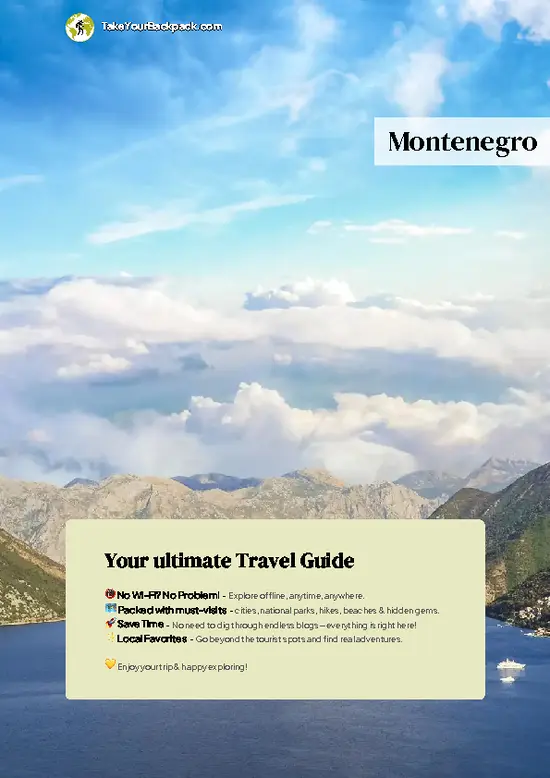
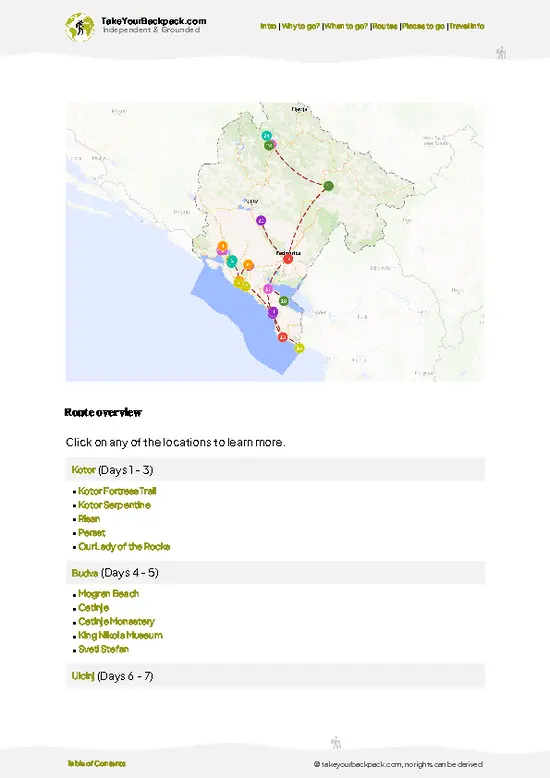
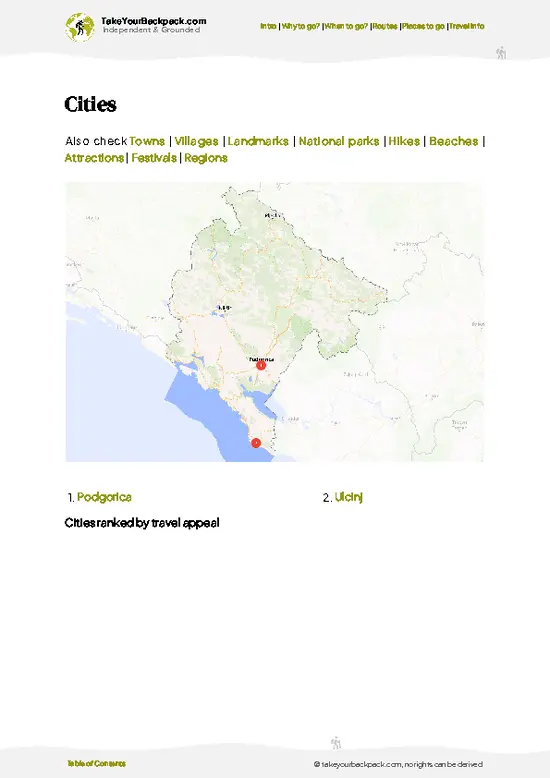
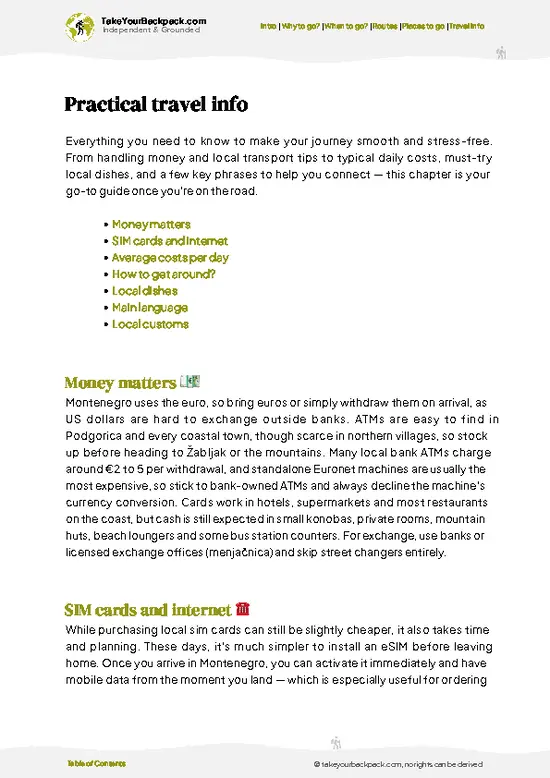
example page 0 from our offline Travel Guide for Montenegro
example page 1 from our offline Travel Guide for Montenegro
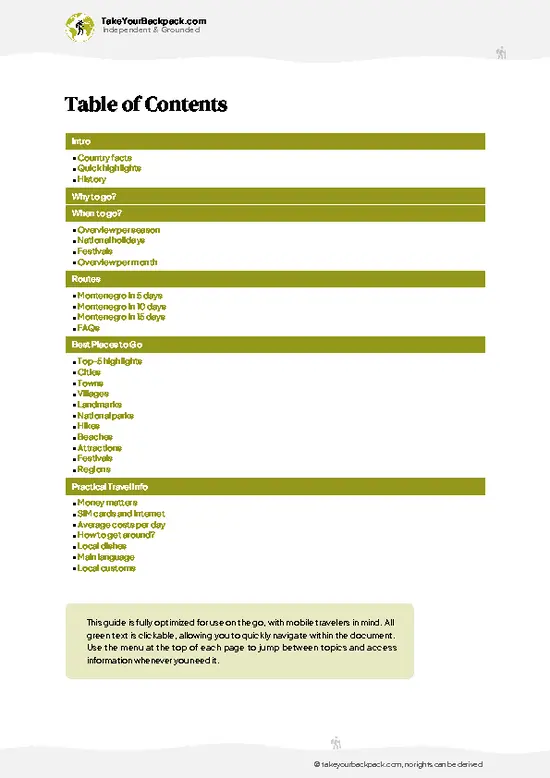
example page 2 from our offline Travel Guide for Montenegro
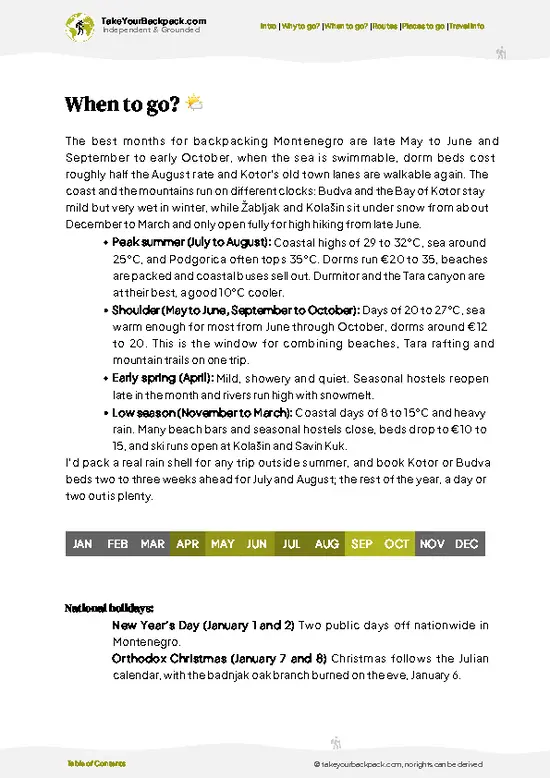
example page 3 from our offline Travel Guide for Montenegro
example page 4 from our offline Travel Guide for Montenegro
example page 5 from our offline Travel Guide for Montenegro
example page 6 from our offline Travel Guide for Montenegro
example page 7 from our offline Travel Guide for Montenegro
The digital guide (241 pages) contains:
✅ 62 highlights, ranked by travel appeal
✅ Optimized 5, 10 & 15-day travel routes
✅ Cities, national parks, landmarks, beaches
✅ How to get around
✅ Offline-friendly for travel without Wi-Fi
👉 Click to see all 30+ guide features

📅 Plan smarter in minutes, not weeks
✅ Month by month travel advice
✅ Festivals & national holidays
✅ Budget expectations

🗺️ Go to the right places, skip the overrated ones
✅ Honest pros & cons of destinations
✅ Top hikes, parks & viewpoints
✅ Lesser-known places most travelers miss
✅ Clear “worth it vs skip it” guidance

🛏️ Travel smoothly without rookie mistakes
✅ Best areas to stay
✅ Transport systems explained simply
✅ Common scams & safety advice
✅ SIM cards, money & practical tips

🌍 Understand the country, not just visit it
✅ Culture & traditions
✅ 52 Essential phrases & customs
✅ Festivals worth planning around
✅ Traveler-friendly historical context
✅ Insights that make places more meaningful

📱 Built for real travel conditions
✅ Fully downloadable PDF
✅ Works completely offline
✅ Optimized for phone use
✅ Useful in remote areas & buses
✅ Everything in one place
Stop searching, start planning
Get instant access to your full guide. 30‑day money-back guarantee.
+ Add another guide for just

By proceeding you agree to our terms.
Sent to your inbox immediately after payment • 100% Secure Checkout
Best Backpacking Travel Advisor 2025 tourism awardBest Backpacking
Travel Advisor
2025
What others say about Take Your Backpack Guides:
⭐⭐⭐⭐⭐
Fantastic, amazing amount of information!
⭐⭐⭐⭐⭐
My goodness this is amazing, it's what I've been looking for hats off too you!
⭐⭐⭐⭐⭐
I think this is absolutely BRILLIANT
⭐⭐⭐⭐
Very complete and informative. It's still missing places, but I gotta to commend you
⭐⭐⭐⭐⭐
This is truly amazing, thank you, can't wait to explore it with my kids!
⭐⭐⭐⭐⭐
Awesome resource, thank you!
⭐⭐⭐⭐⭐
This is amazing! Can't wait to explore the ones I haven't seen
⭐⭐⭐⭐
I love this! Well done, great idea.
⭐⭐⭐⭐⭐
Thanks for taking the time to make this gem!
⭐⭐⭐⭐⭐
This might be the best website I've ever seen.
⭐⭐⭐⭐⭐
Congratulations, and thank you so much for your work; it's incredibly valuable.
⭐⭐⭐⭐
In all seriousness I think you did a great job pointing out the important spots
⭐⭐⭐⭐⭐
10/10 very good
⭐⭐⭐⭐⭐
As someone who's only just starting to visit regularly this is awesome, thank you.
⭐⭐⭐⭐
Thank you very much! I'm going to visit my dad, it's going to be very useful!
⭐⭐⭐⭐⭐
This is really cool! We'll be travelling for the first time and this definitely come in handy.
⭐⭐⭐⭐⭐
You are now our minister of culture, congratulations 👨‍💼
⭐⭐⭐⭐⭐
Just wanted to tell you that this is a pearl! Going to follow your recommendations.
⭐⭐⭐⭐⭐
This is so cool. I'll definitely be using the resource for my travels soon.
⭐⭐⭐⭐⭐
This is very impressive! Good work.
⭐⭐⭐⭐⭐
This is an amazing and informative site. Very well done!

🛏️ Where to stay?Where to Stay in Montenegro

Montenegro has plenty of hostels and guesthouses, with dorm beds typically running €12 to 25 a night in summer and private rooms in family-run apartments (“sobe”) from about €25 to 45. In Kotor, the Old Town puts you inside the walls next to the fortress climb but gets loud and packed on cruise-ship days, while Dobrota just north is quieter and cheaper; Budva around the Old Town and Slovenska Plaža has the most party hostels and late bars, which is great for nightlife and bad for sleep. For mountains and lower prices, Žabljak is the base for Durmitor, and central Podgorica near the bus and train stations has cheap, safe, if unexciting beds that work well for onward connections.

If you enjoy meeting … read more 👉
Montenegro has plenty of hostels and guesthouses, with dorm beds typically running €12 to 25 a night in summer and private rooms in family-run apartments (“sobe”) from about €25 to 45. In Kotor, the Old Town puts you inside the walls next to the fortress climb but gets loud and packed on cruise-ship days, while Dobrota just north is quieter and cheaper; Budva around the Old Town and Slovenska Plaža has the most party hostels and late bars, which is great for nightlife and bad for sleep. For mountains and lower prices, Žabljak is the base for Durmitor, and central Podgorica near the bus and train stations has cheap, safe, if unexciting beds that work well for onward connections.

If you enjoy meeting fellow travelers, consider choosing hostels with high ratings for atmosphere. On the other hand, if you prefer having your own space, a hotel might be a better option.

MontenegroMore of Montenegro

👋 Meet the founderWho’s Behind Take Your Backpack?

Johan, backpacker and founder of TakeYourBackpackHi, I’m Johan (Netherlands 🇳🇱), the creator of TakeYourBackpack. Over the past 3 decades, I’ve backpacked through 90+ countries across six continents, gaining extensive experience with independent travel, long-term trips, and overland routes.

This site is built on a combination of firsthand travel experience and carefully curated insights from other backpackers. Many guides are based on places I’ve personally visited, while others bring together tips, observations, and practical advice shared by trusted travelers I’ve met along the way.

The goal is to provide realistic, experience-driven guidance — not generic itineraries — so you can explore destinations with better context, clearer expectations, and more confidence.