×

Nigeria🇳🇬 | best beachesWhere to Find the 6 Best beaches in Nigeria

Beaches in Nigeria are Atlantic surf coasts, not swimming coves. Expect long, flat sand, heavy swell, tea-colored shallows and a social scene built on loud music, grilled fish and weekend crowds. Skip Nigeria if you want reef snorkeling or clear water, because there is none. The Lagos coast is the easiest and busiest: private beach clubs charge entry, traffic eats hours, prices run high and weekends fill up, though day trips from the city suit independent travel on a short schedule. The southeast coast in Akwa Ibom and Cross River is emptier and cheaper per night, but it needs a flight or a long drive plus local arranging. The Niger Delta shoreline in Bayelsa and Rivers is not worth planning around for backpacking, given security risks and almost no visitor infrastructure. Pick Lagos for convenience and the southeast for space.

By Johan Kruseman 🇳🇱 | Updated October 19, 2026
Explore the best attractions in Nigeria

Why go?Why These beach Stand Out

Nigeria is a beach country for atmosphere, not for resort polish. The coastline runs roughly 850 kilometers along the Gulf of Guinea, and almost all of it is open Atlantic with long, steep-faced swell, strong rip currents and sand that shelves quickly. That makes for dramatic surf and wide beaches, but poor conditions for casual swimming. Drownings happen every year, and lifeguards are rare outside a few private clubs. Go for walking, sunsets, football on the sand and eating, and treat the water as something to wade in.
The coast is also shaped by lagoons, creeks and the Niger Delta. Behind many beaches sit brackish waterways, which is why the water often looks brown and why boats are a normal way to reach some sand. Nothing here resembles the clear, reef-fringed water of the Caribbean or East … read more 👉
Nigeria is a beach country for atmosphere, not for resort polish. The coastline runs roughly 850 kilometers along the Gulf of Guinea, and almost all of it is open Atlantic with long, steep-faced swell, strong rip currents and sand that shelves quickly. That makes for dramatic surf and wide beaches, but poor conditions for casual swimming. Drownings happen every year, and lifeguards are rare outside a few private clubs. Go for walking, sunsets, football on the sand and eating, and treat the water as something to wade in.
The coast is also shaped by lagoons, creeks and the Niger Delta. Behind many beaches sit brackish waterways, which is why the water often looks brown and why boats are a normal way to reach some sand. Nothing here resembles the clear, reef-fringed water of the Caribbean or East Africa, and visitors who arrive expecting it leave disappointed.
Culturally, beaches are social spaces. In Lagos, a beach day means rented plastic chairs, sound systems, suya smoke, horse rides and a paid entry gate. Weekends and public holidays are loud and packed. That energy is the draw, and it is real, but anyone seeking quiet should go on a weekday.
Infrastructure is the main limit. Power cuts, patchy roads and heavy traffic make every transfer slower than the map suggests, and public beaches often lack toilets, shade or waste collection. Cash is still needed at many gates, and card machines fail. Security conditions vary sharply by state, so check current government travel advisories before choosing the east or the delta. Nigeria rewards travelers who want a lively, local coastline and are comfortable planning around logistics. It is a poor choice for a pure beach holiday.
Evaluating the Top Choices
The list of best beaches in Nigeria is created based on beauty, vibe, water quality, activities, and surrounding scenery. If you feel a beach is missing in this list, please let us know.

When to go?Timing Your Visit for the Best Experience

Best Months and Weather: The best months for Nigeria’s beaches are November to March, when the southern coast gets its driest weather and the sea is calmest for the year. Air temperatures sit at 27 to 33°C, the ocean stays around 26 to 28°C, and rain is occasional rather than daily.
The rainy season runs April to October and is not worth planning a beach trip around. Lagos receives roughly 1,500 to 1,800 mm a year, with June often the wettest month at 300 to 450 mm. The southeast coast around Calabar and Akwa Ibom is wetter still, often 2,500 to 3,500 mm, and July and September bring days of near-constant downpour. Roads to coastal communities turn to mud, boats get canceled, and the water goes brown from river runoff.
Shoulder Seasons and Harmattan: March to April and late October to early … read more 👉
Best Months and Weather: The best months for Nigeria’s beaches are November to March, when the southern coast gets its driest weather and the sea is calmest for the year. Air temperatures sit at 27 to 33°C, the ocean stays around 26 to 28°C, and rain is occasional rather than daily.
The rainy season runs April to October and is not worth planning a beach trip around. Lagos receives roughly 1,500 to 1,800 mm a year, with June often the wettest month at 300 to 450 mm. The southeast coast around Calabar and Akwa Ibom is wetter still, often 2,500 to 3,500 mm, and July and September bring days of near-constant downpour. Roads to coastal communities turn to mud, boats get canceled, and the water goes brown from river runoff.
Shoulder Seasons and Harmattan: March to April and late October to early November are workable shoulder periods. Showers arrive in short afternoon bursts, humidity is high (80 percent or more), and rooms cost 10 to 25 percent less than in peak weeks.
December to February brings the harmattan, a dry northeasterly wind carrying Saharan dust. Along the coast it mostly means hazy skies and flat light, so photos look gray, but it is milder than inland. Skip January if blue sky matters to you; November and early December are clearer.
Crowds and Prices: Peak pressure falls from mid-December to early January, when Lagos fills with returning Nigerians and the diaspora. Beach entry, drinks, and hotel rates can double, and popular beach clubs sell out on weekends. Easter weekend is the other spike. Saturdays and Sundays are crowded all year in Lagos, so go on a weekday.
For the best balance of weather, space, and price, choose the last two weeks of November or the first two weeks of February. Avoid June to September entirely unless you accept rain, rough surf, and limited boat service.

beach hoppingTips for Visiting Multiple Destinations

How Many Days You Need: A trip combining several Nigerian beaches needs 7 to 12 days, and anything shorter should stay in one region. Distances are large, domestic transfers eat half a day, and the roads are slow. Trying to cram more in only buys you airports and traffic.
Which Regions Group Together: Nigeria’s beach options split into two workable clusters. The southwest cluster is Lagos and the border-side town of Badagry, about 60 km west, and these pair easily. The southeast cluster is Akwa Ibom (with Uyo as the hub) and Cross River (with Calabar), which sit roughly 2 to 3 hours apart by road. The Niger Delta between them, including Port Harcourt and Bayelsa, is oil country with security concerns and is not worth routing through for sand.
The sensible direction is Lagos first, then a flight … read more 👉
How Many Days You Need: A trip combining several Nigerian beaches needs 7 to 12 days, and anything shorter should stay in one region. Distances are large, domestic transfers eat half a day, and the roads are slow. Trying to cram more in only buys you airports and traffic.
Which Regions Group Together: Nigeria’s beach options split into two workable clusters. The southwest cluster is Lagos and the border-side town of Badagry, about 60 km west, and these pair easily. The southeast cluster is Akwa Ibom (with Uyo as the hub) and Cross River (with Calabar), which sit roughly 2 to 3 hours apart by road. The Niger Delta between them, including Port Harcourt and Bayelsa, is oil country with security concerns and is not worth routing through for sand.
The sensible direction is Lagos first, then a flight east, because Lagos has the international connections, the best cash access, and the most accommodation choice. Flying out of Calabar or Uyo to Lagos at the end gives a buffer before an international departure. Reverse it only if your inbound flight lands in the southeast.
Time Per Stop and Transfers: Allow 3 to 4 days for Lagos and Badagry, 2 to 3 days in Akwa Ibom, and 2 days in Calabar. Lagos to Uyo or Calabar by air takes about 1 hour 15 to 1 hour 30, and flights usually cost US$60 to 130 one way. Uyo to the coast is another 1.5 to 2 hours by road.
Planning Mistakes: The biggest one is going overland from Lagos to the southeast. It is over 1,000 km, 18 to 24 hours on poor roads with checkpoints, and saves little money. Fly instead.
The second is underestimating Lagos traffic. Crossing between the island and Lekki can take 1 to 3 hours, so one beach per day is the limit. Leave for Badagry before 7 am, or the road eats the day.
The third is booking tight domestic connections. Delays and cancellations are routine, so leave a spare day before any international flight.

The ListThe Best beaches of Nigeria

1 Tarkwa Bay Beach

boat access, sheltered bay, water sports rentals

Arrive by boat to a calm, horseshoe-shaped bay where gentle surf and rental options make it ideal for swimming and beginner surfers.

2 Ibeno Beach

endless coastline, Atlantic surf, remote setting

Walk for miles along Nigeria’s longest beach, where the open ocean and wide sands offer solitude and space to unwind.

3 Elegushi Beach

nightlife scene, open-air bars, local street food

Experience a lively coastal spot that draws crowds for music, late-night gatherings, and a constant flow of local flavors and energy.

4 Atican Beach

private resort stretch, family-friendly spaces, clean sands

Relax on a quieter shoreline where well-kept facilities, gentle waves, and a laid-back atmosphere make for an easy Lagos escape.

5 Oniru Beach

event venues, gated access, city skyline views

Attend open-air events or relax with a view of Lagos’s skyline at a managed beach that balances city life with coastal air.

6 Lekki Beach

urban proximity, weekend crowds, beachside vendors

Join locals at a popular city beach known for its easy access, bustling weekends, and a mix of informal stalls and activities.

Loading the map 🌍

Expert viewInsights from Locals and Experts

How Many Beaches to Visit: Visit two or three beaches, no more, even on a two-week trip. Nigerian beach days are logistics days. Reaching the sand often means a long drive, a gated entry, or a boat negotiation, and the surf is rarely good enough for hours of swimming. Two or three visits give you enough contrast between a lively urban shore and a quiet rural one without turning the trip into a transit exercise. A fourth beach adds cost and travel time but very little new experience.
Which Kind Suits Which Traveler: Beaches here fall into three types. Urban beach clubs near Lagos suit travelers who want music, food, and a social scene, and they are the easiest to reach. Rural and village beaches in Akwa Ibom and Cross River suit those who want space and local life, though facilities are thin … read more 👉
How Many Beaches to Visit: Visit two or three beaches, no more, even on a two-week trip. Nigerian beach days are logistics days. Reaching the sand often means a long drive, a gated entry, or a boat negotiation, and the surf is rarely good enough for hours of swimming. Two or three visits give you enough contrast between a lively urban shore and a quiet rural one without turning the trip into a transit exercise. A fourth beach adds cost and travel time but very little new experience.
Which Kind Suits Which Traveler: Beaches here fall into three types. Urban beach clubs near Lagos suit travelers who want music, food, and a social scene, and they are the easiest to reach. Rural and village beaches in Akwa Ibom and Cross River suit those who want space and local life, though facilities are thin and sometimes nonexistent. Historic coastal sites, mostly around Badagry, suit anyone interested in the Atlantic slave trade and are about memory rather than swimming.
If this is your first visit to Nigeria, choose one urban beach and one quieter one. Experienced independent travelers can lean toward the rural coast. Do not travel to Nigeria expecting resort-style islands. That is not what is on offer, and it will disappoint you.
What It Costs: Plan on US$35 to 70 a day outside Lagos and US$60 to 110 in Lagos itself, where guesthouses are priced for business travelers. Budget guesthouses run NGN 20,000 to 50,000 (US$13 to 33). Beach entry at Lagos beach clubs is usually NGN 3,000 to 15,000 (US$2 to 10), and drinks and food cost more than you expect. Community beaches elsewhere may charge nothing or a small gate fee of NGN 500 to 2,000 (US$0.30 to 1.30).
Per visit, budget US$15 to 40 including transport. Ride-hailing apps in Lagos cost US$5 to 15 per leg, and prices spike on weekends and after rain. Boat transfers, where needed, run about NGN 3,000 to 10,000 (US$2 to 7) round trip, and the price must be agreed before boarding. Bring cash, because many rural sites have no card machines and ATMs can be empty.
Safety and Culture: The main physical danger is the sea. Atlantic rip currents run strongly all year, many beaches have no lifeguards, and drownings happen most often at weekends. Wade, do not swim out, and stay off any beach where locals are staying out of the water.
Petty theft and pressure from informal fee collectors occur at crowded beaches. Keep valuables in the car or hotel, carry only small notes, and ask at your accommodation what the official gate fee is so you can recognize an inflated one.
Ask before photographing people, and be aware that drones draw attention and require permission. Dress is relaxed at private clubs but more modest in village settings, where swimwear on the sand is normal but walking through a community in it is not. Same-sex affection is criminalized, so avoid public displays. Skip beach trips after dark, and arrange return transport before you go, since taxis near remote beaches are scarce.

✈️ The backpacker research shortcutNigeria Travel Guide

An offline-friendly backpacking guide with optimized travel routes, ranked highlights, transport advice, and the best areas to stay.
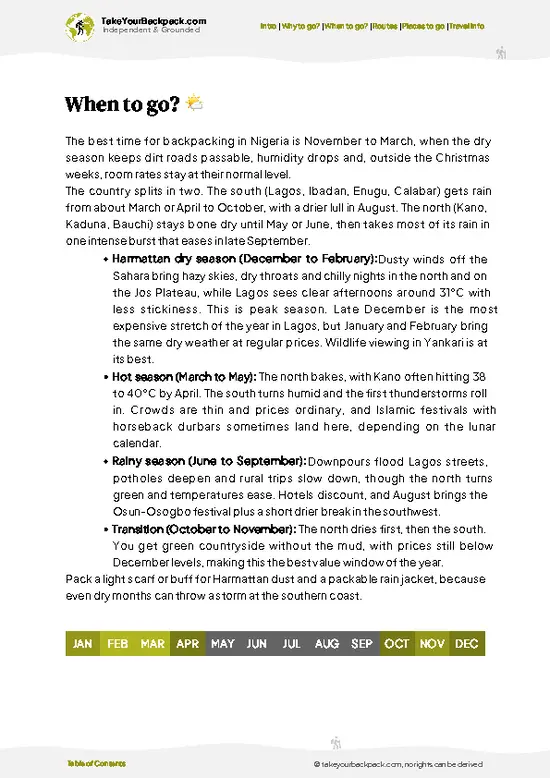
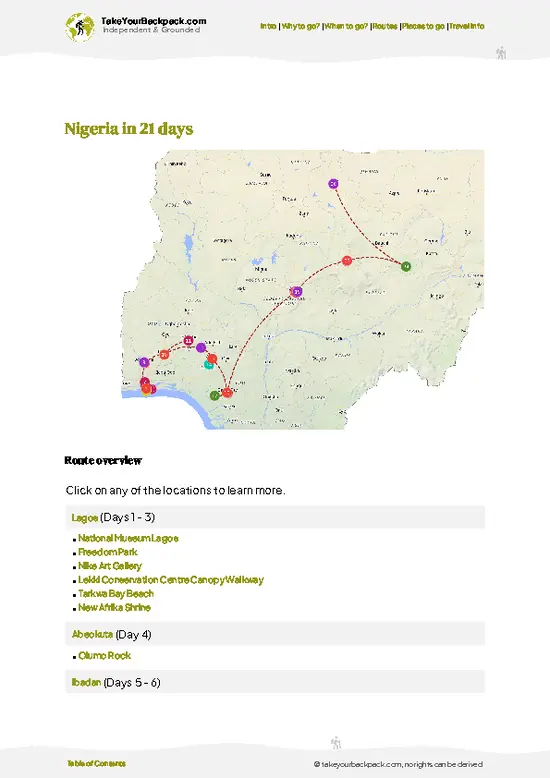
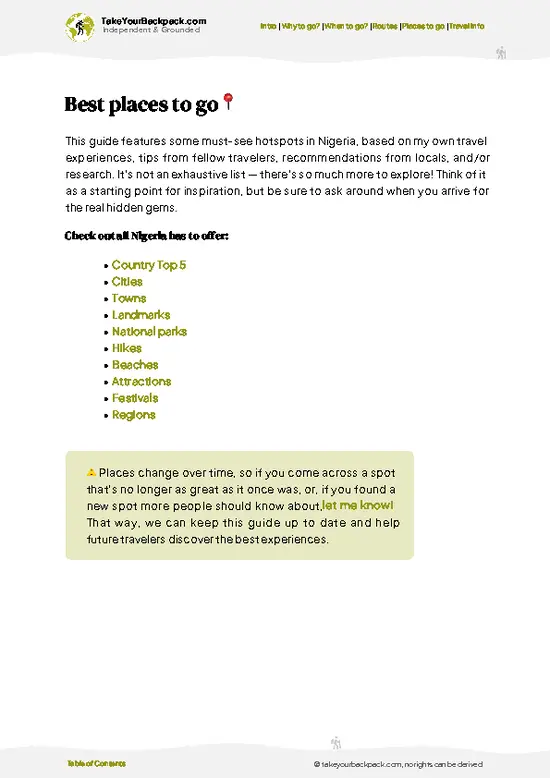
example page 0 from our offline Travel Guide for Nigeria
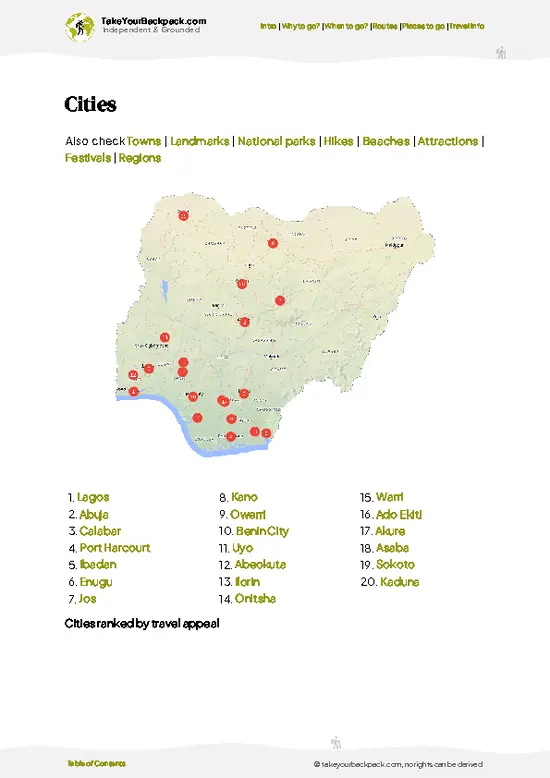
example page 1 from our offline Travel Guide for Nigeria
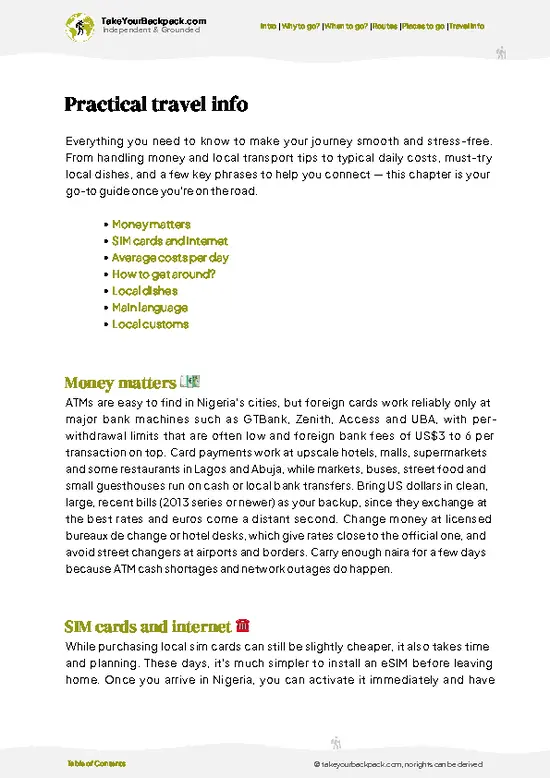
example page 2 from our offline Travel Guide for Nigeria
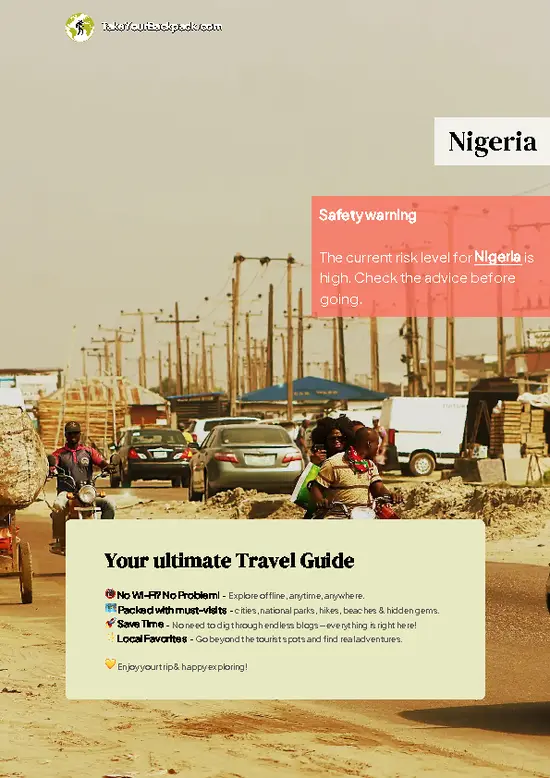
example page 3 from our offline Travel Guide for Nigeria
example page 4 from our offline Travel Guide for Nigeria
example page 5 from our offline Travel Guide for Nigeria
example page 6 from our offline Travel Guide for Nigeria
example page 7 from our offline Travel Guide for Nigeria
The digital guide (313 pages) contains:
✅ 82 highlights, ranked by travel appeal
✅ Optimized 7, 14 & 21-day travel routes
✅ Cities, national parks, landmarks, beaches
✅ How to get around
✅ Offline-friendly for travel without Wi-Fi
👉 Click to see all 30+ guide features

📅 Plan smarter in minutes, not weeks
✅ Month by month travel advice
✅ Festivals & national holidays
✅ Budget expectations

🗺️ Go to the right places, skip the overrated ones
✅ Honest pros & cons of destinations
✅ Top hikes, parks & viewpoints
✅ Lesser-known places most travelers miss
✅ Clear “worth it vs skip it” guidance

🛏️ Travel smoothly without rookie mistakes
✅ Best areas to stay
✅ Transport systems explained simply
✅ Common scams & safety advice
✅ SIM cards, money & practical tips

🌍 Understand the country, not just visit it
✅ Culture & traditions
✅ 52 Essential phrases & customs
✅ Festivals worth planning around
✅ Traveler-friendly historical context
✅ Insights that make places more meaningful

📱 Built for real travel conditions
✅ Fully downloadable PDF
✅ Works completely offline
✅ Optimized for phone use
✅ Useful in remote areas & buses
✅ Everything in one place
Stop searching, start planning
Get instant access to your full guide. 30‑day money-back guarantee.
+ Add another guide for just

By proceeding you agree to our terms.
Sent to your inbox immediately after payment • 100% Secure Checkout
Best Backpacking Travel Advisor 2025 tourism awardBest Backpacking
Travel Advisor
2025
What others say about Take Your Backpack Guides:
⭐⭐⭐⭐⭐
Fantastic, amazing amount of information!
⭐⭐⭐⭐⭐
My goodness this is amazing, it's what I've been looking for hats off too you!
⭐⭐⭐⭐⭐
I think this is absolutely BRILLIANT
⭐⭐⭐⭐
Very complete and informative. It's still missing places, but I gotta to commend you
⭐⭐⭐⭐⭐
This is truly amazing, thank you, can't wait to explore it with my kids!
⭐⭐⭐⭐⭐
Awesome resource, thank you!
⭐⭐⭐⭐⭐
This is amazing! Can't wait to explore the ones I haven't seen
⭐⭐⭐⭐
I love this! Well done, great idea.
⭐⭐⭐⭐⭐
Thanks for taking the time to make this gem!
⭐⭐⭐⭐⭐
This might be the best website I've ever seen.
⭐⭐⭐⭐⭐
Congratulations, and thank you so much for your work; it's incredibly valuable.
⭐⭐⭐⭐
In all seriousness I think you did a great job pointing out the important spots
⭐⭐⭐⭐⭐
10/10 very good
⭐⭐⭐⭐⭐
As someone who's only just starting to visit regularly this is awesome, thank you.
⭐⭐⭐⭐
Thank you very much! I'm going to visit my dad, it's going to be very useful!
⭐⭐⭐⭐⭐
This is really cool! We'll be travelling for the first time and this definitely come in handy.
⭐⭐⭐⭐⭐
You are now our minister of culture, congratulations 👨‍💼
⭐⭐⭐⭐⭐
Just wanted to tell you that this is a pearl! Going to follow your recommendations.
⭐⭐⭐⭐⭐
This is so cool. I'll definitely be using the resource for my travels soon.
⭐⭐⭐⭐⭐
This is very impressive! Good work.
⭐⭐⭐⭐⭐
This is an amazing and informative site. Very well done!

🛏️ Where to stay?Where to Stay: Nigeria Edition

Dorm-style hostels are rare in Nigeria, so backpacking here mostly means budget guesthouses, small hotels and short-let apartments, where a basic private room typically costs ₦20,000 to 45,000 (roughly US$13 to 30) a night. In Lagos, Yaba and Surulere give the best value and a busy local street life but leave you in long traffic crawls to the beaches and galleries. Victoria Island and Lekki put you close to the restaurants and nightlife and feel safer after dark at noticeably higher prices, while Ikeja mainly suits an early flight; in Abuja, Wuse and Garki are central, calm and well policed, with the capital’s bar scene around Wuse 2, though rooms there cost more than in most other Nigerian … read more 👉
Dorm-style hostels are rare in Nigeria, so backpacking here mostly means budget guesthouses, small hotels and short-let apartments, where a basic private room typically costs ₦20,000 to 45,000 (roughly US$13 to 30) a night. In Lagos, Yaba and Surulere give the best value and a busy local street life but leave you in long traffic crawls to the beaches and galleries. Victoria Island and Lekki put you close to the restaurants and nightlife and feel safer after dark at noticeably higher prices, while Ikeja mainly suits an early flight; in Abuja, Wuse and Garki are central, calm and well policed, with the capital’s bar scene around Wuse 2, though rooms there cost more than in most other Nigerian cities.

If you enjoy meeting fellow travelers, consider choosing hostels with high ratings for atmosphere. On the other hand, if you prefer having your own space, a hotel might be a better option.

NigeriaExplore Beyond This Category

👋 Meet the founderWho’s Behind Take Your Backpack?

Johan, backpacker and founder of TakeYourBackpackHi, I’m Johan (Netherlands 🇳🇱), the creator of TakeYourBackpack. Over the past 3 decades, I’ve backpacked through 90+ countries across six continents, gaining extensive experience with independent travel, long-term trips, and overland routes.

This site is built on a combination of firsthand travel experience and carefully curated insights from other backpackers. Many guides are based on places I’ve personally visited, while others bring together tips, observations, and practical advice shared by trusted travelers I’ve met along the way.

The goal is to provide realistic, experience-driven guidance — not generic itineraries — so you can explore destinations with better context, clearer expectations, and more confidence.