×

Palau🇵🇼 | best villagesWhere to Find the 5 Best villages in Palau

Villages in Palau come in two flavors: the Babeldaob communities, reached by road from the Koror hub, and the Rock Islands and southern outliers like Peleliu and Angaur, reached only by boat. Expect quiet streets, bai meeting houses and church-centered life. Babeldaob is cheaper and easier for independent travelers. Southern islands cost more and need planning, but crowds are rare.

By Johan Kruseman 🇳🇱 | Updated October 18, 2026
Explore the best landmarks in Palau

Why go?Key Factors That Shape the Experience

Palau’s villages matter because traditional clan structure still shapes land, titles and daily life. Chiefs and councils hold real authority, and the bai, the painted meeting house, is still a working symbol of that order. Geography keeps communities small and spread out: Babeldaob is the big volcanic island, while many smaller communities sit across reefs and islands that need boats.

Before you choose Palau for villages, know that tourism here is built around diving and the Rock Islands, so village visits are rarely packaged. Public transport is thin, so plan on a rental car, taxi or arranged tour. The US dollar is the currency, and prices run high for Pacific standards. Ask permission before photographing people or entering sites, and bring cash because small places seldom take cards.
Why These Made the Cut
The list of best villages in Palau is created based on authenticity, scenic beauty, community spirit, traditions, and overall character. If you feel a village is missing in this list, please let us know.

When to go?Best Time to Visit Palau for villages

Best months and why: The best months for villages in Palau are February to April, when rain is lightest and roads and boat crossings are most reliable. Days sit around 27 to 31°C, with humidity that never really leaves. Palau is wet all year, with roughly 3,500 mm of rain annually, so a light rain jacket matters in any month.

Shoulder and wet seasons: Wetter months from July to October bring heavier showers and occasional typhoon swells, which can cancel boats to the southern islands. Muddy unpaved village roads on Babeldaob also slow you down. Prices for rooms and tours climb in the dry season, particularly around Christmas and Lunar New Year when visitor numbers peak. May, June and November often offer cheaper rooms with manageable weather. Book boats early, and keep a spare day for sea conditions.

village hoppingPlanning Your Route Efficiently

How long you need: A trip combining several villages in Palau needs 5 to 8 days, with Koror as your base for most of it. Babeldaob communities cluster well together, since one paved ring road, the Compact Road, connects them, and each stop takes 1 to 3 hours. Koror to the island’s far north takes roughly 1 to 1.5 hours by car.

Direction and pacing: Do Babeldaob first by road, then finish with the southern islands, because boats depend on weather and a buffer at the end protects your flight. Boat transfers to Peleliu run about 1 to 2 hours depending on the vessel, and a visit there needs a full day or an overnight.

The common mistake is cramming road and sea stops into the same day. Give boat days to themselves, and avoid scheduling anything on Sunday, when many communities attend church and close up.

The ListThe Best villages of Palau

1 Airai

Painted storyboard bai, airport-side stays, southern Babeldaob, quiet first night

Walk under the carved roof beams of the Bai ra Irrai, then drive north to the muddy forest trail at Ngardmau Waterfall.

2 Melekeok

Capitol hilltop, chiefly village lanes, mangrove shoreline, east coast

Wander stone paths around the paramount chief’s seat, then drift down to tidal flats where mangrove roots meet the lagoon.

3 Angaur

Wild macaques, mine ruins, WWII bunkers, far-south lighthouse

Cycle flat, empty roads past rusting phosphate machinery and wartime caves, with monkeys in the roadside trees and surf on the reef.

4 Ngatpang

Ngeremeduu Bay, kayak paddling, old stone platforms, west coast

Paddle the tidal river between mangrove walls on a rising tide, then search the forest for paved paths from older villages.

5 Ngerulmud

Domed Capitol, manicured lawns, weekday stop, jungle-edged hilltop

Photograph the white legislative building on its wide lawn, then look over forested slopes toward the coast before heading back to Koror.

Loading the map 🌍

Expert viewWhat You Should Know

How many to visit: I advise three to five villages in total. That lets you spend 1 to 3 hours in each without rushing, and keeps boat days separate from road days. Seeing more tends to blur together and costs you extra fuel, tours and time, while seeing fewer misses the contrast between road-accessible and island communities.

Which kind to prioritize: If you are on a tight budget, favor Babeldaob communities. They cost the least in money and effort, since a shared rental car runs about US$50 to 90 a day, and many stops are free or ask a small donation of a few dollars. If you want a deeper cultural encounter and can spend more, add one southern island. The boat and guide cost more, around US$100 to 200 for a day trip, but you get far fewer visitors and more conversation. Comfort is basic … read more 👉
How many to visit: I advise three to five villages in total. That lets you spend 1 to 3 hours in each without rushing, and keeps boat days separate from road days. Seeing more tends to blur together and costs you extra fuel, tours and time, while seeing fewer misses the contrast between road-accessible and island communities.

Which kind to prioritize: If you are on a tight budget, favor Babeldaob communities. They cost the least in money and effort, since a shared rental car runs about US$50 to 90 a day, and many stops are free or ask a small donation of a few dollars. If you want a deeper cultural encounter and can spend more, add one southern island. The boat and guide cost more, around US$100 to 200 for a day trip, but you get far fewer visitors and more conversation. Comfort is basic on the islands, so the extra money buys access, not luxury.

Budget: Plan on US$70 to 130 a day in Palau for a backpacker doing villages, covering a dorm or basic room (US$40 to 80), food (US$20 to 35) and a share of transport. Some sites and bai grounds charge entry of around US$5 to 20, and the Rock Islands permit adds a separate fee for the wider trip. Local guides, where used, usually cost US$30 to 80 for a half day.

Culture and safety: Palau is very safe, with minimal petty crime. The real risks are heat, sudden rain and slick roads. Always ask before entering a bai or walking onto village land, since many sites belong to clans. Dress modestly in villages, with shoulders and knees covered. Carry small US bills, and bring your own water and snacks, because shops in smaller communities close early and keep short hours.

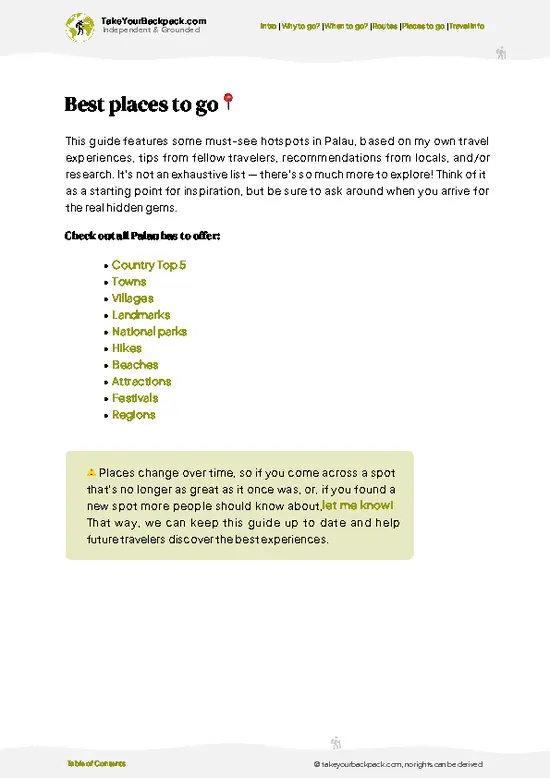
✈️ The backpacker research shortcutPalau Travel Guide

An offline-friendly backpacking guide with optimized travel routes, ranked highlights, transport advice, and the best areas to stay.
example page 0 from our offline Travel Guide for Palau
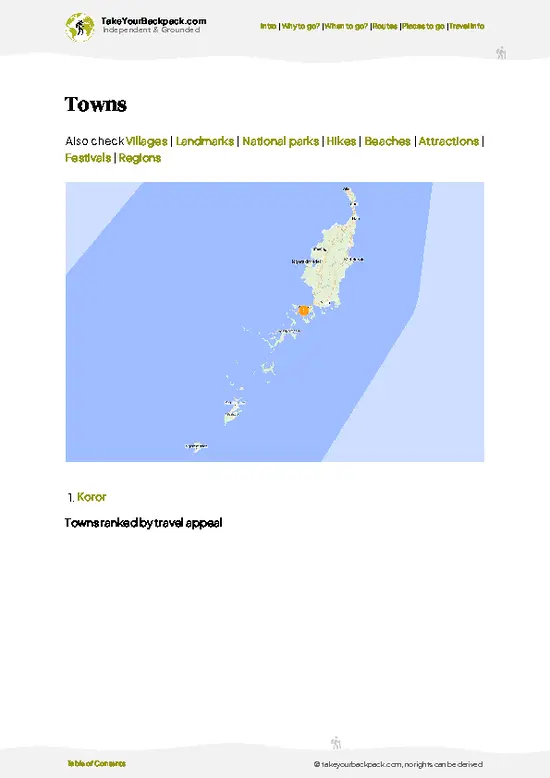
example page 1 from our offline Travel Guide for Palau
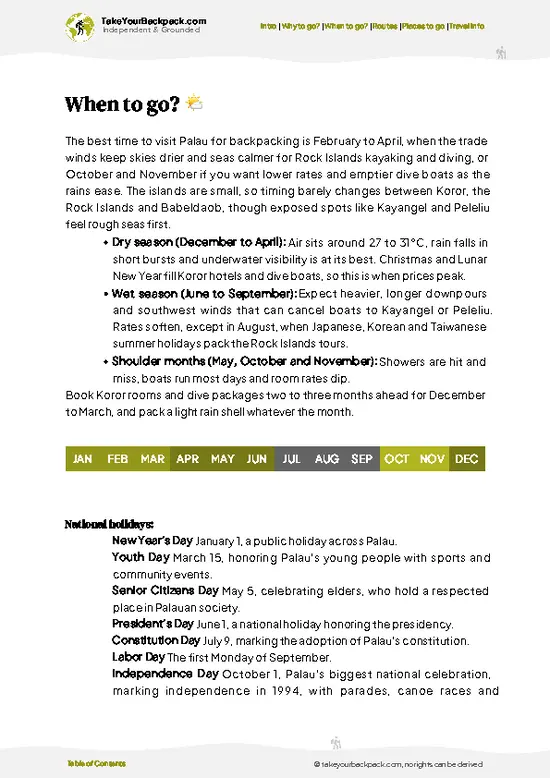
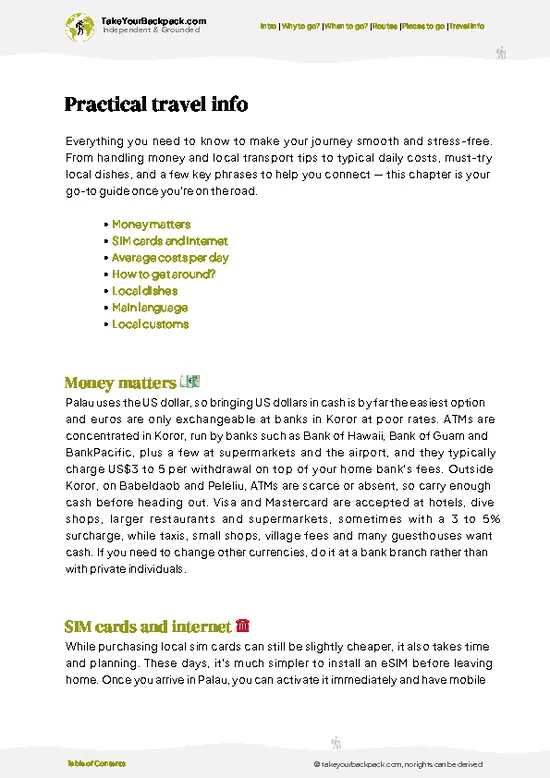
example page 2 from our offline Travel Guide for Palau
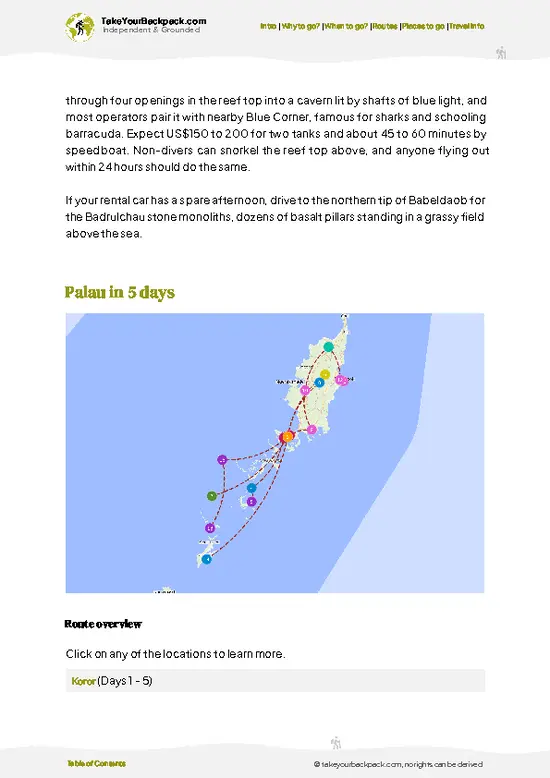
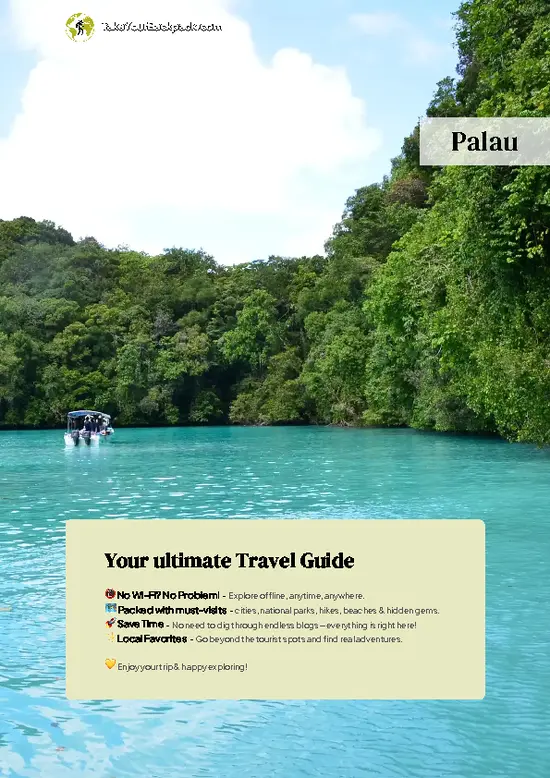
example page 3 from our offline Travel Guide for Palau
example page 4 from our offline Travel Guide for Palau
example page 5 from our offline Travel Guide for Palau
example page 6 from our offline Travel Guide for Palau
example page 7 from our offline Travel Guide for Palau
The digital guide (99 pages) contains:
✅ 22 highlights, ranked by travel appeal
✅ Optimized 2, 3 & 5-day travel routes
✅ Cities, national parks, landmarks, beaches
✅ How to get around
✅ Offline-friendly for travel without Wi-Fi
👉 Click to see all 30+ guide features

📅 Plan smarter in minutes, not weeks
✅ Month by month travel advice
✅ Festivals & national holidays
✅ Budget expectations

🗺️ Go to the right places, skip the overrated ones
✅ Honest pros & cons of destinations
✅ Top hikes, parks & viewpoints
✅ Lesser-known places most travelers miss
✅ Clear “worth it vs skip it” guidance

🛏️ Travel smoothly without rookie mistakes
✅ Best areas to stay
✅ Transport systems explained simply
✅ Common scams & safety advice
✅ SIM cards, money & practical tips

🌍 Understand the country, not just visit it
✅ Culture & traditions
✅ 52 Essential phrases & customs
✅ Festivals worth planning around
✅ Traveler-friendly historical context
✅ Insights that make places more meaningful

📱 Built for real travel conditions
✅ Fully downloadable PDF
✅ Works completely offline
✅ Optimized for phone use
✅ Useful in remote areas & buses
✅ Everything in one place
Stop searching, start planning
Get instant access to your full guide. 30‑day money-back guarantee.
+ Add another guide for just

By proceeding you agree to our terms.
Sent to your inbox immediately after payment • 100% Secure Checkout
Best Backpacking Travel Advisor 2025 tourism awardBest Backpacking
Travel Advisor
2025
What others say about Take Your Backpack Guides:
⭐⭐⭐⭐⭐
Fantastic, amazing amount of information!
⭐⭐⭐⭐⭐
My goodness this is amazing, it's what I've been looking for hats off too you!
⭐⭐⭐⭐⭐
I think this is absolutely BRILLIANT
⭐⭐⭐⭐
Very complete and informative. It's still missing places, but I gotta to commend you
⭐⭐⭐⭐⭐
This is truly amazing, thank you, can't wait to explore it with my kids!
⭐⭐⭐⭐⭐
Awesome resource, thank you!
⭐⭐⭐⭐⭐
This is amazing! Can't wait to explore the ones I haven't seen
⭐⭐⭐⭐
I love this! Well done, great idea.
⭐⭐⭐⭐⭐
Thanks for taking the time to make this gem!
⭐⭐⭐⭐⭐
This might be the best website I've ever seen.
⭐⭐⭐⭐⭐
Congratulations, and thank you so much for your work; it's incredibly valuable.
⭐⭐⭐⭐
In all seriousness I think you did a great job pointing out the important spots
⭐⭐⭐⭐⭐
10/10 very good
⭐⭐⭐⭐⭐
As someone who's only just starting to visit regularly this is awesome, thank you.
⭐⭐⭐⭐
Thank you very much! I'm going to visit my dad, it's going to be very useful!
⭐⭐⭐⭐⭐
This is really cool! We'll be travelling for the first time and this definitely come in handy.
⭐⭐⭐⭐⭐
You are now our minister of culture, congratulations 👨‍💼
⭐⭐⭐⭐⭐
Just wanted to tell you that this is a pearl! Going to follow your recommendations.
⭐⭐⭐⭐⭐
This is so cool. I'll definitely be using the resource for my travels soon.
⭐⭐⭐⭐⭐
This is very impressive! Good work.
⭐⭐⭐⭐⭐
This is an amazing and informative site. Very well done!

🛏️ Where to stay?Top Areas to Stay

Palau has very few true hostels, so budget travelers mostly stay in small guesthouses, motels and apartment rentals, with simple private rooms typically running US$50 to 100 a night. Downtown Koror puts you on the main road within walking distance of restaurants, supermarkets, dive shops and the country’s modest bar scene, while Malakal sits closer to the docks where many dive and Rock Islands boats leave and is quieter at night, though you’ll need a taxi for dinner. Arakebesang is calm and leafy with good water views but spread out, and staying on Babeldaob gives you rural silence at the cost of a 30 to 60 minute drive to the Koror boat departures; all four areas are low-crime and relaxed after … read more 👉
Palau has very few true hostels, so budget travelers mostly stay in small guesthouses, motels and apartment rentals, with simple private rooms typically running US$50 to 100 a night. Downtown Koror puts you on the main road within walking distance of restaurants, supermarkets, dive shops and the country’s modest bar scene, while Malakal sits closer to the docks where many dive and Rock Islands boats leave and is quieter at night, though you’ll need a taxi for dinner. Arakebesang is calm and leafy with good water views but spread out, and staying on Babeldaob gives you rural silence at the cost of a 30 to 60 minute drive to the Koror boat departures; all four areas are low-crime and relaxed after dark.

If you enjoy meeting fellow travelers, consider choosing hostels with high ratings for atmosphere. On the other hand, if you prefer having your own space, a hotel might be a better option.

PalauDiscover the Country

👋 Meet the founderWho’s Behind Take Your Backpack?

Johan, backpacker and founder of TakeYourBackpackHi, I’m Johan (Netherlands 🇳🇱), the creator of TakeYourBackpack. Over the past 3 decades, I’ve backpacked through 90+ countries across six continents, gaining extensive experience with independent travel, long-term trips, and overland routes.

This site is built on a combination of firsthand travel experience and carefully curated insights from other backpackers. Many guides are based on places I’ve personally visited, while others bring together tips, observations, and practical advice shared by trusted travelers I’ve met along the way.

The goal is to provide realistic, experience-driven guidance — not generic itineraries — so you can explore destinations with better context, clearer expectations, and more confidence.