×

Paraguay🇵🇾 | best landmarksTop-Rated 3 landmarks in Paraguay

Landmarks in Paraguay are mostly Jesuit mission ruins, colonial-era churches, river dams and small-town monuments, not the crowded headline sites of its neighbors. Entry is usually inexpensive, and a few places can be visited with almost no other tourists around. The southeast around Encarnación holds the best-organized sites, with signage, guides and regular buses. Asunción offers a compact historic center that is easy on foot. The Chaco and the north have few formal monuments, long distances and rough roads. For backpacking or independent travel, the southeast suits first-timers, while the north rewards those with time and patience.

By Johan Kruseman 🇳🇱 | Updated November 18, 2026
Explore the best national parks in Paraguay

Why go?Key Factors That Shape the Experience

Paraguay’s landmarks exist because of an unusual history. The Jesuit missions of the 17th and 18th centuries left stone churches and settlements among the Guaraní, and the country has long been a place where Spanish and Guaraní culture blended rather than one replacing the other. Guaraní is still spoken by most of the population, which shapes how heritage is explained and understood. The War of the Triple Alliance in the 1860s devastated the country, so many older buildings were lost, and what remains is often modest in scale.

Geography also matters. Paraguay is landlocked, divided by the Paraguay River into a populated, green east and a sparse, dry Chaco in the west. Landmarks cluster in the east, where roads and towns are denser. Large binational engineering projects on the Paraná River … read more 👉
Paraguay’s landmarks exist because of an unusual history. The Jesuit missions of the 17th and 18th centuries left stone churches and settlements among the Guaraní, and the country has long been a place where Spanish and Guaraní culture blended rather than one replacing the other. Guaraní is still spoken by most of the population, which shapes how heritage is explained and understood. The War of the Triple Alliance in the 1860s devastated the country, so many older buildings were lost, and what remains is often modest in scale.

Geography also matters. Paraguay is landlocked, divided by the Paraguay River into a populated, green east and a sparse, dry Chaco in the west. Landmarks cluster in the east, where roads and towns are denser. Large binational engineering projects on the Paraná River are a modern part of the country’s identity and can be visited on organized tours.

Before choosing Paraguay for its landmarks, expect low crowds and low prices, but also limited interpretation in English, irregular opening hours and few polished visitor facilities. Public transport is slow and often runs on its own schedule, and distances between sites can be long. Travelers who value quiet, local context and unhurried visits tend to be satisfied. Those who want large, well-curated monuments will find fewer of them than elsewhere in South America.
Our Approach to Ranking
The list of best unique sites in Paraguay is created based on history or culture, wow factor, atmosphere, quirks, and memorability. If you feel a unique site is missing in this list, please let us know.

When to go?Seasonal Guide to Visiting

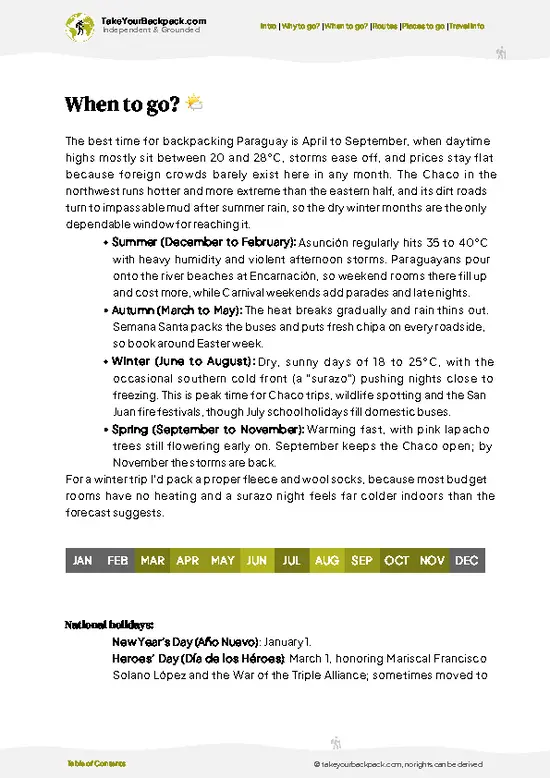
Best months for landmarks in Paraguay: The best months are May to September, when daytime highs run roughly 18 to 28°C and walking around open-air ruins and town centers is comfortable. This is the dry-leaning winter, though rain still falls in every month. Eastern Paraguay receives around 1,400 to 1,700 mm a year, much of it in heavy storms.
Summer heat and storms: From December to February, temperatures in Asunción and the Chaco often pass 35°C and can reach 40°C or more. Humidity is high in the east, and afternoon thunderstorms can turn unpaved roads into mud. In the Chaco, summer heat and flooded tracks can make travel impractical. Sites without shade, such as open ruin complexes, are best visited early in the morning during these months.
Shoulder seasons: March to April and October to November … read more 👉
Best months for landmarks in Paraguay: The best months are May to September, when daytime highs run roughly 18 to 28°C and walking around open-air ruins and town centers is comfortable. This is the dry-leaning winter, though rain still falls in every month. Eastern Paraguay receives around 1,400 to 1,700 mm a year, much of it in heavy storms.
Summer heat and storms: From December to February, temperatures in Asunción and the Chaco often pass 35°C and can reach 40°C or more. Humidity is high in the east, and afternoon thunderstorms can turn unpaved roads into mud. In the Chaco, summer heat and flooded tracks can make travel impractical. Sites without shade, such as open ruin complexes, are best visited early in the morning during these months.
Shoulder seasons: March to April and October to November are mild to warm, with highs of about 26 to 32°C, and less predictable rain. These months work well in the southeast around Encarnación, where the landscape is green and crowds are thin.
Cold snaps and local peaks: Winter nights can drop to 5°C or lower in the south, and cold fronts bring a few damp, chilly days. Paraguay has no strong tourist peak, so prices change little through the year. Holy Week and local patron saint festivals fill transport and rooms in individual towns, and some sites close on public holidays or Mondays, so check ahead for those dates.

unique site hoppingOptimizing Your Multi-Stop Itinerary

How many days to allow: A trip combining several landmarks in Paraguay needs 7 to 10 days, because distances are moderate but buses are slow and stops are spread out. The country divides sensibly into the capital, the southeast and the Paraná border region.
Grouping and direction: Start in Asunción, where international flights and long-distance buses arrive, and where the historic center takes one to two days. From there, head southeast along Ruta 1 toward Encarnación, a trip of roughly 5 to 6 hours by bus. The mission sites cluster within about 30 to 90 minutes of Encarnación, so a base there suits 2 to 3 days. Traveling south is the practical direction, as it ends at the Argentine border crossing at Posadas, which makes an easy exit or onward connection. The Paraná dam region near Ciudad … read more 👉
How many days to allow: A trip combining several landmarks in Paraguay needs 7 to 10 days, because distances are moderate but buses are slow and stops are spread out. The country divides sensibly into the capital, the southeast and the Paraná border region.
Grouping and direction: Start in Asunción, where international flights and long-distance buses arrive, and where the historic center takes one to two days. From there, head southeast along Ruta 1 toward Encarnación, a trip of roughly 5 to 6 hours by bus. The mission sites cluster within about 30 to 90 minutes of Encarnación, so a base there suits 2 to 3 days. Traveling south is the practical direction, as it ends at the Argentine border crossing at Posadas, which makes an easy exit or onward connection. The Paraná dam region near Ciudad del Este sits to the northeast, about 4 to 5 hours from Asunción and 4 to 5 hours from Encarnación, and is best treated as a separate branch with one to two days.
Common planning mistakes: Travelers often underestimate bus times, since stops and breakdowns add one to two hours to published schedules. Build in slack instead of tight connections. Another error is trying to see every site in a single day from Asunción. Pick one regional base and use local buses or a hired driver for the small sites. Finally, avoid adding the Chaco to a short trip, as getting there and back takes several days on its own.

The ListMust-Visit landmarks in Paraguay

1 La Santísima Trinidad de Paraná

Sandstone basilica, carved pulpit, angel-musician reliefs, red-earth hilltop

Walk the open nave and plaza of a Jesuit reduction, studying Guaraní stonework on the pulpit and reliefs before climbing for a wide view.

paraguay-unique-site-la-santisima-trinidad-de-parana
© Google | Andrea Marchini

2 Saltos del Monday

40-meter falls, silt-brown water, stepped descent, Atlantic forest trails

Descend the steep stairs to the foot of a broad river curtain, then cool off among boulders, pools and shaded forest paths.

paraguay-unique-site-saltos-del-monday
© Google | Marcela V

3 Hito Tres Fronteras

Three-river confluence, red-white-blue obelisk, riverside plaza, chipa stalls

Watch the Iguazú and Paraná meet in two shades of water, then spot the Argentine and Brazilian markers across the river at sunset.

paraguay-unique-site-hito-tres-fronteras
© Google | Melissa Martinez
Loading the map 🌍

Expert viewWhat You Should Know

How many landmarks to visit: Plan for four to six landmarks over a week or so. Paraguay’s sites are spread out, buses are slow, and a morning in the heat at an open ruin tends to use up the energy you would need for a second one in the afternoon. One major site per day, with a lighter urban stop in the evening, leaves room for the long waits at terminals and the plastic chair outside a roadside shop where you can watch the town go by with a cold tereré in hand.
Choosing between the kinds: Travelers interested in history should put the Jesuit mission sites first, since they are the most complete and the best signposted. Those who prefer city walking should spend time in Asunción’s old center, where the streets are flat, the buildings are mostly low colonial and early republican, and the riverfront … read more 👉
How many landmarks to visit: Plan for four to six landmarks over a week or so. Paraguay’s sites are spread out, buses are slow, and a morning in the heat at an open ruin tends to use up the energy you would need for a second one in the afternoon. One major site per day, with a lighter urban stop in the evening, leaves room for the long waits at terminals and the plastic chair outside a roadside shop where you can watch the town go by with a cold tereré in hand.
Choosing between the kinds: Travelers interested in history should put the Jesuit mission sites first, since they are the most complete and the best signposted. Those who prefer city walking should spend time in Asunción’s old center, where the streets are flat, the buildings are mostly low colonial and early republican, and the riverfront gives an easy view across to the Chaco side at dusk. Travelers interested in engineering or scale should add one dam visit, which comes with a bus tour and a lot of concrete and water. Small-town churches and plazas in the countryside suit slower travelers, who get a quiet hour with local people rather than a checklist.
What it costs: A realistic budget is US$25 to 45 a day including a dorm bed or simple guesthouse, local meals and buses. Entry fees to historic sites are usually low, roughly 15,000 to 50,000 guaraníes (about US$2 to 7). Dam tours are often free or low-cost and require booking or an ID. Guides at the mission sites cost around US$10 to 25 a group, and are worth it because on-site signs give limited context. Local buses between towns run about US$3 to 12 per leg, and taxis or private drivers for a half-day run roughly US$30 to 60.
Safety and conduct: Sites are generally calm, but petty theft occurs in central Asunción and around bus terminals, so keep phones out of sight and avoid walking quiet streets late at night. Carry cash in guaraníes, since small sites rarely take cards and ATMs can be scarce in villages. Bring water, a hat and sun protection, because shade at ruins is limited. Dress modestly in working churches and ask before photographing people, especially in rural communities. Greeting people before asking a question is expected, and a few words of Spanish go far, since English is rare. In the wet months, carry a rain layer and check road conditions before heading out on unpaved routes.

✈️ The backpacker research shortcutParaguay Travel Guide

What the free pages can't give you: ready-made routes, every place ranked, and it works offline. All in 1 guide.
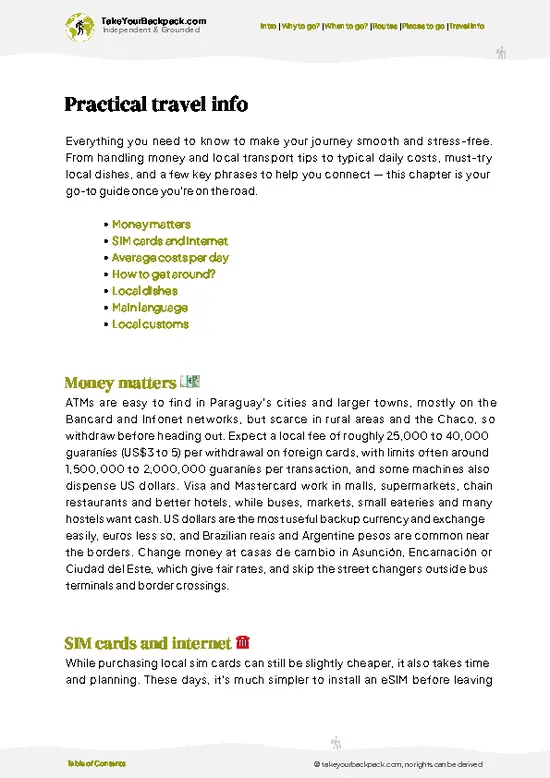
example page 0 from our offline Travel Guide for Paraguay
example page 1 from our offline Travel Guide for Paraguay
example page 2 from our offline Travel Guide for Paraguay
example page 3 from our offline Travel Guide for Paraguay
example page 4 from our offline Travel Guide for Paraguay
example page 5 from our offline Travel Guide for Paraguay
example page 6 from our offline Travel Guide for Paraguay
example page 7 from our offline Travel Guide for Paraguay
The digital guide (226 pages) contains:-page digital guide:
✅ Ready-made 5, 10 & 15-day routes
✅ All 65 places ranked, so you skip the overrated ones
✅ Works offline, all in 1 guide
✅ Cities, national parks, landmarks, beaches
✅ How to get around
👉 Click to see all 30+ guide features

📅 Plan smarter in minutes, not weeks
✅ Month by month travel advice
✅ Festivals & national holidays
✅ Budget expectations

🗺️ Go to the right places, skip the overrated ones
✅ Honest pros & cons of destinations
✅ Top hikes, parks & viewpoints
✅ Lesser-known places most travelers miss
✅ Clear “worth it vs skip it” guidance

🛏️ Travel smoothly without rookie mistakes
✅ Best areas to stay
✅ Transport systems explained simply
✅ Common scams & safety advice
✅ SIM cards, money & practical tips

🌍 Understand the country, not just visit it
✅ Culture & traditions
✅ 52 Essential phrases & customs
✅ Festivals worth planning around
✅ Traveler-friendly historical context
✅ Insights that make places more meaningful

📱 Built for real travel conditions
✅ Fully downloadable PDF
✅ Works completely offline
✅ Optimized for phone use
✅ Useful in remote areas & buses
✅ All in 1 guide
Stop searching, start planning
Get instant access to your full guide. 30‑day money-back guarantee.


By proceeding you agree to our terms.
Sent to your inbox immediately after payment • 100% Secure Checkout
Best Backpacking Travel Advisor 2025 tourism awardBest Backpacking
Travel Advisor
2025
What others say about Take Your Backpack Guides:
⭐⭐⭐⭐⭐
Fantastic, amazing amount of information!
⭐⭐⭐⭐⭐
My goodness this is amazing, it's what I've been looking for hats off too you!
⭐⭐⭐⭐⭐
I think this is absolutely BRILLIANT
⭐⭐⭐⭐
Very complete and informative. It's still missing places, but I gotta to commend you
⭐⭐⭐⭐⭐
This is truly amazing, thank you, can't wait to explore it with my kids!
⭐⭐⭐⭐⭐
Awesome resource, thank you!
⭐⭐⭐⭐⭐
This is amazing! Can't wait to explore the ones I haven't seen
⭐⭐⭐⭐
I love this! Well done, great idea.
⭐⭐⭐⭐⭐
Thanks for taking the time to make this gem!
⭐⭐⭐⭐⭐
This might be the best website I've ever seen.
⭐⭐⭐⭐⭐
Congratulations, and thank you so much for your work; it's incredibly valuable.
⭐⭐⭐⭐
In all seriousness I think you did a great job pointing out the important spots
⭐⭐⭐⭐⭐
10/10 very good
⭐⭐⭐⭐⭐
As someone who's only just starting to visit regularly this is awesome, thank you.
⭐⭐⭐⭐
Thank you very much! I'm going to visit my dad, it's going to be very useful!
⭐⭐⭐⭐⭐
This is really cool! We'll be travelling for the first time and this definitely come in handy.
⭐⭐⭐⭐⭐
You are now our minister of culture, congratulations 👨‍💼
⭐⭐⭐⭐⭐
Just wanted to tell you that this is a pearl! Going to follow your recommendations.
⭐⭐⭐⭐⭐
This is so cool. I'll definitely be using the resource for my travels soon.
⭐⭐⭐⭐⭐
This is very impressive! Good work.
⭐⭐⭐⭐⭐
This is an amazing and informative site. Very well done!

🛏️ Where to stay?Accommodation Highlights

Paraguay has a small but growing hostel scene, with dorm beds mostly in the US$10 to 18 range and simple guesthouses and budget hotels filling the gaps, though private hostels cluster mainly in Asunción and Encarnación. In Asunción, the Centro puts you within walking distance of the Palacio de los López, the Panteón and the riverfront for the lowest prices, but its streets empty out after dark and on weekends, while Villa Morra and Recoleta cost a bit more and sit a 15 to 25 minute bus ride from the old town, in exchange for safer sidewalks, shopping malls and the city’s best bars and restaurants. In Encarnación, the blocks between the center and the Costanera beachfront are the easiest base, … read more 👉
Paraguay has a small but growing hostel scene, with dorm beds mostly in the US$10 to 18 range and simple guesthouses and budget hotels filling the gaps, though private hostels cluster mainly in Asunción and Encarnación. In Asunción, the Centro puts you within walking distance of the Palacio de los López, the Panteón and the riverfront for the lowest prices, but its streets empty out after dark and on weekends, while Villa Morra and Recoleta cost a bit more and sit a 15 to 25 minute bus ride from the old town, in exchange for safer sidewalks, shopping malls and the city’s best bars and restaurants. In Encarnación, the blocks between the center and the Costanera beachfront are the easiest base, close to the riverside nightlife in summer and an easy hop to the Jesuit ruins at Trinidad.

If you enjoy meeting fellow travelers, consider choosing hostels with high ratings for atmosphere. On the other hand, if you prefer having your own space, a hotel might be a better option.

ParaguaySee More of Paraguay

👋 Meet the founderWho’s Behind Take Your Backpack?

Johan, backpacker and founder of TakeYourBackpackHi, I’m Johan (Netherlands 🇳🇱), the creator of TakeYourBackpack. Over the past 30 years, I’ve backpacked through 88 countries across six continents, gaining extensive experience with independent travel, long-term trips, and overland routes.

This site is built on a combination of firsthand travel experience and carefully curated insights from other backpackers. Many guides are based on places I’ve personally visited, while others bring together tips, observations, and practical advice shared by trusted travelers I’ve met along the way.

The goal is to provide realistic, experience-driven guidance — not generic itineraries — so you can explore destinations with better context, clearer expectations, and more confidence.