×

Puerto Rico🇵🇷 | best citiesExplore the 2 Best cities in Puerto Rico

Cities in Puerto Rico come in a few distinct flavors, and picking the right one shapes your whole trip. The San Juan metro in the northeast has the best nightlife, the most hostels and the airport, but also the biggest crowds and prices. The west coast is surf-town territory: slower, cheaper, and happiest with a rental car. The south is hotter and drier, with plazas that fill up on weekends. The central mountains are cool, rural and nearly impossible without wheels. For independent travel, plan on US dollars, no passport check from the mainland, and patchy buses. Aim for weekday visits to dodge the weekend crush.

By Johan Kruseman 🇳🇱 | Updated October 23, 2026
Explore the best towns in Puerto Rico

Why go?What Makes Them Special

Puerto Rico is a U.S. territory with five centuries of Spanish colonial history, and that mix shows in its towns. Most were laid out around a central plaza with a church, so even small places have a walkable core where locals gather in the evening. Add Taíno, African and American influences and you get food, music and festivals that feel distinct from anywhere else in the Caribbean.

The island is small, roughly 160 kilometers (100 miles) long, so you can reach very different urban atmospheres within a few hours. The trade-off is infrastructure. Public transportation outside the San Juan area is limited, so a rental car is the practical choice for most itineraries. The upside is that roads are paved, signs are in Spanish and English, and you pay in dollars with no currency exchange or visa … read more 👉
Puerto Rico is a U.S. territory with five centuries of Spanish colonial history, and that mix shows in its towns. Most were laid out around a central plaza with a church, so even small places have a walkable core where locals gather in the evening. Add Taíno, African and American influences and you get food, music and festivals that feel distinct from anywhere else in the Caribbean.

The island is small, roughly 160 kilometers (100 miles) long, so you can reach very different urban atmospheres within a few hours. The trade-off is infrastructure. Public transportation outside the San Juan area is limited, so a rental car is the practical choice for most itineraries. The upside is that roads are paved, signs are in Spanish and English, and you pay in dollars with no currency exchange or visa hassle for U.S. citizens.

Before choosing Puerto Rico for its cities, know that Spanish is the everyday language, though English works in tourist areas. Power outages and heavy rain can interrupt plans, and Sunday and holiday closures are common in smaller towns. Go in with a flexible mindset and a taste for plaza life, and the cities reward you.
Evaluating the Top Choices
The list of best cities in Puerto Rico is created based on culture, vibe, attractions, transport ease, and local charm. If you feel a city is missing in this list, please let us know.

When to go?Seasonal Guide to Visiting

Best months for city visits: The best months are December to April, when daytime highs sit around 28 to 30°C (82 to 86°F), humidity eases and rain is lightest, often under 100 millimeters a month. This is also the dry stretch on the south coast, which stays sunnier than the north year-round.
Shoulder seasons: May to June and November bring warmer, stickier days (30 to 32°C, 86 to 90°F) and more afternoon showers, but hotel prices drop noticeably, often 20 to 30 percent below winter rates. Mornings are the cool window for walking old streets, so start early and take a long lunch.
Peak periods and the wet season: Mid-December through Easter is peak, with the priciest rooms and fullest weekends. Three Kings Day on January 6 and the San Sebastián Street Festival in mid-January pull big crowds to … read more 👉
Best months for city visits: The best months are December to April, when daytime highs sit around 28 to 30°C (82 to 86°F), humidity eases and rain is lightest, often under 100 millimeters a month. This is also the dry stretch on the south coast, which stays sunnier than the north year-round.
Shoulder seasons: May to June and November bring warmer, stickier days (30 to 32°C, 86 to 90°F) and more afternoon showers, but hotel prices drop noticeably, often 20 to 30 percent below winter rates. Mornings are the cool window for walking old streets, so start early and take a long lunch.
Peak periods and the wet season: Mid-December through Easter is peak, with the priciest rooms and fullest weekends. Three Kings Day on January 6 and the San Sebastián Street Festival in mid-January pull big crowds to the capital area, so book early. August to October is the heart of hurricane season, with heavy rain and some closures, though fares are lowest. The mountains in the center run roughly 5°C (9°F) cooler and wetter than the coast in every season, so pack a light rain jacket.

city hoppingSuggested Travel Strategies

How many days to plan: A trip combining several cities in Puerto Rico needs 7 to 10 days, which gives enough time for three or four stops without constant packing. Because the island is compact, most hops take 1 to 3 hours by road.
Grouping and direction: Start in the San Juan metro, where the main airport sits, and spend 2 to 3 days there. Then loop clockwise or counterclockwise around the island: west coast, south, then back through the central mountains. A loop means you avoid backtracking and can drop the car at the airport. Allow 1 to 2 nights in each smaller city, and 2 to 3 hours of driving between regions, longer on mountain roads where 60 kilometers can easily take 90 minutes.
Common planning mistakes: Travelers often underestimate drive times, since winding roads and traffic around … read more 👉
How many days to plan: A trip combining several cities in Puerto Rico needs 7 to 10 days, which gives enough time for three or four stops without constant packing. Because the island is compact, most hops take 1 to 3 hours by road.
Grouping and direction: Start in the San Juan metro, where the main airport sits, and spend 2 to 3 days there. Then loop clockwise or counterclockwise around the island: west coast, south, then back through the central mountains. A loop means you avoid backtracking and can drop the car at the airport. Allow 1 to 2 nights in each smaller city, and 2 to 3 hours of driving between regions, longer on mountain roads where 60 kilometers can easily take 90 minutes.
Common planning mistakes: Travelers often underestimate drive times, since winding roads and traffic around San Juan turn short distances into long ones. Plan for 40 kilometers per hour on mountain routes. Another mistake is skipping a rental car and counting on buses, which do not reliably link the regions. Many also cram in too many stops, leaving no time for a plaza evening. Choose fewer places, avoid driving after dark on rural roads, and keep Sundays loose since some businesses close.

The ListTop cities of Puerto Rico

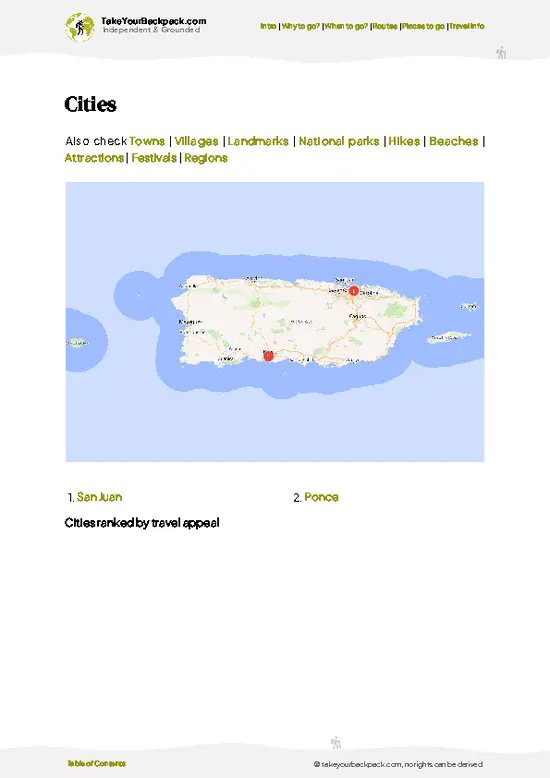
1 San Juan

Fortress ramparts, cobbled Old San Juan, Santurce nightlife, La Perla murals

Walk the sea-facing forts and cobbled lanes by day, then head to Santurce’s market square for late salsa and food among locals.

2 Ponce

Firehouse facade, plaza ceiba, Taíno ceremonial site, south-coast boardwalk

Wander a calmer southern city where a red-and-black firehouse, a serious art museum, and a waterfront boardwalk fill slow days with local company.

Loading the map 🌍

Expert viewPro Tips for Exploring the Best

How many cities to visit: I advise three to four cities on a one-to-two-week trip. Each one needs at least two nights to feel like more than a transit stop, and the roads are slow enough that a fifth stop eats your days in the car.
Choosing by travel style: If you want nightlife, hostels and easy logistics, start with the capital metro area. If you want surf, laid-back streets and cheaper food, favor the west coast. If you like culture and plaza life, the south and central towns suit you, but you need a car. Pick one big city and two smaller ones for balance.
Daily costs: Budget US$70 to 110 a day for a backpacker who uses hostels or simple guesthouses (US$30 to 60 a night for a dorm or basic room), eats at local kitchens and cooks occasionally. A plate of rice, beans and meat at a local spot … read more 👉
How many cities to visit: I advise three to four cities on a one-to-two-week trip. Each one needs at least two nights to feel like more than a transit stop, and the roads are slow enough that a fifth stop eats your days in the car.
Choosing by travel style: If you want nightlife, hostels and easy logistics, start with the capital metro area. If you want surf, laid-back streets and cheaper food, favor the west coast. If you like culture and plaza life, the south and central towns suit you, but you need a car. Pick one big city and two smaller ones for balance.
Daily costs: Budget US$70 to 110 a day for a backpacker who uses hostels or simple guesthouses (US$30 to 60 a night for a dorm or basic room), eats at local kitchens and cooks occasionally. A plate of rice, beans and meat at a local spot is US$8 to 14, and a beer is US$4 to 7. Midrange travelers should expect US$150 to 220.
Visit costs: A rental car runs US$40 to 80 a day plus fuel and insurance, which is the biggest line item. Parking in old towns costs US$5 to 20 a day. Fort and museum entry is typically US$5 to 10, and guided walking tours are US$15 to 30. Highway tolls add up, so carry a toll tag from the rental agency.
Safety: Most visitor areas are comfortable, but petty theft from parked cars is the main issue. Never leave bags visible, and use paid lots at night. Avoid unlit streets and quiet neighborhoods after dark, and use ride-hailing instead of walking long distances. Drivers can be aggressive, and roads have potholes.
Cultural notes: Greet people with a “buenos días” or “buenas tardes” when entering shops, since skipping it comes across as rude. Learn basic Spanish, because it earns warmth. Tipping 15 to 20 percent is standard in restaurants. Weekends are social, with families filling plazas, and Sundays can mean closed shops. Carry some cash for small kiosks, and keep a power bank, since outages happen.

✈️ The backpacker research shortcutPuerto Rico Travel Guide

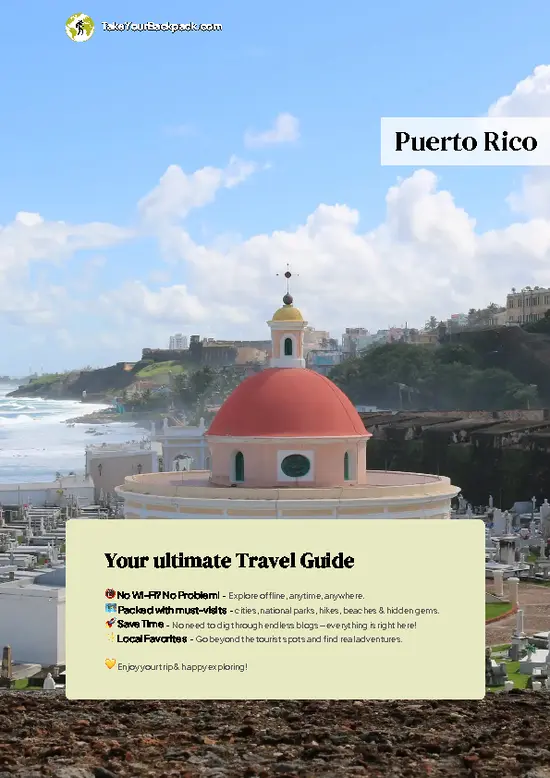
An offline-friendly backpacking guide with optimized travel routes, ranked highlights, transport advice, and the best areas to stay.
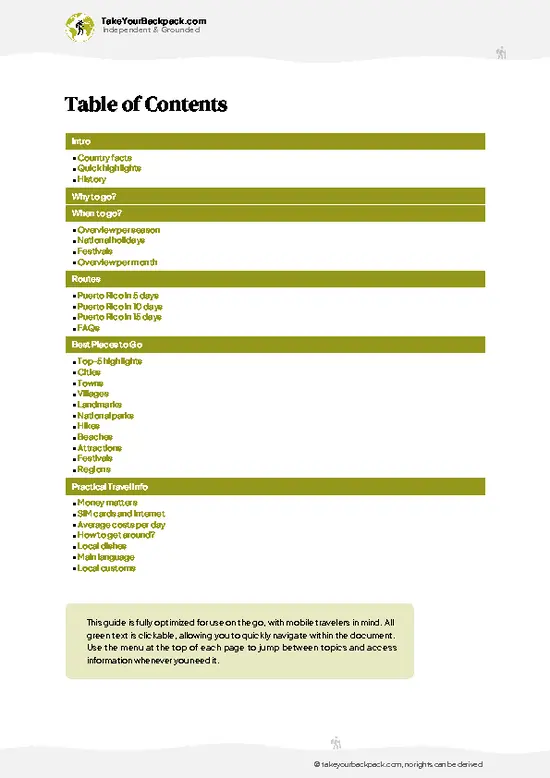
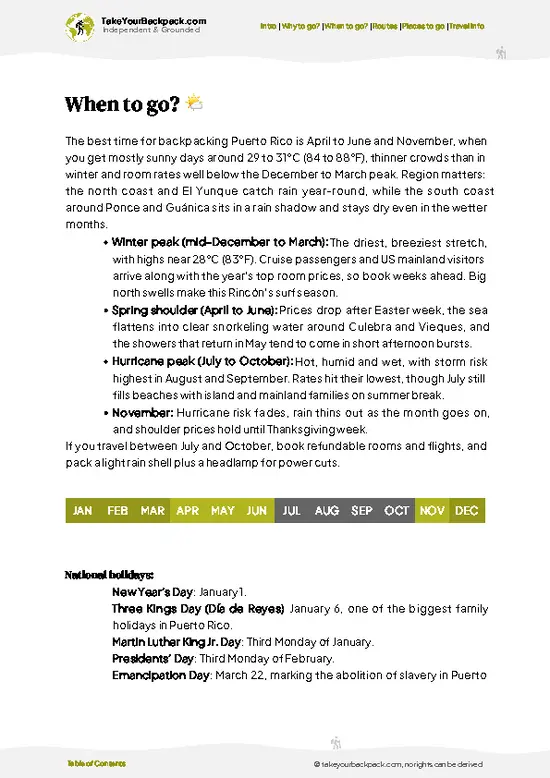
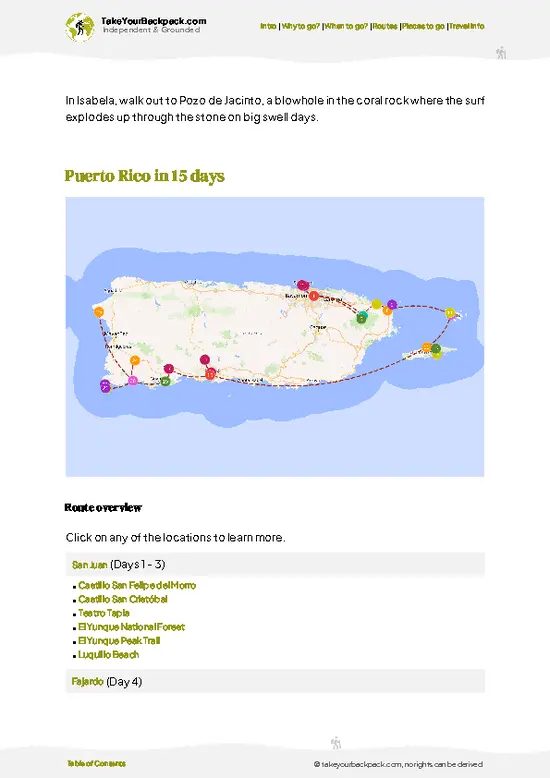
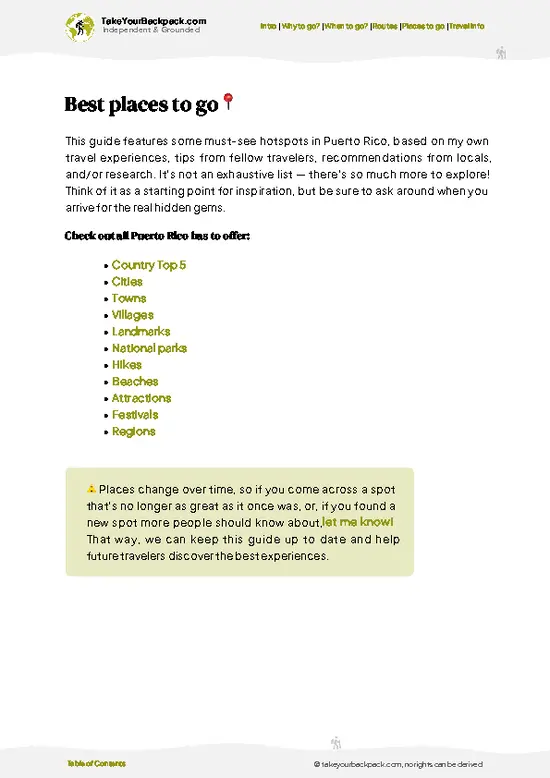
example page 0 from our offline Travel Guide for Puerto Rico
example page 1 from our offline Travel Guide for Puerto Rico
example page 2 from our offline Travel Guide for Puerto Rico
example page 3 from our offline Travel Guide for Puerto Rico
example page 4 from our offline Travel Guide for Puerto Rico
example page 5 from our offline Travel Guide for Puerto Rico
example page 6 from our offline Travel Guide for Puerto Rico
example page 7 from our offline Travel Guide for Puerto Rico
The digital guide (310 pages) contains:
✅ 81 highlights, ranked by travel appeal
✅ Optimized 5, 10 & 15-day travel routes
✅ Cities, national parks, landmarks, beaches
✅ How to get around
✅ Offline-friendly for travel without Wi-Fi
👉 Click to see all 30+ guide features

📅 Plan smarter in minutes, not weeks
✅ Month by month travel advice
✅ Festivals & national holidays
✅ Budget expectations

🗺️ Go to the right places, skip the overrated ones
✅ Honest pros & cons of destinations
✅ Top hikes, parks & viewpoints
✅ Lesser-known places most travelers miss
✅ Clear “worth it vs skip it” guidance

🛏️ Travel smoothly without rookie mistakes
✅ Best areas to stay
✅ Transport systems explained simply
✅ Common scams & safety advice
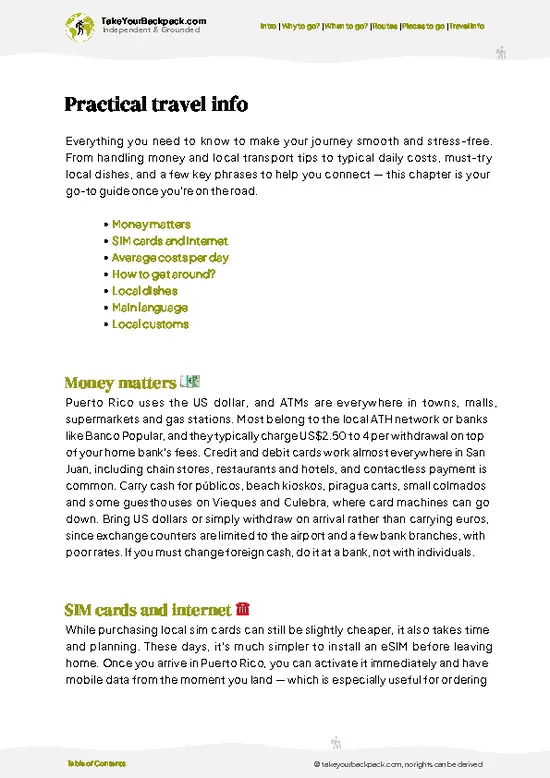
✅ SIM cards, money & practical tips

🌍 Understand the country, not just visit it
✅ Culture & traditions
✅ 52 Essential phrases & customs
✅ Festivals worth planning around
✅ Traveler-friendly historical context
✅ Insights that make places more meaningful

📱 Built for real travel conditions
✅ Fully downloadable PDF
✅ Works completely offline
✅ Optimized for phone use
✅ Useful in remote areas & buses
✅ Everything in one place
Stop searching, start planning
Get instant access to your full guide. 30‑day money-back guarantee.
+ Add another guide for just

By proceeding you agree to our terms.
Sent to your inbox immediately after payment • 100% Secure Checkout
Best Backpacking Travel Advisor 2025 tourism awardBest Backpacking
Travel Advisor
2025
What others say about Take Your Backpack Guides:
⭐⭐⭐⭐⭐
Fantastic, amazing amount of information!
⭐⭐⭐⭐⭐
My goodness this is amazing, it's what I've been looking for hats off too you!
⭐⭐⭐⭐⭐
I think this is absolutely BRILLIANT
⭐⭐⭐⭐
Very complete and informative. It's still missing places, but I gotta to commend you
⭐⭐⭐⭐⭐
This is truly amazing, thank you, can't wait to explore it with my kids!
⭐⭐⭐⭐⭐
Awesome resource, thank you!
⭐⭐⭐⭐⭐
This is amazing! Can't wait to explore the ones I haven't seen
⭐⭐⭐⭐
I love this! Well done, great idea.
⭐⭐⭐⭐⭐
Thanks for taking the time to make this gem!
⭐⭐⭐⭐⭐
This might be the best website I've ever seen.
⭐⭐⭐⭐⭐
Congratulations, and thank you so much for your work; it's incredibly valuable.
⭐⭐⭐⭐
In all seriousness I think you did a great job pointing out the important spots
⭐⭐⭐⭐⭐
10/10 very good
⭐⭐⭐⭐⭐
As someone who's only just starting to visit regularly this is awesome, thank you.
⭐⭐⭐⭐
Thank you very much! I'm going to visit my dad, it's going to be very useful!
⭐⭐⭐⭐⭐
This is really cool! We'll be travelling for the first time and this definitely come in handy.
⭐⭐⭐⭐⭐
You are now our minister of culture, congratulations 👨‍💼
⭐⭐⭐⭐⭐
Just wanted to tell you that this is a pearl! Going to follow your recommendations.
⭐⭐⭐⭐⭐
This is so cool. I'll definitely be using the resource for my travels soon.
⭐⭐⭐⭐⭐
This is very impressive! Good work.
⭐⭐⭐⭐⭐
This is an amazing and informative site. Very well done!

🛏️ Where to stay?Where to Stay in Puerto Rico

Puerto Rico has a small but solid hostel scene, with dorm beds usually running US$30 to 50 a night and private rooms in guesthouses or short-term rentals from about US$80, which is pricier than most of the Caribbean backpacker circuit. In San Juan, Old San Juan puts you within walking distance of the forts and the bar streets but gets loud on weekend nights, Santurce is the pick for nightlife around the La Placita market area and for murals and cheaper food, while Condado and Ocean Park trade some of that buzz for beach access and quieter, generally safe streets (Isla Verde works mainly for a late arrival or early flight). Outside the capital, surf town Rincón on the west coast and the islands … read more 👉
Puerto Rico has a small but solid hostel scene, with dorm beds usually running US$30 to 50 a night and private rooms in guesthouses or short-term rentals from about US$80, which is pricier than most of the Caribbean backpacker circuit. In San Juan, Old San Juan puts you within walking distance of the forts and the bar streets but gets loud on weekend nights, Santurce is the pick for nightlife around the La Placita market area and for murals and cheaper food, while Condado and Ocean Park trade some of that buzz for beach access and quieter, generally safe streets (Isla Verde works mainly for a late arrival or early flight). Outside the capital, surf town Rincón on the west coast and the islands of Vieques and Culebra have guesthouses and a few hostels that fill up fast on weekends and holidays, so book ahead there.

If you enjoy meeting fellow travelers, consider choosing hostels with high ratings for atmosphere. On the other hand, if you prefer having your own space, a hotel might be a better option.

Puerto RicoMore of Puerto Rico

👋 Meet the founderWho’s Behind Take Your Backpack?

Johan, backpacker and founder of TakeYourBackpackHi, I’m Johan (Netherlands 🇳🇱), the creator of TakeYourBackpack. Over the past 3 decades, I’ve backpacked through 90+ countries across six continents, gaining extensive experience with independent travel, long-term trips, and overland routes.

This site is built on a combination of firsthand travel experience and carefully curated insights from other backpackers. Many guides are based on places I’ve personally visited, while others bring together tips, observations, and practical advice shared by trusted travelers I’ve met along the way.

The goal is to provide realistic, experience-driven guidance — not generic itineraries — so you can explore destinations with better context, clearer expectations, and more confidence.