×

Republic of the Congo🇨🇬 | best festivalsThe 3 Top festivals in Congo

Congo (the Republic of the Congo, also known as Congo-Brazzaville) does not run on ticketed festival grounds. Its festivals are music, dance and masquerade gatherings that spill into streets, courtyards and riverbanks, with rumba guitars, drum ensembles and raffia costumes under hot, humid air. In Brazzaville and Pointe-Noire, expect amplified sound, grilled fish and cold Ngok or Primus beer, plus real crowds. In the northern forests and Plateaux, events are smaller, harder to reach and tied to villages. Backpackers and independent travelers should plan for patchy information, cash-only costs and long road days, but the access is intimate.

By Johan Kruseman 🇳🇱 | Updated October 23, 2026
Explore the best regions in Congo

Why go?Why These festival Stand Out

Congo suits festivals because music is public life here. Brazzaville and Kinshasa face each other across the Congo River, and the rumba that grew from that shared bank still fills bars, funerals and street parties with bright guitar lines and sapeur-sharp tailoring. Beyond the cities, Bantu, Teke, Kongo and forest peoples keep dance, drumming and mask traditions that shape community gatherings, so the atmosphere is local first and visitor second.

That is also the hard part. Infrastructure is thin: dates are often announced late, shift, or travel by word of mouth and social media, and there is little tourist machinery to buy tickets from. Roads outside the Brazzaville to Pointe-Noire corridor can turn to red mud in the rains, and the north is mostly reached by river, flight or long 4x4 days. … read more 👉
Congo suits festivals because music is public life here. Brazzaville and Kinshasa face each other across the Congo River, and the rumba that grew from that shared bank still fills bars, funerals and street parties with bright guitar lines and sapeur-sharp tailoring. Beyond the cities, Bantu, Teke, Kongo and forest peoples keep dance, drumming and mask traditions that shape community gatherings, so the atmosphere is local first and visitor second.

That is also the hard part. Infrastructure is thin: dates are often announced late, shift, or travel by word of mouth and social media, and there is little tourist machinery to buy tickets from. Roads outside the Brazzaville to Pointe-Noire corridor can turn to red mud in the rains, and the north is mostly reached by river, flight or long 4x4 days. Heat and humidity hover around 25 to 32°C, so dust, sweat and diesel smoke are part of the night.

Before choosing Congo for festivals, expect flexibility over fixed schedules, carry cash in Central African francs (CFA), arrange a visa in advance, and ask a local host or cultural center to confirm what is actually happening. Photography often needs permission.
Evaluating the Top Choices
The list of best festivals in Congo is created based on energy, traditions, crowd experience, activities, and overall excitement. If you feel a festival is missing in this list, please let us know.

When to go?Optimal Periods for Travel

Best months for festivals: The dry season from June to September is the best window, because rain drops sharply, roads are passable and outdoor stages and street processions run with little disruption. Days in Brazzaville reach roughly 27 to 31°C with a hazy, pale sky, while nights cool to about 18 to 21°C. Pointe-Noire is cooler on the coast thanks to the Benguela current, with mornings of gray cloud and breezy evenings.

Shoulder seasons and rain: The short dry spell in January and February is a workable second option, with brighter days and fewer downpours, though humidity stays heavy. March to May and October to December are the wet months, with rainfall commonly 100 to 250 mm a month in the south, sudden afternoon storms and slick laterite tracks. Events can still happen, but outdoor … read more 👉
Best months for festivals: The dry season from June to September is the best window, because rain drops sharply, roads are passable and outdoor stages and street processions run with little disruption. Days in Brazzaville reach roughly 27 to 31°C with a hazy, pale sky, while nights cool to about 18 to 21°C. Pointe-Noire is cooler on the coast thanks to the Benguela current, with mornings of gray cloud and breezy evenings.

Shoulder seasons and rain: The short dry spell in January and February is a workable second option, with brighter days and fewer downpours, though humidity stays heavy. March to May and October to December are the wet months, with rainfall commonly 100 to 250 mm a month in the south, sudden afternoon storms and slick laterite tracks. Events can still happen, but outdoor schedules slip and transport takes much longer.

North and crowds: In the northern forest zones around Impfondo and Ouesso, rain is more spread across the year, so even the best months bring damp air and mud. Rivers run higher late in the year, which affects boat access. Crowds are largest around national holidays and weekends in the cities. Prices for rooms and domestic flights rise around these dates, often by 10 to 30 percent, so book earlier.

festival hoppingOptimizing Your Multi-Stop Itinerary

How long to allow: A trip linking several festivals in Congo needs 10 to 18 days, because transfers eat time and dates are rarely rigid. The most sensible grouping is the southern corridor: Brazzaville, the Pool and Bouenza areas, and Pointe-Noire on the Atlantic coast. The north, around Impfondo or Ouesso, works as a separate add-on.

Direction and timing: Start in Brazzaville for flights, visas, cultural contacts and the latest event news. Then move south toward Pointe-Noire, which is about 500 km away. The train has been unreliable, so many travelers use the paved RN1 by bus or shared car (roughly 8 to 12 hours) or fly in about an hour. Finish on the coast, where sea air and cooler evenings are a relief after dust. Allow 2 to 4 days per stop, which gives buffer for delays, permissions and … read more 👉
How long to allow: A trip linking several festivals in Congo needs 10 to 18 days, because transfers eat time and dates are rarely rigid. The most sensible grouping is the southern corridor: Brazzaville, the Pool and Bouenza areas, and Pointe-Noire on the Atlantic coast. The north, around Impfondo or Ouesso, works as a separate add-on.

Direction and timing: Start in Brazzaville for flights, visas, cultural contacts and the latest event news. Then move south toward Pointe-Noire, which is about 500 km away. The train has been unreliable, so many travelers use the paved RN1 by bus or shared car (roughly 8 to 12 hours) or fly in about an hour. Finish on the coast, where sea air and cooler evenings are a relief after dust. Allow 2 to 4 days per stop, which gives buffer for delays, permissions and rest. Northern legs by domestic flight or river can take 1 to 3 days each way.

Planning mistakes: The most common error is stacking events on consecutive days, which fails once a bus leaves at 4 a.m. or rain closes a track. Leave one spare day between regions. Another mistake is booking transport before dates are confirmed. Hold flexible tickets, confirm with local hosts, and keep CFA cash for fuel, drivers and fees.

The ListTop festivals of Congo

1 FESPAM (Pan-African Music Festival)

Rumba and soukous nights, Pan-African lineups, Poto-Poto galleries, sapeurs of Bacongo

Follow a week of concerts that moves from Congolese rumba to Malian kora and Afrobeat, then cool off along the Congo River corniche.

2 Mantsina sur Scène

Neighborhood stage, theater and dance, oral storytelling, plastic-chair crowds

Sit among local families for plays, drum-led dance and spoken tales, with grilled fish from stalls beside the crowd between acts.

3 Feux de Brazza

Rumba and hip-hop stages, Poto-Poto bars, painting school, riverside rapids

Catch Congolese rumba, hip-hop and Afro-pop at night, then browse flat-color canvases in the Poto-Poto painting school by day.

Loading the map 🌍

Expert viewWhat You Should Know

How many to attend: Plan on two or three festivals in one trip. Dates move, transport is slow, and each gathering deserves a full day of arriving, waiting, dancing and recovering. More than that turns the trip into a stack of bus rides, with dust in your teeth and little memory of the drums. Two lets you absorb the evening sound, the smell of charcoal and fried plantain, and the loose friendliness that comes only when you stay put.

Which kind suits you: Choose city music events in Brazzaville or Pointe-Noire if you want easier logistics, hotels, taxis and a lively rumba crowd. They suit first-timers and short trips. Choose village or masquerade gatherings if you have time, a local contact and patience. They offer closeness to costume, drumming and ritual, but access is harder and you are … read more 👉
How many to attend: Plan on two or three festivals in one trip. Dates move, transport is slow, and each gathering deserves a full day of arriving, waiting, dancing and recovering. More than that turns the trip into a stack of bus rides, with dust in your teeth and little memory of the drums. Two lets you absorb the evening sound, the smell of charcoal and fried plantain, and the loose friendliness that comes only when you stay put.

Which kind suits you: Choose city music events in Brazzaville or Pointe-Noire if you want easier logistics, hotels, taxis and a lively rumba crowd. They suit first-timers and short trips. Choose village or masquerade gatherings if you have time, a local contact and patience. They offer closeness to costume, drumming and ritual, but access is harder and you are a guest, not an audience. Mixing one of each gives the broadest picture.

What it costs: Budget US$45 to 90 a day in the south, covering a simple room (US$25 to 60), meals (US$5 to 15), and local taxis. Congo is not a cheap backpacking country. Entry to city events is often free or around US$3 to 15, while community events may ask for a small contribution. A local guide or fixer costs roughly US$30 to 70 a day, and a hired car with driver US$100 to 180. Budget US$60 to 150 extra for each remote visit once you add transport and fees. Carry CFA cash in small notes, since cards are rare outside upmarket hotels.

Safety and etiquette: Crowded nights bring pickpocketing, so carry a phone and a small cash stash in front pockets, and leave your passport copy handy but the original locked up. Take licensed taxis after dark and agree the fare first. Police checkpoints are common, so keep a copy of your visa and passport. Ask before photographing dancers, masks, elders or ritual objects, and expect a fee or a firm no. Dress modestly, greet people before asking questions, and follow a host’s lead on when to watch quietly. Avoid political gatherings and military sites. Drink only bottled or treated water, bring repellent, and use a yellow fever certificate as required. Do all that and you get the best seat available, close to the drums with locals pulling you into the circle.

✈️ The backpacker research shortcutCongo Travel Guide

An offline-friendly backpacking guide with optimized travel routes, ranked highlights, transport advice, and the best areas to stay.
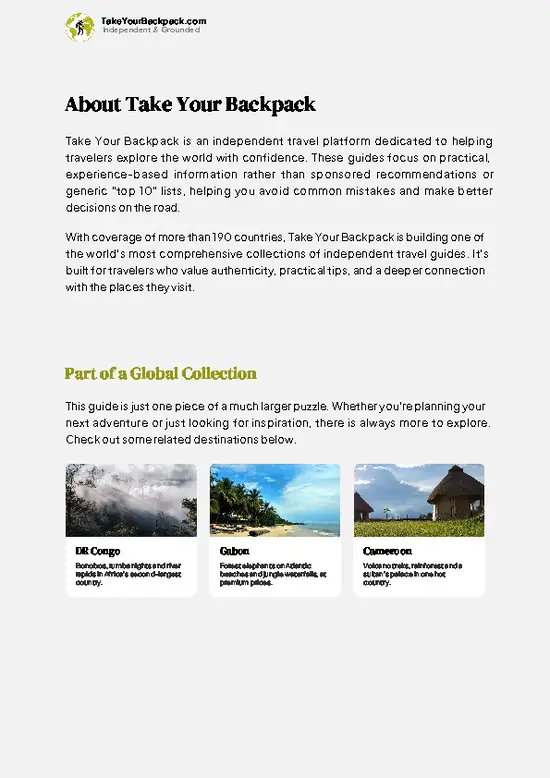
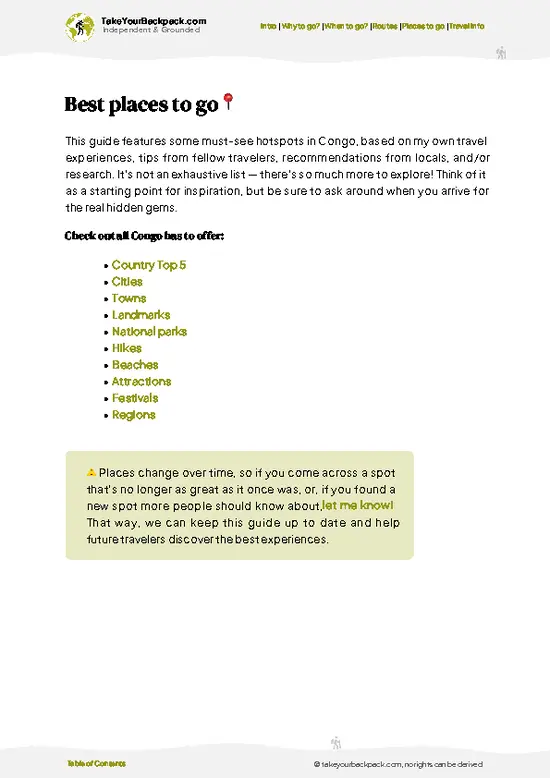
example page 0 from our offline Travel Guide for Republic of the Congo
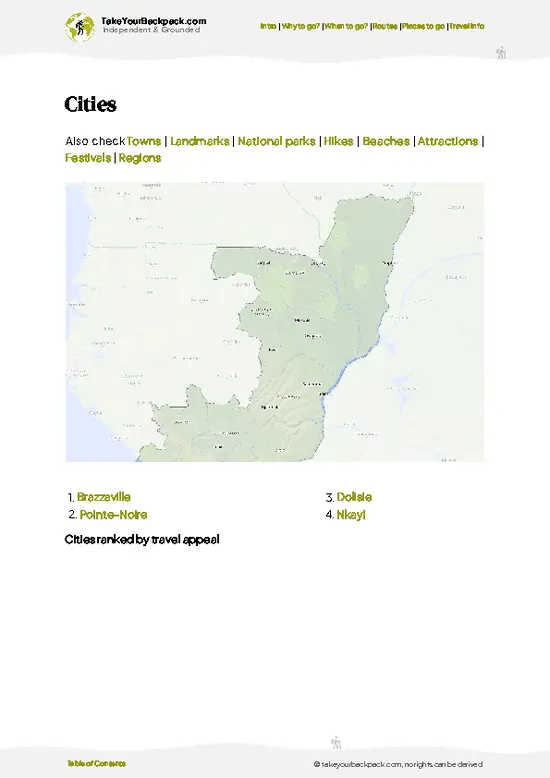
example page 1 from our offline Travel Guide for Republic of the Congo
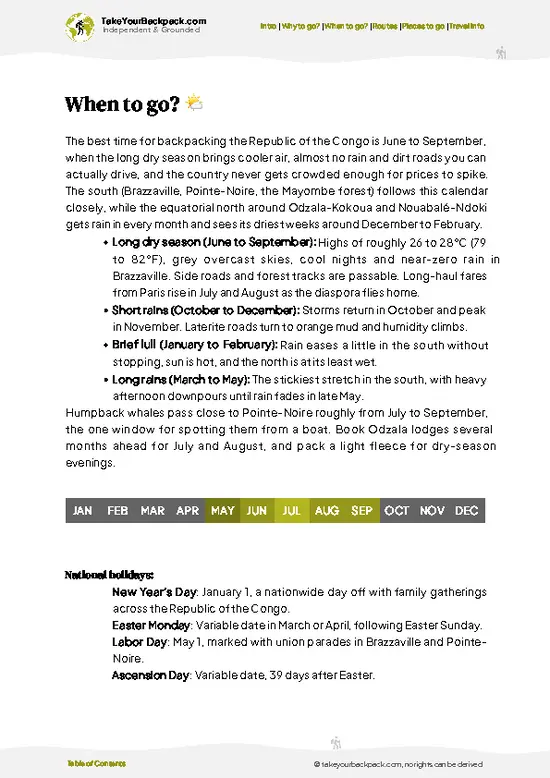
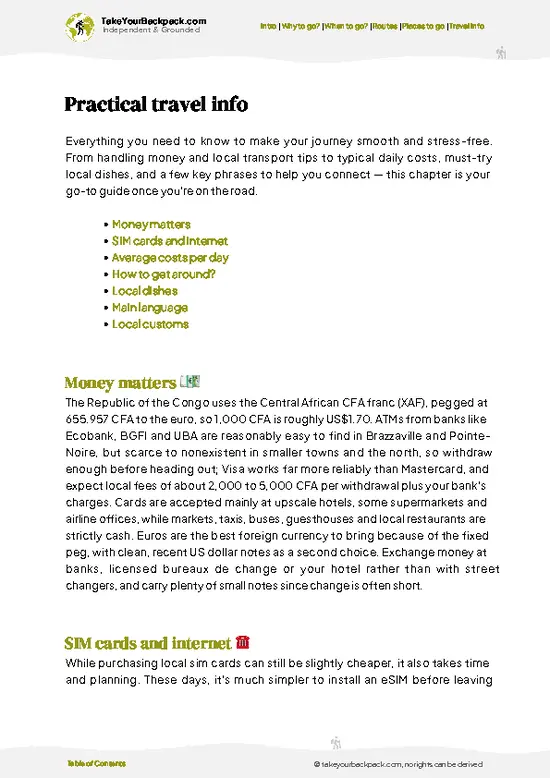
example page 2 from our offline Travel Guide for Republic of the Congo
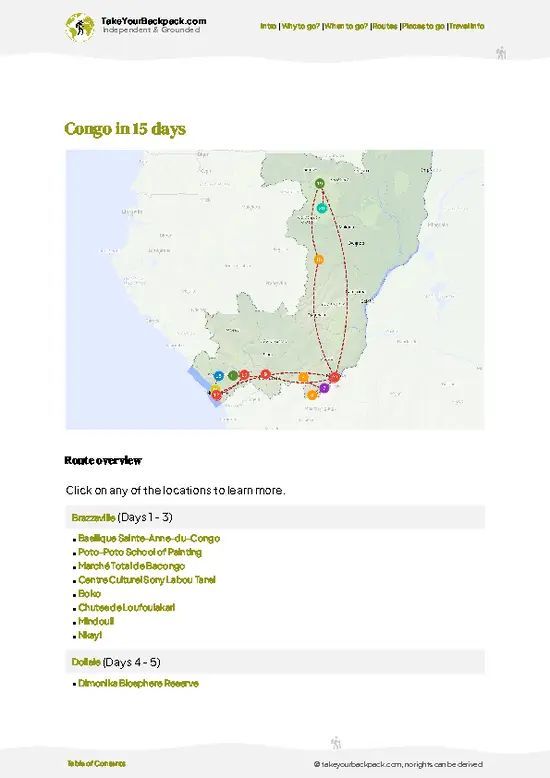
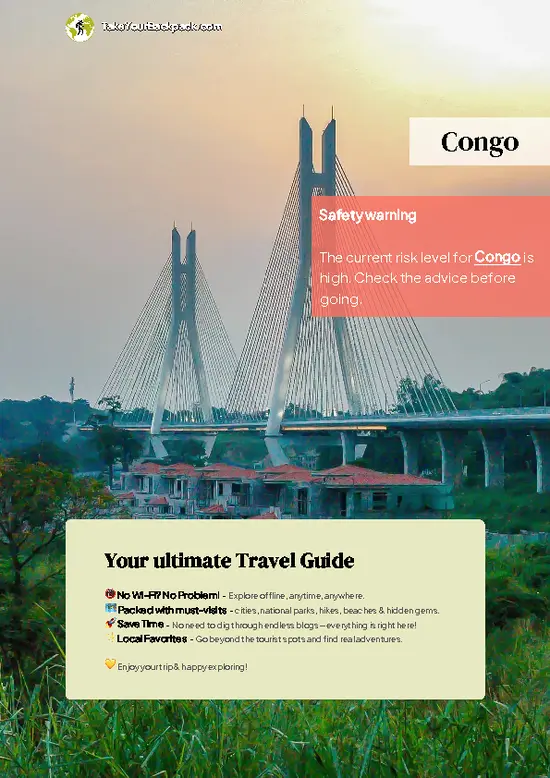
example page 3 from our offline Travel Guide for Republic of the Congo
example page 4 from our offline Travel Guide for Republic of the Congo
example page 5 from our offline Travel Guide for Republic of the Congo
example page 6 from our offline Travel Guide for Republic of the Congo
example page 7 from our offline Travel Guide for Republic of the Congo
The digital guide (205 pages) contains:
✅ 46 highlights, ranked by travel appeal
✅ Optimized 5, 10 & 15-day travel routes
✅ Cities, national parks, landmarks, beaches
✅ How to get around
✅ Offline-friendly for travel without Wi-Fi
👉 Click to see all 30+ guide features

📅 Plan smarter in minutes, not weeks
✅ Month by month travel advice
✅ Festivals & national holidays
✅ Budget expectations

🗺️ Go to the right places, skip the overrated ones
✅ Honest pros & cons of destinations
✅ Top hikes, parks & viewpoints
✅ Lesser-known places most travelers miss
✅ Clear “worth it vs skip it” guidance

🛏️ Travel smoothly without rookie mistakes
✅ Best areas to stay
✅ Transport systems explained simply
✅ Common scams & safety advice
✅ SIM cards, money & practical tips

🌍 Understand the country, not just visit it
✅ Culture & traditions
✅ 52 Essential phrases & customs
✅ Festivals worth planning around
✅ Traveler-friendly historical context
✅ Insights that make places more meaningful

📱 Built for real travel conditions
✅ Fully downloadable PDF
✅ Works completely offline
✅ Optimized for phone use
✅ Useful in remote areas & buses
✅ Everything in one place
Stop searching, start planning
Get instant access to your full guide. 30‑day money-back guarantee.
+ Add another guide for just

By proceeding you agree to our terms.
Sent to your inbox immediately after payment • 100% Secure Checkout
Best Backpacking Travel Advisor 2025 tourism awardBest Backpacking
Travel Advisor
2025
What others say about Take Your Backpack Guides:
⭐⭐⭐⭐⭐
Fantastic, amazing amount of information!
⭐⭐⭐⭐⭐
My goodness this is amazing, it's what I've been looking for hats off too you!
⭐⭐⭐⭐⭐
I think this is absolutely BRILLIANT
⭐⭐⭐⭐
Very complete and informative. It's still missing places, but I gotta to commend you
⭐⭐⭐⭐⭐
This is truly amazing, thank you, can't wait to explore it with my kids!
⭐⭐⭐⭐⭐
Awesome resource, thank you!
⭐⭐⭐⭐⭐
This is amazing! Can't wait to explore the ones I haven't seen
⭐⭐⭐⭐
I love this! Well done, great idea.
⭐⭐⭐⭐⭐
Thanks for taking the time to make this gem!
⭐⭐⭐⭐⭐
This might be the best website I've ever seen.
⭐⭐⭐⭐⭐
Congratulations, and thank you so much for your work; it's incredibly valuable.
⭐⭐⭐⭐
In all seriousness I think you did a great job pointing out the important spots
⭐⭐⭐⭐⭐
10/10 very good
⭐⭐⭐⭐⭐
As someone who's only just starting to visit regularly this is awesome, thank you.
⭐⭐⭐⭐
Thank you very much! I'm going to visit my dad, it's going to be very useful!
⭐⭐⭐⭐⭐
This is really cool! We'll be travelling for the first time and this definitely come in handy.
⭐⭐⭐⭐⭐
You are now our minister of culture, congratulations 👨‍💼
⭐⭐⭐⭐⭐
Just wanted to tell you that this is a pearl! Going to follow your recommendations.
⭐⭐⭐⭐⭐
This is so cool. I'll definitely be using the resource for my travels soon.
⭐⭐⭐⭐⭐
This is very impressive! Good work.
⭐⭐⭐⭐⭐
This is an amazing and informative site. Very well done!

🛏️ Where to stay?Where to Base Yourself

Backpacking the Republic of the Congo means guesthouses (“auberges”) and simple hotels rather than dorm hostels, with fan or air-con rooms typically running 15,000 to 30,000 XAF (US$25 to 50) a night. In Brazzaville, Poto-Poto has the most cheap options and puts you near markets, street food and live-music bars, at the cost of noise and pickpocket risk after dark. Centre-ville and Plateau are calmer and feel safer for walking but cost more, while Bacongo has good nightlife and cheaper rooms but quieter, poorly lit streets late at night; in Pointe-Noire, the Centre-ville near the beach and the Côte Sauvage is easiest, with cheaper rooms in Tié-Tié further from the sea.

If you enjoy meeting fellow … read more 👉
Backpacking the Republic of the Congo means guesthouses (“auberges”) and simple hotels rather than dorm hostels, with fan or air-con rooms typically running 15,000 to 30,000 XAF (US$25 to 50) a night. In Brazzaville, Poto-Poto has the most cheap options and puts you near markets, street food and live-music bars, at the cost of noise and pickpocket risk after dark. Centre-ville and Plateau are calmer and feel safer for walking but cost more, while Bacongo has good nightlife and cheaper rooms but quieter, poorly lit streets late at night; in Pointe-Noire, the Centre-ville near the beach and the Côte Sauvage is easiest, with cheaper rooms in Tié-Tié further from the sea.

If you enjoy meeting fellow travelers, consider choosing hostels with high ratings for atmosphere. On the other hand, if you prefer having your own space, a hotel might be a better option.

CongoExpand Your Journey

👋 Meet the founderWho’s Behind Take Your Backpack?

Johan, backpacker and founder of TakeYourBackpackHi, I’m Johan (Netherlands 🇳🇱), the creator of TakeYourBackpack. Over the past 3 decades, I’ve backpacked through 90+ countries across six continents, gaining extensive experience with independent travel, long-term trips, and overland routes.

This site is built on a combination of firsthand travel experience and carefully curated insights from other backpackers. Many guides are based on places I’ve personally visited, while others bring together tips, observations, and practical advice shared by trusted travelers I’ve met along the way.

The goal is to provide realistic, experience-driven guidance — not generic itineraries — so you can explore destinations with better context, clearer expectations, and more confidence.