×

Republic of the Congo🇨🇬 | best attractionsThe 9 Top attractions in Congo

Attractions in Congo (the Republic of the Congo, also known as Congo-Brazzaville) come in two registers: rainforest and wildlife in the north, river, coast and city life in the south. Up north, you get steamy air, insect hum, mud-red tracks and few other visitors, but access is slow and expensive. Down south, Brazzaville’s riverfront, Pointe-Noire’s Atlantic surf and the rail-linked savanna are easier and cheaper, with market smoke, grilled fish and live rumba drifting from open-air bars. Independent travel is possible, yet permits, flights and 4x4 transfers shape every choice. Expect almost no crowds anywhere, and plan your budget around distance, not entry fees.

By Johan Kruseman 🇳🇱 | Updated October 23, 2026
Explore the best festivals in Congo

Why go?Why These attraction Stand Out

Congo’s appeal comes from geography first. The country straddles the equator, with the Congo River forming its eastern edge and dense lowland forest covering much of the north. Large stretches remain thinly populated, so national parks here feel like working forest: damp air, green dusk light by 5:30 p.m., frogs and hornbills loud at dawn. Few countries let you stand in primary forest with so little foot traffic.

The cultural layer is just as distinct. Brazzaville and Kinshasa face each other across the river, and the city’s music scene, painted bars and sapeur dandies in sharp suits give urban Congo a swagger you won’t find in quieter neighbors. Colonial French history sits in crumbling cathedrals and old railway stations, not in curated museums.

Know the limits before you commit. Infrastructure … read more 👉
Congo’s appeal comes from geography first. The country straddles the equator, with the Congo River forming its eastern edge and dense lowland forest covering much of the north. Large stretches remain thinly populated, so national parks here feel like working forest: damp air, green dusk light by 5:30 p.m., frogs and hornbills loud at dawn. Few countries let you stand in primary forest with so little foot traffic.

The cultural layer is just as distinct. Brazzaville and Kinshasa face each other across the river, and the city’s music scene, painted bars and sapeur dandies in sharp suits give urban Congo a swagger you won’t find in quieter neighbors. Colonial French history sits in crumbling cathedrals and old railway stations, not in curated museums.

Know the limits before you commit. Infrastructure is thin: roads outside the Brazzaville to Pointe-Noire corridor turn to red mud in the rains, tourism facilities are basic, and many remote sites need advance arrangements with an operator. Prices run higher than in neighboring countries because everything is flown or trucked in. A yellow fever certificate and a visa are required, and French is the working language. Come for raw, uncrowded nature, not for polish.
Behind the Scenes of Selection
The list of best attractions in Congo is created based on cultural significance or entertainment value. If you feel a attraction is missing in this list, please let us know.

When to go?Optimal Periods for Travel

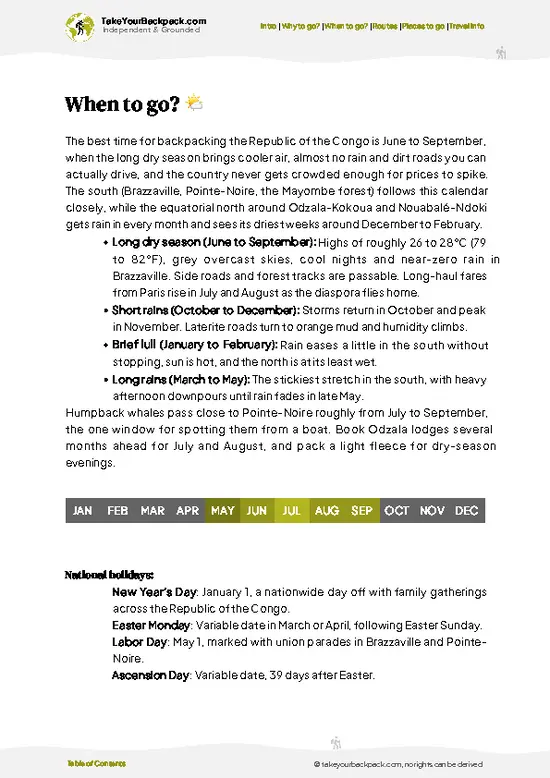
Best months: The best months are June to August, the long dry season, when rainfall drops to near zero in most regions and forest tracks are firmest. Skies are often overcast and hazy rather than sunny, with temperatures around 22 to 28°C in the south and 24 to 31°C in the north.
Shoulder seasons: The short dry spell from December to February works too, with lighter showers and brighter light, though northern forest trails can still be muddy. March to May and September to November are the wettest stretches, with rain often exceeding 150 to 250 mm a month in the north and downpours turning laterite roads into slick red sludge. Air is thick, humidity sits above 80 percent, and some forest camps and river crossings become hard to reach.
Regional differences: The Pointe-Noire coast is cooler and … read more 👉
Best months: The best months are June to August, the long dry season, when rainfall drops to near zero in most regions and forest tracks are firmest. Skies are often overcast and hazy rather than sunny, with temperatures around 22 to 28°C in the south and 24 to 31°C in the north.
Shoulder seasons: The short dry spell from December to February works too, with lighter showers and brighter light, though northern forest trails can still be muddy. March to May and September to November are the wettest stretches, with rain often exceeding 150 to 250 mm a month in the north and downpours turning laterite roads into slick red sludge. Air is thick, humidity sits above 80 percent, and some forest camps and river crossings become hard to reach.
Regional differences: The Pointe-Noire coast is cooler and drier in July and August, when the Benguela current brings gray mornings and sea temperatures drop. Brazzaville stays warm year round, with evening thunderstorms in the rainy months. In the northern Sangha and Likouala areas, rain is spread over more of the year, so even the dry season brings sudden showers.
Crowds and prices: There is no true peak season. Flights and 4x4 hire cost the same all year, but tracks closed by rain can force expensive detours, so the dry months give better value.

attraction hoppingOptimizing Your Multi-Stop Itinerary

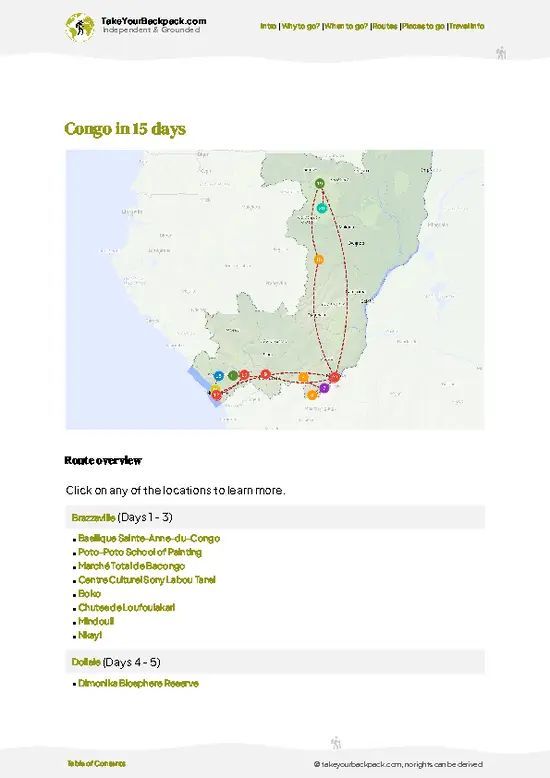
How many days: A trip combining several attractions needs 10 to 16 days, because transport, not sightseeing, eats the calendar.
Grouping regions: The south clusters naturally: Brazzaville, the rail and road corridor through the Pool and Bouenza areas, and Pointe-Noire on the coast. Start in Brazzaville, work west by train or road, and finish at the Atlantic, where sea breezes and fish grills make a calm ending. Brazzaville to Pointe-Noire is roughly 510 km by road, 8 to 12 hours depending on the state of the road and checkpoints, or about 1 hour by plane. The northern forest areas sit apart. Fly Brazzaville to Ouesso (about 2 hours), then continue by 4x4 or boat, which can take 6 to 12 hours more. Treat the north as its own trip, or fly north first and the south second.
Time per stop: Give a … read more 👉
How many days: A trip combining several attractions needs 10 to 16 days, because transport, not sightseeing, eats the calendar.
Grouping regions: The south clusters naturally: Brazzaville, the rail and road corridor through the Pool and Bouenza areas, and Pointe-Noire on the coast. Start in Brazzaville, work west by train or road, and finish at the Atlantic, where sea breezes and fish grills make a calm ending. Brazzaville to Pointe-Noire is roughly 510 km by road, 8 to 12 hours depending on the state of the road and checkpoints, or about 1 hour by plane. The northern forest areas sit apart. Fly Brazzaville to Ouesso (about 2 hours), then continue by 4x4 or boat, which can take 6 to 12 hours more. Treat the north as its own trip, or fly north first and the south second.
Time per stop: Give a city or coastal stop 2 to 3 days. Forest stops need 4 to 6 days once travel and permits are counted.
Planning mistakes: The biggest is trusting road times. Rain, trucks and police stops stretch every journey, so leave a buffer day before any flight. Another is trying to cover north and south in under two weeks, which leaves you in vehicles. Book forest transfers and permits before you arrive, and carry cash in CFA francs, since cards rarely work outside Brazzaville and Pointe-Noire.

The ListTop attractions of Congo

1 Basilique Sainte-Anne-du-Congo

Green glazed roof, bell tower, Sunday choir, Poto-Poto streets

Watch afternoon light deepen the green tiles outside, then sit in the cool nave as colored window light crosses the pews.

2 Cathédrale Sacré-Cœur de Brazzaville

Lingala hymns, parish forecourt, weekday stillness, working cathedral

Join a Sunday service where choirs fill the nave, then linger on the forecourt as families greet neighbors in the shade.

3 Cathédrale Saint-Pierre-Apôtre de Pointe-Noire

Coastal cathedral, drums and clapping, cool nave, central landmark

Step into a cool nave in the city center, then catch drumming and layered voices at Mass before heading to the market.

republic-of-the-congo-attraction-cathedrale-saint-pierre-apotre-de-pointe-noire
© Google |

4 Poto-Poto School of Painting

Open-air studio, flat-color figures, oil and turpentine, small canvases

Watch painters work in an open courtyard, talk with them about their technique, and carry home a small canvas rolled in a tube.

republic-of-the-congo-attraction-poto-poto-school-of-painting
© Google |

5 Grand Marché de Pointe-Noire

Wax-print cloth, Atlantic fish, chikwangue, remedy stalls

Wander narrow aisles of fabric, fresh catch, cassava leaves and tropical fruit, then eat grilled skewers standing among the crowd.

6 Marché Poto-Poto

Cloth lanes, treadle tailors, smoked fish, carving stalls

Bargain for wax-print cloth, have it tailored on the spot, and finish with charcoal-grilled fish before walking to the painters’ studios.

7 Marché Total de Bacongo

Dawn produce, pondu leaves, pedal-machine tailors, neighborhood trade

Arrive early to see heaped cassava, peppers and smoked fish, then have a seamstress sew your cloth into a garment.

republic-of-the-congo-attraction-marche-total-de-bacongo
© Google |

8 Institut Français du Congo

Rumba nights, film hall, mediathèque, courtyard café

Catch a rumba or soukous concert, an African film screening or an exhibition, then unwind over a cold drink in the courtyard.

9 Centre Culturel Sony Labou Tansi

Writer’s legacy, theater troupe, shaded courtyard, rehearsal hum

Trace the world of a Congolese novelist and playwright through a working cultural space where books, stage work and conversation continue.

Loading the map 🌍

Expert viewWhat You Should Know

How many to visit: I advise four to six attractions in total, split between no more than two regions. Distances are long, vehicles are pricey, and each remote stop swallows several days, so more than that means you spend the trip bouncing in a 4x4 with red dust in your teeth. Fewer, longer stays let you hear the forest wake up at 5 a.m. instead of just passing through it.
Choosing by travel style: If you want nature and wildlife, prioritize forest sites and accept the cost, since this is the reason to come. If you prefer culture and nightlife, focus on Brazzaville and Pointe-Noire, where music spills out of bars after dark and street stalls sell grilled fish, plantain and sharp pili-pili. Travelers with limited cash should lean on the south, where independent movement is cheap and you can do … read more 👉
How many to visit: I advise four to six attractions in total, split between no more than two regions. Distances are long, vehicles are pricey, and each remote stop swallows several days, so more than that means you spend the trip bouncing in a 4x4 with red dust in your teeth. Fewer, longer stays let you hear the forest wake up at 5 a.m. instead of just passing through it.
Choosing by travel style: If you want nature and wildlife, prioritize forest sites and accept the cost, since this is the reason to come. If you prefer culture and nightlife, focus on Brazzaville and Pointe-Noire, where music spills out of bars after dark and street stalls sell grilled fish, plantain and sharp pili-pili. Travelers with limited cash should lean on the south, where independent movement is cheap and you can do most things without a package.
What it costs: City travel runs about US$40 to 70 a day (about 22,000 to 40,000 CFA francs) with a basic hotel, local meals and taxis. Remote forest trips run US$150 to 300 a day with guides, vehicles, camp and permits. Park entry and conservation fees typically fall in the US$20 to 60 range per visit, guides add US$20 to 50 a day, and a charter or shared 4x4 transfer can reach US$100 to 250 a leg. Domestic flights cost roughly US$100 to 200 one way.
Safety and etiquette: Carry photocopies of your passport, visa and yellow fever card, because police and military checkpoints are frequent and officials expect paperwork. Stay polite, greet first, and keep your voice level; it saves time. Ask before photographing people, markets, bridges or government buildings, as pictures can cause trouble. Avoid walking alone at night in cities, and skip political gatherings. In forest areas, follow your guide strictly, wear long sleeves for tsetse flies and take malaria prophylaxis. Dress modestly in villages, and bring small bills for tips and informal fees, which makes each stop smoother and your day much calmer.

✈️ The backpacker research shortcutCongo Travel Guide

An offline-friendly backpacking guide with optimized travel routes, ranked highlights, transport advice, and the best areas to stay.
example page 0 from our offline Travel Guide for Republic of the Congo
example page 1 from our offline Travel Guide for Republic of the Congo
example page 2 from our offline Travel Guide for Republic of the Congo
example page 3 from our offline Travel Guide for Republic of the Congo
example page 4 from our offline Travel Guide for Republic of the Congo
example page 5 from our offline Travel Guide for Republic of the Congo
example page 6 from our offline Travel Guide for Republic of the Congo
example page 7 from our offline Travel Guide for Republic of the Congo
The digital guide (205 pages) contains:
✅ 46 highlights, ranked by travel appeal
✅ Optimized 5, 10 & 15-day travel routes
✅ Cities, national parks, landmarks, beaches
✅ How to get around
✅ Offline-friendly for travel without Wi-Fi
👉 Click to see all 30+ guide features

📅 Plan smarter in minutes, not weeks
✅ Month by month travel advice
✅ Festivals & national holidays
✅ Budget expectations

🗺️ Go to the right places, skip the overrated ones
✅ Honest pros & cons of destinations
✅ Top hikes, parks & viewpoints
✅ Lesser-known places most travelers miss
✅ Clear “worth it vs skip it” guidance

🛏️ Travel smoothly without rookie mistakes
✅ Best areas to stay
✅ Transport systems explained simply
✅ Common scams & safety advice
✅ SIM cards, money & practical tips

🌍 Understand the country, not just visit it
✅ Culture & traditions
✅ 52 Essential phrases & customs
✅ Festivals worth planning around
✅ Traveler-friendly historical context
✅ Insights that make places more meaningful

📱 Built for real travel conditions
✅ Fully downloadable PDF
✅ Works completely offline
✅ Optimized for phone use
✅ Useful in remote areas & buses
✅ Everything in one place
Stop searching, start planning
Get instant access to your full guide. 30‑day money-back guarantee.
+ Add another guide for just

By proceeding you agree to our terms.
Sent to your inbox immediately after payment • 100% Secure Checkout
Best Backpacking Travel Advisor 2025 tourism awardBest Backpacking
Travel Advisor
2025
What others say about Take Your Backpack Guides:
⭐⭐⭐⭐⭐
Fantastic, amazing amount of information!
⭐⭐⭐⭐⭐
My goodness this is amazing, it's what I've been looking for hats off too you!
⭐⭐⭐⭐⭐
I think this is absolutely BRILLIANT
⭐⭐⭐⭐
Very complete and informative. It's still missing places, but I gotta to commend you
⭐⭐⭐⭐⭐
This is truly amazing, thank you, can't wait to explore it with my kids!
⭐⭐⭐⭐⭐
Awesome resource, thank you!
⭐⭐⭐⭐⭐
This is amazing! Can't wait to explore the ones I haven't seen
⭐⭐⭐⭐
I love this! Well done, great idea.
⭐⭐⭐⭐⭐
Thanks for taking the time to make this gem!
⭐⭐⭐⭐⭐
This might be the best website I've ever seen.
⭐⭐⭐⭐⭐
Congratulations, and thank you so much for your work; it's incredibly valuable.
⭐⭐⭐⭐
In all seriousness I think you did a great job pointing out the important spots
⭐⭐⭐⭐⭐
10/10 very good
⭐⭐⭐⭐⭐
As someone who's only just starting to visit regularly this is awesome, thank you.
⭐⭐⭐⭐
Thank you very much! I'm going to visit my dad, it's going to be very useful!
⭐⭐⭐⭐⭐
This is really cool! We'll be travelling for the first time and this definitely come in handy.
⭐⭐⭐⭐⭐
You are now our minister of culture, congratulations 👨‍💼
⭐⭐⭐⭐⭐
Just wanted to tell you that this is a pearl! Going to follow your recommendations.
⭐⭐⭐⭐⭐
This is so cool. I'll definitely be using the resource for my travels soon.
⭐⭐⭐⭐⭐
This is very impressive! Good work.
⭐⭐⭐⭐⭐
This is an amazing and informative site. Very well done!

🛏️ Where to stay?Top Places to Consider Staying

Backpacking the Republic of the Congo means guesthouses (“auberges”) and simple hotels rather than dorm hostels, with fan or air-con rooms typically running 15,000 to 30,000 XAF (US$25 to 50) a night. In Brazzaville, Poto-Poto has the most cheap options and puts you near markets, street food and live-music bars, at the cost of noise and pickpocket risk after dark. Centre-ville and Plateau are calmer and feel safer for walking but cost more, while Bacongo has good nightlife and cheaper rooms but quieter, poorly lit streets late at night; in Pointe-Noire, the Centre-ville near the beach and the Côte Sauvage is easiest, with cheaper rooms in Tié-Tié further from the sea.

If you enjoy meeting fellow … read more 👉
Backpacking the Republic of the Congo means guesthouses (“auberges”) and simple hotels rather than dorm hostels, with fan or air-con rooms typically running 15,000 to 30,000 XAF (US$25 to 50) a night. In Brazzaville, Poto-Poto has the most cheap options and puts you near markets, street food and live-music bars, at the cost of noise and pickpocket risk after dark. Centre-ville and Plateau are calmer and feel safer for walking but cost more, while Bacongo has good nightlife and cheaper rooms but quieter, poorly lit streets late at night; in Pointe-Noire, the Centre-ville near the beach and the Côte Sauvage is easiest, with cheaper rooms in Tié-Tié further from the sea.

If you enjoy meeting fellow travelers, consider choosing hostels with high ratings for atmosphere. On the other hand, if you prefer having your own space, a hotel might be a better option.

CongoMore Places Across Congo

👋 Meet the founderWho’s Behind Take Your Backpack?

Johan, backpacker and founder of TakeYourBackpackHi, I’m Johan (Netherlands 🇳🇱), the creator of TakeYourBackpack. Over the past 3 decades, I’ve backpacked through 90+ countries across six continents, gaining extensive experience with independent travel, long-term trips, and overland routes.

This site is built on a combination of firsthand travel experience and carefully curated insights from other backpackers. Many guides are based on places I’ve personally visited, while others bring together tips, observations, and practical advice shared by trusted travelers I’ve met along the way.

The goal is to provide realistic, experience-driven guidance — not generic itineraries — so you can explore destinations with better context, clearer expectations, and more confidence.