×

Romania🇷🇴 | best festivalsTop-Rated 10 festivals in Romania

Romania’s festival calendar splits cleanly by landscape. In Transylvania, medieval citadels and Saxon towns host music and arts crowds, with hostels filling fast and prices rising to match. The Black Sea coast brings sand, bass and a young, loud crowd, plus sunburn and queues for the beach bar. Up in Maramureș, wooden churches, hay smoke and fiddles set a slower, village-scale mood where a bed means a family guesthouse. Independent travelers can reach most events by train or bus, but rural ones take patience. Expect mud, dust and late nights, with food stalls grilling mici over charcoal.

By Johan Kruseman 🇳🇱 | Updated October 18, 2026
Explore the best cities in Romania

Why go?Understanding Their Importance

Romania suits festivals because old rural traditions survive beside a lively modern scene. Villages in Maramureș, Bucovina and the Apuseni Mountains still keep a calendar tied to sheep, harvest and Orthodox feast days, so costumes, carved gates, brass bands and church bells are part of daily life rather than staged for visitors. Meanwhile, cities and former fortress towns have become venues for large music and film events, drawing on Habsburg-era squares, Saxon walls and communist-era concrete. The country’s varied geography lets you pass from Carpathian pine forest to Danube delta reed beds, and each zone has its own sound and smell, from plum brandy to woodsmoke.

Before choosing Romania, know that infrastructure is uneven. Trains are slow and often late, rural buses may run once or twice … read more 👉
Romania suits festivals because old rural traditions survive beside a lively modern scene. Villages in Maramureș, Bucovina and the Apuseni Mountains still keep a calendar tied to sheep, harvest and Orthodox feast days, so costumes, carved gates, brass bands and church bells are part of daily life rather than staged for visitors. Meanwhile, cities and former fortress towns have become venues for large music and film events, drawing on Habsburg-era squares, Saxon walls and communist-era concrete. The country’s varied geography lets you pass from Carpathian pine forest to Danube delta reed beds, and each zone has its own sound and smell, from plum brandy to woodsmoke.

Before choosing Romania, know that infrastructure is uneven. Trains are slow and often late, rural buses may run once or twice a day, and roads in the mountains are narrow and shared with horse carts. Big events lay on shuttles and camping, but small village gatherings may not. Card payment is common in cities and rare in villages, so carry lei in cash. Prices are lower than in Western Europe, though top music events charge international rates. Most of the action sits in warm months, while religious and winter traditions need layers and sturdy boots.
Our Approach to Ranking
The list of best festivals in Romania is created based on energy, traditions, crowd experience, activities, and overall excitement. If you feel a festival is missing in this list, please let us know.

When to go?When to Plan Your Trip

Best months: July and August are the best months for festivals in Romania, because open-air stages, camping fields and coast events all run in dry, hot weather, with daytime highs of 26 to 32°C inland and similar by the sea. Evenings cool fast in the mountains, so a fleece still matters.
Shoulder seasons: June and September are quieter, at 18 to 26°C, with fewer crowds and guesthouse rates often 15 to 30% below midsummer. Thunderstorms arrive often in late spring and can turn dirt car parks into sticky mud. May has fresh green hillsides and village celebrations tied to Orthodox Easter dates, which shift each year. October brings woodsmoke, grape harvest and cooler 8 to 16°C days, with rain more likely.
Winter and regional differences: From December to February, Maramureș and Bucovina are cold, … read more 👉
Best months: July and August are the best months for festivals in Romania, because open-air stages, camping fields and coast events all run in dry, hot weather, with daytime highs of 26 to 32°C inland and similar by the sea. Evenings cool fast in the mountains, so a fleece still matters.
Shoulder seasons: June and September are quieter, at 18 to 26°C, with fewer crowds and guesthouse rates often 15 to 30% below midsummer. Thunderstorms arrive often in late spring and can turn dirt car parks into sticky mud. May has fresh green hillsides and village celebrations tied to Orthodox Easter dates, which shift each year. October brings woodsmoke, grape harvest and cooler 8 to 16°C days, with rain more likely.
Winter and regional differences: From December to February, Maramureș and Bucovina are cold, often below 0°C and snowy, and the winter customs there are best seen with proper boots and a thick coat. Transylvania sees similar frost, while the Black Sea coast is mild but empty, with most beach events shut after September. Book beds one to three months ahead for the peak weeks of July and August, especially near Cluj-Napoca, Sibiu and Constanța. Book earlier still for any weekend that coincides with a big religious holiday, since rooms in villages are limited and trains fill.

festival hoppingSuggested Travel Strategies

How long you need: A trip linking several festivals in Romania needs 10 to 16 days, since distances are modest on a map but slow on the ground. Plan 2 to 3 days per stop for big events, so you can arrive, rest, enjoy the stage nights and recover before moving on.
Regions that group well: Transylvania makes the strongest cluster. Cluj-Napoca, Sibiu and Brașov connect by train or bus in 2.5 to 4 hours each, with Sighișoara roughly halfway between them. Bucharest works as the entry or exit point, about 2.5 to 3 hours from Brașov by train. Maramureș sits apart, 4 to 5 hours from Cluj by road, so pair it with Cluj rather than with Bucharest. The coast is 2.5 hours from Bucharest by train in summer, so it fits best at the start or end of a trip.
Direction and mistakes: A sensible loop runs Bucharest, … read more 👉
How long you need: A trip linking several festivals in Romania needs 10 to 16 days, since distances are modest on a map but slow on the ground. Plan 2 to 3 days per stop for big events, so you can arrive, rest, enjoy the stage nights and recover before moving on.
Regions that group well: Transylvania makes the strongest cluster. Cluj-Napoca, Sibiu and Brașov connect by train or bus in 2.5 to 4 hours each, with Sighișoara roughly halfway between them. Bucharest works as the entry or exit point, about 2.5 to 3 hours from Brașov by train. Maramureș sits apart, 4 to 5 hours from Cluj by road, so pair it with Cluj rather than with Bucharest. The coast is 2.5 hours from Bucharest by train in summer, so it fits best at the start or end of a trip.
Direction and mistakes: A sensible loop runs Bucharest, Transylvania, Maramureș, back through Cluj, then either onward to the coast or home. Common mistakes include cramming a mountain village and a coastal event into one weekend, trusting train timetables to the minute, and arriving without a bed. Instead, leave a spare day after each long transfer, book a room before you leave a city, and take buses or shared minibuses for small towns where trains are slow. Dusty roads, packed carriages and warm bottled water are part of it, so pack snacks.

The ListTop festivals of Romania

1 Untold

stadium stage, global DJs, marathon sets

Join massive crowds for extended dance sessions, elaborate stage designs, and headline acts in a city-center festival zone.

2 Electric Castle

castle grounds, electronic music, rain or shine

Experience live sets in a historic setting where unpredictable weather, immersive art, and diverse crowds shape every day and night.

3 Neversea

Black Sea beach, sunrise parties, electronic acts

Dance on sand through the night, with multiple stages, sea breezes, and a lineup focused on electronic and pop music.

4 George Enescu Festival

classical repertoire, international orchestras, Bucharest venues

Attend performances by renowned musicians in grand halls, with programs spanning symphonic works, chamber music, and contemporary premieres.

5 Transilvania International Film Festival

cinema screenings, Cluj-Napoca, director Q&As

Watch new films in historic theaters and outdoor spaces, with opportunities to meet filmmakers and join late-night discussions.

6 Sibiu International Theatre Festival

street performances, global troupes, citywide venues

Watch plays and dance in open squares and theaters, with a packed schedule and artists from across continents.

7 ARTmania Festival

gothic rock, Sibiu square, visual arts

Experience heavy music and art exhibitions in a medieval square, with fans gathering for concerts and creative workshops.

8 Summer Well

manor park, indie bands, art installations

Relax on lawns while catching live indie acts, exploring pop-up galleries, and sampling food trucks in a leafy estate.

9 Astra Film Festival

documentary focus, Sibiu, filmmaker panels

Engage with non-fiction cinema in a walkable city, featuring screenings, workshops, and conversations with directors.

10 Garana Jazz Festival

mountain village, open-air jazz, pine forests

Listen to jazz in a rural setting, with cool evenings, intimate stages, and a mix of international and Romanian artists.

11 Nostalgia Festival

retro visuals, themed dance floors, vintage costumes

Experience a multi-sensory party where curated music, immersive light shows, and creative dress codes recreate decades of pop culture.

12 Sighișoara Medieval Festival

fortified citadel, costumed parades, craft markets

Step into reenactments and open-air shows inside a UNESCO-listed town, surrounded by artisan stalls and medieval pageantry.

13 Plai Festival

world music, Timisoara, cultural workshops

Join concerts and hands-on activities in a city park, with a focus on global sounds, crafts, and local food stalls.

14 Bucharest International Jazz Competition

emerging talent, club venues, improvisation

Hear up-and-coming jazz musicians compete in intimate settings, with spontaneous collaborations and late-night jam sessions.

15 Iași International Film Festival

arthouse cinema, Moldavian city, open-air screenings

View independent films in historic venues and outdoor plazas, with a program highlighting regional and European filmmakers.

16 Peninsula Festival

Târgu Mureș, multi-genre lineup, camping

Camp near the river and move between stages offering rock, electronic, and local acts, with a laid-back festival atmosphere.

Think you know Romania?

Prove you’re a true local — uncover 6 lesser-known festivals in Romania that locals tend to keep to themselves.
Loading the map 🌍

Expert viewPro Tips for Exploring the Best

How many to attend: Two to four festivals is the right number for a trip of two weeks. Romanian events run late, and a big one takes a full day to recover from, with ears ringing and shoes caked in dust. Fewer stops leave room for the market stalls, pastry shops and village lanes between them, which is where you taste warm covrigi and hear a fiddle drifting over a fence.
Choosing your kind: Music lovers should pick one big open-air event in Transylvania or on the coast and treat it as the trip’s centerpiece. Culture seekers get more from village and folk events in Maramureș, Bucovina or the Apuseni, where you sit on a bench among embroidered blouses and drink tuica from small glasses. Those short on time or money do well with city events in Cluj-Napoca or Sibiu, where entry is often free and … read more 👉
How many to attend: Two to four festivals is the right number for a trip of two weeks. Romanian events run late, and a big one takes a full day to recover from, with ears ringing and shoes caked in dust. Fewer stops leave room for the market stalls, pastry shops and village lanes between them, which is where you taste warm covrigi and hear a fiddle drifting over a fence.
Choosing your kind: Music lovers should pick one big open-air event in Transylvania or on the coast and treat it as the trip’s centerpiece. Culture seekers get more from village and folk events in Maramureș, Bucovina or the Apuseni, where you sit on a bench among embroidered blouses and drink tuica from small glasses. Those short on time or money do well with city events in Cluj-Napoca or Sibiu, where entry is often free and you sleep in a hostel. Mix one big and one small event so you hear both the amplified and the acoustic sides of the country.
What it costs: Plan on US$35 to 60 a day (about 160 to 275 lei) for hostels, street food, local transport and entry to smaller events. Big music festival tickets run roughly US$80 to 250 for multi-day passes, with camping adding US$10 to 30. Village events are often free or cost under US$10, though a guesthouse bed with dinner runs US$25 to 45. Shuttles from a nearby city cost US$3 to 12 a trip. Guides for folk events are optional and run roughly US$30 to 60 for a half day. The payoff is a cold beer and a grilled sausage for under US$6.
Safety and etiquette: Crowds are friendly, but pickpocketing happens in packed city squares and on trains, so keep your phone in a zipped pocket. Use a money belt for cash at rural events where ATMs are scarce. At religious or village gatherings, cover your shoulders and knees near churches, ask before photographing people in costume, and accept a offered drink with a small sip rather than refusing outright. Tap water is fine in cities but bottled is wiser in villages. Stray dogs roam some towns, and mountain roads are unlit at night, so travel home before dark or book a driver. Ear plugs, a rain poncho and a headlamp earn their space in your pack.

✈️ The backpacker research shortcutRomania Travel Guide

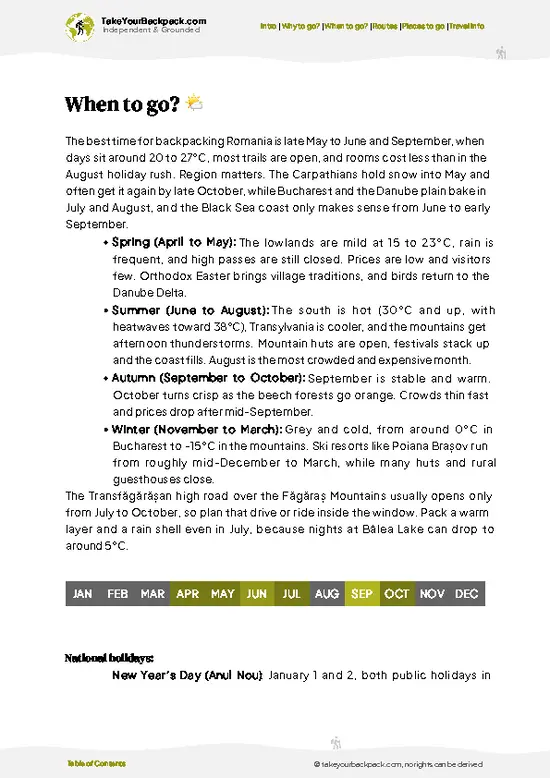
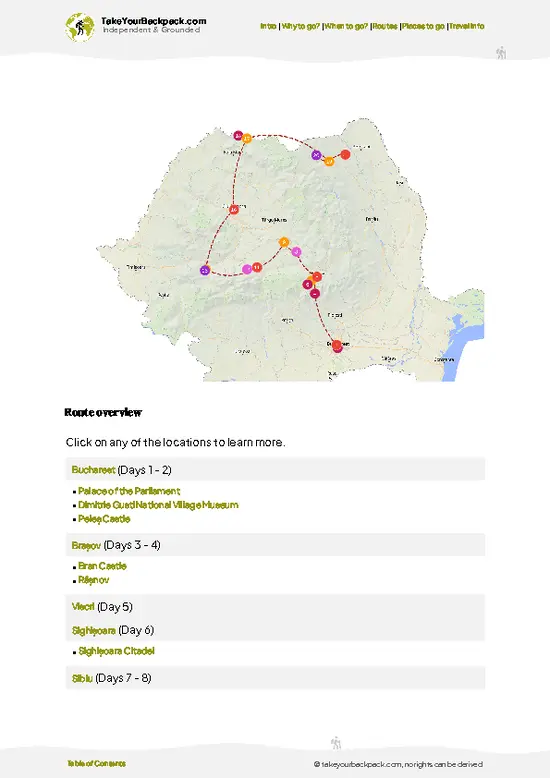
An offline-friendly backpacking guide with optimized travel routes, ranked highlights, transport advice, and the best areas to stay.
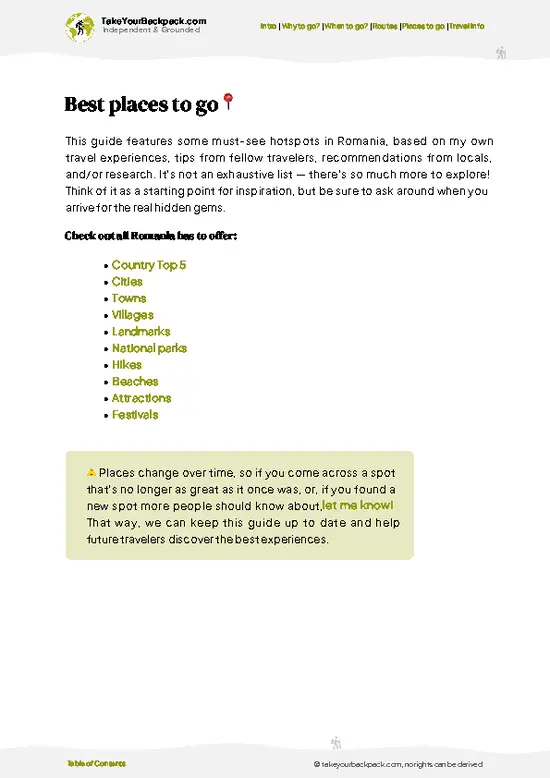
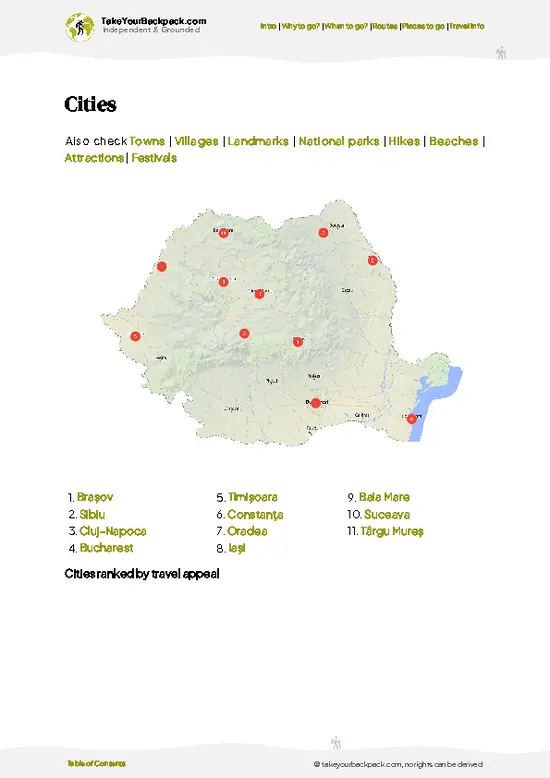
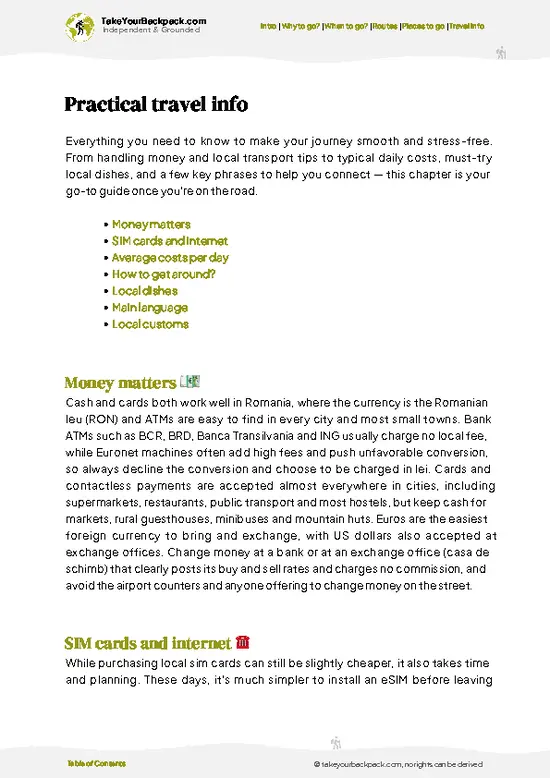
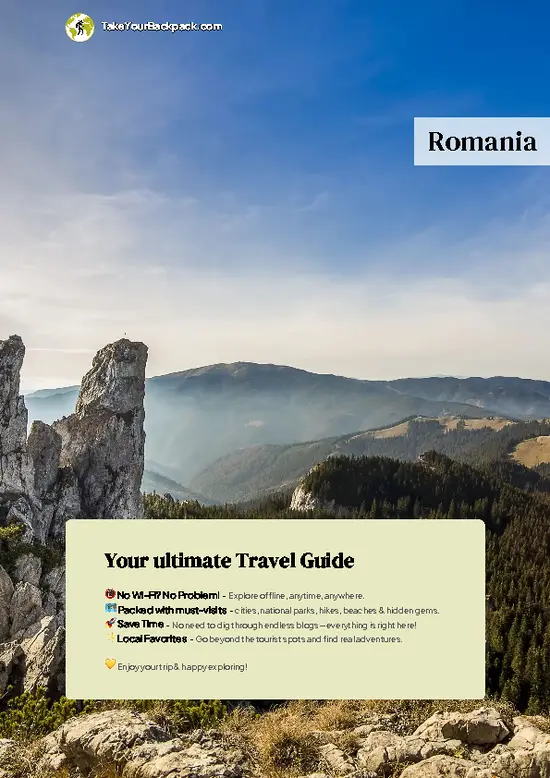
example page 0 from our offline Travel Guide for Romania
example page 1 from our offline Travel Guide for Romania
example page 2 from our offline Travel Guide for Romania
example page 3 from our offline Travel Guide for Romania
example page 4 from our offline Travel Guide for Romania
example page 5 from our offline Travel Guide for Romania
example page 6 from our offline Travel Guide for Romania
example page 7 from our offline Travel Guide for Romania
The digital guide (360 pages) contains:
✅ 94 highlights, ranked by travel appeal
✅ Optimized 5, 10 & 15-day travel routes
✅ Cities, national parks, landmarks, beaches
✅ How to get around
✅ Offline-friendly for travel without Wi-Fi
👉 Click to see all 30+ guide features

📅 Plan smarter in minutes, not weeks
✅ Month by month travel advice
✅ Festivals & national holidays
✅ Budget expectations

🗺️ Go to the right places, skip the overrated ones
✅ Honest pros & cons of destinations
✅ Top hikes, parks & viewpoints
✅ Lesser-known places most travelers miss
✅ Clear “worth it vs skip it” guidance

🛏️ Travel smoothly without rookie mistakes
✅ Best areas to stay
✅ Transport systems explained simply
✅ Common scams & safety advice
✅ SIM cards, money & practical tips

🌍 Understand the country, not just visit it
✅ Culture & traditions
✅ 52 Essential phrases & customs
✅ Festivals worth planning around
✅ Traveler-friendly historical context
✅ Insights that make places more meaningful

📱 Built for real travel conditions
✅ Fully downloadable PDF
✅ Works completely offline
✅ Optimized for phone use
✅ Useful in remote areas & buses
✅ Everything in one place
Stop searching, start planning
Get instant access to your full guide. 30‑day money-back guarantee.
+ Add another guide for just

By proceeding you agree to our terms.
Sent to your inbox immediately after payment • 100% Secure Checkout
Best Backpacking Travel Advisor 2025 tourism awardBest Backpacking
Travel Advisor
2025
What others say about Take Your Backpack Guides:
⭐⭐⭐⭐⭐
Fantastic, amazing amount of information!
⭐⭐⭐⭐⭐
My goodness this is amazing, it's what I've been looking for hats off too you!
⭐⭐⭐⭐⭐
I think this is absolutely BRILLIANT
⭐⭐⭐⭐
Very complete and informative. It's still missing places, but I gotta to commend you
⭐⭐⭐⭐⭐
This is truly amazing, thank you, can't wait to explore it with my kids!
⭐⭐⭐⭐⭐
Awesome resource, thank you!
⭐⭐⭐⭐⭐
This is amazing! Can't wait to explore the ones I haven't seen
⭐⭐⭐⭐
I love this! Well done, great idea.
⭐⭐⭐⭐⭐
Thanks for taking the time to make this gem!
⭐⭐⭐⭐⭐
This might be the best website I've ever seen.
⭐⭐⭐⭐⭐
Congratulations, and thank you so much for your work; it's incredibly valuable.
⭐⭐⭐⭐
In all seriousness I think you did a great job pointing out the important spots
⭐⭐⭐⭐⭐
10/10 very good
⭐⭐⭐⭐⭐
As someone who's only just starting to visit regularly this is awesome, thank you.
⭐⭐⭐⭐
Thank you very much! I'm going to visit my dad, it's going to be very useful!
⭐⭐⭐⭐⭐
This is really cool! We'll be travelling for the first time and this definitely come in handy.
⭐⭐⭐⭐⭐
You are now our minister of culture, congratulations 👨‍💼
⭐⭐⭐⭐⭐
Just wanted to tell you that this is a pearl! Going to follow your recommendations.
⭐⭐⭐⭐⭐
This is so cool. I'll definitely be using the resource for my travels soon.
⭐⭐⭐⭐⭐
This is very impressive! Good work.
⭐⭐⭐⭐⭐
This is an amazing and informative site. Very well done!

🛏️ Where to stay?Where to Stay: Romania Edition

Romania has plenty of hostels and budget guesthouses, with dorm beds typically running 50 to 90 lei (about US$11 to 20) a night and private doubles in family-run guesthouses from roughly 150 lei (US$33). In Bucharest, the Old Town (Lipscani) puts you right on top of the bars and walking distance from most sights, but weekend noise lasts until dawn. The streets around Piața Romană and Piața Victoriei are calmer and still on the metro. In Brașov, the medieval center and the quieter Șchei district sit at the foot of Tâmpa mountain, while central Cluj-Napoca is the pick for student nightlife and Sibiu’s Upper Town is compact, safe and quiet after dark.

If you enjoy meeting fellow travelers, consider … read more 👉
Romania has plenty of hostels and budget guesthouses, with dorm beds typically running 50 to 90 lei (about US$11 to 20) a night and private doubles in family-run guesthouses from roughly 150 lei (US$33). In Bucharest, the Old Town (Lipscani) puts you right on top of the bars and walking distance from most sights, but weekend noise lasts until dawn. The streets around Piața Romană and Piața Victoriei are calmer and still on the metro. In Brașov, the medieval center and the quieter Șchei district sit at the foot of Tâmpa mountain, while central Cluj-Napoca is the pick for student nightlife and Sibiu’s Upper Town is compact, safe and quiet after dark.

If you enjoy meeting fellow travelers, consider choosing hostels with high ratings for atmosphere. On the other hand, if you prefer having your own space, a hotel might be a better option.

RomaniaExplore Beyond This Category

👋 Meet the founderWho’s Behind Take Your Backpack?

Johan, backpacker and founder of TakeYourBackpackHi, I’m Johan (Netherlands 🇳🇱), the creator of TakeYourBackpack. Over the past 3 decades, I’ve backpacked through 90+ countries across six continents, gaining extensive experience with independent travel, long-term trips, and overland routes.

This site is built on a combination of firsthand travel experience and carefully curated insights from other backpackers. Many guides are based on places I’ve personally visited, while others bring together tips, observations, and practical advice shared by trusted travelers I’ve met along the way.

The goal is to provide realistic, experience-driven guidance — not generic itineraries — so you can explore destinations with better context, clearer expectations, and more confidence.