×

Romania🇷🇴 | best national parksTop-Rated 10 national parks in Romania

Romania’s national parks sit mostly along the Carpathian arc, and that arc sets the mood: spruce resin and woodsmoke in the air, cowbells at dusk, mud on the boots after any rain. The Southern and Eastern Carpathians deliver high ridges and marked alpine trails with hut-style lodging, while the Danube Delta trades summits for reed channels, pelican calls and boat-only access. Entry is usually free or cheap, crowds thin out fast beyond the trailheads, and villages nearby supply home-cooked meals at low prices. For backpacking or independent travel, expect patchy buses, so the right park depends on whether you want climbing, forest walking or water.

By Johan Kruseman 🇳🇱 | Updated October 18, 2026
Explore the best hikes in Romania

Why go?Understanding Their Importance

Romania holds some of the largest intact forest tracts in Europe, because the Carpathians were too steep and remote for the heavy industrial logging and farming that flattened woodland elsewhere. The result is a country where brown bears, wolves and lynx still use corridors that cross valleys with working villages. That mix shapes everything. Parks are not walled-off wildernesses. You hike past haystacks, hear sheepdogs before you see the flock, and smell wood smoke from hamlets still heated by stoves.

The protected-area system grew after 1989, so infrastructure is uneven. Some parks have signposted trails with colored-stripe and cross markings, visitor centers and mountain huts. Others have little more than a gravel track and a ranger who may or may not be in the office. Weather is continental … read more 👉
Romania holds some of the largest intact forest tracts in Europe, because the Carpathians were too steep and remote for the heavy industrial logging and farming that flattened woodland elsewhere. The result is a country where brown bears, wolves and lynx still use corridors that cross valleys with working villages. That mix shapes everything. Parks are not walled-off wildernesses. You hike past haystacks, hear sheepdogs before you see the flock, and smell wood smoke from hamlets still heated by stoves.

The protected-area system grew after 1989, so infrastructure is uneven. Some parks have signposted trails with colored-stripe and cross markings, visitor centers and mountain huts. Others have little more than a gravel track and a ranger who may or may not be in the office. Weather is continental and moves fast: sunny mornings can turn to hail on exposed ridges, and snow can linger on high routes into early summer.

Before choosing Romania, know that public transport to trailheads is thin, so rented cars, hitching and local minibuses fill the gaps. Wildlife encounters are real, mud is part of the deal, and the reward is solitude, cheap food and landscapes that still feel lived in rather than staged.
Behind the Scenes of Selection
The list of best national parks in Romania is created based on landscapes, wildlife, adventure opportunities, facilities, and overall experience. If you feel a national park is missing in this list, please let us know.

When to go?When to Plan Your Trip

Best months and weather: The best months for Romania’s national parks are June to September, when mountain trails are usually snow-free and the Danube Delta’s birdlife is at its busiest. Summer days in the Carpathian valleys run roughly 20 to 28°C, but high ridges stay 8 to 15°C cooler, and afternoon thunderstorms are common, so start walks early. Expect the smell of warm spruce, wet grass and hay in the villages.
Shoulder seasons: May and early October bring quieter trails, lower accommodation prices and golden beech forests in autumn. Nights fall near freezing in the mountains, and snow can still block alpine routes in May and sometimes into June. In the Danube Delta, April to May and September are excellent for migrating birds, with fewer mosquitoes than in July and August.
Peak periods and … read more 👉
Best months and weather: The best months for Romania’s national parks are June to September, when mountain trails are usually snow-free and the Danube Delta’s birdlife is at its busiest. Summer days in the Carpathian valleys run roughly 20 to 28°C, but high ridges stay 8 to 15°C cooler, and afternoon thunderstorms are common, so start walks early. Expect the smell of warm spruce, wet grass and hay in the villages.
Shoulder seasons: May and early October bring quieter trails, lower accommodation prices and golden beech forests in autumn. Nights fall near freezing in the mountains, and snow can still block alpine routes in May and sometimes into June. In the Danube Delta, April to May and September are excellent for migrating birds, with fewer mosquitoes than in July and August.
Peak periods and winter: Late July and August, plus mid-August holiday weekends, fill the popular Carpathian trailheads and pensions, and rooms can cost 20 to 40 percent more near well-known mountain areas. Winter, from December to March, brings deep snow, short days and closed or tricky mountain roads. Skiing and snowshoeing work in the Carpathians, but hiking requires winter gear. The Delta is cold, windy and mostly quiet, with limited boat services.

national park hoppingSuggested Travel Strategies

How many days you need: A trip linking several Romanian national parks needs 10 to 14 days, which allows two to four stops without constant packing. Group parks by region: the Southern Carpathians around Brașov and Sibiu, the Eastern and Northern Carpathians toward Maramureș and Bucovina, and the Danube Delta reached from Tulcea. A sensible direction runs from Bucharest into Transylvania, then north or east, finishing at Tulcea for the Delta, or the reverse if flying home from Bucharest.
Time per stop and transfers: Allow 2 to 4 days per mountain park to cover trails, weather delays and slow village buses, and 2 to 3 days for the Delta, since boats set the schedule. Typical transfers between regions take 3 to 7 hours by train, minibus or car, and rural roads can be slower than the map suggests. … read more 👉
How many days you need: A trip linking several Romanian national parks needs 10 to 14 days, which allows two to four stops without constant packing. Group parks by region: the Southern Carpathians around Brașov and Sibiu, the Eastern and Northern Carpathians toward Maramureș and Bucovina, and the Danube Delta reached from Tulcea. A sensible direction runs from Bucharest into Transylvania, then north or east, finishing at Tulcea for the Delta, or the reverse if flying home from Bucharest.
Time per stop and transfers: Allow 2 to 4 days per mountain park to cover trails, weather delays and slow village buses, and 2 to 3 days for the Delta, since boats set the schedule. Typical transfers between regions take 3 to 7 hours by train, minibus or car, and rural roads can be slower than the map suggests. Trains are cheap but slow, and many trailheads need a last leg by taxi, shared van or hitching.
Planning mistakes: The common error is stacking too many parks in a week and spending half the time in transit. Pick fewer places and build in a spare day for rain, since storms can close ridge routes. Another is relying on buses to remote trailheads without checking times, which are often one or two a day. Book the first and last night, and stay flexible between.

The ListTop national parks of Romania

1 Retezat National Park

glacial lakes, rocky summits, dwarf pine zones

Navigate a landscape dotted with clear mountain tarns and jagged peaks, where trails cross above the treeline into open, stony wilderness.

2 Piatra Craiului National Park

limestone ridge, alpine pastures, chamois habitat

Hike along a narrow crest with sweeping views, pass through high meadows, and spot wildlife adapted to the park’s exposed heights.

3 Apuseni Natural Park

karst caves, dense beech forests, remote hamlets

Descend into vast underground chambers, cross mossy woodlands, and meet villagers whose daily life still follows the rhythms of the mountains.

romania-national-park-apuseni-natural-park
© Google |

4 Rodnei Mountains National Park

broad plateaus, subalpine forests, marmot colonies

Roam expansive uplands and dense spruce woods, encountering open vistas and the distinctive calls of wildlife in the high Carpathians.

romania-national-park-rodnei-mountains-national-park
© Google |

5 Cheile Nerei-Beușnița National Park

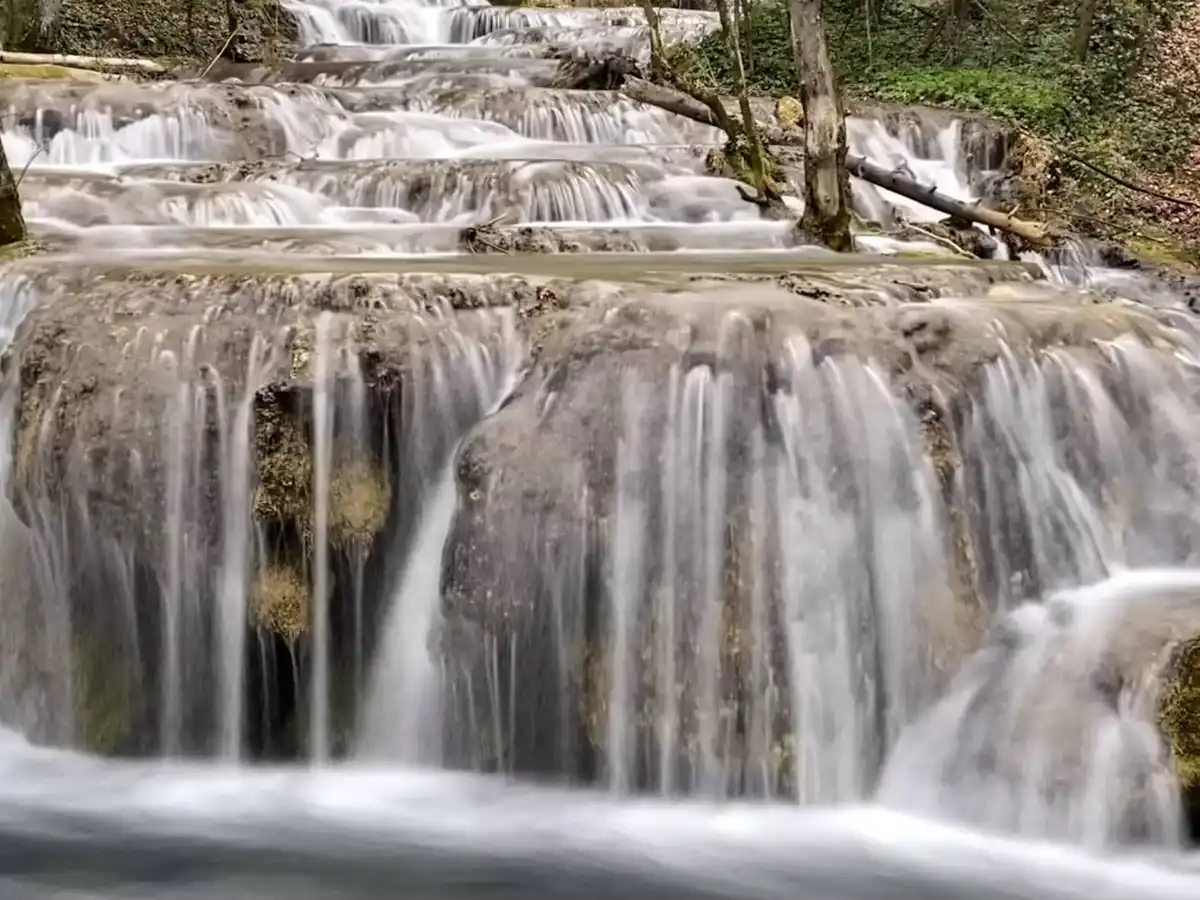
turquoise lakes, limestone gorges, waterfalls

Follow winding trails past clear pools and through narrow canyons, where water shapes the landscape and rare plants cling to rocky ledges.

romania-national-park-cheile-nerei-beusnita-national-park
© Google | Memete Florin

6 Domogled-Valea Cernei National Park

thermal valleys, wildflower meadows, steep cliffs

Traverse sunlit plateaus and deep river valleys, where rare flora thrives and hot springs steam beside dramatic limestone walls.

romania-national-park-domogled-valea-cernei-national-park
© Google | Bogdan Doandeș

7 Maramureș Mountains Natural Park

rolling hills, hay meadows, traditional villages

Wander through patchwork landscapes shaped by farming, where wooden houses and haystacks dot the slopes and local customs remain strong.

romania-national-park-maramures-mountains-natural-park
© Google |

8 Călimani National Park

volcanic craters, dwarf juniper, mineral springs

Cross ancient calderas and barren volcanic slopes, with trails leading to mineral springs and rare plant communities at high altitude.

romania-national-park-calimani-national-park
© Google |

9 Cozia National Park

rugged ridges, thermal springs, ancient monasteries

Climb steep slopes for panoramic views, soak in mineral-rich waters, and discover centuries-old religious sites tucked into forested hills.

romania-national-park-cozia-national-park
© Google | Gabriel Dumitrescu

10 Defileul Jiului National Park

river canyon, steep forested slopes, rock towers

Walk narrow paths above a fast-flowing river, where dense woods cling to cliffs and stone pillars rise from the valley floor.

romania-national-park-defileul-jiului-national-park
© Google |
Loading the map 🌍

Expert viewPro Tips for Exploring the Best

How many parks to visit: I advise two or three national parks on a trip of one to two weeks. Each park needs at least two full days to feel the rhythm: early light on wet meadows, the clang of bells, the long climb that ends in a ridge view. Squeezing in more means bus timetables and rain delays eat the walking time you came for.
Choosing by travel style: Hikers who want ridgelines and marked routes should prioritize a Carpathian mountain park, where you earn broad views with steep, rocky switchbacks and finish at a hut with hot soup. Slow travelers and photographers will get more from the Danube Delta, where mornings are mist, reeds and pelican wingbeats from a small boat. Anyone short on time or gear can choose a lower forest park near a town with day-walk access and a bed in a family pension … read more 👉
How many parks to visit: I advise two or three national parks on a trip of one to two weeks. Each park needs at least two full days to feel the rhythm: early light on wet meadows, the clang of bells, the long climb that ends in a ridge view. Squeezing in more means bus timetables and rain delays eat the walking time you came for.
Choosing by travel style: Hikers who want ridgelines and marked routes should prioritize a Carpathian mountain park, where you earn broad views with steep, rocky switchbacks and finish at a hut with hot soup. Slow travelers and photographers will get more from the Danube Delta, where mornings are mist, reeds and pelican wingbeats from a small boat. Anyone short on time or gear can choose a lower forest park near a town with day-walk access and a bed in a family pension afterward.
What it costs: Budget about US$30 to 55 a day (roughly 140 to 250 lei) including food, a bed and local transport. Many parks charge no entry fee, while some charge small fees or require a permit, usually a few lei to about US$5. Mountain huts and pensions run US$10 to 30 for a bed, a hearty meal of polenta, sour cream and sausage costs US$5 to 10, and a local guide for a day costs roughly US$50 to 100. Delta boat trips run about US$15 to 40 per person on shared boats, more on private ones. Car rental adds US$30 to 60 a day and often saves time.
Safety and culture: Brown bears live in many Carpathian forests. Hike in daylight, make noise on forest trails, store food away from your tent, and follow ranger advice. Weather is the larger risk: storms and fog can arrive within an hour, so carry a waterproof layer, a headlamp and offline maps. Mountain rescue is reached by calling 112. Shepherd dogs guard flocks and can be aggressive, so stop, stay calm and give flocks a wide berth. In villages, greet people with “bună ziua”, ask before photographing, and accept a glass of homemade țuică in the spirit offered. Camping rules differ by park, so confirm locally.

✈️ The backpacker research shortcutRomania Travel Guide

An offline-friendly backpacking guide with optimized travel routes, ranked highlights, transport advice, and the best areas to stay.
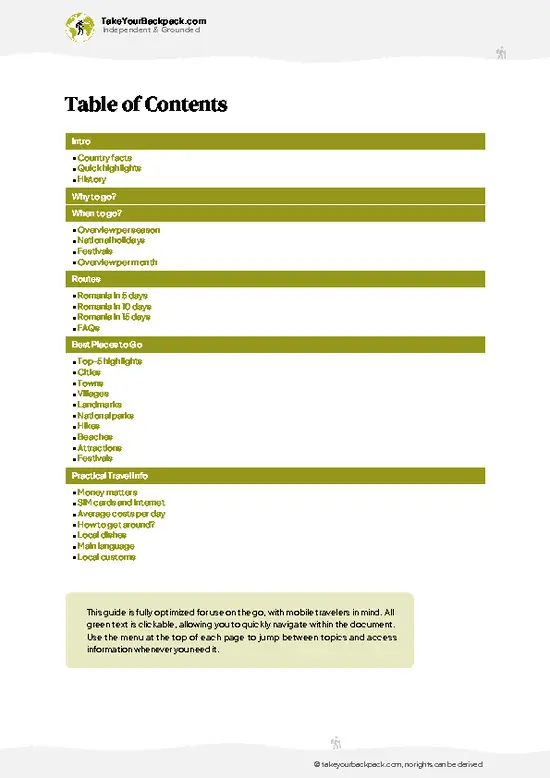
example page 0 from our offline Travel Guide for Romania
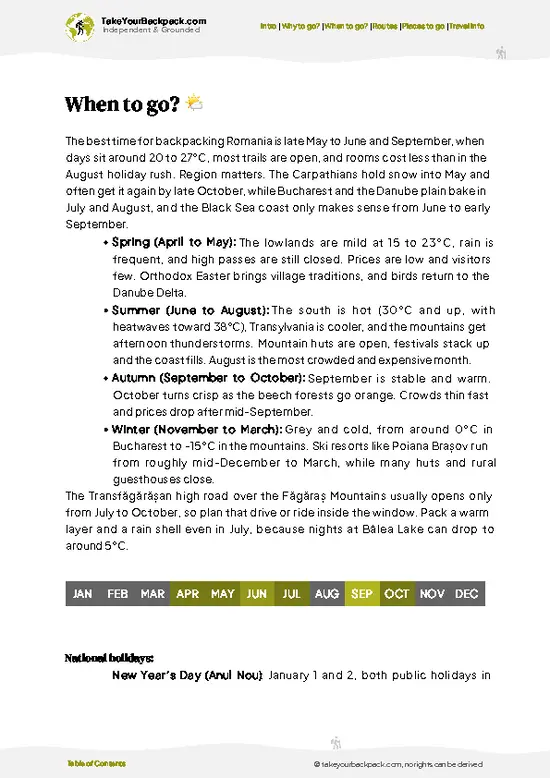
example page 1 from our offline Travel Guide for Romania
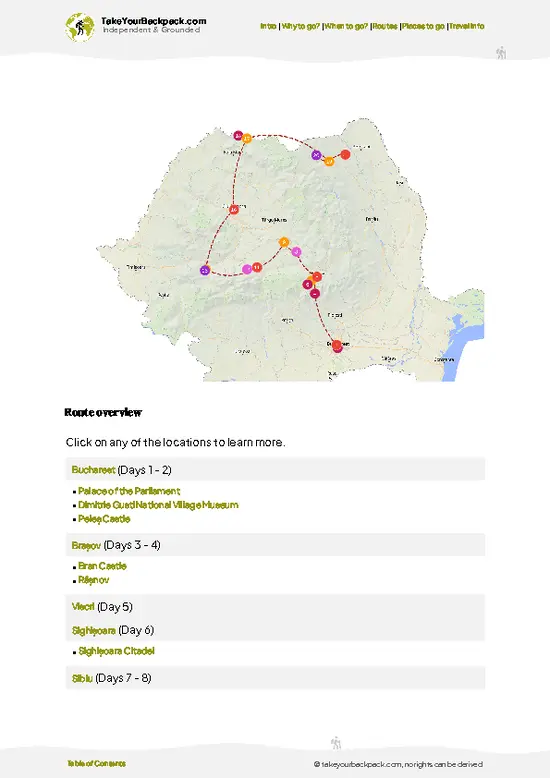
example page 2 from our offline Travel Guide for Romania
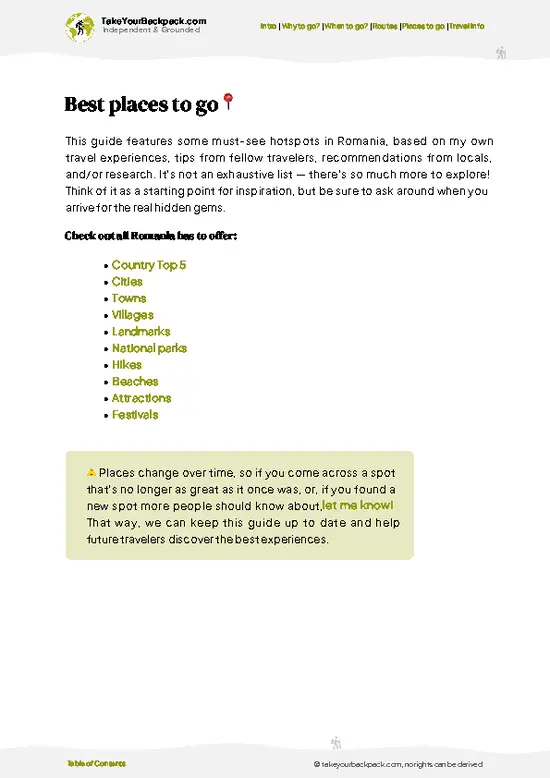
example page 3 from our offline Travel Guide for Romania
example page 4 from our offline Travel Guide for Romania
example page 5 from our offline Travel Guide for Romania
example page 6 from our offline Travel Guide for Romania
example page 7 from our offline Travel Guide for Romania
The digital guide (360 pages) contains:
✅ 94 highlights, ranked by travel appeal
✅ Optimized 5, 10 & 15-day travel routes
✅ Cities, national parks, landmarks, beaches
✅ How to get around
✅ Offline-friendly for travel without Wi-Fi
👉 Click to see all 30+ guide features

📅 Plan smarter in minutes, not weeks
✅ Month by month travel advice
✅ Festivals & national holidays
✅ Budget expectations

🗺️ Go to the right places, skip the overrated ones
✅ Honest pros & cons of destinations
✅ Top hikes, parks & viewpoints
✅ Lesser-known places most travelers miss
✅ Clear “worth it vs skip it” guidance

🛏️ Travel smoothly without rookie mistakes
✅ Best areas to stay
✅ Transport systems explained simply
✅ Common scams & safety advice
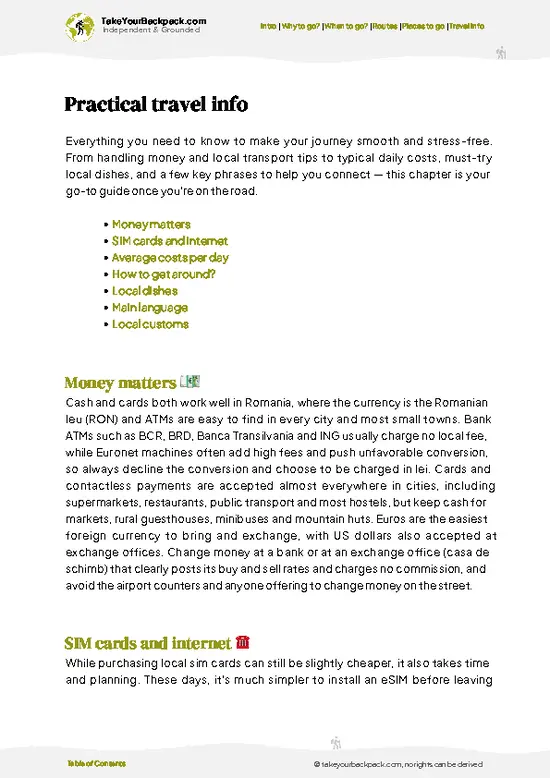
✅ SIM cards, money & practical tips

🌍 Understand the country, not just visit it
✅ Culture & traditions
✅ 52 Essential phrases & customs
✅ Festivals worth planning around
✅ Traveler-friendly historical context
✅ Insights that make places more meaningful

📱 Built for real travel conditions
✅ Fully downloadable PDF
✅ Works completely offline
✅ Optimized for phone use
✅ Useful in remote areas & buses
✅ Everything in one place
Stop searching, start planning
Get instant access to your full guide. 30‑day money-back guarantee.
+ Add another guide for just

By proceeding you agree to our terms.
Sent to your inbox immediately after payment • 100% Secure Checkout
Best Backpacking Travel Advisor 2025 tourism awardBest Backpacking
Travel Advisor
2025
What others say about Take Your Backpack Guides:
⭐⭐⭐⭐⭐
Fantastic, amazing amount of information!
⭐⭐⭐⭐⭐
My goodness this is amazing, it's what I've been looking for hats off too you!
⭐⭐⭐⭐⭐
I think this is absolutely BRILLIANT
⭐⭐⭐⭐
Very complete and informative. It's still missing places, but I gotta to commend you
⭐⭐⭐⭐⭐
This is truly amazing, thank you, can't wait to explore it with my kids!
⭐⭐⭐⭐⭐
Awesome resource, thank you!
⭐⭐⭐⭐⭐
This is amazing! Can't wait to explore the ones I haven't seen
⭐⭐⭐⭐
I love this! Well done, great idea.
⭐⭐⭐⭐⭐
Thanks for taking the time to make this gem!
⭐⭐⭐⭐⭐
This might be the best website I've ever seen.
⭐⭐⭐⭐⭐
Congratulations, and thank you so much for your work; it's incredibly valuable.
⭐⭐⭐⭐
In all seriousness I think you did a great job pointing out the important spots
⭐⭐⭐⭐⭐
10/10 very good
⭐⭐⭐⭐⭐
As someone who's only just starting to visit regularly this is awesome, thank you.
⭐⭐⭐⭐
Thank you very much! I'm going to visit my dad, it's going to be very useful!
⭐⭐⭐⭐⭐
This is really cool! We'll be travelling for the first time and this definitely come in handy.
⭐⭐⭐⭐⭐
You are now our minister of culture, congratulations 👨‍💼
⭐⭐⭐⭐⭐
Just wanted to tell you that this is a pearl! Going to follow your recommendations.
⭐⭐⭐⭐⭐
This is so cool. I'll definitely be using the resource for my travels soon.
⭐⭐⭐⭐⭐
This is very impressive! Good work.
⭐⭐⭐⭐⭐
This is an amazing and informative site. Very well done!

🛏️ Where to stay?Best Stay Options in Romania

Romania has plenty of hostels and budget guesthouses, with dorm beds typically running 50 to 90 lei (about US$11 to 20) a night and private doubles in family-run guesthouses from roughly 150 lei (US$33). In Bucharest, the Old Town (Lipscani) puts you right on top of the bars and walking distance from most sights, but weekend noise lasts until dawn. The streets around Piața Romană and Piața Victoriei are calmer and still on the metro. In Brașov, the medieval center and the quieter Șchei district sit at the foot of Tâmpa mountain, while central Cluj-Napoca is the pick for student nightlife and Sibiu’s Upper Town is compact, safe and quiet after dark.

If you enjoy meeting fellow travelers, consider … read more 👉
Romania has plenty of hostels and budget guesthouses, with dorm beds typically running 50 to 90 lei (about US$11 to 20) a night and private doubles in family-run guesthouses from roughly 150 lei (US$33). In Bucharest, the Old Town (Lipscani) puts you right on top of the bars and walking distance from most sights, but weekend noise lasts until dawn. The streets around Piața Romană and Piața Victoriei are calmer and still on the metro. In Brașov, the medieval center and the quieter Șchei district sit at the foot of Tâmpa mountain, while central Cluj-Napoca is the pick for student nightlife and Sibiu’s Upper Town is compact, safe and quiet after dark.

If you enjoy meeting fellow travelers, consider choosing hostels with high ratings for atmosphere. On the other hand, if you prefer having your own space, a hotel might be a better option.

RomaniaWhere to Go Next

👋 Meet the founderWho’s Behind Take Your Backpack?

Johan, backpacker and founder of TakeYourBackpackHi, I’m Johan (Netherlands 🇳🇱), the creator of TakeYourBackpack. Over the past 3 decades, I’ve backpacked through 90+ countries across six continents, gaining extensive experience with independent travel, long-term trips, and overland routes.

This site is built on a combination of firsthand travel experience and carefully curated insights from other backpackers. Many guides are based on places I’ve personally visited, while others bring together tips, observations, and practical advice shared by trusted travelers I’ve met along the way.

The goal is to provide realistic, experience-driven guidance — not generic itineraries — so you can explore destinations with better context, clearer expectations, and more confidence.