×

Romania🇷🇴 | best landmarksTop-Rated 7 landmarks in Romania

Romania packs fortified churches, painted monasteries, hilltop citadels and wooden gates into a country where a day’s drive changes the architecture completely. In Transylvania, Saxon walls of rough stone and ochre plaster rise over cobbled squares, and the Carpathian air smells of woodsmoke and wet slate. Bucovina offers frescoed monastery walls in blue and red, with nuns’ bells carrying across meadows. Maramureș trades stone for oak, with carved gates and tall shingled steeples. Entry fees are low, often a few lei to about 40 lei, but roads are slow and buses thin. Independent travelers get the quietest mornings, especially outside Brașov and Bucharest.

By Johan Kruseman 🇳🇱 | Updated October 18, 2026
Explore the best national parks in Romania

Why go?Understanding Their Importance

Romania sits where Byzantine, Habsburg, Ottoman and Saxon influences overlapped, and the Carpathian arc kept those layers separated rather than blended. That is why a single country holds Orthodox monasteries with outdoor frescoes, Gothic-era Saxon church-fortresses and timber churches built without iron nails. Mountains acted as both shield and border, so villages preserved crafts, dialects and building methods long after cities modernized. Expect the smell of beeswax and damp stone inside churches, the creak of old wooden floors, and the clatter of horse carts on village lanes.

The infrastructure is uneven. Highways are limited, and many rural roads are narrow, potholed and shared with livestock, so distances that look short on a map can take hours. Trains are cheap but slow, and regional … read more 👉
Romania sits where Byzantine, Habsburg, Ottoman and Saxon influences overlapped, and the Carpathian arc kept those layers separated rather than blended. That is why a single country holds Orthodox monasteries with outdoor frescoes, Gothic-era Saxon church-fortresses and timber churches built without iron nails. Mountains acted as both shield and border, so villages preserved crafts, dialects and building methods long after cities modernized. Expect the smell of beeswax and damp stone inside churches, the creak of old wooden floors, and the clatter of horse carts on village lanes.

The infrastructure is uneven. Highways are limited, and many rural roads are narrow, potholed and shared with livestock, so distances that look short on a map can take hours. Trains are cheap but slow, and regional buses often run only a few times a day. Smaller sites keep irregular hours, may close for lunch or on Mondays, and sometimes require finding a caretaker with a key. Communist-era demolition and neglect left some heritage in poor condition, while restoration continues in patches.

Before choosing Romania for landmarks, know that modest comfort is the price of authenticity. Dress rules apply at active monasteries, cash is still useful in villages, and a rental car or tight planning makes a major difference.
Evaluating the Top Choices
The list of best unique sites in Romania is created based on history or culture, wow factor, atmosphere, quirks, and memorability. If you feel a unique site is missing in this list, please let us know.

When to go?When to Plan Your Trip

Best months and weather: Late May to June and September to early October are the best months, with daytime highs of about 18 to 27°C, long light, and fewer crowds than July and August. Spring brings green hills, cool mornings and occasional showers, with May and June being the wettest months in much of the country at roughly 60 to 90 mm. September smells of ripe plums and woodsmoke, and the light turns golden by late afternoon.
Summer and peak periods: July and August reach 28 to 35°C in Bucharest and the southern plains, while the Carpathians stay cooler, often 20 to 26°C. Thunderstorms can roll in quickly over mountain areas. Brașov, Sibiu and popular Bucovina monasteries fill up in these months, and accommodation can cost 20 to 40 percent more, especially on weekends and around August 15, … read more 👉
Best months and weather: Late May to June and September to early October are the best months, with daytime highs of about 18 to 27°C, long light, and fewer crowds than July and August. Spring brings green hills, cool mornings and occasional showers, with May and June being the wettest months in much of the country at roughly 60 to 90 mm. September smells of ripe plums and woodsmoke, and the light turns golden by late afternoon.
Summer and peak periods: July and August reach 28 to 35°C in Bucharest and the southern plains, while the Carpathians stay cooler, often 20 to 26°C. Thunderstorms can roll in quickly over mountain areas. Brașov, Sibiu and popular Bucovina monasteries fill up in these months, and accommodation can cost 20 to 40 percent more, especially on weekends and around August 15, when pilgrims gather at monasteries.
Winter and shoulder seasons: November to March is cold, with Transylvania and the north often between minus 10 and 3°C, and snow can make rural roads slow or impassable. Some small rural sites reduce hours or close, though cities stay open and prices are lowest. Frosted citadel walls and snow on timber roofs can be striking, but daylight ends around 4:30 pm in midwinter. April and late October are changeable, with mud, fog and spotty opening hours.

unique site hoppingSuggested Travel Strategies

How long to allow: A trip combining several landmarks in Romania needs 7 to 14 days, because roads are slow and the main regions sit hours apart. Transylvania clusters well around Brașov, Sibiu and Sighișoara, with 1.5 to 3 hours between them by train, bus or car. Bucovina and Maramureș sit in the north and need a separate leg, often 5 to 7 hours from Transylvania by road.
Direction and pacing: Start in Bucharest for international flights, then move north into Transylvania, continue to Cluj-Napoca, and loop through Maramureș and Bucovina before heading back south by train from Suceava, which takes about 6 to 8 hours to Bucharest. Allow half a day for small stops such as a village church or monastery, and one full day for citadels and large complexes. Add a buffer day for the long northern transfer. … read more 👉
How long to allow: A trip combining several landmarks in Romania needs 7 to 14 days, because roads are slow and the main regions sit hours apart. Transylvania clusters well around Brașov, Sibiu and Sighișoara, with 1.5 to 3 hours between them by train, bus or car. Bucovina and Maramureș sit in the north and need a separate leg, often 5 to 7 hours from Transylvania by road.
Direction and pacing: Start in Bucharest for international flights, then move north into Transylvania, continue to Cluj-Napoca, and loop through Maramureș and Bucovina before heading back south by train from Suceava, which takes about 6 to 8 hours to Bucharest. Allow half a day for small stops such as a village church or monastery, and one full day for citadels and large complexes. Add a buffer day for the long northern transfer.
Planning mistakes: The most common error is trusting map distances. A 150 km drive can take 3 to 4 hours on two-lane roads behind trucks and tractors, with diesel fumes mixing with hay and pine on the air. Packing too many stops into a day leaves no time for closing hours, which can be as early as 4 to 5 pm. Pick two regions in a week instead, and book trains and key rooms ahead in summer.

The ListTop landmarks of Romania

1 Transfăgărășan Highway

hairpin bends, alpine scenery, mountain pass

Drive or cycle a winding route that cuts through high peaks, offering panoramic views and sudden changes in weather and altitude.

romania-unique-site-transfagarasan-highway
© Google |

2 Painted Monasteries of Bucovina

frescoed walls, Orthodox heritage, rural hills

Admire vivid exterior murals depicting centuries-old stories, set against rolling countryside and the quiet rhythm of monastic life.

romania-unique-site-painted-monasteries-of-bucovina
© Google |

3 Corvin Castle

gothic towers, drawbridge, medieval halls

Walk beneath pointed arches and through echoing chambers, tracing the footsteps of knights and rulers in a fortress shaped by centuries.

romania-unique-site-corvin-castle
© Google | Lavinia Tettamanzi

4 Salina Turda

underground chambers, salt mine, subterranean lake

Descend into vast caverns carved from salt, where echoing tunnels lead to an underground lake and surreal, sculpted spaces.

romania-unique-site-salina-turda
© Google |

5 Sarmizegetusa Regia

ancient stone circles, Dacian ruins, forested plateau

Climb to a remote archaeological site where mossy stones and earthworks reveal traces of a lost mountain stronghold.

6 Cascada Bigăr

moss-draped waterfall, shaded gorge, forested trails

Stand before a curtain of water spilling over mossy stone, surrounded by dense woodland and the cool air of a shaded ravine.

romania-unique-site-cascada-bigar
© Google |

7 Lacul Roșu

submerged tree stumps, mountain lake, pine forest

Paddle or hike along a lake where tree trunks rise from still water, ringed by steep cliffs and dense evergreens.

romania-unique-site-lacul-rosu
© Google |
Loading the map 🌍

Expert viewPro Tips for Exploring the Best

How many to visit: I advise 6 to 9 landmarks on a typical 7 to 10 day trip. Romanian roads are slow, many sites are small and need unhurried time, and opening hours can be short. Fewer stops mean you can linger in a monastery courtyard while the smell of incense and beeswax drifts through the doorway, instead of sprinting for a photo.
Choosing the kind: First-timers who want variety should balance one fortified town or citadel, one painted monastery and one wooden village church. History enthusiasts can prioritize Saxon fortified churches and fortresses, where thick walls hold the chill even in July. Photographers and culture seekers should lean toward Bucovina and Maramureș, especially in early morning light when mist clings to the hills and the paint colors glow. Travelers with little time … read more 👉
How many to visit: I advise 6 to 9 landmarks on a typical 7 to 10 day trip. Romanian roads are slow, many sites are small and need unhurried time, and opening hours can be short. Fewer stops mean you can linger in a monastery courtyard while the smell of incense and beeswax drifts through the doorway, instead of sprinting for a photo.
Choosing the kind: First-timers who want variety should balance one fortified town or citadel, one painted monastery and one wooden village church. History enthusiasts can prioritize Saxon fortified churches and fortresses, where thick walls hold the chill even in July. Photographers and culture seekers should lean toward Bucovina and Maramureș, especially in early morning light when mist clings to the hills and the paint colors glow. Travelers with little time or no car should stick to the Transylvanian cities, which are reachable by train and bus.
What it costs: Budget US$30 to 55 a day (roughly 140 to 250 lei) for a mix of hostel or guesthouse beds, local meals and public transport. Entry fees usually run 10 to 40 lei (about US$2 to 9) for most sites, with the larger castles at the upper end. Photography permits cost a few extra lei at some monasteries. Local guides cost about 100 to 250 lei for a tour, and are worth hiring where there are no signs or the caretaker only speaks Romanian. Trains cost roughly 20 to 60 lei per leg, while rental cars run about US$35 to 60 a day plus fuel. Cash is useful in villages, and a hot bowl of ciorbă for 15 to 30 lei is the best lunch deal.
Safety and etiquette: Dress modestly at active monasteries: women should cover shoulders and knees, and many provide wraps or skirts at the entrance. Men should remove hats inside. Speak quietly during services and ask before photographing worshippers, as photography inside some churches is limited or paid for. Respect the caretakers, who often live beside the site and open it by hand.
Watch out for: Drive carefully, since horse carts, unlit villages and overtaking trucks make night driving risky, and potholes can jolt a small car hard. Stray dogs near rural sites are common, so keep a calm distance. In crowded squares, watch pockets, and use official taxi apps instead of street cabs in Bucharest. Carry water and a rain layer for stone steps that turn slick, since a muddy hillside path can add effort to a steep citadel climb, but the view at the top makes it worth it.

✈️ The backpacker research shortcutRomania Travel Guide

An offline-friendly backpacking guide with optimized travel routes, ranked highlights, transport advice, and the best areas to stay.
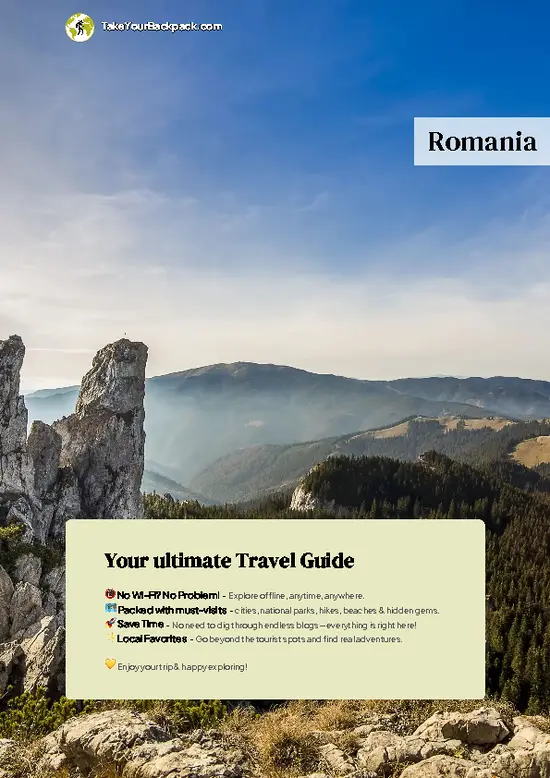
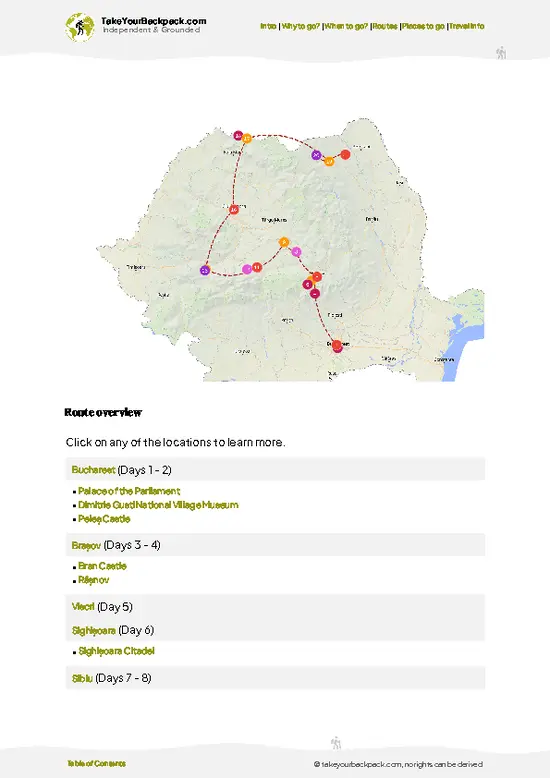
example page 0 from our offline Travel Guide for Romania
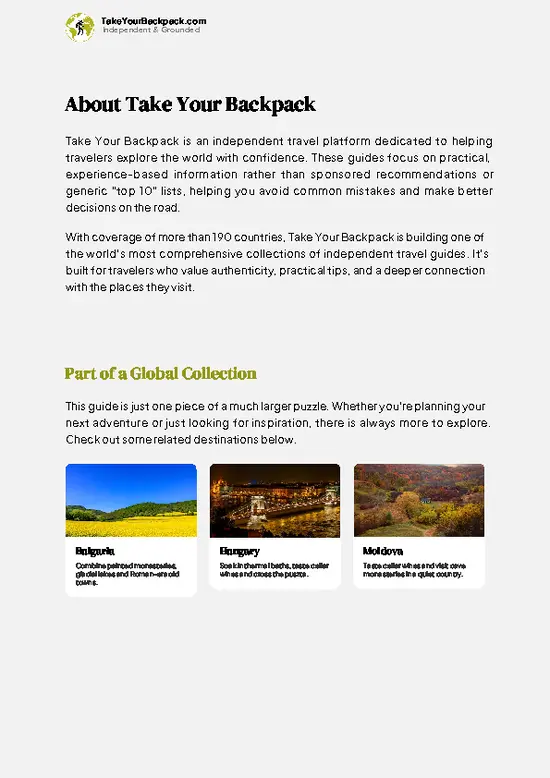
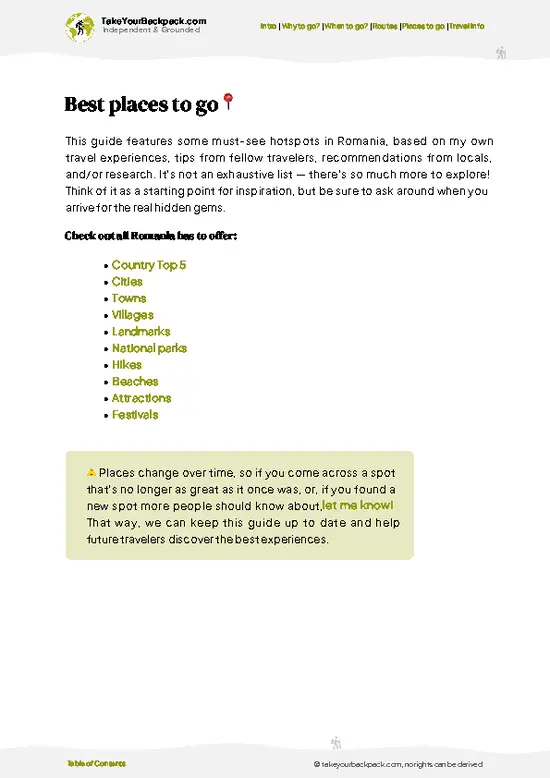
example page 1 from our offline Travel Guide for Romania
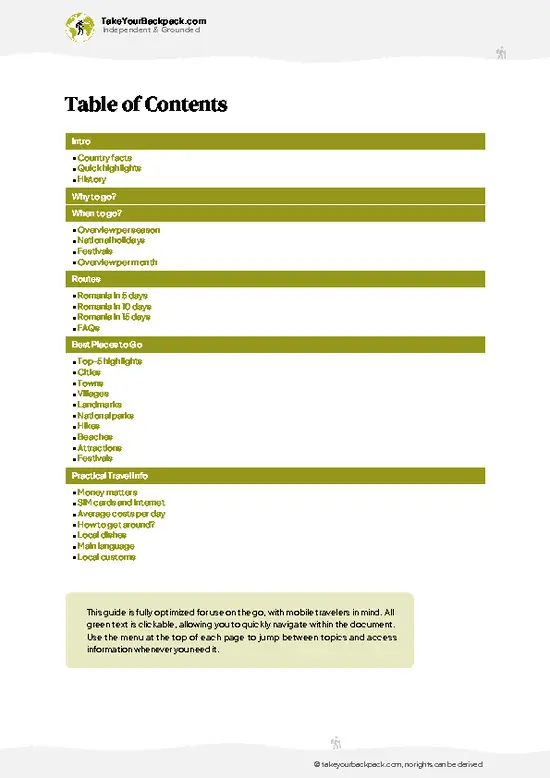
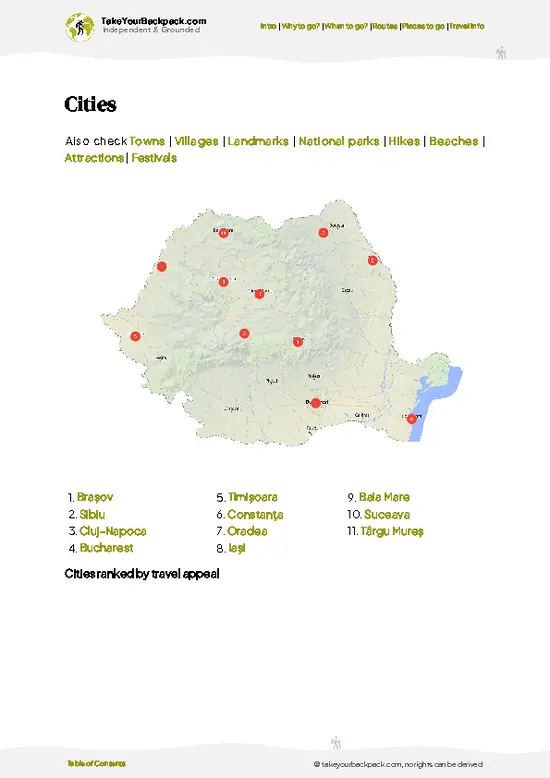
example page 2 from our offline Travel Guide for Romania
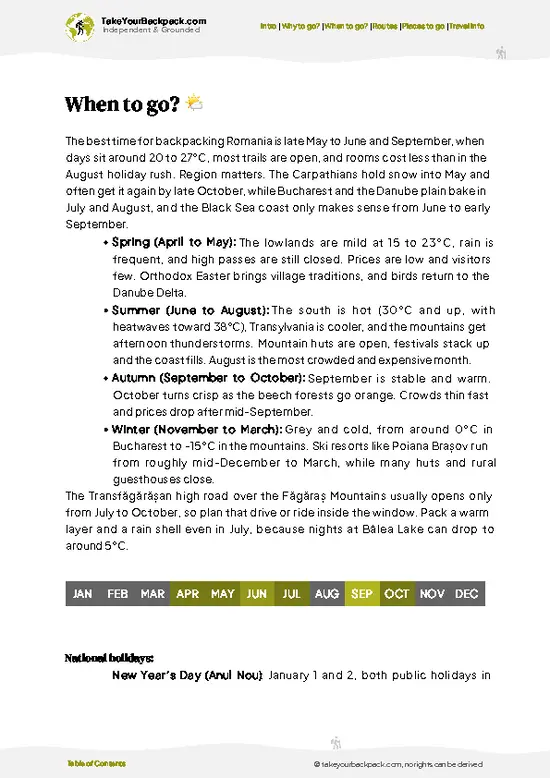
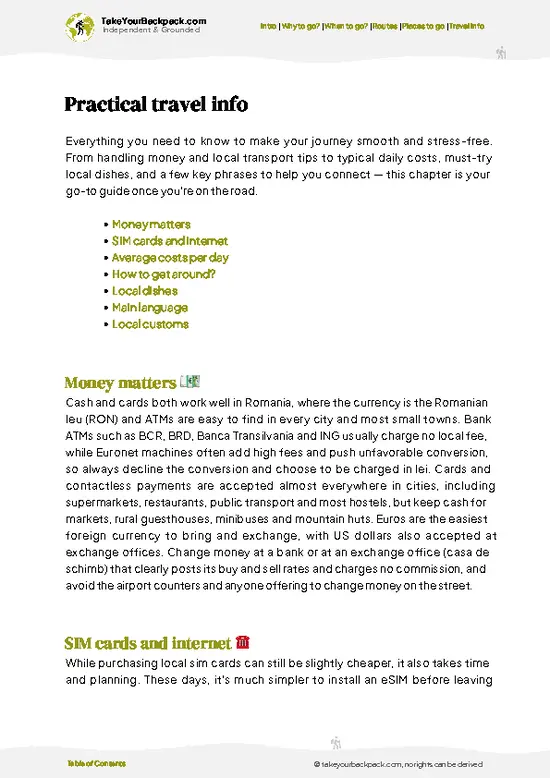
example page 3 from our offline Travel Guide for Romania
example page 4 from our offline Travel Guide for Romania
example page 5 from our offline Travel Guide for Romania
example page 6 from our offline Travel Guide for Romania
example page 7 from our offline Travel Guide for Romania
The digital guide (360 pages) contains:
✅ 94 highlights, ranked by travel appeal
✅ Optimized 5, 10 & 15-day travel routes
✅ Cities, national parks, landmarks, beaches
✅ How to get around
✅ Offline-friendly for travel without Wi-Fi
👉 Click to see all 30+ guide features

📅 Plan smarter in minutes, not weeks
✅ Month by month travel advice
✅ Festivals & national holidays
✅ Budget expectations

🗺️ Go to the right places, skip the overrated ones
✅ Honest pros & cons of destinations
✅ Top hikes, parks & viewpoints
✅ Lesser-known places most travelers miss
✅ Clear “worth it vs skip it” guidance

🛏️ Travel smoothly without rookie mistakes
✅ Best areas to stay
✅ Transport systems explained simply
✅ Common scams & safety advice
✅ SIM cards, money & practical tips

🌍 Understand the country, not just visit it
✅ Culture & traditions
✅ 52 Essential phrases & customs
✅ Festivals worth planning around
✅ Traveler-friendly historical context
✅ Insights that make places more meaningful

📱 Built for real travel conditions
✅ Fully downloadable PDF
✅ Works completely offline
✅ Optimized for phone use
✅ Useful in remote areas & buses
✅ Everything in one place
Stop searching, start planning
Get instant access to your full guide. 30‑day money-back guarantee.
+ Add another guide for just

By proceeding you agree to our terms.
Sent to your inbox immediately after payment • 100% Secure Checkout
Best Backpacking Travel Advisor 2025 tourism awardBest Backpacking
Travel Advisor
2025
What others say about Take Your Backpack Guides:
⭐⭐⭐⭐⭐
Fantastic, amazing amount of information!
⭐⭐⭐⭐⭐
My goodness this is amazing, it's what I've been looking for hats off too you!
⭐⭐⭐⭐⭐
I think this is absolutely BRILLIANT
⭐⭐⭐⭐
Very complete and informative. It's still missing places, but I gotta to commend you
⭐⭐⭐⭐⭐
This is truly amazing, thank you, can't wait to explore it with my kids!
⭐⭐⭐⭐⭐
Awesome resource, thank you!
⭐⭐⭐⭐⭐
This is amazing! Can't wait to explore the ones I haven't seen
⭐⭐⭐⭐
I love this! Well done, great idea.
⭐⭐⭐⭐⭐
Thanks for taking the time to make this gem!
⭐⭐⭐⭐⭐
This might be the best website I've ever seen.
⭐⭐⭐⭐⭐
Congratulations, and thank you so much for your work; it's incredibly valuable.
⭐⭐⭐⭐
In all seriousness I think you did a great job pointing out the important spots
⭐⭐⭐⭐⭐
10/10 very good
⭐⭐⭐⭐⭐
As someone who's only just starting to visit regularly this is awesome, thank you.
⭐⭐⭐⭐
Thank you very much! I'm going to visit my dad, it's going to be very useful!
⭐⭐⭐⭐⭐
This is really cool! We'll be travelling for the first time and this definitely come in handy.
⭐⭐⭐⭐⭐
You are now our minister of culture, congratulations 👨‍💼
⭐⭐⭐⭐⭐
Just wanted to tell you that this is a pearl! Going to follow your recommendations.
⭐⭐⭐⭐⭐
This is so cool. I'll definitely be using the resource for my travels soon.
⭐⭐⭐⭐⭐
This is very impressive! Good work.
⭐⭐⭐⭐⭐
This is an amazing and informative site. Very well done!

🛏️ Where to stay?Top Areas to Stay

Romania has plenty of hostels and budget guesthouses, with dorm beds typically running 50 to 90 lei (about US$11 to 20) a night and private doubles in family-run guesthouses from roughly 150 lei (US$33). In Bucharest, the Old Town (Lipscani) puts you right on top of the bars and walking distance from most sights, but weekend noise lasts until dawn. The streets around Piața Romană and Piața Victoriei are calmer and still on the metro. In Brașov, the medieval center and the quieter Șchei district sit at the foot of Tâmpa mountain, while central Cluj-Napoca is the pick for student nightlife and Sibiu’s Upper Town is compact, safe and quiet after dark.

If you enjoy meeting fellow travelers, consider … read more 👉
Romania has plenty of hostels and budget guesthouses, with dorm beds typically running 50 to 90 lei (about US$11 to 20) a night and private doubles in family-run guesthouses from roughly 150 lei (US$33). In Bucharest, the Old Town (Lipscani) puts you right on top of the bars and walking distance from most sights, but weekend noise lasts until dawn. The streets around Piața Romană and Piața Victoriei are calmer and still on the metro. In Brașov, the medieval center and the quieter Șchei district sit at the foot of Tâmpa mountain, while central Cluj-Napoca is the pick for student nightlife and Sibiu’s Upper Town is compact, safe and quiet after dark.

If you enjoy meeting fellow travelers, consider choosing hostels with high ratings for atmosphere. On the other hand, if you prefer having your own space, a hotel might be a better option.

RomaniaDiscover the Country

👋 Meet the founderWho’s Behind Take Your Backpack?

Johan, backpacker and founder of TakeYourBackpackHi, I’m Johan (Netherlands 🇳🇱), the creator of TakeYourBackpack. Over the past 3 decades, I’ve backpacked through 90+ countries across six continents, gaining extensive experience with independent travel, long-term trips, and overland routes.

This site is built on a combination of firsthand travel experience and carefully curated insights from other backpackers. Many guides are based on places I’ve personally visited, while others bring together tips, observations, and practical advice shared by trusted travelers I’ve met along the way.

The goal is to provide realistic, experience-driven guidance — not generic itineraries — so you can explore destinations with better context, clearer expectations, and more confidence.