×

Sierra Leone🇸🇱 | townsLungiFerry jetty, estuary fish landing, mangrove shoreline | things to do and best time to go

Explore KabalaExplore Magburaka

Backpacking in Lungi
🏆 Top picktown ranked #3
By Johan Kruseman 🇳🇱 | Updated October 22, 2026

Most people see Lungi only as the airport, the place where the plane door opens onto warm, wet air that smells of diesel, woodsmoke and river mud. What travelers overlook is that the town sits on the wide Sierra Leone River estuary, with fishing boats, a working ferry terminal and beach edges that feel local and unpolished. Lungi lies in the north of Sierra Leone, across the water from Freetown. It is a stopover rather than a place to linger: guesthouses are few, nightlife is a few loud bar speakers, and meeting other backpackers mostly happens on the ferry queue. The water is the reason the town works this way, since no bridge links it to the capital, so you cross by boat. Experienced travelers book the crossing before landing and arrive with small US dollar bills ready, as change is scarce.

Discover everything you want to know in the 📖 Sierra Leone Travel Guide.


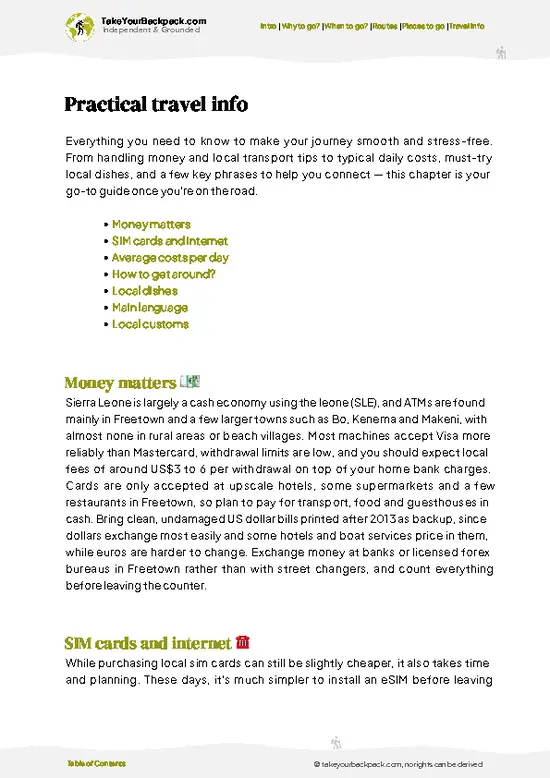
example page 0 from our offline Travel Guide for Sierra Leone
example page 1 from our offline Travel Guide for Sierra Leone
example page 2 from our offline Travel Guide for Sierra Leone
example page 3 from our offline Travel Guide for Sierra Leone
example page 4 from our offline Travel Guide for Sierra Leone
example page 5 from our offline Travel Guide for Sierra Leone
example page 6 from our offline Travel Guide for Sierra Leone
example page 7 from our offline Travel Guide for Sierra Leone
Loading the map 🌍
CLICK TO FILTER
cities
towns
landmarks
national parks
hikes
beaches
attractions
festivals
regions
SHOW COUNTRY’S BESTSHOW ALL

✨ Why go?
Ranked #3 town in Sierra Leone
Reasons people choose to visit here

Lungi earns a place on a route because it is where you arrive, and a little curiosity here pays off. If you land late, sleeping in Lungi beats a dark crossing, and you wake to fishing boats on the estuary and the call to prayer over tin roofs. Most travelers stay a night, sometimes two, which is enough to wander the market, eat grilled fish and cassava with locals, and sit on the shore watching the pirogues. It suits solo travelers who like unscripted afternoons and anyone who wants a gentle first taste of Sierra Leone before Freetown's noise. The Tagrin ferry terminal is the hub for the onward trip, so you can sort tickets and talk to other passengers. Hikers and beach hunters will want to move on quickly, because the famous peninsula beaches and Bunce Island are reached from the Freetown … read more 👉
Lungi earns a place on a route because it is where you arrive, and a little curiosity here pays off. If you land late, sleeping in Lungi beats a dark crossing, and you wake to fishing boats on the estuary and the call to prayer over tin roofs. Most travelers stay a night, sometimes two, which is enough to wander the market, eat grilled fish and cassava with locals, and sit on the shore watching the pirogues. It suits solo travelers who like unscripted afternoons and anyone who wants a gentle first taste of Sierra Leone before Freetown's noise. The Tagrin ferry terminal is the hub for the onward trip, so you can sort tickets and talk to other passengers. Hikers and beach hunters will want to move on quickly, because the famous peninsula beaches and Bunce Island are reached from the Freetown side. Treat Lungi as a soft landing with a few real-life hours attached.

💡 HighlightsEssential experiences to have while visiting Lungi

  1. Tagrin Ferry Terminal and crossing: The jetty is the town's front door, a scrum of porters, ticket sellers and passengers hauling sacks onto boats. Go in the morning when departures are frequent and the air is cooler. Tickets run roughly US$5 to 10 depending on the service, and with queueing you should allow 1 to 2 hours. Watching the estuary open up behind you is the best view of the area.
  2. Lungi waterfront fish landing: Wooden pirogues come in with the catch, and women carry baskets up the sand to be sorted and smoked. Early morning is best, when the catch is freshest and the light is soft. It is free, and 45 minutes is plenty. Ask before photographing people.
  3. Lungi town market: A working market of palm oil, pepper, dried fish, secondhand clothes and phone-charging stalls. Come before midday,
… read more 👉
  1. Tagrin Ferry Terminal and crossing: The jetty is the town's front door, a scrum of porters, ticket sellers and passengers hauling sacks onto boats. Go in the morning when departures are frequent and the air is cooler. Tickets run roughly US$5 to 10 depending on the service, and with queueing you should allow 1 to 2 hours. Watching the estuary open up behind you is the best view of the area.
  2. Lungi waterfront fish landing: Wooden pirogues come in with the catch, and women carry baskets up the sand to be sorted and smoked. Early morning is best, when the catch is freshest and the light is soft. It is free, and 45 minutes is plenty. Ask before photographing people.
  3. Lungi town market: A working market of palm oil, pepper, dried fish, secondhand clothes and phone-charging stalls. Come before midday, when the heat builds and the best produce is gone. Entry is free, and a loop takes about an hour. Buy bananas or groundnuts for a few dollars at most, and bargain politely.
  4. Estuary shoreline walk: A stretch of sand and mangrove edge where kids play football at low tide and the river smells of salt and silt. Late afternoon is the most pleasant time. It costs nothing and takes 1 to 2 hours at an easy pace. Wear sandals you can get muddy.
For day trips beyond Lungi, Port Loko town, the historic Bunce Island slave fort in the river and the Freetown Peninsula beaches such as Tokeh make the best outings. Start with the Tagrin ferry terminal, because understanding how the crossing works makes everything else on your route easier.
Spotted a mistake or missing something? Contact us.

🏘️ NeighborhoodsKey areas and districts to know

Lungi is spread along one road system on the peninsula, so the areas below blur into each other, and you will want a motorbike taxi between them in the heat.
  • Lungi Town center: The market streets sit around the main junction, loud with horns, generators and radio, and smelling of palm oil, charcoal and drying fish. Stalls sell rice with cassava-leaf stew and grilled fish for a few dollars. Walk it in the morning, before the sun flattens everything. By midday the dust and heat make a short okada hop the smarter call.
  • Airport area: Roads here are wider and quieter, lined with taxi touts, small chop bars and money changers. It exists to serve arrivals, so prices are inflated and the haggling starts at your elbow. Agree a fare before you sit down, and carry small notes, because drivers rarely have
… read more 👉
Lungi is spread along one road system on the peninsula, so the areas below blur into each other, and you will want a motorbike taxi between them in the heat.
  • Lungi Town center: The market streets sit around the main junction, loud with horns, generators and radio, and smelling of palm oil, charcoal and drying fish. Stalls sell rice with cassava-leaf stew and grilled fish for a few dollars. Walk it in the morning, before the sun flattens everything. By midday the dust and heat make a short okada hop the smarter call.
  • Airport area: Roads here are wider and quieter, lined with taxi touts, small chop bars and money changers. It exists to serve arrivals, so prices are inflated and the haggling starts at your elbow. Agree a fare before you sit down, and carry small notes, because drivers rarely have change.
  • Tagrin ferry terminal: A crowd of porters, sellers of cold water and peanuts, and the diesel smell of the ferry fill this waterfront. Estuary light is bright and hazy, and the breeze is the only relief. It is walkable inside the terminal, but you will be hustled by porters, so keep your own bag and decline politely with a firm smile.
  • Surrounding villages and creeks: Mangrove edges and fishing landings lie a short motorbike ride away. Mornings bring the sounds of nets and wooden canoes. Go with a local guide, because tracks turn to mud and signs do not exist.

⌛️ 1 dayHow to make the most of one day

6:30 AM, Lungi waterfront: Begin where the town is most alive. Pirogues land the night's catch and the light is soft, so you see how people live before the heat. Walk the sand slowly and buy a coffee or sweet tea from a roadside vendor.

8:30 AM, Lungi town market: Move inland on foot or by a short motorbike ride. Browse the stalls of pepper, palm oil and dried fish, and try fried dough or akara for breakfast. Prices are low, so carry small notes.

11:00 AM, Backstreets and local mosque area: Not on any standard itinerary, the residential lanes behind the market show the real Lungi: women pounding cassava leaf, tailors on treadle machines and goats among the doorways. Greet people first and keep cameras down unless invited.

1:00 PM, Lunch at a local cookhouse: Pick a place with a crowd and order … read more 👉
6:30 AM, Lungi waterfront: Begin where the town is most alive. Pirogues land the night's catch and the light is soft, so you see how people live before the heat. Walk the sand slowly and buy a coffee or sweet tea from a roadside vendor.

8:30 AM, Lungi town market: Move inland on foot or by a short motorbike ride. Browse the stalls of pepper, palm oil and dried fish, and try fried dough or akara for breakfast. Prices are low, so carry small notes.

11:00 AM, Backstreets and local mosque area: Not on any standard itinerary, the residential lanes behind the market show the real Lungi: women pounding cassava leaf, tailors on treadle machines and goats among the doorways. Greet people first and keep cameras down unless invited.

1:00 PM, Lunch at a local cookhouse: Pick a place with a crowd and order rice with cassava leaf or groundnut stew, plus grilled fish if available. Eat slowly, then rest in the shade through the hottest hours.

3:30 PM, Estuary shoreline: Walk the sand and mangrove edge as the tide and temperature change. Kids play football on the flats, and the water turns silver-gray. This is the best time for photographs and a quiet drink.

5:30 PM, Tagrin Ferry Terminal: Finish at the jetty, even if you are not crossing. Watch the last boats load, check next-day departure times and talk to fellow travelers. Then head to your guesthouse for an early night.

🌤️ When to go?When to go for the best experience

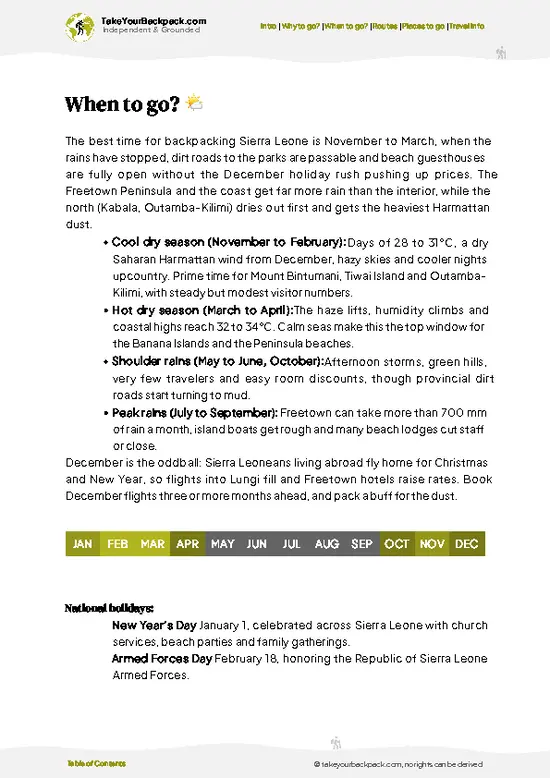
The dry months from roughly November to April give Lungi its easiest travel, with the estuary crossing calm and the roads firm.
  • Dry Season (November to April): Days reach 30 to 33°C (86 to 91°F) and nights drop to around 22 to 24°C (72 to 75°F). December to February brings Harmattan haze, which dulls the light and can delay flights. Crowds and flight prices peak around Christmas.
  • Early Rains (May to June): Humid, 27 to 31°C (81 to 88°F), with sudden downpours. Fewer visitors and softer prices.
  • Peak Rains (July to September): Among the wettest places on the African coast. Roads turn to mud, ferries can run rough, and some creek trips stop. Cheapest period, with long, gray days.
  • Late Rains (October): Storms ease and the landscape is green, a good time for a cheaper trip.
Book flights for January if you want calm water, but expect higher fares.

source: climatestotravel.comJANJanuary: excellent for travelingFEBFebruary: excellent for travelingMARMarch: excellent for travelingAPRApril: highly recommended for travelingMAYMay: fair for travelingJUNJune: fair for travelingJULJuly: fair for travelingAUGAugust: fair for travelingSEPSeptember: fair for travelingOCTOctober: fair for travelingNOVNovember: highly recommended for travelingDECDecember: excellent for traveling
when-to-go

✈️ The backpacker research shortcutSierra Leone Travel Guide

An offline-friendly backpacking guide with optimized travel routes, ranked highlights, transport advice, and the best areas to stay.
example page 0 from our offline Travel Guide for Sierra Leone
example page 1 from our offline Travel Guide for Sierra Leone
example page 2 from our offline Travel Guide for Sierra Leone
example page 3 from our offline Travel Guide for Sierra Leone
example page 4 from our offline Travel Guide for Sierra Leone
example page 5 from our offline Travel Guide for Sierra Leone
example page 6 from our offline Travel Guide for Sierra Leone
example page 7 from our offline Travel Guide for Sierra Leone
The digital guide (242 pages) contains:
✅ 50 highlights, ranked by travel appeal
✅ Optimized 5, 10 & 15-day travel routes
✅ Cities, national parks, landmarks, beaches
✅ How to get around
✅ Offline-friendly for travel without Wi-Fi
👉 Click to see all 30+ guide features

📅 Plan smarter in minutes, not weeks
✅ Month by month travel advice
✅ Festivals & national holidays
✅ Budget expectations

🗺️ Go to the right places, skip the overrated ones
✅ Honest pros & cons of destinations
✅ Top hikes, parks & viewpoints
✅ Lesser-known places most travelers miss
✅ Clear “worth it vs skip it” guidance

🛏️ Travel smoothly without rookie mistakes
✅ Best areas to stay
✅ Transport systems explained simply
✅ Common scams & safety advice
✅ SIM cards, money & practical tips

🌍 Understand the country, not just visit it
✅ Culture & traditions
✅ 52 Essential phrases & customs
✅ Festivals worth planning around
✅ Traveler-friendly historical context
✅ Insights that make places more meaningful

📱 Built for real travel conditions
✅ Fully downloadable PDF
✅ Works completely offline
✅ Optimized for phone use
✅ Useful in remote areas & buses
✅ Everything in one place
Stop searching, start planning
Get instant access to your full guide. 30‑day money-back guarantee.
+ Add another guide for just

By proceeding you agree to our terms.
Sent to your inbox immediately after payment • 100% Secure Checkout
Best Backpacking Travel Advisor 2025 tourism awardBest Backpacking
Travel Advisor
2025
What others say about Take Your Backpack Guides:
⭐⭐⭐⭐⭐
Fantastic, amazing amount of information!
⭐⭐⭐⭐⭐
My goodness this is amazing, it's what I've been looking for hats off too you!
⭐⭐⭐⭐⭐
I think this is absolutely BRILLIANT
⭐⭐⭐⭐
Very complete and informative. It's still missing places, but I gotta to commend you
⭐⭐⭐⭐⭐
This is truly amazing, thank you, can't wait to explore it with my kids!
⭐⭐⭐⭐⭐
Awesome resource, thank you!
⭐⭐⭐⭐⭐
This is amazing! Can't wait to explore the ones I haven't seen
⭐⭐⭐⭐
I love this! Well done, great idea.
⭐⭐⭐⭐⭐
Thanks for taking the time to make this gem!
⭐⭐⭐⭐⭐
This might be the best website I've ever seen.
⭐⭐⭐⭐⭐
Congratulations, and thank you so much for your work; it's incredibly valuable.
⭐⭐⭐⭐
In all seriousness I think you did a great job pointing out the important spots
⭐⭐⭐⭐⭐
10/10 very good
⭐⭐⭐⭐⭐
As someone who's only just starting to visit regularly this is awesome, thank you.
⭐⭐⭐⭐
Thank you very much! I'm going to visit my dad, it's going to be very useful!
⭐⭐⭐⭐⭐
This is really cool! We'll be travelling for the first time and this definitely come in handy.
⭐⭐⭐⭐⭐
You are now our minister of culture, congratulations 👨‍💼
⭐⭐⭐⭐⭐
Just wanted to tell you that this is a pearl! Going to follow your recommendations.
⭐⭐⭐⭐⭐
This is so cool. I'll definitely be using the resource for my travels soon.
⭐⭐⭐⭐⭐
This is very impressive! Good work.
⭐⭐⭐⭐⭐
This is an amazing and informative site. Very well done!

🛏️ Where to stay?Choosing the right base

The best budget bed in Lungi is in the town center, near the market and the main road, where small guesthouses are clustered. Dorm hostels do not exist here, so expect private rooms with a fan or air conditioning for about US$20 to 40 a night. Rooms are basic and power outages are common, so ask whether a generator runs and bring a headlamp.

The center works best because food, water, phone credit and okada are within a few minutes’ reach, and motorbike taxis pass until late evening. Noise is the price: generators, music and early morning calls start before dawn, so earplugs help. Walking after … read more 👉
The best budget bed in Lungi is in the town center, near the market and the main road, where small guesthouses are clustered. Dorm hostels do not exist here, so expect private rooms with a fan or air conditioning for about US$20 to 40 a night. Rooms are basic and power outages are common, so ask whether a generator runs and bring a headlamp.

The center works best because food, water, phone credit and okada are within a few minutes’ reach, and motorbike taxis pass until late evening. Noise is the price: generators, music and early morning calls start before dawn, so earplugs help. Walking after dark is fine along the main stretch, but side streets are unlit, so take a short okada ride back.

The airport area is the second option if you have an early flight. Guesthouses there cost a little more, about US$30 to 50, and are quiet with a short transfer, though food choice is thin and everything depends on drivers. Both places are best booked by phone or a message ahead, as walk-in rooms fill up when flights are delayed. Carry cash in small notes, because card payment is rare.

🚌 Getting aroundGetting around like a local

Lungi has no bus station, so from the airport terminal you take a shared minibus or taxi into the town center, a ride of about 10 to 15 minutes costing roughly US$1 to 3 per seat or US$8 to 15 for a whole taxi. Prices are set by negotiation, which is why you agree first and pay at the end. Roads are mostly paved near the airport but potholed and dusty on side streets, and traffic is mild apart from the ferry rush. Most backpackers move by okada and ferry.
  • Walking: Fine in the center and around the market in the cool early morning. Midday heat is heavy and pavements are scarce, so you share the road with motorbikes, and the roadside is red dust that coats your shoes.
  • Okada (motorbike taxi): The fastest way around, at US$0.50 to 2 per ride. Ask for a helmet, because few drivers carry one, and
… read more 👉
Lungi has no bus station, so from the airport terminal you take a shared minibus or taxi into the town center, a ride of about 10 to 15 minutes costing roughly US$1 to 3 per seat or US$8 to 15 for a whole taxi. Prices are set by negotiation, which is why you agree first and pay at the end. Roads are mostly paved near the airport but potholed and dusty on side streets, and traffic is mild apart from the ferry rush. Most backpackers move by okada and ferry.
  • Walking: Fine in the center and around the market in the cool early morning. Midday heat is heavy and pavements are scarce, so you share the road with motorbikes, and the roadside is red dust that coats your shoes.
  • Okada (motorbike taxi): The fastest way around, at US$0.50 to 2 per ride. Ask for a helmet, because few drivers carry one, and fix the price before you climb on, since there are no meters. Rides are loud, hot and exhilarating.
  • Keke (tricycle) and shared taxis: Cheaper per person on fixed corridors, about US$0.30 to 1 per seat, but they wait until full. Start early, as vehicles thin out by evening, usually after dark.
  • Tagrin ferry to Freetown: The cheapest crossing for Freetown, around US$3 to 6, taking 30 to 45 minutes across the estuary plus waiting. Boarding is a crush of bags and sellers, so keep valuables in front. Schedules slip and the last sailings are in the afternoon, so don’t plan a late return. Arrive early for a seat out of the sun.
  • Speedboat transfer to Freetown: The faster, drier choice at about US$40 to 45 one way and roughly 20 to 30 minutes on the water. Worth it for a night flight or a tight connection, as the hard benches and spray are bearable only for a short crossing.

👛 Costs (as of 22 October 2026)How expensive it really is

Lungi costs about US$60 a day for a backpacker, and since transfers and rooms are priced for airport traffic, that is more than inland towns.
CategoryBudget RangeLocal Reality
Dorm accommodationUS$20 to 40No true dorms. Private guesthouse rooms with a fan, with generator power that comes and goes.
MealsUS$4 to 8Rice with stew or grilled fish at chop bars costs US$2 to 4. Restaurant meals cost more.
Local transportUS$2 to 5Okada rides at US$0.50 to 2. The ferry to Freetown costs US$3 to 6 each way.
Basic activities/entry feesUS$0 to 10Walking the market and waterfront costs nothing. Sites on day trips charge about US$10 to 15.
Miscellaneous expensesUS$3 to 6Water, SIM credit and small tips. Cash in local currency is used, so exchange in small amounts.
Total Daily BudgetUS$60Before day trips and speedboat
… read more 👉
Lungi costs about US$60 a day for a backpacker, and since transfers and rooms are priced for airport traffic, that is more than inland towns.
CategoryBudget RangeLocal Reality
Dorm accommodationUS$20 to 40No true dorms. Private guesthouse rooms with a fan, with generator power that comes and goes.
MealsUS$4 to 8Rice with stew or grilled fish at chop bars costs US$2 to 4. Restaurant meals cost more.
Local transportUS$2 to 5Okada rides at US$0.50 to 2. The ferry to Freetown costs US$3 to 6 each way.
Basic activities/entry feesUS$0 to 10Walking the market and waterfront costs nothing. Sites on day trips charge about US$10 to 15.
Miscellaneous expensesUS$3 to 6Water, SIM credit and small tips. Cash in local currency is used, so exchange in small amounts.
Total Daily BudgetUS$60Before day trips and speedboat transfers.
Take the ferry rather than a speedboat and buy meals at local chop bars to save US$30 or more on a crossing day.
⚠️ Prices can change and everyone travels differently, so take this as a rough guide. Hope it helps you plan your adventure!

🚌 Day tripsShort trips worth adding

Lungi works as a base for a few long days, mostly pointed south toward Freetown, and the ferry timetable controls everything.
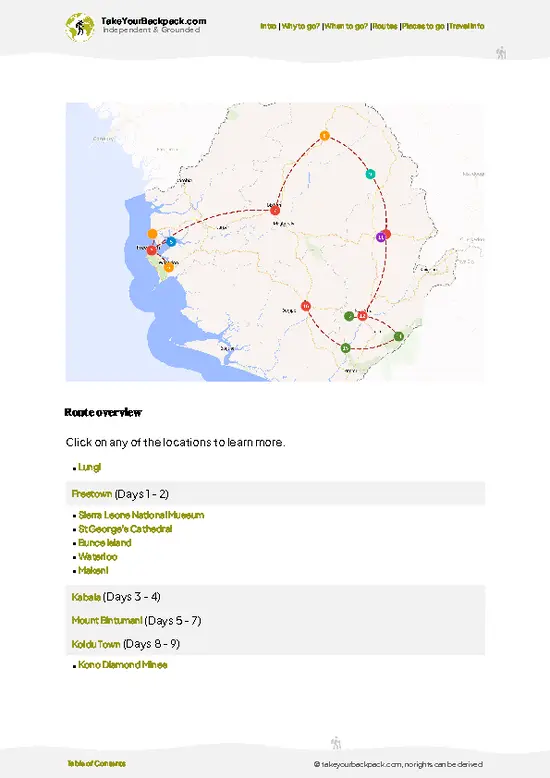
Freetown and Tacugama: Cross on the Tagrin ferry, about 30 to 45 minutes, then take shared taxis to the capital for the National Museum, the Cotton Tree and Lumley Beach. Tacugama Chimpanzee Sanctuary in the hills is a half-day extra, with entry around US$10 to 15 and taxi costs of US$10 to 20. Total outlay is about US$25 to 40. Leave by 7 am and do not miss the last ferry back.
👉 Explore Freetown
Bunce Island: The ruined slave fort in the river is Sierra Leone’s most affecting heritage site, with crumbling brick walls and cannons under big trees. Boats go from the Freetown side, usually with a guide, and cost roughly US$50 to 100 depending on group size, plus about US$10 … read more 👉
Lungi works as a base for a few long days, mostly pointed south toward Freetown, and the ferry timetable controls everything.
Freetown and Tacugama: Cross on the Tagrin ferry, about 30 to 45 minutes, then take shared taxis to the capital for the National Museum, the Cotton Tree and Lumley Beach. Tacugama Chimpanzee Sanctuary in the hills is a half-day extra, with entry around US$10 to 15 and taxi costs of US$10 to 20. Total outlay is about US$25 to 40. Leave by 7 am and do not miss the last ferry back.
👉 Explore Freetown
Bunce Island: The ruined slave fort in the river is Sierra Leone’s most affecting heritage site, with crumbling brick walls and cannons under big trees. Boats go from the Freetown side, usually with a guide, and cost roughly US$50 to 100 depending on group size, plus about US$10 to 15 entry. Count a full day. Go in the dry season, when the river is calm, and arrange the boat the day before.
👉 Explore Bunce Island
Port Loko: This district town lies inland by road, about 1.5 to 2 hours by shared taxi at US$3 to 6. The reward is the riverside setting, the market and the old trading history. The common mistake is leaving late, because transport back thins by mid-afternoon, so start at dawn.
👉 Explore Port Loko
Tombo and the peninsula beaches: From Freetown, shared taxis run to fishing villages on the peninsula, where smoking racks and painted boats line the sand. Costs run US$10 to 25 beyond the crossing, and weekdays are quieter. Wear shoes for the hot sand.

🛡️ SafetyScams, Hazards, and Annoyances

Lungi is generally calm, and most trouble is petty rather than violent. The airport area and ferry terminal are the places to stay alert, because touts and porters crowd arrivals, grab bags and then demand payment. Say a firm no, carry your own luggage, and agree taxi and okada prices before leaving. Change money only at known counters, and count it twice. Solo travelers, women included, are fine in daylight, but side streets are unlit, so use a motorbike taxi after dark and avoid walking with a phone in hand. Keep valuables out of sight in ferry crowds, where pickpockets work the boarding crush. Police and officials may occasionally ask for informal payments at checkpoints, so stay polite, carry a passport copy and keep the original to hand. Drink bottled water, use mosquito protection at … read more 👉
Lungi is generally calm, and most trouble is petty rather than violent. The airport area and ferry terminal are the places to stay alert, because touts and porters crowd arrivals, grab bags and then demand payment. Say a firm no, carry your own luggage, and agree taxi and okada prices before leaving. Change money only at known counters, and count it twice. Solo travelers, women included, are fine in daylight, but side streets are unlit, so use a motorbike taxi after dark and avoid walking with a phone in hand. Keep valuables out of sight in ferry crowds, where pickpockets work the boarding crush. Police and officials may occasionally ask for informal payments at checkpoints, so stay polite, carry a passport copy and keep the original to hand. Drink bottled water, use mosquito protection at all times, and start trips early, as travel after dusk is slower and riskier.

FAQFrequently asked questions about Lungi

Lungi is mostly a gateway, but a day or two works if you like estuary scenery and local markets. The Tagrin ferry terminal, the town center market and mangrove creeks give a taste of life on the peninsula, while the real draws are across the water in Freetown and at Bunce Island. Rooms run about US$20 to 40 a night.
Lungi needs one night if you are connecting through the airport and two days if you want to explore. A day covers the market, ferry terminal and creeks, and a second day can go to Freetown or Port Loko, which is about 1.5 to 2 hours inland. Most travelers spend longer on the Freetown side, where beaches and sights are concentrated.
Yes, Lungi can be a day trip from Freetown, using the Tagrin ferry that takes 30 to 45 minutes and costs about US$3 to 6 each way. Speedboats take 20 to 30 minutes at roughly US$40 to 45. There is little to see, so most people only come for the airport, so plan to return before the last afternoon sailings.
⚠️ Things can change over time, so always validate details locally before you go.

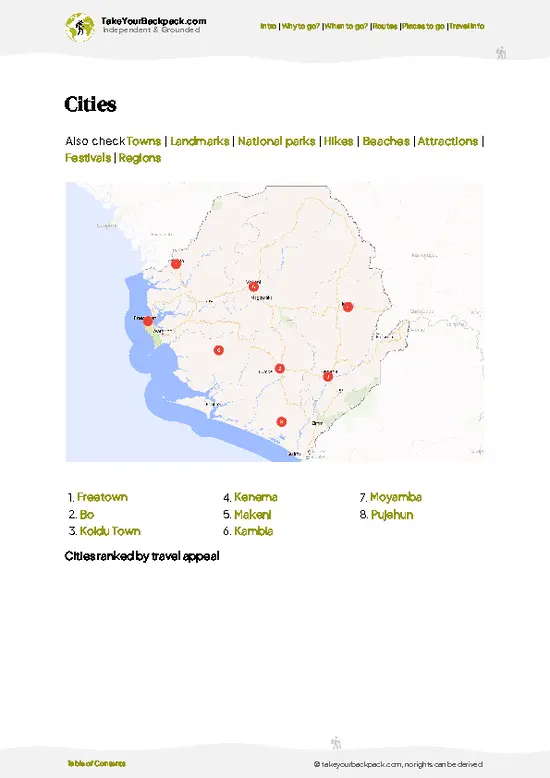
Other Sierra Leonean towns near Lungi

Explore more nearby:

  • Waterloo—Transport park, up-country transfers, peninsula forest edge| 40 km away
  • Port Loko—Tidal creek wharf, Temne chieftaincy, colonial-era streets| 50 km away
  • Rokupr—Rice research station, Great Scarcies landing, tidal paddies| 50 km away

💡 Not sure where to go next?
Create a personalized itinerary for Sierra Leone including Lungi and the places that fit your trip.

Generate my itinerary

👉 Discover all towns

Or checkout all Sierra Leone has to offer (think cities, towns, villages, national parks, hikes, beaches, festivals)
Country photo of Sierra Leone

We 💚 feedbackSumming up the experience

Lungi pairs best with a Freetown stay and a trip to the Peninsula beaches, so use it as the quiet first or last night of the route. Keep the evening free for the waterfront and stash your boat tickets early. I would skip rushing the crossing and carry small US dollar bills and a headlamp for when the power drops.

✍️ Help improve this page!
The information on this page is based on in-depth research, insights shared by experienced travelers, and feedback from the local travel community in Sierra Leone. While every effort is made to keep the information accurate and current, conditions can change — so if you spot anything incorrect or outdated, please get in touch.


🙋‍♂️ Give feedback

👋 Meet the founderWho’s Behind Take Your Backpack?

Johan, backpacker and founder of TakeYourBackpackHi, I’m Johan (Netherlands 🇳🇱), the creator of TakeYourBackpack. Over the past 3 decades, I’ve backpacked through 90+ countries across six continents, gaining extensive experience with independent travel, long-term trips, and overland routes.

This site is built on a combination of firsthand travel experience and carefully curated insights from other backpackers. Many guides are based on places I’ve personally visited, while others bring together tips, observations, and practical advice shared by trusted travelers I’ve met along the way.

The goal is to provide realistic, experience-driven guidance — not generic itineraries — so you can explore destinations with better context, clearer expectations, and more confidence.