Short answer: Somalia is not an easy or typical country to backpack independently, especially for budget travelers, and in many areas it is not advisable at all. Security is the main issue, not money or logistics. Large parts of the country, especially much of south-central Somalia including Mogadishu and surrounding regions, have ongoing security risks such as armed conflict, terrorism, kidnappings, and clan-related violence. Independent backpacking in those areas is far beyond the normal “adventure travel” category and usually requires armed escorts, strict movement controls, and serious risk tolerance. That is not the kind of place where you just show up with a backpack and wing it.
If you are determined to visit the Somali region with a backpacker mindset, the more realistic entry point is Somaliland (the self-declared republic in the northwest, with Hargeisa as its capital) and, to a lesser extent, Puntland (around Garowe and Bosaso). These areas are comparatively more stable and have a small but growing trickle of independent travelers. Even there, you are not really “free roaming” in the classic Southeast Asia or South America sense. You will often need permits, police escorts on certain routes, and you must stay on top of local advice.
For a first-time visitor, the safest and most practical approach is to treat Somalia as a place where you travel semi-independently but lean heavily on local fixers, trusted guesthouses, or small local agencies. That means: arranging airport pickup in advance, having your first nights booked, and asking your host which areas are safe to walk and which require a car and escort. You will not be casually hitchhiking or wild camping.
Budget-wise, Somalia is deceptive. Daily costs for food and basic accommodation can be low, but security-related costs (escorts, private drivers, permits, staying in safer hotels) can push your daily budget far above typical backpacker levels. If you try to cut corners on safety to save money, you are making a very bad trade. This is one of those countries where “value” means paying for safety and local knowledge, not chasing the absolute cheapest option.
In practical terms, Somalia is suitable only for experienced travelers who are comfortable in high-risk environments, used to dealing with checkpoints, and willing to accept that plans can change quickly. If you are on your first big backpacking trip, there are many other East African countries that offer rich culture and adventure with far fewer hard risks. Somalia is a specialist destination, not a casual add-on.
For most backpackers, 7–10 days is enough for a focused, realistic trip to the safer and more accessible parts of Somalia, mainly Somaliland and possibly Puntland. This gives you time to land, get your bearings, adjust to the security rhythm, and see a few key places without rushing through checkpoints and long drives.
If you are concentrating on Somaliland only, a tight but workable plan is 5–7 days: a couple of days in Hargeisa to sort permits and understand local norms, a side trip to Laas Geel (the rock art site), and maybe a run to Berbera on the coast for the Gulf of Aden and some downtime. That already gives you a good feel for the region’s culture and landscape without pushing your luck or your budget.
If you want to add Puntland (for example, flying into Bosaso for the coast or Garowe for a look at the interior), you should aim for 10–14 days. Travel between regions is slow, security checks take time, and you cannot assume you can just hop on any bus at any hour. Building in buffer days is smart, because flights can be delayed, roads can be closed, and local authorities may change rules on short notice.
Trying to “do Somalia” in 3–4 days is not worth it. You will spend most of your time dealing with logistics and security briefings rather than actually experiencing anything. On the other hand, staying longer than two weeks only makes sense if you have a specific purpose (research, work, family ties) and strong local support. As a pure backpacker, your risk exposure rises with time, while the marginal reward after two weeks is relatively small unless you are deeply invested in the place.
The sweet spot for most budget-conscious, safety-aware travelers is: one week in Somaliland if you are adding it to a broader Horn of Africa trip, or up to two weeks if you are deliberately focusing on Somali regions and want to move slowly and cautiously.
You technically can move around parts of Somalia without having your own car, but it is not like backpacking in countries with easy public transport. The answer depends heavily on which region you are in and how much risk you are willing to accept.
In Somaliland, there are shared minibuses and 4x4s running between major towns like Hargeisa, Berbera, and Burco. These are cheap and used by locals, but foreigners are sometimes required to have a police escort on certain routes, especially outside main cities. That can mean you either join a vehicle arranged by your guesthouse or you pay extra for a private car with an escort. Walking around central Hargeisa by day is usually possible, but you still need to follow local advice about where not to go and when to be back at your accommodation.
In Puntland and especially in south-central Somalia, independent use of public transport is much more complicated and often not recommended. Many foreigners move only in pre-arranged vehicles, often with security staff, and sometimes only between secure compounds, airports, and specific sites. That is the opposite of spontaneous backpacker travel.
For a budget traveler, the most realistic strategy is a hybrid: use local minibuses or shared taxis on routes that your host or fixer confirms are safe and legal for foreigners, and accept that for some legs you will need to pay for a private car. This will cost more than a typical backpacking day but is still cheaper than trying to rent and drive your own vehicle, which adds risk at checkpoints and in chaotic traffic.
Cycling and hitchhiking are not practical or safe options in most of Somalia. Long-distance walking between towns is also not realistic due to security, heat, and lack of infrastructure. Think of Somalia as a place where you can move without owning a car, but you cannot move without local help and a flexible budget for transport.
For a backpacker willing to take on the challenge, the “must-visit” list in Somalia is really a “must-consider, if security allows” list. The focus is on places that combine cultural depth with relatively better stability and some basic infrastructure.
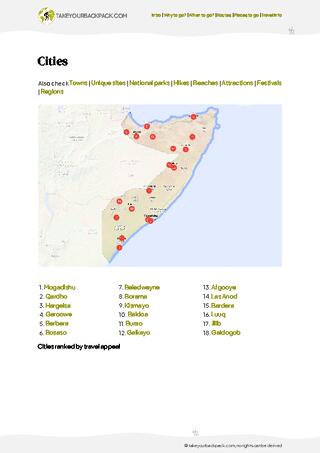
1. Hargeisa (Somaliland)
Hargeisa is the practical and cultural entry point for most independent travelers. It has a busy, dusty energy, strong tea culture, and a sense of local pride. You can wander markets, drink endless shaah (tea), and get a feel for everyday Somali life without the intense edge of Mogadishu. It is also where you sort permits and arrange trips to other parts of Somaliland.
2. Laas Geel Rock Art (near Hargeisa)
Laas Geel is one of the most impressive rock art sites in Africa, with vivid ancient paintings of cattle, humans, and ritual scenes. The site is relatively compact but atmospheric, set among rocky outcrops with wide views. You usually visit on a day trip from Hargeisa with a car and guide, often with a police escort. For many travelers, this is the single most compelling reason to come to Somaliland.
3. Berbera (Somaliland coast)
Berbera sits on the Gulf of Aden and offers a mix of decaying Ottoman and colonial-era architecture, a long beach, and a harsh, dry coastal climate. It is not a polished beach resort; it is more about slow walks, swimming when conditions allow, and watching port life. For backpackers, it is a good place to decompress after the intensity of inland travel and to see another side of Somali life.
4. Bosaso (Puntland, if security allows)
Bosaso is a major port city on the Gulf of Aden with a strong trading vibe. If conditions are stable and you have solid local contacts, it can be an interesting base to see how maritime trade shapes the region. It is not a classic tourist destination, but for travelers who like ports, markets, and raw edges, it has character.
5. Everyday tea houses and markets
The real “must-visit” in Somalia is the daily social life: tea stalls, khat markets, small restaurants serving rice and goat, and the informal conversations that happen when people realize you are a foreigner who chose to come here. These are not single points on a map, but they are where you actually feel the country. Prioritize time sitting, watching, and talking over ticking off a long list of sights.
Mogadishu and other south-central cities can be fascinating and historically important, but for most backpackers they are not realistic “must-visits” due to security. If you ever go, it should be with serious preparation, local partners, and an understanding that this is more like a controlled field visit than casual travel.
If you are short on time or working with a tight risk budget, the key is to focus on a compact, safer route and skip anything that adds complexity without adding much reward.
1. Skip south-central Somalia (including Mogadishu) unless you have a specific reason and strong support
For most backpackers, Mogadishu and surrounding regions are not worth the security risk, cost, and logistical headache. You will likely be confined to secure areas, moved around in controlled vehicles, and pay high prices for hotels and security. You will not get the freedom that makes backpacking fun. Unless you have work, research, or family reasons, concentrate on Somaliland instead.
2. Skip trying to “cover the whole country”
Somalia is large, infrastructure is limited, and security varies widely. Trying to see “all of Somalia” in one trip is unrealistic and dangerous. Pick one region—usually Somaliland—and do it properly rather than racing between Hargeisa, Bosaso, and any southern city just to say you have been there.
3. Skip remote rural areas without a clear plan
The idea of trekking into remote villages or wild camping in the Somali countryside sounds adventurous, but it is not practical for most visitors. Security, landmines in some areas, clan boundaries, and lack of services make this a high-risk, low-reward move. If you want nature, short, guided excursions from cities like Hargeisa or Berbera are a better bet.
4. Skip nightlife and late-night wandering
If you are short on time, do not waste energy trying to find a “scene” after dark. Most social life is daytime or early evening. Late-night wandering adds risk and rarely adds insight. Use evenings to rest, write, and talk with your hosts instead.
5. Skip chasing ultra-cheap options that compromise safety
In Somalia, the temptation to save a few dollars by taking the absolute cheapest bus, staying in the least secure guesthouse, or skipping an escort is not worth it. If you are short on time, pay for the safer, more direct option so you can actually see something instead of getting stuck in avoidable problems.
In practice, a time-pressed backpacker should focus on Hargeisa, Laas Geel, and Berbera, and skip everything that requires long, uncertain overland journeys or heavy security arrangements. That way you still get a real taste of Somali culture without turning your trip into a stress test.
v2.webp)
 Best Backpacking

