×

Somalia🇸🇴 | best landmarksYour Guide to the 4 Best landmarks in Somalia

Landmarks in Somalia are ancient, remote and almost never staffed. Expect rock shelters, ruined coastal towns, Ottoman-era stone buildings and dervish forts, not ticket booths. Somaliland is where independent travel works: a guide and a 4x4 can be arranged in Hargeisa, roads are paved to the coast, and you will often be the only visitor. Puntland has remote sites and needs local fixers. South-central Somalia, including Mogadishu, is not worth planning a backpacking trip around because of the security situation. Skip anything that depends on a casual, unescorted wander. Back the northwest.

By Johan Kruseman 🇳🇱 | Updated November 10, 2026
Explore the best national parks in Somalia

Why go?What Makes Them Special

Somalia’s landmarks are unusual because they come from trade, pastoral life and resistance, not from empires that left monuments behind. The coastline is the longest on mainland Africa, and old ports on the Gulf of Aden and the Indian Ocean carry Arab, Persian, Ottoman and Italian layers. Inland, the dry, rocky north preserved prehistoric rock art and stone ruins that wetter countries would have lost to vegetation.

The trade-off is infrastructure. There is almost no heritage management, so signage, museums and interpretation are thin or missing, and conservation is uneven. Some sites have been damaged by conflict, looting or neglect. If you want polished visitor centers and printed maps, choose another country.

Know the map before you commit. Somaliland is the practical choice, with relative … read more 👉
Somalia’s landmarks are unusual because they come from trade, pastoral life and resistance, not from empires that left monuments behind. The coastline is the longest on mainland Africa, and old ports on the Gulf of Aden and the Indian Ocean carry Arab, Persian, Ottoman and Italian layers. Inland, the dry, rocky north preserved prehistoric rock art and stone ruins that wetter countries would have lost to vegetation.

The trade-off is infrastructure. There is almost no heritage management, so signage, museums and interpretation are thin or missing, and conservation is uneven. Some sites have been damaged by conflict, looting or neglect. If you want polished visitor centers and printed maps, choose another country.

Know the map before you commit. Somaliland is the practical choice, with relative stability, a working capital and reachable sites. Most governments advise against travel to much of the rest of Somalia, and insurance may not cover it. Independent wandering is not realistic: local guides, permits and sometimes armed escorts are part of the cost. Come for atmosphere, scale and silence, and bring patience for logistics.
Why These Made the Cut
The list of best unique sites in Somalia is created based on history or culture, wow factor, atmosphere, quirks, and memorability. If you feel a unique site is missing in this list, please let us know.

When to go?When to Plan Your Trip

Best months and why: The best months are November to March, when the dry Jilal season brings clear skies, cool mornings and firm tracks to the northwest. In Hargeisa (about 1,300 m) daytime highs run roughly 22 to 28°C and nights can drop to 8 to 14°C, which makes long site visits comfortable.

Shoulder seasons: October and April to May are workable but less predictable. The Gu rains arrive from April and deliver short, heavy downpours that can flood dry riverbeds and make unpaved tracks slow or impassable for a day or two. A second, lighter rainy spell, the Deyr, usually falls in October and November. Hargeisa can also see showers in August and September.

Seasons to avoid: June to August is the weak window along the coast. Berbera and Zeila regularly hit 38 to 45°C with heavy humidity, and shade … read more 👉
Best months and why: The best months are November to March, when the dry Jilal season brings clear skies, cool mornings and firm tracks to the northwest. In Hargeisa (about 1,300 m) daytime highs run roughly 22 to 28°C and nights can drop to 8 to 14°C, which makes long site visits comfortable.

Shoulder seasons: October and April to May are workable but less predictable. The Gu rains arrive from April and deliver short, heavy downpours that can flood dry riverbeds and make unpaved tracks slow or impassable for a day or two. A second, lighter rainy spell, the Deyr, usually falls in October and November. Hargeisa can also see showers in August and September.

Seasons to avoid: June to August is the weak window along the coast. Berbera and Zeila regularly hit 38 to 45°C with heavy humidity, and shade is scarce at open ruins. On the Indian Ocean side, including Puntland’s eastern coast, the southwest monsoon stirs rough seas and strong, dusty winds, which makes coastal sites unpleasant and boat access unreliable. Skip them in these months.

Crowds are not a factor anywhere, so peak pricing barely exists. Costs change instead with demand for vehicles: around Eid and in cool-season weeks, book a 4x4 and driver a few days ahead. Ramadan shifts opening hours and food availability, so confirm daily plans with your guide.

unique site hoppingSuggested Travel Strategies

How many days to plan: A trip combining several landmarks in Somalia needs 7 to 10 days, and nearly all of it should be based in Somaliland, with Hargeisa as the hub.

Which regions go together: Cluster by road. The area around Hargeisa is a series of short day trips, then the Berbera coast (about 150 km, 2 to 3 hours on a paved road), then a loop toward Sheikh and Burao (Hargeisa to Burao is roughly 3.5 to 4 hours). Zeila and the Borama side of Awdal lie to the west and need their own leg: allow 7 to 9 hours each way from Hargeisa and an overnight. Travel outward from Hargeisa and return the same way, not a tight circle, because road conditions and checkpoint timing can change plans.

Time per stop: Give each site half a day to a full day, including the drive. Rock-art and ruin sites need two … read more 👉
How many days to plan: A trip combining several landmarks in Somalia needs 7 to 10 days, and nearly all of it should be based in Somaliland, with Hargeisa as the hub.

Which regions go together: Cluster by road. The area around Hargeisa is a series of short day trips, then the Berbera coast (about 150 km, 2 to 3 hours on a paved road), then a loop toward Sheikh and Burao (Hargeisa to Burao is roughly 3.5 to 4 hours). Zeila and the Borama side of Awdal lie to the west and need their own leg: allow 7 to 9 hours each way from Hargeisa and an overnight. Travel outward from Hargeisa and return the same way, not a tight circle, because road conditions and checkpoint timing can change plans.

Time per stop: Give each site half a day to a full day, including the drive. Rock-art and ruin sites need two to three hours on foot in good light. Sites in Puntland, such as dervish-era forts near Taleh, need their own planning and add several days each way, so do not squeeze them into a Somaliland trip.

Planning mistakes: The usual error is cramming three stops into a day. Distances look short on a map, but 4x4 tracks, police checkpoints and heat slow everything. Plan one major stop per day. The second error is leaving arrangements until arrival. Book the guide and vehicle in Hargeisa the day before, and add a buffer day for rain or delayed permits.

The ListThe Best landmarks of Somalia

1 Laas Geel

Painted rock shelters, lyre-horned cattle, granite outcrop, caretaker-led

Climb a low granite hill with the caretaker to see ochre, white and black cattle painted thousands of years ago, then reach the ceremonial cow.

2 Old Port of Mogadishu

Dhow quay, fish landing, coral-stone Hamar Weyne, medieval mosques

Watch wooden boats unload tuna at the working quay, then follow narrow lanes behind it to battered coral-stone houses and thirteenth-century mosques.

3 Elman Peace Centre

Working compound, survivor support, former fighters retrained, family-led

Arrange a visit to hear staff explain a crisis center and a rehabilitation program for former child soldiers, told by the Somalis who run them.

4 Abasa

Adal-era ruins, 200 stone houses, mosque columns, 4x4 access

Walk the wall lines of a ruined highland town, study the mosque’s mixed column forms, and read the street plan across open thorn-dotted ground.

Loading the map 🌍

Expert viewExpert Commentary on landmarks

How many landmarks to visit: Plan on four to six landmarks in total, all in Somaliland. Roads are long, daylight working hours are short, and each stop needs a guide and a vehicle, so more than one major site a day wastes money and leaves you tired for the next. Fewer than four rarely justifies the visa and the flight in.

Which kind to prioritize: Choose by travel style. If you want the one thing Somalia does better than anywhere nearby, put prehistoric rock art and open-landscape sites first: they are close to Hargeisa and cheap to reach. If you like architecture, favor old port towns, where crumbling Ottoman and coral-stone buildings take an hour or two to see, not a day. Skip trying to reach remote forts or sites in Puntland on a short, low-budget trip. They are the most expensive per hour … read more 👉
How many landmarks to visit: Plan on four to six landmarks in total, all in Somaliland. Roads are long, daylight working hours are short, and each stop needs a guide and a vehicle, so more than one major site a day wastes money and leaves you tired for the next. Fewer than four rarely justifies the visa and the flight in.

Which kind to prioritize: Choose by travel style. If you want the one thing Somalia does better than anywhere nearby, put prehistoric rock art and open-landscape sites first: they are close to Hargeisa and cheap to reach. If you like architecture, favor old port towns, where crumbling Ottoman and coral-stone buildings take an hour or two to see, not a day. Skip trying to reach remote forts or sites in Puntland on a short, low-budget trip. They are the most expensive per hour of sightseeing and the hardest to arrange safely. History-focused travelers can spend extra on a good local guide instead of adding more sites.

What it costs: Budget US$60 to 110 a day for independent travel with a guide. A 4x4 with driver typically costs US$100 to 150 a day, shared among passengers, and a guide US$30 to 50 a day. Site fees and guide charges at the better-known rock-art area are usually in the US$10 to 25 per person range. Basic guesthouses in Hargeisa run about US$25 to 60 a night. Prices are quoted in US dollars, which is what you will actually pay, though Somaliland shillings circulate for small purchases. Carry clean, recent US$ notes. Damaged or older notes are often refused.

Costs and delays that catch travelers out: Booking a vehicle on the spot at a site means a tourist markup. Agree the full price, fuel and driver meals in writing in Hargeisa. Late permits and checkpoints also eat time, so register with tourism authorities in the capital before heading out, and start drives by 7 or 8 am. Mobile money is common but cards are not, so withdraw and exchange cash in Hargeisa. Do not rely on ATMs at remote stops.

Safety and cultural rules: Hire a local guide for every site, even where it is not strictly required. Guides handle checkpoints, local relationships and navigation, and a hired armed escort is sometimes necessary and must be arranged beforehand. Avoid the Sool and Sanaag border areas and anywhere south of the Somaliland frontier unless an experienced local operator advises otherwise. Get a policy that explicitly covers Somalia. Dress modestly, cover shoulders and knees, and ask before photographing people, military buildings or religious sites. Do not touch or climb on rock art or old walls, and never remove pottery or stones. Respect prayer times and avoid public eating and drinking during daylight in Ramadan.

✈️ The backpacker research shortcutSomalia Travel Guide

What the free pages can't give you: ready-made routes, every place ranked, and it works offline. All in 1 guide.
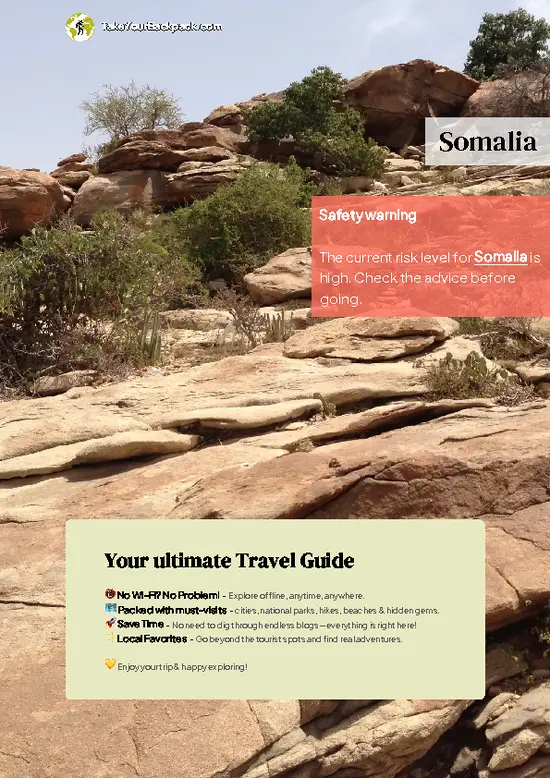
example page 0 from our offline Travel Guide for Somalia
example page 1 from our offline Travel Guide for Somalia
example page 2 from our offline Travel Guide for Somalia
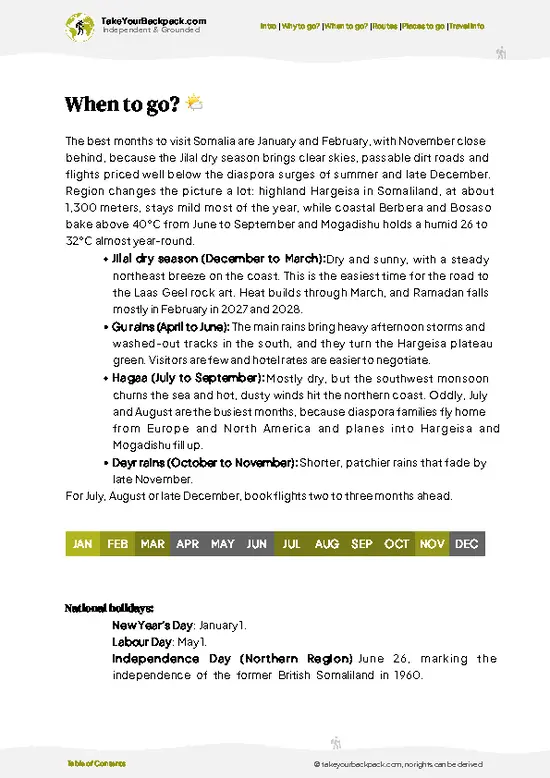
example page 3 from our offline Travel Guide for Somalia
example page 4 from our offline Travel Guide for Somalia
example page 5 from our offline Travel Guide for Somalia
example page 6 from our offline Travel Guide for Somalia
example page 7 from our offline Travel Guide for Somalia
The digital guide (237 pages) contains:-page digital guide:
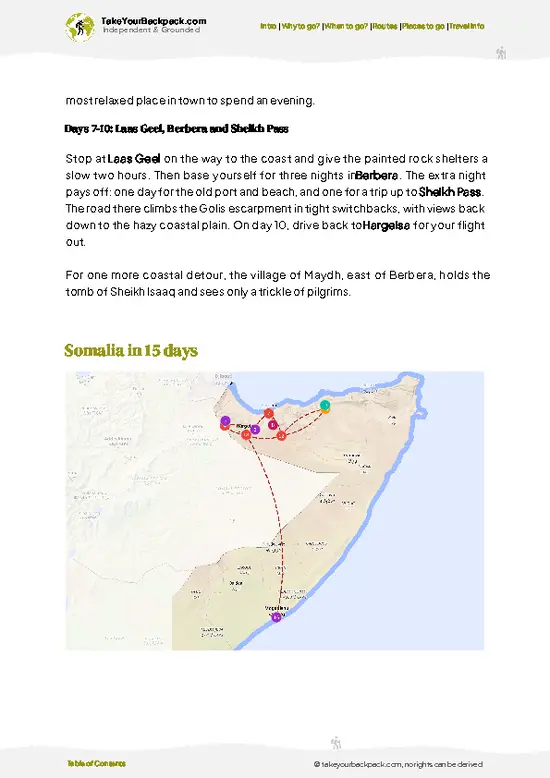
✅ Ready-made 5, 10 & 15-day routes
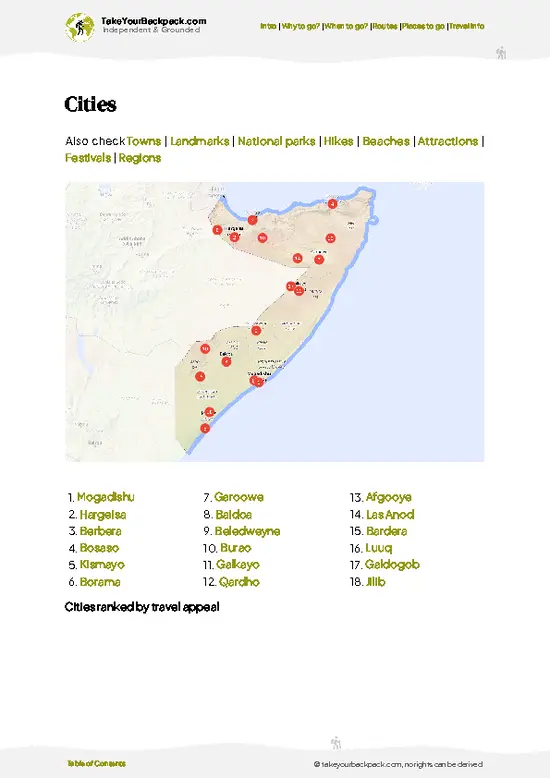
✅ All 68 places ranked, so you skip the overrated ones
✅ Works offline, all in 1 guide
✅ Cities, national parks, landmarks, beaches
✅ How to get around
👉 Click to see all 30+ guide features

📅 Plan smarter in minutes, not weeks
✅ Month by month travel advice
✅ Festivals & national holidays
✅ Budget expectations

🗺️ Go to the right places, skip the overrated ones
✅ Honest pros & cons of destinations
✅ Top hikes, parks & viewpoints
✅ Lesser-known places most travelers miss
✅ Clear “worth it vs skip it” guidance

🛏️ Travel smoothly without rookie mistakes
✅ Best areas to stay
✅ Transport systems explained simply
✅ Common scams & safety advice
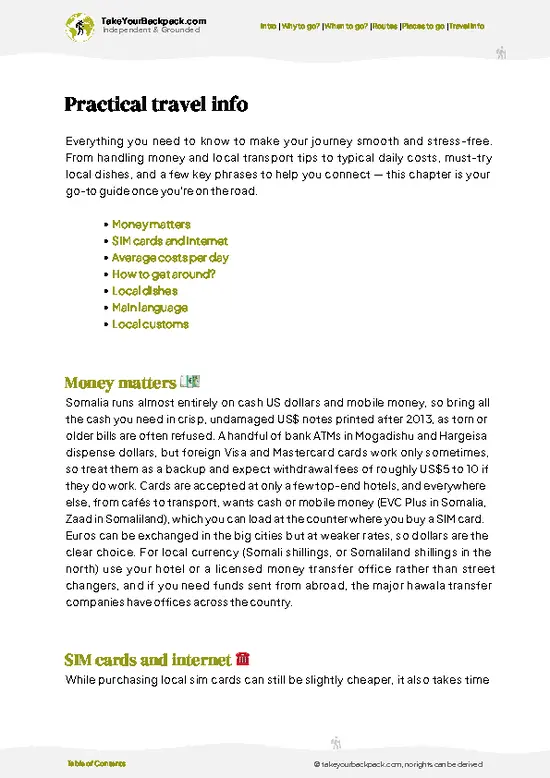
✅ SIM cards, money & practical tips

🌍 Understand the country, not just visit it
✅ Culture & traditions
✅ 52 Essential phrases & customs
✅ Festivals worth planning around
✅ Traveler-friendly historical context
✅ Insights that make places more meaningful

📱 Built for real travel conditions
✅ Fully downloadable PDF
✅ Works completely offline
✅ Optimized for phone use
✅ Useful in remote areas & buses
✅ All in 1 guide
Stop searching, start planning
Get instant access to your full guide. 30‑day money-back guarantee.


By proceeding you agree to our terms.
Sent to your inbox immediately after payment • 100% Secure Checkout
Best Backpacking Travel Advisor 2025 tourism awardBest Backpacking
Travel Advisor
2025
What others say about Take Your Backpack Guides:
⭐⭐⭐⭐⭐
Fantastic, amazing amount of information!
⭐⭐⭐⭐⭐
My goodness this is amazing, it's what I've been looking for hats off too you!
⭐⭐⭐⭐⭐
I think this is absolutely BRILLIANT
⭐⭐⭐⭐
Very complete and informative. It's still missing places, but I gotta to commend you
⭐⭐⭐⭐⭐
This is truly amazing, thank you, can't wait to explore it with my kids!
⭐⭐⭐⭐⭐
Awesome resource, thank you!
⭐⭐⭐⭐⭐
This is amazing! Can't wait to explore the ones I haven't seen
⭐⭐⭐⭐
I love this! Well done, great idea.
⭐⭐⭐⭐⭐
Thanks for taking the time to make this gem!
⭐⭐⭐⭐⭐
This might be the best website I've ever seen.
⭐⭐⭐⭐⭐
Congratulations, and thank you so much for your work; it's incredibly valuable.
⭐⭐⭐⭐
In all seriousness I think you did a great job pointing out the important spots
⭐⭐⭐⭐⭐
10/10 very good
⭐⭐⭐⭐⭐
As someone who's only just starting to visit regularly this is awesome, thank you.
⭐⭐⭐⭐
Thank you very much! I'm going to visit my dad, it's going to be very useful!
⭐⭐⭐⭐⭐
This is really cool! We'll be travelling for the first time and this definitely come in handy.
⭐⭐⭐⭐⭐
You are now our minister of culture, congratulations 👨‍💼
⭐⭐⭐⭐⭐
Just wanted to tell you that this is a pearl! Going to follow your recommendations.
⭐⭐⭐⭐⭐
This is so cool. I'll definitely be using the resource for my travels soon.
⭐⭐⭐⭐⭐
This is very impressive! Good work.
⭐⭐⭐⭐⭐
This is an amazing and informative site. Very well done!

🛏️ Where to stay?Top Places to Consider Staying

Somalia has no real backpacker hostel scene, so budget travel here means simple guesthouses and local hotels at roughly US$20 to 40 a night in Hargeisa and Garowe, while secure hotels in Mogadishu typically cost US$50 to 150 because guards, blast walls and airport transfers are built into the price. In Mogadishu, Lido puts you near the beach and the city’s seafront cafes but draws crowds and has been targeted before, while Hodan and the KM4 area sit closer to the airport road, with more mid-range options and fewer late-night crowds. Hargeisa’s city center around the main market is the easiest base for walking to restaurants and money changers, though it gets noisy with traffic and the call to … read more 👉
Somalia has no real backpacker hostel scene, so budget travel here means simple guesthouses and local hotels at roughly US$20 to 40 a night in Hargeisa and Garowe, while secure hotels in Mogadishu typically cost US$50 to 150 because guards, blast walls and airport transfers are built into the price. In Mogadishu, Lido puts you near the beach and the city’s seafront cafes but draws crowds and has been targeted before, while Hodan and the KM4 area sit closer to the airport road, with more mid-range options and fewer late-night crowds. Hargeisa’s city center around the main market is the easiest base for walking to restaurants and money changers, though it gets noisy with traffic and the call to prayer from early morning.

If you enjoy meeting fellow travelers, consider choosing hostels with high ratings for atmosphere. On the other hand, if you prefer having your own space, a hotel might be a better option.

SomaliaMore Places Across Somalia

👋 Meet the founderWho’s Behind Take Your Backpack?

Johan, backpacker and founder of TakeYourBackpackHi, I’m Johan (Netherlands 🇳🇱), the creator of TakeYourBackpack. Over the past 30 years, I’ve backpacked through 88 countries across six continents, gaining extensive experience with independent travel, long-term trips, and overland routes.

This site is built on a combination of firsthand travel experience and carefully curated insights from other backpackers. Many guides are based on places I’ve personally visited, while others bring together tips, observations, and practical advice shared by trusted travelers I’ve met along the way.

The goal is to provide realistic, experience-driven guidance — not generic itineraries — so you can explore destinations with better context, clearer expectations, and more confidence.