×

Somalia🇸🇴 | best regionsYour Guide to the 3 Best regions in Somalia

Somalia is not a country where you pick regions off a menu and hop between them on cheap buses. The options split into three kinds: the relatively stable northwest and northeast (Somaliland and Puntland), the south-central belt around Mogadishu, and the long Indian Ocean coast. Access, cost and risk differ sharply between them. Independent travel is realistic only in the north, where costs run higher than in neighboring countries because of mandatory escorts and few budget beds. Crowds are essentially absent everywhere. The south-central regions are not worth planning a backpacking trip around, since security there dictates every move you make.

By Johan Kruseman 🇳🇱 | Updated November 10, 2026
Explore the best cities in Somalia

Why go?What Makes Them Special

Somalia is unlike any other backpacking country because governance decides what a region means. The country is split between a federal government, the self-declared republic of Somaliland and the semi-autonomous state of Puntland, and each runs its own visa, security and permit system. Visiting one does not clear you for the next.

The geography is what makes the country special: the longest mainland coastline in Africa, at roughly 3,300 kilometers, with ancient trading ports, plus dry plateaus and limestone cliffs in the north holding some of the Horn's oldest rock art. The clan-based culture shapes daily life, and hospitality is real, but it works through introductions and local contacts rather than walk-up guesthouses.

Be clear on the downsides. Infrastructure is thin, with few paved roads … read more 👉
Somalia is unlike any other backpacking country because governance decides what a region means. The country is split between a federal government, the self-declared republic of Somaliland and the semi-autonomous state of Puntland, and each runs its own visa, security and permit system. Visiting one does not clear you for the next.

The geography is what makes the country special: the longest mainland coastline in Africa, at roughly 3,300 kilometers, with ancient trading ports, plus dry plateaus and limestone cliffs in the north holding some of the Horn's oldest rock art. The clan-based culture shapes daily life, and hospitality is real, but it works through introductions and local contacts rather than walk-up guesthouses.

Be clear on the downsides. Infrastructure is thin, with few paved roads outside main corridors, limited public transport and cash-heavy economies. Most governments advise against travel to large parts of the country, and travel insurance is often void there, so check your policy before anything else. Al-Shabaab remains active in parts of the south and center.

The climate is hot and arid almost everywhere, which keeps landscapes stark and rules out casual hiking in midday heat. Choose Somalia for rare, difficult, rewarding travel, not for convenience or a packed itinerary of sights.
Why These Made the Cut
The list of best regions in Somalia is created based on landscapes, local culture, attractions, vibes, and overall appeal. If you feel a region is missing in this list, please let us know.

When to go?When to Plan Your Trip

Best months and weather: The best months are December to February, when the dry, cooler season keeps northern highland temperatures near 15 to 28°C and coastal heat tolerable at about 28 to 32°C. Roads are firmest and rain is least likely to cut off tracks.
Shoulder seasons: March to May is the first rainy season (Gu), with the heaviest showers in April and May in the south and center, where flooded roads and washed-out tracks are common. Skip these months for anything overland in the south. The north gets less rain, usually 100 to 400 mm a year in the interior, so it stays workable, though dust turns to mud on unpaved routes.
Seasons to avoid: June to September is the Hagaa season, and the coast turns brutal. The southwest monsoon whips up rough seas that make much of the Indian Ocean coast … read more 👉
Best months and weather: The best months are December to February, when the dry, cooler season keeps northern highland temperatures near 15 to 28°C and coastal heat tolerable at about 28 to 32°C. Roads are firmest and rain is least likely to cut off tracks.
Shoulder seasons: March to May is the first rainy season (Gu), with the heaviest showers in April and May in the south and center, where flooded roads and washed-out tracks are common. Skip these months for anything overland in the south. The north gets less rain, usually 100 to 400 mm a year in the interior, so it stays workable, though dust turns to mud on unpaved routes.
Seasons to avoid: June to September is the Hagaa season, and the coast turns brutal. The southwest monsoon whips up rough seas that make much of the Indian Ocean coast unsuitable for boats and beach time, and temperatures in Berbera and the Gulf of Aden coast regularly pass 40°C. Anyone heading to the northern coast in these months is wasting energy. The highlands around Hargeisa stay milder, about 25 to 30°C, and are the only sensible choice then.
Second rains and prices: October to November brings the short Deyr rains, lighter than spring but enough to disrupt southern roads. Prices do not follow tourist seasons since there is no mass tourism; flights and escorts cost the same year-round, but demand spikes around Eid, so book domestic flights early.

region hoppingSuggested Travel Strategies

How long to allow: A trip combining several regions in Somalia needs 10 to 14 days, and more if you add Puntland. Distances look short on a map but permits, escorts and bad roads eat time.
What groups together and which way to go: The northern regions cluster well: Hargeisa, Berbera and the interior highlands connect by paved roads, and Puntland sits further east by a long, slower road. Start in Hargeisa, which has the main international airport connections via Addis Ababa or Dubai, then work toward the coast and finish where your flight out is easiest to secure. Ground travel from Hargeisa to Berbera takes about 2 to 3 hours, and Hargeisa to Burao roughly 3 hours. Hargeisa to Garowe is a full day or more on rough roads, so a flight is usually the better call.
Time per stop: Allow 2 to 3 days … read more 👉
How long to allow: A trip combining several regions in Somalia needs 10 to 14 days, and more if you add Puntland. Distances look short on a map but permits, escorts and bad roads eat time.
What groups together and which way to go: The northern regions cluster well: Hargeisa, Berbera and the interior highlands connect by paved roads, and Puntland sits further east by a long, slower road. Start in Hargeisa, which has the main international airport connections via Addis Ababa or Dubai, then work toward the coast and finish where your flight out is easiest to secure. Ground travel from Hargeisa to Berbera takes about 2 to 3 hours, and Hargeisa to Burao roughly 3 hours. Hargeisa to Garowe is a full day or more on rough roads, so a flight is usually the better call.
Time per stop: Allow 2 to 3 days per base. Anything shorter wastes the effort of getting a permit and a vehicle arranged, and anything longer in a single town adds little once the main sites are seen.
Mistakes to avoid: The most common error is stacking the north and south-central regions into one trip. They run separate entry systems, and the security situation in the south needs its own plan and budget, so treat it as a different journey or leave it out. Another is planning overland legs at night, which is both unsafe and often prohibited. Build in buffer days, since delays from escorts, flooding and flight cancellations are normal rather than exceptional. Do not plan tight connections to international flights, as schedules shift.

The ListThe Best regions of Somalia

1 Karkaar Mountains

Limestone ridge, Cape Guardafui, Qandala coast, Bosaso harbor

Follow a rough 4x4 route from Bosaso’s fish market through misty juniper woodland and frankincense hills to the windy rocky tip of the Horn.

2 Awdal Region

Zeila coral-stone ruins, Gulf of Aden fishing beaches, Borama highland markets, Jaribaan ridges

Wander Zeila’s coral-stone lanes and old mosques, then climb to Borama’s cooler highlands for livestock trading, tea houses and walks along rocky ridges.

3 Sool Plateau

Taleh Dervish forts, camel markets, open grazing plains, Las Anod tea houses

Cross open grassland where herders move camels between wells, haggle-watch at Las Anod’s livestock market and reach the stone ruins of Taleh’s Dervish forts.

Loading the map 🌍

Expert viewExpert Commentary on regions

How many regions to visit: Two regions is the realistic ceiling for one trip to Somalia, and one is often smarter. Overland movement between regions runs through checkpoints, depends on local security briefings and frequently needs a day of buffer, so every extra region eats days rather than adding a stop. A second region only makes sense if you have at least two weeks and a host or operator on the ground in both.
Choosing between kinds of regions: Independent travel in Somalia does not work like it does in Thailand or Peru. You do not wander in and improvise. If you want relative ease, favor the northern regions that run their own administrations, have functioning immigration desks and see the occasional overlander. If you want coastline and a capital-city experience, accept that you will … read more 👉
How many regions to visit: Two regions is the realistic ceiling for one trip to Somalia, and one is often smarter. Overland movement between regions runs through checkpoints, depends on local security briefings and frequently needs a day of buffer, so every extra region eats days rather than adding a stop. A second region only makes sense if you have at least two weeks and a host or operator on the ground in both.
Choosing between kinds of regions: Independent travel in Somalia does not work like it does in Thailand or Peru. You do not wander in and improvise. If you want relative ease, favor the northern regions that run their own administrations, have functioning immigration desks and see the occasional overlander. If you want coastline and a capital-city experience, accept that you will travel with armed escorts, a pre-arranged driver and a fixer, and that spontaneity is off the table. Skip the south-central interior and the border zones entirely. No view, market or conversation there justifies the risk, and most insurers will not cover it.
What it actually costs: Budget US$80 to 150 a day in the calmer northern areas, covering a guesthouse or modest hotel (US$25 to 60), meals (US$8 to 20), local transport and a guide. In the capital and anywhere that needs security, expect US$200 to 400 a day once you add an escort vehicle (often US$100 to 200 a day), a hotel inside a secured compound (US$80 to 150 a night) and a fixer (US$50 to 100 a day). Visa fees run roughly US$60 to 100 for an e-visa, and some administrations charge a separate entry or registration fee, usually under US$50. Domestic flights between hubs cost about US$120 to 250 one way. Carry clean US dollar notes, because cards rarely work, and local mobile money is used for everyday payments.
Mistakes that cost you money and time: Arriving without a confirmed host is the costliest error. Without an invitation or reliable local contact, you can lose several days and a few hundred dollars sorting out transport and security on the fly. Book a vetted operator or local contact before you buy flights.
Booking tight connections is the next trap. Flights get retimed and security situations shift, so leave one spare day per region and keep your return ticket flexible.
Paying for informal escorts or drivers who come with no references also goes badly. Agree prices in writing, in US dollars, before you leave town.
Safety and culture: Read your government’s travel advisory and buy specialist insurance that explicitly covers Somalia, because standard policies exclude it. Travel only with local guidance on current conditions, and be ready to change plans on the day. Somalia is a conservative, overwhelmingly Muslim society. Women should cover their hair and wear loose, long clothing, and men should avoid shorts. Ask before photographing people, and never photograph checkpoints, soldiers, ports or government buildings. Alcohol is effectively unavailable. During Ramadan, avoid eating or drinking in public in daylight hours. Learn a few Somali greetings. They earn real warmth, and hosts usually respond with generous hospitality.

✈️ The backpacker research shortcutSomalia Travel Guide

What the free pages can't give you: ready-made routes, every place ranked, and it works offline. All in 1 guide.
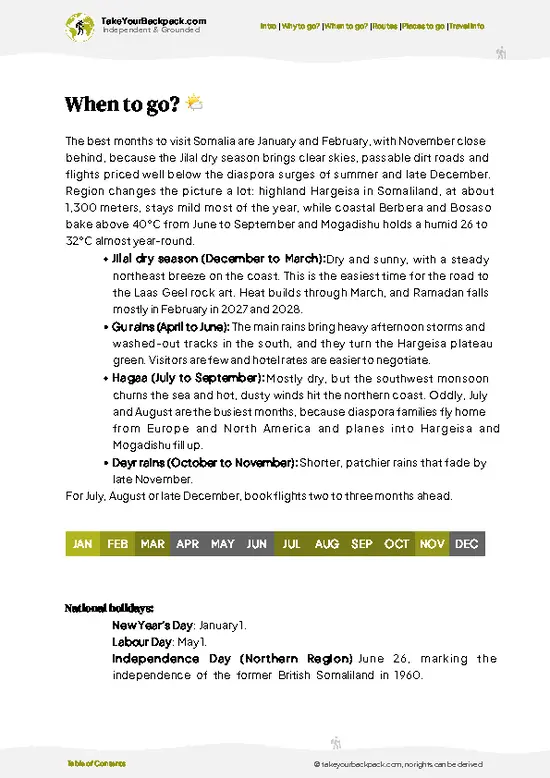
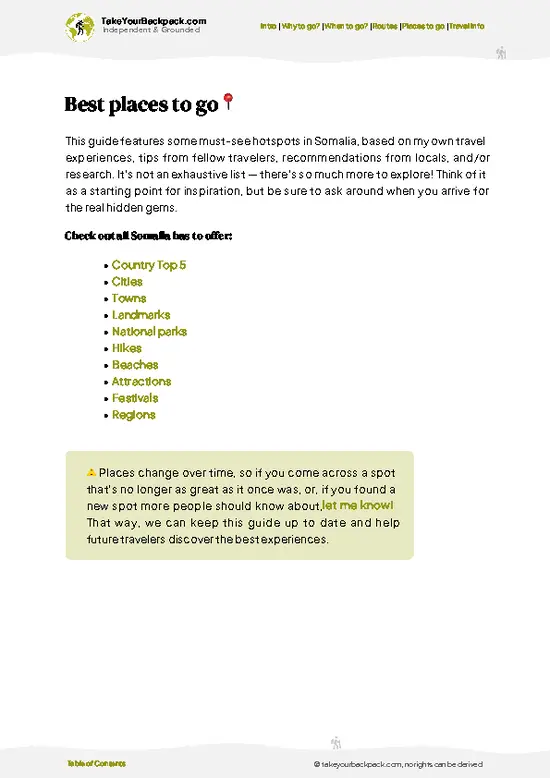
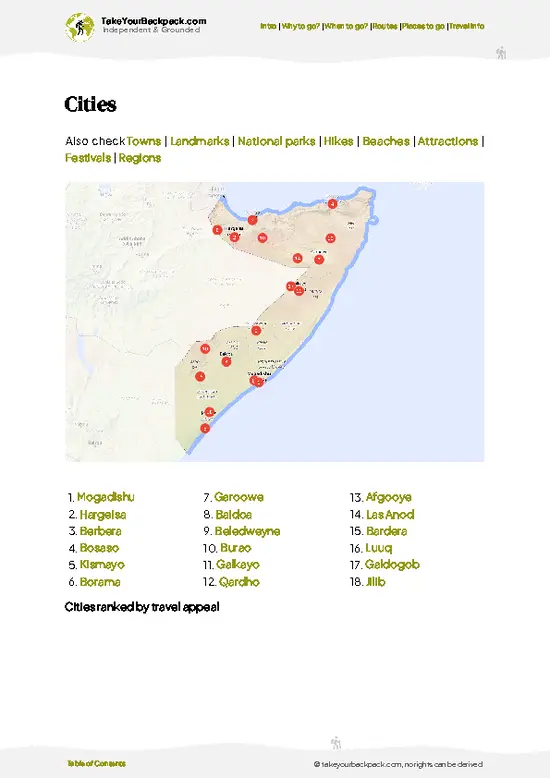
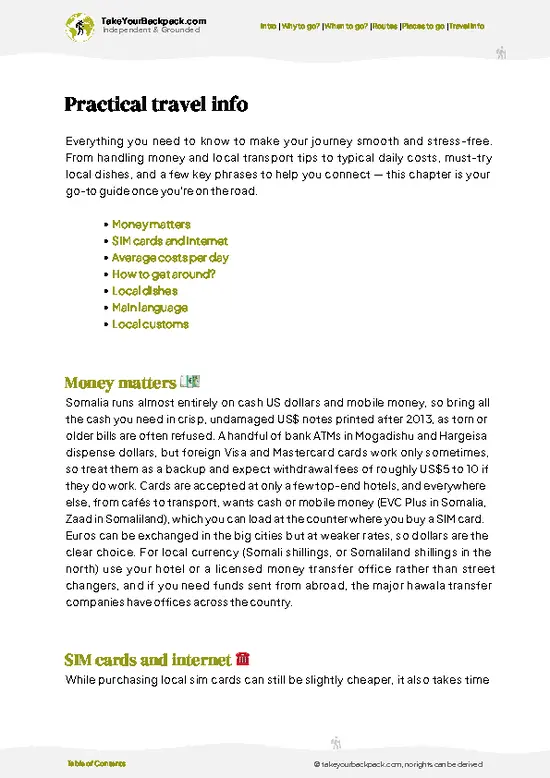
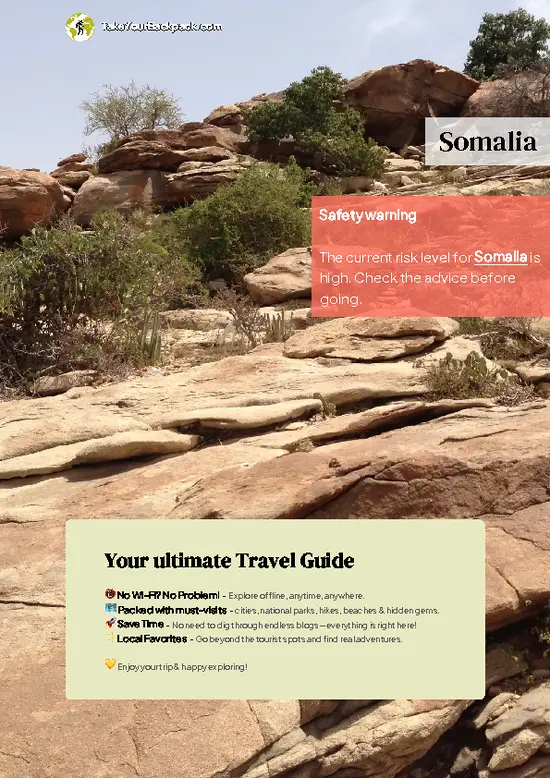
example page 0 from our offline Travel Guide for Somalia
example page 1 from our offline Travel Guide for Somalia
example page 2 from our offline Travel Guide for Somalia
example page 3 from our offline Travel Guide for Somalia
example page 4 from our offline Travel Guide for Somalia
example page 5 from our offline Travel Guide for Somalia
example page 6 from our offline Travel Guide for Somalia
example page 7 from our offline Travel Guide for Somalia
The digital guide (237 pages) contains:-page digital guide:
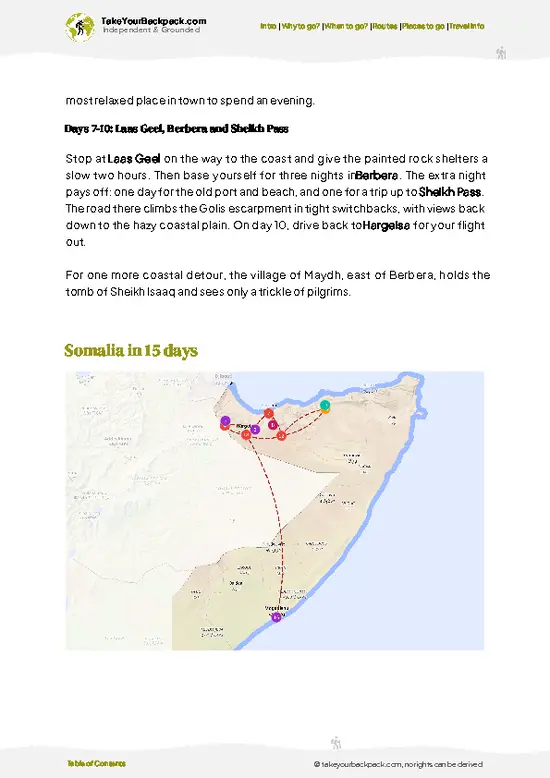
✅ Ready-made 5, 10 & 15-day routes
✅ All 68 places ranked, so you skip the overrated ones
✅ Works offline, all in 1 guide
✅ Cities, national parks, landmarks, beaches
✅ How to get around
👉 Click to see all 30+ guide features

📅 Plan smarter in minutes, not weeks
✅ Month by month travel advice
✅ Festivals & national holidays
✅ Budget expectations

🗺️ Go to the right places, skip the overrated ones
✅ Honest pros & cons of destinations
✅ Top hikes, parks & viewpoints
✅ Lesser-known places most travelers miss
✅ Clear “worth it vs skip it” guidance

🛏️ Travel smoothly without rookie mistakes
✅ Best areas to stay
✅ Transport systems explained simply
✅ Common scams & safety advice
✅ SIM cards, money & practical tips

🌍 Understand the country, not just visit it
✅ Culture & traditions
✅ 52 Essential phrases & customs
✅ Festivals worth planning around
✅ Traveler-friendly historical context
✅ Insights that make places more meaningful

📱 Built for real travel conditions
✅ Fully downloadable PDF
✅ Works completely offline
✅ Optimized for phone use
✅ Useful in remote areas & buses
✅ All in 1 guide
Stop searching, start planning
Get instant access to your full guide. 30‑day money-back guarantee.


By proceeding you agree to our terms.
Sent to your inbox immediately after payment • 100% Secure Checkout
Best Backpacking Travel Advisor 2025 tourism awardBest Backpacking
Travel Advisor
2025
What others say about Take Your Backpack Guides:
⭐⭐⭐⭐⭐
Fantastic, amazing amount of information!
⭐⭐⭐⭐⭐
My goodness this is amazing, it's what I've been looking for hats off too you!
⭐⭐⭐⭐⭐
I think this is absolutely BRILLIANT
⭐⭐⭐⭐
Very complete and informative. It's still missing places, but I gotta to commend you
⭐⭐⭐⭐⭐
This is truly amazing, thank you, can't wait to explore it with my kids!
⭐⭐⭐⭐⭐
Awesome resource, thank you!
⭐⭐⭐⭐⭐
This is amazing! Can't wait to explore the ones I haven't seen
⭐⭐⭐⭐
I love this! Well done, great idea.
⭐⭐⭐⭐⭐
Thanks for taking the time to make this gem!
⭐⭐⭐⭐⭐
This might be the best website I've ever seen.
⭐⭐⭐⭐⭐
Congratulations, and thank you so much for your work; it's incredibly valuable.
⭐⭐⭐⭐
In all seriousness I think you did a great job pointing out the important spots
⭐⭐⭐⭐⭐
10/10 very good
⭐⭐⭐⭐⭐
As someone who's only just starting to visit regularly this is awesome, thank you.
⭐⭐⭐⭐
Thank you very much! I'm going to visit my dad, it's going to be very useful!
⭐⭐⭐⭐⭐
This is really cool! We'll be travelling for the first time and this definitely come in handy.
⭐⭐⭐⭐⭐
You are now our minister of culture, congratulations 👨‍💼
⭐⭐⭐⭐⭐
Just wanted to tell you that this is a pearl! Going to follow your recommendations.
⭐⭐⭐⭐⭐
This is so cool. I'll definitely be using the resource for my travels soon.
⭐⭐⭐⭐⭐
This is very impressive! Good work.
⭐⭐⭐⭐⭐
This is an amazing and informative site. Very well done!

🛏️ Where to stay?Where to Stay in Somalia

Somalia has no real backpacker hostel scene, so budget travel here means simple guesthouses and local hotels at roughly US$20 to 40 a night in Hargeisa and Garowe, while secure hotels in Mogadishu typically cost US$50 to 150 because guards, blast walls and airport transfers are built into the price. In Mogadishu, Lido puts you near the beach and the city’s seafront cafes but draws crowds and has been targeted before, while Hodan and the KM4 area sit closer to the airport road, with more mid-range options and fewer late-night crowds. Hargeisa’s city center around the main market is the easiest base for walking to restaurants and money changers, though it gets noisy with traffic and the call to … read more 👉
Somalia has no real backpacker hostel scene, so budget travel here means simple guesthouses and local hotels at roughly US$20 to 40 a night in Hargeisa and Garowe, while secure hotels in Mogadishu typically cost US$50 to 150 because guards, blast walls and airport transfers are built into the price. In Mogadishu, Lido puts you near the beach and the city’s seafront cafes but draws crowds and has been targeted before, while Hodan and the KM4 area sit closer to the airport road, with more mid-range options and fewer late-night crowds. Hargeisa’s city center around the main market is the easiest base for walking to restaurants and money changers, though it gets noisy with traffic and the call to prayer from early morning.

If you enjoy meeting fellow travelers, consider choosing hostels with high ratings for atmosphere. On the other hand, if you prefer having your own space, a hotel might be a better option.

SomaliaMore of Somalia

👋 Meet the founderWho’s Behind Take Your Backpack?

Johan, backpacker and founder of TakeYourBackpackHi, I’m Johan (Netherlands 🇳🇱), the creator of TakeYourBackpack. Over the past 30 years, I’ve backpacked through 88 countries across six continents, gaining extensive experience with independent travel, long-term trips, and overland routes.

This site is built on a combination of firsthand travel experience and carefully curated insights from other backpackers. Many guides are based on places I’ve personally visited, while others bring together tips, observations, and practical advice shared by trusted travelers I’ve met along the way.

The goal is to provide realistic, experience-driven guidance — not generic itineraries — so you can explore destinations with better context, clearer expectations, and more confidence.