×

Somalia🇸🇴 | best hikesYour Guide to the 3 Best hikes in Somalia

Hiking in Somalia means guided walks, not trail networks. There are no marked paths, huts or park offices. The best terrain sits in the northern highlands, especially the Cal Madow range in Sanaag, where juniper forest and cool air at 2,000 meters and above are a world away from the hot coast. Somaliland is the practical base, with a working visa system and a calm capital. Puntland offers rugged coastal walks but needs far more planning. Central and southern Somalia are not worth considering. Independent travel here only works with a local fixer, a driver and an escort. Expect low crowds, high logistics costs and slow access.

By Johan Kruseman 🇳🇱 | Updated November 10, 2026
Explore the best beaches in Somalia

Why go?What Makes Them Special

Somalia suits hiking in one narrow way: the northern escarpments and highlands rise from a scorched coastal plain to cool, forested plateaus with real altitude. Elevations top 2,400 meters, and the contrast with the Guban lowlands is dramatic. Add nomadic pastoral culture, and you get landscapes walked for centuries by herders who know every spring and pass. That local knowledge is the actual infrastructure.

Everything else is thin. There are no maps, marked trails, rescue services or visitor centers, and mobile coverage drops quickly outside towns. Roads to trailheads are rough, slow and sometimes closed after rain. Do not choose Somalia for a quick weekend walk or for a collection of ticked peaks. It makes sense only if you want remote terrain, a near-empty landscape and a hands-on cultural … read more 👉
Somalia suits hiking in one narrow way: the northern escarpments and highlands rise from a scorched coastal plain to cool, forested plateaus with real altitude. Elevations top 2,400 meters, and the contrast with the Guban lowlands is dramatic. Add nomadic pastoral culture, and you get landscapes walked for centuries by herders who know every spring and pass. That local knowledge is the actual infrastructure.

Everything else is thin. There are no maps, marked trails, rescue services or visitor centers, and mobile coverage drops quickly outside towns. Roads to trailheads are rough, slow and sometimes closed after rain. Do not choose Somalia for a quick weekend walk or for a collection of ticked peaks. It makes sense only if you want remote terrain, a near-empty landscape and a hands-on cultural encounter.

Know the security picture before deciding. Most governments advise against all travel to Somalia, and conditions differ sharply by region. Somaliland and parts of Puntland are far calmer than the south, but disputed border areas in the east remain unstable. Insurance is hard to obtain, and medical care outside Hargeisa is basic. Arrange permits, escorts and a reputable local operator before arrival, because turning up and improvising wastes money and can be dangerous.
Why These Made the Cut
The list of best hikes in Somalia is created based on scenery, challenge, trail quality, landmarks, and overall enjoyment. If you feel a hike is missing in this list, please let us know.

When to go?When to Plan Your Trip

Best months for highland hiking: The best months are November to March, when the Jilaal dry season brings clear skies, firm tracks and cool highland air. At 1,800 to 2,400 meters in Sanaag, days reach roughly 18 to 25°C and nights can fall to 5°C or lower, so a proper sleeping layer matters. Visibility is sharpest in December and January.

Shoulder seasons: April to June brings the Gu rains. Highland slopes turn green and the forest looks its best, but dirt roads become slippery or impassable, and river crossings can delay a day or more. Expect rain on perhaps a third of days at altitude. A second, lighter rainy spell, the Deyr, falls around October and November. Early November is workable if the roads have dried.

Months to skip: Avoid July and August for anything near the coast. Berbera and … read more 👉
Best months for highland hiking: The best months are November to March, when the Jilaal dry season brings clear skies, firm tracks and cool highland air. At 1,800 to 2,400 meters in Sanaag, days reach roughly 18 to 25°C and nights can fall to 5°C or lower, so a proper sleeping layer matters. Visibility is sharpest in December and January.

Shoulder seasons: April to June brings the Gu rains. Highland slopes turn green and the forest looks its best, but dirt roads become slippery or impassable, and river crossings can delay a day or more. Expect rain on perhaps a third of days at altitude. A second, lighter rainy spell, the Deyr, falls around October and November. Early November is workable if the roads have dried.

Months to skip: Avoid July and August for anything near the coast. Berbera and the Guban plain regularly pass 40°C, and the hot Hagaa winds make walking at low elevation miserable. Highland temperatures stay tolerable, but haze and mist often reduce views, so the trip rarely justifies the heat on the journey in.

Crowds and prices: There is no true peak season. Visitor numbers stay low all year, and prices barely shift. The exception is the days around Eid, when drivers and guides become scarce and costs for vehicles can rise. Book transport at least two to three weeks ahead for November to February.

hike hoppingSuggested Travel Strategies

How long a combined trip takes: A trip combining several hikes in Somalia needs 8 to 12 days on the ground, plus a buffer of two spare days for road delays. Do not try to cover more than the northern highlands. The south and the Puntland interior add risk and travel time without a matching gain.

Regions and direction of travel: Fly into Hargeisa, which is the only sensible hub for permits, fixers, supplies and 4x4 hire. Moving east toward Burao and then Erigavo keeps the hardest, highest terrain for the later part of the trip, once your legs and paperwork are sorted. Berbera and the coast fit at either end as a rest stop. Going east first and returning west is better than zigzagging, because the roads run in a rough line and backtracking burns whole days.

Time per stop and between regions: Hargeisa … read more 👉
How long a combined trip takes: A trip combining several hikes in Somalia needs 8 to 12 days on the ground, plus a buffer of two spare days for road delays. Do not try to cover more than the northern highlands. The south and the Puntland interior add risk and travel time without a matching gain.

Regions and direction of travel: Fly into Hargeisa, which is the only sensible hub for permits, fixers, supplies and 4x4 hire. Moving east toward Burao and then Erigavo keeps the hardest, highest terrain for the later part of the trip, once your legs and paperwork are sorted. Berbera and the coast fit at either end as a rest stop. Going east first and returning west is better than zigzagging, because the roads run in a rough line and backtracking burns whole days.

Time per stop and between regions: Hargeisa to Berbera takes about 2 hours, and Hargeisa to Burao roughly 3 to 4 hours. Burao to Erigavo takes 6 to 9 hours on rough surfaces, longer after rain. Give each highland base two to three nights, which allows one rest day for weather or a blocked road.

Planning mistakes: The most common error is scheduling a hike the day you arrive after a long drive. Add a recovery night instead. Another is trusting map distances, since 100 kilometers of track may take five hours. Plan travel at dawn, not after midday, when checkpoints, heat and fading light all push against you.

The ListThe Best hikes of Somalia

1 Daallo Forest

Lichen-hung junipers, escarpment rim, cool mist, baboon troops

Wander a soft, needle-floored loop under old junipers, then follow the plateau edge to open views north over the lowlands.

2 Golis Mountains

Sheikh hill town, juniper ridges, goat tracks, camel herds

Climb steep herder paths above Sheikh into olive and juniper woodland, with Gulf of Aden haze spread far below the escarpment.

3 Shimbiris

Somalia's highest summit, Cal Madow escarpment, juniper forest, Erigavo start, Warsangli linnet

Climb from Erigavo onto a cool, broad summit above steep escarpment folds, passing old lichen-draped juniper where an endemic finch lives.

Loading the map 🌍

Expert viewExpert Commentary on hikes

How many hikes to attempt: Plan on two or three hikes in one trip, no more. Each needs a full day of walking plus a day of driving to reach it, and the roads eat any slack in your schedule. Trying for five means you spend most of the trip in a vehicle, and a single washed-out track can collapse the whole plan.

Which kind to prioritize: For a first visit, pick the highland forest and escarpment walks in the northern ranges. They deliver the cool air, altitude and scale that define hiking here. Choose a lower coastal or hill walk only if time is short or you want an easy acclimatization day. Anyone interested in culture should favor routes passing through herding settlements, where hosting is part of the day. Peak-baggers should accept that summit logistics cost more than the walking is worth, … read more 👉
How many hikes to attempt: Plan on two or three hikes in one trip, no more. Each needs a full day of walking plus a day of driving to reach it, and the roads eat any slack in your schedule. Trying for five means you spend most of the trip in a vehicle, and a single washed-out track can collapse the whole plan.

Which kind to prioritize: For a first visit, pick the highland forest and escarpment walks in the northern ranges. They deliver the cool air, altitude and scale that define hiking here. Choose a lower coastal or hill walk only if time is short or you want an easy acclimatization day. Anyone interested in culture should favor routes passing through herding settlements, where hosting is part of the day. Peak-baggers should accept that summit logistics cost more than the walking is worth, and skip the farthest, highest targets unless you have a week to spare.

What it costs: Budget US$80 to 150 a day if you share costs, and US$150 to 250 if you travel alone. Most of that goes on transport and security, not on lodging or food. A 4x4 with driver runs about US$100 to 150 a day, a hiking guide US$30 to 60, and an armed escort, where required, an extra US$20 to 40. Hargeisa guesthouses cost US$30 to 70 a night, and camp meals US$5 to 12. The Somaliland visa costs roughly US$70 to 80. Pay in US dollars with small, clean notes. Old or torn bills are often refused. A full eight-day trip typically lands at US$900 to 1,600 per person in a group of two to three.

Costs and delays that catch travelers out: Vehicle hire is where budgets break. Agree the daily rate, fuel, and the driver’s food and lodging in writing before departure, and confirm what happens if rain strands you for a night. Do not pay the full amount upfront. Pay a deposit, then the balance after the final day. Permits and checkpoint registration can take a day in Hargeisa, so start them the moment you land.

Safety and cultural considerations: Register with your embassy if one is present and buy medical and evacuation insurance that explicitly covers Somalia. Many policies exclude it. Never leave the agreed route, and take the escort advice seriously, because security can shift quickly in disputed areas near the Puntland border. Carry a satellite messenger, as mobile signal fails in the highlands. Bring all medication, water purification and a full first-aid kit, since pharmacies disappear outside towns.

Dress modestly: long trousers and covered shoulders for all, with a headscarf expected for women in towns. Ask permission before photographing people, livestock owners or any military site. Alcohol is unavailable and public displays of affection are unwelcome. If a nomad family offers tea, accepting is polite, and a small gift of sugar or rice is a better thank-you than cash. I would also carry a printed copy of your permits, since phones die and officials ask for paper.

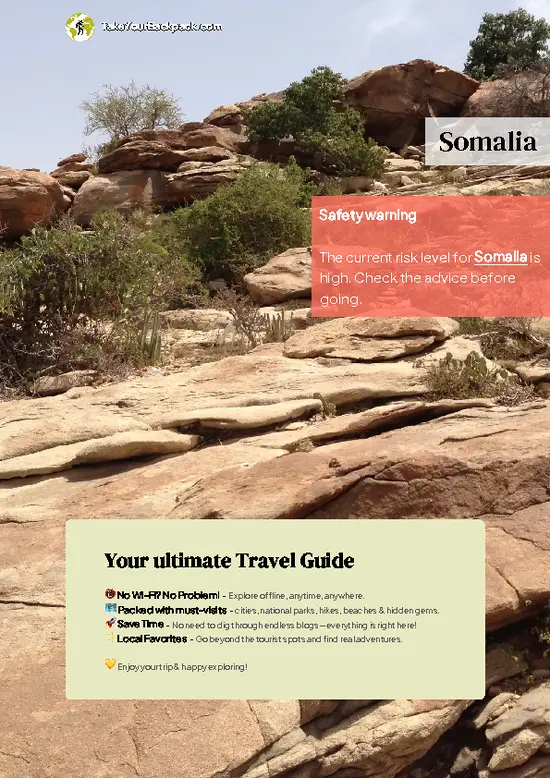
✈️ The backpacker research shortcutSomalia Travel Guide

What the free pages can't give you: ready-made routes, every place ranked, and it works offline. All in 1 guide.
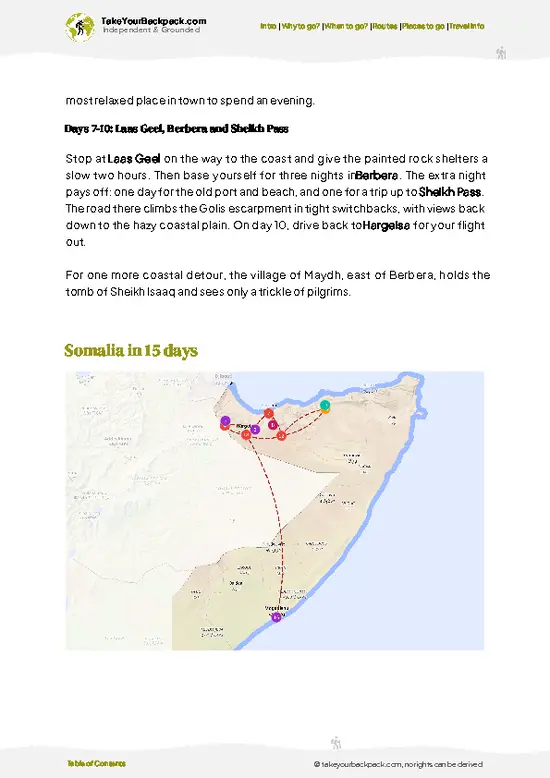
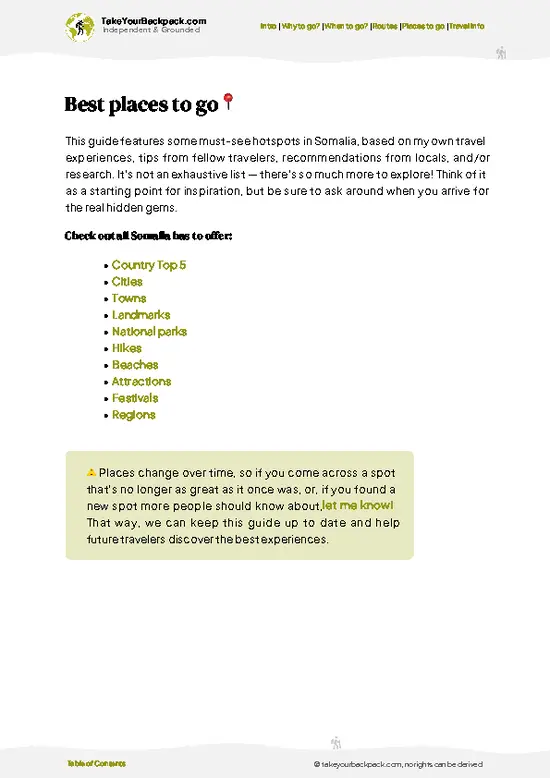
example page 0 from our offline Travel Guide for Somalia
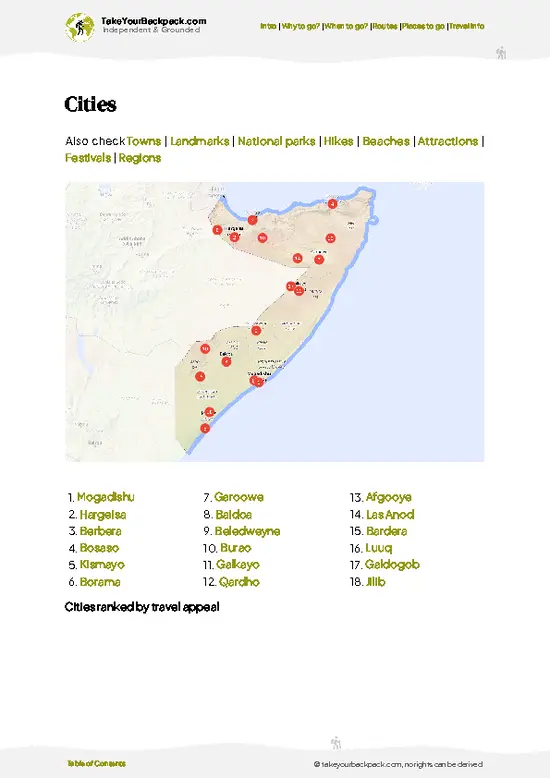
example page 1 from our offline Travel Guide for Somalia
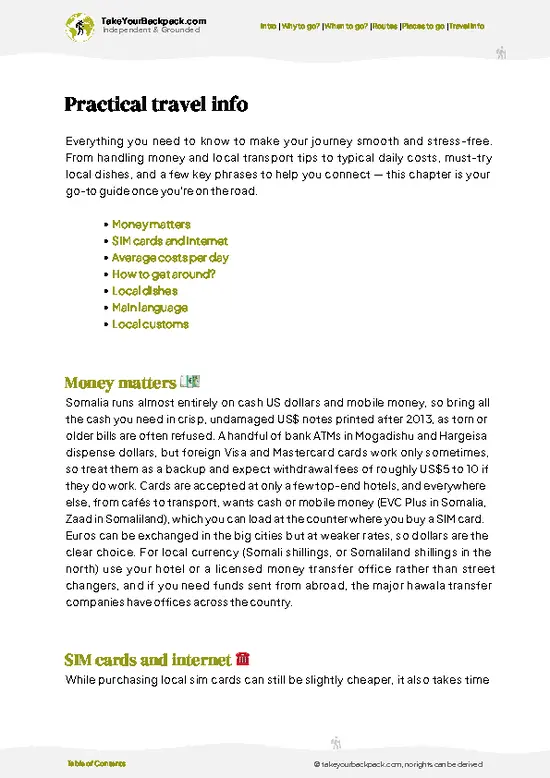
example page 2 from our offline Travel Guide for Somalia
example page 3 from our offline Travel Guide for Somalia
example page 4 from our offline Travel Guide for Somalia
example page 5 from our offline Travel Guide for Somalia
example page 6 from our offline Travel Guide for Somalia
example page 7 from our offline Travel Guide for Somalia
The digital guide (237 pages) contains:-page digital guide:
✅ Ready-made 5, 10 & 15-day routes
✅ All 68 places ranked, so you skip the overrated ones
✅ Works offline, all in 1 guide
✅ Cities, national parks, landmarks, beaches
✅ How to get around
👉 Click to see all 30+ guide features

📅 Plan smarter in minutes, not weeks
✅ Month by month travel advice
✅ Festivals & national holidays
✅ Budget expectations

🗺️ Go to the right places, skip the overrated ones
✅ Honest pros & cons of destinations
✅ Top hikes, parks & viewpoints
✅ Lesser-known places most travelers miss
✅ Clear “worth it vs skip it” guidance

🛏️ Travel smoothly without rookie mistakes
✅ Best areas to stay
✅ Transport systems explained simply
✅ Common scams & safety advice
✅ SIM cards, money & practical tips

🌍 Understand the country, not just visit it
✅ Culture & traditions
✅ 52 Essential phrases & customs
✅ Festivals worth planning around
✅ Traveler-friendly historical context
✅ Insights that make places more meaningful

📱 Built for real travel conditions
✅ Fully downloadable PDF
✅ Works completely offline
✅ Optimized for phone use
✅ Useful in remote areas & buses
✅ All in 1 guide
Stop searching, start planning
Get instant access to your full guide. 30‑day money-back guarantee.


By proceeding you agree to our terms.
Sent to your inbox immediately after payment • 100% Secure Checkout
Best Backpacking Travel Advisor 2025 tourism awardBest Backpacking
Travel Advisor
2025
What others say about Take Your Backpack Guides:
⭐⭐⭐⭐⭐
Fantastic, amazing amount of information!
⭐⭐⭐⭐⭐
My goodness this is amazing, it's what I've been looking for hats off too you!
⭐⭐⭐⭐⭐
I think this is absolutely BRILLIANT
⭐⭐⭐⭐
Very complete and informative. It's still missing places, but I gotta to commend you
⭐⭐⭐⭐⭐
This is truly amazing, thank you, can't wait to explore it with my kids!
⭐⭐⭐⭐⭐
Awesome resource, thank you!
⭐⭐⭐⭐⭐
This is amazing! Can't wait to explore the ones I haven't seen
⭐⭐⭐⭐
I love this! Well done, great idea.
⭐⭐⭐⭐⭐
Thanks for taking the time to make this gem!
⭐⭐⭐⭐⭐
This might be the best website I've ever seen.
⭐⭐⭐⭐⭐
Congratulations, and thank you so much for your work; it's incredibly valuable.
⭐⭐⭐⭐
In all seriousness I think you did a great job pointing out the important spots
⭐⭐⭐⭐⭐
10/10 very good
⭐⭐⭐⭐⭐
As someone who's only just starting to visit regularly this is awesome, thank you.
⭐⭐⭐⭐
Thank you very much! I'm going to visit my dad, it's going to be very useful!
⭐⭐⭐⭐⭐
This is really cool! We'll be travelling for the first time and this definitely come in handy.
⭐⭐⭐⭐⭐
You are now our minister of culture, congratulations 👨‍💼
⭐⭐⭐⭐⭐
Just wanted to tell you that this is a pearl! Going to follow your recommendations.
⭐⭐⭐⭐⭐
This is so cool. I'll definitely be using the resource for my travels soon.
⭐⭐⭐⭐⭐
This is very impressive! Good work.
⭐⭐⭐⭐⭐
This is an amazing and informative site. Very well done!

🛏️ Where to stay?Best Stay Options in Somalia

Somalia has no real backpacker hostel scene, so budget travel here means simple guesthouses and local hotels at roughly US$20 to 40 a night in Hargeisa and Garowe, while secure hotels in Mogadishu typically cost US$50 to 150 because guards, blast walls and airport transfers are built into the price. In Mogadishu, Lido puts you near the beach and the city’s seafront cafes but draws crowds and has been targeted before, while Hodan and the KM4 area sit closer to the airport road, with more mid-range options and fewer late-night crowds. Hargeisa’s city center around the main market is the easiest base for walking to restaurants and money changers, though it gets noisy with traffic and the call to … read more 👉
Somalia has no real backpacker hostel scene, so budget travel here means simple guesthouses and local hotels at roughly US$20 to 40 a night in Hargeisa and Garowe, while secure hotels in Mogadishu typically cost US$50 to 150 because guards, blast walls and airport transfers are built into the price. In Mogadishu, Lido puts you near the beach and the city’s seafront cafes but draws crowds and has been targeted before, while Hodan and the KM4 area sit closer to the airport road, with more mid-range options and fewer late-night crowds. Hargeisa’s city center around the main market is the easiest base for walking to restaurants and money changers, though it gets noisy with traffic and the call to prayer from early morning.

If you enjoy meeting fellow travelers, consider choosing hostels with high ratings for atmosphere. On the other hand, if you prefer having your own space, a hotel might be a better option.

SomaliaWhere to Go Next

👋 Meet the founderWho’s Behind Take Your Backpack?

Johan, backpacker and founder of TakeYourBackpackHi, I’m Johan (Netherlands 🇳🇱), the creator of TakeYourBackpack. Over the past 30 years, I’ve backpacked through 88 countries across six continents, gaining extensive experience with independent travel, long-term trips, and overland routes.

This site is built on a combination of firsthand travel experience and carefully curated insights from other backpackers. Many guides are based on places I’ve personally visited, while others bring together tips, observations, and practical advice shared by trusted travelers I’ve met along the way.

The goal is to provide realistic, experience-driven guidance — not generic itineraries — so you can explore destinations with better context, clearer expectations, and more confidence.