×

Somalia🇸🇴 | best attractionsYour Guide to the 11 Best attractions in Somalia

Attractions in Somalia are not a checklist circuit. There is almost no tourism infrastructure, so the draw is raw: the longest coastline in mainland Africa, ancient ruins, rock art and old trading towns. Somaliland in the northwest is the easiest to visit, with a working visa system, hotels and guides. Puntland is harder and needs security arrangements. Mogadishu and the south run on armed escorts and high costs, so skip them on a tight budget. Crowds are close to zero everywhere, which is the appeal. Independent travel works only in the north, and even there you hire a local guide. Do not expect signage, ticket booths or cafes.

By Johan Kruseman 🇳🇱 | Updated November 10, 2026
Explore the best festivals in Somalia

Why go?What Makes Them Special

Somalia is unusual because its attractions have survived neglect rather than management. Decades of conflict meant no restoration, no tour industry and no visitor numbers, so sites are still unfenced and often unexcavated. The country sits on the Horn of Africa with a coastline of roughly 3,300 kilometers, ancient Red Sea and Indian Ocean trade links, and a pastoral culture built around camels and clan networks. That history explains the coastal towns, the Islamic architecture and the rock art in the north.

Be clear about what this means. Somalia is poorly suited to anyone who wants convenience. There are no public transport timetables for visitors, few signed sites and almost no printed information. Government travel advisories from most countries warn against travel to large parts of the … read more 👉
Somalia is unusual because its attractions have survived neglect rather than management. Decades of conflict meant no restoration, no tour industry and no visitor numbers, so sites are still unfenced and often unexcavated. The country sits on the Horn of Africa with a coastline of roughly 3,300 kilometers, ancient Red Sea and Indian Ocean trade links, and a pastoral culture built around camels and clan networks. That history explains the coastal towns, the Islamic architecture and the rock art in the north.

Be clear about what this means. Somalia is poorly suited to anyone who wants convenience. There are no public transport timetables for visitors, few signed sites and almost no printed information. Government travel advisories from most countries warn against travel to large parts of the country, and insurers often exclude it, so check cover before you book anything. Regional authorities differ sharply: Somaliland issues its own visas and runs a relatively calm northwest, while the south remains unstable.

The reward is access without crowds and a hospitality culture where visitors are met with real curiosity. Go if you can accept limited facilities, mandatory guides and plans that change. Skip it if you need certainty.
Behind the Scenes of Selection
The list of best attractions in Somalia is created based on cultural significance or entertainment value. If you feel a attraction is missing in this list, please let us know.

When to go?When to Plan Your Trip

Best months for visiting: The best months are November to February, when northern Somalia is at its coolest and driest, with daytime highs around 25 to 32°C instead of the 35 to 45°C of summer. Roads are passable and long drives in open country are bearable.
Seasons and regional differences: Somalia has two rainy seasons, the Gu from April to June and the shorter Deyr from October to November, though rainfall is low and erratic in the north, often under 250 mm a year along the coast. In the south and along the Shabelle and Juba rivers, heavy rain can wash out unpaved roads and make travel slow or impossible. The northern coast around Berbera is brutally hot from June to September, with humidity and daytime temperatures that regularly pass 40°C. Skip those months for coastal sightseeing. The … read more 👉
Best months for visiting: The best months are November to February, when northern Somalia is at its coolest and driest, with daytime highs around 25 to 32°C instead of the 35 to 45°C of summer. Roads are passable and long drives in open country are bearable.
Seasons and regional differences: Somalia has two rainy seasons, the Gu from April to June and the shorter Deyr from October to November, though rainfall is low and erratic in the north, often under 250 mm a year along the coast. In the south and along the Shabelle and Juba rivers, heavy rain can wash out unpaved roads and make travel slow or impossible. The northern coast around Berbera is brutally hot from June to September, with humidity and daytime temperatures that regularly pass 40°C. Skip those months for coastal sightseeing. The highlands near Hargeisa stay milder, typically 20 to 30°C, and are the only area comfortable in summer.
Crowds, prices and closures: There are no tourist crowds to avoid and no real peak season, so prices are driven by security costs and not by month. Flights and guides can cost more around Eid and during the diaspora return in summer, when Hargeisa hotels fill. Book early then. During Ramadan, many restaurants close in daylight and travel runs at a slower pace.

attraction hoppingSuggested Travel Strategies

How long to allow: A trip linking several attractions in Somalia needs 7 to 12 days, and nearly all of it should stay within the northwest. Distances are long, roads are uneven and every move depends on guides and security arrangements, so cramming more in wastes the money you spend on them.
Grouping and direction: Start in Hargeisa, the main entry point by air, and work outward. The ruins and rock art of the interior and the port of Berbera on the Gulf of Aden group naturally, with Berbera about 150 to 180 km from Hargeisa, a drive of roughly 2.5 to 3.5 hours on a decent paved road. Heading east toward Burao and Puntland is much slower, with journeys of 6 to 10 hours and more security planning. Treat Puntland as a separate trip. Allow one to two days per stop, and three if a site sits far … read more 👉
How long to allow: A trip linking several attractions in Somalia needs 7 to 12 days, and nearly all of it should stay within the northwest. Distances are long, roads are uneven and every move depends on guides and security arrangements, so cramming more in wastes the money you spend on them.
Grouping and direction: Start in Hargeisa, the main entry point by air, and work outward. The ruins and rock art of the interior and the port of Berbera on the Gulf of Aden group naturally, with Berbera about 150 to 180 km from Hargeisa, a drive of roughly 2.5 to 3.5 hours on a decent paved road. Heading east toward Burao and Puntland is much slower, with journeys of 6 to 10 hours and more security planning. Treat Puntland as a separate trip. Allow one to two days per stop, and three if a site sits far off the paved road.
Planning mistakes: The first mistake is overbooking distant regions: a Hargeisa and Mogadishu combination is not realistic, as it needs different permissions, flights and budgets. The second is using fixed return flights with no slack, because security holds, weather and vehicle trouble all cause delay. Leave a spare day at each end. The third is assuming ground transport can be arranged on arrival. Book your driver and guide before landing, and confirm road conditions the week you go.

The ListThe Best attractions of Somalia

1 Arba’a Rukun Mosque

Four pillars, weathered coral stone, call to prayer, Hamar Weyne lanes

Visit a working mosque about 750 years old, modestly dressed and ideally with a local host, then follow the old coral-stone lanes toward the ocean.

2 Sheikh Pass

Road switchbacks, Guban plain views, colonial stone town, dik-dik slopes

Walk the bends of the Golis escarpment road as the air cools, ending with tea among the stone buildings of Sheikh.

3 Fakr ad-Din Mosque

1269 inscription, Kufic lettering, plain prayer hall, medieval trade

Look in from the entrance at a small coral-stone mosque dated to 1269, then walk on to the neighboring mosque, fish market and waterfront.

4 Mogadishu Cathedral Ruins

Twin towers, roofless nave, shrapnel scars, Italian-era shell

Tour the open-sky nave and pitted towers of a former cathedral with an escort, guided briefly through its colonial and war history.

5 Hargeisa Cultural Centre

Book fair origins, Somali library, poetry nights, courtyard tea

Browse Somali-language shelves, catch an exhibition and talk with writers and students in the courtyard that hosts the Hargeysa book fair.

6 Saryan Museum

SNM photographs, press archive, 1991 independence, former fighter’s collection

Study black-and-white war photographs, old newspapers and everyday objects from the SNM struggle, with staff who add context, then walk next door to the cultural centre.

7 Hiddo Dhawr

Live Somali music, poet-named halls, thatched huts, dinner stage

Arrive around dusk, eat Somali dishes in a hut-style compound, then stay for bands and poetry recitals in halls named after the country’s poets.

8 Hargeisa War Memorial

Plinthed MiG, 1988 bombardment, twenty-minute stop, local conversation

Walk around a Somali Air Force jet mounted nose-up and hear locals describe the attacks that flattened the city.

9 National Theatre of Somalia

1960s facade, main auditorium, empty stage, rebuilt walls

Photograph the imposing front, glimpse the auditorium and hear caretakers recall the era when Somali music and drama filled this stage.

10 Bakaara Market

Shilling stacks, spice sacks, cloth aisles, khat bargaining

Follow a trusted local host through the money changers, spice stalls and textile lanes of Mogadishu's largest open market, then eat lunch elsewhere.

11 Hargeisa Livestock Market

Camel rows, palm-slap brokers, export herds, dust and noise

Watch brokers settle prices with hidden hand-clasps among camels, goats and sheep bound for Gulf ports, with sweet tea between deals.

Loading the map 🌍

Expert viewExpert Commentary on attractions

How many attractions to plan: Plan four to six attractions in a single trip. Each one involves a guide, a vehicle and often a security check, so a day usually holds one site and a lot of driving. Pushing past six buys exhaustion and not much more. Backpackers short on time should choose fewer places and see them properly.
What to prioritize: If you like history and archaeology, put the rock art and ruins first, since they are the strongest reason to come at all. If you want comfort, favor coastal and city sights near Hargeisa and Berbera, where hotels and restaurants exist. If you want adventure, accept longer drives and basic stays, but only with an experienced local operator. Skip anything that needs a long detour for a single photograph. Souvenir markets and city sights are quick stops and … read more 👉
How many attractions to plan: Plan four to six attractions in a single trip. Each one involves a guide, a vehicle and often a security check, so a day usually holds one site and a lot of driving. Pushing past six buys exhaustion and not much more. Backpackers short on time should choose fewer places and see them properly.
What to prioritize: If you like history and archaeology, put the rock art and ruins first, since they are the strongest reason to come at all. If you want comfort, favor coastal and city sights near Hargeisa and Berbera, where hotels and restaurants exist. If you want adventure, accept longer drives and basic stays, but only with an experienced local operator. Skip anything that needs a long detour for a single photograph. Souvenir markets and city sights are quick stops and not worth a full day.
What it costs: Expect US$80 to 150 a day in Somaliland, far above neighboring countries because there is no budget tourism market. A hotel in Hargeisa runs US$30 to 70 a night. A private driver with a vehicle is typically US$80 to 150 a day, and a guide US$30 to 60. Site fees are usually small, from nothing to about US$10 to 20, but permits and any required escort add to that. Budget a further US$100 to 200 for a visa, travel insurance that accepts Somalia and extra security. The costs that catch people out are paying cash only (bring US dollars in clean, recent notes, as ATMs are unreliable), late-added escort fees and a driver who quotes per day and charges extra for waiting. Agree the full price in writing before you set out.
Safety and cultural considerations: Check your government’s advice before booking, since many advise against all travel. Somaliland is far calmer than the south, but you should still never travel without a local guide and should keep your movements private. Avoid travel after dark. Carry your passport and permits and expect checkpoints.

Dress modestly: long sleeves and trousers for men, and a headscarf with loose, full-length clothing for women. Ask before photographing people, soldiers or government buildings, and never photograph military sites, which can lead to detention. Alcohol is not available, and public displays of affection are inappropriate. During prayer times, expect shops and services to pause. Greet people properly and accept tea when offered, since refusing without explanation can offend.

✈️ The backpacker research shortcutSomalia Travel Guide

What the free pages can't give you: ready-made routes, every place ranked, and it works offline. All in 1 guide.
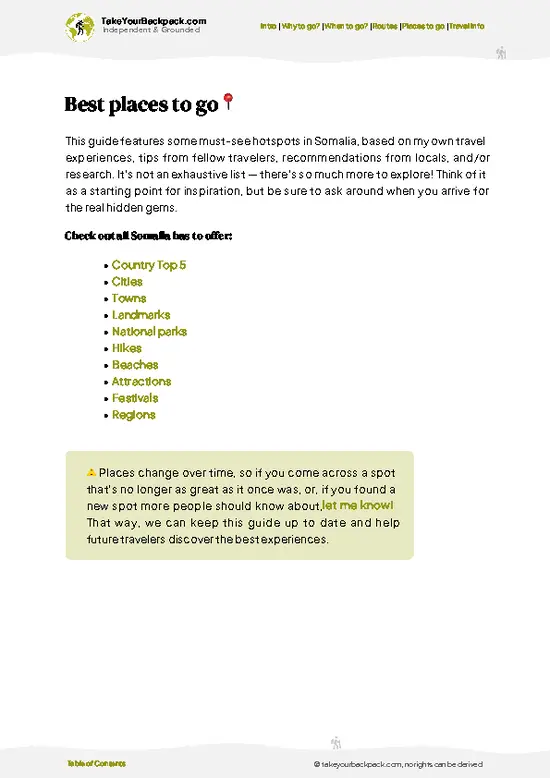
example page 0 from our offline Travel Guide for Somalia
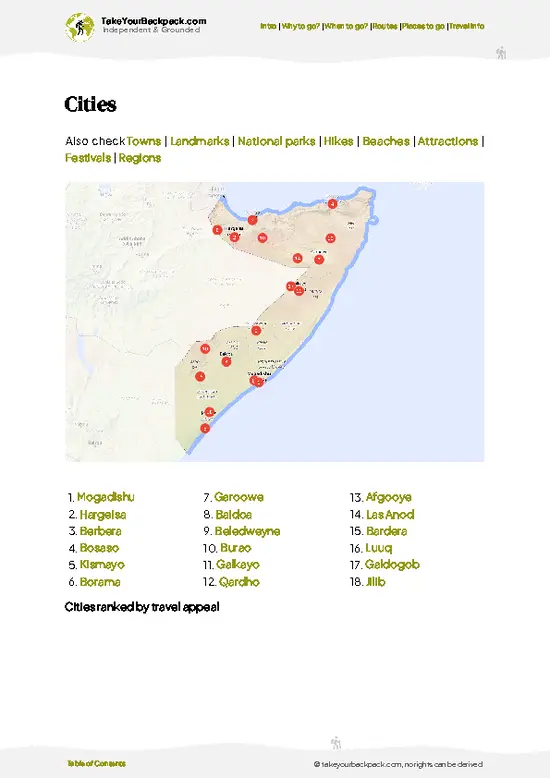
example page 1 from our offline Travel Guide for Somalia
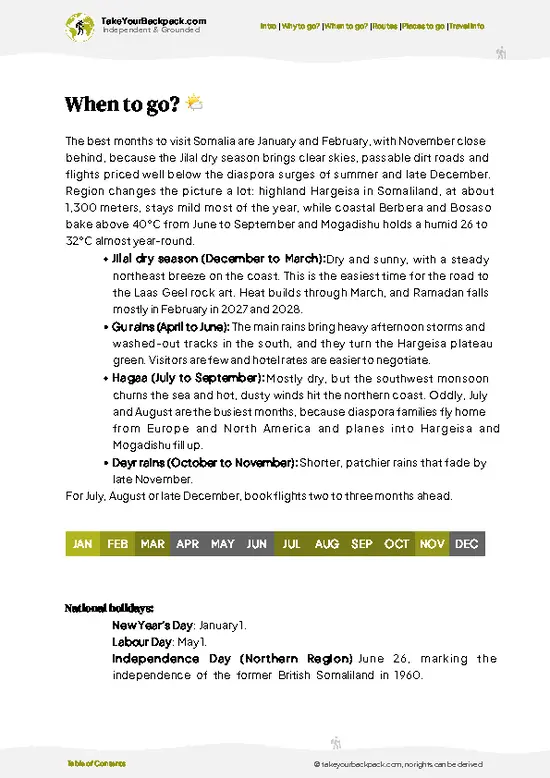
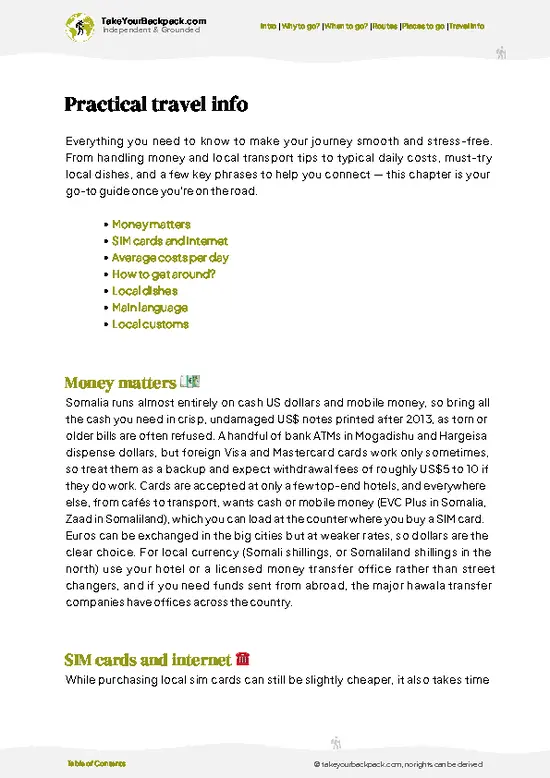
example page 2 from our offline Travel Guide for Somalia
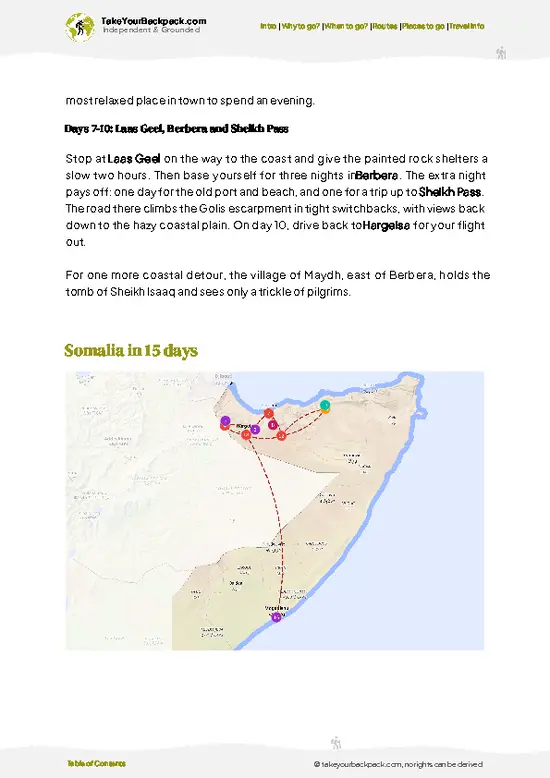
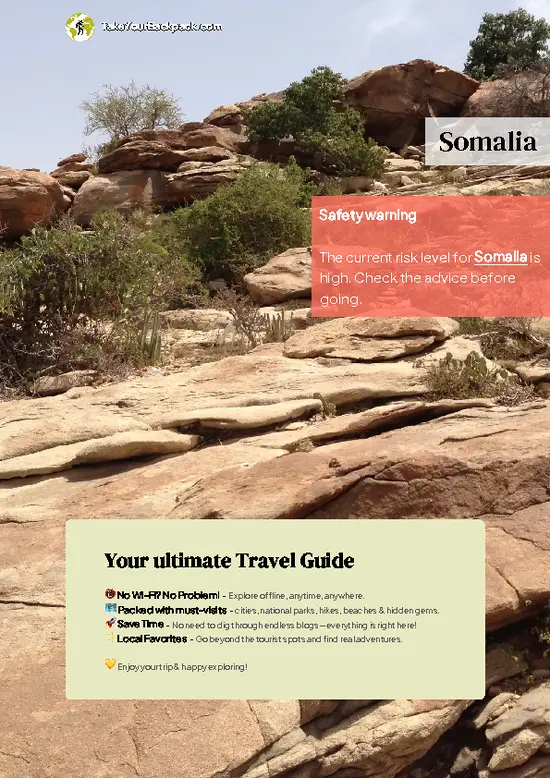
example page 3 from our offline Travel Guide for Somalia
example page 4 from our offline Travel Guide for Somalia
example page 5 from our offline Travel Guide for Somalia
example page 6 from our offline Travel Guide for Somalia
example page 7 from our offline Travel Guide for Somalia
The digital guide (237 pages) contains:-page digital guide:
✅ Ready-made 5, 10 & 15-day routes
✅ All 68 places ranked, so you skip the overrated ones
✅ Works offline, all in 1 guide
✅ Cities, national parks, landmarks, beaches
✅ How to get around
👉 Click to see all 30+ guide features

📅 Plan smarter in minutes, not weeks
✅ Month by month travel advice
✅ Festivals & national holidays
✅ Budget expectations

🗺️ Go to the right places, skip the overrated ones
✅ Honest pros & cons of destinations
✅ Top hikes, parks & viewpoints
✅ Lesser-known places most travelers miss
✅ Clear “worth it vs skip it” guidance

🛏️ Travel smoothly without rookie mistakes
✅ Best areas to stay
✅ Transport systems explained simply
✅ Common scams & safety advice
✅ SIM cards, money & practical tips

🌍 Understand the country, not just visit it
✅ Culture & traditions
✅ 52 Essential phrases & customs
✅ Festivals worth planning around
✅ Traveler-friendly historical context
✅ Insights that make places more meaningful

📱 Built for real travel conditions
✅ Fully downloadable PDF
✅ Works completely offline
✅ Optimized for phone use
✅ Useful in remote areas & buses
✅ All in 1 guide
Stop searching, start planning
Get instant access to your full guide. 30‑day money-back guarantee.


By proceeding you agree to our terms.
Sent to your inbox immediately after payment • 100% Secure Checkout
Best Backpacking Travel Advisor 2025 tourism awardBest Backpacking
Travel Advisor
2025
What others say about Take Your Backpack Guides:
⭐⭐⭐⭐⭐
Fantastic, amazing amount of information!
⭐⭐⭐⭐⭐
My goodness this is amazing, it's what I've been looking for hats off too you!
⭐⭐⭐⭐⭐
I think this is absolutely BRILLIANT
⭐⭐⭐⭐
Very complete and informative. It's still missing places, but I gotta to commend you
⭐⭐⭐⭐⭐
This is truly amazing, thank you, can't wait to explore it with my kids!
⭐⭐⭐⭐⭐
Awesome resource, thank you!
⭐⭐⭐⭐⭐
This is amazing! Can't wait to explore the ones I haven't seen
⭐⭐⭐⭐
I love this! Well done, great idea.
⭐⭐⭐⭐⭐
Thanks for taking the time to make this gem!
⭐⭐⭐⭐⭐
This might be the best website I've ever seen.
⭐⭐⭐⭐⭐
Congratulations, and thank you so much for your work; it's incredibly valuable.
⭐⭐⭐⭐
In all seriousness I think you did a great job pointing out the important spots
⭐⭐⭐⭐⭐
10/10 very good
⭐⭐⭐⭐⭐
As someone who's only just starting to visit regularly this is awesome, thank you.
⭐⭐⭐⭐
Thank you very much! I'm going to visit my dad, it's going to be very useful!
⭐⭐⭐⭐⭐
This is really cool! We'll be travelling for the first time and this definitely come in handy.
⭐⭐⭐⭐⭐
You are now our minister of culture, congratulations 👨‍💼
⭐⭐⭐⭐⭐
Just wanted to tell you that this is a pearl! Going to follow your recommendations.
⭐⭐⭐⭐⭐
This is so cool. I'll definitely be using the resource for my travels soon.
⭐⭐⭐⭐⭐
This is very impressive! Good work.
⭐⭐⭐⭐⭐
This is an amazing and informative site. Very well done!

🛏️ Where to stay?Where to Stay: Somalia Edition

Somalia has no real backpacker hostel scene, so budget travel here means simple guesthouses and local hotels at roughly US$20 to 40 a night in Hargeisa and Garowe, while secure hotels in Mogadishu typically cost US$50 to 150 because guards, blast walls and airport transfers are built into the price. In Mogadishu, Lido puts you near the beach and the city’s seafront cafes but draws crowds and has been targeted before, while Hodan and the KM4 area sit closer to the airport road, with more mid-range options and fewer late-night crowds. Hargeisa’s city center around the main market is the easiest base for walking to restaurants and money changers, though it gets noisy with traffic and the call to … read more 👉
Somalia has no real backpacker hostel scene, so budget travel here means simple guesthouses and local hotels at roughly US$20 to 40 a night in Hargeisa and Garowe, while secure hotels in Mogadishu typically cost US$50 to 150 because guards, blast walls and airport transfers are built into the price. In Mogadishu, Lido puts you near the beach and the city’s seafront cafes but draws crowds and has been targeted before, while Hodan and the KM4 area sit closer to the airport road, with more mid-range options and fewer late-night crowds. Hargeisa’s city center around the main market is the easiest base for walking to restaurants and money changers, though it gets noisy with traffic and the call to prayer from early morning.

If you enjoy meeting fellow travelers, consider choosing hostels with high ratings for atmosphere. On the other hand, if you prefer having your own space, a hotel might be a better option.

SomaliaExplore Beyond This Category

👋 Meet the founderWho’s Behind Take Your Backpack?

Johan, backpacker and founder of TakeYourBackpackHi, I’m Johan (Netherlands 🇳🇱), the creator of TakeYourBackpack. Over the past 30 years, I’ve backpacked through 88 countries across six continents, gaining extensive experience with independent travel, long-term trips, and overland routes.

This site is built on a combination of firsthand travel experience and carefully curated insights from other backpackers. Many guides are based on places I’ve personally visited, while others bring together tips, observations, and practical advice shared by trusted travelers I’ve met along the way.

The goal is to provide realistic, experience-driven guidance — not generic itineraries — so you can explore destinations with better context, clearer expectations, and more confidence.