×

Spain🇪🇸 | best beachesTop-Rated 12 beaches in Spain

Spain has more than 8,000 kilometers of coastline, which is roughly 8,000 reasons to disagree with your travel partner about where to put the towel. The country splits into beach personalities fast. The Mediterranean coast (Costa Brava, Valencia, Costa del Sol) delivers warm, tideless water, packed promenades and plenty of cheap beds. The Atlantic north (Galicia, Asturias, Cantabria) trades heat for green cliffs, cold surf and uncrowded sand. The Balearic and Canary Islands add turquoise coves and year-round sun, with ferries, flights and higher prices attached. Most Spanish beaches are free, public and backed by a chiringuito (beach bar) selling cold beer and grilled sardines. Independent travelers can reach most big sands by local bus or train, though the prettiest coves often need a short walk or a rental car. August turns the Mediterranean into a densely arranged umbrella exhibition. Choose your coast by season and budget, not by Instagram.

By Johan Kruseman 🇳🇱 | Updated October 19, 2026
Explore the best attractions in Spain

Why go?Why Travelers Love These Spots

Spain is a peninsula with coastline on the Atlantic, the Mediterranean and the Bay of Biscay, plus two island groups, so one country offers several entirely different beach experiences. That variety is the main reason it works so well. The Mediterranean side has calm water, little tide and long swimming seasons, while the Atlantic side brings big tides, real waves and surf culture. The Canary Islands sit off the coast of Africa, which is why you can find a warm swim in winter when most of Europe is wearing three layers.

Infrastructure is the other big advantage. Decades of mass tourism built reliable coastal rail, regional buses and cheap domestic flights, and hostels and apartments exist in nearly every beach town. Lifeguards, showers and beach bars are standard on popular sands. Beach life … read more 👉
Spain is a peninsula with coastline on the Atlantic, the Mediterranean and the Bay of Biscay, plus two island groups, so one country offers several entirely different beach experiences. That variety is the main reason it works so well. The Mediterranean side has calm water, little tide and long swimming seasons, while the Atlantic side brings big tides, real waves and surf culture. The Canary Islands sit off the coast of Africa, which is why you can find a warm swim in winter when most of Europe is wearing three layers.

Infrastructure is the other big advantage. Decades of mass tourism built reliable coastal rail, regional buses and cheap domestic flights, and hostels and apartments exist in nearly every beach town. Lifeguards, showers and beach bars are standard on popular sands. Beach life is also woven into Spanish culture: families claim spots early, lunch runs late, and the evening paseo (stroll) is a ritual, so a beach day here includes real social life.

There are things to know before you commit. Parts of the Mediterranean, especially the big resort strips, are heavily developed with high-rises behind the sand, and July and August bring crowds, higher prices and few free beds. The north is green because it rains, and water temperatures there stay cool for swimming even in summer. Sun in the south is strong, with the Andalusian midday heat making a shade rule sensible. Many of the loveliest coves require walking or a car, and parking near them fills by mid-morning in summer. Topless sunbathing is common and nobody blinks, nudism is tolerated on designated beaches, and the siesta means shops and some beach bars may close mid-afternoon. Plan around those rhythms and Spain is easy to enjoy.
Behind the Scenes of Selection
The list of best beaches in Spain is created based on beauty, vibe, water quality, activities, and surrounding scenery. If you feel a beach is missing in this list, please let us know.

When to go?Seasonal Guide to Visiting

Best months for beaches in Spain: The best months for Spanish beaches are June and September, when Mediterranean air temperatures sit around 25 to 30°C, the sea is 20 to 24°C and the crowds are bearable. July and August are hotter (often 30 to 38°C inland and in the south) but also the point at which half of Europe, and most of Spain, arrives at the same strip of sand.
Peak, shoulder and off-season: August is the Spanish national holiday month, so coastal prices for beds can run 30 to 80 percent above shoulder rates, and popular towns book out weeks ahead. Shoulder seasons (May, June, September and early October) offer warm swimming, open beach bars and noticeably gentler prices. In May the Mediterranean is still cool, around 17 to 19°C, which is refreshing in the way a cold shower is refreshing. … read more 👉
Best months for beaches in Spain: The best months for Spanish beaches are June and September, when Mediterranean air temperatures sit around 25 to 30°C, the sea is 20 to 24°C and the crowds are bearable. July and August are hotter (often 30 to 38°C inland and in the south) but also the point at which half of Europe, and most of Spain, arrives at the same strip of sand.
Peak, shoulder and off-season: August is the Spanish national holiday month, so coastal prices for beds can run 30 to 80 percent above shoulder rates, and popular towns book out weeks ahead. Shoulder seasons (May, June, September and early October) offer warm swimming, open beach bars and noticeably gentler prices. In May the Mediterranean is still cool, around 17 to 19°C, which is refreshing in the way a cold shower is refreshing.
Regional differences: The Atlantic north (Galicia, Asturias, Cantabria, the Basque coast) has its best weather in July to September, with air around 22 to 27°C and water around 17 to 21°C. Rain is possible in any month there, so a dry week is a bonus rather than a promise. The Balearic Islands run roughly May to October, with many beach businesses closing from November to March. The south, including Andalusia, stays warm into October, with sea temperatures peaking around 22 to 24°C. The Canary Islands are the exception: air temperatures of 20 to 28°C all year make them the winter beach choice, though Atlantic wind and swell can make swimming a negotiation. Mainland sea water from December to March is too cold for most people, around 13 to 16°C, and many seasonal chiringuitos are shuttered.

beach hoppingPlanning Your Route Efficiently

How long a multi-beach trip needs: A trip linking several Spanish beach regions needs 10 to 14 days, and 7 days works if you stay in a single region. Spain is bigger than it looks on a map, and a Barcelona to Seville train or drive is roughly 5.5 to 10 hours depending on the route, so stuffing in every coast quickly turns a beach holiday into a commuting job.
Which regions group well: The Mediterranean line clusters neatly: Catalonia (Barcelona as a hub), then Valencia, then Andalusia's Costa del Sol or Costa de Almería. Barcelona to Valencia is about 3 to 3.5 hours by train, and Valencia to Málaga is around 4.5 to 6 hours by train or bus with a change possible. Traveling south as the trip goes on makes sense, because the south stays warm later and hot days are easier to manage near the end. … read more 👉
How long a multi-beach trip needs: A trip linking several Spanish beach regions needs 10 to 14 days, and 7 days works if you stay in a single region. Spain is bigger than it looks on a map, and a Barcelona to Seville train or drive is roughly 5.5 to 10 hours depending on the route, so stuffing in every coast quickly turns a beach holiday into a commuting job.
Which regions group well: The Mediterranean line clusters neatly: Catalonia (Barcelona as a hub), then Valencia, then Andalusia's Costa del Sol or Costa de Almería. Barcelona to Valencia is about 3 to 3.5 hours by train, and Valencia to Málaga is around 4.5 to 6 hours by train or bus with a change possible. Traveling south as the trip goes on makes sense, because the south stays warm later and hot days are easier to manage near the end. The Atlantic north is a separate trip: it groups well with Bilbao or Santiago de Compostela, and trains between northern cities are slower than you expect. The Balearics pair with Barcelona or Valencia by short flight or ferry (flights roughly 1 hour, ferries 7 to 8 hours), while the Canaries are far enough away that they deserve their own trip.
Time per stop: Give each coastal base 3 to 4 nights. One night barely covers unpacking, and two leaves just one real beach day. Islands need 4 to 5 nights because ferries and buses can eat a half day.
Common planning mistakes: The standard error is trying to cover the Costa Brava, Costa del Sol and the north in one week, which turns the trip into a long series of bus stations. Pick two regions at most for a week. Another is skipping car logistics: remote coves need wheels, while city-based bases such as Valencia, Málaga or Barcelona do not. Travelers also forget that Sunday and August schedules thin out regional buses, so check them a day ahead. Book accommodation early for August and leave one flexible day for weather.

The ListMust-Visit beaches in Spain

1 Playa de la Concha

crescent bay, sheltered swimming, city backdrop

Enjoy calm water and a broad sweep of sand set against elegant city buildings, with easy access to cafes and scenic promenades.

spain-beach-playa-de-la-concha
© Google |

2 Cíes Islands

clear Atlantic water, pine forests, ferry access

Arrive by boat to find white sand bordered by forest, where protected wildlife and strict visitor limits shape a quiet, natural escape.

spain-beach-cies-islands
© Google |

3 Playa de las Catedrales

arched rock formations, tidal access, photogenic cliffs

Time your visit for low tide to walk beneath towering stone arches and explore caves carved by the Atlantic along a dramatic coastline.

4 Playa de Bolonia

dune fields, Roman ruins, wild coastline

Climb shifting dunes for sweeping views, then explore ancient stone ruins before finding a quiet spot along the undeveloped shoreline.

spain-beach-playa-de-bolonia
© Google |

5 Playa de Ses Illetes

narrow sandbar, turquoise shallows, yacht moorings

Walk along a slender spit of sand surrounded by shallow water, with anchored boats and distant views of Ibiza on the horizon.

spain-beach-playa-de-ses-illetes
© Google | Cecilia Calabrese

6 Playa de Papagayo

cliff-backed coves, golden sand, remote access

Reach a series of sheltered coves by rough track or foot, where clear water and steep cliffs create a sense of seclusion.

spain-beach-playa-de-papagayo
© Google | Peter Bielik

7 Playa de Maspalomas

sand dunes, lighthouse, LGBTQ-friendly

Cross rolling dunes to reach a lively beach scene, where open-minded crowds gather near the historic lighthouse and sunset bars.

8 Playa d’en Bossa

nightclubs, long sandy strip, water sports rentals

Experience a lively atmosphere where music spills onto the sand, with easy options for jet skiing, paddleboarding, and late-night parties.

spain-beach-playa-den-bossa
© Google |

9 Playa de Tossa de Mar

medieval castle, rocky headlands, old town views

Swim beneath castle walls and explore rocky inlets, then wander narrow streets that climb from the beach into the historic town.

10 El Cotillo Beaches

black volcanic rock, tidal lagoons, windsurfing

Watch Atlantic waves break on rugged shores, then move between calm lagoons and open surf favored by experienced wind and kite surfers.

spain-beach-el-cotillo-beaches
© Google | Vincent Haar

11 Playa de la Victoria

wide urban stretch, sports courts, city amenities

Spend the day on a spacious city beach with volleyball nets, lifeguards, and a long promenade lined with shops and local eateries.

spain-beach-playa-de-la-victoria
© Google |

12 Playa de Güigüí

remote cove, volcanic cliffs, black sand

Descend steep, arid slopes to a secluded Atlantic beach, where isolation and dramatic geology reward the effort.

Loading the map 🌍

Expert viewWhat You Should Know

How many beaches to visit: Plan on four to six beach days in a week and no more than two beaches per region. Beach time in Spain is slow by design: lunch is late, shade is precious and the afternoon heat makes frantic sightseeing a poor idea. Racking up beaches like trophies means more transit and less swimming. Two or three per coast is plenty for a feel of the place.
Choosing a kind of beach: Social travelers should go for the big city or resort-town beaches on the Mediterranean, where hostels, bars and buses are all within walking distance. They are lively, crowded and cheap to reach, and they are worth the time if you want people to talk to. Hikers, surfers and quiet seekers should head north to Galicia, Asturias or the Basque coast, where the sand is emptier and the water colder. Anyone … read more 👉
How many beaches to visit: Plan on four to six beach days in a week and no more than two beaches per region. Beach time in Spain is slow by design: lunch is late, shade is precious and the afternoon heat makes frantic sightseeing a poor idea. Racking up beaches like trophies means more transit and less swimming. Two or three per coast is plenty for a feel of the place.
Choosing a kind of beach: Social travelers should go for the big city or resort-town beaches on the Mediterranean, where hostels, bars and buses are all within walking distance. They are lively, crowded and cheap to reach, and they are worth the time if you want people to talk to. Hikers, surfers and quiet seekers should head north to Galicia, Asturias or the Basque coast, where the sand is emptier and the water colder. Anyone who wants clear water and small coves should go to the Balearics or the Costa Brava, but accept the walking and the higher prices. The Canaries are the answer for winter travelers only; in summer they offer little the mainland cannot. The heavily developed high-rise resort strips are worth skipping unless you want cheap beds and nightlife, since the beach itself is rarely the best part.
What it costs: Budget US$45 to 80 a day in shoulder season on the mainland, covering a hostel dorm bed (€20 to 40), meals and local transport. In July and August, dorms rise to €35 to 60 or more, and a daily total of US$70 to 110 is more realistic. The Balearics cost roughly 30 to 50 percent more. Most beaches are free. Sun lounger and umbrella sets at beach clubs run €10 to 30 per day, with premium clubs charging far more, and the free sand is almost always fine. Parking near popular coves can cost €5 to 15, and some protected areas charge a vehicle fee or require advance reservation in summer. Local buses to beaches usually cost €1.50 to 5. A set lunch (menú del día) at a chiringuito or nearby bar costs about €12 to 18 and is better value than ordering à la carte.
Safety and etiquette: Petty theft is the main risk: do not leave phones or wallets unattended on the sand while swimming, and travel with a dry bag or in pairs. Beach-towel and bag thefts spike in crowded resort towns. Flag colors matter: green means swim, yellow means caution and red means stay out of the water. Rip currents and strong Atlantic swell are real in the north, and lifeguards are seasonal, usually from around June to September. Sun is the other hazard, so SPF 50, a hat and a midday break in shade are practical. Jellyfish sometimes appear on the Mediterranean in summer and are worth a glance at local advisories. Topless bathing is accepted and nudism is tolerated on designated beaches, so photograph with care and never point a camera at strangers. Glass and alcohol rules vary by town, and some municipalities fine public drinking or wearing swimwear away from the beach, so cover up in town. Dinner starts at 9 pm or later, so adjust your clock.

✈️ The backpacker research shortcutSpain Travel Guide

An offline-friendly backpacking guide with optimized travel routes, ranked highlights, transport advice, and the best areas to stay.
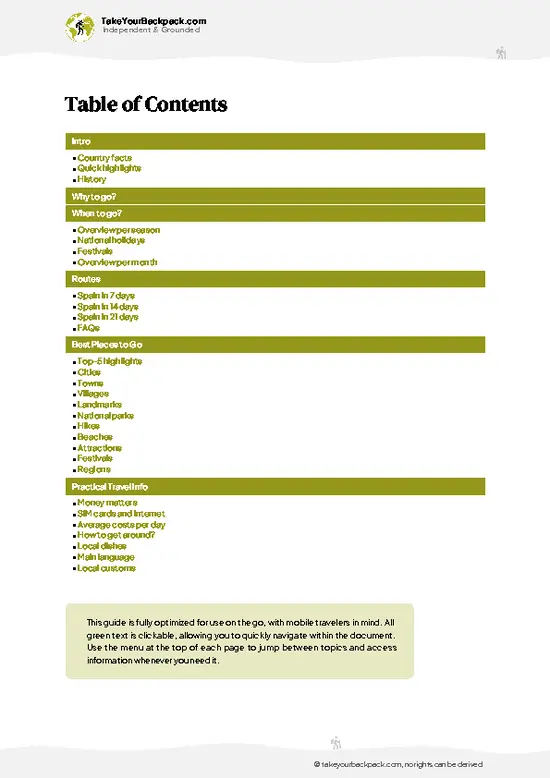
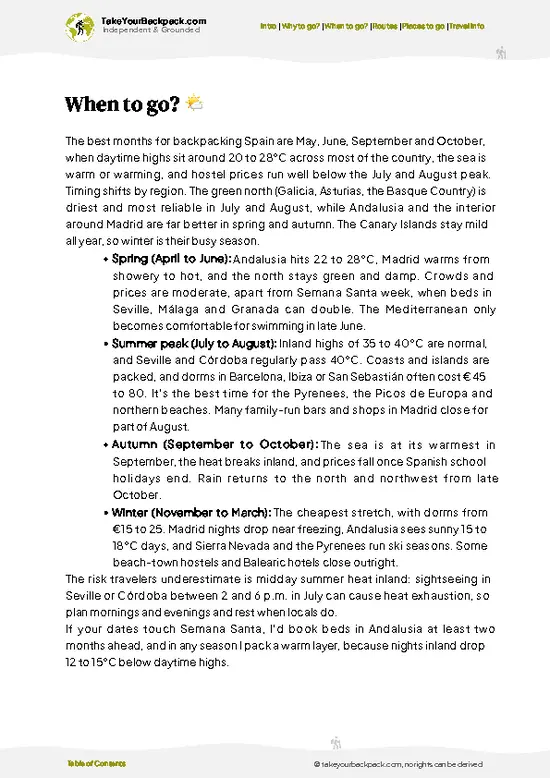
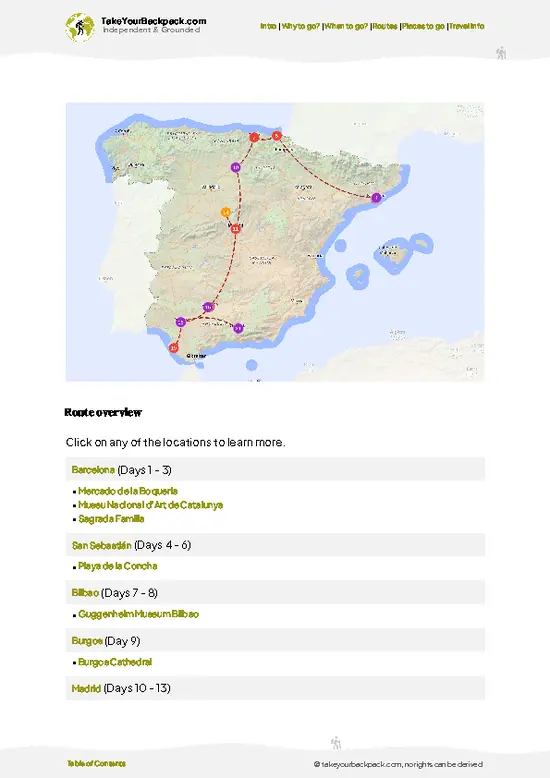
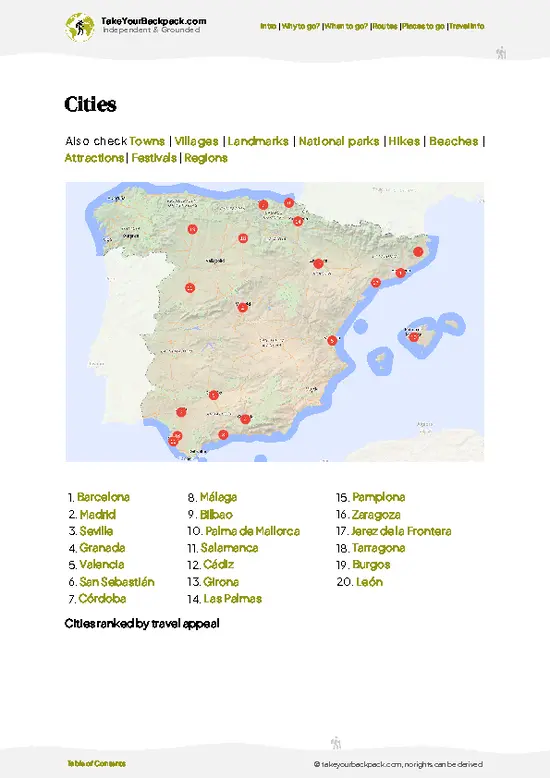
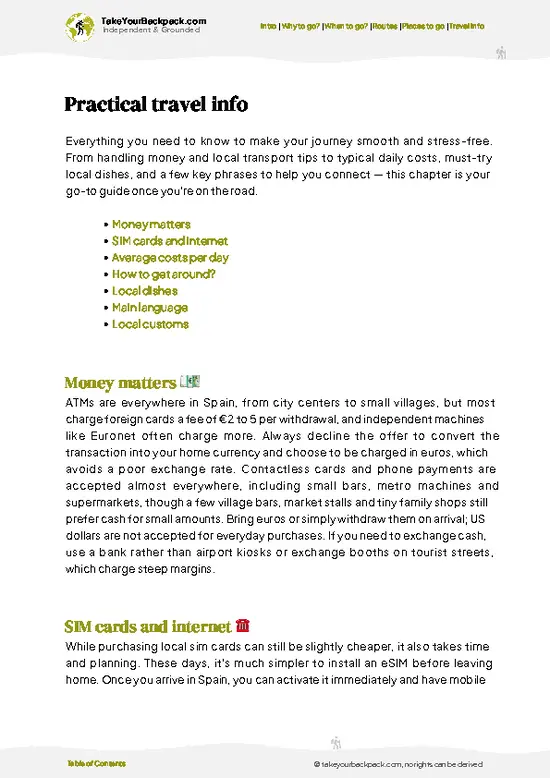
example page 0 from our offline Travel Guide for Spain
example page 1 from our offline Travel Guide for Spain
example page 2 from our offline Travel Guide for Spain
example page 3 from our offline Travel Guide for Spain
example page 4 from our offline Travel Guide for Spain
example page 5 from our offline Travel Guide for Spain
example page 6 from our offline Travel Guide for Spain
example page 7 from our offline Travel Guide for Spain
The digital guide (543 pages) contains:
✅ 147 highlights, ranked by travel appeal
✅ Optimized 7, 14 & 21-day travel routes
✅ Cities, national parks, landmarks, beaches
✅ How to get around
✅ Offline-friendly for travel without Wi-Fi
👉 Click to see all 30+ guide features

📅 Plan smarter in minutes, not weeks
✅ Month by month travel advice
✅ Festivals & national holidays
✅ Budget expectations

🗺️ Go to the right places, skip the overrated ones
✅ Honest pros & cons of destinations
✅ Top hikes, parks & viewpoints
✅ Lesser-known places most travelers miss
✅ Clear “worth it vs skip it” guidance

🛏️ Travel smoothly without rookie mistakes
✅ Best areas to stay
✅ Transport systems explained simply
✅ Common scams & safety advice
✅ SIM cards, money & practical tips

🌍 Understand the country, not just visit it
✅ Culture & traditions
✅ 52 Essential phrases & customs
✅ Festivals worth planning around
✅ Traveler-friendly historical context
✅ Insights that make places more meaningful

📱 Built for real travel conditions
✅ Fully downloadable PDF
✅ Works completely offline
✅ Optimized for phone use
✅ Useful in remote areas & buses
✅ Everything in one place
Stop searching, start planning
Get instant access to your full guide. 30‑day money-back guarantee.
+ Add another guide for just

By proceeding you agree to our terms.
Sent to your inbox immediately after payment • 100% Secure Checkout
Best Backpacking Travel Advisor 2025 tourism awardBest Backpacking
Travel Advisor
2025
What others say about Take Your Backpack Guides:
⭐⭐⭐⭐⭐
Fantastic, amazing amount of information!
⭐⭐⭐⭐⭐
My goodness this is amazing, it's what I've been looking for hats off too you!
⭐⭐⭐⭐⭐
I think this is absolutely BRILLIANT
⭐⭐⭐⭐
Very complete and informative. It's still missing places, but I gotta to commend you
⭐⭐⭐⭐⭐
This is truly amazing, thank you, can't wait to explore it with my kids!
⭐⭐⭐⭐⭐
Awesome resource, thank you!
⭐⭐⭐⭐⭐
This is amazing! Can't wait to explore the ones I haven't seen
⭐⭐⭐⭐
I love this! Well done, great idea.
⭐⭐⭐⭐⭐
Thanks for taking the time to make this gem!
⭐⭐⭐⭐⭐
This might be the best website I've ever seen.
⭐⭐⭐⭐⭐
Congratulations, and thank you so much for your work; it's incredibly valuable.
⭐⭐⭐⭐
In all seriousness I think you did a great job pointing out the important spots
⭐⭐⭐⭐⭐
10/10 very good
⭐⭐⭐⭐⭐
As someone who's only just starting to visit regularly this is awesome, thank you.
⭐⭐⭐⭐
Thank you very much! I'm going to visit my dad, it's going to be very useful!
⭐⭐⭐⭐⭐
This is really cool! We'll be travelling for the first time and this definitely come in handy.
⭐⭐⭐⭐⭐
You are now our minister of culture, congratulations 👨‍💼
⭐⭐⭐⭐⭐
Just wanted to tell you that this is a pearl! Going to follow your recommendations.
⭐⭐⭐⭐⭐
This is so cool. I'll definitely be using the resource for my travels soon.
⭐⭐⭐⭐⭐
This is very impressive! Good work.
⭐⭐⭐⭐⭐
This is an amazing and informative site. Very well done!

🛏️ Where to stay?Best Stay Options in Spain

Spain has hostels in every major city, with dorm beds usually costing €20 to €40 a night and private budget rooms or pensiones from about €45 to €80. In Madrid, Malasaña and La Latina put you close to the main sights and the best bars but get loud on weekends, while Lavapiés is cheaper and multicultural yet a little rougher after dark. In Barcelona, the Gothic Quarter and El Raval are central and lively but known for pickpockets, Gràcia is calmer and more local at the cost of a metro ride, and in Seville the Alameda area mixes cheap beds with late nightlife a short walk from the cathedral.

If you enjoy meeting fellow travelers, consider choosing hostels with high ratings for atmosphere. On the … read more 👉
Spain has hostels in every major city, with dorm beds usually costing €20 to €40 a night and private budget rooms or pensiones from about €45 to €80. In Madrid, Malasaña and La Latina put you close to the main sights and the best bars but get loud on weekends, while Lavapiés is cheaper and multicultural yet a little rougher after dark. In Barcelona, the Gothic Quarter and El Raval are central and lively but known for pickpockets, Gràcia is calmer and more local at the cost of a metro ride, and in Seville the Alameda area mixes cheap beds with late nightlife a short walk from the cathedral.

If you enjoy meeting fellow travelers, consider choosing hostels with high ratings for atmosphere. On the other hand, if you prefer having your own space, a hotel might be a better option.

SpainWhere to Go Next

👋 Meet the founderWho’s Behind Take Your Backpack?

Johan, backpacker and founder of TakeYourBackpackHi, I’m Johan (Netherlands 🇳🇱), the creator of TakeYourBackpack. Over the past 3 decades, I’ve backpacked through 90+ countries across six continents, gaining extensive experience with independent travel, long-term trips, and overland routes.

This site is built on a combination of firsthand travel experience and carefully curated insights from other backpackers. Many guides are based on places I’ve personally visited, while others bring together tips, observations, and practical advice shared by trusted travelers I’ve met along the way.

The goal is to provide realistic, experience-driven guidance — not generic itineraries — so you can explore destinations with better context, clearer expectations, and more confidence.