×

Spain🇪🇸 | best citiesTop-Rated 10 cities in Spain

Spain packs more urban variety into one peninsula than most countries manage across a whole continent. The north is green, drizzly and Atlantic, with cooler summers and a food scene that treats lunch as a contact sport. The Mediterranean coast is sunny, beach-adjacent and busy. The interior plateau is hot, historic and gloriously unhurried. Andalusia in the south sits at the far end of that spectrum, with Moorish architecture and temperatures that make a 3 p.m. plan look optimistic.
Costs follow geography. Big-name hubs and island capitals run higher on beds and drinks, while inland and northwestern cities often offer free tapas with a drink and dorm beds a notch cheaper. Access is easy: high-speed AVE trains and cheap buses link nearly everything, which makes independent travel here almost suspiciously smooth. Crowds are the real variable. Pick the kind of city first, and the rest sorts itself out.

By Johan Kruseman 🇳🇱 | Updated October 19, 2026
Explore the best towns in Spain

Why go?Why Travelers Love These Spots

Spain’s cities work because the country was built around them. Romans, Visigoths, Moors and Christian kingdoms each fought over the same hilltops and river crossings, and each left layers behind. The result is dense, walkable old centers where a cathedral, a former mosque or a Roman wall may share one block. Add the plaza tradition, and almost every town has a central square where life happens outdoors, for hours, at volumes that suggest a minor emergency but are just dinner.
Geography adds to it. The central plateau (the Meseta) is ringed by mountains, so the country has sharply different regional identities, with their own languages (Catalan, Basque, Galician), cuisines and festivals. Cities in different regions can feel like different countries, which is great value for one border crossing … read more 👉
Spain’s cities work because the country was built around them. Romans, Visigoths, Moors and Christian kingdoms each fought over the same hilltops and river crossings, and each left layers behind. The result is dense, walkable old centers where a cathedral, a former mosque or a Roman wall may share one block. Add the plaza tradition, and almost every town has a central square where life happens outdoors, for hours, at volumes that suggest a minor emergency but are just dinner.
Geography adds to it. The central plateau (the Meseta) is ringed by mountains, so the country has sharply different regional identities, with their own languages (Catalan, Basque, Galician), cuisines and festivals. Cities in different regions can feel like different countries, which is great value for one border crossing you never have to make.
Climate and infrastructure finish the job. Mild winters on the coast and long, light evenings mean a street-focused social life, and Europe’s largest high-speed rail network in kilometers makes hopping between them easy.
A few things are worth knowing before you commit. Meals run late: lunch usually starts around 2 p.m. and dinner rarely before 9 p.m., so a 6 p.m. appetite means snacks. Many shops shut for a midday break outside big centers, and some close Sundays. Summer heat in the interior and south is serious. Tourism pressure has pushed up prices and sparked local pushback in the most visited places, so a little respect and a bit of quiet after midnight in residential areas goes a long way. English is common in tourist zones and patchy elsewhere, and a few Spanish phrases earn real goodwill.
Our Approach to Ranking
The list of best cities in Spain is created based on culture, vibe, attractions, transport ease, and local charm. If you feel a city is missing in this list, please let us know.

When to go?Seasonal Guide to Visiting

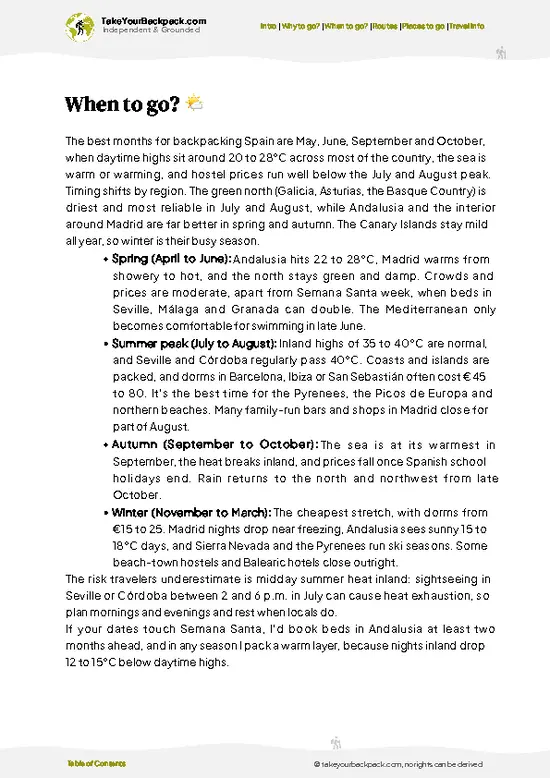
Best months and why: April to June and September to October are the best months for Spanish cities, with daytime highs of roughly 18 to 28°C, long daylight and no need to plan around heatstroke. Spring brings flowers and festivals, autumn brings warm evenings and lighter crowds, and both leave room for sightseeing before lunch and a nap after it, which is the correct national schedule.
Summer, and where it bites: July and August are hot. Seville, Córdoba and much of the interior and south regularly pass 38°C, and sometimes 42 to 45°C, so sightseeing hours shrink to early morning and late evening. The Atlantic north (the Basque Country, Cantabria, Galicia) stays around 22 to 27°C, which makes it the sensible summer refuge. Coastal cities are warm and humid and also packed, as August is when … read more 👉
Best months and why: April to June and September to October are the best months for Spanish cities, with daytime highs of roughly 18 to 28°C, long daylight and no need to plan around heatstroke. Spring brings flowers and festivals, autumn brings warm evenings and lighter crowds, and both leave room for sightseeing before lunch and a nap after it, which is the correct national schedule.
Summer, and where it bites: July and August are hot. Seville, Córdoba and much of the interior and south regularly pass 38°C, and sometimes 42 to 45°C, so sightseeing hours shrink to early morning and late evening. The Atlantic north (the Basque Country, Cantabria, Galicia) stays around 22 to 27°C, which makes it the sensible summer refuge. Coastal cities are warm and humid and also packed, as August is when many Spaniards take their own holidays. Accommodation can cost 30 to 60 percent more than in shoulder months, and popular places book out.
Winter and shoulder seasons: November to March is low season for most cities and much cheaper. Madrid and the plateau can drop to 0 to 10°C with cold, dry air, and frost is common at night. The Mediterranean south and coast stay milder, about 12 to 18°C by day. The north is the rainiest area, with frequent drizzle from October to April, often 100 to 150 mm a month. Elsewhere rainfall is modest.
Peak periods that change plans: Semana Santa (the week before Easter) fills Andalusia and parts of the interior, with prices up sharply and processions blocking streets. Local fiestas such as Las Fallas in March, Feria de Abril in Andalusia and San Fermín in July also spike demand. August 15 and the first days of January mean closures. Many museums close on Mondays, and a few restaurants take a month off in August.

city hoppingPlanning Your Route Efficiently

How many days you need: A trip linking several cities in Spain works best at 10 to 16 days, which allows three to five stops without turning the holiday into a timetable. Fewer than 10 days works for two regions, while more than 16 lets you add slower inland or northern detours.
Grouping regions and direction: Regions cluster cleanly. Madrid and the central plateau sit between everything, so they work as a hinge. The Andalusian south, the Mediterranean east coast with Catalonia, and the Atlantic north each make a natural loop. A reasonable direction is to arrive in Barcelona or Madrid, travel south by train in spring or autumn, then loop back north, or run the reverse in summer so the hottest regions come early or late in the day, not at midday peak. Flying into one city and out of another … read more 👉
How many days you need: A trip linking several cities in Spain works best at 10 to 16 days, which allows three to five stops without turning the holiday into a timetable. Fewer than 10 days works for two regions, while more than 16 lets you add slower inland or northern detours.
Grouping regions and direction: Regions cluster cleanly. Madrid and the central plateau sit between everything, so they work as a hinge. The Andalusian south, the Mediterranean east coast with Catalonia, and the Atlantic north each make a natural loop. A reasonable direction is to arrive in Barcelona or Madrid, travel south by train in spring or autumn, then loop back north, or run the reverse in summer so the hottest regions come early or late in the day, not at midday peak. Flying into one city and out of another saves a long backtrack.
Time per stop and travel times: Give a major city two to three nights. Smaller historic towns reward one or two. Moving between regions takes time: Madrid to Seville is around 2.5 hours on AVE, Madrid to Barcelona about 2.5 to 3 hours, Madrid to Valencia roughly 1.5 to 2 hours, and Barcelona to Seville about 5.5 to 6 hours by train. Buses cost less and cover places without rail, but run slower, often 5 to 8 hours for long hauls. Advance train fares start around €15 to 30 on high-speed routes and climb sharply close to departure.
Planning mistakes to avoid: The classic error is cramming too many stops in, so half the trip passes in stations. Cap yourself at one move every two to three days. Another is trying the length of the country in a week, since the distances are bigger than the map suggests. Booking trains late on peak dates also hurts, so reserve once your dates are firm. Do not overlap a big festival with a planned city unless you have booked a bed months ahead. Finally, remember that Sunday and public holiday timetables thin out, and arrive in time to find dinner before the kitchens open at 8:30 p.m.

The ListMust-Visit cities in Spain

1 Barcelona

modernist architecture, urban beaches, Catalan markets

Experience a city where Gaudí’s designs, city beaches, and bustling food halls create a distinct rhythm between sea and street.

Spain - Barcelona

2 Madrid

royal palace, art museums, grand boulevards

Navigate a capital city where world-class galleries, historic landmarks, and sprawling parks shape the urban experience.

Spain - Madrid

3 Seville

Giralda tower, flamenco venues, orange tree courtyards

Experience a city where Moorish relics, lively music, and shaded squares create a distinct Andalusian atmosphere.

spain-city-seville
© Google |

4 Granada

Alhambra palace, Albaicín district, Sierra Nevada views

Roam hillside neighborhoods with Moorish roots, snow-capped mountain backdrops, and the enduring presence of the Alhambra.

5 Valencia

City of Arts, Turia gardens, paella origins

Cycle through green parks, explore futuristic architecture, and try traditional rice dishes in this Mediterranean city.

spain-city-valencia
© Google |

6 San Sebastián

La Concha bay, Belle Époque architecture, pintxos bars

Swim, stroll, and sample Basque flavors in a city where elegant facades overlook one of Spain’s most scenic urban beaches.

7 Córdoba

Mezquita mosque, Roman bridge, Andalusian patios

Step into a city layered with Islamic, Roman, and Spanish influences, where shaded courtyards and historic monuments invite exploration.

8 Málaga

Costa del Sol, Picasso birthplace, port promenade

Balance city energy and seaside relaxation in a place where art, beaches, and Andalusian flavors converge.

Spain - Málaga

9 Bilbao

industrial heritage, Guggenheim Museum, Basque cuisine

Discover a riverside city transformed by contemporary art, inventive pintxos bars, and a legacy of steel and shipbuilding.

spain-city-bilbao
© Google |

10 Palma de Mallorca

Mediterranean port, Gothic cathedral, city beaches

Wander through narrow lanes lined with sandstone buildings, pause at lively markets, and swim from urban shores within minutes of the center.

11 Salamanca

university city, sandstone buildings, Plaza Mayor

Absorb the academic atmosphere and golden-hued architecture in a city shaped by centuries of student life.

spain-city-salamanca
© Google | Orlando Codeço

12 Cádiz

Atlantic coastline, ancient port, seafood taverns

Stroll narrow lanes opening to ocean views, where maritime traditions and fresh seafood define daily life by the bay.

13 Girona

medieval walls, Jewish quarter, riverside views

Walk cobbled streets beneath ancient ramparts, discovering quiet corners and panoramic vistas above the Onyar River.

14 Las Palmas

Canary Islands, urban beaches, subtropical climate

Enjoy year-round warmth, volcanic landscapes, and city life that blends Spanish and island influences beside the Atlantic.

15 Pamplona

San Fermín festival, medieval citadel, Navarre cuisine

Visit a city known for its annual festivities, fortified walls, and a culinary tradition rooted in the surrounding region.

16 Zaragoza

Ebro River, Mudéjar landmarks, tapas alleys

Cross bridges to discover a city marked by diverse architecture, lively food streets, and the broad Ebro waterway.

17 Jerez de la Frontera

sherry bodegas, equestrian shows, Andalusian plazas

Sample local wines in atmospheric cellars and watch horse displays in a city known for its deep-rooted traditions.

18 Tarragona

Roman amphitheater, Mediterranean port, ancient ruins

Uncover layers of Roman history and coastal life in a city where archaeological sites meet the sea.

19 Burgos

Gothic cathedral, pilgrimage stop, Castilian plazas

Trace centuries of history in a city marked by monumental stonework, quiet squares, and the Camino de Santiago’s steady flow.

20 León

Roman walls, Gothic cathedral, tapas streets

Explore a compact city where ancient ramparts encircle lively lanes filled with local bars and architectural contrasts.

21 Gijón

Asturian coast, cider houses, urban beaches

Relax in a northern city where green hills meet the sea, and local sidrerías offer a taste of regional culture.

22 Oviedo

Asturian capital, pre-Romanesque churches, cider bars

Find green parks, distinctive architecture, and a strong local identity in this northern city surrounded by rolling hills.

23 Logroño

Rioja wine, pedestrian streets, tapas crawl

Taste regional wines and hop between bars in a city famous for its food scene and relaxed, walkable center.

Think you know Spain?

Prove you’re a true local — uncover 13 lesser-known cities in Spain that locals tend to keep to themselves.
Loading the map 🌍

Expert viewWhat You Should Know

How many cities to visit: Three to five cities is the right number for most trips of 10 to 14 days, and I would not go higher. Spain’s best urban moments are slow ones: a long lunch, an evening walk, a wander with no plan. Each stop needs at least two nights to arrive, sleep and actually see something. Pack in eight cities and you will mostly see train platforms and the inside of a backpack.
Choosing the kind of city: Match the type to how you travel. If you love history and architecture, choose the historic southern and central cities, where Roman, Moorish and Christian layers sit within walking distance. If food is the priority, spend more time in the north, where pintxos and cider houses beat any attraction ticket. If you want beaches, nightlife and an easy social scene in hostels, pick … read more 👉
How many cities to visit: Three to five cities is the right number for most trips of 10 to 14 days, and I would not go higher. Spain’s best urban moments are slow ones: a long lunch, an evening walk, a wander with no plan. Each stop needs at least two nights to arrive, sleep and actually see something. Pack in eight cities and you will mostly see train platforms and the inside of a backpack.
Choosing the kind of city: Match the type to how you travel. If you love history and architecture, choose the historic southern and central cities, where Roman, Moorish and Christian layers sit within walking distance. If food is the priority, spend more time in the north, where pintxos and cider houses beat any attraction ticket. If you want beaches, nightlife and an easy social scene in hostels, pick a Mediterranean city, though this is also where the most crowded and priciest areas are. If you are on a very tight budget, smaller inland and northwestern cities give the best value. A capital is worth one stop for its museums, but skip repeat visits to the same type of cathedral. By the third one, you are mostly collecting photographs.
What it costs: A backpacker can manage on roughly €45 to 70 a day. That covers a dorm bed at €20 to 40, depending on city and season, a menú del día lunch at €12 to 16, a few coffees or tapas, and local transit. Mid-range independent travelers should plan on €90 to 140. Typical extras: city metro or bus tickets of €1.50 to 2.50 a ride, major cathedral or palace tickets of €10 to 20, and the most famous monuments of €15 to 35 or more. Many museums offer free hours in the late afternoon or on certain days, and those are worth using. Guided walking tours run €15 to 30, while free tours operate on tips, usually €10 to 15 each. A quality guide is worth paying for at one heavyweight monument, but the rest are better explored alone with a good map. Skip the hop-on bus, which is overpriced and slow almost everywhere. Intercity train and bus fares add around €15 to 60 per leg depending on booking time.
The menú del día, a set weekday lunch with three courses, bread and a drink, is the best food value in the country. Dinner is often costlier and later, so make lunch your main meal.
Safety and culture: Spanish cities are safe in terms of violent crime, but pickpocketing is real, especially around major stations, metros and crowded plazas in the busiest cities. Keep phones out of back pockets and zip your bag in front. Never leave a phone on a café table. Carry a photocopy or photo of your passport instead of the original, and use a hostel locker. Scams are usually minor: unsolicited “free” bracelets or flowers, fake petitions, and rigged street games. A firm no works.
Culturally, timing matters. Locals eat late, and turning up for dinner at 7 p.m. gets you an empty room and a puzzled look. Greet staff with a quick “hola” or “buenas”, which really changes the interaction. Keep noise down late at night in residential streets, since resident frustration with party tourism is real. Dress modestly for churches, with covered shoulders and knees. In regions with their own languages, such as Catalonia, the Basque Country and Galicia, a couple of local words are appreciated, and treating the region as simply “Spain” is a quick way to annoy people. Finally, tipping is modest. Rounding up or leaving a euro or two at a sit-down meal is plenty.

✈️ The backpacker research shortcutSpain Travel Guide

An offline-friendly backpacking guide with optimized travel routes, ranked highlights, transport advice, and the best areas to stay.
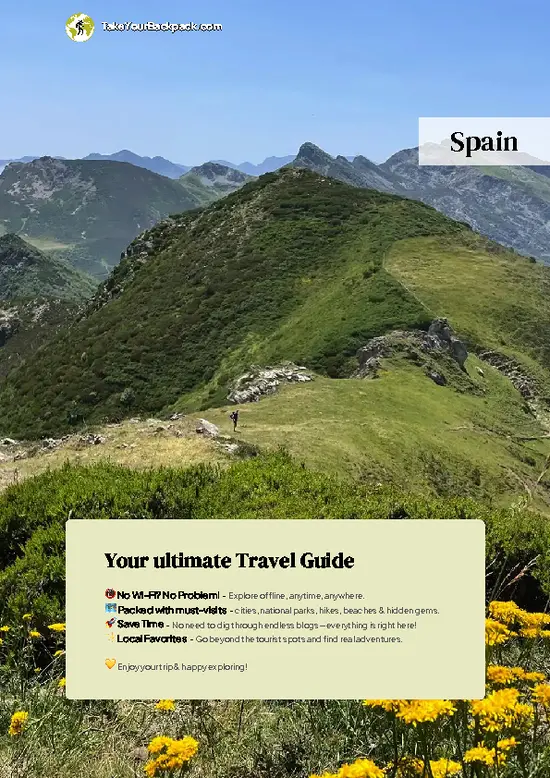
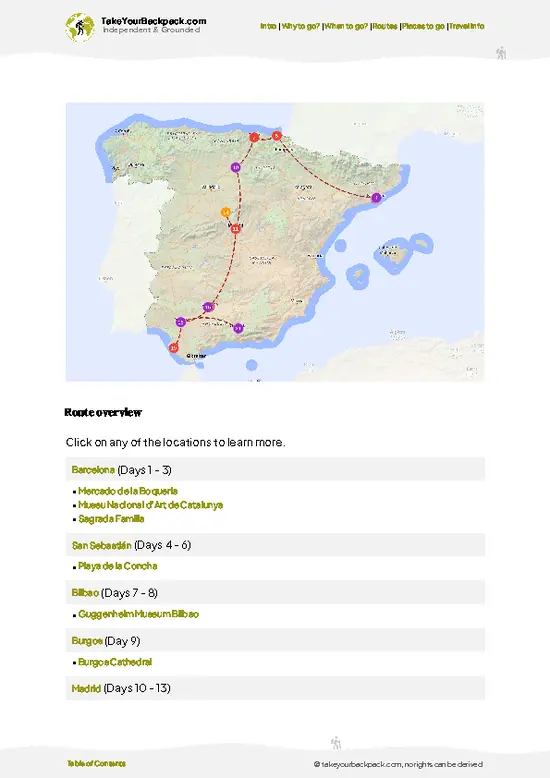
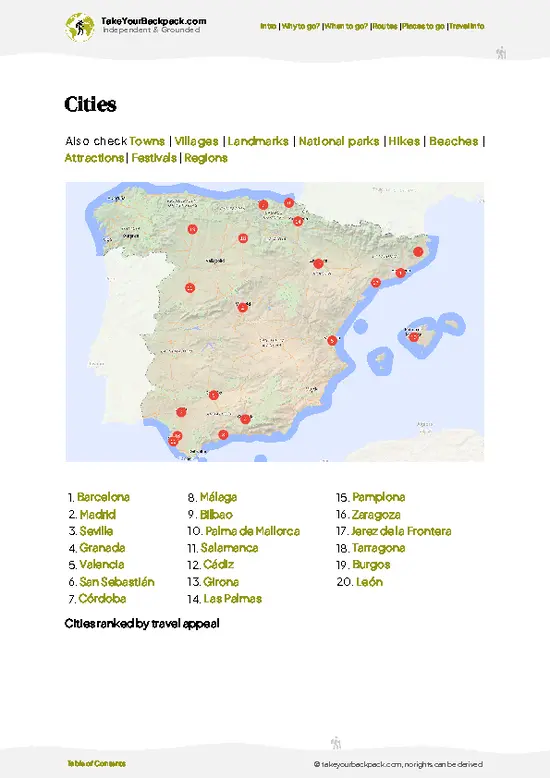
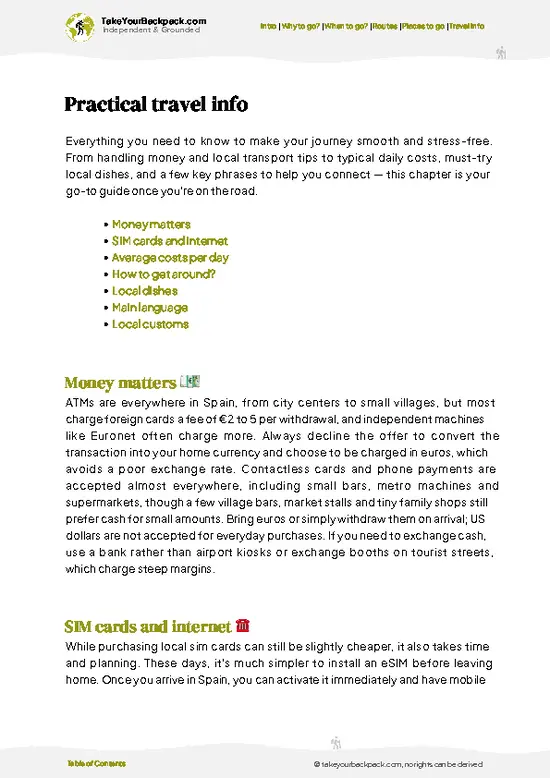
example page 0 from our offline Travel Guide for Spain
example page 1 from our offline Travel Guide for Spain
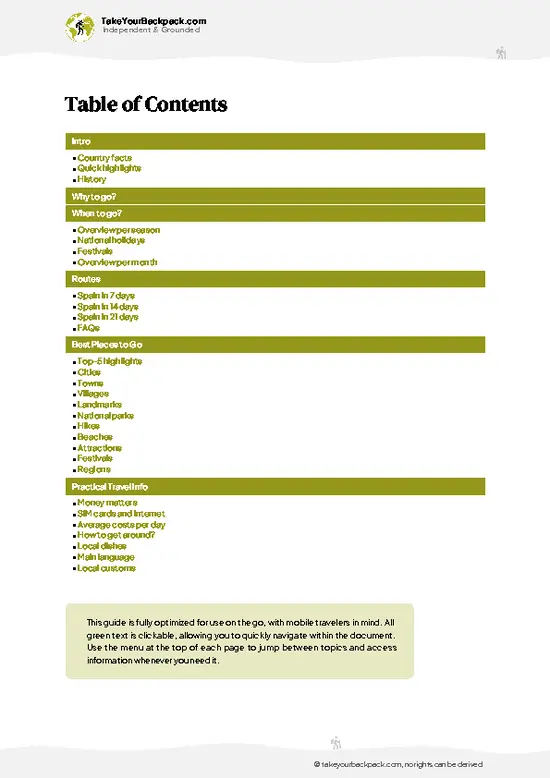
example page 2 from our offline Travel Guide for Spain
example page 3 from our offline Travel Guide for Spain
example page 4 from our offline Travel Guide for Spain
example page 5 from our offline Travel Guide for Spain
example page 6 from our offline Travel Guide for Spain
example page 7 from our offline Travel Guide for Spain
The digital guide (543 pages) contains:
✅ 147 highlights, ranked by travel appeal
✅ Optimized 7, 14 & 21-day travel routes
✅ Cities, national parks, landmarks, beaches
✅ How to get around
✅ Offline-friendly for travel without Wi-Fi
👉 Click to see all 30+ guide features

📅 Plan smarter in minutes, not weeks
✅ Month by month travel advice
✅ Festivals & national holidays
✅ Budget expectations

🗺️ Go to the right places, skip the overrated ones
✅ Honest pros & cons of destinations
✅ Top hikes, parks & viewpoints
✅ Lesser-known places most travelers miss
✅ Clear “worth it vs skip it” guidance

🛏️ Travel smoothly without rookie mistakes
✅ Best areas to stay
✅ Transport systems explained simply
✅ Common scams & safety advice
✅ SIM cards, money & practical tips

🌍 Understand the country, not just visit it
✅ Culture & traditions
✅ 52 Essential phrases & customs
✅ Festivals worth planning around
✅ Traveler-friendly historical context
✅ Insights that make places more meaningful

📱 Built for real travel conditions
✅ Fully downloadable PDF
✅ Works completely offline
✅ Optimized for phone use
✅ Useful in remote areas & buses
✅ Everything in one place
Stop searching, start planning
Get instant access to your full guide. 30‑day money-back guarantee.
+ Add another guide for just

By proceeding you agree to our terms.
Sent to your inbox immediately after payment • 100% Secure Checkout
Best Backpacking Travel Advisor 2025 tourism awardBest Backpacking
Travel Advisor
2025
What others say about Take Your Backpack Guides:
⭐⭐⭐⭐⭐
Fantastic, amazing amount of information!
⭐⭐⭐⭐⭐
My goodness this is amazing, it's what I've been looking for hats off too you!
⭐⭐⭐⭐⭐
I think this is absolutely BRILLIANT
⭐⭐⭐⭐
Very complete and informative. It's still missing places, but I gotta to commend you
⭐⭐⭐⭐⭐
This is truly amazing, thank you, can't wait to explore it with my kids!
⭐⭐⭐⭐⭐
Awesome resource, thank you!
⭐⭐⭐⭐⭐
This is amazing! Can't wait to explore the ones I haven't seen
⭐⭐⭐⭐
I love this! Well done, great idea.
⭐⭐⭐⭐⭐
Thanks for taking the time to make this gem!
⭐⭐⭐⭐⭐
This might be the best website I've ever seen.
⭐⭐⭐⭐⭐
Congratulations, and thank you so much for your work; it's incredibly valuable.
⭐⭐⭐⭐
In all seriousness I think you did a great job pointing out the important spots
⭐⭐⭐⭐⭐
10/10 very good
⭐⭐⭐⭐⭐
As someone who's only just starting to visit regularly this is awesome, thank you.
⭐⭐⭐⭐
Thank you very much! I'm going to visit my dad, it's going to be very useful!
⭐⭐⭐⭐⭐
This is really cool! We'll be travelling for the first time and this definitely come in handy.
⭐⭐⭐⭐⭐
You are now our minister of culture, congratulations 👨‍💼
⭐⭐⭐⭐⭐
Just wanted to tell you that this is a pearl! Going to follow your recommendations.
⭐⭐⭐⭐⭐
This is so cool. I'll definitely be using the resource for my travels soon.
⭐⭐⭐⭐⭐
This is very impressive! Good work.
⭐⭐⭐⭐⭐
This is an amazing and informative site. Very well done!

🛏️ Where to stay?Top Areas to Stay

Spain has hostels in every major city, with dorm beds usually costing €20 to €40 a night and private budget rooms or pensiones from about €45 to €80. In Madrid, Malasaña and La Latina put you close to the main sights and the best bars but get loud on weekends, while Lavapiés is cheaper and multicultural yet a little rougher after dark. In Barcelona, the Gothic Quarter and El Raval are central and lively but known for pickpockets, Gràcia is calmer and more local at the cost of a metro ride, and in Seville the Alameda area mixes cheap beds with late nightlife a short walk from the cathedral.

If you enjoy meeting fellow travelers, consider choosing hostels with high ratings for atmosphere. On the … read more 👉
Spain has hostels in every major city, with dorm beds usually costing €20 to €40 a night and private budget rooms or pensiones from about €45 to €80. In Madrid, Malasaña and La Latina put you close to the main sights and the best bars but get loud on weekends, while Lavapiés is cheaper and multicultural yet a little rougher after dark. In Barcelona, the Gothic Quarter and El Raval are central and lively but known for pickpockets, Gràcia is calmer and more local at the cost of a metro ride, and in Seville the Alameda area mixes cheap beds with late nightlife a short walk from the cathedral.

If you enjoy meeting fellow travelers, consider choosing hostels with high ratings for atmosphere. On the other hand, if you prefer having your own space, a hotel might be a better option.

SpainDiscover the Country

👋 Meet the founderWho’s Behind Take Your Backpack?

Johan, backpacker and founder of TakeYourBackpackHi, I’m Johan (Netherlands 🇳🇱), the creator of TakeYourBackpack. Over the past 3 decades, I’ve backpacked through 90+ countries across six continents, gaining extensive experience with independent travel, long-term trips, and overland routes.

This site is built on a combination of firsthand travel experience and carefully curated insights from other backpackers. Many guides are based on places I’ve personally visited, while others bring together tips, observations, and practical advice shared by trusted travelers I’ve met along the way.

The goal is to provide realistic, experience-driven guidance — not generic itineraries — so you can explore destinations with better context, clearer expectations, and more confidence.