×

Tajikistan🇹🇯 | best townsEssential 12 towns to Explore in Tajikistan

Tajikistan’s towns are small, mountain-hemmed and wonderfully unpolished, and each region pulls the trip in a different direction. The Fann Mountains and Zarafshan valley bring trekkers, homestays and the most visitors. The Pamir Highway settlements sit above 2,000 meters, with fewer comforts, higher transport costs and huge rewards. The Ferghana Valley in the north is lower, hotter and easier to reach, with bazaars and Silk Road history. Dushanbe is the capital and the logistics base. Independent travel here means shared taxis, homestays and flexible plans. Pick your landscape first, then choose towns to match.

By Johan Kruseman 🇳🇱 | Updated October 19, 2026
Explore the best villages in Tajikistan

Why go?Why Travelers Love These Spots

Tajikistan is about 93 percent mountains, so geography decides everything about its towns. Settlements cluster wherever a river carves out flat, irrigated land, which is why you find compact oasis towns in valleys and tiny roadside villages beside glacial rivers high in the Pamirs. Few places in Central Asia let you cross from poplar-lined Soviet boulevards to Wakhan Valley mud-brick hamlets within a few days.

The cultural mix adds depth. Tajik is a Persian language, so the region’s roots run closer to Iran and Afghanistan than to the Turkic neighbors. Pamiri communities in the east are largely Ismaili Muslim and have their own languages, houses and hospitality customs. Soviet planning left grid-pattern centers, concrete apartment blocks and big public squares, layered over much older bazaar … read more 👉
Tajikistan is about 93 percent mountains, so geography decides everything about its towns. Settlements cluster wherever a river carves out flat, irrigated land, which is why you find compact oasis towns in valleys and tiny roadside villages beside glacial rivers high in the Pamirs. Few places in Central Asia let you cross from poplar-lined Soviet boulevards to Wakhan Valley mud-brick hamlets within a few days.

The cultural mix adds depth. Tajik is a Persian language, so the region’s roots run closer to Iran and Afghanistan than to the Turkic neighbors. Pamiri communities in the east are largely Ismaili Muslim and have their own languages, houses and hospitality customs. Soviet planning left grid-pattern centers, concrete apartment blocks and big public squares, layered over much older bazaar towns.

Before choosing Tajikistan for towns, know that infrastructure is thin. Expect homestays rather than hotels in most places, patchy internet, unreliable hot water and long shared-taxi rides on rough mountain roads. Sights are spread out, so you spend plenty of time in transit. Visitors need a visa or e-visa, and a separate GBAO permit for the Pamirs. Go for atmosphere, hospitality and landscape, and treat the lack of polish as part of the adventure.
Our Approach to Ranking
The list of best towns in Tajikistan is created based on charm, local culture, atmosphere, hidden gems, and visitor appeal. If you feel a town is missing in this list, please let us know.

When to go?Seasonal Guide to Visiting

Best months for towns: Late May to June and September to early October are the best months for towns in Tajikistan, because valley temperatures sit around 18 to 30°C and mountain passes are open. July and August push lowland towns like those in the Ferghana Valley and around Dushanbe to 35 to 42°C, so they are best explored early in the morning and again after sunset.
Shoulder seasons and mountain regions: April and early May bring blossom and green valleys, but rain is most frequent in spring, with Dushanbe seeing roughly 60 to 100 mm a month in March and April, and high roads can still be snowed in. Treat the Pamirs and the Fann Mountains differently: at 2,000 to 3,500 meters, nights drop near freezing even in summer, and the best window runs from June to September. Sunny days on the Pamir … read more 👉
Best months for towns: Late May to June and September to early October are the best months for towns in Tajikistan, because valley temperatures sit around 18 to 30°C and mountain passes are open. July and August push lowland towns like those in the Ferghana Valley and around Dushanbe to 35 to 42°C, so they are best explored early in the morning and again after sunset.
Shoulder seasons and mountain regions: April and early May bring blossom and green valleys, but rain is most frequent in spring, with Dushanbe seeing roughly 60 to 100 mm a month in March and April, and high roads can still be snowed in. Treat the Pamirs and the Fann Mountains differently: at 2,000 to 3,500 meters, nights drop near freezing even in summer, and the best window runs from June to September. Sunny days on the Pamir Highway are warm, but you need layers in the evening.
Winter and prices: November to March is cold, with snow in the mountains, closed passes, shut guesthouses in remote areas and sparse transport. Lowland towns stay accessible, at around 0 to 10°C in Dushanbe. Peak season is July and August, when homestay beds and shared-taxi seats fill and prices rise by about 10 to 20 percent. Shoulder months bring easier bargaining and quieter roads.

town hoppingHow to Combine towns Into One Trip

How many days to plan: A trip linking several Tajik towns needs 10 to 21 days, because distances are short on the map and long on the road. Dushanbe works as the natural hub, with flights, banks, SIM cards and shared-taxi stations.
Which regions group well: Three clusters make sense. The Fann Mountains and Zarafshan valley sit 3 to 5 hours north of Dushanbe by shared taxi. The Ferghana Valley in the far north is 4 to 6 hours from the Zarafshan area, often via the Anzob tunnel road. The Pamir Highway in the east is the big one: Dushanbe to Khorog takes 12 to 16 hours by shared jeep, and the full route to Murghab and Osh takes about 4 to 7 days if you stop. Start with the mountain clusters near the capital, then head east and finish in Osh in Kyrgyzstan, or reverse the direction if you are arriving … read more 👉
How many days to plan: A trip linking several Tajik towns needs 10 to 21 days, because distances are short on the map and long on the road. Dushanbe works as the natural hub, with flights, banks, SIM cards and shared-taxi stations.
Which regions group well: Three clusters make sense. The Fann Mountains and Zarafshan valley sit 3 to 5 hours north of Dushanbe by shared taxi. The Ferghana Valley in the far north is 4 to 6 hours from the Zarafshan area, often via the Anzob tunnel road. The Pamir Highway in the east is the big one: Dushanbe to Khorog takes 12 to 16 hours by shared jeep, and the full route to Murghab and Osh takes about 4 to 7 days if you stop. Start with the mountain clusters near the capital, then head east and finish in Osh in Kyrgyzstan, or reverse the direction if you are arriving from there.
Time per stop and common mistakes: Allow 1 to 3 nights per town, with extra buffer days in the Pamirs. The classic error is stacking transfers back to back, since landslides, checkpoints and slow jeep departures regularly add hours. Many travelers also forget permits, or fly to Khorog on a weather-dependent flight and miss a connection. Instead, add at least one spare day around each mountain transfer, secure the GBAO permit with your visa, and leave early in the morning when shared taxis fill fastest.

The ListMust-Visit towns in Tajikistan

1 Khorog

Pamir capital, university town, riverside gardens

Settle into a high-altitude town with a lively student presence, lush parks, and a gateway feel to the Pamir region.

2 Panjakent

Ancient ruins, archaeological sites, Zarafshan Valley

Walk among the remains of Sogdian settlements and use the city as a base for exploring remote mountain villages and petroglyphs.

3 Murghab

high-altitude plateau, Kyrgyz influences, windswept bazaar

Experience stark uplands where nomadic traditions persist, market stalls offer supplies, and the air feels thin and brisk.

tajikistan-city-murghab
© Google |

4 Langar

Wakhan Valley, petroglyph fields, remote hamlet

Venture to a windswept outpost where ancient rock carvings overlook a narrow valley at the edge of the country.

5 Ayni

mountain crossroads, Zeravshan River, ancient ruins

Discover a meeting point for mountain routes, where riverbanks and archaeological sites hint at centuries of movement.

6 Vanj

broad valley, glacial rivers, Pamiri villages

Journey through a fertile valley framed by peaks, where traditional homes and rushing water define the rhythm of life.

7 Garm

mountain basin, Pamir Highway junction, local bazaars

Pause in a highland hub where mountain roads converge, and daily commerce brings together travelers and villagers.

8 Fayzobod

mountain foothills, market town, Sufi shrine

Experience a crossroads where mountain trails meet spiritual sites and the region’s produce fills open-air stalls.

9 Jirgatol

eastern gateway, river plain, livestock markets

Arrive at a trading post on open plains, where herders gather and the road eastward begins to climb.

tajikistan-city-jirgatol
© Google |

10 Tavildara

alpine meadows, river confluence, trekking base

Start mountain journeys from a riverside settlement, where grassy slopes and clear streams attract hikers and shepherds alike.

11 Danghara

Agricultural hub, cotton fields, rural landscape

Experience the rhythms of rural Tajikistan by passing through fields and villages where agriculture shapes daily life and local identity.

12 Asht

orchard valleys, Uzbek border, rural crossroads

Travel through a patchwork of fruit farms and borderland villages, where cultures blend and agriculture dominates the scenery.

Loading the map 🌍

Expert viewExpert Commentary on towns

How many towns to visit: Four to six towns is the right number for most backpackers, over two to three weeks. Roads are slow, and the bumpy jeep rides between valleys eat whole days, so every extra stop costs real time. Fewer stops mean more mornings spent walking through bazaars, sharing tea and watching mountains turn pink at dusk.
Choosing the kind of town: Pick by travel style. Hikers should prioritize Fann Mountain and Zarafshan gateways, where you can walk straight from a homestay to turquoise lakes. Culture seekers do better in the Ferghana Valley and the capital region, where bazaars overflow with dried apricots, fresh non bread and samsa. Road-trippers and landscape chasers belong in the Pamirs and Wakhan Valley, where mud-brick villages face Afghan peaks across a narrow river, and … read more 👉
How many towns to visit: Four to six towns is the right number for most backpackers, over two to three weeks. Roads are slow, and the bumpy jeep rides between valleys eat whole days, so every extra stop costs real time. Fewer stops mean more mornings spent walking through bazaars, sharing tea and watching mountains turn pink at dusk.
Choosing the kind of town: Pick by travel style. Hikers should prioritize Fann Mountain and Zarafshan gateways, where you can walk straight from a homestay to turquoise lakes. Culture seekers do better in the Ferghana Valley and the capital region, where bazaars overflow with dried apricots, fresh non bread and samsa. Road-trippers and landscape chasers belong in the Pamirs and Wakhan Valley, where mud-brick villages face Afghan peaks across a narrow river, and hot springs soak away the dust.
What it costs: Budget US$25 to 45 a day for homestays with dinner and breakfast, shared transport and cheap café lunches. Going more comfortable runs US$50 to 80. Homestays typically cost US$15 to 30 per person with meals. Shared taxis between towns run roughly US$5 to 25 depending on distance, while a private 4x4 for the Pamir Highway costs around US$100 to 150 a day, shared among passengers. Entry fees at museums and forts are small, usually US$1 to 5. Guides for treks cost US$30 to 60 a day. Carry cash in somoni, as ATMs are scarce outside the cities and cards rarely work in small places.
Safety and cultural habits: Tajikistan is generally safe for travelers, and locals tend to be warm and curious. The real risks are road conditions, altitude and weather, so travel with spare time, water and layers. Check current advice for the Afghan border area, and keep your passport and registration papers with you, since police checkpoints are common on highways. Photography near military sites and borders is a bad idea.

Dress modestly, especially in rural towns: covered shoulders and knees for everyone. Remove your shoes in homes. Accept tea when offered, and take bread with your right hand. Alcohol is available in cities but not everywhere, so be discreet. If you are invited to dinner, the toast and the long meal are the best part of the day.

✈️ The backpacker research shortcutTajikistan Travel Guide

An offline-friendly backpacking guide with optimized travel routes, ranked highlights, transport advice, and the best areas to stay.
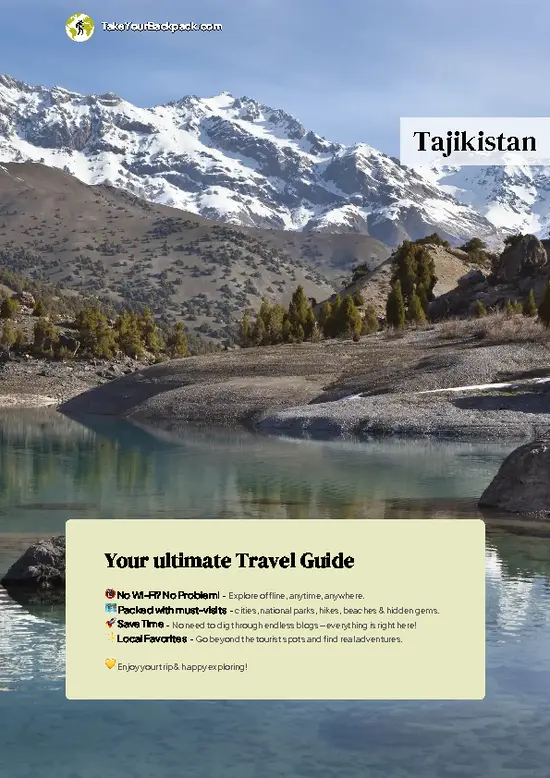
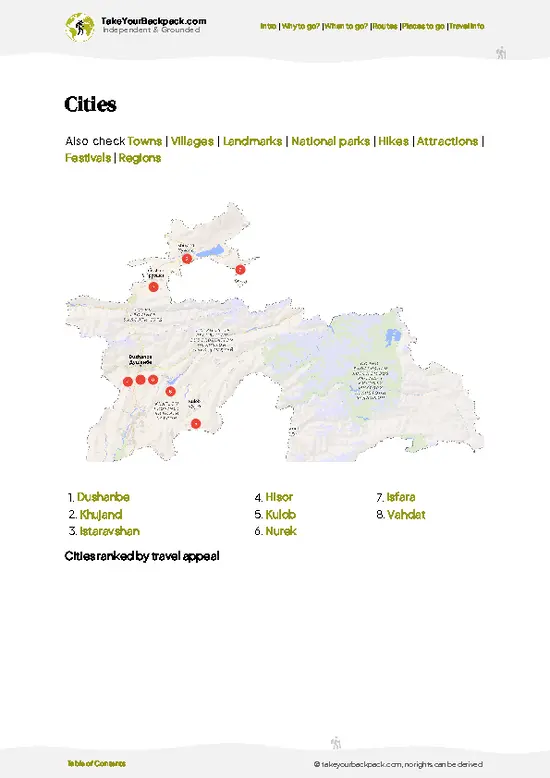
example page 0 from our offline Travel Guide for Tajikistan
example page 1 from our offline Travel Guide for Tajikistan
example page 2 from our offline Travel Guide for Tajikistan
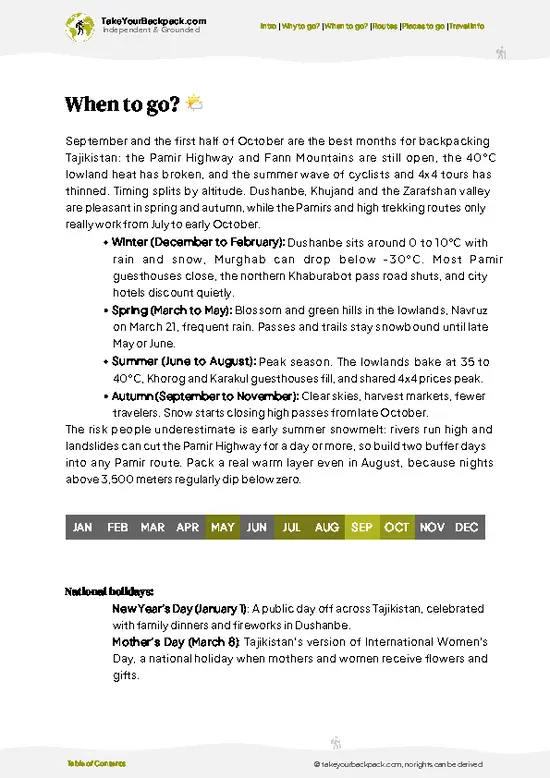
example page 3 from our offline Travel Guide for Tajikistan
example page 4 from our offline Travel Guide for Tajikistan
example page 5 from our offline Travel Guide for Tajikistan
example page 6 from our offline Travel Guide for Tajikistan
example page 7 from our offline Travel Guide for Tajikistan
The digital guide (268 pages) contains:
✅ 64 highlights, ranked by travel appeal
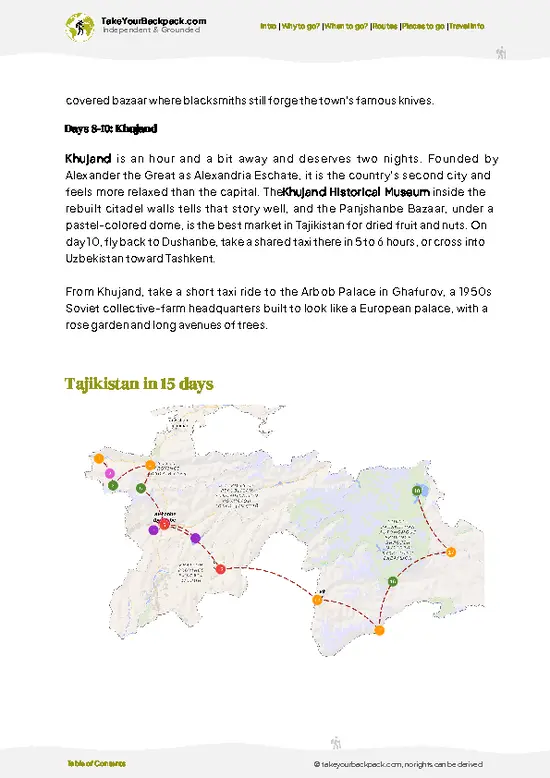
✅ Optimized 5, 10 & 15-day travel routes
✅ Cities, national parks, landmarks, beaches
✅ How to get around
✅ Offline-friendly for travel without Wi-Fi
👉 Click to see all 30+ guide features

📅 Plan smarter in minutes, not weeks
✅ Month by month travel advice
✅ Festivals & national holidays
✅ Budget expectations

🗺️ Go to the right places, skip the overrated ones
✅ Honest pros & cons of destinations
✅ Top hikes, parks & viewpoints
✅ Lesser-known places most travelers miss
✅ Clear “worth it vs skip it” guidance

🛏️ Travel smoothly without rookie mistakes
✅ Best areas to stay
✅ Transport systems explained simply
✅ Common scams & safety advice
✅ SIM cards, money & practical tips

🌍 Understand the country, not just visit it
✅ Culture & traditions
✅ 52 Essential phrases & customs
✅ Festivals worth planning around
✅ Traveler-friendly historical context
✅ Insights that make places more meaningful

📱 Built for real travel conditions
✅ Fully downloadable PDF
✅ Works completely offline
✅ Optimized for phone use
✅ Useful in remote areas & buses
✅ Everything in one place
Stop searching, start planning
Get instant access to your full guide. 30‑day money-back guarantee.
+ Add another guide for just

By proceeding you agree to our terms.
Sent to your inbox immediately after payment • 100% Secure Checkout
Best Backpacking Travel Advisor 2025 tourism awardBest Backpacking
Travel Advisor
2025
What others say about Take Your Backpack Guides:
⭐⭐⭐⭐⭐
Fantastic, amazing amount of information!
⭐⭐⭐⭐⭐
My goodness this is amazing, it's what I've been looking for hats off too you!
⭐⭐⭐⭐⭐
I think this is absolutely BRILLIANT
⭐⭐⭐⭐
Very complete and informative. It's still missing places, but I gotta to commend you
⭐⭐⭐⭐⭐
This is truly amazing, thank you, can't wait to explore it with my kids!
⭐⭐⭐⭐⭐
Awesome resource, thank you!
⭐⭐⭐⭐⭐
This is amazing! Can't wait to explore the ones I haven't seen
⭐⭐⭐⭐
I love this! Well done, great idea.
⭐⭐⭐⭐⭐
Thanks for taking the time to make this gem!
⭐⭐⭐⭐⭐
This might be the best website I've ever seen.
⭐⭐⭐⭐⭐
Congratulations, and thank you so much for your work; it's incredibly valuable.
⭐⭐⭐⭐
In all seriousness I think you did a great job pointing out the important spots
⭐⭐⭐⭐⭐
10/10 very good
⭐⭐⭐⭐⭐
As someone who's only just starting to visit regularly this is awesome, thank you.
⭐⭐⭐⭐
Thank you very much! I'm going to visit my dad, it's going to be very useful!
⭐⭐⭐⭐⭐
This is really cool! We'll be travelling for the first time and this definitely come in handy.
⭐⭐⭐⭐⭐
You are now our minister of culture, congratulations 👨‍💼
⭐⭐⭐⭐⭐
Just wanted to tell you that this is a pearl! Going to follow your recommendations.
⭐⭐⭐⭐⭐
This is so cool. I'll definitely be using the resource for my travels soon.
⭐⭐⭐⭐⭐
This is very impressive! Good work.
⭐⭐⭐⭐⭐
This is an amazing and informative site. Very well done!

🛏️ Where to stay?Top Places to Consider Staying

Tajikistan has a small but growing hostel scene, with dorm beds from roughly US$7 to 12 and guesthouse rooms from about US$15 to 30, most of them in Dushanbe, Khorog and Khujand. In Dushanbe, the streets around Rudaki Avenue put you within walking distance of the parks, museums and the few bars and cafes that stay open late, while the quieter residential lanes south toward the Shohmansur bazaar area are cheaper and closer to shared taxi stands but a longer walk from evening life. In Khorog, places near the center and the Panj River make it easy to arrange Pamir Highway transport, and nights are calm and safe with almost no nightlife, while homestays in the Pamir and Fann Mountain villages trade … read more 👉
Tajikistan has a small but growing hostel scene, with dorm beds from roughly US$7 to 12 and guesthouse rooms from about US$15 to 30, most of them in Dushanbe, Khorog and Khujand. In Dushanbe, the streets around Rudaki Avenue put you within walking distance of the parks, museums and the few bars and cafes that stay open late, while the quieter residential lanes south toward the Shohmansur bazaar area are cheaper and closer to shared taxi stands but a longer walk from evening life. In Khorog, places near the center and the Panj River make it easy to arrange Pamir Highway transport, and nights are calm and safe with almost no nightlife, while homestays in the Pamir and Fann Mountain villages trade hostel social life for home-cooked meals and very early nights.

If you enjoy meeting fellow travelers, consider choosing hostels with high ratings for atmosphere. On the other hand, if you prefer having your own space, a hotel might be a better option.

TajikistanMore Places Across Tajikistan

👋 Meet the founderWho’s Behind Take Your Backpack?

Johan, backpacker and founder of TakeYourBackpackHi, I’m Johan (Netherlands 🇳🇱), the creator of TakeYourBackpack. Over the past 3 decades, I’ve backpacked through 90+ countries across six continents, gaining extensive experience with independent travel, long-term trips, and overland routes.

This site is built on a combination of firsthand travel experience and carefully curated insights from other backpackers. Many guides are based on places I’ve personally visited, while others bring together tips, observations, and practical advice shared by trusted travelers I’ve met along the way.

The goal is to provide realistic, experience-driven guidance — not generic itineraries — so you can explore destinations with better context, clearer expectations, and more confidence.