×

Thailand🇹🇭 | best hikesYour Guide to the 10 Best hikes in Thailand

Hiking in Thailand splits into three personalities, and picking the right one saves you money and sweat. The north (Chiang Mai, Pai, Mae Hong Son) offers cool-season ridge walks, hill-tribe villages and homestays, with easy bus access and plenty of independent travel options. The national parks of the center and northeast, such as Khao Yai and Phu Kradueng, feel more local, with Thai weekend crowds and park-run campsites. The south mixes limestone karst, jungle and island trails, so heat and humidity decide your day. Get moving by 6 or 7 a.m. almost everywhere, because the afternoons are brutal and the light is better early. Book popular campsites and park huts online ahead of long weekends, when Thai families arrive in force. Many trails are short, cheap and well signed, which makes them friendly for beginners, while guides add depth where trails fade.

By Johan Kruseman 🇳🇱 | Updated October 19, 2026
Explore the best beaches in Thailand

Why go?Key Factors That Shape the Experience

Thailand suits hiking in a way that surprises people who only know the beaches. The country stretches across roughly 1,600 kilometers from north to south, so you get cool northern highlands, dry deciduous forest, wet tropical rainforest and limestone karst, all reachable by cheap buses, trains and domestic flights. The national park system, run by the Department of National Parks, protects over a hundred parks with trail networks, ranger stations, basic campsites and bungalows. Fees for foreigners are higher than for Thais, typically 100 to 500 baht (about US$3 to 14), but still modest by international standards.

Culture shapes the walking too. Many northern routes pass through hill-tribe villages of Karen, Hmong, Akha and Lahu communities, which means homestays, village meals and a different … read more 👉
Thailand suits hiking in a way that surprises people who only know the beaches. The country stretches across roughly 1,600 kilometers from north to south, so you get cool northern highlands, dry deciduous forest, wet tropical rainforest and limestone karst, all reachable by cheap buses, trains and domestic flights. The national park system, run by the Department of National Parks, protects over a hundred parks with trail networks, ranger stations, basic campsites and bungalows. Fees for foreigners are higher than for Thais, typically 100 to 500 baht (about US$3 to 14), but still modest by international standards.

Culture shapes the walking too. Many northern routes pass through hill-tribe villages of Karen, Hmong, Akha and Lahu communities, which means homestays, village meals and a different pace than wilderness trekking. Remember these are living communities, so dress modestly, ask before taking photos and buy from village stalls rather than just walking through.

Be realistic about the downsides. Summit views are not alpine, as the highest peak, Doi Inthanon, is about 2,565 meters. Heat and humidity are the main challenge, not altitude. Trails can turn muddy and leech-prone in the rainy season, and smoke from agricultural burning can hang over the north in late winter and early spring. Many parks require guides or permits on certain routes, and some close for the wet season. Carry cash, because small park offices and villages rarely take cards, and pack insect repellent plus a light rain layer. Come with these expectations and the country gives you easy logistics, good food at the trailhead and low costs.
Our Approach to Ranking
The list of best hikes in Thailand is created based on scenery, challenge, trail quality, landmarks, and overall enjoyment. If you feel a hike is missing in this list, please let us know.

When to go?Timing Your Visit for the Best Experience

Best months and why: The best months for hiking in Thailand are November to February, when the dry cool season brings clear skies, low humidity and comfortable walking temperatures across most of the country. In the northern highlands, days sit around 25 to 30°C, while nights on high ridges can drop to 5 to 12°C, so bring a warm layer and a sleeping bag liner if you camp. Summit sunrises in this window are cold but dependable.

Shoulder seasons: March to May is the hot season. Temperatures climb to 35 to 40°C in the lowlands, and the north often suffers from agricultural burning smoke, especially from late February through April, which cuts visibility and irritates lungs. If you must go then, favor higher, shaded forest and start before 7 a.m. June to October is the rainy season for most of … read more 👉
Best months and why: The best months for hiking in Thailand are November to February, when the dry cool season brings clear skies, low humidity and comfortable walking temperatures across most of the country. In the northern highlands, days sit around 25 to 30°C, while nights on high ridges can drop to 5 to 12°C, so bring a warm layer and a sleeping bag liner if you camp. Summit sunrises in this window are cold but dependable.

Shoulder seasons: March to May is the hot season. Temperatures climb to 35 to 40°C in the lowlands, and the north often suffers from agricultural burning smoke, especially from late February through April, which cuts visibility and irritates lungs. If you must go then, favor higher, shaded forest and start before 7 a.m. June to October is the rainy season for most of the country, with the heaviest rain commonly in August and September. The upside is green forest, full waterfalls and far fewer people, but trails are slippery and leeches appear. Some parks close routes during this time.

Regional differences: The south works to a different calendar. The Andaman side is wettest from roughly May to October, while the Gulf side, including areas near Surat Thani, gets its heaviest rain from October to December. That makes January to April the safest window for southern trails.

Crowds and prices: December and January are peak season, with guesthouse and homestay rates in popular northern bases often 20 to 50 percent higher, and park campsites filling on weekends and holidays. Book ahead around New Year and avoid Songkran in mid-April if you want a quiet trip, since transport is packed. November and February give you the best balance of good weather and manageable prices.

hike hoppingHow to Combine hikes Into One Trip

How many days to allow: A trip combining several hikes in Thailand needs 10 to 16 days, which leaves room for travel days and a buffer for weather. Thailand is long, so the smartest plan clusters trails by region rather than zigzagging across the map.

Which regions group well: The north is the natural core. Chiang Mai works as the hub, with Pai, Chiang Dao and Mae Hong Son loops all within a few hours by minivan or bus. Allow 2 to 4 days per stop so you can hike, rest and absorb the changes in altitude and temperature. A second cluster sits in the center and northeast, around Khao Yai or Phu Kradueng, which fits well after Bangkok. The south, around Krabi, Khao Sok and Surat Thani, makes a third cluster that you can reach by a 1 to 1.5 hour domestic flight.

Direction of travel: Start in … read more 👉
How many days to allow: A trip combining several hikes in Thailand needs 10 to 16 days, which leaves room for travel days and a buffer for weather. Thailand is long, so the smartest plan clusters trails by region rather than zigzagging across the map.

Which regions group well: The north is the natural core. Chiang Mai works as the hub, with Pai, Chiang Dao and Mae Hong Son loops all within a few hours by minivan or bus. Allow 2 to 4 days per stop so you can hike, rest and absorb the changes in altitude and temperature. A second cluster sits in the center and northeast, around Khao Yai or Phu Kradueng, which fits well after Bangkok. The south, around Krabi, Khao Sok and Surat Thani, makes a third cluster that you can reach by a 1 to 1.5 hour domestic flight.

Direction of travel: Start in the north in the cooler months, then fly or take the overnight train south. Chiang Mai to Bangkok takes about 11 to 13 hours by sleeper train or around 1 hour 20 minutes by air, and Bangkok to Krabi or Surat Thani takes about 1 hour 15 minutes by plane. Overnight buses and trains from Bangkok to the south take 9 to 12 hours. Moving north to south means you finish near beaches, which suits tired legs.

Planning mistakes: The most common error is trying to cover all three regions in a week, which turns the trip into transit. Instead, pick two regions and give each real time. Another is arriving in a town and hiking the same day after an overnight bus. Schedule a rest or easy day after long journeys. Travelers also ignore seasonal closures and smoke, so check conditions before booking nonrefundable transport. Finally, minivans and trains fill up around public holidays, so reserve a few days ahead.

The ListMust-Visit hikes in Thailand

1 Kew Mae Pan Nature Trail

alpine ridge, cloud forest, panoramic viewpoints

Follow a narrow ridge above the clouds, passing through mossy woods and open grasslands with sweeping views across Doi Inthanon’s highlands.

thailand-hike-kew-mae-pan-nature-trail
© Google |

2 Doi Suthep

forest stairway, temple complex, city overlook

Climb through shaded woods to a mountaintop temple, where golden spires and panoramic views frame Chiang Mai below.

3 Dragon Crest Mountain

coastal peaks, rocky outcrops, Andaman views

Ascend through forest to a summit where the land falls away to reveal the islands and turquoise bays of Krabi’s coastline.

4 Phu Chi Fa

cliff edge, sea of mist, sunrise spectacle

Reach the rim before dawn to watch fog roll over Laos, as the first light reveals jagged peaks and a shifting ocean of clouds.

5 Phu Kradueng Summit Trail

plateau summit, pine forest, seasonal wildflowers

Climb steadily to a cool plateau, where pine woods and open meadows offer a rare escape from the tropical lowlands.

thailand-hike-phu-kradueng-summit-trail
© Google |

6 Khao Chang Phueak Trail

knife-edge ridge, grassy slopes, borderland views

Traverse a narrow ridgeline above Thong Pha Phum, where open slopes and distant horizons mark the edge of Thailand and Myanmar.

7 Pha Dok Siew Nature Trail

rice terraces, waterfalls, Karen village

Descend past layered paddies and cool cascades, ending in a working village where local guides share insight into daily rural life.

8 Khao Mokoju Trail

remote wilderness, river crossings, misty summit

Trek deep into Mae Wong National Park, crossing streams and dense forest before reaching a cloud-wrapped peak rarely visited by tourists.

9 Pai Canyon

narrow ridges, red earth, sunset vistas

Walk exposed sandstone spines above the Pai valley, where sharp drops and shifting light create a dramatic, ever-changing landscape.

10 Khao Sok Lake Trail

limestone cliffs, flooded forest, floating bungalows

Travel by boat and foot through flooded jungle, discovering caves, wildlife, and the surreal landscape of Cheow Lan Lake’s emerald waters.

thailand-hike-khao-sok-lake-trail
© Google |
Loading the map 🌍

Expert viewExpert Commentary on hikes

How many hikes to do: I advise three to five hikes on a trip of two weeks. Fewer than three and you miss how different the north, the national parks and the south feel. More than five and you spend your days in vans and sore calves, with little recovery. Thai heat saps energy faster than most people expect, so quality beats quantity. Treat one rest day for every two hiking days as normal.

Which kind for which traveler: If you are a first-timer or on a short trip, prioritize a well-marked national park day hike with a ranger station and a clear loop. They are cheap, safe and give you a feel for the forest. If you want culture and conversation, choose a multi-day northern trek with village homestays, and pick a small, locally run operator over a big agency. If you like wildlife and rainforest, … read more 👉
How many hikes to do: I advise three to five hikes on a trip of two weeks. Fewer than three and you miss how different the north, the national parks and the south feel. More than five and you spend your days in vans and sore calves, with little recovery. Thai heat saps energy faster than most people expect, so quality beats quantity. Treat one rest day for every two hiking days as normal.

Which kind for which traveler: If you are a first-timer or on a short trip, prioritize a well-marked national park day hike with a ranger station and a clear loop. They are cheap, safe and give you a feel for the forest. If you want culture and conversation, choose a multi-day northern trek with village homestays, and pick a small, locally run operator over a big agency. If you like wildlife and rainforest, head to Khao Yai or Khao Sok and go with a licensed guide, because animals are seen mostly at dawn and at night. If your priority is views, the north in the cool season beats everything else. I would skip crowded sunrise spots on weekends, where you queue on the trail and see more phones than horizon.

What it costs: Budget US$25 to 50 a day (about 900 to 1,800 baht) for independent hiking, covering a dorm or simple bungalow, street food, local transport and park fees. National park entry for foreigners usually costs 100 to 500 baht. Camping fees are often 30 to 100 baht a night, and tent hire runs roughly 200 to 400 baht. A one-day guide is about 800 to 1,500 baht, while a two- to three-day village trek with guide, meals and homestay is roughly 2,500 to 6,000 baht per person depending on group size. Motorbike or songthaew transfers to trailheads usually run 100 to 500 baht. A realistic cost per hike, including transport, fees and a guide when needed, is US$15 to 60. A guide is worth paying for on remote or unmarked routes and in wildlife areas, and a waste on short, signed loops.

Safety: Heat is the main hazard, so carry 2 to 3 liters of water, start by 7 a.m. and wear a hat. Leeches in the wet season are harmless but annoying, so use repellent and long socks. In the north, check the air quality (AQI) in the burning season before you go, and skip strenuous hiking when it is poor. Never hike alone on remote trails, tell your guesthouse your route, and download offline maps because signal drops in valleys. Snakes and monitor lizards are common, so watch where you step and do not walk at night. Rivers rise quickly in the rainy season, so avoid crossings after heavy rain. Travel insurance should cover hiking and emergency evacuation. Dial 1155 for the tourist police.

Cultural rules: In hill-tribe villages, ask before photographing people, homes or children. Dress modestly, avoid touching spirit houses and shrines, and remove your shoes before entering a home. Bring small gifts such as fruit or school supplies only through your host, not handed out to children. Respect the monarchy, never joke about it, and keep to marked trails in parks, where drones are restricted. Carry out all your trash, since many village and park bins are scarce.

✈️ The backpacker research shortcutThailand Travel Guide

An offline-friendly backpacking guide with optimized travel routes, ranked highlights, transport advice, and the best areas to stay.
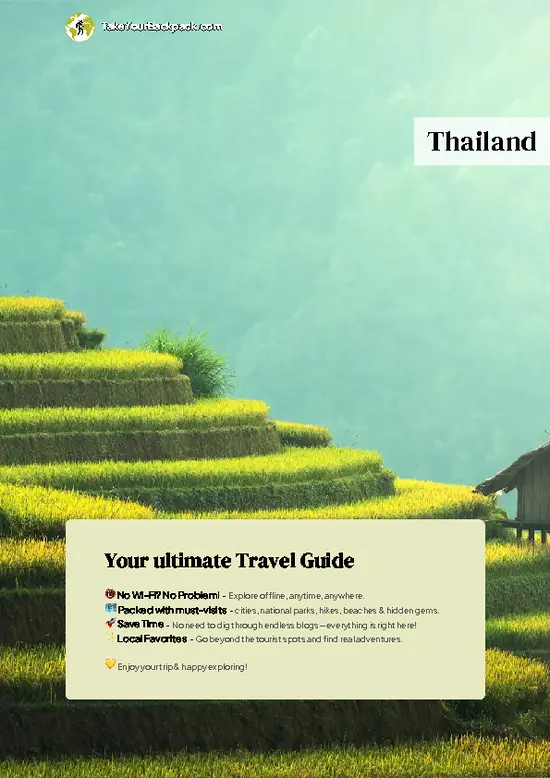
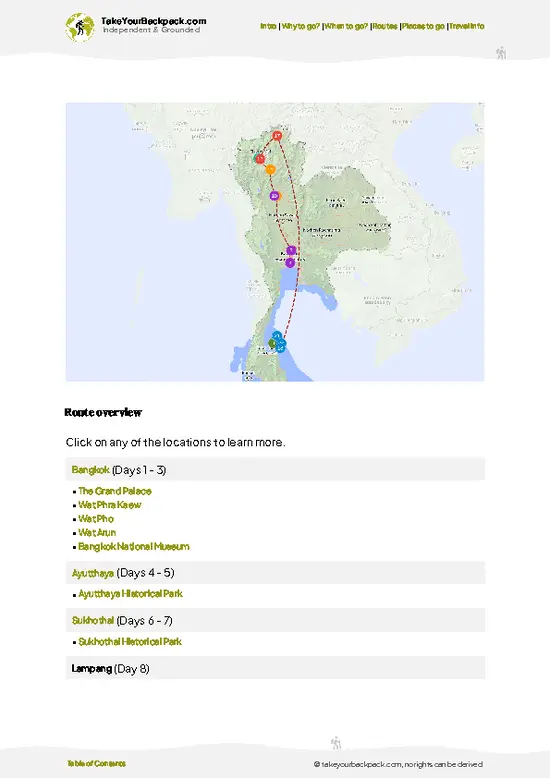
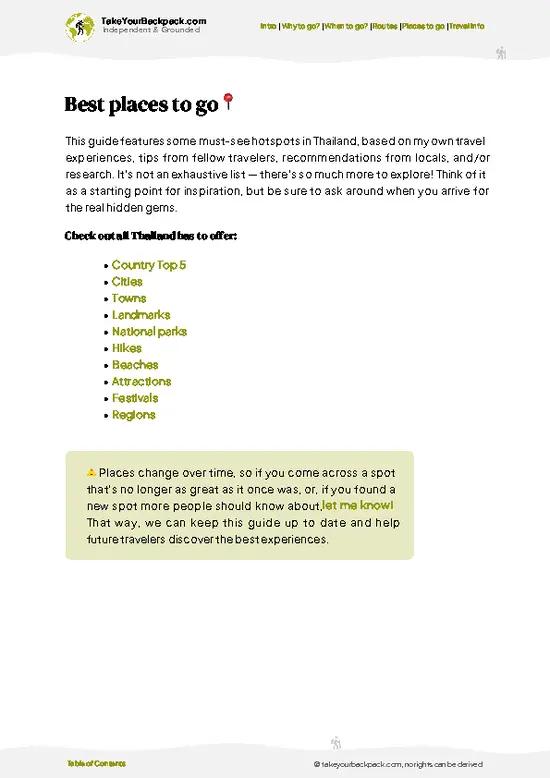
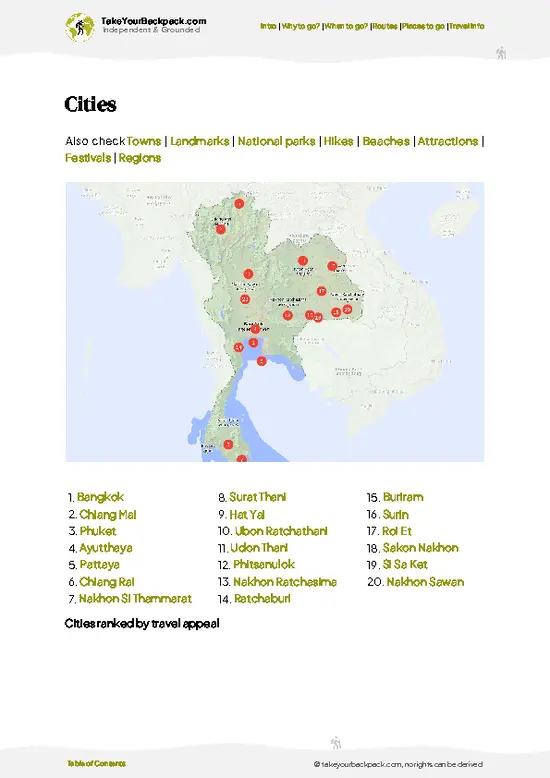
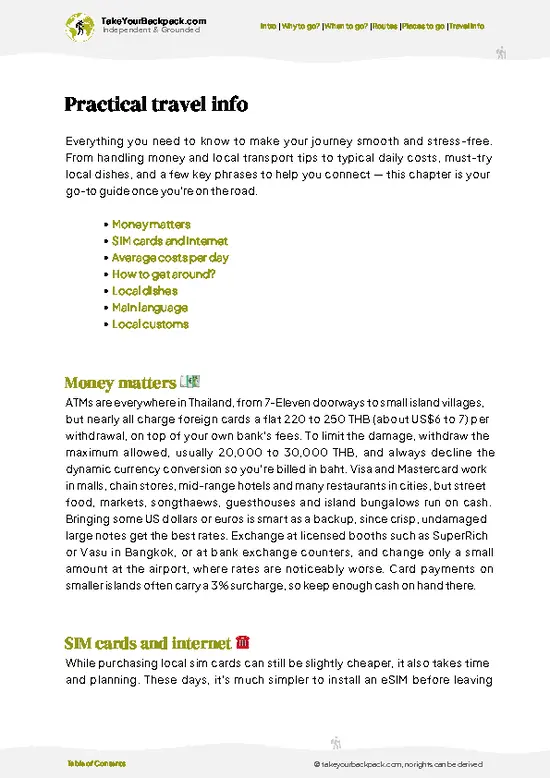
example page 0 from our offline Travel Guide for Thailand
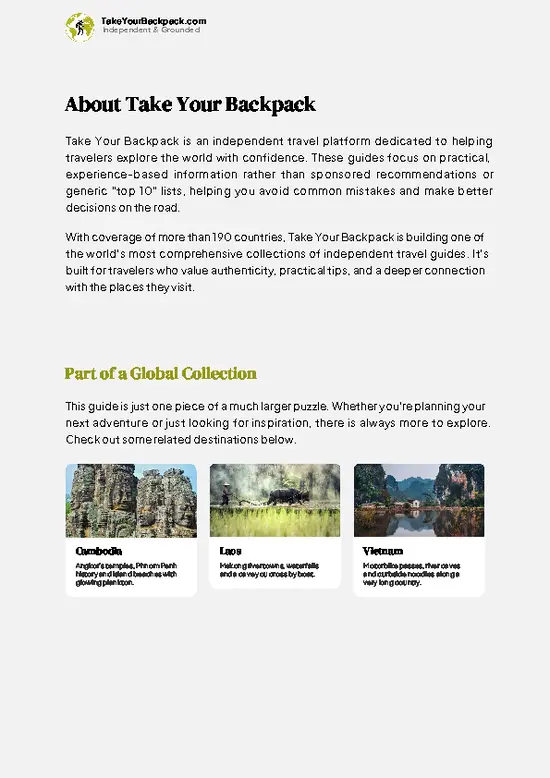
example page 1 from our offline Travel Guide for Thailand
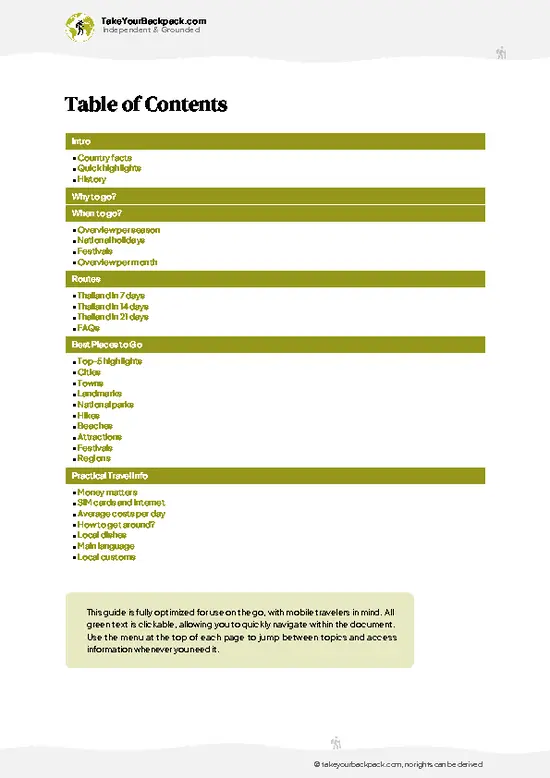
example page 2 from our offline Travel Guide for Thailand
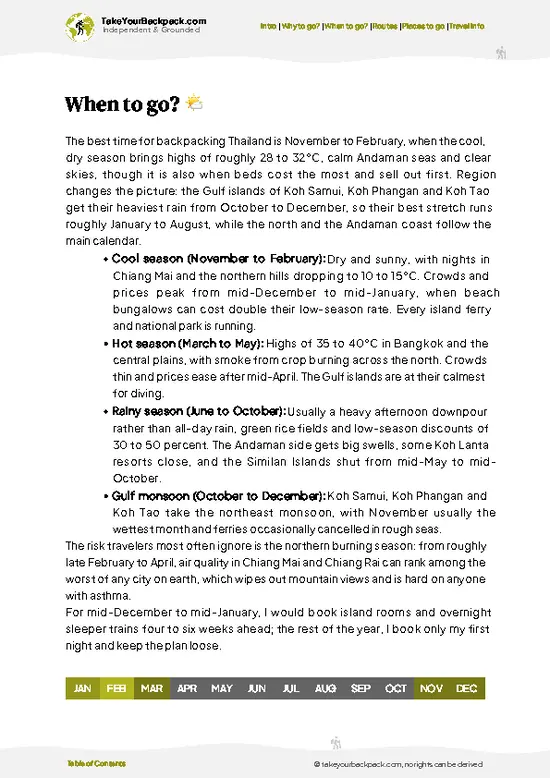
example page 3 from our offline Travel Guide for Thailand
example page 4 from our offline Travel Guide for Thailand
example page 5 from our offline Travel Guide for Thailand
example page 6 from our offline Travel Guide for Thailand
example page 7 from our offline Travel Guide for Thailand
The digital guide (476 pages) contains:
✅ 131 highlights, ranked by travel appeal
✅ Optimized 7, 14 & 21-day travel routes
✅ Cities, national parks, landmarks, beaches
✅ How to get around
✅ Offline-friendly for travel without Wi-Fi
👉 Click to see all 30+ guide features

📅 Plan smarter in minutes, not weeks
✅ Month by month travel advice
✅ Festivals & national holidays
✅ Budget expectations

🗺️ Go to the right places, skip the overrated ones
✅ Honest pros & cons of destinations
✅ Top hikes, parks & viewpoints
✅ Lesser-known places most travelers miss
✅ Clear “worth it vs skip it” guidance

🛏️ Travel smoothly without rookie mistakes
✅ Best areas to stay
✅ Transport systems explained simply
✅ Common scams & safety advice
✅ SIM cards, money & practical tips

🌍 Understand the country, not just visit it
✅ Culture & traditions
✅ 52 Essential phrases & customs
✅ Festivals worth planning around
✅ Traveler-friendly historical context
✅ Insights that make places more meaningful

📱 Built for real travel conditions
✅ Fully downloadable PDF
✅ Works completely offline
✅ Optimized for phone use
✅ Useful in remote areas & buses
✅ Everything in one place
Stop searching, start planning
Get instant access to your full guide. 30‑day money-back guarantee.
+ Add another guide for just

By proceeding you agree to our terms.
Sent to your inbox immediately after payment • 100% Secure Checkout
Best Backpacking Travel Advisor 2025 tourism awardBest Backpacking
Travel Advisor
2025
What others say about Take Your Backpack Guides:
⭐⭐⭐⭐⭐
Fantastic, amazing amount of information!
⭐⭐⭐⭐⭐
My goodness this is amazing, it's what I've been looking for hats off too you!
⭐⭐⭐⭐⭐
I think this is absolutely BRILLIANT
⭐⭐⭐⭐
Very complete and informative. It's still missing places, but I gotta to commend you
⭐⭐⭐⭐⭐
This is truly amazing, thank you, can't wait to explore it with my kids!
⭐⭐⭐⭐⭐
Awesome resource, thank you!
⭐⭐⭐⭐⭐
This is amazing! Can't wait to explore the ones I haven't seen
⭐⭐⭐⭐
I love this! Well done, great idea.
⭐⭐⭐⭐⭐
Thanks for taking the time to make this gem!
⭐⭐⭐⭐⭐
This might be the best website I've ever seen.
⭐⭐⭐⭐⭐
Congratulations, and thank you so much for your work; it's incredibly valuable.
⭐⭐⭐⭐
In all seriousness I think you did a great job pointing out the important spots
⭐⭐⭐⭐⭐
10/10 very good
⭐⭐⭐⭐⭐
As someone who's only just starting to visit regularly this is awesome, thank you.
⭐⭐⭐⭐
Thank you very much! I'm going to visit my dad, it's going to be very useful!
⭐⭐⭐⭐⭐
This is really cool! We'll be travelling for the first time and this definitely come in handy.
⭐⭐⭐⭐⭐
You are now our minister of culture, congratulations 👨‍💼
⭐⭐⭐⭐⭐
Just wanted to tell you that this is a pearl! Going to follow your recommendations.
⭐⭐⭐⭐⭐
This is so cool. I'll definitely be using the resource for my travels soon.
⭐⭐⭐⭐⭐
This is very impressive! Good work.
⭐⭐⭐⭐⭐
This is an amazing and informative site. Very well done!

🛏️ Where to stay?Top Areas to Stay

Thailand has one of Asia’s deepest hostel scenes, with dorm beds from about 250 to 500 baht (US$7 to 15) and private fan or air-con rooms from roughly 600 to 1,200 baht (US$18 to 35). In Bangkok, Banglamphu around Khao San Road puts you a short walk from the Grand Palace and the river boats but stays loud until late, while Sukhumvit has better Skytrain links and polished nightlife at higher prices, and Silom mixes business-district calm with lively side streets. In Chiang Mai the moated Old City is walkable, temple-dense and fairly quiet after dark, Nimmanhaemin suits cafe hoppers, and on the islands Haad Rin on Koh Phangan is all party, so choose the island’s west coast or Koh Lanta for sleep. … read more 👉
Thailand has one of Asia’s deepest hostel scenes, with dorm beds from about 250 to 500 baht (US$7 to 15) and private fan or air-con rooms from roughly 600 to 1,200 baht (US$18 to 35). In Bangkok, Banglamphu around Khao San Road puts you a short walk from the Grand Palace and the river boats but stays loud until late, while Sukhumvit has better Skytrain links and polished nightlife at higher prices, and Silom mixes business-district calm with lively side streets. In Chiang Mai the moated Old City is walkable, temple-dense and fairly quiet after dark, Nimmanhaemin suits cafe hoppers, and on the islands Haad Rin on Koh Phangan is all party, so choose the island’s west coast or Koh Lanta for sleep.

If you enjoy meeting fellow travelers, consider choosing hostels with high ratings for atmosphere. On the other hand, if you prefer having your own space, a hotel might be a better option.

ThailandDiscover the Country

👋 Meet the founderWho’s Behind Take Your Backpack?

Johan, backpacker and founder of TakeYourBackpackHi, I’m Johan (Netherlands 🇳🇱), the creator of TakeYourBackpack. Over the past 3 decades, I’ve backpacked through 90+ countries across six continents, gaining extensive experience with independent travel, long-term trips, and overland routes.

This site is built on a combination of firsthand travel experience and carefully curated insights from other backpackers. Many guides are based on places I’ve personally visited, while others bring together tips, observations, and practical advice shared by trusted travelers I’ve met along the way.

The goal is to provide realistic, experience-driven guidance — not generic itineraries — so you can explore destinations with better context, clearer expectations, and more confidence.