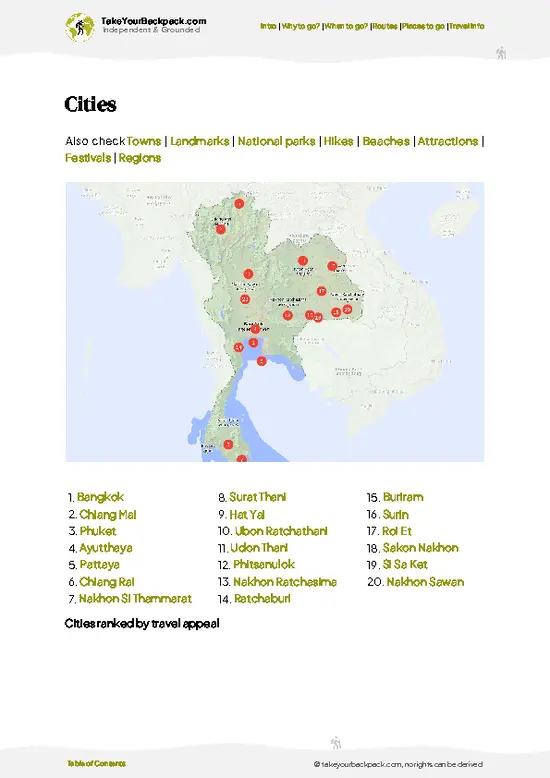
How many cities to visit: Three to four cities is the number I would advise for a standard two-week trip. Thai cities are spread out, and each rewards a minimum of 2 to 3 nights, because the good parts are dawn markets, evening street food and temples at quiet hours, not a quick lap of sights. Anything above four means more time on buses than on the street, and your budget leaks into transport fees.
Choosing between kinds of cities: Thailand offers roughly four types. The big central metropolis is the one to pick if you want
food variety, nightlife, rooftop bars and easy connections. It is also hot, loud and the most tourist-heavy, so one visit of 3 nights is enough for most people. The northern old-town cities are worth the most time if you like
cafes, temples, cooking classes and cycling, …
read more 👉 How many cities to visit: Three to four cities is the number I would advise for a standard two-week trip. Thai cities are spread out, and each rewards a minimum of 2 to 3 nights, because the good parts are dawn markets, evening street food and temples at quiet hours, not a quick lap of sights. Anything above four means more time on buses than on the street, and your budget leaks into transport fees.
Choosing between kinds of cities: Thailand offers roughly four types. The big central metropolis is the one to pick if you want food variety, nightlife, rooftop bars and easy connections. It is also hot, loud and the most tourist-heavy, so one visit of 3 nights is enough for most people. The northern old-town cities are worth the most time if you like cafes, temples, cooking classes and cycling, and they suit slower travelers best. Isan cities are the pick for value and local life: fewer travelers, spicier food and almost no English, which is exactly why they feel unfiltered. Southern cities are worth a stop mainly as gateways to the coast, and I would skip lingering in them unless the architecture or food is your reason for going. If you must choose one pairing, take the capital plus a northern city. It covers the widest contrast for the least effort.
What it costs: A backpacker can live on US$25 to 45 a day (about 900 to 1,600 baht), depending on region. Dorm beds run 200 to 450 baht (US$6 to 13), private guesthouse rooms 500 to 900 baht (US$14 to 26), and a street meal 50 to 100 baht (US$1.50 to 3). Local buses and songthaews cost roughly 8 to 30 baht, while Grab rides across a city usually land between 80 and 250 baht. Airport and long-distance transfers are the real budget swing: a sleeper train berth is around 800 to 1,500 baht, budget flights 800 to 2,500 baht.
Entry fees are modest except for a few. The main royal palace complex charges 500 baht (about US$14), a handful of major temples ask 50 to 200 baht, and most neighborhood temples are free. A half-day local guide costs about 1,000 to 1,500 baht (US$28 to 43) and is worth it only at big historical sites, where context changes what you see. For markets, food and general wandering, a guide is wasted money. A cooking class at 900 to 1,500 baht is worth the splurge once.
Safety and local etiquette: City safety is good, and violent crime against travelers is uncommon. The usual trouble is scams: a friendly stranger telling you a major temple is closed, then steering you to a gem shop or overpriced tuk-tuk tour. The sight is open. Ignore the stranger. Insist on the meter in taxis, or use Grab, and agree on a price before climbing into a tuk-tuk. Motorbike rentals are the biggest real danger, because accidents are common and insurance often excludes unlicensed riders, so skip scooters unless you hold the right license and a helmet.
Culture matters more than most visitors expect. The monarchy is protected by strict law, so do not joke about or criticize it, in conversation or online. Stand when the royal anthem plays, as it does in some public spaces at 8 a.m. and 6 p.m. and before cinema screenings. Cover shoulders and knees at temples, take shoes off before entering any hall, and never point your feet at a Buddha image or touch someone’s head. Women should not hand items directly to monks. E-cigarettes are illegal to bring in and can bring fines, so leave them at home. Carry small bills of 20 and 50 baht, since many market stalls and songthaew drivers cannot break 1,000 baht notes.



 Best Backpacking
 Hi, I’m Johan (Netherlands 🇳🇱), the creator of TakeYourBackpack. Over the past 3 decades, I’ve backpacked through 90+ countries across six continents, gaining extensive experience with independent travel, long-term trips, and overland routes.