×

Thailand🇹🇭 | best landmarksYour Guide to the 6 Best landmarks in Thailand

In Thailand, unique sites are defined by their cultural, historical, or natural significance, offering experiences that resonate deeply with backpackers and independent travelers. From the ancient ruins of Ayutthaya to the vibrant floating markets of Damnoen Saduak, each location tells a story that reflects the country’s rich heritage.

Regional differences play a crucial role; for instance, the northern mountains offer serene temples and hill tribe cultures, while the southern islands boast stunning beaches and vibrant marine life. Timing is key—visiting during the cooler months can enhance your experience, while the rainy season may limit access to certain sites.

Choosing the right unique site impacts your vibe, budget, and cultural immersion. Some places are bustling with tourists, while others provide a more intimate connection to local life. Understanding these nuances ensures a rewarding journey through Thailand’s diverse landscapes and traditions.

By Johan Kruseman 🇳🇱 | Updated June 9, 2026
Explore the best national parks in Thailand

Why go?Key Factors That Shape the Experience

In Thailand, unique sites resonate with a rich tapestry of cultural, historical, and natural significance that sets them apart from those in other countries. The country’s Buddhist heritage permeates its landscapes, with temples and sacred sites reflecting centuries of devotion and artistry. This spiritual depth offers travelers a chance to connect with traditions that have shaped Thai identity, making each visit more than just a sightseeing trip.

Geographically, Thailand’s diverse ecosystems—from lush jungles to stunning coastlines—provide a backdrop for unique experiences that are hard to replicate elsewhere. The climate plays a crucial role; the tropical weather can dictate travel plans, with the rainy season often limiting access to certain areas. Timing your visit is essential; peak … read more 👉
In Thailand, unique sites resonate with a rich tapestry of cultural, historical, and natural significance that sets them apart from those in other countries. The country’s Buddhist heritage permeates its landscapes, with temples and sacred sites reflecting centuries of devotion and artistry. This spiritual depth offers travelers a chance to connect with traditions that have shaped Thai identity, making each visit more than just a sightseeing trip.

Geographically, Thailand’s diverse ecosystems—from lush jungles to stunning coastlines—provide a backdrop for unique experiences that are hard to replicate elsewhere. The climate plays a crucial role; the tropical weather can dictate travel plans, with the rainy season often limiting access to certain areas. Timing your visit is essential; peak tourist seasons can lead to overcrowded sites, diluting the experience.

Accessibility is another factor to consider. While major attractions are often well-connected, many of the most meaningful sites require a bit of effort to reach. This trade-off can lead to a more immersive experience, allowing travelers to engage with local communities and understand the nuances of Thai life. However, those seeking convenience may find themselves missing out on the depth that comes from venturing off the beaten path.

Thailand’s infrastructure supports tourism, but it can also create a dichotomy. While urban areas boast modern amenities, rural sites may lack the same level of comfort. This contrast can enhance the adventure but may also pose challenges for those unprepared for the realities of travel in less developed regions.

Ultimately, the unique sites in Thailand offer a profound opportunity for exploration, but understanding the constraints and trade-offs involved is crucial for a rewarding experience. Embracing these factors can transform a trip into a journey of discovery, revealing the soul of a country rich in history and culture.
Behind the Scenes of Selection
The list of best unique sites in Thailand is created based on history or culture, wow factor, atmosphere, quirks, and memorability. If you feel a unique site is missing in this list, please let us know.

When to go?Timing Your Visit for the Best Experience

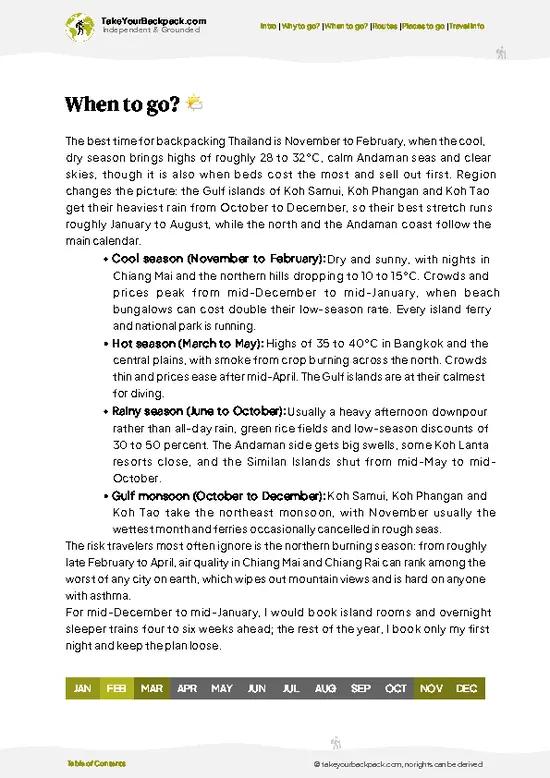
Seasonality plays a crucial role in experiencing the unique sites of Thailand. The country generally has three main seasons: the cool season, the hot season, and the rainy season. Each brings distinct advantages and challenges.

The cool season, typically from November to February, is the most popular time to visit. Temperatures are comfortable, making it ideal for exploring outdoor sites. However, this is also peak tourist season. Expect larger crowds and higher prices. If visiting during this time, aim for early mornings or late afternoons to avoid the throngs.

The hot season, from March to May, can be sweltering. While temperatures soar, this period offers fewer tourists and lower costs. Unique sites may be less crowded, allowing for a more intimate experience. However, the heat can be … read more 👉
Seasonality plays a crucial role in experiencing the unique sites of Thailand. The country generally has three main seasons: the cool season, the hot season, and the rainy season. Each brings distinct advantages and challenges.

The cool season, typically from November to February, is the most popular time to visit. Temperatures are comfortable, making it ideal for exploring outdoor sites. However, this is also peak tourist season. Expect larger crowds and higher prices. If visiting during this time, aim for early mornings or late afternoons to avoid the throngs.

The hot season, from March to May, can be sweltering. While temperatures soar, this period offers fewer tourists and lower costs. Unique sites may be less crowded, allowing for a more intimate experience. However, the heat can be intense, so plan visits for early mornings or late afternoons. Hydration and sun protection become essential.

The rainy season, from June to October, brings heavy downpours but also lush landscapes. This is the least popular time for tourists, leading to significant savings. Some sites may be less accessible due to flooding or maintenance, but the rain often comes in short bursts, leaving plenty of time for exploration. The vibrant greenery and fewer crowds can make for a rewarding experience, but travelers should be prepared for sudden weather changes.

Shoulder seasons—the transitions between these main periods—offer a mix of benefits. Visiting in late October or early November can provide a sweet spot with decent weather and manageable crowds. Similarly, late February can be a good time to catch the tail end of the cool season before the heat sets in.

Understanding these seasonal patterns helps in planning visits to unique sites, ensuring a more enriching experience while navigating potential constraints.

unique site hoppingHow to Combine landmarks Into One Trip

Regional Clustering
Thailand is a tapestry of diverse experiences, and grouping sites by region is key to maximizing your journey. Start in Bangkok, where you can explore the Grand Palace and Wat Pho in a single day. From there, head north to Chiang Mai, a hub for ancient temples and vibrant markets. This route not only saves travel time but also allows for a deeper dive into the local culture.

Optimal Sequencing
Consider the flow of your trip. After Chiang Mai, make your way to Pai for a laid-back vibe and stunning natural beauty. Then, loop back south to explore the historical wonders of Ayutthaya. This sequence keeps travel efficient while ensuring each stop feels distinct and rewarding.

Time Management
Allocate at least half a day for major sites. Temples often require time for reflection … read more 👉
Regional Clustering
Thailand is a tapestry of diverse experiences, and grouping sites by region is key to maximizing your journey. Start in Bangkok, where you can explore the Grand Palace and Wat Pho in a single day. From there, head north to Chiang Mai, a hub for ancient temples and vibrant markets. This route not only saves travel time but also allows for a deeper dive into the local culture.

Optimal Sequencing
Consider the flow of your trip. After Chiang Mai, make your way to Pai for a laid-back vibe and stunning natural beauty. Then, loop back south to explore the historical wonders of Ayutthaya. This sequence keeps travel efficient while ensuring each stop feels distinct and rewarding.

Time Management
Allocate at least half a day for major sites. Temples often require time for reflection and exploration, while markets are best enjoyed at a leisurely pace. A full day in each city allows for spontaneous discoveries, which are often the highlights of any trip.

Common Mistakes
Travelers often over-schedule, cramming too many sites into a short timeframe. This leads to burnout and missed opportunities for genuine experiences. Prioritize quality over quantity; a few well-chosen stops can be far more enriching than a packed itinerary.

Trade-offs and Constraints
Speed versus depth is a constant balancing act. Rushing through sites may save time but sacrifices the immersive experience. Budget constraints can also dictate comfort levels; consider local guesthouses for a more authentic stay. Flexibility is crucial; unexpected delays can lead to serendipitous adventures. Embrace the journey, and let the rhythm of Thailand guide you.

The ListMust-Visit landmarks in Thailand

1 Historic City of Ayutthaya

ancient ruins, river island, stone Buddha faces

Wander through a landscape of crumbling temples and headless statues, where the remains of a former Siamese capital meet the slow flow of three rivers.

2 Historic Town of Sukhothai

moated temples, lotus ponds, early Thai art

Cycle quiet park paths past serene Buddha images and lotus-filled moats, tracing the origins of Thai architecture and sculpture in a peaceful setting.

3 Wat Phra Kaew

emerald Buddha, gilded halls, royal temple complex

Step into a ceremonial heart of Bangkok, where sacred relics and ornate murals reflect centuries of royal patronage and religious devotion.

4 Sanctuary Of Truth

wooden carvings, seafront structure, mythological motifs

Admire intricate hand-carved woodwork and elaborate religious symbolism in a towering structure that rises directly from the Gulf of Thailand’s edge.

5 Wat Tham Sua

hilltop chedi, tiger cave, panoramic stair climb

Climb steep steps past limestone outcrops and golden statues to reach sweeping views and a cave temple with deep spiritual significance.

6 Si Thep

laterite towers, Dvaravati relics, ancient city mound

Walk among grassy mounds and weathered brick towers, discovering a lesser-known archaeological site that reveals early regional influences on Thai civilization.

Loading the map 🌍

Expert viewExpert Commentary on landmarks

Essential


Thailand is a treasure trove of unique sites that offer a genuine taste of its rich culture and history. Aim for about five to seven essential spots to get a well-rounded experience. This isn’t a race; it’s about savoring the moments.

Timing is crucial. Many sites are best visited early in the morning or late in the afternoon to avoid the sweltering heat and the crowds. For instance, if you’re eyeing a popular temple, plan to arrive just as it opens. You’ll not only beat the rush but also enjoy the serene atmosphere that’s often lost in the midday chaos.

Consider the regional variations. Northern Thailand offers lush mountains and indigenous cultures, while the south boasts stunning beaches and vibrant marine life. Each area has its own rhythm and charm. If you’re in the north, … read more 👉

Essential


Thailand is a treasure trove of unique sites that offer a genuine taste of its rich culture and history. Aim for about five to seven essential spots to get a well-rounded experience. This isn’t a race; it’s about savoring the moments.

Timing is crucial. Many sites are best visited early in the morning or late in the afternoon to avoid the sweltering heat and the crowds. For instance, if you’re eyeing a popular temple, plan to arrive just as it opens. You’ll not only beat the rush but also enjoy the serene atmosphere that’s often lost in the midday chaos.

Consider the regional variations. Northern Thailand offers lush mountains and indigenous cultures, while the south boasts stunning beaches and vibrant marine life. Each area has its own rhythm and charm. If you’re in the north, you might want to combine a visit to a hill tribe village with a trek through the jungle. In the south, a day spent exploring an island can easily be paired with snorkeling or diving.

Travel constraints can be a real factor. Some sites are remote, requiring a bit of effort to reach. Expect to spend a few hours on transport, whether it’s a bus ride or a boat trip. Factor in the time it takes to soak in the experience. You don’t want to rush through a cultural site just to check it off your list.

Safety is generally good, but always be mindful of local customs. Dress appropriately when visiting temples, and be respectful of the local culture. A little research goes a long way in ensuring you don’t inadvertently offend anyone.

Overrated


Now, let’s talk about some spots that might not live up to the hype. You’ll find a few places that are often touted as must-sees but can feel more like tourist traps. These are the spots where you’ll find the selfie sticks and the crowds, often overshadowing the authentic experience you’re after.

Take the infamous floating markets, for example. They can be a logistical nightmare, packed with tourists and overpriced goods. Instead of spending half your day navigating through throngs of people, consider visiting a local market where you can interact with vendors and sample authentic street food without the inflated prices.

Another spot that often disappoints is the overly commercialized beach areas. Sure, they look great in photos, but the reality can be a crowded stretch of sand with loud music and overpriced drinks. Seek out quieter beaches or lesser-known islands where you can truly unwind and connect with nature.

Keep in mind that some of these overrated spots can still be enjoyable if you approach them with the right mindset. If you do decide to visit, try to go during off-peak hours. This can make a world of difference in your experience.

Planning & Prioritizing


When planning your itinerary, think about how to group sites based on proximity and theme. For example, if you’re exploring cultural sites, try to cluster temples and historical landmarks together. This not only saves time but also allows you to dive deeper into the local history and traditions.

Budget is another consideration. While some sites may have entrance fees, many cultural experiences are free or low-cost. Allocate your funds wisely. Spend more on experiences that resonate with you, like a cooking class or a guided tour that offers insights you wouldn’t get otherwise.

Effort is key. Some unique sites require a bit of hiking or navigating rough terrain. If you’re not up for a strenuous trek, don’t force it. There are plenty of accessible options that still offer a rich experience.

Cultural considerations are paramount. Always be aware of local customs, especially when visiting sacred sites. A simple gesture, like removing your shoes before entering a temple, can show respect and enhance your experience.

In summary, focus on five to seven essential sites that resonate with you, avoid the overrated tourist traps, and plan your journey with an eye toward cultural immersion and genuine experiences. You’ll leave Thailand with stories that resonate far beyond the typical travel narrative.

✈️ The backpacker research shortcutThailand Travel Guide

An offline-friendly backpacking guide with optimized travel routes, ranked highlights, transport advice, and the best areas to stay.
example page 0 from our offline Travel Guide for Thailand
example page 1 from our offline Travel Guide for Thailand
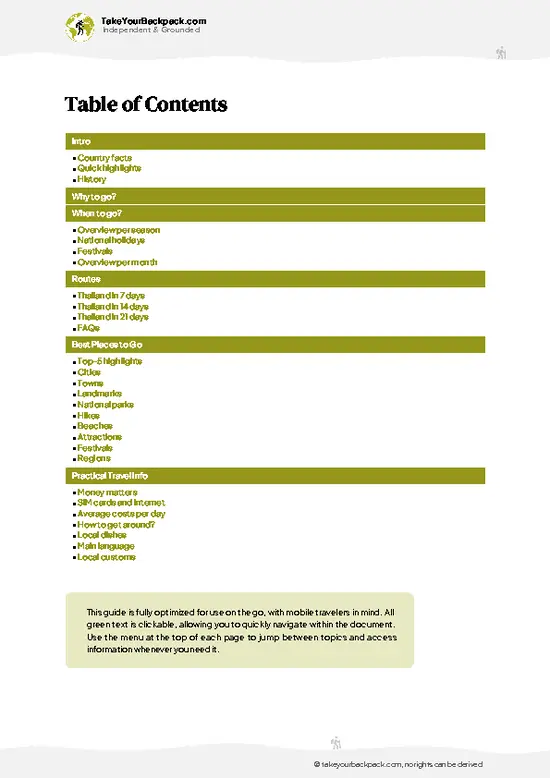
example page 2 from our offline Travel Guide for Thailand
example page 3 from our offline Travel Guide for Thailand
example page 4 from our offline Travel Guide for Thailand
example page 5 from our offline Travel Guide for Thailand
example page 6 from our offline Travel Guide for Thailand
example page 7 from our offline Travel Guide for Thailand
The digital guide (510 pages) contains:
139 highlights, ranked by travel appeal
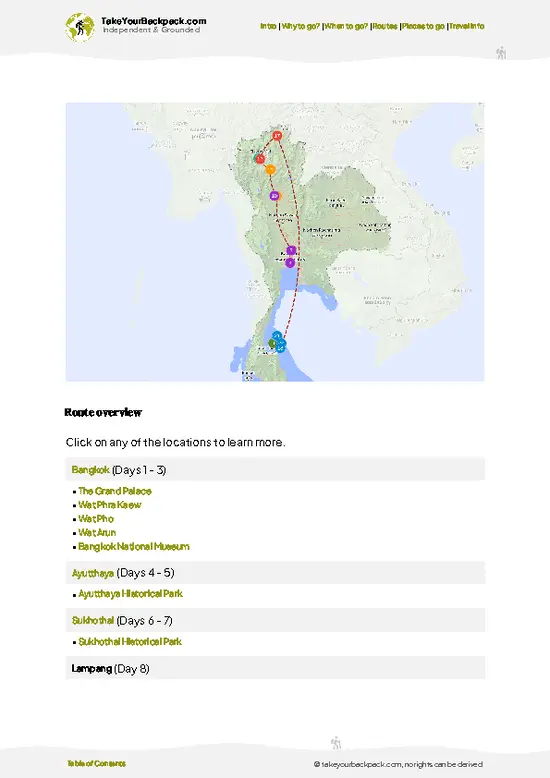
Optimized 7, 14 & 21-day travel routes
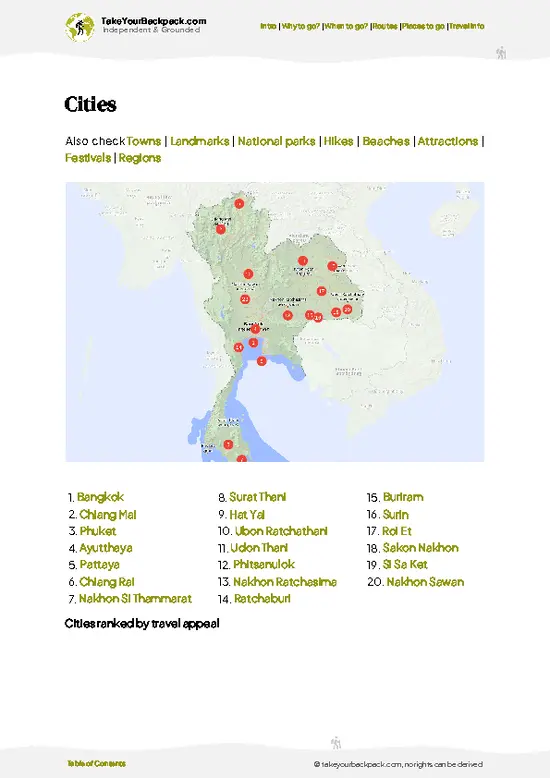
Cities, national parks, landmarks, beaches
How to get around
Offline-friendly for travel without Wi-Fi
👉 Click to see all 30+ guide features

📅 Plan smarter in minutes, not weeks
Month by month travel advice
Festivals & national holidays
Budget expectations

🗺️ Go to the right places, skip the overrated ones
Honest pros & cons of destinations
Top hikes, parks & viewpoints
Lesser-known places most travelers miss
Clear “worth it vs skip it” guidance

🛏️ Travel smoothly without rookie mistakes
Best areas to stay
Transport systems explained simply
Common scams & safety advice
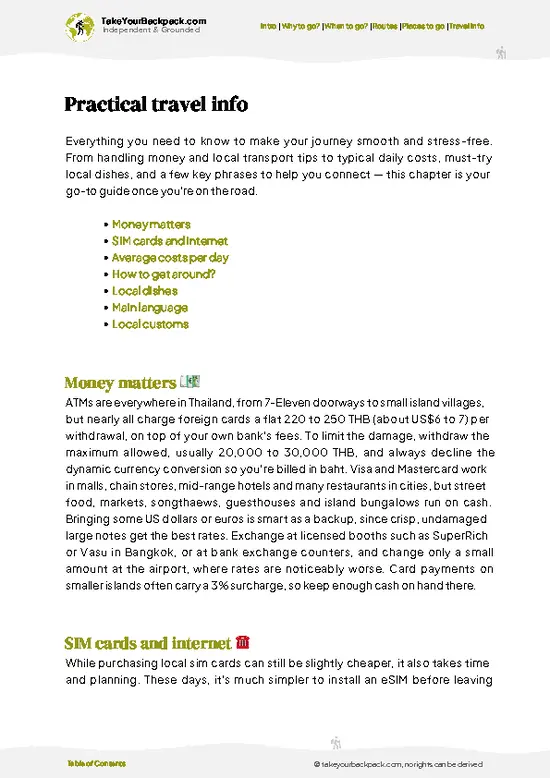
SIM cards, money & practical tips

🌍 Understand the country, not just visit it
Culture & traditions
52 Essential phrases & customs
Festivals worth planning around
Traveler-friendly historical context
Insights that make places more meaningful

📱 Built for real travel conditions
Fully downloadable PDF
Works completely offline
Optimized for phone use
Useful in remote areas & buses
Everything in one place
Save weeks of stressful planning
Get instant access to your full guide. 30‑day money-back guarantee.


By proceeding you agree to our terms.
Sent to your inbox immediately after payment • 100% Secure Checkout
Best Backpacking Travel Advisor 2025 tourism awardBest Backpacking
Travel Advisor
2025
What others say about Take Your Backpack Guides:
⭐⭐⭐⭐⭐
Fantastic, amazing amount of information!
⭐⭐⭐⭐⭐
My goodness this is amazing, it's what I've been looking for hats off too you!
⭐⭐⭐⭐⭐
I think this is absolutely BRILLIANT
⭐⭐⭐⭐
Very complete and informative. It's still missing places, but I gotta to commend you
⭐⭐⭐⭐⭐
This is truly amazing, thank you, can't wait to explore it with my kids!
⭐⭐⭐⭐⭐
Awesome resource, thank you!
⭐⭐⭐⭐⭐
This is amazing! Can't wait to explore the ones I haven't seen
⭐⭐⭐⭐
I love this! Well done, great idea.
⭐⭐⭐⭐⭐
Thanks for taking the time to make this gem!
⭐⭐⭐⭐⭐
This might be the best website I've ever seen.
⭐⭐⭐⭐⭐
Congratulations, and thank you so much for your work; it's incredibly valuable.
⭐⭐⭐⭐
In all seriousness I think you did a great job pointing out the important spots
⭐⭐⭐⭐⭐
10/10 very good
⭐⭐⭐⭐⭐
As someone who's only just starting to visit regularly this is awesome, thank you.
⭐⭐⭐⭐
Thank you very much! I'm going to visit my dad, it's going to be very useful!
⭐⭐⭐⭐⭐
This is really cool! We'll be travelling for the first time and this definitely come in handy.
⭐⭐⭐⭐⭐
You are now our minister of culture, congratulations 👨‍💼
⭐⭐⭐⭐⭐
Just wanted to tell you that this is a pearl! Going to follow your recommendations.
⭐⭐⭐⭐⭐
This is so cool. I'll definitely be using the resource for my travels soon.
⭐⭐⭐⭐⭐
This is very impressive! Good work.
⭐⭐⭐⭐⭐
This is an amazing and informative site. Very well done!

🛏️ Where to stay?Best Stay Options in Thailand

Yes, hostels and budget accommodation are plentiful across Thailand, concentrated in backpacker and transit hubs such as Khao San Road, Sukhumvit and Silom in Bangkok, Old City and Nimmanhaemin in Chiang Mai, and beach towns like Patong, Kata/Karon on Phuket and Chaweng, Lamai on Koh Samui.
Khao San and Patong deliver the cheapest beds and nonstop nightlife but are noisy and very touristy; Sukhumvit and Silom give the best transit links and a mix of nightlife with higher prices; Chiang Mai Old City is compact, temple-close and quieter at night while Nimmanhaemin has more cafes and slightly pricier rooms; Kata/Karon and Lamai are calmer beach options with better swimming and family-friendly … read more 👉
Yes, hostels and budget accommodation are plentiful across Thailand, concentrated in backpacker and transit hubs such as Khao San Road, Sukhumvit and Silom in Bangkok, Old City and Nimmanhaemin in Chiang Mai, and beach towns like Patong, Kata/Karon on Phuket and Chaweng, Lamai on Koh Samui.
Khao San and Patong deliver the cheapest beds and nonstop nightlife but are noisy and very touristy; Sukhumvit and Silom give the best transit links and a mix of nightlife with higher prices; Chiang Mai Old City is compact, temple-close and quieter at night while Nimmanhaemin has more cafes and slightly pricier rooms; Kata/Karon and Lamai are calmer beach options with better swimming and family-friendly evenings compared with party-heavy Chaweng.
Choose by priority: pick Khao San/Patong/Chaweng for social, budget party scenes; Sukhumvit/Silom for transport convenience and variety; Chiang Mai Old City for culture and quiet; Kata/Karon/Lamai for relaxed beach time to avoid noise and overpriced central hostels.

If you enjoy meeting fellow travelers, consider choosing hostels with high ratings for atmosphere. On the other hand, if you prefer having your own space, a hotel might be a better option.

ThailandWhere to Go Next

👋 Meet the founderWho’s Behind Take Your Backpack?

Johan, backpacker and founder of TakeYourBackpackHi, I’m Johan (Netherlands 🇳🇱), the creator of TakeYourBackpack. Over the past decade, I’ve backpacked through 80+ countries across six continents, gaining extensive experience with independent travel, long-term trips, and overland routes.

This site is built on a combination of firsthand travel experience and carefully curated insights from other backpackers. Many guides are based on places I’ve personally visited, while others bring together tips, observations, and practical advice shared by trusted travelers I’ve met along the way.

The goal is to provide realistic, experience-driven guidance — not generic itineraries — so you can explore destinations with better context, clearer expectations, and more confidence.

Get full Thailand guide •
Instant download • 139 highlights • Full Offline guide