×

Tunisia🇹🇳 | citiesBizerteFishing harbor, lift bridge, Spanish fort, Cap Blanc coves | things to do and best time to go

Explore Kerkennah Islands BeachExplore Hammamet

Backpacking in Bizerte
🌟 Highlightcity ranked #5
By Johan Kruseman 🇳🇱 | Updated October 22, 2026

Bizerte used to be a naval garrison town that most visitors drove through on the way to somewhere with better postcards. Today it is a working port city with a fishing harbor you can actually sit beside, and a calm that Tunis and Sousse lost long ago. It sits on the Mediterranean coast in the north of Tunisia, at the mouth of a lagoon channel crossed by a lift bridge. Choosing between a beach day and a medina day costs you little either way, since both are close, but the old harbor gives a backpacker the most for the least effort. Hostels are scarce and English is spoken less than on the tourist coast, so you pay in comfort and gain in authenticity. It suits slow walkers, seafood fans and people who like to be the only foreigner at the café. It won't suit anyone chasing nightlife or a long checklist.

Discover everything you want to know in the 📖 Tunisia Travel Guide.


example page 0 from our offline Travel Guide for Tunisia
example page 1 from our offline Travel Guide for Tunisia
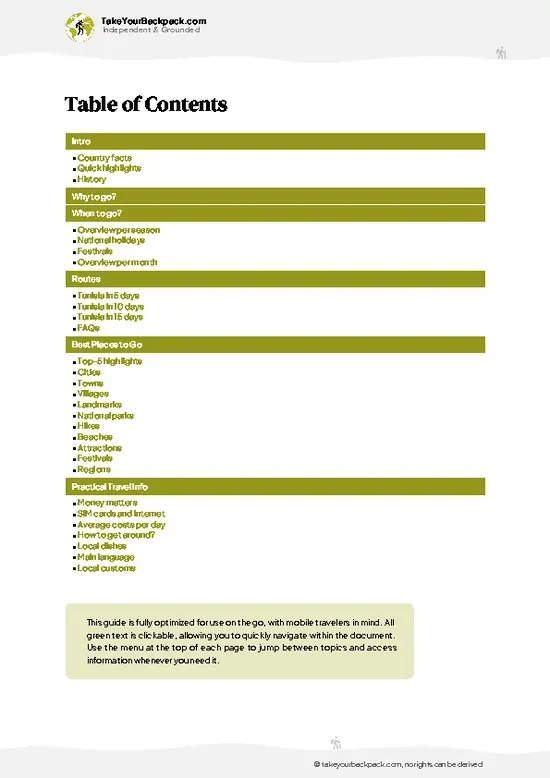
example page 2 from our offline Travel Guide for Tunisia
example page 3 from our offline Travel Guide for Tunisia
example page 4 from our offline Travel Guide for Tunisia
example page 5 from our offline Travel Guide for Tunisia
example page 6 from our offline Travel Guide for Tunisia
example page 7 from our offline Travel Guide for Tunisia
Loading the map 🌍
CLICK TO FILTER
cities
towns
villages
landmarks
national parks
hikes
beaches
attractions
festivals
regions
SHOW COUNTRY’S BESTSHOW ALL

✨ Why go?
Ranked #5 city in Tunisia
Reasons people choose to visit here

Bizerte earns its place on a route for two reasons: it is the most relaxed northern coastal stop, and it works as a hub for the lakes, beaches and hills around it. The old port, the medina and the sea-facing corniche all sit within an easy walk of each other, so you can leave the bag in your room and cover the center on foot. Seafood is the draw at mealtimes, with grilled fish straight from the harbor boats and sandwich counters that keep locals loyal. There is no hostel scene, so expect modest hotels and guesthouses, which suits a quiet stay but not a social one. Onward travel is simple, with the Tunis road to the south and the Cap Blanc coast to the west, plus buses and shared taxis heading in both directions. Give it two nights if you like unhurried places, or one if you need hostel company.

💡 HighlightsPlaces and moments you shouldn't skip

  1. Old Port (Vieux Port): The postcard view, with pastel fishermen’s houses, nets drying on the quay and cafés lining the water. Free, 1 to 2 hours, best at golden hour when the boats come in.
  2. The Kasbah: A fortified citadel above the medina, with thick ramparts, a quiet interior and views over the channel. Entry is usually free or about US$1 to 2, allow 1 hour, and go in the morning for the cooler air.
  3. Spanish Fort (Borj Sidi Salem): A hilltop fortress on the edge of the city, built in the 16th century, with wide views of the bay and the lagoon. About US$1 to 3, 1 hour, clearest in the morning.
  4. Medina and Great Mosque: Narrow alleys of spice sellers, bakers and tailors around the Great Mosque, whose minaret is a good landmark. Free to wander, 1 to 2 hours, livelier before noon and closed in part
… read more 👉
  1. Old Port (Vieux Port): The postcard view, with pastel fishermen’s houses, nets drying on the quay and cafés lining the water. Free, 1 to 2 hours, best at golden hour when the boats come in.
  2. The Kasbah: A fortified citadel above the medina, with thick ramparts, a quiet interior and views over the channel. Entry is usually free or about US$1 to 2, allow 1 hour, and go in the morning for the cooler air.
  3. Spanish Fort (Borj Sidi Salem): A hilltop fortress on the edge of the city, built in the 16th century, with wide views of the bay and the lagoon. About US$1 to 3, 1 hour, clearest in the morning.
  4. Medina and Great Mosque: Narrow alleys of spice sellers, bakers and tailors around the Great Mosque, whose minaret is a good landmark. Free to wander, 1 to 2 hours, livelier before noon and closed in part on Fridays.
  5. Corniche and Cap Blanc beaches: A seafront promenade toward the cape with clear water and rocky coves, where locals swim in summer. Free, 2 to 3 hours, best from June to September.
  6. Oceanographic Museum: A small museum in an old fort on the seafront, with marine specimens and a few aquariums. About US$1 to 3, 45 minutes, a good rainy-hour stop.
  7. Lift Bridge (Pont Mobile): The bridge over the channel rises to let boats pass, and watching it is a local ritual. Free, 20 to 30 minutes, ask around for the usual opening times.
For day trips, Bizerte puts you within reach of Ichkeul National Park, the lake and wetland that attracts migrating birds, Utica’s Punic and Roman ruins, Ghar el Melh lagoon and the Cap Angela headland, the northernmost point of Africa. For a first visit, the Old Port is the one to start with, because it sums up the city in a single walk.
Spotted a mistake or missing something? Contact us.

Things to do near Bizerte

Ratings based on Tripadvisor reviews. When you book through this link, you support our work at no extra cost to you.

🏘️ NeighborhoodsNeighborhood guide to Bizerte

Bizerte is small enough that choosing a neighborhood mostly means choosing which stretch of waterfront to walk along. Everything below is reachable on foot or with a short, cheap taxi ride.
  • Old Port and Medina: The postcard core, where fishing boats and café terraces face each other across a narrow channel with a small lifting bridge. The medina behind it is compact, with the Kasbah fortress and the Spanish Fort on the hill. Grilled fish and strong coffee are easy to find. It is fully walkable, quiet by 10 pm, and gives a backpacker the most for the least effort.
  • Corniche: A long seafront road running northwest toward the caves and beaches, lined with cafés, ice cream stands and families strolling after dark. A taxi saves you a sweaty 3 km, but walking one way and riding back is the sensible
… read more 👉
Bizerte is small enough that choosing a neighborhood mostly means choosing which stretch of waterfront to walk along. Everything below is reachable on foot or with a short, cheap taxi ride.
  • Old Port and Medina: The postcard core, where fishing boats and café terraces face each other across a narrow channel with a small lifting bridge. The medina behind it is compact, with the Kasbah fortress and the Spanish Fort on the hill. Grilled fish and strong coffee are easy to find. It is fully walkable, quiet by 10 pm, and gives a backpacker the most for the least effort.
  • Corniche: A long seafront road running northwest toward the caves and beaches, lined with cafés, ice cream stands and families strolling after dark. A taxi saves you a sweaty 3 km, but walking one way and riding back is the sensible compromise.
  • Ville Nouvelle: The grid of French-era streets around Avenue Bourguiba holds banks, pastry shops, the louage stands and everyday errands. It has little to photograph, but it is where you sort out cash and onward travel.
  • Remel and Cap Blanc: Beach suburbs to the north, where the sand is better but buses are slow and you will want a taxi. Cap Blanc, the northernmost point of Africa, is worth a day of your time, not a night.

⌛️ 1 dayA smart one-day plan

This is a harbor-and-ramparts day, slow on the feet and heavy on coffee, with the old port as your anchor.
8:30 AM: Old Port (Vieux Port)
Start where the fishing boats tie up beneath pastel houses along the narrow channel. Order a coffee at a waterfront café and watch the nets get sorted. It costs little and sets the pace for the day. Walk along the quay toward the old town when you finish.
10:00 AM: Kasbah and Medina
Cross into the old town through the lanes behind the port. The Kasbah walls are Ottoman-era, and the alleys inside are narrow, whitewashed and quiet before midday. Wander without a plan, then follow the signs up to the Spanish Fort (Ksar el Andalous) viewpoint for the sweep over the channel.
12:30 PM: Lunch near the Old Port
Back at the water, pick a small grill that cooks the catch … read more 👉
This is a harbor-and-ramparts day, slow on the feet and heavy on coffee, with the old port as your anchor.
8:30 AM: Old Port (Vieux Port)
Start where the fishing boats tie up beneath pastel houses along the narrow channel. Order a coffee at a waterfront café and watch the nets get sorted. It costs little and sets the pace for the day. Walk along the quay toward the old town when you finish.
10:00 AM: Kasbah and Medina
Cross into the old town through the lanes behind the port. The Kasbah walls are Ottoman-era, and the alleys inside are narrow, whitewashed and quiet before midday. Wander without a plan, then follow the signs up to the Spanish Fort (Ksar el Andalous) viewpoint for the sweep over the channel.
12:30 PM: Lunch near the Old Port
Back at the water, pick a small grill that cooks the catch of the day. Grilled fish with salad and bread is the obvious order. Eat slowly, because shops close up for the afternoon lull anyway.
2:30 PM: Oceanographic Museum
Walk the quay to this small, old-fashioned museum set in a Ottoman-era bastion on the seafront. It holds Mediterranean marine specimens and is rarely crowded. It takes about an hour and gives the harbor some context.
4:00 PM: Corniche Walk
Head out along the seafront road toward the beaches west of town. This is where locals stroll, and the rocky coast is a good place to sit with a cold drink. Keep going as far as your legs allow, then flag a taxi back.
6:30 PM: Sunset at the Channel Bridge
End at the lifting bridge over the channel, a local landmark where boats pass between the lake and the sea. Cafés nearby fill up with families as the light drops. Stay for mint tea and a slow dinner before calling it a night.

🌤️ When to go?Weather, crowds, and seasonal trade-offs

  • Spring (April to June): Highs of 18 to 27°C (64 to 81°F), wildflowers on the hills and calm seas. Days run long, and prices stay moderate.
  • Summer (July to August): Hot at 28 to 33°C (82 to 91°F), with sea breezes that keep Bizerte more tolerable than inland Tunisia. Tunisian families fill the beaches and rooms cost the most.
  • Autumn (September to October): Sea temperatures stay warm at around 24°C (75°F), crowds thin and rates drop. This is my favorite window.
  • Winter (November to March): Cooler at 8 to 16°C (46 to 61°F), with rain and wind, especially December to February. Many beach cafés shut, but the old port is empty and rooms are cheapest.
Book summer beds early, and aim for late September if you want swimming without the crowds.

source: climatestotravel.comJANJanuary: good for travelingFEBFebruary: good for travelingMARMarch: highly recommended for travelingAPRApril: excellent for travelingMAYMay: excellent for travelingJUNJune: highly recommended for travelingJULJuly: fair for travelingAUGAugust: fair for travelingSEPSeptember: excellent for travelingOCTOctober: excellent for travelingNOVNovember: highly recommended for travelingDECDecember: good for traveling
when-to-go

✈️ The backpacker research shortcutTunisia Travel Guide

An offline-friendly backpacking guide with optimized travel routes, ranked highlights, transport advice, and the best areas to stay.
example page 0 from our offline Travel Guide for Tunisia
example page 1 from our offline Travel Guide for Tunisia
example page 2 from our offline Travel Guide for Tunisia
example page 3 from our offline Travel Guide for Tunisia
example page 4 from our offline Travel Guide for Tunisia
example page 5 from our offline Travel Guide for Tunisia
example page 6 from our offline Travel Guide for Tunisia
example page 7 from our offline Travel Guide for Tunisia
The digital guide (355 pages) contains:
✅ 90 highlights, ranked by travel appeal
✅ Optimized 5, 10 & 15-day travel routes
✅ Cities, national parks, landmarks, beaches
✅ How to get around
✅ Offline-friendly for travel without Wi-Fi
👉 Click to see all 30+ guide features

📅 Plan smarter in minutes, not weeks
✅ Month by month travel advice
✅ Festivals & national holidays
✅ Budget expectations

🗺️ Go to the right places, skip the overrated ones
✅ Honest pros & cons of destinations
✅ Top hikes, parks & viewpoints
✅ Lesser-known places most travelers miss
✅ Clear “worth it vs skip it” guidance

🛏️ Travel smoothly without rookie mistakes
✅ Best areas to stay
✅ Transport systems explained simply
✅ Common scams & safety advice
✅ SIM cards, money & practical tips

🌍 Understand the country, not just visit it
✅ Culture & traditions
✅ 52 Essential phrases & customs
✅ Festivals worth planning around
✅ Traveler-friendly historical context
✅ Insights that make places more meaningful

📱 Built for real travel conditions
✅ Fully downloadable PDF
✅ Works completely offline
✅ Optimized for phone use
✅ Useful in remote areas & buses
✅ Everything in one place
Stop searching, start planning
Get instant access to your full guide. 30‑day money-back guarantee.
+ Add another guide for just

By proceeding you agree to our terms.
Sent to your inbox immediately after payment • 100% Secure Checkout
Best Backpacking Travel Advisor 2025 tourism awardBest Backpacking
Travel Advisor
2025
What others say about Take Your Backpack Guides:
⭐⭐⭐⭐⭐
Fantastic, amazing amount of information!
⭐⭐⭐⭐⭐
My goodness this is amazing, it's what I've been looking for hats off too you!
⭐⭐⭐⭐⭐
I think this is absolutely BRILLIANT
⭐⭐⭐⭐
Very complete and informative. It's still missing places, but I gotta to commend you
⭐⭐⭐⭐⭐
This is truly amazing, thank you, can't wait to explore it with my kids!
⭐⭐⭐⭐⭐
Awesome resource, thank you!
⭐⭐⭐⭐⭐
This is amazing! Can't wait to explore the ones I haven't seen
⭐⭐⭐⭐
I love this! Well done, great idea.
⭐⭐⭐⭐⭐
Thanks for taking the time to make this gem!
⭐⭐⭐⭐⭐
This might be the best website I've ever seen.
⭐⭐⭐⭐⭐
Congratulations, and thank you so much for your work; it's incredibly valuable.
⭐⭐⭐⭐
In all seriousness I think you did a great job pointing out the important spots
⭐⭐⭐⭐⭐
10/10 very good
⭐⭐⭐⭐⭐
As someone who's only just starting to visit regularly this is awesome, thank you.
⭐⭐⭐⭐
Thank you very much! I'm going to visit my dad, it's going to be very useful!
⭐⭐⭐⭐⭐
This is really cool! We'll be travelling for the first time and this definitely come in handy.
⭐⭐⭐⭐⭐
You are now our minister of culture, congratulations 👨‍💼
⭐⭐⭐⭐⭐
Just wanted to tell you that this is a pearl! Going to follow your recommendations.
⭐⭐⭐⭐⭐
This is so cool. I'll definitely be using the resource for my travels soon.
⭐⭐⭐⭐⭐
This is very impressive! Good work.
⭐⭐⭐⭐⭐
This is an amazing and informative site. Very well done!

🛏️ Where to stay?Best areas to stay in Tunisia

The old port and medina area is the best base for a budget stay in Bizerte, with the Ville Nouvelle second. Budget beds are limited here, with a few hostels and guesthouses and many small hotels, so book ahead in July and August.
The old port wins because you can walk to cafés, the Kasbah and the waterfront, and the streets stay lively without being rowdy. Evenings are calm, and walking back after dinner is comfortable, though the medina alleys are dim, so carry a phone light. Noise comes mainly from café chatter and the morning fish market, so pack earplugs if you sleep lightly.
The Ville Nouvelle … read more 👉
The old port and medina area is the best base for a budget stay in Bizerte, with the Ville Nouvelle second. Budget beds are limited here, with a few hostels and guesthouses and many small hotels, so book ahead in July and August.
The old port wins because you can walk to cafés, the Kasbah and the waterfront, and the streets stay lively without being rowdy. Evenings are calm, and walking back after dinner is comfortable, though the medina alleys are dim, so carry a phone light. Noise comes mainly from café chatter and the morning fish market, so pack earplugs if you sleep lightly.
The Ville Nouvelle is the practical alternative. It sits near the bus and louage stations, which suits early departures, and its simple hotels are often a little cheaper. It is plainer and quieter at night, and you will walk 15 to 20 minutes to the waterfront.
Beach suburbs like Remel have apartments and resort-style rooms that are pricey in summer and half empty in winter. They are poor value for backpackers because transport back to town is slow.

🚌 Getting aroundTransportation options and practical tips

From the bus and louage stations on the edge of the Ville Nouvelle, the old port is a 15 to 20 minute walk or a taxi ride of US$1 to 2. Bizerte is compact and flat, traffic jams only around the lifting bridge when it opens, and public transport exists but runs on its own mood.
  • Walking: Free, and the best way to cover the medina, port and the first stretch of the Corniche. You will pass three cafés before you notice you were heading somewhere.
  • Local buses: Fares are around US$0.30 to 0.60 and routes reach Remel, Corniche beaches and nearby villages. They are cheap but crowded in summer and timetables are more of a suggestion. Use them for longer beach runs when you are not in a hurry.
  • Taxis: Yellow taxis are metered, with most city rides at US$1 to 4. They are the best value after dark or for
… read more 👉
From the bus and louage stations on the edge of the Ville Nouvelle, the old port is a 15 to 20 minute walk or a taxi ride of US$1 to 2. Bizerte is compact and flat, traffic jams only around the lifting bridge when it opens, and public transport exists but runs on its own mood.
  • Walking: Free, and the best way to cover the medina, port and the first stretch of the Corniche. You will pass three cafés before you notice you were heading somewhere.
  • Local buses: Fares are around US$0.30 to 0.60 and routes reach Remel, Corniche beaches and nearby villages. They are cheap but crowded in summer and timetables are more of a suggestion. Use them for longer beach runs when you are not in a hurry.
  • Taxis: Yellow taxis are metered, with most city rides at US$1 to 4. They are the best value after dark or for Cap Blanc, which costs roughly US$8 to 12 return with waiting time if you agree the price first. Insist on the meter in town.
  • Louages: Shared minibuses leave when full to Tunis (about 1.5 hours, US$4 to 5), Tabarka and nearby towns. They are faster than buses and the cheapest way to move between cities. Mornings are the best time, since by late afternoon you may wait for a full car.
  • Trains and intercity buses: Buses to Tunis cost a little less than louages but take longer. Pick them if you have luggage and want a seat guaranteed, and pick louages for speed.
For most backpackers, walking plus the occasional taxi is the winning combination, and louages for everything beyond the city limits.

👛 Costs (as of 22 October 2026)Travel costs and budget guide for Bizerte

Bizerte costs a backpacker about US$38 a day when you sleep in a dorm in high season, eat local and keep to buses and shared taxis. Prices are paid in Tunisian dinars, and the city runs cheaper than Tunis or the resort coast.
CategoryBudget RangeLocal Reality
Dorm accommodation (high season)US$12 to 18Beds are few, so budget guesthouse rooms with a shared bathroom often fill the gap in July and August.
Dorm accommodation (off-season)US$8 to 12Winter is quiet and owners usually drop the price if you ask.
MealsUS$8 to 12A fish sandwich, a plate of couscous or a grilled fish lunch at a simple spot keeps the day cheap, and coffee costs under US$1.
Local transportUS$1 to 3City buses and shared taxis cover most trips, and a short taxi ride across town runs US$1.50 to 3.
City transport passNot availableNo
… read more 👉
Bizerte costs a backpacker about US$38 a day when you sleep in a dorm in high season, eat local and keep to buses and shared taxis. Prices are paid in Tunisian dinars, and the city runs cheaper than Tunis or the resort coast.
CategoryBudget RangeLocal Reality
Dorm accommodation (high season)US$12 to 18Beds are few, so budget guesthouse rooms with a shared bathroom often fill the gap in July and August.
Dorm accommodation (off-season)US$8 to 12Winter is quiet and owners usually drop the price if you ask.
MealsUS$8 to 12A fish sandwich, a plate of couscous or a grilled fish lunch at a simple spot keeps the day cheap, and coffee costs under US$1.
Local transportUS$1 to 3City buses and shared taxis cover most trips, and a short taxi ride across town runs US$1.50 to 3.
City transport passNot availableNo tourist pass exists, so you pay per ride.
Basic activities and entry feesUS$2 to 5The Kasbah and the Spanish Fort cost a few dollars at most, while the old port, the corniche and the beaches are free.
MiscellaneousUS$3 to 5Covers water, SIM data, snacks and a swim-day sunscreen.
Total Daily BudgetUS$38Based on a high-season dorm bed, local meals and shared transport.
Money-saving advice: buy lunch from the sandwich counters near the old port and take it to the waterfront, where you eat for a fraction of a sit-down restaurant meal and get the view for free.
⚠️ Prices can change and everyone travels differently, so take this as a rough guide. Hope it helps you plan your adventure!

🚌 Day tripsBest day trips from Bizerte

Bizerte works well as a base for day trips, because the sights are small, close and reachable by louage or taxi.
Cap Blanc: Africa’s northernmost point is a cliff-edged headland with sea caves and a quiet beach. A taxi runs roughly 30 minutes each way, and a return with waiting costs about US$8 to 12. Go in spring or autumn, when the light is clear and the wind is gentler. First-timers often forget to agree the waiting price before leaving.

Ichkeul National Park: A freshwater lake and wetland that hosts huge flocks of migratory birds, including greylag geese and flamingos, from late autumn to early spring. It lies roughly 30 km south and is easiest by taxi or a rented car, with a day costing about US$20 to 35 split between travelers. Bring binoculars, and avoid summer when the lake is mostly … read more 👉
Bizerte works well as a base for day trips, because the sights are small, close and reachable by louage or taxi.
Cap Blanc: Africa’s northernmost point is a cliff-edged headland with sea caves and a quiet beach. A taxi runs roughly 30 minutes each way, and a return with waiting costs about US$8 to 12. Go in spring or autumn, when the light is clear and the wind is gentler. First-timers often forget to agree the waiting price before leaving.

Ichkeul National Park: A freshwater lake and wetland that hosts huge flocks of migratory birds, including greylag geese and flamingos, from late autumn to early spring. It lies roughly 30 km south and is easiest by taxi or a rented car, with a day costing about US$20 to 35 split between travelers. Bring binoculars, and avoid summer when the lake is mostly dry.
👉 Explore Ichkeul National Park
Utica: The ruins of a Phoenician and Roman city, with mosaics and house foundations on a quiet plain. Reach it by a louage toward Tunis and a short onward taxi, about 45 minutes in total and US$4 to 8 round trip. The site is open and shadeless, so avoid midday in summer.

Tunis and Carthage: The capital’s medina and the Bardo museum are around 1.5 hours away by louage at US$4 to 5 each way. Leave early, since louages fill slowly late in the day. Trying to fit Carthage in as well is the classic overreach, so pick one or the other.
👉 Explore Tunis

🍲 FoodEating & Drinking in Bizerte

Bizerte’s food is built on the sea. The old port is the place for grilled fish picked from the day’s catch, usually served with a mound of salad and bread, and a plate for two runs about US$12 to 20. Look for fresh sea urchin and octopus salad in winter and spring, and try the local fish soup, thick with garlic and chili-spiced harissa.
For a cheap bite, head to the Ville Nouvelle, where small stalls sell fricassé (fried bread rolls stuffed with tuna, egg and olives) for about US$0.80 to 1.50. The fish market near the old port is loud and smells of brine, and it is worth a walk even if you buy nothing.
Sweet tooth? Bizerte is known for its pastry shops and ice cream along the Corniche, where families queue after sunset. Coffee is strong and cheap at US$0.60 to 1.20, and you drink it slowly on … read more 👉
Bizerte’s food is built on the sea. The old port is the place for grilled fish picked from the day’s catch, usually served with a mound of salad and bread, and a plate for two runs about US$12 to 20. Look for fresh sea urchin and octopus salad in winter and spring, and try the local fish soup, thick with garlic and chili-spiced harissa.
For a cheap bite, head to the Ville Nouvelle, where small stalls sell fricassé (fried bread rolls stuffed with tuna, egg and olives) for about US$0.80 to 1.50. The fish market near the old port is loud and smells of brine, and it is worth a walk even if you buy nothing.
Sweet tooth? Bizerte is known for its pastry shops and ice cream along the Corniche, where families queue after sunset. Coffee is strong and cheap at US$0.60 to 1.20, and you drink it slowly on a port-side terrace, which is the whole point. Alcohol is available in a few licensed restaurants and bars, mostly in the Corniche and Remel areas.

🛡️ SafetyScams, Hazards, and Annoyances

Bizerte is broadly safe, and most visitors find it calmer than larger Tunisian cities. Petty theft is rare but possible in crowded places like summer beaches and louage stations, so keep your phone and wallet out of back pockets. The old port and Corniche are comfortable in the evening, while the medina’s side alleys are poorly lit, so stay on the main lanes after dark. Solo travelers, including women, generally manage fine, though you may get attention from café-side conversation. A firm, polite no and continuing to walk handles it. Unlicensed drivers and unmetered taxis are the most common annoyance, so insist on the meter or agree on a fare before getting in. Swim only on beaches with calm water and avoid strong currents on exposed stretches near Cap Blanc. Carry a photocopy of your passport.

FAQFrequently asked questions about Bizerte

Two days is enough for Bizerte itself, covering the old port, the Kasbah and Spanish Fort, and the Corniche. A third day lets you add Cap Blanc (a 30 minute taxi ride, roughly US$8 to 12 return) or Ichkeul National Park. Bizerte also works as a quiet stop on the way between Tunis, 1.5 hours away, and Tabarka.
Bizerte is broadly safe for solo backpackers, including women, and feels calmer than Tunis. Keep valuables out of sight in crowded beach and louage areas, and stick to lit streets in the medina after dark. Insist on the meter in taxis, which cost about US$1 to 4 for most rides in town.
Bizerte is known for its old port with a small lifting bridge, the Kasbah and Spanish Fort, and Cap Blanc, the northernmost point of Africa. Fresh fish, sea urchin and fricassé rolls are the local flavors, and Ichkeul National Park, a bird-filled wetland, lies about 30 km south. Corniche beaches draw Tunisian families in July and August.
⚠️ Things can change over time, so always validate details locally before you go.

Other Tunisian cities near Bizerte

Explore more nearby:

  • Tunis—Souk maze, Bardo mosaics, French-era boulevard, rooftop café| 59 km away
  • Béja—Byzantine kasbah walls, grain-town souk, weekly farm market| 85 km away
  • Hammamet—Gulf beach, sea-facing fort, Yasmine marina, Cap Bon base| 118 km away

💡 Not sure where to go next?
Create a personalized itinerary for Tunisia including Bizerte and the places that fit your trip.

Generate my itinerary

👉 Discover all cities

Or checkout all Tunisia has to offer (think cities, towns, villages, national parks, hikes, beaches, festivals)
Country photo of Tunisia

We 💚 feedbackIs it worth it?

Bizerte is best in late spring or early autumn, when the sea is warm enough for a swim and the cafés on the old port are still half empty. Come in the evening, when fishermen are back and locals walk the quay. I would skip August, when the beaches fill up, and pack a hat for the Kasbah.

✍️ Help improve this page!
The information on this page is based on in-depth research, insights shared by experienced travelers, and feedback from the local travel community in Tunisia. While every effort is made to keep the information accurate and current, conditions can change — so if you spot anything incorrect or outdated, please get in touch.


🙋‍♂️ Give feedback

👋 Meet the founderWho’s Behind Take Your Backpack?

Johan, backpacker and founder of TakeYourBackpackHi, I’m Johan (Netherlands 🇳🇱), the creator of TakeYourBackpack. Over the past 3 decades, I’ve backpacked through 90+ countries across six continents, gaining extensive experience with independent travel, long-term trips, and overland routes.

This site is built on a combination of firsthand travel experience and carefully curated insights from other backpackers. Many guides are based on places I’ve personally visited, while others bring together tips, observations, and practical advice shared by trusted travelers I’ve met along the way.

The goal is to provide realistic, experience-driven guidance — not generic itineraries — so you can explore destinations with better context, clearer expectations, and more confidence.