×

Tuvalu🇹🇻 | best villagesBest 4 villages in Tuvalu

Tuvalu has nine low coral islands, and villages here mean whole communities sharing a lagoon, a church and a meeting house. The capital atoll, Funafuti, is the easy, pricier one with the only airport. The outer islands are quieter, cheaper per meal, and reached by an irregular ship. For independent travel, decide early which side you want, because switching mid-trip is slow.

By Johan Kruseman 🇳🇱 | Updated October 18, 2026
Explore the best beaches in Tuvalu

Why go?What Makes Them Special

Tuvalu works for village travel because there is almost nothing else competing with it. Each island is a single community of a few hundred to a few thousand people, run by a falekaupule (island council) and organized around the maneapa, the open meeting hall where decisions, feasts and dance nights happen. Land is held by families, so visiting means being hosted, not wandering through.
The flip side is infrastructure. Atolls are roughly a few hundred meters wide, rainwater tanks supply drinking water, and flights only land on Funafuti. Outer islands depend on a ship that runs on its own clock. Go for the community life, not for sights, and carry small cash in Australian dollars, because outer-island shops are basic and card machines are rare.
How the List Was Created
The list of best villages in Tuvalu is created based on authenticity, scenic beauty, community spirit, traditions, and overall character. If you feel a village is missing in this list, please let us know.

When to go?When to Plan Your Trip

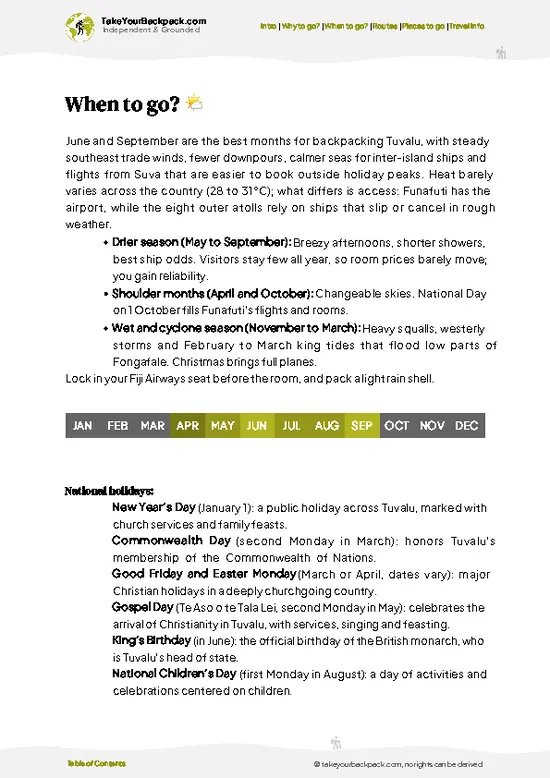
Best months: The best months are May to October, when the dry season brings less rain, steadier trade winds and calmer seas for ship crossings. Temperatures sit around 28 to 32°C all year, so the real swing is rainfall (roughly 3,000 mm a year, mostly November to April).
Shoulder and wet season: November to April is cyclone season, and heavy squalls can delay the ship and cancel flights. Around February and March, king tides push seawater up through the porous coral, flooding low spots even on sunny days. Prices barely change by season, but guesthouse beds are tight at Christmas and New Year, when families return home and island feasts run for days. Book ahead then, and keep two spare days at either end of any trip.

village hoppingOptimizing Your Multi-Stop Itinerary

How long to allow: A trip combining several villages in Tuvalu needs 10 to 14 days if you stay on Funafuti plus one or two outer islands, and up to three weeks when you depend on the ship.
Direction and pacing: Fly into Funafuti, the only hub, then go out to the outer islands and return, because every route starts and ends there. The central and southern atolls sit closest, roughly 8 to 20 hours by ship, while the far northern ones can take 24 to 36 hours. Plan 3 to 5 nights per outer island, since a ship stop can stretch into a week. The common mistake is booking an international flight home right after a ship trip. Get written confirmation of the ship’s return sailing, and leave a 3 to 4 day buffer before your flight out.

The ListMust-Visit villages in Tuvalu

1 Vaiaku Village

Runway street, lagoon beachfront, stamp bureau, scooter-wide island

Watch the airstrip fill with walkers and ball games at dusk, swim the shallow lagoon, and buy stamps at the bureau.

2 Fangaua

Glassy shallows, Pepesala village, Congregational church, Elekana story, fatele nights

Wade the clear, shallow lagoon at low tide, walk through Pepesala, sit in on hymn singing, and cross to the surf-battered reef side.

3 Nanumea

B-24 airstrip, Tefolaha stories, lagoon, supply-ship access

Walk the 1943 runway, then spend the evening in the maneapa or at Sunday hymns.

4 Savave

Nukufetau atoll, village quiet, wartime bomber strip, giant clams

Hire a village boat to the overgrown 1943 bomber airfield, then snorkel the calm shallows beside the village lane.

Loading the map 🌍

Expert viewExpert Commentary on villages

How many villages: Visit two to three communities. Getting between islands eats days, and a stay only becomes interesting after the first evening in the maneapa, so depth beats count.
Which kind to prioritize: If you have a week or less, or limited tolerance for rough seas, stick to Funafuti, where flights, guesthouses and restaurants exist. If you have two weeks or more and are comfortable with basic conditions, add an outer island for the real community life: shared meals, fishing, church singing and fatele dancing.
What it costs: Funafuti runs roughly US$70 to 120 a day, with guesthouse rooms around A$80 to 150 (US$50 to 100) and meals US$8 to 15. Outer-island homestays with meals typically cost US$30 to 60 a day. Ship passage is usually a modest fare, roughly US$30 to 80 depending on the … read more 👉
How many villages: Visit two to three communities. Getting between islands eats days, and a stay only becomes interesting after the first evening in the maneapa, so depth beats count.
Which kind to prioritize: If you have a week or less, or limited tolerance for rough seas, stick to Funafuti, where flights, guesthouses and restaurants exist. If you have two weeks or more and are comfortable with basic conditions, add an outer island for the real community life: shared meals, fishing, church singing and fatele dancing.
What it costs: Funafuti runs roughly US$70 to 120 a day, with guesthouse rooms around A$80 to 150 (US$50 to 100) and meals US$8 to 15. Outer-island homestays with meals typically cost US$30 to 60 a day. Ship passage is usually a modest fare, roughly US$30 to 80 depending on the cabin or deck, and there are no entry fees, but a guide or boat trip for fishing or lagoon visits is usually A$30 to 100 (US$20 to 65). Bring all the cash you need from Funafuti.
Safety and etiquette: Crime is very low. The risks are sun, dehydration and sea conditions, so carry reusable bottles and ask before swimming in channels with currents. Report to the island council or your host on arrival, and ask before photographing people or the maneapa. Dress modestly: shorts below the knee and covered shoulders away from the beach, no swimwear in the village. Sunday is church day, with shops closed and fishing and loud activities frowned upon. Bring a small gift of rice, tinned fish or sugar for your host family, and do not use rainwater tanks for washing.

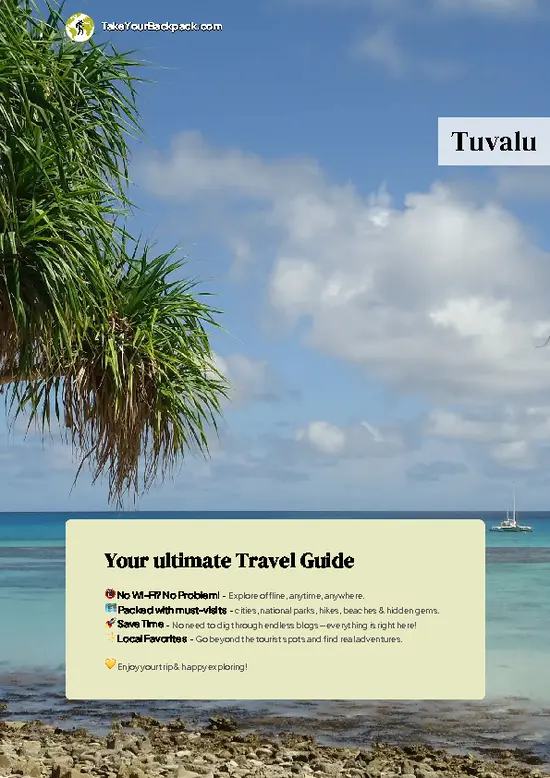
✈️ The backpacker research shortcutTuvalu Travel Guide

An offline-friendly backpacking guide with optimized travel routes, ranked highlights, transport advice, and the best areas to stay.
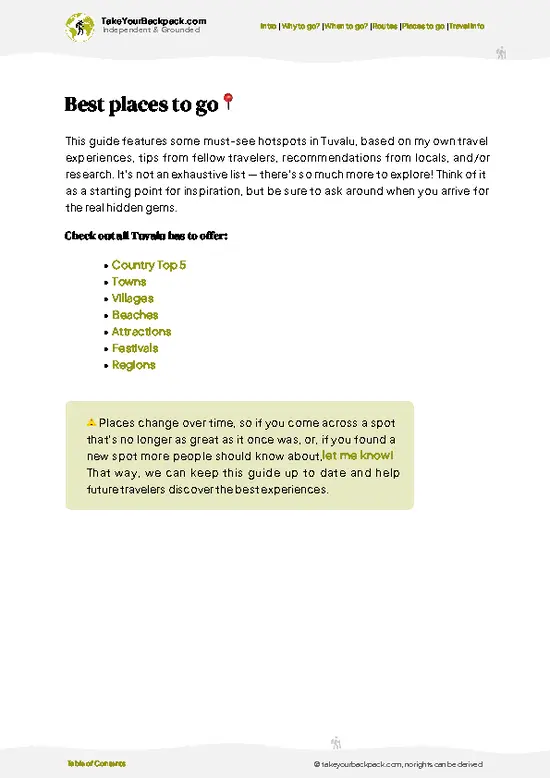
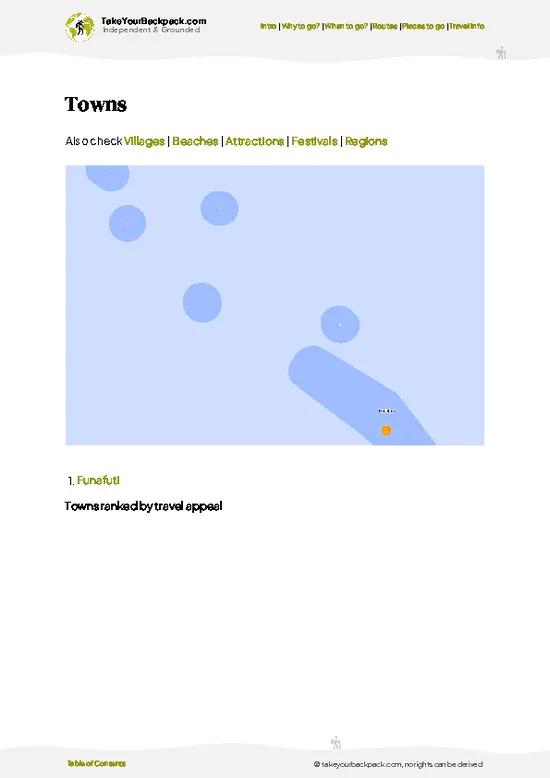
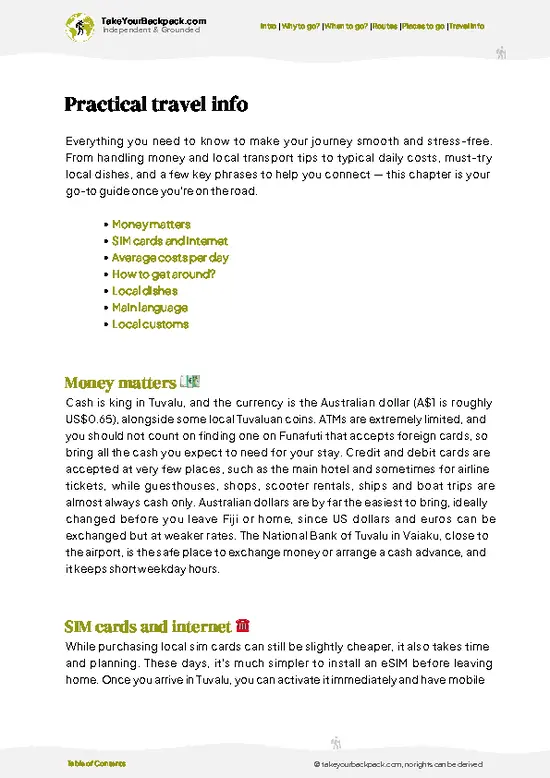
example page 0 from our offline Travel Guide for Tuvalu
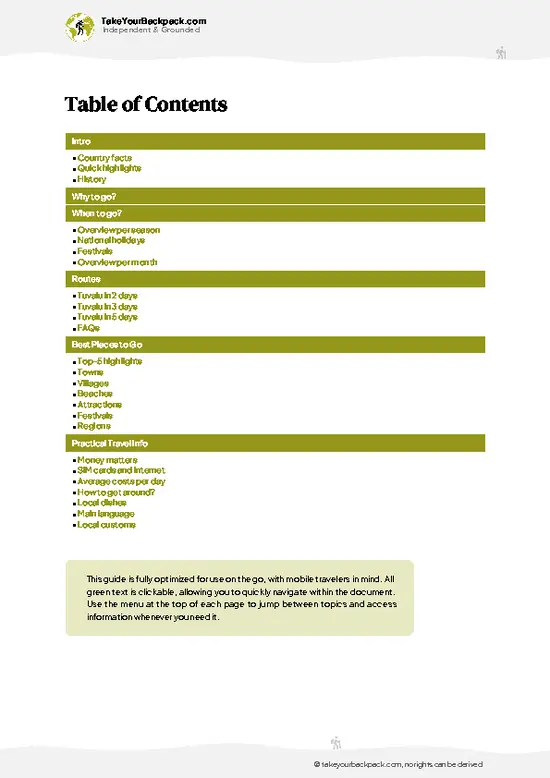
example page 1 from our offline Travel Guide for Tuvalu
example page 2 from our offline Travel Guide for Tuvalu
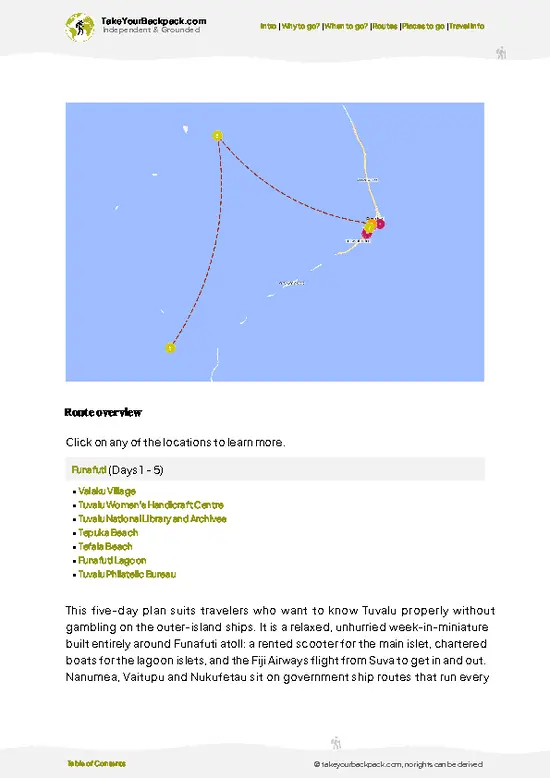
example page 3 from our offline Travel Guide for Tuvalu
example page 4 from our offline Travel Guide for Tuvalu
example page 5 from our offline Travel Guide for Tuvalu
example page 6 from our offline Travel Guide for Tuvalu
example page 7 from our offline Travel Guide for Tuvalu
The digital guide (97 pages) contains:
✅ 20 highlights, ranked by travel appeal
✅ Optimized 2, 3 & 5-day travel routes
✅ Cities, national parks, landmarks, beaches
✅ How to get around
✅ Offline-friendly for travel without Wi-Fi
👉 Click to see all 30+ guide features

📅 Plan smarter in minutes, not weeks
✅ Month by month travel advice
✅ Festivals & national holidays
✅ Budget expectations

🗺️ Go to the right places, skip the overrated ones
✅ Honest pros & cons of destinations
✅ Top hikes, parks & viewpoints
✅ Lesser-known places most travelers miss
✅ Clear “worth it vs skip it” guidance

🛏️ Travel smoothly without rookie mistakes
✅ Best areas to stay
✅ Transport systems explained simply
✅ Common scams & safety advice
✅ SIM cards, money & practical tips

🌍 Understand the country, not just visit it
✅ Culture & traditions
✅ 52 Essential phrases & customs
✅ Festivals worth planning around
✅ Traveler-friendly historical context
✅ Insights that make places more meaningful

📱 Built for real travel conditions
✅ Fully downloadable PDF
✅ Works completely offline
✅ Optimized for phone use
✅ Useful in remote areas & buses
✅ Everything in one place
Stop searching, start planning
Get instant access to your full guide. 30‑day money-back guarantee.
+ Add another guide for just

By proceeding you agree to our terms.
Sent to your inbox immediately after payment • 100% Secure Checkout
Best Backpacking Travel Advisor 2025 tourism awardBest Backpacking
Travel Advisor
2025
What others say about Take Your Backpack Guides:
⭐⭐⭐⭐⭐
Fantastic, amazing amount of information!
⭐⭐⭐⭐⭐
My goodness this is amazing, it's what I've been looking for hats off too you!
⭐⭐⭐⭐⭐
I think this is absolutely BRILLIANT
⭐⭐⭐⭐
Very complete and informative. It's still missing places, but I gotta to commend you
⭐⭐⭐⭐⭐
This is truly amazing, thank you, can't wait to explore it with my kids!
⭐⭐⭐⭐⭐
Awesome resource, thank you!
⭐⭐⭐⭐⭐
This is amazing! Can't wait to explore the ones I haven't seen
⭐⭐⭐⭐
I love this! Well done, great idea.
⭐⭐⭐⭐⭐
Thanks for taking the time to make this gem!
⭐⭐⭐⭐⭐
This might be the best website I've ever seen.
⭐⭐⭐⭐⭐
Congratulations, and thank you so much for your work; it's incredibly valuable.
⭐⭐⭐⭐
In all seriousness I think you did a great job pointing out the important spots
⭐⭐⭐⭐⭐
10/10 very good
⭐⭐⭐⭐⭐
As someone who's only just starting to visit regularly this is awesome, thank you.
⭐⭐⭐⭐
Thank you very much! I'm going to visit my dad, it's going to be very useful!
⭐⭐⭐⭐⭐
This is really cool! We'll be travelling for the first time and this definitely come in handy.
⭐⭐⭐⭐⭐
You are now our minister of culture, congratulations 👨‍💼
⭐⭐⭐⭐⭐
Just wanted to tell you that this is a pearl! Going to follow your recommendations.
⭐⭐⭐⭐⭐
This is so cool. I'll definitely be using the resource for my travels soon.
⭐⭐⭐⭐⭐
This is very impressive! Good work.
⭐⭐⭐⭐⭐
This is an amazing and informative site. Very well done!

🛏️ Where to stay?Where to Stay: Tuvalu Edition

Tuvalu has no true hostels, so budget travel here means small family guesthouses and a few simple lodges on Funafuti, typically A$60 to 150 (about US$40 to 100) a night for a private room, often with shared bathrooms. Vaiaku, the central stretch facing the lagoon, has the most options and puts you a short walk from the airport, government offices, shops and the island’s handful of bars, though evenings bring motorbike noise and crowds playing sport on the runway. The quieter village areas further along Fongafale islet, plus basic homestays on outer islands such as Nanumea or Nukulaelae, trade convenience for calm, very safe nights and a real look at village life, but you will need a scooter … read more 👉
Tuvalu has no true hostels, so budget travel here means small family guesthouses and a few simple lodges on Funafuti, typically A$60 to 150 (about US$40 to 100) a night for a private room, often with shared bathrooms. Vaiaku, the central stretch facing the lagoon, has the most options and puts you a short walk from the airport, government offices, shops and the island’s handful of bars, though evenings bring motorbike noise and crowds playing sport on the runway. The quieter village areas further along Fongafale islet, plus basic homestays on outer islands such as Nanumea or Nukulaelae, trade convenience for calm, very safe nights and a real look at village life, but you will need a scooter on Funafuti and patience with the infrequent boats to the outer islands.

If you enjoy meeting fellow travelers, consider choosing hostels with high ratings for atmosphere. On the other hand, if you prefer having your own space, a hotel might be a better option.

TuvaluExplore Beyond This Category

👋 Meet the founderWho’s Behind Take Your Backpack?

Johan, backpacker and founder of TakeYourBackpackHi, I’m Johan (Netherlands 🇳🇱), the creator of TakeYourBackpack. Over the past 3 decades, I’ve backpacked through 90+ countries across six continents, gaining extensive experience with independent travel, long-term trips, and overland routes.

This site is built on a combination of firsthand travel experience and carefully curated insights from other backpackers. Many guides are based on places I’ve personally visited, while others bring together tips, observations, and practical advice shared by trusted travelers I’ve met along the way.

The goal is to provide realistic, experience-driven guidance — not generic itineraries — so you can explore destinations with better context, clearer expectations, and more confidence.