×

Tuvalu🇹🇻 | villagesNanumeaB-24 airstrip, Tefolaha stories, lagoon, supply-ship access | things to do and best time to go

Explore LofeagaiExplore Vaiaku Village

Backpacking in Nanumea
👍 Recommendedvillage ranked #3
By Johan Kruseman 🇳🇱 | Updated October 16, 2026

The generator hums off at 10 p.m., the lagoon goes black, and you realize the whole village is walking home by the sound of flip-flops on coral gravel. Nanumea sits in the northwest of Tuvalu, an atoll far from Funafuti, and reaching it takes planning around an irregular supply ship. On the plus side, nobody is selling anything, the lagoon is clear, and the island holds real World War II remains. On the downside, guesthouse beds are few, food is simple and flights get bumped. Evenings are quiet, with church hymns, cards and shared fish. You will meet locals long before other travelers. Carry cash in Australian dollars and extra snacks. A first day could go like this: arrive, greet the island council office, walk the old airstrip at golden hour, then eat wherever you are invited.

Discover everything you want to know in the 📖 Tuvalu Travel Guide.


example page 0 from our offline Travel Guide for Tuvalu
example page 1 from our offline Travel Guide for Tuvalu
example page 2 from our offline Travel Guide for Tuvalu
example page 3 from our offline Travel Guide for Tuvalu
example page 4 from our offline Travel Guide for Tuvalu
example page 5 from our offline Travel Guide for Tuvalu
example page 6 from our offline Travel Guide for Tuvalu
example page 7 from our offline Travel Guide for Tuvalu
Loading the map 🌍
CLICK TO FILTER
towns
villages
beaches
attractions
festivals
regions
SHOW COUNTRY’S BESTSHOW ALL

✨ Why go?
Ranked #3 village in Tuvalu
What makes it a must-see village

You go to Nanumea because it is one of the few places in Tuvalu where the outer-island routine is still the whole show. Days run on fishing boats, pulaka (swamp taro) pits, and church bells, and a visitor is noticed and welcomed within an hour. The island also carries a serious wartime past: the 1943 US airfield that launched bombers toward the Gilberts still cuts across the land, with bunkers and rusted fittings in the brush. Beyond that, the lagoon is the draw, calm enough for swimming and clear enough that you can see coral heads from a canoe. Stays tend to be longer than planned, since transport decides your departure, not you. It suits slow travelers, history-minded solo travelers, and anyone comfortable with limited choice at the table and unpredictable schedules. Nightlife, shops and … read more 👉
You go to Nanumea because it is one of the few places in Tuvalu where the outer-island routine is still the whole show. Days run on fishing boats, pulaka (swamp taro) pits, and church bells, and a visitor is noticed and welcomed within an hour. The island also carries a serious wartime past: the 1943 US airfield that launched bombers toward the Gilberts still cuts across the land, with bunkers and rusted fittings in the brush. Beyond that, the lagoon is the draw, calm enough for swimming and clear enough that you can see coral heads from a canoe. Stays tend to be longer than planned, since transport decides your departure, not you. It suits slow travelers, history-minded solo travelers, and anyone comfortable with limited choice at the table and unpredictable schedules. Nightlife, shops and tour desks are absent. If you need constant activity or a fixed itinerary, treat it as a skip. If you want a place where you are the only outsider at a feast, it is hard to beat.

💡 HighlightsKey sights and experiences for travelers

  1. World War II airfield and relics. The US Navy built the airstrip here in 1943, and B-24 Liberators flew from it. Walk the runway and look for bunkers, concrete remnants and scattered wartime metal in the bush on either side. Go early morning or late afternoon for cool air and low light. It is free to walk, and a local guide, if you ask around, may take you for a small gift or a few Australian dollars. Allow 2 to 3 hours.
  2. The village maneapa (meeting hall). Every Tuvaluan community has one, and in Nanumea it is where decisions, feasts and dances happen, with oral traditions about the ancestor Tefolaha still told. Visit when there is a gathering, usually on a weekend or a special occasion, and ask permission before sitting. Entry is free, but bring a small gift such as tinned fish or tea, around
… read more 👉
  1. World War II airfield and relics. The US Navy built the airstrip here in 1943, and B-24 Liberators flew from it. Walk the runway and look for bunkers, concrete remnants and scattered wartime metal in the bush on either side. Go early morning or late afternoon for cool air and low light. It is free to walk, and a local guide, if you ask around, may take you for a small gift or a few Australian dollars. Allow 2 to 3 hours.
  2. The village maneapa (meeting hall). Every Tuvaluan community has one, and in Nanumea it is where decisions, feasts and dances happen, with oral traditions about the ancestor Tefolaha still told. Visit when there is a gathering, usually on a weekend or a special occasion, and ask permission before sitting. Entry is free, but bring a small gift such as tinned fish or tea, around A$5 to 15 (US$3 to 10). Plan about 1 to 2 hours, longer if a fatele dance night is on.
  3. Sunday church service. The congregation sings in layered harmony, loud enough to carry across the village, and nearly everyone attends in white or their best clothes. Arrive about 15 minutes before the start, which is typically in the morning, cover shoulders and knees, and sit toward the back. It is free, with a collection plate where a coin or two (A$1 to 2) is polite. Expect 1.5 to 2 hours, since sermons run long.
Most visitors fixate on the war relics and skip the Sunday service, yet the singing is the thing locals will quietly ask whether you stayed for. For day trips, hire a local boatman to reach the white-sand islet of Lakena on the atoll rim, and ask about the smaller motu around the lagoon for picnics and snorkeling.
Spotted a mistake or missing something? Contact us.

🌤️ When to go?Seasonal considerations and timing

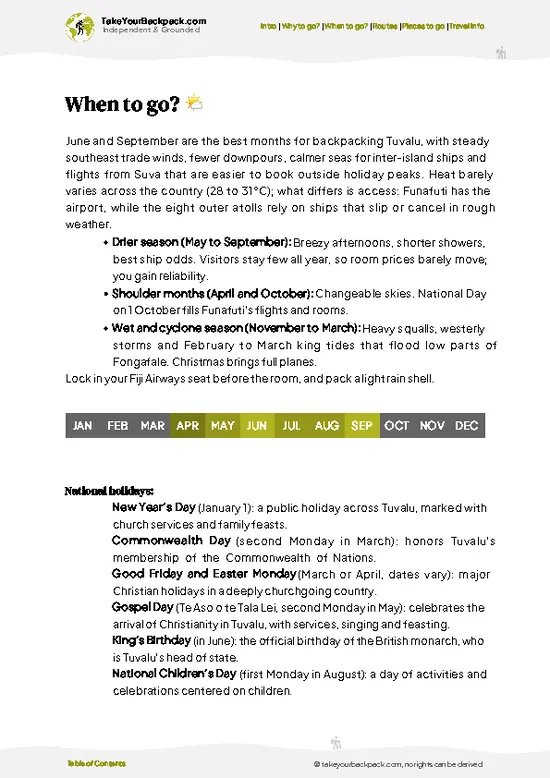
May to October is the easiest window for Nanumea, with steadier sunshine and calmer lagoon crossings.
  • Drier Season (May to October): Days run 28 to 31°C (82 to 88°F), with trade winds that take the edge off the heat. Showers still pass through, but the lagoon is usually calm enough for boat trips. Daylight stays at about 12 hours all year.
  • Wet Season (November to April): Expect heavy squalls, humid air near 30 to 32°C (86 to 90°F) and rougher seas. Cyclone risk is highest from roughly December to March. Ship schedules to the outer islands slip often.
  • Crowds and Prices: Visitors are very few in any month, so there is no peak pricing. Costs depend on how much food and fuel the supply ship has brought in.
  • Local Events: Christmas and New Year bring feasting, dancing and singing in the village. Those
… read more 👉
May to October is the easiest window for Nanumea, with steadier sunshine and calmer lagoon crossings.
  • Drier Season (May to October): Days run 28 to 31°C (82 to 88°F), with trade winds that take the edge off the heat. Showers still pass through, but the lagoon is usually calm enough for boat trips. Daylight stays at about 12 hours all year.
  • Wet Season (November to April): Expect heavy squalls, humid air near 30 to 32°C (86 to 90°F) and rougher seas. Cyclone risk is highest from roughly December to March. Ship schedules to the outer islands slip often.
  • Crowds and Prices: Visitors are very few in any month, so there is no peak pricing. Costs depend on how much food and fuel the supply ship has brought in.
  • Local Events: Christmas and New Year bring feasting, dancing and singing in the village. Those are lively weeks, but transport is hard to arrange then.
Book transport first, then fit the dates around it, because the schedule matters more than the weather.


source: climatestotravel.comJANJanuary: fair for travelingFEBFebruary: fair for travelingMARMarch: fair for travelingAPRApril: good for travelingMAYMay: highly recommended for travelingJUNJune: excellent for travelingJULJuly: excellent for travelingAUGAugust: excellent for travelingSEPSeptember: excellent for travelingOCTOctober: highly recommended for travelingNOVNovember: good for travelingDECDecember: fair for traveling
when-to-go

✈️ The backpacker research shortcutTuvalu Travel Guide

An offline-friendly backpacking guide with optimized travel routes, ranked highlights, transport advice, and the best areas to stay.
example page 0 from our offline Travel Guide for Tuvalu
example page 1 from our offline Travel Guide for Tuvalu
example page 2 from our offline Travel Guide for Tuvalu
example page 3 from our offline Travel Guide for Tuvalu
example page 4 from our offline Travel Guide for Tuvalu
example page 5 from our offline Travel Guide for Tuvalu
example page 6 from our offline Travel Guide for Tuvalu
example page 7 from our offline Travel Guide for Tuvalu
The digital guide (97 pages) contains:
✅ 20 highlights, ranked by travel appeal
✅ Optimized 2, 3 & 5-day travel routes
✅ Cities, national parks, landmarks, beaches
✅ How to get around
✅ Offline-friendly for travel without Wi-Fi
👉 Click to see all 30+ guide features

📅 Plan smarter in minutes, not weeks
✅ Month by month travel advice
✅ Festivals & national holidays
✅ Budget expectations

🗺️ Go to the right places, skip the overrated ones
✅ Honest pros & cons of destinations
✅ Top hikes, parks & viewpoints
✅ Lesser-known places most travelers miss
✅ Clear “worth it vs skip it” guidance

🛏️ Travel smoothly without rookie mistakes
✅ Best areas to stay
✅ Transport systems explained simply
✅ Common scams & safety advice
✅ SIM cards, money & practical tips

🌍 Understand the country, not just visit it
✅ Culture & traditions
✅ 52 Essential phrases & customs
✅ Festivals worth planning around
✅ Traveler-friendly historical context
✅ Insights that make places more meaningful

📱 Built for real travel conditions
✅ Fully downloadable PDF
✅ Works completely offline
✅ Optimized for phone use
✅ Useful in remote areas & buses
✅ Everything in one place
Stop searching, start planning
Get instant access to your full guide. 30‑day money-back guarantee.
+ Add another guide for just

By proceeding you agree to our terms.
Sent to your inbox immediately after payment • 100% Secure Checkout
Best Backpacking Travel Advisor 2025 tourism awardBest Backpacking
Travel Advisor
2025
What others say about Take Your Backpack Guides:
⭐⭐⭐⭐⭐
Fantastic, amazing amount of information!
⭐⭐⭐⭐⭐
My goodness this is amazing, it's what I've been looking for hats off too you!
⭐⭐⭐⭐⭐
I think this is absolutely BRILLIANT
⭐⭐⭐⭐
Very complete and informative. It's still missing places, but I gotta to commend you
⭐⭐⭐⭐⭐
This is truly amazing, thank you, can't wait to explore it with my kids!
⭐⭐⭐⭐⭐
Awesome resource, thank you!
⭐⭐⭐⭐⭐
This is amazing! Can't wait to explore the ones I haven't seen
⭐⭐⭐⭐
I love this! Well done, great idea.
⭐⭐⭐⭐⭐
Thanks for taking the time to make this gem!
⭐⭐⭐⭐⭐
This might be the best website I've ever seen.
⭐⭐⭐⭐⭐
Congratulations, and thank you so much for your work; it's incredibly valuable.
⭐⭐⭐⭐
In all seriousness I think you did a great job pointing out the important spots
⭐⭐⭐⭐⭐
10/10 very good
⭐⭐⭐⭐⭐
As someone who's only just starting to visit regularly this is awesome, thank you.
⭐⭐⭐⭐
Thank you very much! I'm going to visit my dad, it's going to be very useful!
⭐⭐⭐⭐⭐
This is really cool! We'll be travelling for the first time and this definitely come in handy.
⭐⭐⭐⭐⭐
You are now our minister of culture, congratulations 👨‍💼
⭐⭐⭐⭐⭐
Just wanted to tell you that this is a pearl! Going to follow your recommendations.
⭐⭐⭐⭐⭐
This is so cool. I'll definitely be using the resource for my travels soon.
⭐⭐⭐⭐⭐
This is very impressive! Good work.
⭐⭐⭐⭐⭐
This is an amazing and informative site. Very well done!

🛏️ Where to stay?Best areas to stay in Tuvalu

Homestays arranged through the island council (kaupule) and local families are the main way to sleep in Nanumea. Expect a simple setup: a mattress or mat, a mosquito net, shared washing facilities and rainwater for bathing.
Budget about A$40 to 80 (US$26 to 52) per person per night, usually with meals included. Confirm the price before you arrive, and ask exactly what is covered. Meals lean on fish, coconut, taro, pulaka and rice. Fresh vegetables and cold drinks are limited, so bring snacks and a water bottle with a filter.
Staying in the main villages of Lolua and Haumaefa keeps you close to the … read more 👉
Homestays arranged through the island council (kaupule) and local families are the main way to sleep in Nanumea. Expect a simple setup: a mattress or mat, a mosquito net, shared washing facilities and rainwater for bathing.
Budget about A$40 to 80 (US$26 to 52) per person per night, usually with meals included. Confirm the price before you arrive, and ask exactly what is covered. Meals lean on fish, coconut, taro, pulaka and rice. Fresh vegetables and cold drinks are limited, so bring snacks and a water bottle with a filter.
Staying in the main villages of Lolua and Haumaefa keeps you close to the church, the meeting hall (maneapa), the small shops and the airstrip. Boats to the other islets leave from this side of the atoll. Electricity is available but power cuts happen, so carry a headlamp and a power bank.
Contact the kaupule or your Funafuti contacts before you sail. Do not turn up and hope. Bring cash in Australian dollars, because there are no ATMs and card payments are not realistic. Dress modestly in the village, and a gift of rice or tinned goods for your host family is a thoughtful touch.

🚌 Day tripsBest day trips from Nanumea

Nanumea is a small atoll, and every outing starts from the village by boat, bicycle or on foot, which makes it easy to base yourself here. Everything is informal, so arrange transport through your host the day before.
Lakena Islet: The sandy islet across the lagoon is the best excursion on the atoll. Expect a boat ride of about 30 to 60 minutes, depending on tides and the engine, and a fuel contribution of roughly A$30 to 60 (US$20 to 39) split among passengers. The lagoon is calmest from May to October. The classic first-timer mistake is leaving without enough water and sun protection, because there is almost no shade on the shore.

World War II Sites: American forces built an airfield on Nanumea in 1943, and rusting relics and bomb scars still sit in the bush near the runway. It is a half-day … read more 👉
Nanumea is a small atoll, and every outing starts from the village by boat, bicycle or on foot, which makes it easy to base yourself here. Everything is informal, so arrange transport through your host the day before.
Lakena Islet: The sandy islet across the lagoon is the best excursion on the atoll. Expect a boat ride of about 30 to 60 minutes, depending on tides and the engine, and a fuel contribution of roughly A$30 to 60 (US$20 to 39) split among passengers. The lagoon is calmest from May to October. The classic first-timer mistake is leaving without enough water and sun protection, because there is almost no shade on the shore.

World War II Sites: American forces built an airfield on Nanumea in 1943, and rusting relics and bomb scars still sit in the bush near the runway. It is a half-day walk or bike ride along flat tracks from the village, and a local guide helps you spot the remains. Tip your guide A$10 to 20 (US$6.50 to 13). Go early before the heat peaks, and wear closed shoes against sharp coral rock and thorns.

Lagoon Fishing and Reef Walk: Join a local fisherman for a morning on the lagoon and the outer reef edge. Trips take three to five hours and cost A$20 to 40 (US$13 to 26) as a gift for the host or for fuel. Low tide in the morning is best for reef walking. Ask permission before fishing or taking shells, because the lagoon belongs to specific families.

FAQFrequently asked questions about Nanumea

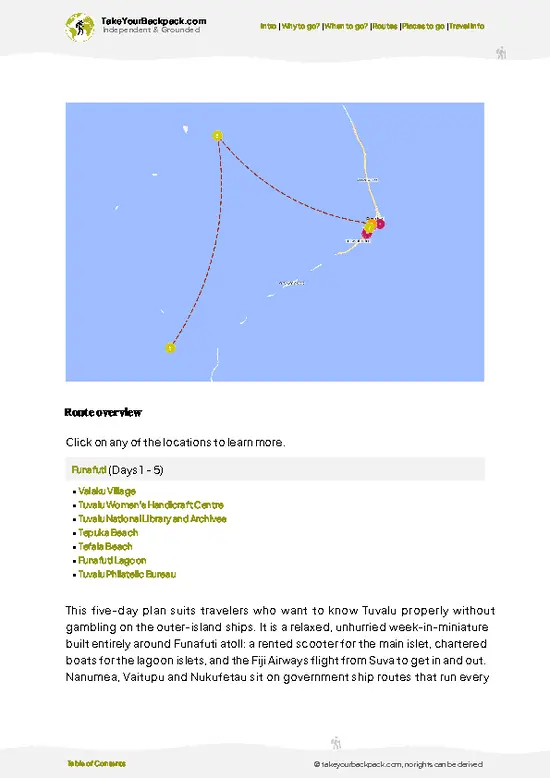
Sail from Funafuti on the supply ship, the only practical route, since there are no scheduled domestic flights. Book passage well ahead in Funafuti. The supply ship takes roughly two days each way and runs on an irregular schedule. Allow a buffer of several days either side, and carry Australian dollars in cash.
Yes, if you want a place with almost no tourism, a lagoon with few boats and WWII relics left in the bush. Plan on three to five nights to cover Lakena islet, the airfield remains and a fishing trip with locals. Expect basic homestay conditions at about A$40 to 80 (US$26 to 52) per night, and little in the way of shops or nightlife.
No. Nanumea lies roughly 450 kilometers from Funafuti, and ships are too infrequent for a same-day return. Plan at least a few nights, and check your return seat before leaving. Once on the atoll, short outings such as Lakena islet or the airfield sites can each be done in a morning or afternoon.
⚠️ Things can change over time, so always validate details locally before you go.

Other Tuvaluan villages near Nanumea

Explore more nearby:

  • Savave—Nukufetau atoll, village quiet, wartime bomber strip, giant clams| 354 km away
  • Vaiaku Village—Runway street, lagoon beachfront, stamp bureau, scooter-wide island| 462 km away
  • Fangaua—Glassy shallows, Pepesala village, Congregational church, Elekana story, fatele nights| 576 km away

💡 Not sure where to go next?
Create a personalized itinerary for Tuvalu including Nanumea and the places that fit your trip.

Generate my itinerary

👉 Discover all villages

Or checkout all Tuvalu has to offer (think cities, towns, villages, national parks, hikes, beaches, festivals)
Country photo of Tuvalu

We 💚 feedbackParting advice and final tips

Go in the early morning, ideally just before sunrise, when the lagoon is flat, the air is still cool and fishing canoes slide out one by one. Schedule your arrival in the drier months, roughly May to October, so boats are less likely to slip. Bring a small gift for your hosts, and keep at least one empty afternoon for the sunset walk along the airstrip.

✍️ Help improve this page!
The information on this page is based on in-depth research, insights shared by experienced travelers, and feedback from the local travel community in Tuvalu. While every effort is made to keep the information accurate and current, conditions can change — so if you spot anything incorrect or outdated, please get in touch.


🙋‍♂️ Give feedback

👋 Meet the founderWho’s Behind Take Your Backpack?

Johan, backpacker and founder of TakeYourBackpackHi, I’m Johan (Netherlands 🇳🇱), the creator of TakeYourBackpack. Over the past 3 decades, I’ve backpacked through 90+ countries across six continents, gaining extensive experience with independent travel, long-term trips, and overland routes.

This site is built on a combination of firsthand travel experience and carefully curated insights from other backpackers. Many guides are based on places I’ve personally visited, while others bring together tips, observations, and practical advice shared by trusted travelers I’ve met along the way.

The goal is to provide realistic, experience-driven guidance — not generic itineraries — so you can explore destinations with better context, clearer expectations, and more confidence.