×

Uganda🇺🇬 | best beachesDiscover the 3 Best beaches Across Uganda

Forget ocean surf. Uganda is landlocked, so its beaches are freshwater shores of giant lakes, and that changes everything about how you plan. Sand and swimming cluster around Lake Victoria, where the Ssese Islands deliver quiet, palm-backed strands and the Entebbe and Kampala shoreline serves weekend crowds with music and grilled tilapia. Farther west, Lake Albert and Lake Bunyonyi trade sunbathing for wild views and canoe rides. Costs stay low, but access varies from an easy taxi to a ferry and a long boda ride. Independent travelers who like to explore will find each shore has its own pace.

By Johan Kruseman 🇳🇱 | Updated October 23, 2026
Explore the best attractions in Uganda

Why go?Understanding Their Importance

Uganda does beaches differently, and that is the point. With no coastline, every beach sits on a freshwater lake, and the country holds a huge share of Lake Victoria, Africa’s largest lake, plus Albert, Edward, Kyoga and Bunyonyi. The result is warm, salt-free water, no tides and no surf, so swimming is calm and sunburn arrives faster than you expect at roughly 1,100 to 1,300 meters above sea level on the equator.

Culture shapes the experience as much as geography. Lake shores are working places: fishing communities, landing sites and ferry docks sit beside the sand, and local weekends revolve around music, boat rides and roadside fish rather than resort routines. Infrastructure is thin outside Kampala, Entebbe and Jinja, so expect basic lodges, patchy electricity and few organized water … read more 👉
Uganda does beaches differently, and that is the point. With no coastline, every beach sits on a freshwater lake, and the country holds a huge share of Lake Victoria, Africa’s largest lake, plus Albert, Edward, Kyoga and Bunyonyi. The result is warm, salt-free water, no tides and no surf, so swimming is calm and sunburn arrives faster than you expect at roughly 1,100 to 1,300 meters above sea level on the equator.

Culture shapes the experience as much as geography. Lake shores are working places: fishing communities, landing sites and ferry docks sit beside the sand, and local weekends revolve around music, boat rides and roadside fish rather than resort routines. Infrastructure is thin outside Kampala, Entebbe and Jinja, so expect basic lodges, patchy electricity and few organized water sports.

Know the health picture before you commit. Bilharzia (schistosomiasis) is a risk in many shallow, reedy lake edges, and hippos and crocodiles live in several waters, notably the western lakes. Locals and lodge staff know which stretches are used for swimming, and following them is the smart move. Choose Uganda for lake life, gorilla and savanna add-ons, and low prices, not for a classic tropical beach holiday.
How the List Was Created
The list of best beaches in Uganda is created based on beauty, vibe, water quality, activities, and surrounding scenery. If you feel a beach is missing in this list, please let us know.

When to go?Optimal Periods for Travel

Best Months for Lake Beaches: The best months are December to February and June to August, when the two dry seasons bring the most sunshine, calmer water and passable dirt roads. Daytime temperatures hover around 25 to 29°C year-round near the lakes, and lake water stays comfortably swimmable at roughly 24 to 26°C, so the real difference is rain, not heat.
Shoulder and Wet Seasons: The long rains run March to May and the short rains September to November. Expect afternoon downpours rather than all-day gray, with annual rainfall around 1,200 to 1,600 mm on the Lake Victoria shore, and more on the islands. Shoulder months such as early March, late May and September still give plenty of sunny mornings, emptier shores and lodge rates that often drop 10 to 30 percent. Dirt tracks to island and western … read more 👉
Best Months for Lake Beaches: The best months are December to February and June to August, when the two dry seasons bring the most sunshine, calmer water and passable dirt roads. Daytime temperatures hover around 25 to 29°C year-round near the lakes, and lake water stays comfortably swimmable at roughly 24 to 26°C, so the real difference is rain, not heat.
Shoulder and Wet Seasons: The long rains run March to May and the short rains September to November. Expect afternoon downpours rather than all-day gray, with annual rainfall around 1,200 to 1,600 mm on the Lake Victoria shore, and more on the islands. Shoulder months such as early March, late May and September still give plenty of sunny mornings, emptier shores and lodge rates that often drop 10 to 30 percent. Dirt tracks to island and western lake shores turn slick in April and May, so ferries and boda rides get slower.
Crowds and Regional Differences: Crowds peak on weekends and public holidays, especially around Kampala and Entebbe, where day-use spots fill from Saturday noon. Christmas and New Year push prices up at island lodges, so book ahead. The western Lake Albert and Lake Edward areas get less rain in their drier stretches, but heat is stronger there. For the quietest sand, pick a weekday in June, July or January.

beach hoppingHow to Combine beaches Into One Trip

Days and Regions: A trip linking several beaches in Uganda needs 7 to 12 days, which lets you cover two or three regions without living in a minibus. Lake Victoria shores cluster naturally: Entebbe and Kampala at the center, Jinja to the east, and the Ssese Islands reached through the southwest ferry crossing. Western lakes such as Albert and Bunyonyi sit in a separate arc that suits a longer trip.
Direction and Timing: Start at Entebbe, where the international airport sits, and work outward. Kampala to Jinja takes about 2 to 3 hours by road, and the road to the island ferry at Bukakata takes roughly 3 to 4 hours before a crossing of about 1.5 hours. Kampala to Lake Bunyonyi runs 8 to 9 hours by bus, so break it with a night in Mbarara. Give each stop 2 to 3 nights, and a full 3 to 4 days on … read more 👉
Days and Regions: A trip linking several beaches in Uganda needs 7 to 12 days, which lets you cover two or three regions without living in a minibus. Lake Victoria shores cluster naturally: Entebbe and Kampala at the center, Jinja to the east, and the Ssese Islands reached through the southwest ferry crossing. Western lakes such as Albert and Bunyonyi sit in a separate arc that suits a longer trip.
Direction and Timing: Start at Entebbe, where the international airport sits, and work outward. Kampala to Jinja takes about 2 to 3 hours by road, and the road to the island ferry at Bukakata takes roughly 3 to 4 hours before a crossing of about 1.5 hours. Kampala to Lake Bunyonyi runs 8 to 9 hours by bus, so break it with a night in Mbarara. Give each stop 2 to 3 nights, and a full 3 to 4 days on the islands, where rides and boats eat time.
Planning Mistakes: The common error is cramming a western lake and an island into one week, then spending most of it in transit. Pick one cluster per week. Another is ignoring ferry schedules: arrive early for the crossing and avoid late-afternoon arrivals on the islands. Kampala traffic can add an hour or two, so leave the city at dawn instead of midday. Build in a buffer day before any international flight out of Entebbe.

The ListHighly Recommended beaches of Uganda

1 Entebbe Beach

Airport-adjacent shoreline, wading shallows, marabou storks, grilled tilapia

Wade the warm Lake Victoria shallows near the airport, then follow the shore to the botanical gardens and a charcoal-grilled fish dinner at dusk.

uganda-beach-entebbe-beach
© Google |

2 Lutembe Beach

Ramsar bird roost, papyrus channels, weekend sound systems

Paddle through papyrus at dawn to reach gull and tern flocks on the bay, then settle in for whole grilled tilapia on the sand.

3 Jinja Beach

Nile’s starting point, boat trips, Gandhi memorial, rapids nearby

Board a local canoe to the spot where Lake Victoria drains into the Nile, with fish eagles and cormorants overhead along the way.

Loading the map 🌍

Expert viewTips and Advice from Travelers

How Many Beaches to Visit: Three is the number I advise. One lake shore each from Lake Victoria’s city fringe, the islands and a western lake gives you three distinct moods and leaves time to rest. Lake travel in Uganda is slow because dirt roads, ferries and boda rides stretch every hop, and a fourth stop usually means a day lost in transit.
Choosing Your Kind of Beach: Social travelers do best on the Kampala and Entebbe shoreline, where hostels, bars and day-use spots make meeting people easy. If you want quiet, pick the islands, where evenings mean stars, a lantern and the fire. If you care about scenery and paddling more than sunbathing, choose a western lake and plan on canoes instead of swimming. A beach day here fits around other trips like gorilla tracking or rafting, so give the lake … read more 👉
How Many Beaches to Visit: Three is the number I advise. One lake shore each from Lake Victoria’s city fringe, the islands and a western lake gives you three distinct moods and leaves time to rest. Lake travel in Uganda is slow because dirt roads, ferries and boda rides stretch every hop, and a fourth stop usually means a day lost in transit.
Choosing Your Kind of Beach: Social travelers do best on the Kampala and Entebbe shoreline, where hostels, bars and day-use spots make meeting people easy. If you want quiet, pick the islands, where evenings mean stars, a lantern and the fire. If you care about scenery and paddling more than sunbathing, choose a western lake and plan on canoes instead of swimming. A beach day here fits around other trips like gorilla tracking or rafting, so give the lake time at the start or end of a busy week.
What It Costs: Budget US$25 to 45 a day (about UGX 90,000 to 165,000) for dorm or basic banda lodging, local meals and shared transport. A dorm bed runs UGX 40,000 to 70,000 (US$11 to 19), a private lodge room UGX 100,000 to 250,000 (US$27 to 68), and a plate of grilled tilapia with matoke UGX 15,000 to 30,000 (US$4 to 8). Per visit, day-use fees at lake lodges commonly run UGX 10,000 to 30,000 (US$3 to 8), a boda ride to a shore costs UGX 5,000 to 20,000 (US$1 to 5), and a local canoe or boat hire runs UGX 30,000 to 100,000 (US$8 to 27). Foot passengers on lake ferries pay only a modest fare, but island lodge meals cost more because supplies come by boat, so carry snacks and water. Bring cash, since card machines and mobile signals vanish on remote shores.
Safety and Local Etiquette: Health comes first. Swimming in shallow, reedy water raises bilharzia risk, so swim where locals do, avoid dusk and dawn, and ask lodge staff about hippos and crocodiles before you wade in. Never swim alone in western lakes. A dose of praziquantel after high-risk exposure is something to discuss with a travel clinic. Sun is brutal at altitude on the equator, so use SPF 50 and a hat.

Uganda is conservative, so wear shorts or a sarong over swimwear when you walk off the sand, and skip topless sunbathing. Ask before photographing fishers and landing-site workers, and expect a small tip or purchase of fish to be appreciated. Use licensed boat operators with life jackets, since overloaded wooden boats are a known hazard, and refuse to sail in windy weather or after dark. Keep valuables in a dry bag, as petty theft can occur on crowded weekend shores.

✈️ The backpacker research shortcutUganda Travel Guide

An offline-friendly backpacking guide with optimized travel routes, ranked highlights, transport advice, and the best areas to stay.
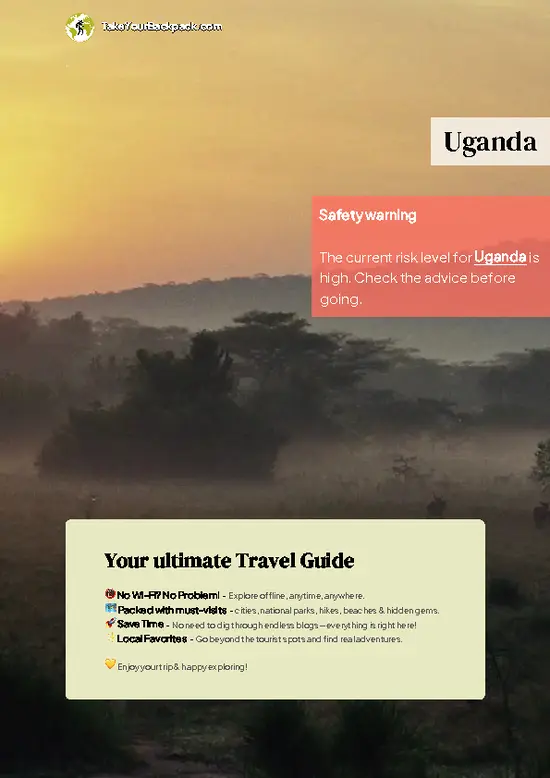
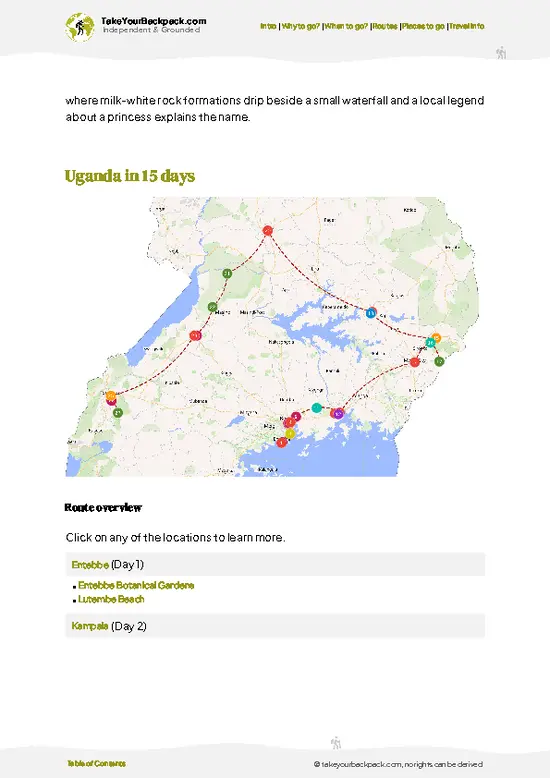
example page 0 from our offline Travel Guide for Uganda
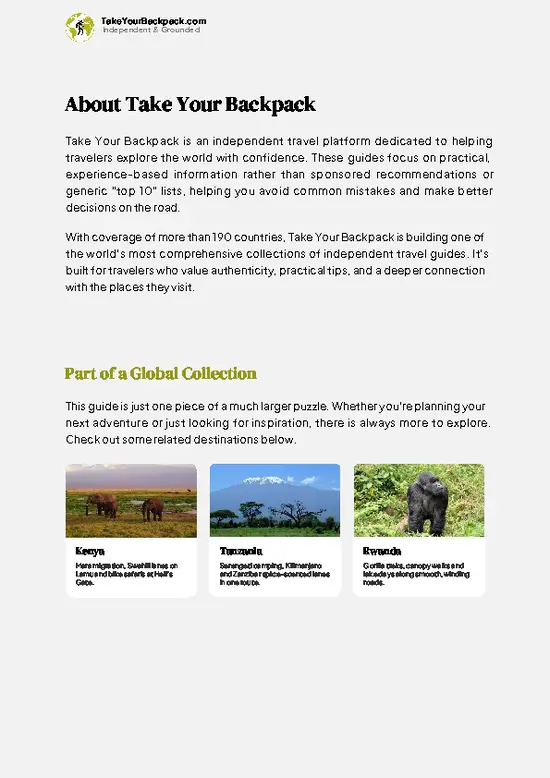
example page 1 from our offline Travel Guide for Uganda
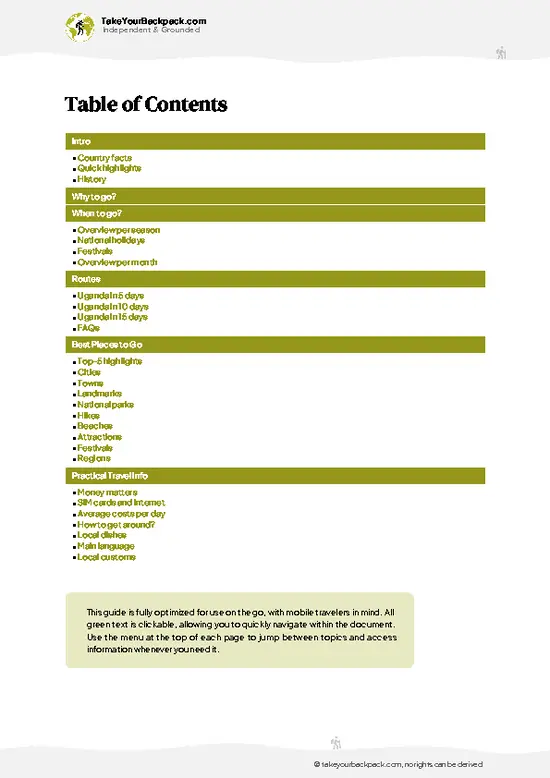
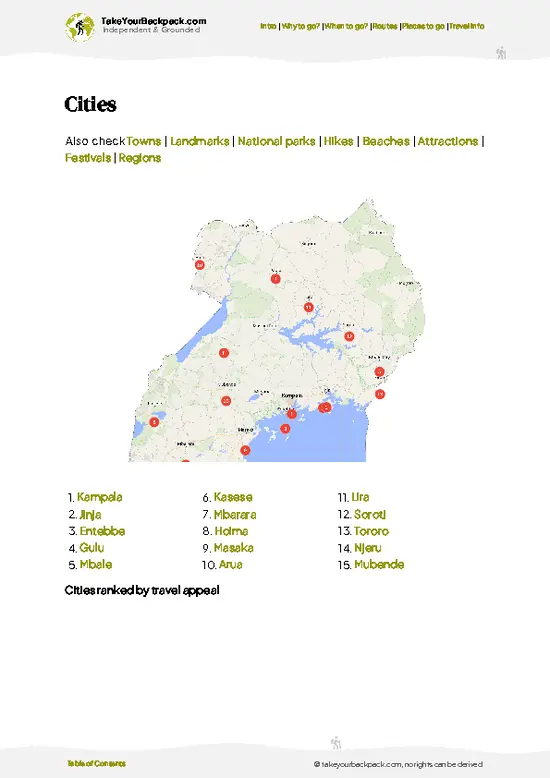
example page 2 from our offline Travel Guide for Uganda
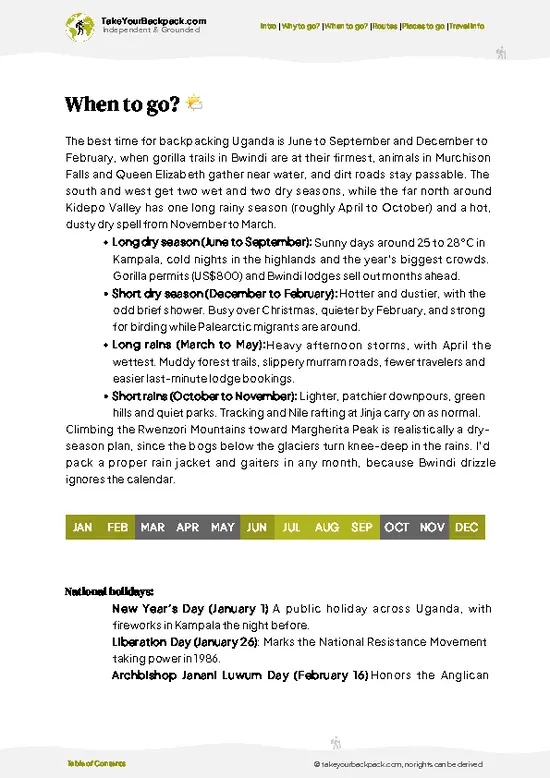
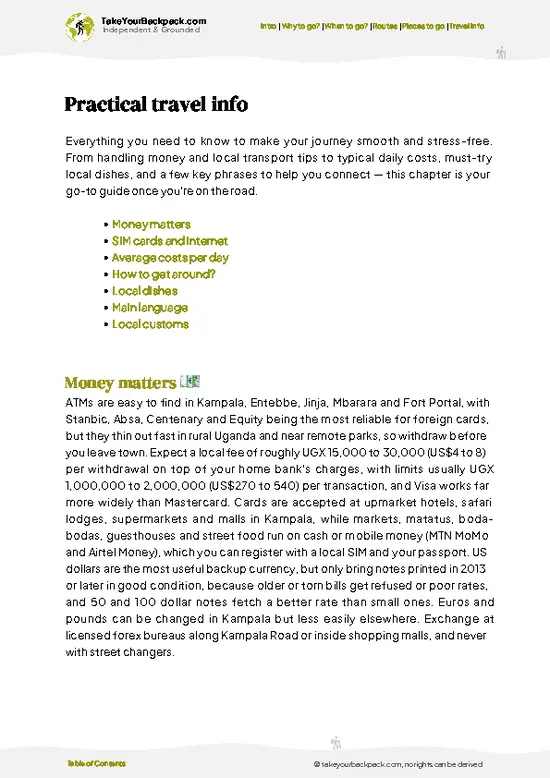
example page 3 from our offline Travel Guide for Uganda
example page 4 from our offline Travel Guide for Uganda
example page 5 from our offline Travel Guide for Uganda
example page 6 from our offline Travel Guide for Uganda
example page 7 from our offline Travel Guide for Uganda
The digital guide (372 pages) contains:
✅ 96 highlights, ranked by travel appeal
✅ Optimized 5, 10 & 15-day travel routes
✅ Cities, national parks, landmarks, beaches
✅ How to get around
✅ Offline-friendly for travel without Wi-Fi
👉 Click to see all 30+ guide features

📅 Plan smarter in minutes, not weeks
✅ Month by month travel advice
✅ Festivals & national holidays
✅ Budget expectations

🗺️ Go to the right places, skip the overrated ones
✅ Honest pros & cons of destinations
✅ Top hikes, parks & viewpoints
✅ Lesser-known places most travelers miss
✅ Clear “worth it vs skip it” guidance

🛏️ Travel smoothly without rookie mistakes
✅ Best areas to stay
✅ Transport systems explained simply
✅ Common scams & safety advice
✅ SIM cards, money & practical tips

🌍 Understand the country, not just visit it
✅ Culture & traditions
✅ 52 Essential phrases & customs
✅ Festivals worth planning around
✅ Traveler-friendly historical context
✅ Insights that make places more meaningful

📱 Built for real travel conditions
✅ Fully downloadable PDF
✅ Works completely offline
✅ Optimized for phone use
✅ Useful in remote areas & buses
✅ Everything in one place
Stop searching, start planning
Get instant access to your full guide. 30‑day money-back guarantee.
+ Add another guide for just

By proceeding you agree to our terms.
Sent to your inbox immediately after payment • 100% Secure Checkout
Best Backpacking Travel Advisor 2025 tourism awardBest Backpacking
Travel Advisor
2025
What others say about Take Your Backpack Guides:
⭐⭐⭐⭐⭐
Fantastic, amazing amount of information!
⭐⭐⭐⭐⭐
My goodness this is amazing, it's what I've been looking for hats off too you!
⭐⭐⭐⭐⭐
I think this is absolutely BRILLIANT
⭐⭐⭐⭐
Very complete and informative. It's still missing places, but I gotta to commend you
⭐⭐⭐⭐⭐
This is truly amazing, thank you, can't wait to explore it with my kids!
⭐⭐⭐⭐⭐
Awesome resource, thank you!
⭐⭐⭐⭐⭐
This is amazing! Can't wait to explore the ones I haven't seen
⭐⭐⭐⭐
I love this! Well done, great idea.
⭐⭐⭐⭐⭐
Thanks for taking the time to make this gem!
⭐⭐⭐⭐⭐
This might be the best website I've ever seen.
⭐⭐⭐⭐⭐
Congratulations, and thank you so much for your work; it's incredibly valuable.
⭐⭐⭐⭐
In all seriousness I think you did a great job pointing out the important spots
⭐⭐⭐⭐⭐
10/10 very good
⭐⭐⭐⭐⭐
As someone who's only just starting to visit regularly this is awesome, thank you.
⭐⭐⭐⭐
Thank you very much! I'm going to visit my dad, it's going to be very useful!
⭐⭐⭐⭐⭐
This is really cool! We'll be travelling for the first time and this definitely come in handy.
⭐⭐⭐⭐⭐
You are now our minister of culture, congratulations 👨‍💼
⭐⭐⭐⭐⭐
Just wanted to tell you that this is a pearl! Going to follow your recommendations.
⭐⭐⭐⭐⭐
This is so cool. I'll definitely be using the resource for my travels soon.
⭐⭐⭐⭐⭐
This is very impressive! Good work.
⭐⭐⭐⭐⭐
This is an amazing and informative site. Very well done!

🛏️ Where to stay?Where to Stay in Uganda

Uganda has a solid network of hostels and budget guesthouses, with dorm beds typically running UGX 35,000 to 70,000 (about US$10 to 20) and simple private rooms from roughly UGX 75,000 (US$20). In Kampala, Kabalagala and Kansanga along Ggaba Road put you closest to the city’s liveliest bar strip, though weekends get loud, while leafy Kololo and Bukoto are quieter and feel safer after dark but cost more and sit farther from cheap street food. Outside the capital, Entebbe is the calm pick for first and last nights near the airport, Jinja clusters its backpacker lodges on the Nile near the rafting operators, and Fort Portal works well as a cheap base for the crater lakes and Kibale.

If you enjoy … read more 👉
Uganda has a solid network of hostels and budget guesthouses, with dorm beds typically running UGX 35,000 to 70,000 (about US$10 to 20) and simple private rooms from roughly UGX 75,000 (US$20). In Kampala, Kabalagala and Kansanga along Ggaba Road put you closest to the city’s liveliest bar strip, though weekends get loud, while leafy Kololo and Bukoto are quieter and feel safer after dark but cost more and sit farther from cheap street food. Outside the capital, Entebbe is the calm pick for first and last nights near the airport, Jinja clusters its backpacker lodges on the Nile near the rafting operators, and Fort Portal works well as a cheap base for the crater lakes and Kibale.

If you enjoy meeting fellow travelers, consider choosing hostels with high ratings for atmosphere. On the other hand, if you prefer having your own space, a hotel might be a better option.

UgandaMore of Uganda

👋 Meet the founderWho’s Behind Take Your Backpack?

Johan, backpacker and founder of TakeYourBackpackHi, I’m Johan (Netherlands 🇳🇱), the creator of TakeYourBackpack. Over the past 3 decades, I’ve backpacked through 90+ countries across six continents, gaining extensive experience with independent travel, long-term trips, and overland routes.

This site is built on a combination of firsthand travel experience and carefully curated insights from other backpackers. Many guides are based on places I’ve personally visited, while others bring together tips, observations, and practical advice shared by trusted travelers I’ve met along the way.

The goal is to provide realistic, experience-driven guidance — not generic itineraries — so you can explore destinations with better context, clearer expectations, and more confidence.