×

United Arab Emirates🇦🇪 | best townsTop-Rated 7 towns in UAE

The United Arab Emirates (UAE) is not a country of villages. Its towns are oases, fishing ports and mountain settlements that sit between and beyond the big skyline cities. On the Gulf coast, expect creek-side souks, dhow harbors and sleepy corniches. Inland, Al Ain country means date palms and shade. On the east coast and in the Hajar Mountains, you get cooler air, fewer people and the best hiking. Independent travel is easy because roads are excellent, but costs run higher than in neighboring Oman. Go early in the morning, when the markets wake up and the light is soft.

By Johan Kruseman 🇳🇱 | Updated October 19, 2026
Explore the best villages in UAE

Why go?What Makes Them Special

The UAE suits towns in a way few Gulf countries do, because seven emirates grew from separate trading, pearling and farming settlements, each keeping its own fort, market and rhythm. Over a few hours you can pass from desert oasis to mountain wadi to Indian Ocean beach, which is rare in a country this compact. Distances are short and roads are smooth, so a rental car turns a long wish list into an easy loop.

Know the limits before you commit. Public transport between smaller towns is thin, and most intercity buses start from Dubai, Abu Dhabi or Sharjah, so reaching mountain or east-coast spots without a car takes planning. Heat shapes everything, so outdoor wandering is a winter affair, and summer pushes you into air-conditioned malls and early dawn walks. Heritage here is often restored … read more 👉
The UAE suits towns in a way few Gulf countries do, because seven emirates grew from separate trading, pearling and farming settlements, each keeping its own fort, market and rhythm. Over a few hours you can pass from desert oasis to mountain wadi to Indian Ocean beach, which is rare in a country this compact. Distances are short and roads are smooth, so a rental car turns a long wish list into an easy loop.

Know the limits before you commit. Public transport between smaller towns is thin, and most intercity buses start from Dubai, Abu Dhabi or Sharjah, so reaching mountain or east-coast spots without a car takes planning. Heat shapes everything, so outdoor wandering is a winter affair, and summer pushes you into air-conditioned malls and early dawn walks. Heritage here is often restored or rebuilt, with clean forts and tidy old quarters, so the feel is polished rather than raw. That makes it comfortable for first-timers, though veterans should seek out working fish markets, date farms and Friday livestock souks for the real texture. Alcohol is limited to licensed hotels in most emirates, and Sharjah is fully dry. Dress modestly in small towns, and shoulders and knees covered is the safe default.
Why These Made the Cut
The list of best towns in UAE is created based on charm, local culture, atmosphere, hidden gems, and visitor appeal. If you feel a town is missing in this list, please let us know.

When to go?Timing Your Visit for the Best Experience

Best months and why: The best months for UAE towns are November to March, when daytime highs sit around 24 to 32°C and you can walk old quarters, forts and corniches without wilting. Rain is rare, usually under 100 mm for the whole year, falling mostly December to March in short, sharp showers that can flood wadis in the mountains.

Shoulder seasons: April, May, October and early November are workable. Highs reach 35 to 40°C by midday, so plan outdoor visits before 10 am and after 4 pm, and use the hot hours for museums and long lunches. The Hajar Mountains and east coast stay a few degrees cooler than Abu Dhabi, Dubai and the desert interior, making them smart choices at the edges of the season.

Summer and peak periods: From June to September, temperatures hit 40 to 48°C with high humidity … read more 👉
Best months and why: The best months for UAE towns are November to March, when daytime highs sit around 24 to 32°C and you can walk old quarters, forts and corniches without wilting. Rain is rare, usually under 100 mm for the whole year, falling mostly December to March in short, sharp showers that can flood wadis in the mountains.

Shoulder seasons: April, May, October and early November are workable. Highs reach 35 to 40°C by midday, so plan outdoor visits before 10 am and after 4 pm, and use the hot hours for museums and long lunches. The Hajar Mountains and east coast stay a few degrees cooler than Abu Dhabi, Dubai and the desert interior, making them smart choices at the edges of the season.

Summer and peak periods: From June to September, temperatures hit 40 to 48°C with high humidity on the coast. It is possible to visit, and hotel rates drop by roughly 30 to 60 percent, but you will be outside only at dawn and after sunset. Peak prices land from December to the New Year, so book two to three months ahead. During Ramadan, daytime eating and drinking in public is discouraged, many cafes close until sunset, and evenings turn lively, which suits flexible travelers.

town hoppingPlanning Your Route Efficiently

How many days to plan: A trip combining several UAE towns needs 5 to 8 days, because distances are short but heat, traffic and slow public transport eat time. Allow half a day to a full day per stop, and a full day or an overnight for anywhere you want to hike or eat slowly.

Grouping and direction: Think in three clusters. The northern emirates (Sharjah, Ajman, Umm Al Quwain, Ras Al Khaimah) sit close together, with 30 to 60 minutes between neighbors. The inland oasis and mountain belt around Al Ain and the Hajar range is 1.5 to 2 hours from Dubai or Abu Dhabi. The east coast on the Gulf of Oman is 1.5 to 2.5 hours across the mountains from the main airports. A sensible direction is to land in Dubai or Abu Dhabi, loop the inland towns first, cross the mountains to the east coast, then run … read more 👉
How many days to plan: A trip combining several UAE towns needs 5 to 8 days, because distances are short but heat, traffic and slow public transport eat time. Allow half a day to a full day per stop, and a full day or an overnight for anywhere you want to hike or eat slowly.

Grouping and direction: Think in three clusters. The northern emirates (Sharjah, Ajman, Umm Al Quwain, Ras Al Khaimah) sit close together, with 30 to 60 minutes between neighbors. The inland oasis and mountain belt around Al Ain and the Hajar range is 1.5 to 2 hours from Dubai or Abu Dhabi. The east coast on the Gulf of Oman is 1.5 to 2.5 hours across the mountains from the main airports. A sensible direction is to land in Dubai or Abu Dhabi, loop the inland towns first, cross the mountains to the east coast, then run up the coast and come back through the northern emirates.

Planning mistakes: The classic error is cramming too many stops into a day and spending it in a car. Cap yourself at two towns daily. Another is leaving the midday heat for sightseeing, so drive in the hot hours and walk at dawn and dusk. Last, travelers often assume buses link every town. They do not, so either rent a car for the loop or pick one base and use taxis or ride-hailing for short hops.

The ListMust-Visit towns in UAE

1 Dibba Al-Fujairah

rocky coastline, fishing port, mountain backdrop

Swim in clear waters, see dhows unloading their catch, and hike trails where the Hajar Mountains meet the Gulf of Oman.

2 Al Hamra

golf resort, marina, planned community

Stay in modern villas, walk landscaped promenades, and access beaches and leisure facilities in a purpose-built coastal enclave.

3 Kalba

mangrove reserve, coastal lagoon, birdwatching

Spot rare wildlife along tidal creeks, walk shaded boardwalks, and watch fishermen at work in a town shaped by its wetlands.

4 Al Dhaid

date farms, Friday market, inland oasis

Sample fresh produce at bustling stalls, drive through fertile plains, and glimpse daily life in a town built around agriculture.

5 Masafi

natural springs, roadside market, mountain pass

Browse stalls for local goods, refill water bottles from cool springs, and pause at a crossroads between Fujairah and Ras Al Khaimah.

6 Al Mirfa

quiet beach, fishing harbor, date plantations

Relax on empty sands, watch boats return at dusk, and explore a small town surrounded by groves and the Arabian Gulf.

7 Al Rams

mountain foothills, old watchtower, fishing village

Climb rocky slopes for broad views, observe daily routines by the sea, and find traces of Ras Al Khaimah’s maritime past.

Loading the map 🌍

Expert viewWhat You Should Know

How many towns to visit: Aim for four to six towns on a trip of a week. That gives each place a half day or more, leaves room for a long lunch and a dawn walk, and keeps driving under about two hours on any given day. Beyond six, you are collecting car windows, not places.

Choosing between kinds of towns: For history and culture, favor the old trading and pearling towns on the Gulf coast, with their forts, museums and souks. For nature and hiking, choose mountain and east-coast settlements, where wadis, coves and snorkeling cost almost nothing. For slower oasis life, pick inland date-palm towns with shaded falaj walkways and farm lanes. Budget travelers should lean on the second and third types, because entry is mostly free and nights are cheaper. If you only get a short trip, pair one heritage … read more 👉
How many towns to visit: Aim for four to six towns on a trip of a week. That gives each place a half day or more, leaves room for a long lunch and a dawn walk, and keeps driving under about two hours on any given day. Beyond six, you are collecting car windows, not places.

Choosing between kinds of towns: For history and culture, favor the old trading and pearling towns on the Gulf coast, with their forts, museums and souks. For nature and hiking, choose mountain and east-coast settlements, where wadis, coves and snorkeling cost almost nothing. For slower oasis life, pick inland date-palm towns with shaded falaj walkways and farm lanes. Budget travelers should lean on the second and third types, because entry is mostly free and nights are cheaper. If you only get a short trip, pair one heritage town with one mountain or coastal town for contrast.

What it costs: Budget about US$60 to 90 a day (roughly 220 to 330 AED) if you sleep in hostels or simple hotels, eat at South Asian cafeterias and use buses or shared rides. A midrange day with a private room, a restaurant dinner and a rental car runs US$130 to 200. Fort and museum entry is typically 5 to 25 AED (US$1.50 to 7). Guided desert or mountain tours cost about 150 to 400 AED (US$40 to 110). A rental car is around 100 to 180 AED a day plus fuel, and fuel is cheap by Western standards. Buses between emirates cost roughly 10 to 30 AED. Cafeteria meals run 10 to 25 AED, while resort drinks easily top 40 AED each.

Safety and cultural considerations: The UAE is among the safest countries for travelers, with very low street crime. Rules matter more than risks. Cover shoulders and knees in small towns and at mosques, and ask before photographing people, especially women. Public displays of affection and drunkenness can bring trouble, and drinking is only legal in licensed venues. Sharjah is dry. Drones need permits, and photographing government buildings and military sites is banned. Respect prayer times, and during Ramadan avoid eating or drinking in public by day. In summer, carry at least 3 liters of water and never hike mountain wadis when rain is forecast, since flash floods are the real hazard.

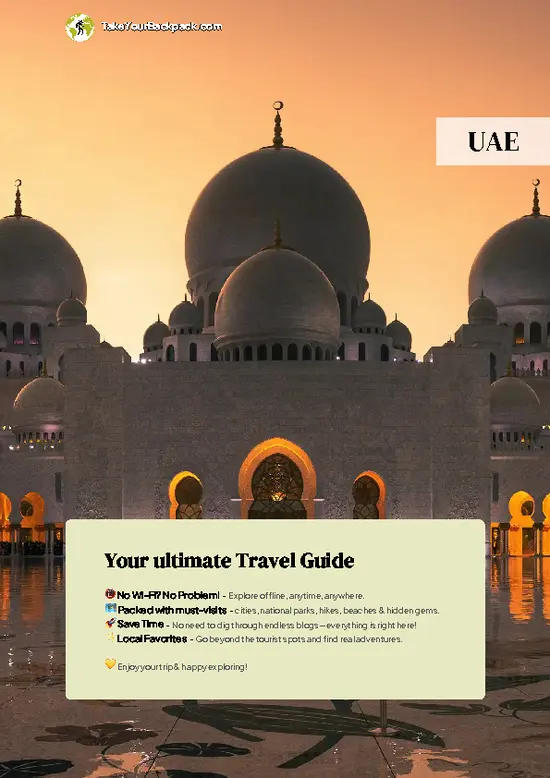
✈️ The backpacker research shortcutUAE Travel Guide

An offline-friendly backpacking guide with optimized travel routes, ranked highlights, transport advice, and the best areas to stay.
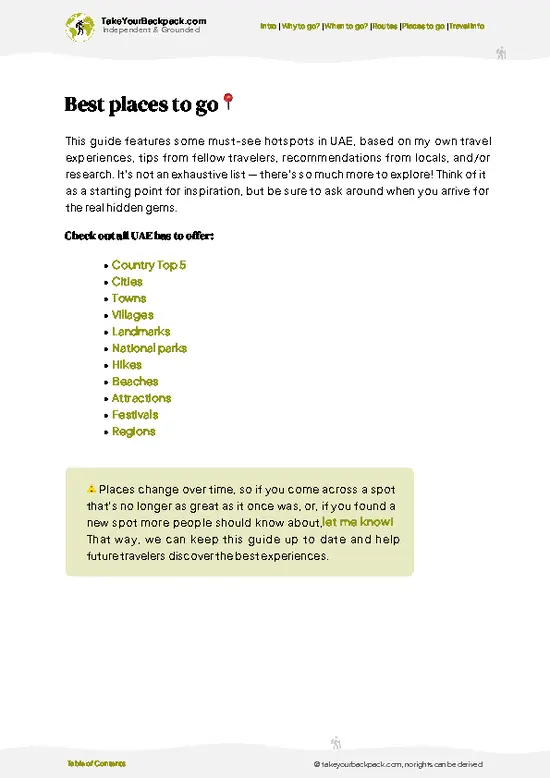
example page 0 from our offline Travel Guide for United Arab Emirates
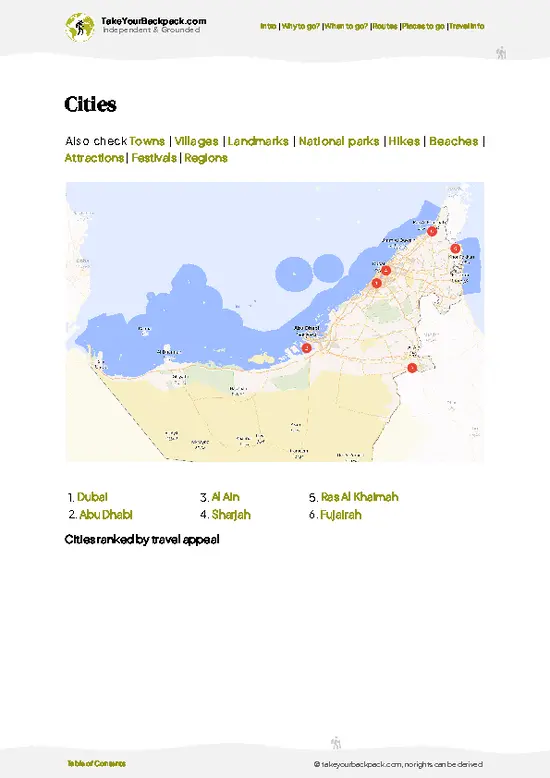
example page 1 from our offline Travel Guide for United Arab Emirates
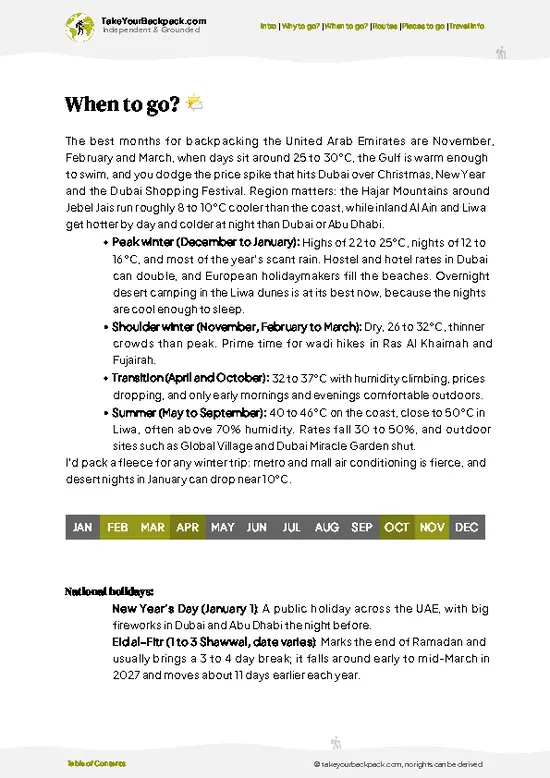
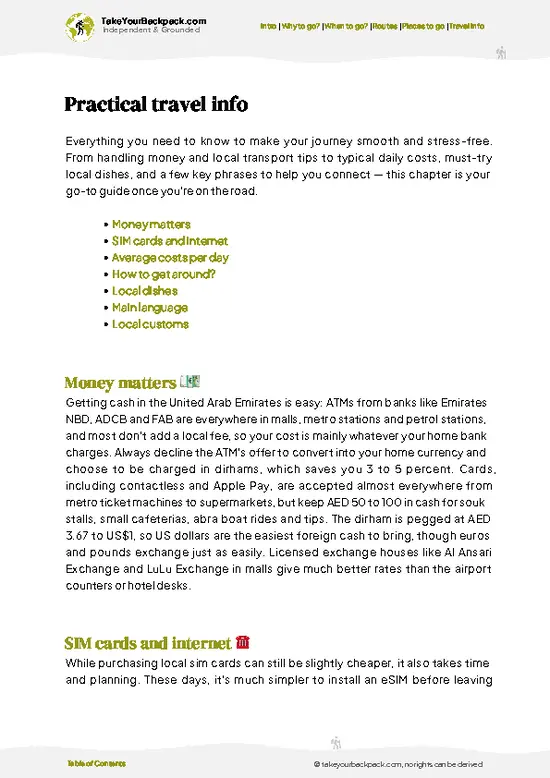
example page 2 from our offline Travel Guide for United Arab Emirates
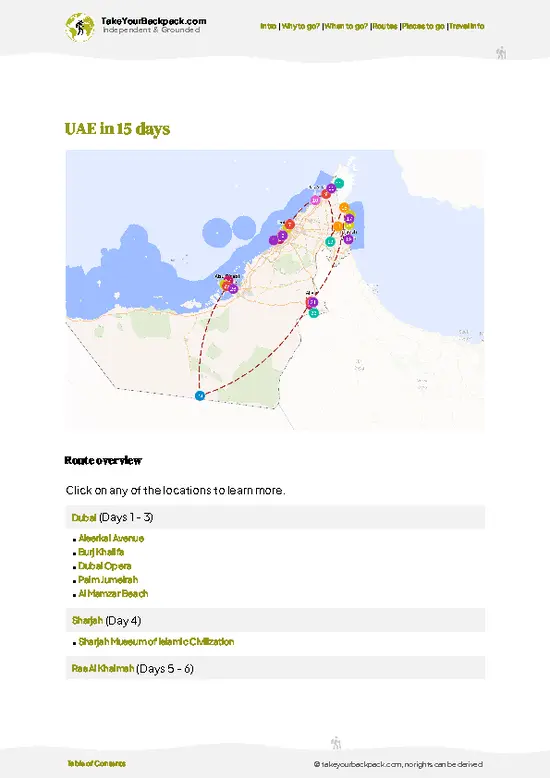
example page 3 from our offline Travel Guide for United Arab Emirates
example page 4 from our offline Travel Guide for United Arab Emirates
example page 5 from our offline Travel Guide for United Arab Emirates
example page 6 from our offline Travel Guide for United Arab Emirates
example page 7 from our offline Travel Guide for United Arab Emirates
The digital guide (263 pages) contains:
✅ 71 highlights, ranked by travel appeal
✅ Optimized 5, 10 & 15-day travel routes
✅ Cities, national parks, landmarks, beaches
✅ How to get around
✅ Offline-friendly for travel without Wi-Fi
👉 Click to see all 30+ guide features

📅 Plan smarter in minutes, not weeks
✅ Month by month travel advice
✅ Festivals & national holidays
✅ Budget expectations

🗺️ Go to the right places, skip the overrated ones
✅ Honest pros & cons of destinations
✅ Top hikes, parks & viewpoints
✅ Lesser-known places most travelers miss
✅ Clear “worth it vs skip it” guidance

🛏️ Travel smoothly without rookie mistakes
✅ Best areas to stay
✅ Transport systems explained simply
✅ Common scams & safety advice
✅ SIM cards, money & practical tips

🌍 Understand the country, not just visit it
✅ Culture & traditions
✅ 52 Essential phrases & customs
✅ Festivals worth planning around
✅ Traveler-friendly historical context
✅ Insights that make places more meaningful

📱 Built for real travel conditions
✅ Fully downloadable PDF
✅ Works completely offline
✅ Optimized for phone use
✅ Useful in remote areas & buses
✅ Everything in one place
Stop searching, start planning
Get instant access to your full guide. 30‑day money-back guarantee.
+ Add another guide for just

By proceeding you agree to our terms.
Sent to your inbox immediately after payment • 100% Secure Checkout
Best Backpacking Travel Advisor 2025 tourism awardBest Backpacking
Travel Advisor
2025
What others say about Take Your Backpack Guides:
⭐⭐⭐⭐⭐
Fantastic, amazing amount of information!
⭐⭐⭐⭐⭐
My goodness this is amazing, it's what I've been looking for hats off too you!
⭐⭐⭐⭐⭐
I think this is absolutely BRILLIANT
⭐⭐⭐⭐
Very complete and informative. It's still missing places, but I gotta to commend you
⭐⭐⭐⭐⭐
This is truly amazing, thank you, can't wait to explore it with my kids!
⭐⭐⭐⭐⭐
Awesome resource, thank you!
⭐⭐⭐⭐⭐
This is amazing! Can't wait to explore the ones I haven't seen
⭐⭐⭐⭐
I love this! Well done, great idea.
⭐⭐⭐⭐⭐
Thanks for taking the time to make this gem!
⭐⭐⭐⭐⭐
This might be the best website I've ever seen.
⭐⭐⭐⭐⭐
Congratulations, and thank you so much for your work; it's incredibly valuable.
⭐⭐⭐⭐
In all seriousness I think you did a great job pointing out the important spots
⭐⭐⭐⭐⭐
10/10 very good
⭐⭐⭐⭐⭐
As someone who's only just starting to visit regularly this is awesome, thank you.
⭐⭐⭐⭐
Thank you very much! I'm going to visit my dad, it's going to be very useful!
⭐⭐⭐⭐⭐
This is really cool! We'll be travelling for the first time and this definitely come in handy.
⭐⭐⭐⭐⭐
You are now our minister of culture, congratulations 👨‍💼
⭐⭐⭐⭐⭐
Just wanted to tell you that this is a pearl! Going to follow your recommendations.
⭐⭐⭐⭐⭐
This is so cool. I'll definitely be using the resource for my travels soon.
⭐⭐⭐⭐⭐
This is very impressive! Good work.
⭐⭐⭐⭐⭐
This is an amazing and informative site. Very well done!

🛏️ Where to stay?Best Places to Stay in UAE

The United Arab Emirates has a small but growing hostel scene, with dorm beds typically running AED 60 to 120 (US$16 to 33) a night and basic private rooms in budget hotels from roughly AED 150 to 250 (US$40 to 70). In Dubai, the old districts of Deira and Bur Dubai hold the most cheap beds, close to the creek, the souks and the metro, safe and lively until late but noisy and a bit dated. Al Barsha and Dubai Marina put you nearer the beach, malls and nightlife at higher prices, while in Abu Dhabi the downtown grid around Al Zahiyah and Al Markaziyah is quiet and very safe, though most big sights there need a bus or taxi ride.

If you enjoy meeting fellow travelers, consider choosing hostels with … read more 👉
The United Arab Emirates has a small but growing hostel scene, with dorm beds typically running AED 60 to 120 (US$16 to 33) a night and basic private rooms in budget hotels from roughly AED 150 to 250 (US$40 to 70). In Dubai, the old districts of Deira and Bur Dubai hold the most cheap beds, close to the creek, the souks and the metro, safe and lively until late but noisy and a bit dated. Al Barsha and Dubai Marina put you nearer the beach, malls and nightlife at higher prices, while in Abu Dhabi the downtown grid around Al Zahiyah and Al Markaziyah is quiet and very safe, though most big sights there need a bus or taxi ride.

If you enjoy meeting fellow travelers, consider choosing hostels with high ratings for atmosphere. On the other hand, if you prefer having your own space, a hotel might be a better option.

UAEExplore UAE

👋 Meet the founderWho’s Behind Take Your Backpack?

Johan, backpacker and founder of TakeYourBackpackHi, I’m Johan (Netherlands 🇳🇱), the creator of TakeYourBackpack. Over the past 3 decades, I’ve backpacked through 90+ countries across six continents, gaining extensive experience with independent travel, long-term trips, and overland routes.

This site is built on a combination of firsthand travel experience and carefully curated insights from other backpackers. Many guides are based on places I’ve personally visited, while others bring together tips, observations, and practical advice shared by trusted travelers I’ve met along the way.

The goal is to provide realistic, experience-driven guidance — not generic itineraries — so you can explore destinations with better context, clearer expectations, and more confidence.