×

United Arab Emirates🇦🇪 | best villagesTop-Rated villages in UAE

Villages in the United Arab Emirates (UAE) are not what the postcards suggest. Forget a single sandy cliché: you get oasis settlements of date palms and falaj channels around Al Ain and Hatta, mountain hamlets in the Hajar range, and fishing and pearling coves on the Gulf coast and in Ras Al Khaimah. Cost stays moderate once you skip resorts, crowds thin out fast outside weekends, and a rental car beats buses almost everywhere. Independent travelers should plan stops for early morning, when stone lanes are cool, shops open and the light is kind.

By Johan Kruseman 🇳🇱 | Updated October 19, 2026
Explore the best landmarks in UAE

Why go?What Makes Them Special

The UAE is a young federation, yet its villages hold remarkably old layers. Trade, pearling, date farming and herding shaped settlements long before oil, and the falaj irrigation systems that still feed some oases date back thousands of years. Geography splits the country into distinct village types: the Hajar Mountains in the northeast, the Gulf and east coasts, and the desert fringe near Al Ain. Few countries let you cover that range in a single rental-car loop.

The flip side is that rapid development means many traditional settlements are now restored heritage sites or have been absorbed by suburbs, so living, working villages are fewer than in Oman or Iran. Expect museums, restored forts and handicraft stalls more than daily village life, and expect English and Arabic everywhere.

Before … read more 👉
The UAE is a young federation, yet its villages hold remarkably old layers. Trade, pearling, date farming and herding shaped settlements long before oil, and the falaj irrigation systems that still feed some oases date back thousands of years. Geography splits the country into distinct village types: the Hajar Mountains in the northeast, the Gulf and east coasts, and the desert fringe near Al Ain. Few countries let you cover that range in a single rental-car loop.

The flip side is that rapid development means many traditional settlements are now restored heritage sites or have been absorbed by suburbs, so living, working villages are fewer than in Oman or Iran. Expect museums, restored forts and handicraft stalls more than daily village life, and expect English and Arabic everywhere.

Before choosing the UAE for villages, know that public transport is thin outside the cities, distances are short but roads are fast, and midday heat can make walking miserable for much of the year. Opening hours are often shorter on Fridays and during Ramadan. Go in for the contrasts and easy logistics, and treat village stops as half-day detours rather than whole-day destinations.
Evaluating the Top Choices
The list of best villages in UAE is created based on authenticity, scenic beauty, community spirit, traditions, and overall character. If you feel a village is missing in this list, please let us know.

When to go?Timing Your Visit for the Best Experience

Best months: November to March: Daytime highs of 24 to 32°C and cool evenings make November to March the best window, because walking lanes, oases and mountain trails is actually pleasant. Rain is rare and light, usually 60 to 100 mm across the whole year, falling mostly December to March, though mountain wadis can flash flood after storms.

Shoulder seasons and summer: October and April stay workable if you start at sunrise, with highs of 33 to 38°C by afternoon. From June to September, coastal temperatures reach 40 to 46°C with heavy humidity, and heritage sites often cut hours or close in the afternoon. The Hajar Mountains run roughly 8 to 10°C cooler than the coast, which makes them the only sensible summer option, ideally at dawn or dusk.

Crowds and prices: Peak season runs December … read more 👉
Best months: November to March: Daytime highs of 24 to 32°C and cool evenings make November to March the best window, because walking lanes, oases and mountain trails is actually pleasant. Rain is rare and light, usually 60 to 100 mm across the whole year, falling mostly December to March, though mountain wadis can flash flood after storms.

Shoulder seasons and summer: October and April stay workable if you start at sunrise, with highs of 33 to 38°C by afternoon. From June to September, coastal temperatures reach 40 to 46°C with heavy humidity, and heritage sites often cut hours or close in the afternoon. The Hajar Mountains run roughly 8 to 10°C cooler than the coast, which makes them the only sensible summer option, ideally at dawn or dusk.

Crowds and prices: Peak season runs December to February, when hotels can cost 30 to 60 percent more than in summer, especially around the New Year. Weekends (Friday and Saturday) bring day-trippers from Dubai and Abu Dhabi to the popular mountain and coastal spots, so go midweek. During Ramadan, expect later opening and quiet daytime streets, while evenings are lively and atmospheric.

village hoppingPlanning Your Route Efficiently

Plan on 4 to 7 days: A trip linking several villages in the UAE works well in 4 to 7 days, since distances are short and the real limit is the heat and driving fatigue, not mileage. Give each stop 1.5 to 3 hours for strolling, a fort or museum and a coffee, or a half day if you hike.

Which regions group together: Three clusters make sense. The northern emirates (Ras Al Khaimah, Fujairah, Sharjah's east coast) sit within 1 to 2 hours of each other. The Hajar Mountains link to the oasis belt around Al Ain, about 1.5 to 2 hours from Dubai and Abu Dhabi. The Gulf coast stops fit well into a day from Dubai. A sensible direction is to start in Dubai, loop through the mountains and east coast, then finish in Al Ain or Abu Dhabi, avoiding backtracking.

Planning mistakes: Travelers often rely on … read more 👉
Plan on 4 to 7 days: A trip linking several villages in the UAE works well in 4 to 7 days, since distances are short and the real limit is the heat and driving fatigue, not mileage. Give each stop 1.5 to 3 hours for strolling, a fort or museum and a coffee, or a half day if you hike.

Which regions group together: Three clusters make sense. The northern emirates (Ras Al Khaimah, Fujairah, Sharjah's east coast) sit within 1 to 2 hours of each other. The Hajar Mountains link to the oasis belt around Al Ain, about 1.5 to 2 hours from Dubai and Abu Dhabi. The Gulf coast stops fit well into a day from Dubai. A sensible direction is to start in Dubai, loop through the mountains and east coast, then finish in Al Ain or Abu Dhabi, avoiding backtracking.

Planning mistakes: Travelers often rely on buses and taxis for remote stops, which eats hours and money. Rent a car for at least the mountain and east coast legs, and pick it up at the airport, where rates are competitive. Another common error is cramming five or six stops into one day, which leaves you arriving at midday in full sun. Instead, do one or two per day, early, and break for the hottest hours. Check Friday prayer times and Ramadan hours before fixing any schedule.

The ListMust-Visit villages in UAE

1 Al Jazirah Al Hamra

abandoned village, coral-stone houses, desert edge

Step into silent streets, examine weathered walls, and sense the history of a once-thriving pearling settlement left to the sands.

Loading the map 🌍

Expert viewWhat You Should Know

How many villages to visit: Visit 4 to 6 villages on a typical trip. Each one takes only a couple of hours, but repeated restored forts, coffee houses and palm groves start to blur after the sixth, and the heat caps how much you can do in a day. Four gives a relaxed pace with a hike; six suits a week with a car.

Prioritizing by travel style: Hikers should favor mountain settlements, where wadi walks and terraces give the real payoff. History-minded travelers do best at oasis villages with falaj channels and mudbrick towers. Anyone short on time or without a car should choose coastal heritage villages close to Dubai, Sharjah and Ras Al Khaimah, which are easiest to reach. Mixing one of each type gives the clearest picture of the country.

What it costs: Budget US$55 to 95 a day (about AED … read more 👉
How many villages to visit: Visit 4 to 6 villages on a typical trip. Each one takes only a couple of hours, but repeated restored forts, coffee houses and palm groves start to blur after the sixth, and the heat caps how much you can do in a day. Four gives a relaxed pace with a hike; six suits a week with a car.

Prioritizing by travel style: Hikers should favor mountain settlements, where wadi walks and terraces give the real payoff. History-minded travelers do best at oasis villages with falaj channels and mudbrick towers. Anyone short on time or without a car should choose coastal heritage villages close to Dubai, Sharjah and Ras Al Khaimah, which are easiest to reach. Mixing one of each type gives the clearest picture of the country.

What it costs: Budget US$55 to 95 a day (about AED 200 to 350) if you sleep in hostels or budget hotels, eat at South Asian cafeterias and share a rental car. Car hire runs US$25 to 45 a day (AED 90 to 165), plus fuel at roughly US$0.70 to 0.80 a liter (AED 2.5 to 3). Most heritage villages and forts charge nothing or AED 5 to 25 (US$1.50 to 7) for entry, and some museums add AED 10 to 30. Guided hikes in the mountains cost US$40 to 90 a person. Meals at local cafeterias are US$3 to 7, and a sit-down meal in a small restaurant US$10 to 20. Mountain guesthouses and camps cost more at weekends.

Safety and cultural considerations: Crime is very low, and the main risks are heat, dehydration and flash floods. Carry at least 3 liters of water per person, start hikes at sunrise and skip wadi walks when rain is forecast. Roads are fast, so drive defensively, especially on mountain bends, and never drive off-road in sand without experience.

Dress modestly in villages: shoulders and knees covered, loose clothing for women and men alike. Always ask before photographing residents, particularly women, and do not fly drones without a permit, since rules are strict. Alcohol is only served in licensed hotels, so do not carry it into villages, and public displays of affection can cause offense. During Ramadan, avoid eating, drinking or smoking in public during daylight. Friday is the weekly holiday, so some shops close until mid-afternoon. Carry a copy of your passport and some cash in dirhams, since small stalls and parking machines may not take cards.

✈️ The backpacker research shortcutUAE Travel Guide

An offline-friendly backpacking guide with optimized travel routes, ranked highlights, transport advice, and the best areas to stay.
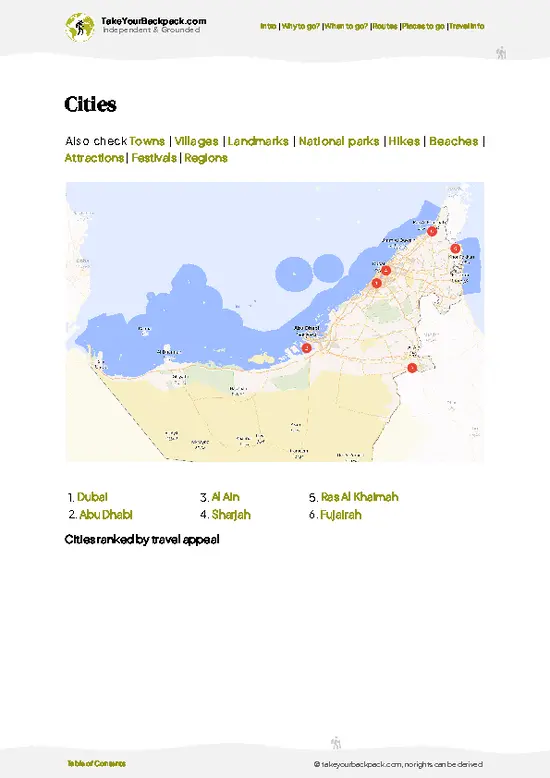
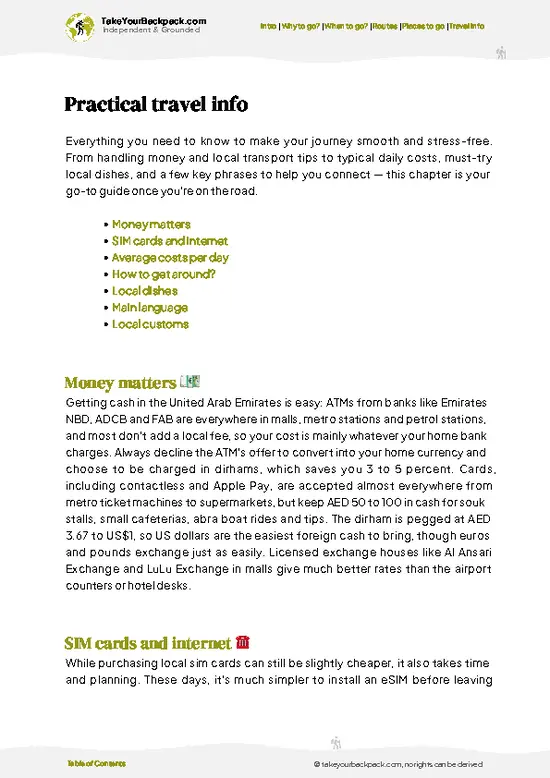
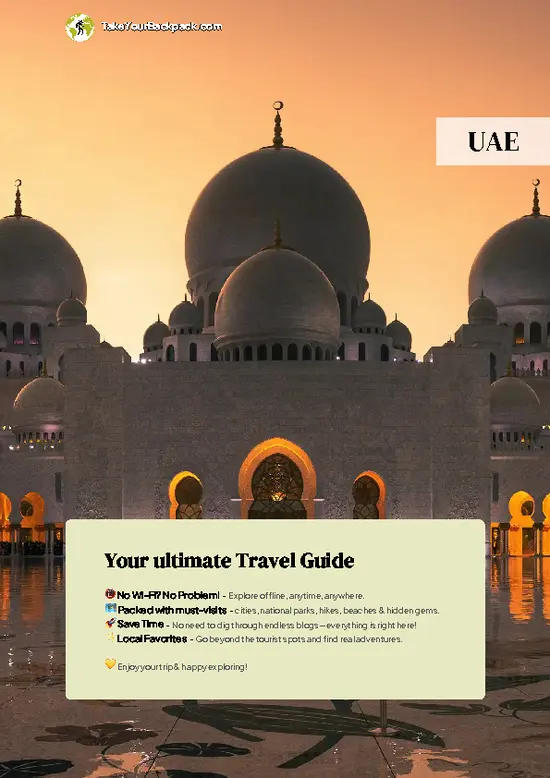
example page 0 from our offline Travel Guide for United Arab Emirates
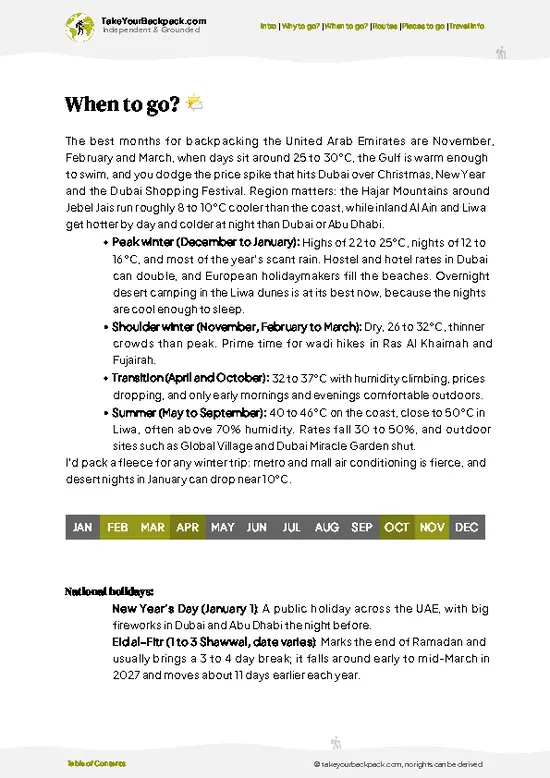
example page 1 from our offline Travel Guide for United Arab Emirates
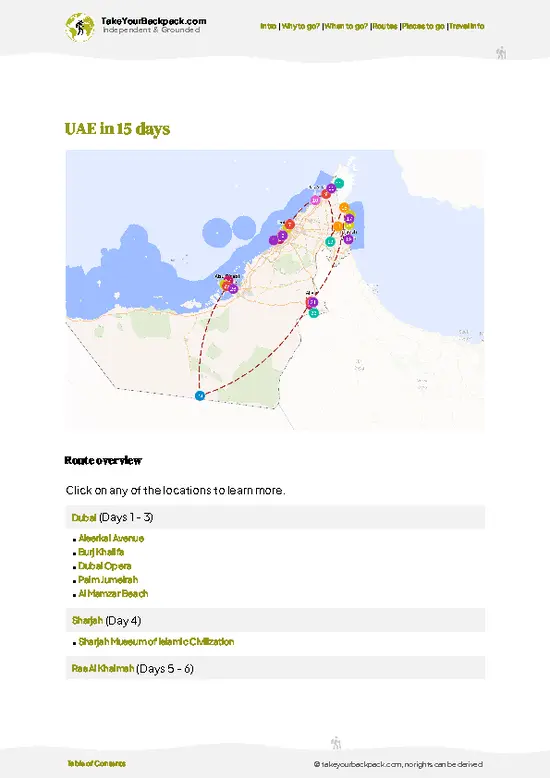
example page 2 from our offline Travel Guide for United Arab Emirates
example page 3 from our offline Travel Guide for United Arab Emirates
example page 4 from our offline Travel Guide for United Arab Emirates
example page 5 from our offline Travel Guide for United Arab Emirates
example page 6 from our offline Travel Guide for United Arab Emirates
example page 7 from our offline Travel Guide for United Arab Emirates
The digital guide (263 pages) contains:
✅ 71 highlights, ranked by travel appeal
✅ Optimized 5, 10 & 15-day travel routes
✅ Cities, national parks, landmarks, beaches
✅ How to get around
✅ Offline-friendly for travel without Wi-Fi
👉 Click to see all 30+ guide features

📅 Plan smarter in minutes, not weeks
✅ Month by month travel advice
✅ Festivals & national holidays
✅ Budget expectations

🗺️ Go to the right places, skip the overrated ones
✅ Honest pros & cons of destinations
✅ Top hikes, parks & viewpoints
✅ Lesser-known places most travelers miss
✅ Clear “worth it vs skip it” guidance

🛏️ Travel smoothly without rookie mistakes
✅ Best areas to stay
✅ Transport systems explained simply
✅ Common scams & safety advice
✅ SIM cards, money & practical tips

🌍 Understand the country, not just visit it
✅ Culture & traditions
✅ 52 Essential phrases & customs
✅ Festivals worth planning around
✅ Traveler-friendly historical context
✅ Insights that make places more meaningful

📱 Built for real travel conditions
✅ Fully downloadable PDF
✅ Works completely offline
✅ Optimized for phone use
✅ Useful in remote areas & buses
✅ Everything in one place
Stop searching, start planning
Get instant access to your full guide. 30‑day money-back guarantee.
+ Add another guide for just

By proceeding you agree to our terms.
Sent to your inbox immediately after payment • 100% Secure Checkout
Best Backpacking Travel Advisor 2025 tourism awardBest Backpacking
Travel Advisor
2025
What others say about Take Your Backpack Guides:
⭐⭐⭐⭐⭐
Fantastic, amazing amount of information!
⭐⭐⭐⭐⭐
My goodness this is amazing, it's what I've been looking for hats off too you!
⭐⭐⭐⭐⭐
I think this is absolutely BRILLIANT
⭐⭐⭐⭐
Very complete and informative. It's still missing places, but I gotta to commend you
⭐⭐⭐⭐⭐
This is truly amazing, thank you, can't wait to explore it with my kids!
⭐⭐⭐⭐⭐
Awesome resource, thank you!
⭐⭐⭐⭐⭐
This is amazing! Can't wait to explore the ones I haven't seen
⭐⭐⭐⭐
I love this! Well done, great idea.
⭐⭐⭐⭐⭐
Thanks for taking the time to make this gem!
⭐⭐⭐⭐⭐
This might be the best website I've ever seen.
⭐⭐⭐⭐⭐
Congratulations, and thank you so much for your work; it's incredibly valuable.
⭐⭐⭐⭐
In all seriousness I think you did a great job pointing out the important spots
⭐⭐⭐⭐⭐
10/10 very good
⭐⭐⭐⭐⭐
As someone who's only just starting to visit regularly this is awesome, thank you.
⭐⭐⭐⭐
Thank you very much! I'm going to visit my dad, it's going to be very useful!
⭐⭐⭐⭐⭐
This is really cool! We'll be travelling for the first time and this definitely come in handy.
⭐⭐⭐⭐⭐
You are now our minister of culture, congratulations 👨‍💼
⭐⭐⭐⭐⭐
Just wanted to tell you that this is a pearl! Going to follow your recommendations.
⭐⭐⭐⭐⭐
This is so cool. I'll definitely be using the resource for my travels soon.
⭐⭐⭐⭐⭐
This is very impressive! Good work.
⭐⭐⭐⭐⭐
This is an amazing and informative site. Very well done!

🛏️ Where to stay?Where to Stay: UAE Edition

The United Arab Emirates has a small but growing hostel scene, with dorm beds typically running AED 60 to 120 (US$16 to 33) a night and basic private rooms in budget hotels from roughly AED 150 to 250 (US$40 to 70). In Dubai, the old districts of Deira and Bur Dubai hold the most cheap beds, close to the creek, the souks and the metro, safe and lively until late but noisy and a bit dated. Al Barsha and Dubai Marina put you nearer the beach, malls and nightlife at higher prices, while in Abu Dhabi the downtown grid around Al Zahiyah and Al Markaziyah is quiet and very safe, though most big sights there need a bus or taxi ride.

If you enjoy meeting fellow travelers, consider choosing hostels with … read more 👉
The United Arab Emirates has a small but growing hostel scene, with dorm beds typically running AED 60 to 120 (US$16 to 33) a night and basic private rooms in budget hotels from roughly AED 150 to 250 (US$40 to 70). In Dubai, the old districts of Deira and Bur Dubai hold the most cheap beds, close to the creek, the souks and the metro, safe and lively until late but noisy and a bit dated. Al Barsha and Dubai Marina put you nearer the beach, malls and nightlife at higher prices, while in Abu Dhabi the downtown grid around Al Zahiyah and Al Markaziyah is quiet and very safe, though most big sights there need a bus or taxi ride.

If you enjoy meeting fellow travelers, consider choosing hostels with high ratings for atmosphere. On the other hand, if you prefer having your own space, a hotel might be a better option.

UAEExplore Beyond This Category

👋 Meet the founderWho’s Behind Take Your Backpack?

Johan, backpacker and founder of TakeYourBackpackHi, I’m Johan (Netherlands 🇳🇱), the creator of TakeYourBackpack. Over the past 3 decades, I’ve backpacked through 90+ countries across six continents, gaining extensive experience with independent travel, long-term trips, and overland routes.

This site is built on a combination of firsthand travel experience and carefully curated insights from other backpackers. Many guides are based on places I’ve personally visited, while others bring together tips, observations, and practical advice shared by trusted travelers I’ve met along the way.

The goal is to provide realistic, experience-driven guidance — not generic itineraries — so you can explore destinations with better context, clearer expectations, and more confidence.