
×

Uruguay🇺🇾 | festivalsCarnaval de MontevideoCandombe drums, murga satire, neighborhood tablados, Llamadas parade | things to do and best time to go

Explore PaysandúExplore Festival Internacional de Jazz de Punta del Este

Backpacking in Carnaval de Montevideo
🏆 Top pickfestival ranked #1
By Johan Kruseman 🇳🇱 | Updated October 19, 2026

Carnaval de Montevideo in Montevideo is free to watch on most streets, and the neighborhood parades cost nothing, so a backpacker's only real outlay is a bed. It takes place in Uruguay's capital, mostly in the barrios south and east of the center, with the main stages in Palermo, Barrio Sur and the old city. The festival is said to be the longest in the world, running roughly 40 days from January into March, and its sound is candombe, drumming rooted in Afro-Uruguayan communities, plus murga, a theatrical choir with satire and costume. On the ground, that means a side street closed off, a wall of drums rolling up the block, and dancers in front who pull you in with a nod. Neighbors bring chairs to the curb, so you get a seat and a snack from a stall. Audiences are mostly local families, which keeps the mood warm and unhurried. It suits curious travelers who like music and don't mind late nights. It will not suit anyone wanting a polished, big-budget spectacle or a quiet beach week.

Discover everything you want to know in the 📖 Uruguay Travel Guide.


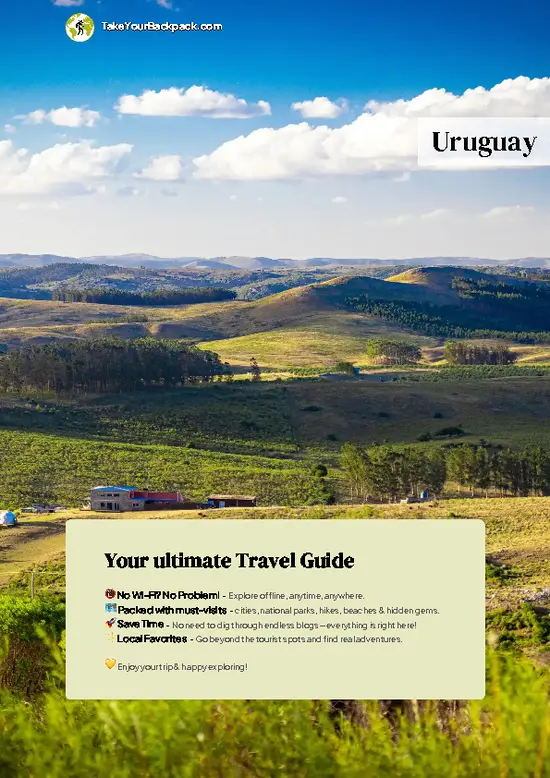
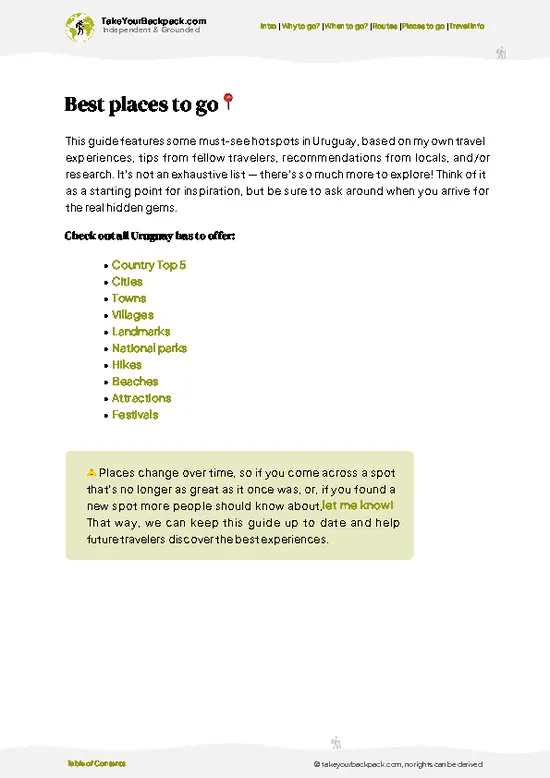
example page 0 from our offline Travel Guide for Uruguay
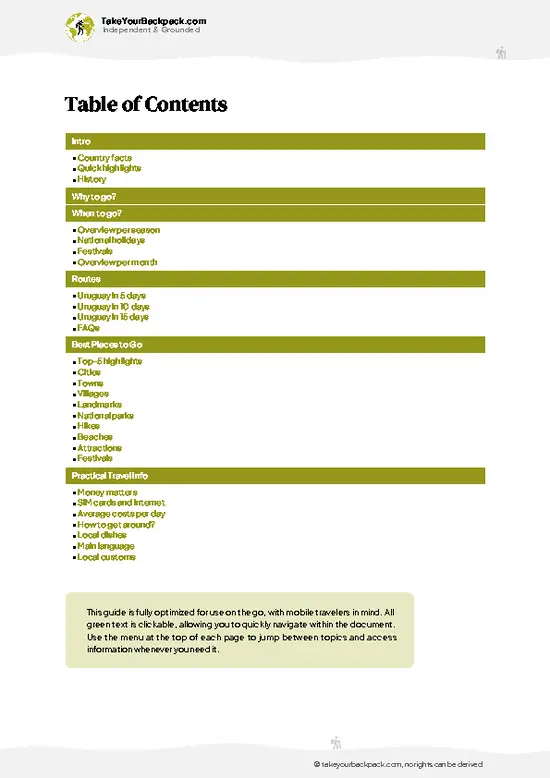
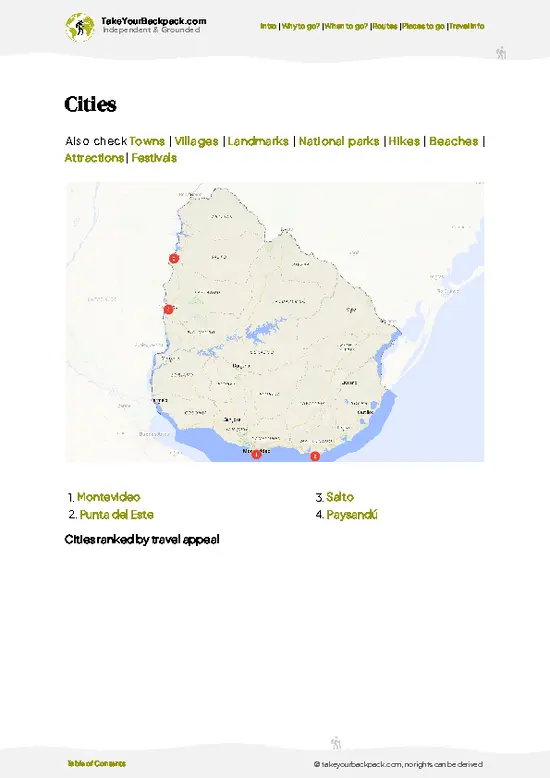
example page 1 from our offline Travel Guide for Uruguay
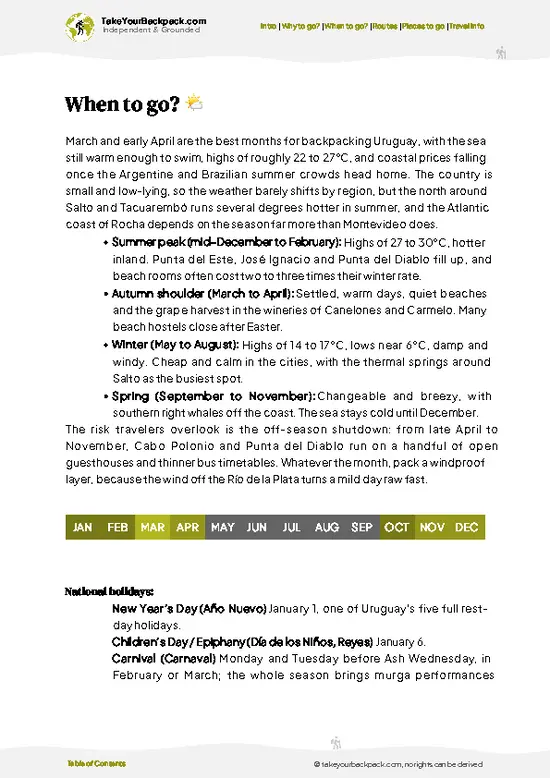
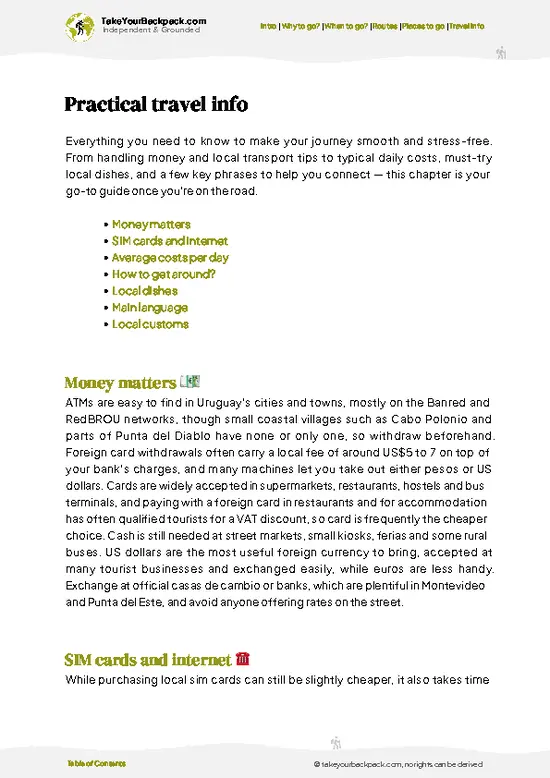
example page 2 from our offline Travel Guide for Uruguay
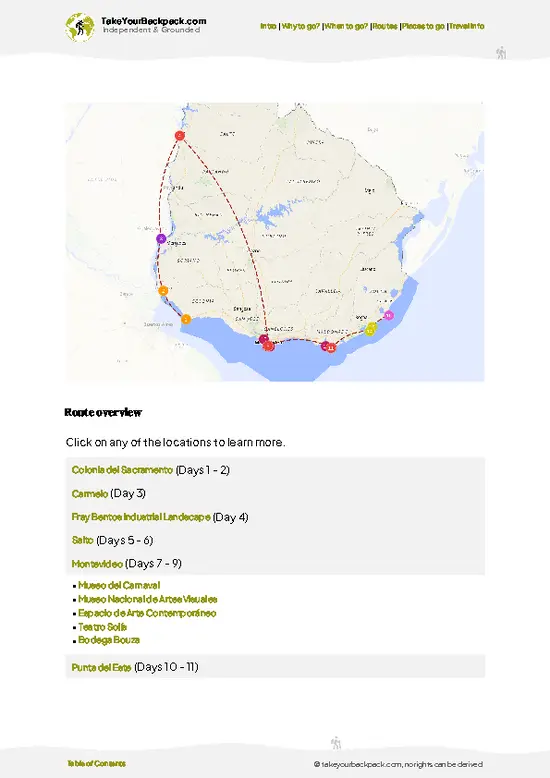
example page 3 from our offline Travel Guide for Uruguay
example page 4 from our offline Travel Guide for Uruguay
example page 5 from our offline Travel Guide for Uruguay
example page 6 from our offline Travel Guide for Uruguay
example page 7 from our offline Travel Guide for Uruguay
Loading the map 🌍
CLICK TO FILTER
cities
towns
villages
landmarks
national parks
hikes
beaches
attractions
festivals
SHOW COUNTRY’S BESTSHOW ALL

✨ Why go?
Ranked #1 festival in Uruguay
The unique appeal for travelers

Carnaval de Montevideo draws backpackers because it is a month-plus of live culture that you can drop into on any night, with no ticket tied to one weekend. That flexibility matters: you can fold a few evenings into a longer route along the Río de la Plata, say between Buenos Aires and the Atlantic beaches of Rocha and Punta del Este, without rearranging everything.

The community side is what sticks. Hostels in Ciudad Vieja and Pocitos fill with travelers heading to the same Desfile de Llamadas, so you usually find a group to walk over with. At the neighborhood tablados, small open-air stages, you sit among locals who know every verse of the murga songs, and you pick up Montevideo slang and politics faster than any museum could teach. Entry is cheap or free at many of them, which makes Carnaval … read more 👉
Carnaval de Montevideo draws backpackers because it is a month-plus of live culture that you can drop into on any night, with no ticket tied to one weekend. That flexibility matters: you can fold a few evenings into a longer route along the Río de la Plata, say between Buenos Aires and the Atlantic beaches of Rocha and Punta del Este, without rearranging everything.

The community side is what sticks. Hostels in Ciudad Vieja and Pocitos fill with travelers heading to the same Desfile de Llamadas, so you usually find a group to walk over with. At the neighborhood tablados, small open-air stages, you sit among locals who know every verse of the murga songs, and you pick up Montevideo slang and politics faster than any museum could teach. Entry is cheap or free at many of them, which makes Carnaval de Montevideo one of the better-value festivals in South America. Expect to pay more for the official theater competition, but the street events alone fill a week.

💡 HighlightsDon't-miss highlights and experiences

  1. Desfile de Llamadas: The parade down Barrio Sur and Palermo, usually early in the season, is the signature event. Hundreds of drummers play candombe in rows, with dancers and stock characters such as the Mama Vieja and the Gramillero. Arrive early for a spot on the curb.
  2. Tablados: Neighborhood stages put up across the city host murga, parodistas and humoristas. Seating is plastic chairs and the tickets are low-priced. This is where you hear the sharpest local humor.
  3. Concurso Oficial at Teatro de Verano: The official competition is held at the open-air Teatro de Verano in Parque Rodó. Groups in full costume compete in categories, and a night here shows the production side of the festival.
  4. Murga performances: A chorus of around a dozen singers, with percussion, performs political and social satire
… read more 👉
  1. Desfile de Llamadas: The parade down Barrio Sur and Palermo, usually early in the season, is the signature event. Hundreds of drummers play candombe in rows, with dancers and stock characters such as the Mama Vieja and the Gramillero. Arrive early for a spot on the curb.
  2. Tablados: Neighborhood stages put up across the city host murga, parodistas and humoristas. Seating is plastic chairs and the tickets are low-priced. This is where you hear the sharpest local humor.
  3. Concurso Oficial at Teatro de Verano: The official competition is held at the open-air Teatro de Verano in Parque Rodó. Groups in full costume compete in categories, and a night here shows the production side of the festival.
  4. Murga performances: A chorus of around a dozen singers, with percussion, performs political and social satire in painted faces and sequins. Even with limited Spanish, the harmonies and the audience reaction carry the evening.
  5. Candombe on Calle Isla de Flores and in Barrio Sur: Outside parade days, drummers tune their drums over fires and rehearse in the street. Walking by at dusk gets you close to the sound, and locals are usually happy to let you watch.
For a first visit, the Desfile de Llamadas gives you the most concentrated dose of candombe in one evening.
Spotted a mistake or missing something? Contact us.

Things to do around Carnaval de Montevideo

Ratings based on Tripadvisor reviews. When you book through this link, you support our work at no extra cost to you.

🌤️ When to go?When is the celebration of Carnaval de Montevideo?

Carnaval de Montevideo in Montevideo runs for roughly 40 days from mid-January to late February or early March, with the main stage at the Teatro de Verano in Parque Rodó and neighborhood tablados across the city.
  • Best nights: The Desfile Inaugural de Carnaval, along Avenida 18 de Julio, opens the season with floats and drum troupes. The Desfile de Llamadas, held in Barrio Sur and Palermo on two nights in early February, is the highlight, so go to one of those.
  • Weather: Expect 20 to 29°C (68 to 84°F), humid, with sudden thunderstorms. Bring a rain poncho, sunscreen and a light layer for breezy nights by the river.
  • Booking: Reserve beds four to six weeks ahead for Llamadas weekends. Rates in the central neighborhoods rise by about 20 to 40 percent, and Teatro de Verano seats sell out for popular
… read more 👉
Carnaval de Montevideo in Montevideo runs for roughly 40 days from mid-January to late February or early March, with the main stage at the Teatro de Verano in Parque Rodó and neighborhood tablados across the city.
  • Best nights: The Desfile Inaugural de Carnaval, along Avenida 18 de Julio, opens the season with floats and drum troupes. The Desfile de Llamadas, held in Barrio Sur and Palermo on two nights in early February, is the highlight, so go to one of those.
  • Weather: Expect 20 to 29°C (68 to 84°F), humid, with sudden thunderstorms. Bring a rain poncho, sunscreen and a light layer for breezy nights by the river.
  • Booking: Reserve beds four to six weeks ahead for Llamadas weekends. Rates in the central neighborhoods rise by about 20 to 40 percent, and Teatro de Verano seats sell out for popular groups.
  • Getting around: Llamadas streets close to traffic by late afternoon, and buses are rerouted. Arrive by 7 pm for a spot along the route and leave on foot toward Ciudad Vieja.
Check the official Intendencia de Montevideo program, since dates shift slightly each year.


source: climatestotravel.comJANJanuary: highly recommended for travelingFEBFebruary: highly recommended for travelingMARMarch: highly recommended for travelingAPRApril: not recommended for travelingMAYMay: not recommended for travelingJUNJune: not recommended for travelingJULJuly: not recommended for travelingAUGAugust: not recommended for travelingSEPSeptember: not recommended for travelingOCTOctober: not recommended for travelingNOVNovember: not recommended for travelingDECDecember: not recommended for traveling

✈️ The backpacker research shortcutUruguay Travel Guide

An offline-friendly backpacking guide with optimized travel routes, ranked highlights, transport advice, and the best areas to stay.
example page 0 from our offline Travel Guide for Uruguay
example page 1 from our offline Travel Guide for Uruguay
example page 2 from our offline Travel Guide for Uruguay
example page 3 from our offline Travel Guide for Uruguay
example page 4 from our offline Travel Guide for Uruguay
example page 5 from our offline Travel Guide for Uruguay
example page 6 from our offline Travel Guide for Uruguay
example page 7 from our offline Travel Guide for Uruguay
The digital guide (198 pages) contains:
✅ 56 highlights, ranked by travel appeal
✅ Optimized 5, 10 & 15-day travel routes
✅ Cities, national parks, landmarks, beaches
✅ How to get around
✅ Offline-friendly for travel without Wi-Fi
👉 Click to see all 30+ guide features

📅 Plan smarter in minutes, not weeks
✅ Month by month travel advice
✅ Festivals & national holidays
✅ Budget expectations

🗺️ Go to the right places, skip the overrated ones
✅ Honest pros & cons of destinations
✅ Top hikes, parks & viewpoints
✅ Lesser-known places most travelers miss
✅ Clear “worth it vs skip it” guidance

🛏️ Travel smoothly without rookie mistakes
✅ Best areas to stay
✅ Transport systems explained simply
✅ Common scams & safety advice
✅ SIM cards, money & practical tips

🌍 Understand the country, not just visit it
✅ Culture & traditions
✅ 52 Essential phrases & customs
✅ Festivals worth planning around
✅ Traveler-friendly historical context
✅ Insights that make places more meaningful

📱 Built for real travel conditions
✅ Fully downloadable PDF
✅ Works completely offline
✅ Optimized for phone use
✅ Useful in remote areas & buses
✅ Everything in one place
Stop searching, start planning
Get instant access to your full guide. 30‑day money-back guarantee.
+ Add another guide for just

By proceeding you agree to our terms.
Sent to your inbox immediately after payment • 100% Secure Checkout
Best Backpacking Travel Advisor 2025 tourism awardBest Backpacking
Travel Advisor
2025
What others say about Take Your Backpack Guides:
⭐⭐⭐⭐⭐
Fantastic, amazing amount of information!
⭐⭐⭐⭐⭐
My goodness this is amazing, it's what I've been looking for hats off too you!
⭐⭐⭐⭐⭐
I think this is absolutely BRILLIANT
⭐⭐⭐⭐
Very complete and informative. It's still missing places, but I gotta to commend you
⭐⭐⭐⭐⭐
This is truly amazing, thank you, can't wait to explore it with my kids!
⭐⭐⭐⭐⭐
Awesome resource, thank you!
⭐⭐⭐⭐⭐
This is amazing! Can't wait to explore the ones I haven't seen
⭐⭐⭐⭐
I love this! Well done, great idea.
⭐⭐⭐⭐⭐
Thanks for taking the time to make this gem!
⭐⭐⭐⭐⭐
This might be the best website I've ever seen.
⭐⭐⭐⭐⭐
Congratulations, and thank you so much for your work; it's incredibly valuable.
⭐⭐⭐⭐
In all seriousness I think you did a great job pointing out the important spots
⭐⭐⭐⭐⭐
10/10 very good
⭐⭐⭐⭐⭐
As someone who's only just starting to visit regularly this is awesome, thank you.
⭐⭐⭐⭐
Thank you very much! I'm going to visit my dad, it's going to be very useful!
⭐⭐⭐⭐⭐
This is really cool! We'll be travelling for the first time and this definitely come in handy.
⭐⭐⭐⭐⭐
You are now our minister of culture, congratulations 👨‍💼
⭐⭐⭐⭐⭐
Just wanted to tell you that this is a pearl! Going to follow your recommendations.
⭐⭐⭐⭐⭐
This is so cool. I'll definitely be using the resource for my travels soon.
⭐⭐⭐⭐⭐
This is very impressive! Good work.
⭐⭐⭐⭐⭐
This is an amazing and informative site. Very well done!

🛏️ Where to stay?How to pick the right area

Ciudad Vieja and Centro are the best bases for backpackers during Carnaval de Montevideo, because the main parades, tablados and most late-night buses are within a short walk or ride.
Ciudad Vieja is the most social choice. The old port quarter has the highest concentration of backpacker-oriented lodging, plenty of bars on Peatonal Sarandí and Plaza Independencia, and a short walk to the Mercado del Puerto. It is busy on weekend nights and quiet and a bit empty after dark on weekdays, so stay on main streets with other people around and take a taxi or ride-hailing car when returning late.
Centro, … read more 👉
Ciudad Vieja and Centro are the best bases for backpackers during Carnaval de Montevideo, because the main parades, tablados and most late-night buses are within a short walk or ride.
Ciudad Vieja is the most social choice. The old port quarter has the highest concentration of backpacker-oriented lodging, plenty of bars on Peatonal Sarandí and Plaza Independencia, and a short walk to the Mercado del Puerto. It is busy on weekend nights and quiet and a bit empty after dark on weekdays, so stay on main streets with other people around and take a taxi or ride-hailing car when returning late.
Centro, along and around Avenida 18 de Julio, is a more practical option for opening-parade nights, with many buses and a lively street scene. It is slightly noisier and grittier, so keep your phone and bag close.
Barrio Sur and Palermo put you inside the Llamadas route itself. Drums echo through the night, which is wonderful if you want that, but not great if you need sleep. Stay here only if you accept the noise, and book very early.
Pocitos and Parque Rodó offer a calmer, safer, beach-adjacent alternative with easy bus links to the Teatro de Verano, and they suit solo travelers who want a quiet retreat after crowded nights. Rooms and shared apartments are often easier to find here late.

👛 Costs (as of 19 October 2026)Travel costs and budget guide for Carnaval de Montevideo

Expect to spend about US$50 to 123 per day for Carnaval de Montevideo in Montevideo, with accommodation the biggest variable.
CategoryBudget RangeLocal Reality
Festival ticketsUS$0 to 15Street parades and most tablados are free or by small donation. Teatro de Verano seats for the Concurso Oficial cost about US$5 to 15.
AccommodationUS$25 to 55Dorm beds in Ciudad Vieja or Centro cost about US$20 to 30 in low season and US$30 to 55 in Carnaval de Montevideo peak. Private rooms start near US$60.
Local transportUS$2 to 8City buses cost about US$1 per ride with a STM card. Taxis or ride-hailing from the Llamadas run US$4 to 10.
Food & drinksUS$18 to 30Chivitos cost US$7 to 12, street snacks US$2 to 5 and a large beer US$4 to 6. Prices climb near the venues.
Miscellaneous expensesUS$5 to 15Poncho, sunscreen,
… read more 👉
Expect to spend about US$50 to 123 per day for Carnaval de Montevideo in Montevideo, with accommodation the biggest variable.
CategoryBudget RangeLocal Reality
Festival ticketsUS$0 to 15Street parades and most tablados are free or by small donation. Teatro de Verano seats for the Concurso Oficial cost about US$5 to 15.
AccommodationUS$25 to 55Dorm beds in Ciudad Vieja or Centro cost about US$20 to 30 in low season and US$30 to 55 in Carnaval de Montevideo peak. Private rooms start near US$60.
Local transportUS$2 to 8City buses cost about US$1 per ride with a STM card. Taxis or ride-hailing from the Llamadas run US$4 to 10.
Food & drinksUS$18 to 30Chivitos cost US$7 to 12, street snacks US$2 to 5 and a large beer US$4 to 6. Prices climb near the venues.
Miscellaneous expensesUS$5 to 15Poncho, sunscreen, mosquito repellent and small tips for drummers and guards.
Total Daily BudgetUS$50 to 123Roughly US$85 to 120 per day at the high-season rate, with peak nights sitting at the top of that range.


source: montevideo.gub.uy
⚠️ Prices can change and everyone travels differently, so take this as a rough guide. Hope it helps you plan your adventure!

🍲 FoodLocal Cuisine & Drinks

The classic Carnaval de Montevideo snack is the chivito, a steak sandwich piled with ham, cheese, egg and olives, sold from stalls and food trucks near the tablados and the Teatro de Verano. Grab one on a bun with fries before a long night of drumming.
Around the Llamadas route, street vendors sell choripán and torta frita, the round fried dough often eaten with sugar and, on rainy nights, a thermos of mate on the side. Popcorn and pastelitos (sweet quince-filled pastries) circulate through the crowd. Try the asado at a neighborhood parrilla in Barrio Sur for a proper sit-down meal, usually US$8 to 15.
Drinks lean toward cold Patricia or Pilsen beer in large bottles, shared among friends, plus clericó (wine with fruit) and the sweet-and-sharp medio y medio, a blend of white and sparkling wine. … read more 👉
The classic Carnaval de Montevideo snack is the chivito, a steak sandwich piled with ham, cheese, egg and olives, sold from stalls and food trucks near the tablados and the Teatro de Verano. Grab one on a bun with fries before a long night of drumming.
Around the Llamadas route, street vendors sell choripán and torta frita, the round fried dough often eaten with sugar and, on rainy nights, a thermos of mate on the side. Popcorn and pastelitos (sweet quince-filled pastries) circulate through the crowd. Try the asado at a neighborhood parrilla in Barrio Sur for a proper sit-down meal, usually US$8 to 15.
Drinks lean toward cold Patricia or Pilsen beer in large bottles, shared among friends, plus clericó (wine with fruit) and the sweet-and-sharp medio y medio, a blend of white and sparkling wine. Soda and water are cheap from carts along the route.
Cash is easier at stalls, and small bills help, though many bars and restaurants take cards. Locals share bottles and snacks freely, so accept a cup of mate if offered and pass it back after drinking. Lines at chivito stands get long after 10 pm, so eat early.

FAQTraveler FAQ

Carnaval de Montevideo in Uruguay runs for about 40 days from mid-January to late February or early March, with the exact dates set each year by the Intendencia de Montevideo. The Desfile Inaugural usually happens in January along Avenida 18 de Julio, and the Desfile de Llamadas takes place on two nights in early February in Barrio Sur and Palermo. Official contests at the Teatro de Verano in Parque Rodó run most nights during the season.
Carnaval de Montevideo costs little to watch, since the street parades and most tablados are free. Teatro de Verano tickets run about US$5 to 15, and a realistic daily budget for a backpacker is US$85 to 120 including a dorm bed, food and local buses. Beds in Ciudad Vieja and Centro often cost US$30 to 55 during peak weekends.
Carnaval de Montevideo does not need advance tickets for the parades, since the Desfile Inaugural and Llamadas are free street events, so arriving about two hours early is enough for a good spot. Tickets for the Teatro de Verano contests are sold at the box office and online, and the most popular nights sell out days ahead. Book your bed four to six weeks ahead, especially for the early February Llamadas weekends.
⚠️ Things can change over time, so always validate details locally before you go.

Other Uruguayan festivals near Carnaval de Montevideo

Explore more nearby:


💡 Not sure where to go next?
Create a personalized itinerary for Uruguay including Carnaval de Montevideo and the places that fit your trip.

Generate my itinerary

👉 Discover all festivals

Or checkout all Uruguay has to offer (think cities, towns, villages, national parks, hikes, beaches, festivals)
Country photo of Uruguay

We 💚 feedbackParting advice and final tips

Give Carnaval de Montevideo four or five nights in Montevideo. That is enough for the Llamadas parade, two or three tablados in different barrios and one night at the Teatro de Verano, with a free day to recover. Stay in Ciudad Vieja or Cordón so you can walk home, and bring a light layer for the late evenings, because the breeze off the river cools quickly.

✍️ Help improve this page!
The information on this page is based on in-depth research, insights shared by experienced travelers, and feedback from the local travel community in Uruguay. While every effort is made to keep the information accurate and current, conditions can change — so if you spot anything incorrect or outdated, please get in touch.


🙋‍♂️ Give feedback

👋 Meet the founderWho’s Behind Take Your Backpack?

Johan, backpacker and founder of TakeYourBackpackHi, I’m Johan (Netherlands 🇳🇱), the creator of TakeYourBackpack. Over the past 3 decades, I’ve backpacked through 90+ countries across six continents, gaining extensive experience with independent travel, long-term trips, and overland routes.

This site is built on a combination of firsthand travel experience and carefully curated insights from other backpackers. Many guides are based on places I’ve personally visited, while others bring together tips, observations, and practical advice shared by trusted travelers I’ve met along the way.

The goal is to provide realistic, experience-driven guidance — not generic itineraries — so you can explore destinations with better context, clearer expectations, and more confidence.