×

Vietnam🇻🇳 | best villagesDiscover the Best villages Across Vietnam

Villages in Vietnam come in flavors as different as the landscapes around them. In the far north, hill-tribe villages of Hmong, Dao and Tay people cling to rice terraces, and you reach them by motorbike, local bus and plenty of walking. The Mekong Delta serves up river villages where life runs on boats, orchards and canals. The central coast adds fishing and craft villages, plus old trading towns with lantern-lit lanes. Around Hanoi, ancient red-delta villages keep communal houses, pagodas and potters' kilns going. Costs stay low everywhere, with homestays at roughly US$8 to 20 a night, but access and crowds shift sharply. The north is rugged and quiet outside peak season, the central heritage spots fill with day-trippers, and the delta is flat and easy. Independent travelers can hop between all of them on cheap buses and trains, so pick the kind that matches your pace and go.

By Johan Kruseman 🇳🇱 | Updated October 18, 2026
Explore the best landmarks in Vietnam

Why go?Key Factors That Shape the Experience

Vietnam packs an absurd range of village life into a long, narrow country, and that is exactly what makes it special. A thousand-year-old wet-rice civilization shaped the lowlands, so communities grew around dikes, canals, communal houses and shrines to the village guardian spirit. In the mountains, 54 recognized ethnic groups brought their own languages, indigo-dyed clothing, stilt houses and market days. Geography does the rest. The Red River Delta, the Mekong Delta, the central coastal strip and the northern highlands each force a different way of living, from terraced slopes to floating markets.

The country is also unusually easy to explore. A dense network of motorbike-friendly roads, cheap sleeper buses and family-run homestays means you can reach rural areas without a tour, and prices … read more 👉
Vietnam packs an absurd range of village life into a long, narrow country, and that is exactly what makes it special. A thousand-year-old wet-rice civilization shaped the lowlands, so communities grew around dikes, canals, communal houses and shrines to the village guardian spirit. In the mountains, 54 recognized ethnic groups brought their own languages, indigo-dyed clothing, stilt houses and market days. Geography does the rest. The Red River Delta, the Mekong Delta, the central coastal strip and the northern highlands each force a different way of living, from terraced slopes to floating markets.

The country is also unusually easy to explore. A dense network of motorbike-friendly roads, cheap sleeper buses and family-run homestays means you can reach rural areas without a tour, and prices stay modest. Mobile coverage is good even in many remote valleys.

Know a few things before you commit. Rapid development has swallowed some villages, and concrete extensions now sit beside traditional wooden houses, so authenticity varies widely. Popular spots can feel staged during holidays and weekends, while quieter ones reward a longer detour. Weather and road conditions shape what is possible, with landslides and flooded lanes in the rainy months. English is limited outside tourist hubs, so a translation app and a few Vietnamese phrases go a long way. Many ethnic-minority areas also require respect around photography, sacred spaces and household privacy. Treat each village as someone's home first, and the welcome you get will be warm, curious and often generous with rice wine.
How the List Was Created
The list of best villages in Vietnam is created based on authenticity, scenic beauty, community spirit, traditions, and overall character. If you feel a village is missing in this list, please let us know.

When to go?When to Plan Your Trip

Best months: September to November and March to April are the best months for villages in Vietnam, because skies are clearer, temperatures are comfortable and lanes, trails and terraces are passable. Autumn in the north brings golden rice, typically late September to October, with days of 18 to 26°C and cool nights. Spring sees green terraces and flowers, with temperatures around 18 to 28°C.
Shoulder and low seasons: May to August is hot and wet across much of the country. The northern highlands see heavy rain from June to August, with landslides and slick roads, though terraces turn emerald and crowds thin. The Mekong Delta has its rainy season from May to October, with short afternoon downpours that rarely ruin a morning on the water. The delta stays hot year-round at 27 to 35°C, and the … read more 👉
Best months: September to November and March to April are the best months for villages in Vietnam, because skies are clearer, temperatures are comfortable and lanes, trails and terraces are passable. Autumn in the north brings golden rice, typically late September to October, with days of 18 to 26°C and cool nights. Spring sees green terraces and flowers, with temperatures around 18 to 28°C.
Shoulder and low seasons: May to August is hot and wet across much of the country. The northern highlands see heavy rain from June to August, with landslides and slick roads, though terraces turn emerald and crowds thin. The Mekong Delta has its rainy season from May to October, with short afternoon downpours that rarely ruin a morning on the water. The delta stays hot year-round at 27 to 35°C, and the dry months from December to April are the easiest for boat rides and orchard visits.
Central coast timing: Central Vietnam runs on its own clock. February to August is mostly dry and hot, often 30 to 36°C in summer, while September to December brings heavy rain, typhoon risk and flooding, particularly around Hoi An and Hue in October and November. Plan coastal and craft villages for the drier months.
Winter in the north: December to February can drop to 0 to 10°C in the highlands, with fog, frost and occasional snow on the highest peaks. Layers matter, and the views can vanish into mist.
Peak periods and prices: Tet, the Lunar New Year in late January or February, shuts many shops and homestays for several days, and transport sells out. Weekends and public holidays such as April 30 to May 1 and September 2 fill the popular villages and push homestay prices up 20 to 50 percent. Book ahead for those dates, or travel midweek.

village hoppingOptimizing Your Multi-Stop Itinerary

How long you need: A trip combining several villages in Vietnam works best in 10 to 16 days, which leaves room for two or three regions without living on buses. Fewer than a week forces you to pick one region and dig in.
Regions that cluster well: The north groups naturally. Hanoi is the hub for the red-delta craft villages, the hill country around Sapa and Ha Giang, and the limestone valleys of Ninh Binh and Mai Chau. The center clusters around Da Nang, which connects Hoi An, Hue and the coastal fishing communities within one to three hours by road. The south centers on Ho Chi Minh City, with delta villages two to four hours away by bus or ferry.
Direction and transport: North to south suits most travelers. It lets you start in cooler hills, then warm up along the coast and finish on flat, … read more 👉
How long you need: A trip combining several villages in Vietnam works best in 10 to 16 days, which leaves room for two or three regions without living on buses. Fewer than a week forces you to pick one region and dig in.
Regions that cluster well: The north groups naturally. Hanoi is the hub for the red-delta craft villages, the hill country around Sapa and Ha Giang, and the limestone valleys of Ninh Binh and Mai Chau. The center clusters around Da Nang, which connects Hoi An, Hue and the coastal fishing communities within one to three hours by road. The south centers on Ho Chi Minh City, with delta villages two to four hours away by bus or ferry.
Direction and transport: North to south suits most travelers. It lets you start in cooler hills, then warm up along the coast and finish on flat, easy delta roads. Between regions, fly or take the train: Hanoi to Da Nang runs about 14 to 17 hours by train or 1 hour 20 minutes by plane, and Da Nang to Ho Chi Minh City takes roughly 1 hour 30 minutes by air. Hanoi to Sapa by sleeper bus or train plus transfer takes 5 to 7 hours. Within regions, buses, vans and rented scooters fill the gaps.
Time per stop: Plan one to two nights for lowland and delta villages. Mountain villages deserve two to three nights, because the roads are slow and the best light comes at dawn and dusk. Travel days between regions should be treated as half-days at best.
Common planning mistakes: Stacking a different village every night wastes hours in transit, so cap yourself at one move per day. Underestimating mountain roads is another trap, where 100 kilometers can take four hours or more. Trying to cover north, center and south in under a week leads to airports instead of lanes. Choose two regions, add buffer for weather, and let one unplanned afternoon happen.

The ListHighly Recommended villages of Vietnam

1 Tam Thanh Mural Village

painted houses, coastal lanes, fishing boats

Stroll narrow streets lined with murals, observe daily routines of local fishers, and notice how art transforms a quiet seaside community.

Loading the map 🌍

Expert viewPro Tips for Exploring the Best

How many villages to visit: Aim for four to six villages on a trip of two weeks, and two or three on a shorter one. That number leaves time for the slow parts, like drinking tea on a stilt-house porch or walking terrace paths until the afternoon fog rolls in. Pack in more and each stop becomes a photo and a bus seat. Dwell in fewer and you actually learn names, share meals and hear the rooster at 4 a.m. The reward is conversation, not a checklist.
Choosing between the kinds: Hill-tribe villages suit hikers and motorbike riders who want big views, cold mornings and a steeper learning curve. Expect muddy trails, steep switchbacks and sunrise over layered ridgelines. Delta and river villages suit travelers who prefer easy days, with boat rides under coconut palms and fruit tasted straight from … read more 👉
How many villages to visit: Aim for four to six villages on a trip of two weeks, and two or three on a shorter one. That number leaves time for the slow parts, like drinking tea on a stilt-house porch or walking terrace paths until the afternoon fog rolls in. Pack in more and each stop becomes a photo and a bus seat. Dwell in fewer and you actually learn names, share meals and hear the rooster at 4 a.m. The reward is conversation, not a checklist.
Choosing between the kinds: Hill-tribe villages suit hikers and motorbike riders who want big views, cold mornings and a steeper learning curve. Expect muddy trails, steep switchbacks and sunrise over layered ridgelines. Delta and river villages suit travelers who prefer easy days, with boat rides under coconut palms and fruit tasted straight from the orchard. Craft and heritage villages near cities suit short trips and families, offering hands-on lessons in pottery, silk, lanterns or conical-hat weaving, and the pleasure of making something you carry home. Coastal fishing communities suit early risers, since the best moment is the dawn catch coming ashore.
What it costs: Budget US$25 to 45 a day for independent travel in the villages, covering a homestay bed at US$8 to 20, home-cooked meals at US$2 to 6 each and local transport. Guides for trekking run US$20 to 40 a day, usually per group, and are worth hiring for multi-day routes where trails fork and the guide's family hosts the lunch. Per-visit costs are modest. Many villages charge entry fees of about US$1 to 5, while heritage and craft sites may charge a bit more. Boat rides in the delta cost roughly US$3 to 10 a person for shared trips, and a rented scooter runs US$6 to 12 a day. Carry small notes in Vietnamese dong, since cards rarely work past the main road and ATMs thin out fast.
Safety on the ground: The biggest risk is the road. Mountain bends are narrow, trucks cut corners and rain turns clay to grease, so riders need a valid license, a proper helmet and a hard look at their own skill. Hire a driver if you doubt it. Landslide risk peaks from June to September in the north. Tap water is not safe to drink, so carry a filter bottle or buy sealed water. Border areas in the far north may require permits that homestays can usually arrange, and carrying your passport is wise.
Cultural manners: Dress modestly, with covered shoulders and knees. Remove shoes before stepping into a home, and never step on the threshold. Ask before photographing people, especially children and elders, and skip drones near homes and ceremonies. Do not touch altars or ancestor shrines, and avoid pointing your feet at them. When offered rice wine or tea, accept at least a sip. Buy crafts directly from makers instead of bargaining down to the last thousand dong, and pay homestay hosts for meals fairly. Handing out candy or money to children encourages begging, so share a smile and a photo on their phone instead. Do that, and the moment you get is a welcome with a full table.

✈️ The backpacker research shortcutVietnam Travel Guide

An offline-friendly backpacking guide with optimized travel routes, ranked highlights, transport advice, and the best areas to stay.
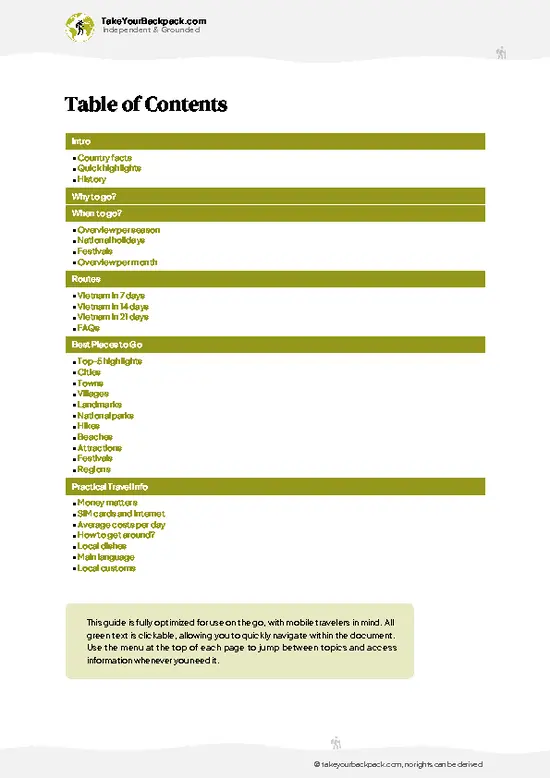
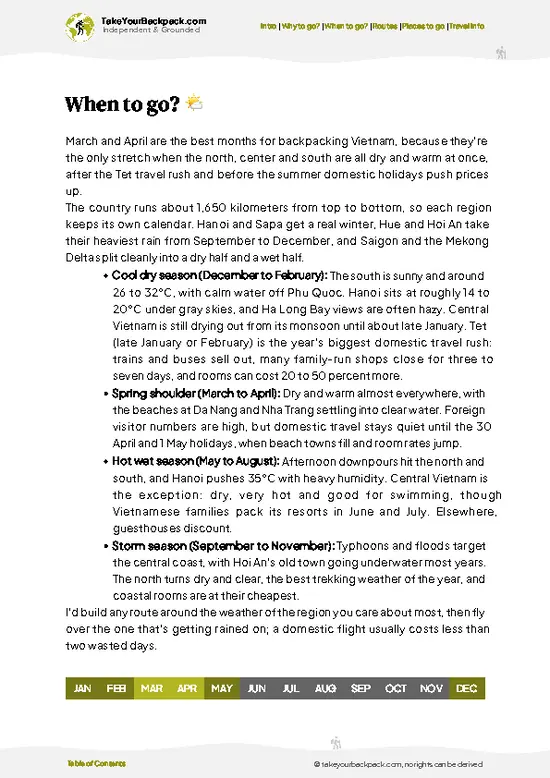
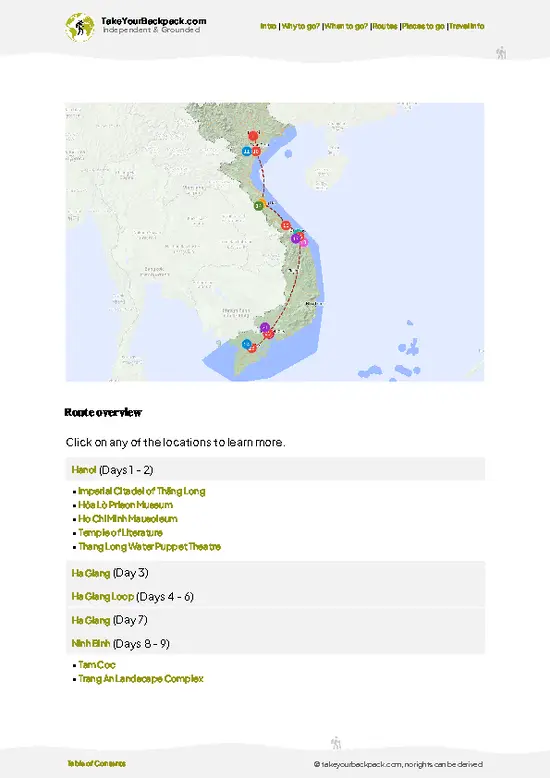
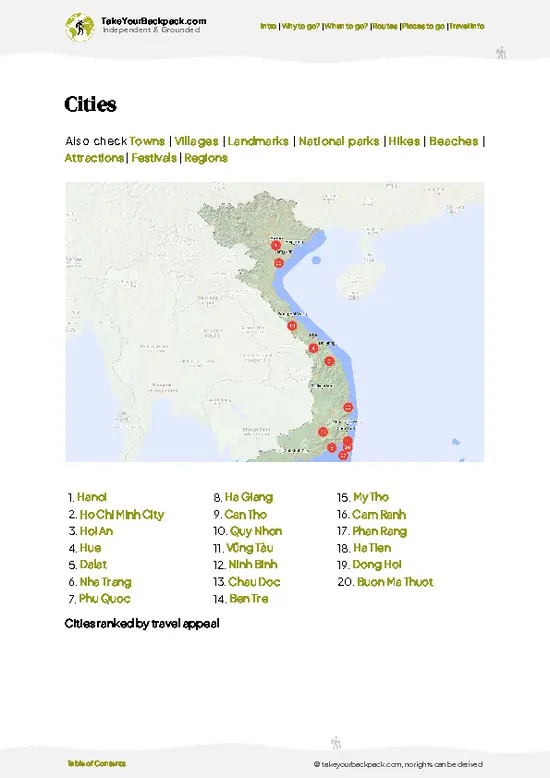
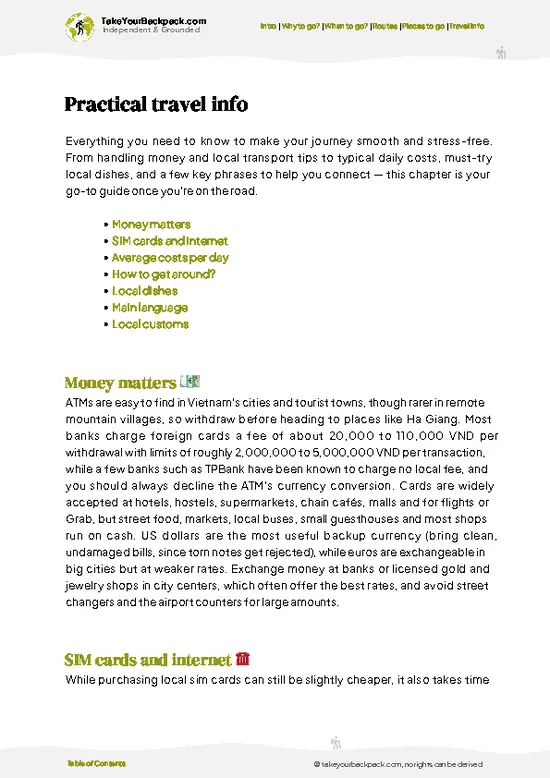
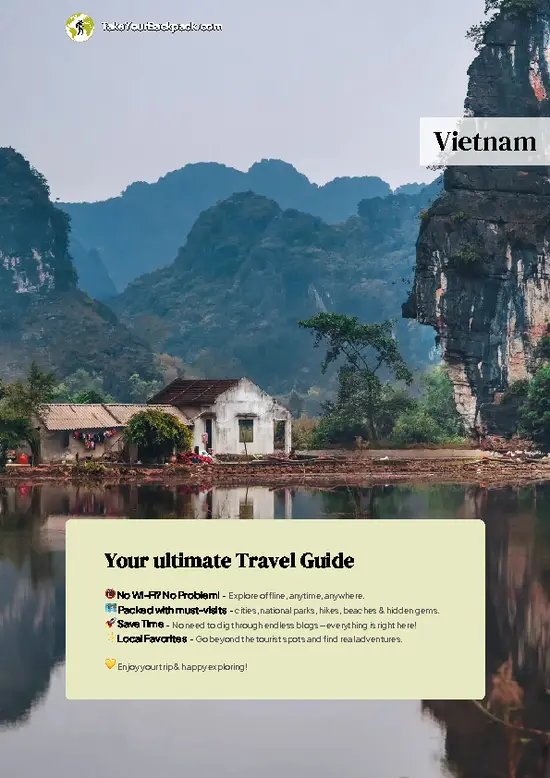
example page 0 from our offline Travel Guide for Vietnam
example page 1 from our offline Travel Guide for Vietnam
example page 2 from our offline Travel Guide for Vietnam
example page 3 from our offline Travel Guide for Vietnam
example page 4 from our offline Travel Guide for Vietnam
example page 5 from our offline Travel Guide for Vietnam
example page 6 from our offline Travel Guide for Vietnam
example page 7 from our offline Travel Guide for Vietnam
The digital guide (422 pages) contains:
✅ 118 highlights, ranked by travel appeal
✅ Optimized 7, 14 & 21-day travel routes
✅ Cities, national parks, landmarks, beaches
✅ How to get around
✅ Offline-friendly for travel without Wi-Fi
👉 Click to see all 30+ guide features

📅 Plan smarter in minutes, not weeks
✅ Month by month travel advice
✅ Festivals & national holidays
✅ Budget expectations

🗺️ Go to the right places, skip the overrated ones
✅ Honest pros & cons of destinations
✅ Top hikes, parks & viewpoints
✅ Lesser-known places most travelers miss
✅ Clear “worth it vs skip it” guidance

🛏️ Travel smoothly without rookie mistakes
✅ Best areas to stay
✅ Transport systems explained simply
✅ Common scams & safety advice
✅ SIM cards, money & practical tips

🌍 Understand the country, not just visit it
✅ Culture & traditions
✅ 52 Essential phrases & customs
✅ Festivals worth planning around
✅ Traveler-friendly historical context
✅ Insights that make places more meaningful

📱 Built for real travel conditions
✅ Fully downloadable PDF
✅ Works completely offline
✅ Optimized for phone use
✅ Useful in remote areas & buses
✅ Everything in one place
Stop searching, start planning
Get instant access to your full guide. 30‑day money-back guarantee.
+ Add another guide for just

By proceeding you agree to our terms.
Sent to your inbox immediately after payment • 100% Secure Checkout
Best Backpacking Travel Advisor 2025 tourism awardBest Backpacking
Travel Advisor
2025
What others say about Take Your Backpack Guides:
⭐⭐⭐⭐⭐
Fantastic, amazing amount of information!
⭐⭐⭐⭐⭐
My goodness this is amazing, it's what I've been looking for hats off too you!
⭐⭐⭐⭐⭐
I think this is absolutely BRILLIANT
⭐⭐⭐⭐
Very complete and informative. It's still missing places, but I gotta to commend you
⭐⭐⭐⭐⭐
This is truly amazing, thank you, can't wait to explore it with my kids!
⭐⭐⭐⭐⭐
Awesome resource, thank you!
⭐⭐⭐⭐⭐
This is amazing! Can't wait to explore the ones I haven't seen
⭐⭐⭐⭐
I love this! Well done, great idea.
⭐⭐⭐⭐⭐
Thanks for taking the time to make this gem!
⭐⭐⭐⭐⭐
This might be the best website I've ever seen.
⭐⭐⭐⭐⭐
Congratulations, and thank you so much for your work; it's incredibly valuable.
⭐⭐⭐⭐
In all seriousness I think you did a great job pointing out the important spots
⭐⭐⭐⭐⭐
10/10 very good
⭐⭐⭐⭐⭐
As someone who's only just starting to visit regularly this is awesome, thank you.
⭐⭐⭐⭐
Thank you very much! I'm going to visit my dad, it's going to be very useful!
⭐⭐⭐⭐⭐
This is really cool! We'll be travelling for the first time and this definitely come in handy.
⭐⭐⭐⭐⭐
You are now our minister of culture, congratulations 👨‍💼
⭐⭐⭐⭐⭐
Just wanted to tell you that this is a pearl! Going to follow your recommendations.
⭐⭐⭐⭐⭐
This is so cool. I'll definitely be using the resource for my travels soon.
⭐⭐⭐⭐⭐
This is very impressive! Good work.
⭐⭐⭐⭐⭐
This is an amazing and informative site. Very well done!

🛏️ Where to stay?Where to Stay in Vietnam

Vietnam has one of Southeast Asia’s densest hostel scenes, with dorm beds typically running 120,000 to 250,000 VND (about US$5 to 10) a night and private rooms in family-run guesthouses from around 300,000 VND (US$12). In Hanoi, the Old Quarter puts you within walking distance of Hoan Kiem Lake and the Ta Hien beer street, but scooter horns and late bars carry on well past midnight. In Ho Chi Minh City, Pham Ngu Lao around Bui Vien in District 1 is the cheapest and loudest base, where you should keep a hand on your phone, while Hoi An’s rice-field homestays near An Bang beach and Da Nang’s An Thuong area by My Khe beach trade nightlife for quiet nights and a short bike or Grab ride to the sights. … read more 👉
Vietnam has one of Southeast Asia’s densest hostel scenes, with dorm beds typically running 120,000 to 250,000 VND (about US$5 to 10) a night and private rooms in family-run guesthouses from around 300,000 VND (US$12). In Hanoi, the Old Quarter puts you within walking distance of Hoan Kiem Lake and the Ta Hien beer street, but scooter horns and late bars carry on well past midnight. In Ho Chi Minh City, Pham Ngu Lao around Bui Vien in District 1 is the cheapest and loudest base, where you should keep a hand on your phone, while Hoi An’s rice-field homestays near An Bang beach and Da Nang’s An Thuong area by My Khe beach trade nightlife for quiet nights and a short bike or Grab ride to the sights.

If you enjoy meeting fellow travelers, consider choosing hostels with high ratings for atmosphere. On the other hand, if you prefer having your own space, a hotel might be a better option.

VietnamMore of Vietnam

👋 Meet the founderWho’s Behind Take Your Backpack?

Johan, backpacker and founder of TakeYourBackpackHi, I’m Johan (Netherlands 🇳🇱), the creator of TakeYourBackpack. Over the past 3 decades, I’ve backpacked through 90+ countries across six continents, gaining extensive experience with independent travel, long-term trips, and overland routes.

This site is built on a combination of firsthand travel experience and carefully curated insights from other backpackers. Many guides are based on places I’ve personally visited, while others bring together tips, observations, and practical advice shared by trusted travelers I’ve met along the way.

The goal is to provide realistic, experience-driven guidance — not generic itineraries — so you can explore destinations with better context, clearer expectations, and more confidence.