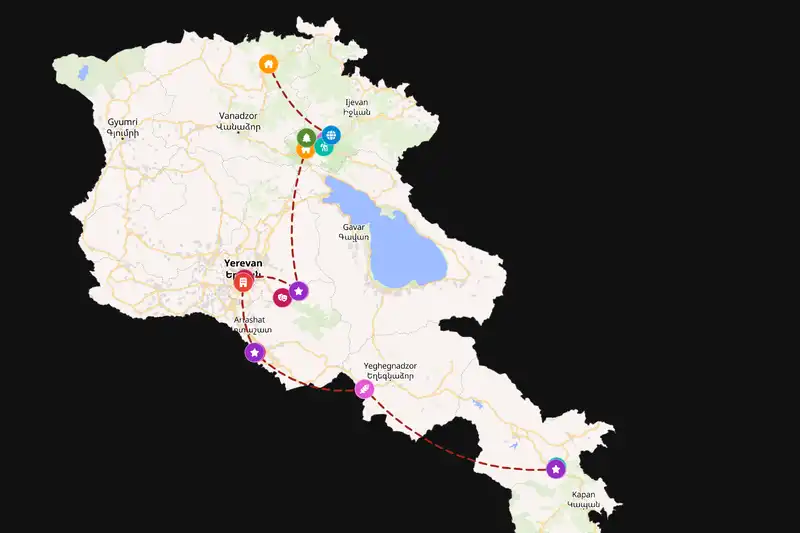
Short version: yes, Armenia is very doable to backpack independently, even on a tight budget, as long as you’re okay with a bit of improvising and using a few apps. English is common with younger people in Yerevan and in tourist-facing spots, but Russian is more widely understood overall, so offline translation apps help a lot once you leave the capital. The country is compact, people are generally direct and helpful, and crime rates against tourists are low, so you can relax about safety and focus on logistics.
The main challenge is that information on transport and opening hours can be vague or outdated, so you plan loosely instead of down to the minute. Marshrutkas (minibuses) often leave when full, not exactly on schedule, and some rural guesthouses are best contacted by phone or messaging apps rather than email. This is where having a local SIM card is almost mandatory; it’s cheap and makes everything easier, from calling a taxi to confirming homestays.
Wild camping is widely tolerated if you’re respectful, away from houses and churches, and leave no trace. In many rural areas, people will be more curious than suspicious if they see a tent. If you prefer a roof, you’ll find homestays and simple guesthouses in most popular regions, and they’re usually good value with huge home-cooked meals. Armenia is also a great place to hitchhike if you’re comfortable with it; drivers often refuse money and might insist on feeding you instead.
If you’re used to ultra-slick Western Europe infrastructure, Armenia will feel a bit rough around the edges, but that’s part of the charm: it’s safe, affordable, and friendly, just not hyper-organized. Pack patience, offline maps, and a flexible mindset, and independent backpacking here works very well.
For a fast but worthwhile taste of Armenia, 5–7 days is the minimum that still feels like a trip rather than a layover. That gives you time for Yerevan, a couple of classic monasteries, and at least one mountain or lake area without sprinting.
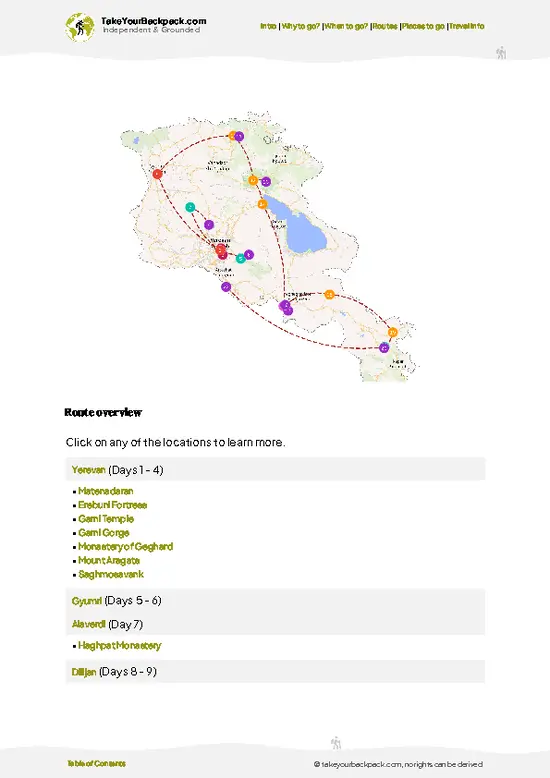
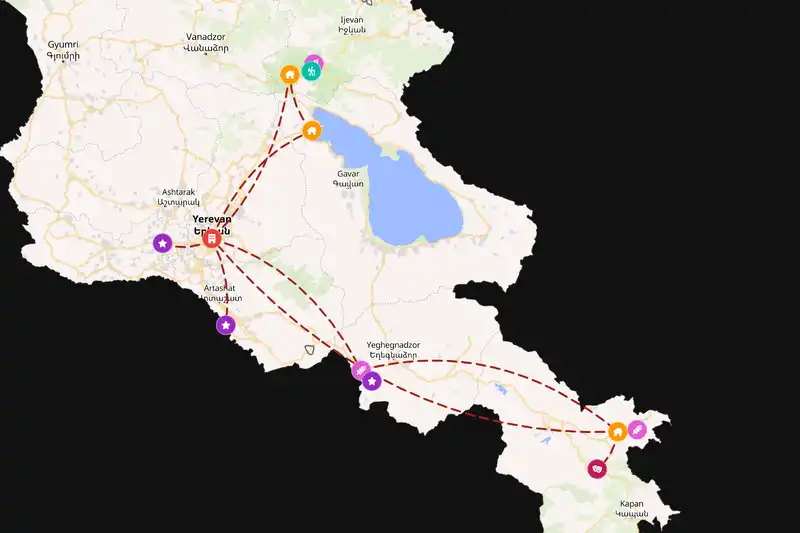
If you want a solid backpacking trip that mixes cities, villages, and hiking, 10–14 days is the sweet spot. With two weeks you can:
- Base in Yerevan for 3–4 nights to explore the city, do day trips to Garni, Geghard, Khor Virap, and maybe Etchmiadzin.
- Spend 2–3 nights around Dilijan for forest hikes and lakes.
- Add 2–3 nights in the south (Goris, Tatev, or around Sisian) for canyons, monasteries, and more remote landscapes.
- Use any extra days for Lake Sevan, Debed Canyon, or an extra hiking base.
If you’re a slow-travel or trekking person, 3–4 weeks lets you really dig in: multi-day hikes in Dilijan National Park or the southern mountains, more time in Debed Canyon villages, and extra side trips to lesser-known monasteries and Soviet-era towns.
On a tight schedule, prioritize depth over distance. Armenia is small, but roads are winding and public transport is not lightning-fast, so trying to “do the whole country” in under a week just means you’ll spend most of your time in vehicles. It’s better to pick 2–3 regions and actually walk the trails, linger in village guesthouses, and enjoy the food instead of collecting checkmarks.
You can absolutely get around Armenia without a car, but it helps to understand how the system really works so you don’t waste days waiting in the wrong place.
Between major towns, marshrutkas (minibuses) are your backbone. They’re cheap, reasonably frequent on popular routes (like Yerevan–Dilijan, Yerevan–Sevan, Yerevan–Gyumri, Yerevan–Goris), and usually leave from specific bus stations or metro-adjacent hubs in Yerevan. They often depart when full rather than exactly on schedule, so arrive early and be flexible. For longer routes, ask the driver where to get off for your guesthouse; they’ll usually drop you close.
Inside Yerevan, the metro, buses, and rideshare-style taxis are cheap and easy. The metro is simple, with one main line, and taxis booked via apps are very affordable, especially if you’re splitting costs with another backpacker.
For more remote monasteries and trailheads, public transport can get you close, but not always to the door. This is where you combine tools: take a marshrutka to the nearest town, then use a taxi app or negotiate with a local driver for the last stretch. For some spots like Tatev, Noravank, or certain Lake Sevan beaches, shared taxis or hitchhiking are common and safe options.
If you’re short on time, hiring a taxi for a half or full day can be a good-value splurge, especially if you’re two or three people. You can chain several sites in one loop instead of trying to puzzle together multiple marshrutkas.
So yes, you can travel Armenia without renting a car, but you trade some spontaneity for patience. If you’re okay with early starts, occasional crowded minibuses, and the odd hitchhike or taxi, you’ll be fine.
For a budget traveler or backpacker, the must-visits in Armenia are the places where landscape, history, and local life all intersect, not just the postcard shots.
Yerevan: Base yourself here first. It’s not just a capital to pass through; it’s where you feel modern Armenia. Walk the Cascade area, people-watch in Republic Square, and eat your way through cheap bakeries and small restaurants. The History Museum and the Armenian Genocide Memorial and Museum are heavy but essential for context.
Garni & Geghard: Easy day trip from Yerevan and a great first outing. Garni’s pagan temple sits above a dramatic gorge, and Geghard Monastery is partly carved into the rock. You can hike in the Garni Gorge if you want to stretch your legs instead of just hopping out for photos.
Khor Virap: The monastery itself is small, but the setting with Mount Ararat looming across the border is what makes it special. It’s an easy half-day from Yerevan and pairs well with nearby wineries if you want a cheap tasting and a slow lunch.
Dilijan & Dilijan National Park: This is where backpackers start to breathe. Forest trails, cool air, and a slower pace. You can base in Dilijan town and do day hikes to Parz Lake, Goshavank, and Haghartsin, or link trails for longer walks. Guesthouses here are usually great value with big breakfasts.
Lake Sevan: Not every corner of the lake is special, but Sevanavank Monastery on the peninsula plus a swim or lakeside picnic is worth a day, especially in warmer months. It’s an easy hop from Yerevan or Dilijan.
Southern Armenia: Goris & Tatev: If you have time to go south, do it. Goris has a relaxed small-town feel and weird rock formations around Old Goris. Tatev Monastery, perched above a deep gorge, is one of the most dramatic sites in the country. You can reach it by road or via the long cable car; either way, the surrounding canyons and villages are where Armenia feels wild and big.
Debed Canyon (Lori region): Less visited than Dilijan but fantastic for backpackers. Deep green valleys, old Soviet industrial towns, and cliffside monasteries like Haghpat and Sanahin. It’s easy to string together short hikes between villages and stay in homestays that feel very local and very generous.
If you hit Yerevan, one or two classic monastery day trips, one mountain/forest base (Dilijan or Debed), and one big landscape area (Sevan or the south), you’ll get a very complete first look at Armenia.
If you’re short on time, skip anything that’s just a repeat of what you’ve already seen, and avoid long detours that don’t add a new kind of experience. Armenia has a lot of monasteries and viewpoints; you don’t need to see every single one to understand the country.
You can usually skip:
-
Extra monastery stops that feel like clones: After Garni, Geghard, Khor Virap, and one of the big northern or southern monasteries (Haghpat, Sanahin, Tatev, or Noravank), the fifth or sixth stone complex on a hill won’t change your life. If your schedule is tight, cut the smaller, out-of-the-way ones.
-
Deep south or far north on a very short trip: If you have under a week, going all the way to both Goris/Tatev in the south and Debed Canyon in the north will turn your trip into a bus marathon. Pick one direction and do it properly instead of racing both.
-
Multiple days at Lake Sevan if you’re not visiting in warm weather or you’re not into swimming. A quick stop at Sevanavank and a lakeside meal is enough for many travelers; extra days are better spent hiking in Dilijan or exploring Debed Canyon.
-
Overlong museum crawls in Yerevan if you’re not a hardcore museum person. Prioritize the Genocide Memorial and one history or art museum, then spend the rest of your time walking neighborhoods, markets, and parks. Street-level time teaches you more about modern Armenia than a fourth museum.
-
Shopping-focused stops like big souvenir markets if your budget is tight. Armenia’s value is in landscapes, food, and conversations, not fridge magnets.
When in doubt, choose time on trails, in marshrutkas, and at homestay dinner tables over ticking off another church. Armenia rewards depth: one extra night in a village or mountain town is worth more than three extra photo stops from a car window.