×
Armenia🇦🇲 | 15 days itinerary

15 Days in Armenia

By Johan Kruseman 🇳🇱 | Updated May 7, 2026
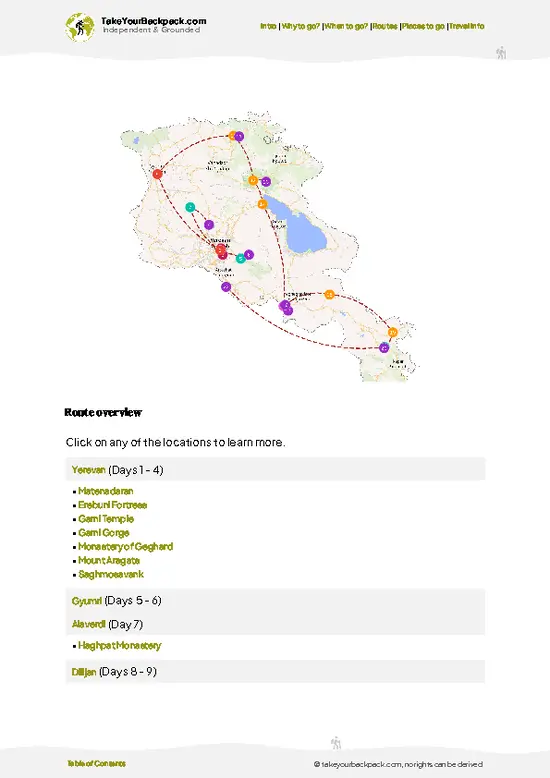
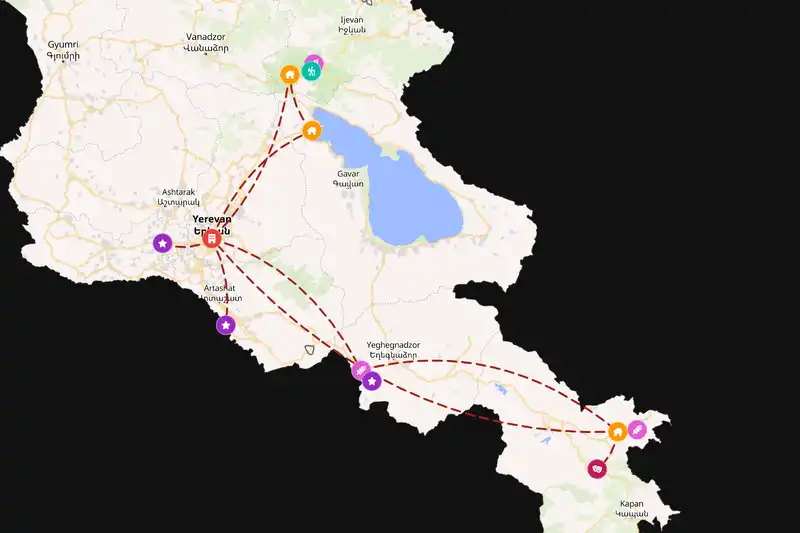
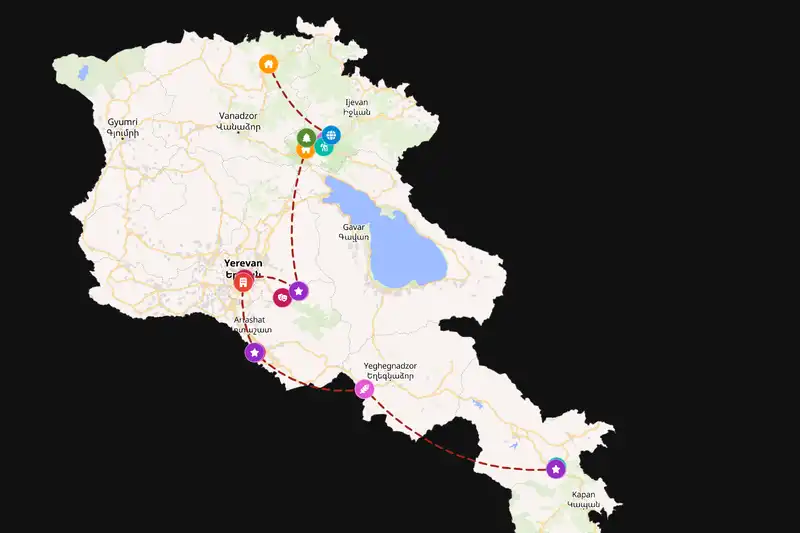
This 15-day route is for travelers who want to really work through Armenia’s layers: capital culture, high mountains, wine country, deep south canyons, and the forested northeast, with enough time to breathe in each place. The pace is steady but not punishing, using a mix of marshrutkas, shared taxis, and the occasional private transfer for longer hops, with no back-to-back marathon travel days so you can actually enjoy the hikes and hot springs instead of just surviving the roads.

Days 1-3: Yerevan, Manuscripts, and Underground Cinema

You start with three nights in Yerevan to let the city’s rhythm sink in before you start bouncing around the country. One day is for the History Museum of Armenia and a slow wander around Republic Square and the Cascade, optionally dipping into the Cafesjian Center for the Arts for modern art and terrace views. Another day you give to the Matenadaran, where the manuscripts and maps make every later monastery visit feel like a continuation of a story you’ve … read more 👉
This 15-day route is for travelers who want to really work through Armenia’s layers: capital culture, high mountains, wine country, deep south canyons, and the forested northeast, with enough time to breathe in each place. The pace is steady but not punishing, using a mix of marshrutkas, shared taxis, and the occasional private transfer for longer hops, with no back-to-back marathon travel days so you can actually enjoy the hikes and hot springs instead of just surviving the roads.

Days 1-3: Yerevan, Manuscripts, and Underground Cinema

You start with three nights in Yerevan to let the city’s rhythm sink in before you start bouncing around the country. One day is for the History Museum of Armenia and a slow wander around Republic Square and the Cascade, optionally dipping into the Cafesjian Center for the Arts for modern art and terrace views. Another day you give to the Matenadaran, where the manuscripts and maps make every later monastery visit feel like a continuation of a story you’ve already started reading. In between, you carve out time for the Sergei Parajanov Museum, a quirky, intimate space that shows off the surreal, collage-heavy world of one of Armenia’s most important filmmakers, and an evening tour at the Yerevan Brandy Company if you want to see how brandy became part of the national identity. If you’re into performance, you can even slip in a night at the Yerevan Opera Theatre, trading hiking boots for something slightly less dusty for a few hours.

Days 4-5: Temples, Gorges, and Khosrov Forest

With the city foundation laid, you head east for two days of nature and early-Christian history. First you visit Garni Temple, Armenia’s outlier pagan temple, then drop into the Garni Gorge for a hike among basalt columns and riverbanks that feels like a natural amphitheater. From there you continue to Geghard Monastery (also known as Monastery of Geghard), partly carved into the rock, where the acoustics and dim stone chambers make it one of the most atmospheric stops of the trip. On the second day you push a bit farther into the Khosrov Forest State Reserve, one of the country’s oldest protected areas, for guided hiking or jeep-accessible viewpoints that show off a wilder, more rugged side of central Armenia. You overnight back in Yerevan both nights to keep logistics simple and avoid packing and unpacking.

Days 6-7: Mount Aragats and Aragatsotn Villages

Next you swing northwest into the highlands of Aragatsotn, basing yourself in or around the region for two nights to tackle Mount Aragats and nearby villages. One day is dedicated to Mount Aragats itself, where you can choose your level of ambition: a hike from the lake area toward one of the lower summits, or a more serious push if conditions and fitness allow. The following day you slow down, exploring the village of Byurakan with its observatory and laid-back rural feel, and, if you like, making a short hop to Saghmosavank, a monastery perched near a gorge that gives you big views without a big hike. This phase gives you altitude, open skies, and a sense of Armenia’s mountain backbone before you drop south into wine country.

Days 8-10: Wine, Canyons, and Jermuk Waters

From Aragatsotn you travel south into Vayots Dzor, stopping first in the village of Areni, Armenia’s wine hub, where you can taste local vintages and see how winemaking is woven into everyday life. Nearby, you visit Areni Cave, where some of the world’s oldest known wine-making artifacts were found, and then continue to the cliff-hugging Noravank monastery, whose red rock canyon setting makes it one of the most photogenic religious sites in the country. You then base yourself in Jermuk for two nights, using the town’s cool air and mineral waters as a reset: walk the canyon, sample the springs, and take easy hikes in the surrounding hills. If you want to stretch your legs more, you can add a day trip to the Vayots Dzor’s Spitakavor Monastery Trail, a quieter, more remote hike that rewards you with a lonely monastery and big-sky views without crowds.

Days 11-12: Tatev, Devil’s Bridge, and Khndzoresk

From Jermuk you continue south into Syunik, basing yourself in Goris for two nights to explore one of Armenia’s most dramatic regions. One day is for the Tatev Monastery and Wings of Tatev Aerial Tramway, where you ride the cable car over a deep gorge to reach Tatev Monastery itself, then hike part of the Tatev to Devil’s Bridge Trail down toward the canyon and its natural rock bridge and pools. The next day you visit the cave village of Khndzoresk, crossing the long suspension bridge and wandering among rock-cut dwellings that show how people adapted to this rugged landscape. Evenings in Goris are for slow dinners and short walks among its stone houses, giving you a sense of a real southern town rather than just a string of sights.

Days 13-15: Lake Sevan, Dilijan Forests, and Lori Gorges

To finish, you arc back north rather than straight to the capital, giving yourself a three-day cool-down through water and forest. First you head to Sevan for a night by Lake Sevan, exploring the peninsula and the broader Sevan National Park, and, if the weather cooperates, spending time at Gold Beach for a swim or lakeside lunch. Then you continue to Dilijan for a night or two, walking the old quarter and heading into Dilijan National Park for the Dilijan National Park’s Parz Lake Trail, a forest hike that feels worlds away from the rocky south. If time and energy allow, you push into the Lori Region for a day trip to Alaverdi and the Haghpat Monastery, trading forests for deep gorges and one last heavyweight monastery before looping back to Yerevan for your final night and departure, feeling like you’ve traced a full circle through the country’s main landscapes.

As a final bonus detour for a future deep dive, keep the remote village of Shatili just across the border in mind, where medieval stone towers stack up a valley like a fortress village from another century, reachable only when the mountain pass is open.
Loading the map 🌍
film
0
0
0a
Yerevan
film
1
1
1a
Garni Gorge
film
2
2
2a
Monastery of Geghard
film
3
3
3a
Khosrov Forest State Reserve
film
4
4
4a
Aragatsotn
film
5
5
5a
Mount Aragats
film
6
6
6a
Byurakan
film
7
7
7a
Saghmosavank
film
8
8
8a
Areni
film
9
9
9a
Areni Cave
film
10
10
10a
Noravank
film
11
11
11a
Goris
film
12
12
12a
Tatev Monastery
film
13
13
13a
Tatev to Devil’s Bridge Trail
film
14
14
14a
Sevan
film
15
15
15a
Gold Beach
film
16
16
16a
Dilijan
film
17
17
17a
Dilijan ’s Parz Lake Trail
film
18
18
18a
Lori Region
film
19
19
19a
Haghpat Monastery

✈️ The backpacker research shortcutArmenia Travel Guide

An offline-friendly backpacking guide with optimized travel routes, ranked highlights, transport advice, and the best areas to stay.
example page 0 from our offline Travel Guide for Armeniaexample page 1 from our offline Travel Guide for Armeniaexample page 2 from our offline Travel Guide for Armeniaexample page 3 from our offline Travel Guide for Armeniaexample page 4 from our offline Travel Guide for Armeniaexample page 5 from our offline Travel Guide for Armenia
The digital guide (235 pages) contains:
69 highlights, ranked by travel appeal
Optimized 5, 10 & 15-day travel routes
Best neighborhoods to stay
How to get around
Offline-friendly for travel without Wi-Fi
👉 See all 30+ guide features

📅 Plan smarter in minutes, not weeks
Month by month travel advice
Festivals & national holidays
Budget expectations

🗺️ Go to the right places, skip the overrated ones
Honest pros & cons of destinations
Top hikes, parks & viewpoints
Lesser-known places most travelers miss
Clear “worth it vs skip it” guidance

🛏️ Travel smoothly without rookie mistakes
Best areas to stay
Transport systems explained simply
Common scams & safety advice
SIM cards, money & practical tips

🌍 Understand the country, not just visit it
Culture & traditions
52 Essential phrases & customs
Festivals worth planning around
Traveler-friendly historical context
Insights that make places more meaningful

📱 Built for real travel conditions
Fully downloadable PDF
Works completely offline
Optimized for phone use
Useful in remote areas & buses
Everything in one place
Save weeks of stressful planning
Get instant access to the full guide directly. 30-day money-back guarantee.


Sent to your inbox immediately after payment • 100% Secure Checkout
Best Backpacking Travel Advisor 2025 tourism awardBest Backpacking
Travel Advisor
2025
What others say about Take Your Backpack Guides:
⭐⭐⭐⭐⭐
Fantastic, amazing amount of information!
⭐⭐⭐⭐⭐
My goodness this is amazing, it's what I've been looking for hats off too you!
⭐⭐⭐⭐⭐
I think this is absolutely BRILLIANT
⭐⭐⭐⭐
Very complete and informative. It's still missing places, but I gotta to commend you
⭐⭐⭐⭐⭐
This is truly amazing, thank you, can't wait to explore it with my kids!
⭐⭐⭐⭐⭐
Awesome resource, thank you!
⭐⭐⭐⭐⭐
This is amazing! Can't wait to explore the ones I haven't seen
⭐⭐⭐⭐
I love this! Well done, great idea.
⭐⭐⭐⭐⭐
Thanks for taking the time to make this gem!
⭐⭐⭐⭐⭐
This might be the best website I've ever seen.
⭐⭐⭐⭐⭐
Congratulations, and thank you so much for your work; it's incredibly valuable.
⭐⭐⭐⭐
In all seriousness I think you did a great job pointing out the important spots
⭐⭐⭐⭐⭐
10/10 very good
⭐⭐⭐⭐⭐
As someone who's only just starting to visit regularly this is awesome, thank you.
⭐⭐⭐⭐
Thank you very much! I'm going to visit my dad, it's going to be very useful!
⭐⭐⭐⭐⭐
This is really cool! We'll be travelling for the first time and this definitely come in handy.
⭐⭐⭐⭐⭐
You are now our minister of culture, congratulations 👨‍💼
⭐⭐⭐⭐⭐
Just wanted to tell you that this is a pearl! Going to follow your recommendations.
⭐⭐⭐⭐⭐
This is so cool. I'll definitely be using the resource for my travels soon.
⭐⭐⭐⭐⭐
This is very impressive! Good work.
⭐⭐⭐⭐⭐
This is an amazing and informative site. Very well done!

🧭 RouteOther Route Options

Travel Armenia your way — from a quick highlights trip to a slow-paced adventure.

🙋 FAQFAQ: Backpacking Armenia

Short version: yes, Armenia is very doable to backpack independently, even on a tight budget, as long as you’re okay with a bit of improvising and using a few apps. English is common with younger people in Yerevan and in tourist-facing spots, but Russian is more widely understood overall, so offline translation apps help a lot once you leave the capital. The country is compact, people are generally direct and helpful, and crime rates against tourists are low, so you can relax about safety and focus on logistics.

The main challenge is that information on transport and opening hours can be vague or outdated, so you plan loosely instead of down to the minute. Marshrutkas (minibuses) often leave when full, not exactly on schedule, and some rural guesthouses are best contacted by phone or messaging apps rather than email. This is where having a local SIM card is almost mandatory; it’s cheap and makes everything easier, from calling a taxi to confirming homestays.

Wild camping is widely tolerated if you’re respectful, away from houses and churches, and leave no trace. In many rural areas, people will be more curious than suspicious if they see a tent. If you prefer a roof, you’ll find homestays and simple guesthouses in most popular regions, and they’re usually good value with huge home-cooked meals. Armenia is also a great place to hitchhike if you’re comfortable with it; drivers often refuse money and might insist on feeding you instead.

If you’re used to ultra-slick Western Europe infrastructure, Armenia will feel a bit rough around the edges, but that’s part of the charm: it’s safe, affordable, and friendly, just not hyper-organized. Pack patience, offline maps, and a flexible mindset, and independent backpacking here works very well.
For a fast but worthwhile taste of Armenia, 5–7 days is the minimum that still feels like a trip rather than a layover. That gives you time for Yerevan, a couple of classic monasteries, and at least one mountain or lake area without sprinting.

If you want a solid backpacking trip that mixes cities, villages, and hiking, 10–14 days is the sweet spot. With two weeks you can:
- Base in Yerevan for 3–4 nights to explore the city, do day trips to Garni, Geghard, Khor Virap, and maybe Etchmiadzin.
- Spend 2–3 nights around Dilijan for forest hikes and lakes.
- Add 2–3 nights in the south (Goris, Tatev, or around Sisian) for canyons, monasteries, and more remote landscapes.
- Use any extra days for Lake Sevan, Debed Canyon, or an extra hiking base.

If you’re a slow-travel or trekking person, 3–4 weeks lets you really dig in: multi-day hikes in Dilijan National Park or the southern mountains, more time in Debed Canyon villages, and extra side trips to lesser-known monasteries and Soviet-era towns.

On a tight schedule, prioritize depth over distance. Armenia is small, but roads are winding and public transport is not lightning-fast, so trying to “do the whole country” in under a week just means you’ll spend most of your time in vehicles. It’s better to pick 2–3 regions and actually walk the trails, linger in village guesthouses, and enjoy the food instead of collecting checkmarks.
You can absolutely get around Armenia without a car, but it helps to understand how the system really works so you don’t waste days waiting in the wrong place.

Between major towns, marshrutkas (minibuses) are your backbone. They’re cheap, reasonably frequent on popular routes (like Yerevan–Dilijan, Yerevan–Sevan, Yerevan–Gyumri, Yerevan–Goris), and usually leave from specific bus stations or metro-adjacent hubs in Yerevan. They often depart when full rather than exactly on schedule, so arrive early and be flexible. For longer routes, ask the driver where to get off for your guesthouse; they’ll usually drop you close.

Inside Yerevan, the metro, buses, and rideshare-style taxis are cheap and easy. The metro is simple, with one main line, and taxis booked via apps are very affordable, especially if you’re splitting costs with another backpacker.

For more remote monasteries and trailheads, public transport can get you close, but not always to the door. This is where you combine tools: take a marshrutka to the nearest town, then use a taxi app or negotiate with a local driver for the last stretch. For some spots like Tatev, Noravank, or certain Lake Sevan beaches, shared taxis or hitchhiking are common and safe options.

If you’re short on time, hiring a taxi for a half or full day can be a good-value splurge, especially if you’re two or three people. You can chain several sites in one loop instead of trying to puzzle together multiple marshrutkas.

So yes, you can travel Armenia without renting a car, but you trade some spontaneity for patience. If you’re okay with early starts, occasional crowded minibuses, and the odd hitchhike or taxi, you’ll be fine.
For a budget traveler or backpacker, the must-visits in Armenia are the places where landscape, history, and local life all intersect, not just the postcard shots.

Yerevan: Base yourself here first. It’s not just a capital to pass through; it’s where you feel modern Armenia. Walk the Cascade area, people-watch in Republic Square, and eat your way through cheap bakeries and small restaurants. The History Museum and the Armenian Genocide Memorial and Museum are heavy but essential for context.

Garni & Geghard: Easy day trip from Yerevan and a great first outing. Garni’s pagan temple sits above a dramatic gorge, and Geghard Monastery is partly carved into the rock. You can hike in the Garni Gorge if you want to stretch your legs instead of just hopping out for photos.

Khor Virap: The monastery itself is small, but the setting with Mount Ararat looming across the border is what makes it special. It’s an easy half-day from Yerevan and pairs well with nearby wineries if you want a cheap tasting and a slow lunch.

Dilijan & Dilijan National Park: This is where backpackers start to breathe. Forest trails, cool air, and a slower pace. You can base in Dilijan town and do day hikes to Parz Lake, Goshavank, and Haghartsin, or link trails for longer walks. Guesthouses here are usually great value with big breakfasts.

Lake Sevan: Not every corner of the lake is special, but Sevanavank Monastery on the peninsula plus a swim or lakeside picnic is worth a day, especially in warmer months. It’s an easy hop from Yerevan or Dilijan.

Southern Armenia: Goris & Tatev: If you have time to go south, do it. Goris has a relaxed small-town feel and weird rock formations around Old Goris. Tatev Monastery, perched above a deep gorge, is one of the most dramatic sites in the country. You can reach it by road or via the long cable car; either way, the surrounding canyons and villages are where Armenia feels wild and big.

Debed Canyon (Lori region): Less visited than Dilijan but fantastic for backpackers. Deep green valleys, old Soviet industrial towns, and cliffside monasteries like Haghpat and Sanahin. It’s easy to string together short hikes between villages and stay in homestays that feel very local and very generous.

If you hit Yerevan, one or two classic monastery day trips, one mountain/forest base (Dilijan or Debed), and one big landscape area (Sevan or the south), you’ll get a very complete first look at Armenia.
If you’re short on time, skip anything that’s just a repeat of what you’ve already seen, and avoid long detours that don’t add a new kind of experience. Armenia has a lot of monasteries and viewpoints; you don’t need to see every single one to understand the country.

You can usually skip:
- Extra monastery stops that feel like clones: After Garni, Geghard, Khor Virap, and one of the big northern or southern monasteries (Haghpat, Sanahin, Tatev, or Noravank), the fifth or sixth stone complex on a hill won’t change your life. If your schedule is tight, cut the smaller, out-of-the-way ones.
- Deep south or far north on a very short trip: If you have under a week, going all the way to both Goris/Tatev in the south and Debed Canyon in the north will turn your trip into a bus marathon. Pick one direction and do it properly instead of racing both.
- Multiple days at Lake Sevan if you’re not visiting in warm weather or you’re not into swimming. A quick stop at Sevanavank and a lakeside meal is enough for many travelers; extra days are better spent hiking in Dilijan or exploring Debed Canyon.
- Overlong museum crawls in Yerevan if you’re not a hardcore museum person. Prioritize the Genocide Memorial and one history or art museum, then spend the rest of your time walking neighborhoods, markets, and parks. Street-level time teaches you more about modern Armenia than a fourth museum.
- Shopping-focused stops like big souvenir markets if your budget is tight. Armenia’s value is in landscapes, food, and conversations, not fridge magnets.

When in doubt, choose time on trails, in marshrutkas, and at homestay dinner tables over ticking off another church. Armenia rewards depth: one extra night in a village or mountain town is worth more than three extra photo stops from a car window.

🇦🇲 ArmeniaExpand Your Journey

Ready to build a truly unique trip? Predefined routes are perfect for first-time visitors, but there is so much more to discover. Whether you are chasing a city trip, pristine national parks, local food scenes, or quiet beaches, pick a category to design your own path.