×

Armenia🇦🇲 | best townsTop-Rated 10 towns in Armenia

Towns in Armenia are small, Soviet-planned or ancient, and almost always ringed by mountains. Woodsmoke, apricot trees and the clatter of old Ladas fill the streets. The north is greener, with basalt buildings and damp, chilly winters. The south is drier and rockier, with canyons and long drives between stops. Lakeside and highland towns sit above 1,900 meters, so mornings feel sharp even in summer. Costs stay low outside Yerevan, and marshrutkas reach most places, though they leave when full. For backpacking or independent travel, the choice is between easy access near the capital and quieter, slower places farther out.

By Johan Kruseman 🇳🇱 | Updated October 18, 2026
Explore the best villages in Armenia

Why go?Why Travelers Love These Spots

Armenia suits town travel because the country is compact, about the size of Maryland, yet it holds one of the world’s oldest Christian traditions. Stone churches, monasteries and khachkars (carved cross-stones) sit within or beside most settlements, so a town here usually comes with a thousand years or more of layered history. The volcanic landscape shapes everything. Dark tuff and basalt give buildings their color, and gorges, plateaus and high passes decide where people settled and how far apart they live.

The Soviet legacy is also visible. Wide concrete squares, apartment blocks and unfinished factories sit beside family homes with grapevines and walnut trees. Some places feel worn, with potholes, patchy signage and few English menus. That roughness is part of the experience, and hospitality … read more 👉
Armenia suits town travel because the country is compact, about the size of Maryland, yet it holds one of the world’s oldest Christian traditions. Stone churches, monasteries and khachkars (carved cross-stones) sit within or beside most settlements, so a town here usually comes with a thousand years or more of layered history. The volcanic landscape shapes everything. Dark tuff and basalt give buildings their color, and gorges, plateaus and high passes decide where people settled and how far apart they live.

The Soviet legacy is also visible. Wide concrete squares, apartment blocks and unfinished factories sit beside family homes with grapevines and walnut trees. Some places feel worn, with potholes, patchy signage and few English menus. That roughness is part of the experience, and hospitality often fills the gaps: expect coffee, brandy or a plate of fruit pressed on you.

Travelers should know that public transport is cheap but irregular, that departures depend on passengers, and that mountain roads slow every journey. Winters bring snow and fog to the highlands. Closed borders with Turkey and Azerbaijan mean routes mostly run north to south through Yerevan or via Georgia and Iran. Carry cash in Armenian dram, as small towns often lack card machines.
Our Approach to Ranking
The list of best towns in Armenia is created based on charm, local culture, atmosphere, hidden gems, and visitor appeal. If you feel a town is missing in this list, please let us know.

When to go?Seasonal Guide to Visiting

Best months: The best months for Armenian towns are May to June and September to October, when daytime temperatures sit around 18 to 28°C and the roads, hillsides and church courtyards are comfortable to walk. In spring, orchards bloom and streams run loud with snowmelt. In autumn, the light turns amber and markets overflow with grapes, pomegranates and dried fruit.

Summer and shoulder seasons: July and August bring dry heat to the Ararat plain and southern valleys, often 35°C or higher, with dust in the air and little shade. Highland and northern towns stay cooler at 20 to 28°C, but afternoon thunderstorms can turn dirt tracks to mud. Guesthouse prices rise slightly in summer and around holidays, usually by 10 to 30 percent in popular places, while midweek stays remain easy to book. Early … read more 👉
Best months: The best months for Armenian towns are May to June and September to October, when daytime temperatures sit around 18 to 28°C and the roads, hillsides and church courtyards are comfortable to walk. In spring, orchards bloom and streams run loud with snowmelt. In autumn, the light turns amber and markets overflow with grapes, pomegranates and dried fruit.

Summer and shoulder seasons: July and August bring dry heat to the Ararat plain and southern valleys, often 35°C or higher, with dust in the air and little shade. Highland and northern towns stay cooler at 20 to 28°C, but afternoon thunderstorms can turn dirt tracks to mud. Guesthouse prices rise slightly in summer and around holidays, usually by 10 to 30 percent in popular places, while midweek stays remain easy to book. Early spring and late autumn are quieter and cheaper, though some seasonal guesthouses and cafes close.

Winter: From December to March, highland towns can drop well below freezing, with snow, icy roads and slow marshrutkas. Heating is often by stove or radiator, so rooms feel warm indoors and brutal outside. Lower elevations in the south and around Yerevan are milder, but still cold and gray. Winter travel can be rewarding, but it requires flexibility and good boots.

town hoppingTips for Visiting Multiple Destinations

Trip length: A trip linking several Armenian towns works best in 7 to 12 days, which allows two or three regional bases without constant packing. Cluster by region rather than by map distance. The north and Lake Sevan area pair well, and the southern provinces make a separate loop toward Syunik and the Iranian border.

Direction and pacing: Starting in Yerevan and moving north, then east, then south keeps distances manageable and avoids doubling back along the same highways. Allow one to two nights per stop, enough for a morning walk, a market stop and a quiet evening. Travel between regions typically takes 2 to 6 hours, and the road from Yerevan to the far south can reach 5 to 7 hours by marshrutka. Mountain bends and roadworks make the clock unreliable.

Common planning mistakes: Many travelers … read more 👉
Trip length: A trip linking several Armenian towns works best in 7 to 12 days, which allows two or three regional bases without constant packing. Cluster by region rather than by map distance. The north and Lake Sevan area pair well, and the southern provinces make a separate loop toward Syunik and the Iranian border.

Direction and pacing: Starting in Yerevan and moving north, then east, then south keeps distances manageable and avoids doubling back along the same highways. Allow one to two nights per stop, enough for a morning walk, a market stop and a quiet evening. Travel between regions typically takes 2 to 6 hours, and the road from Yerevan to the far south can reach 5 to 7 hours by marshrutka. Mountain bends and roadworks make the clock unreliable.

Common planning mistakes: Many travelers try to fit too many towns into too few days and spend the trip in vans. Choose fewer stops and use Yerevan as a transit hub rather than linking remote places by cross-country shortcuts, which often lack scheduled service. Another error is leaving late in the day. Marshrutkas fill in the morning and thin out after midday, so leave before 10:00. In winter, add buffer time for snow, and confirm onward departures the evening before at the bus station.

The ListTop towns of Armenia

1 Dilijan

artisan workshops, pine forests, lakeside park

Experience a town shaped by craft traditions, surrounded by thick woodland and a national park that invites slow exploration.

2 Jermuk

mineral springs, spa hotels, waterfall gorge

Relax in a spa town known for its healing waters, with easy access to riverside walks and a striking canyon waterfall.

3 Tsaghkadzor

ski slopes, forest trails, monastery complex

Ski in winter or hike wooded hills in summer, then visit a centuries-old monastery set above the valley floor.

armenia-city-tsaghkadzor
© Google |

4 Sevan

lake shore, peninsula monastery, fish restaurants

Spend time by Armenia’s largest lake, where cool breezes, fresh fish, and a hilltop monastery define the lakeside experience.

armenia-city-sevan
© Google |

5 Goris

rock formations, cave dwellings, winding streets

Discover a town where homes are carved into cliffs, and narrow lanes lead to dramatic landscapes shaped by volcanic stone.

armenia-city-goris
© Google |

6 Echmiadzin

cathedral complex, religious festivals, pilgrimage site

Observe daily life in Armenia’s spiritual center, where ancient rituals and church architecture draw visitors year-round.

7 Vanadzor

industrial quarter, city parks, Soviet architecture

Navigate a city shaped by factories and wide boulevards, with green spaces and concrete blocks reflecting its Soviet past.

armenia-city-vanadzor
© Google |

8 Alaverdi

river gorge, copper smelter, medieval churches

Visit a town in a deep canyon, where industrial relics and ancient monasteries coexist along the tumbling Debed River.

9 Kapan

southern mountains, mining legacy, borderland markets

Travelers find a working town set among steep ridges, where local markets and industrial history meet remote southern scenery.

10 Ijevan

market square, riverside park, carpet workshops

Browse local markets and riverside paths in a regional hub known for its textile crafts and relaxed pace.

11 Stepanavan

pine forest park, sanatoriums, river valley

Stay in a cool-climate retreat favored for its clean air, forest walks, and riverside views.

armenia-city-stepanavan
© Google |

12 Ashtarak

stone bridges, apricot orchards, village churches

Stroll through a small town known for its fruit trees and centuries-old bridges, with quiet lanes leading to rural churches.

13 Meghri

subtropical gardens, border crossing, hillside fort

Experience Armenia’s southernmost town, where pomegranate orchards and a mild climate set the tone for cross-border travel.

14 Sisian

prehistoric stones, highland plateau, riverside camping

Explore a plateau town near ancient standing stones, with riverbanks offering quiet spots for camping and stargazing.

armenia-city-sisian
© Google |

15 Vayk

road junction, roadside inns, vineyard slopes

Pause in a crossroads town surrounded by vineyards, where travelers find simple guesthouses and easy access to southern routes.

16 Spitak

earthquake memorials, rebuilt neighborhoods, mountain backdrop

See a town rebuilt after disaster, where new streets and memorials sit beneath the shadow of surrounding peaks.

17 Vedi

arid hills, wine cellars, rural market

Sample local wines and produce in a small town set among dry hills, with a market that serves nearby villages.

Think you know Armenia?

Prove you’re a true local — uncover 7 lesser-known towns in Armenia that locals tend to keep to themselves.
Loading the map 🌍

Expert viewExpert Commentary on towns

How many towns to visit: Plan on three to five towns over a week or ten days. Armenian roads twist through gorges and passes, so a 120 km hop can eat half a day, and each stop needs time for the local market, a slow lunch and an unhurried walk. Fewer bases also mean you actually talk to the guesthouse hosts, who often serve homemade jam, cheese and strong coffee at breakfast.

Which kind to prioritize: If you like history and monasteries, favor towns near the canyons and old pilgrimage roads, where stone churches sit above the road with cold air inside. If you prefer hiking and quiet, choose highland and forest towns, where the sound is wind, cowbells and the occasional Soviet-era truck. If you want nightlife, restaurants and easy onward transport, stay near the Ararat plain and use day trips. … read more 👉
How many towns to visit: Plan on three to five towns over a week or ten days. Armenian roads twist through gorges and passes, so a 120 km hop can eat half a day, and each stop needs time for the local market, a slow lunch and an unhurried walk. Fewer bases also mean you actually talk to the guesthouse hosts, who often serve homemade jam, cheese and strong coffee at breakfast.

Which kind to prioritize: If you like history and monasteries, favor towns near the canyons and old pilgrimage roads, where stone churches sit above the road with cold air inside. If you prefer hiking and quiet, choose highland and forest towns, where the sound is wind, cowbells and the occasional Soviet-era truck. If you want nightlife, restaurants and easy onward transport, stay near the Ararat plain and use day trips. Spa-era and industrial towns suit travelers who enjoy faded concrete and local life more than polish. The reward is often a table of grilled meat, lavash, herbs and a glass of local wine.

Budget: Independent travelers can manage on US$30 to 55 a day outside Yerevan, using guesthouses at about US$15 to 30 for a bed, meals at US$4 to 12, and marshrutkas at about US$2 to 8 per leg. Taxis between nearby towns cost US$10 to 40 depending on distance. Monastery entry is usually free or costs up to about US$3 to 5, and a local guide at a major site may be US$20 to 50. Bring Armenian dram in cash, since small towns often lack ATMs and card machines.

Safety and cultural considerations: Armenia is generally safe for walkers and solo travelers, and petty crime is low. The main risks are road conditions, stray dogs in rural areas, and winter ice. Avoid the border zones with Azerbaijan, and check the current situation before heading toward southern or eastern frontier areas. Dress modestly in churches, with covered shoulders and knees, and do not photograph worshippers during services.

Hospitality is a social contract here. If you are invited for coffee, brandy or a meal, accept at least a small portion, and expect toasts. Refusing everything can read as coldness, while sharing a table often leads to the best conversation of the trip.

✈️ The backpacker research shortcutArmenia Travel Guide

An offline-friendly backpacking guide with optimized travel routes, ranked highlights, transport advice, and the best areas to stay.
example page 0 from our offline Travel Guide for Armenia
example page 1 from our offline Travel Guide for Armenia
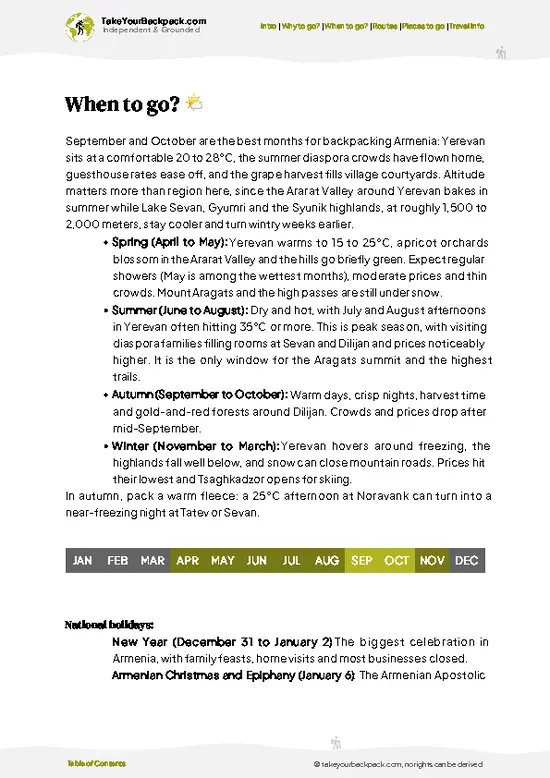
example page 2 from our offline Travel Guide for Armenia
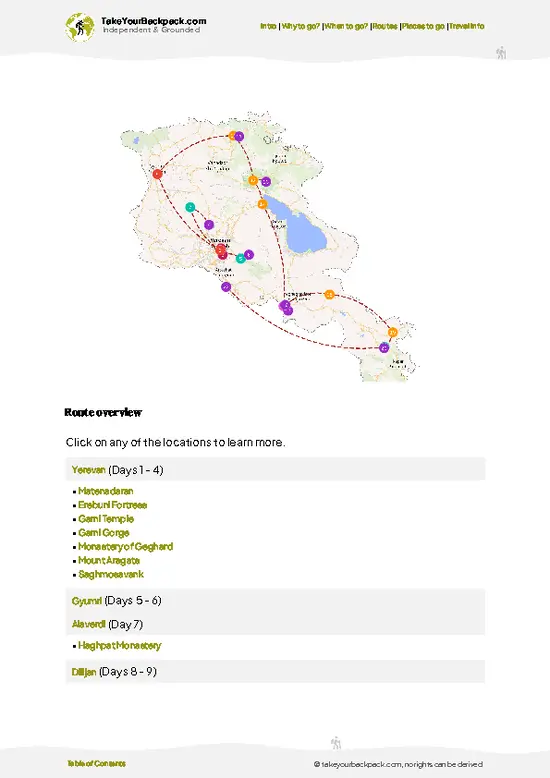
example page 3 from our offline Travel Guide for Armenia
example page 4 from our offline Travel Guide for Armenia
example page 5 from our offline Travel Guide for Armenia
example page 6 from our offline Travel Guide for Armenia
example page 7 from our offline Travel Guide for Armenia
The digital guide (257 pages) contains:
✅ 65 highlights, ranked by travel appeal
✅ Optimized 5, 10 & 15-day travel routes
✅ Cities, national parks, landmarks, beaches
✅ How to get around
✅ Offline-friendly for travel without Wi-Fi
👉 Click to see all 30+ guide features

📅 Plan smarter in minutes, not weeks
✅ Month by month travel advice
✅ Festivals & national holidays
✅ Budget expectations

🗺️ Go to the right places, skip the overrated ones
✅ Honest pros & cons of destinations
✅ Top hikes, parks & viewpoints
✅ Lesser-known places most travelers miss
✅ Clear “worth it vs skip it” guidance

🛏️ Travel smoothly without rookie mistakes
✅ Best areas to stay
✅ Transport systems explained simply
✅ Common scams & safety advice
✅ SIM cards, money & practical tips

🌍 Understand the country, not just visit it
✅ Culture & traditions
✅ 52 Essential phrases & customs
✅ Festivals worth planning around
✅ Traveler-friendly historical context
✅ Insights that make places more meaningful

📱 Built for real travel conditions
✅ Fully downloadable PDF
✅ Works completely offline
✅ Optimized for phone use
✅ Useful in remote areas & buses
✅ Everything in one place
Stop searching, start planning
Get instant access to your full guide. 30‑day money-back guarantee.
+ Add another guide for just

By proceeding you agree to our terms.
Sent to your inbox immediately after payment • 100% Secure Checkout
Best Backpacking Travel Advisor 2025 tourism awardBest Backpacking
Travel Advisor
2025
What others say about Take Your Backpack Guides:
⭐⭐⭐⭐⭐
Fantastic, amazing amount of information!
⭐⭐⭐⭐⭐
My goodness this is amazing, it's what I've been looking for hats off too you!
⭐⭐⭐⭐⭐
I think this is absolutely BRILLIANT
⭐⭐⭐⭐
Very complete and informative. It's still missing places, but I gotta to commend you
⭐⭐⭐⭐⭐
This is truly amazing, thank you, can't wait to explore it with my kids!
⭐⭐⭐⭐⭐
Awesome resource, thank you!
⭐⭐⭐⭐⭐
This is amazing! Can't wait to explore the ones I haven't seen
⭐⭐⭐⭐
I love this! Well done, great idea.
⭐⭐⭐⭐⭐
Thanks for taking the time to make this gem!
⭐⭐⭐⭐⭐
This might be the best website I've ever seen.
⭐⭐⭐⭐⭐
Congratulations, and thank you so much for your work; it's incredibly valuable.
⭐⭐⭐⭐
In all seriousness I think you did a great job pointing out the important spots
⭐⭐⭐⭐⭐
10/10 very good
⭐⭐⭐⭐⭐
As someone who's only just starting to visit regularly this is awesome, thank you.
⭐⭐⭐⭐
Thank you very much! I'm going to visit my dad, it's going to be very useful!
⭐⭐⭐⭐⭐
This is really cool! We'll be travelling for the first time and this definitely come in handy.
⭐⭐⭐⭐⭐
You are now our minister of culture, congratulations 👨‍💼
⭐⭐⭐⭐⭐
Just wanted to tell you that this is a pearl! Going to follow your recommendations.
⭐⭐⭐⭐⭐
This is so cool. I'll definitely be using the resource for my travels soon.
⭐⭐⭐⭐⭐
This is very impressive! Good work.
⭐⭐⭐⭐⭐
This is an amazing and informative site. Very well done!

🛏️ Where to stay?Where to Base Yourself

Armenia has plenty of hostels and family-run guesthouses, with dorm beds in Yerevan typically running 4,000 to 8,000 AMD (US$10 to 20) a night. The densest cluster sits in central Kentron, around Republic Square, Northern Avenue and the Cascade, where you can walk to most sights and the wine bars but should expect street noise late into the night, while neighboring Arabkir is quieter, residential and still only a 15 to 20 minute walk from the center. Outside the capital, Gyumri and Dilijan lean toward homestays and small guesthouses with breakfast included, which suits slower travel but gives you little nightlife after dark.

If you enjoy meeting fellow travelers, consider choosing hostels with … read more 👉
Armenia has plenty of hostels and family-run guesthouses, with dorm beds in Yerevan typically running 4,000 to 8,000 AMD (US$10 to 20) a night. The densest cluster sits in central Kentron, around Republic Square, Northern Avenue and the Cascade, where you can walk to most sights and the wine bars but should expect street noise late into the night, while neighboring Arabkir is quieter, residential and still only a 15 to 20 minute walk from the center. Outside the capital, Gyumri and Dilijan lean toward homestays and small guesthouses with breakfast included, which suits slower travel but gives you little nightlife after dark.

If you enjoy meeting fellow travelers, consider choosing hostels with high ratings for atmosphere. On the other hand, if you prefer having your own space, a hotel might be a better option.

ArmeniaExpand Your Journey

👋 Meet the founderWho’s Behind Take Your Backpack?

Johan, backpacker and founder of TakeYourBackpackHi, I’m Johan (Netherlands 🇳🇱), the creator of TakeYourBackpack. Over the past 3 decades, I’ve backpacked through 90+ countries across six continents, gaining extensive experience with independent travel, long-term trips, and overland routes.

This site is built on a combination of firsthand travel experience and carefully curated insights from other backpackers. Many guides are based on places I’ve personally visited, while others bring together tips, observations, and practical advice shared by trusted travelers I’ve met along the way.

The goal is to provide realistic, experience-driven guidance — not generic itineraries — so you can explore destinations with better context, clearer expectations, and more confidence.