×

Armenia🇦🇲 | best villagesTop-Rated 4 villages in Armenia

Villages in Armenia sit in stone, not in postcards: basalt and tuff houses, smoke from tonir ovens, apricot and walnut trees, and cows ambling home at dusk on dirt lanes. The country is small, but the character shifts fast. Lori and Tavush in the north are green, damp and forested, with fog sliding through gorges. Syunik in the south is rugged, high and quiet, with long, rough roads. Around Lake Sevan and Aragats, air is thin and cold even in summer. Homestays cost far less than in Georgia or Turkey’s tourist zones. Independent travelers can reach most places by marshrutka or shared taxi, though timetables are thin and crowds appear only at a few famous monasteries.

By Johan Kruseman 🇳🇱 | Updated October 18, 2026
Explore the best landmarks in Armenia

Why go?Why Travelers Love These Spots

Armenia suits village travel because nearly everything sits above 1,000 meters, and the land is folded into gorges, volcanic plateaus and alpine meadows. Villages grew beside springs and river canyons, so each one has its own microclimate and its own crop, from apricots and grapes in the Ararat plain to potatoes and hay in the highlands. A Christian history of seventeen centuries means that even small settlements keep khachkars (carved cross-stones), chapels and monastery ruins within walking distance. The Soviet era left a second layer: concrete apartment blocks, shuttered factories and pipelines running above the fields, which sit beside much older stone houses.

Before choosing Armenia for villages, know that rural life is working life. Haymaking, cheese and lavash baking set the rhythm, … read more 👉
Armenia suits village travel because nearly everything sits above 1,000 meters, and the land is folded into gorges, volcanic plateaus and alpine meadows. Villages grew beside springs and river canyons, so each one has its own microclimate and its own crop, from apricots and grapes in the Ararat plain to potatoes and hay in the highlands. A Christian history of seventeen centuries means that even small settlements keep khachkars (carved cross-stones), chapels and monastery ruins within walking distance. The Soviet era left a second layer: concrete apartment blocks, shuttered factories and pipelines running above the fields, which sit beside much older stone houses.

Before choosing Armenia for villages, know that rural life is working life. Haymaking, cheese and lavash baking set the rhythm, and guesthouses are usually family homes with shared meals of dolma, fresh herbs, cheese and strong coffee. Roads are patchy, with potholes and unpaved stretches in the south and the far northeast. Public transport often runs once a day, and winter snow can close mountain passes. English is limited outside guesthouses, so a few Armenian or Russian phrases help. Expect generous hosting, a lot of toasts with homemade brandy or fruit vodka, and very little tourist infrastructure.
Our Approach to Ranking
The list of best villages in Armenia is created based on authenticity, scenic beauty, community spirit, traditions, and overall character. If you feel a village is missing in this list, please let us know.

When to go?Seasonal Guide to Visiting

Best months and shoulder seasons: Late May to June and September to mid-October are the best months for Armenian villages, because days are typically 18 to 28°C, hiking trails are open and orchards or vineyards are either in bloom or heavy with fruit. In June the hills are green and smell of wild thyme. In late September the grape harvest begins, and you can hear presses and see crates stacked in courtyards. Rain is most likely in spring, roughly 50 to 80 mm a month in northern Lori and Tavush, and can turn dirt tracks to mud.
Summer and winter: July and August reach 30 to 40°C in the Ararat plain and Vayots Dzor, but highland villages near Sevan, Aragats and Syunik stay 10 to 15 degrees cooler. Evenings can drop below 10°C even in midsummer. Guesthouse prices rise slightly, perhaps 10 to 20 … read more 👉
Best months and shoulder seasons: Late May to June and September to mid-October are the best months for Armenian villages, because days are typically 18 to 28°C, hiking trails are open and orchards or vineyards are either in bloom or heavy with fruit. In June the hills are green and smell of wild thyme. In late September the grape harvest begins, and you can hear presses and see crates stacked in courtyards. Rain is most likely in spring, roughly 50 to 80 mm a month in northern Lori and Tavush, and can turn dirt tracks to mud.
Summer and winter: July and August reach 30 to 40°C in the Ararat plain and Vayots Dzor, but highland villages near Sevan, Aragats and Syunik stay 10 to 15 degrees cooler. Evenings can drop below 10°C even in midsummer. Guesthouse prices rise slightly, perhaps 10 to 20 percent, around festivals and holidays, but crowds remain small except at popular monasteries on weekends. From November to March, the highlands see snow and temperatures between -15 and 0°C, with some mountain roads and pass crossings closed, and many small guesthouses reduce service. The lower valleys stay milder, and wood smoke and warm bread make winter stays cozy for those who plan around the limited transport.

village hoppingTips for Visiting Multiple Destinations

Time needed: A trip combining several villages in Armenia needs 7 to 12 days, enough to cover two or three regions without spending every day in a minibus. Most travelers start in Yerevan, the hub for marshrutkas and shared taxis. A sensible loop heads north first to Lori and Tavush, then swings east through the Sevan basin, then south through Vayots Dzor into Syunik, and returns by road to the capital. Doing it in that direction keeps the highest, hardest roads for when you are settled into the rhythm.
Pacing and transfers: Plan two nights per base. That gives one full day for walking, a long meal and the unplanned invitations that come with village life. Travel between regions takes roughly 2 to 4 hours, for example Yerevan to Dilijan or Yerevan to Yeghegnadzor, and 5 to 7 hours to reach … read more 👉
Time needed: A trip combining several villages in Armenia needs 7 to 12 days, enough to cover two or three regions without spending every day in a minibus. Most travelers start in Yerevan, the hub for marshrutkas and shared taxis. A sensible loop heads north first to Lori and Tavush, then swings east through the Sevan basin, then south through Vayots Dzor into Syunik, and returns by road to the capital. Doing it in that direction keeps the highest, hardest roads for when you are settled into the rhythm.
Pacing and transfers: Plan two nights per base. That gives one full day for walking, a long meal and the unplanned invitations that come with village life. Travel between regions takes roughly 2 to 4 hours, for example Yerevan to Dilijan or Yerevan to Yeghegnadzor, and 5 to 7 hours to reach deep Syunik. Marshrutkas leave from Yerevan’s bus stations in the morning and often depart when full, so arrive early. Village links can be sparse, and a pre-arranged taxi or host pickup costs a modest sum.
Common planning mistakes: The usual error is cramming a different village into every day, which leaves you mostly looking through a dusty window. Another is relying on afternoon buses that may not exist. Build slack into the schedule, confirm departures with your host, and keep one buffer day for weather, as fog and snow can close high roads.

The ListTop villages of Armenia

1 Haghartsin

forest monastery, mountain trails, woodland silence

Wander through dense forests to reach a centuries-old monastery, where quiet paths and mountain air create a sense of seclusion.

2 Areni

wine cellars, vineyard slopes, archaeological sites

Sample local vintages in stone cellars, walk through vineyards, and visit excavations that reveal traces of early winemaking traditions.

armenia-city-areni
© Google |

3 Khndzoresk

cave dwellings, swinging bridge, rugged cliffs

Cross a suspension bridge to reach ancient cave homes carved into steep rock, then wander trails that reveal the village’s layered past.

4 Byurakan

observatory, volcanic plateau, mountain views

Watch the night sky from a renowned observatory, then hike open landscapes where volcanic rock meets broad vistas of Aragats.

armenia-city-byurakan
© Google |
Loading the map 🌍

Expert viewExpert Commentary on villages

How many villages to visit: Plan on four to six villages in a one to two week trip. Fewer than that and you only skim the surface, while more than that turns into a blur of guesthouse check-ins and long, rutted roads. With two nights in most places, you get time for a morning on a stony path, a lunch of lavash and fresh cheese, and an evening on a terrace as the light turns copper on the cliffs.
Choosing the kind: Choose by travel style. Hikers should favor high-altitude and gorge villages where trails start at the door and the air smells of grass and juniper. History lovers should pick settlements near monasteries and khachkar fields, where you can walk among weathered stones. Food-focused travelers will enjoy wine, brandy and orchard villages in the south and the Ararat plain, especially … read more 👉
How many villages to visit: Plan on four to six villages in a one to two week trip. Fewer than that and you only skim the surface, while more than that turns into a blur of guesthouse check-ins and long, rutted roads. With two nights in most places, you get time for a morning on a stony path, a lunch of lavash and fresh cheese, and an evening on a terrace as the light turns copper on the cliffs.
Choosing the kind: Choose by travel style. Hikers should favor high-altitude and gorge villages where trails start at the door and the air smells of grass and juniper. History lovers should pick settlements near monasteries and khachkar fields, where you can walk among weathered stones. Food-focused travelers will enjoy wine, brandy and orchard villages in the south and the Ararat plain, especially in harvest season. Travelers short on time should stay near Yerevan, where day trips by shared taxi are easy and cheap, though you lose the silence and the stars.
What it costs: Budget US$25 to 45 a day for a backpacker using homestays, marshrutkas and home-cooked meals. A guesthouse bed with dinner and breakfast usually costs about 8,000 to 20,000 AMD (roughly US$20 to 50), and a hearty dinner on its own around 3,000 to 6,000 AMD. Local transport per leg runs about 500 to 3,000 AMD, while a private taxi for a rough mountain road can cost 15,000 to 40,000 AMD. Monastery entry is often free or a few hundred dram, and a local guide for a half-day walk is around 10,000 to 25,000 AMD. Carry cash, because village shops rarely take cards and ATMs are scarce.
Safety and etiquette: Armenia is generally safe for visitors, and petty crime in villages is rare. The real hazards are rough roads, stray dogs near sheep pens, sudden mountain storms and unmarked hiking trails, so download offline maps and tell your host your route. Stay well away from the borders with Azerbaijan and keep to roads that locals recommend in Syunik and Tavush. Accept coffee and food when offered, as refusing can seem rude, and expect toasts at dinner. Dress modestly in churches, cover shoulders, and ask before photographing people or their homes. One short practical note from the road: carry a few small bills for a ride, since drivers rarely have change.

✈️ The backpacker research shortcutArmenia Travel Guide

An offline-friendly backpacking guide with optimized travel routes, ranked highlights, transport advice, and the best areas to stay.
example page 0 from our offline Travel Guide for Armenia
example page 1 from our offline Travel Guide for Armenia
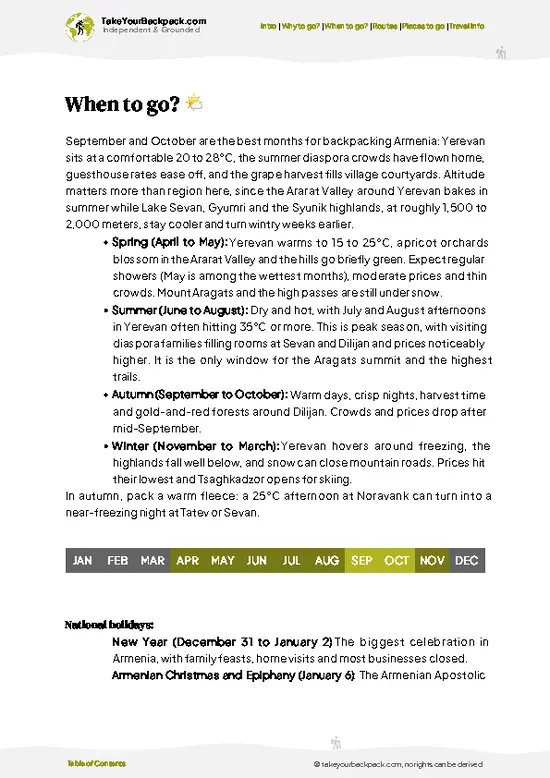
example page 2 from our offline Travel Guide for Armenia
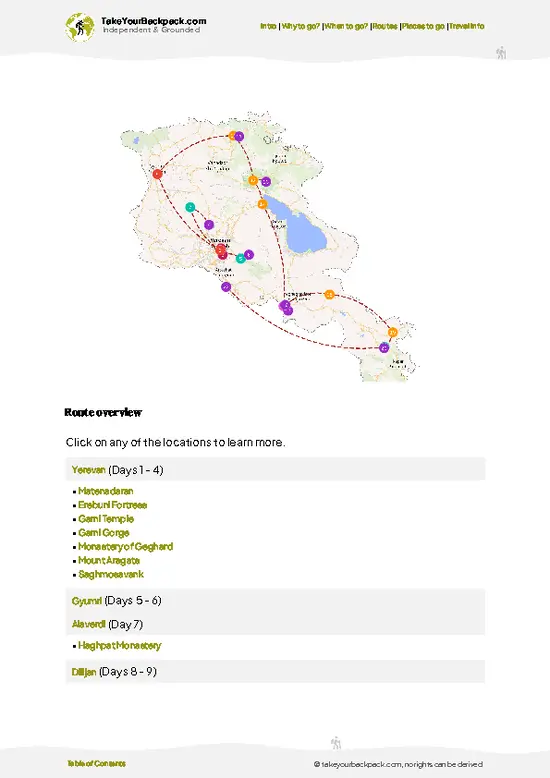
example page 3 from our offline Travel Guide for Armenia
example page 4 from our offline Travel Guide for Armenia
example page 5 from our offline Travel Guide for Armenia
example page 6 from our offline Travel Guide for Armenia
example page 7 from our offline Travel Guide for Armenia
The digital guide (257 pages) contains:
✅ 65 highlights, ranked by travel appeal
✅ Optimized 5, 10 & 15-day travel routes
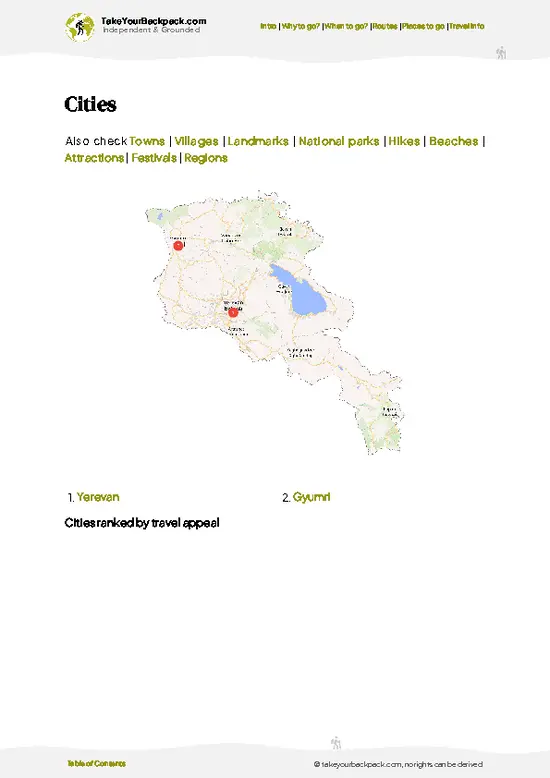
✅ Cities, national parks, landmarks, beaches
✅ How to get around
✅ Offline-friendly for travel without Wi-Fi
👉 Click to see all 30+ guide features

📅 Plan smarter in minutes, not weeks
✅ Month by month travel advice
✅ Festivals & national holidays
✅ Budget expectations

🗺️ Go to the right places, skip the overrated ones
✅ Honest pros & cons of destinations
✅ Top hikes, parks & viewpoints
✅ Lesser-known places most travelers miss
✅ Clear “worth it vs skip it” guidance

🛏️ Travel smoothly without rookie mistakes
✅ Best areas to stay
✅ Transport systems explained simply
✅ Common scams & safety advice
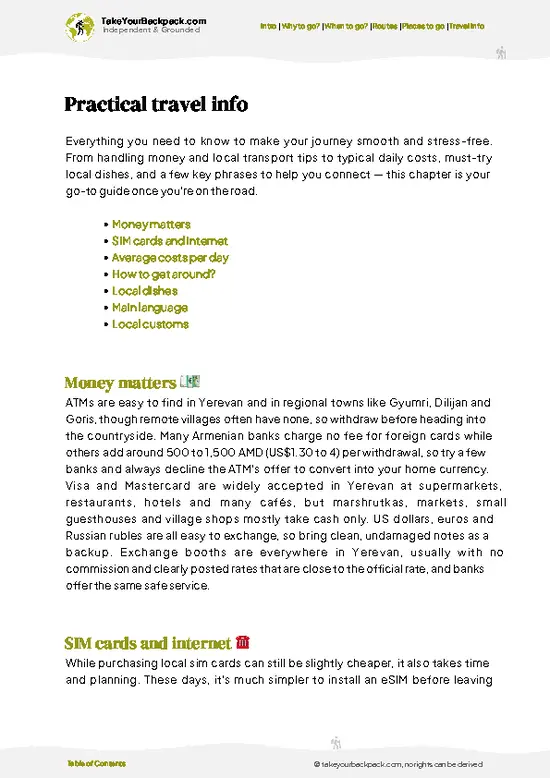
✅ SIM cards, money & practical tips

🌍 Understand the country, not just visit it
✅ Culture & traditions
✅ 52 Essential phrases & customs
✅ Festivals worth planning around
✅ Traveler-friendly historical context
✅ Insights that make places more meaningful

📱 Built for real travel conditions
✅ Fully downloadable PDF
✅ Works completely offline
✅ Optimized for phone use
✅ Useful in remote areas & buses
✅ Everything in one place
Stop searching, start planning
Get instant access to your full guide. 30‑day money-back guarantee.
+ Add another guide for just

By proceeding you agree to our terms.
Sent to your inbox immediately after payment • 100% Secure Checkout
Best Backpacking Travel Advisor 2025 tourism awardBest Backpacking
Travel Advisor
2025
What others say about Take Your Backpack Guides:
⭐⭐⭐⭐⭐
Fantastic, amazing amount of information!
⭐⭐⭐⭐⭐
My goodness this is amazing, it's what I've been looking for hats off too you!
⭐⭐⭐⭐⭐
I think this is absolutely BRILLIANT
⭐⭐⭐⭐
Very complete and informative. It's still missing places, but I gotta to commend you
⭐⭐⭐⭐⭐
This is truly amazing, thank you, can't wait to explore it with my kids!
⭐⭐⭐⭐⭐
Awesome resource, thank you!
⭐⭐⭐⭐⭐
This is amazing! Can't wait to explore the ones I haven't seen
⭐⭐⭐⭐
I love this! Well done, great idea.
⭐⭐⭐⭐⭐
Thanks for taking the time to make this gem!
⭐⭐⭐⭐⭐
This might be the best website I've ever seen.
⭐⭐⭐⭐⭐
Congratulations, and thank you so much for your work; it's incredibly valuable.
⭐⭐⭐⭐
In all seriousness I think you did a great job pointing out the important spots
⭐⭐⭐⭐⭐
10/10 very good
⭐⭐⭐⭐⭐
As someone who's only just starting to visit regularly this is awesome, thank you.
⭐⭐⭐⭐
Thank you very much! I'm going to visit my dad, it's going to be very useful!
⭐⭐⭐⭐⭐
This is really cool! We'll be travelling for the first time and this definitely come in handy.
⭐⭐⭐⭐⭐
You are now our minister of culture, congratulations 👨‍💼
⭐⭐⭐⭐⭐
Just wanted to tell you that this is a pearl! Going to follow your recommendations.
⭐⭐⭐⭐⭐
This is so cool. I'll definitely be using the resource for my travels soon.
⭐⭐⭐⭐⭐
This is very impressive! Good work.
⭐⭐⭐⭐⭐
This is an amazing and informative site. Very well done!

🛏️ Where to stay?Top Places to Consider Staying

Armenia has plenty of hostels and family-run guesthouses, with dorm beds in Yerevan typically running 4,000 to 8,000 AMD (US$10 to 20) a night. The densest cluster sits in central Kentron, around Republic Square, Northern Avenue and the Cascade, where you can walk to most sights and the wine bars but should expect street noise late into the night, while neighboring Arabkir is quieter, residential and still only a 15 to 20 minute walk from the center. Outside the capital, Gyumri and Dilijan lean toward homestays and small guesthouses with breakfast included, which suits slower travel but gives you little nightlife after dark.

If you enjoy meeting fellow travelers, consider choosing hostels with … read more 👉
Armenia has plenty of hostels and family-run guesthouses, with dorm beds in Yerevan typically running 4,000 to 8,000 AMD (US$10 to 20) a night. The densest cluster sits in central Kentron, around Republic Square, Northern Avenue and the Cascade, where you can walk to most sights and the wine bars but should expect street noise late into the night, while neighboring Arabkir is quieter, residential and still only a 15 to 20 minute walk from the center. Outside the capital, Gyumri and Dilijan lean toward homestays and small guesthouses with breakfast included, which suits slower travel but gives you little nightlife after dark.

If you enjoy meeting fellow travelers, consider choosing hostels with high ratings for atmosphere. On the other hand, if you prefer having your own space, a hotel might be a better option.

ArmeniaMore Places Across Armenia

👋 Meet the founderWho’s Behind Take Your Backpack?

Johan, backpacker and founder of TakeYourBackpackHi, I’m Johan (Netherlands 🇳🇱), the creator of TakeYourBackpack. Over the past 3 decades, I’ve backpacked through 90+ countries across six continents, gaining extensive experience with independent travel, long-term trips, and overland routes.

This site is built on a combination of firsthand travel experience and carefully curated insights from other backpackers. Many guides are based on places I’ve personally visited, while others bring together tips, observations, and practical advice shared by trusted travelers I’ve met along the way.

The goal is to provide realistic, experience-driven guidance — not generic itineraries — so you can explore destinations with better context, clearer expectations, and more confidence.