×

Australia🇦🇺 | best villagesWhere to Find the 4 Best villages in Australia

Australia does not really do villages the way Europe does. Here, a “village” is usually a handful of streets, a pub, a general store and a long, empty road in every direction. The distances are the plot twist: two lovely places can sit 600 kilometers apart, which on a map looks like a short hop and in a car looks like a full day with one servo (gas station) between them.

The country splits into very different flavors. The east coast and the southeast hold heritage hill towns, wine valleys and beach hamlets, with the easiest access and the heaviest weekend crowds from Sydney and Melbourne. Tasmania adds cool, green, quiet settlements. Western Australia and the Northern Territory offer tiny outposts and remote communities where fuel, water and phone signal become real planning items. Prices swing too: a pub room in a coastal holiday hamlet in January costs triple what the same bed fetches in the outback in winter.

For backpackers and independent travelers, the choice comes down to how much driving you can tolerate, whether you want company or silence, and how much you will pay for a flat white at the end of the road. Pick the kind first, then the dot on the map.

By Johan Kruseman 🇳🇱 | Updated October 18, 2026
Explore the best landmarks in Australia

Why go?Understanding Their Importance

Australia is a young country in European terms, and that shapes everything about its villages. Most settlements date from the 1800s, when gold rushes, sheep and cattle runs, and railway lines created towns almost overnight. Many then shrank when the gold ran out or the train stopped, which is why you find grand stone pubs and banks in places with a few hundred residents. The architecture is out of proportion to the population, and that is much of the appeal.

The land itself decides where people live. About 85 percent of Australians live within 50 kilometers of the coast, so the interior is thinly settled and the few villages there exist because of a water source, a mine or a stock route. Distance is the defining fact. Nothing is “just down the road,” and public transport between small places … read more 👉
Australia is a young country in European terms, and that shapes everything about its villages. Most settlements date from the 1800s, when gold rushes, sheep and cattle runs, and railway lines created towns almost overnight. Many then shrank when the gold ran out or the train stopped, which is why you find grand stone pubs and banks in places with a few hundred residents. The architecture is out of proportion to the population, and that is much of the appeal.

The land itself decides where people live. About 85 percent of Australians live within 50 kilometers of the coast, so the interior is thinly settled and the few villages there exist because of a water source, a mine or a stock route. Distance is the defining fact. Nothing is “just down the road,” and public transport between small places is thin to nonexistent. A hire car, a campervan or a very patient thumb is the usual answer, and the cost of fuel and rental belongs in your plan before the accommodation does.

It also matters that the continent is old and the Aboriginal and Torres Strait Islander presence runs back at least 60,000 years. Many places carry traditional names and living cultural meaning, and some remote communities are on Aboriginal land where entry needs a permit. Visiting is possible and often rewarding when done through community-run tours, but it is not a free-for-all.

Climate adds another layer. The north has a wet season that can cut roads, the south has bushfire season, and the center is hot enough in summer to make a midday walk a poor idea. None of this makes Australia a bad choice. It means villages here suit travelers who like space, big skies and a bit of planning.

Before committing, know three things: accommodation in small places is limited and books out on school holidays, many shops and kitchens close early (a 7 pm dinner can be a gamble), and card payment works nearly everywhere but mobile coverage does not. Download maps offline, carry water, and treat a fuel gauge at half as a suggestion to fill up.
How the List Was Created
The list of best villages in Australia is created based on authenticity, scenic beauty, community spirit, traditions, and overall character. If you feel a village is missing in this list, please let us know.

When to go?Optimal Periods for Travel

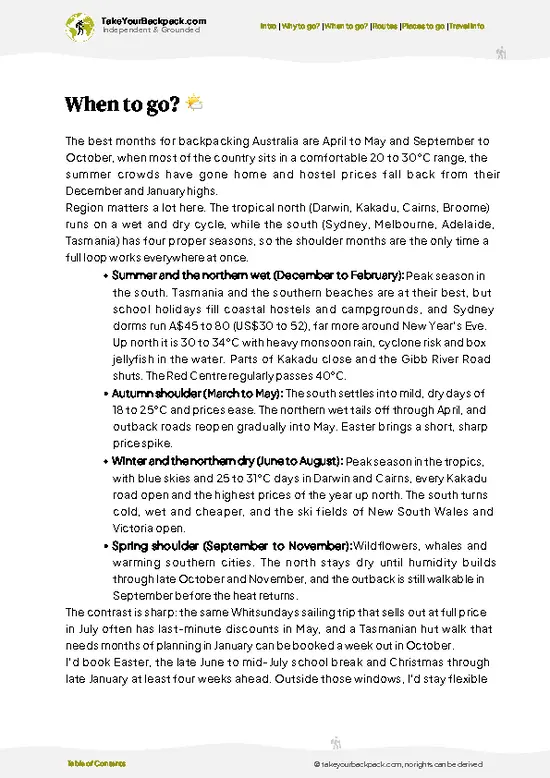
Best months: Autumn and spring, roughly March to May and September to November, are the best months for villages in Australia because temperatures sit around 18 to 27°C across the populated southeast and the heat and storm extremes of other seasons stay away. Australia’s seasons are flipped from the Northern Hemisphere, a fact that still catches people packing for the wrong December.

In the southeast (Victoria, New South Wales, South Australia, Tasmania) autumn brings clear days, golden foliage in the hills and wine harvest. Spring means wildflowers and long light, though it can also bring four seasons in one afternoon. Summer, December to February, runs 25 to 35°C and above, with bushfire risk in dry bushland and packed coastal places during school holidays. Winter, June to August, is cold … read more 👉
Best months: Autumn and spring, roughly March to May and September to November, are the best months for villages in Australia because temperatures sit around 18 to 27°C across the populated southeast and the heat and storm extremes of other seasons stay away. Australia’s seasons are flipped from the Northern Hemisphere, a fact that still catches people packing for the wrong December.

In the southeast (Victoria, New South Wales, South Australia, Tasmania) autumn brings clear days, golden foliage in the hills and wine harvest. Spring means wildflowers and long light, though it can also bring four seasons in one afternoon. Summer, December to February, runs 25 to 35°C and above, with bushfire risk in dry bushland and packed coastal places during school holidays. Winter, June to August, is cold in the highlands and Tasmania (often 0 to 12°C, with snow in the alpine areas), but quiet and cheap.

The tropical north and the center: Northern Queensland, the Top End of the Northern Territory and the Kimberley in Western Australia run on wet and dry seasons. The dry season, May to October, is the time to go: days of 28 to 32°C, low humidity and open roads. The wet season, November to April, brings heat, humidity, monsoon downpours (the Top End can receive over 1,500 mm), flooded roads and closed tracks. Some tours and lodges shut entirely, and stinger season keeps swimmers out of the sea in northern waters.

The red center is best from April to September. Winter days sit around 18 to 24°C but nights can fall near freezing, so a warm layer is not optional. From December to February, daytime temperatures regularly exceed 40°C.

Crowds and prices: School holidays, especially mid-December to late January and the Easter break, are when small places fill and rates can climb 30 to 100 percent, with minimum stays of two or three nights common. Long weekends do the same, quietly. Shoulder periods and midweek stays offer the best value, and winter in the south and the wet season in the north offer the lowest prices, for those who accept the weather. Book accommodation weeks ahead for peak times, and check opening days, since small cafes and pubs often close one or two days a week outside summer.

village hoppingHow to Combine villages Into One Trip

How long and how to link regions: A trip combining several villages in Australia needs 10 to 21 days, and the lower end only works if you stay within one region. The country punishes ambition. A map makes Sydney to Melbourne look like a tidy hop, but it is about 880 kilometers, roughly 9 to 10 hours of driving, or a short flight of 1 hour 30 minutes.

Regions cluster by state. The southeast loop works well from Sydney or Melbourne, with the Blue Mountains, Southern Highlands and south coast on one side and Victoria’s goldfields, High Country and Great Ocean Road on the other. Tasmania is a separate trip of 5 to 8 days, reached by a 1 hour 15 minute flight from Melbourne or the overnight Spirit of Tasmania ferry from Geelong. Queensland’s Sunshine Coast hinterland and the northern rainforest … read more 👉
How long and how to link regions: A trip combining several villages in Australia needs 10 to 21 days, and the lower end only works if you stay within one region. The country punishes ambition. A map makes Sydney to Melbourne look like a tidy hop, but it is about 880 kilometers, roughly 9 to 10 hours of driving, or a short flight of 1 hour 30 minutes.

Regions cluster by state. The southeast loop works well from Sydney or Melbourne, with the Blue Mountains, Southern Highlands and south coast on one side and Victoria’s goldfields, High Country and Great Ocean Road on the other. Tasmania is a separate trip of 5 to 8 days, reached by a 1 hour 15 minute flight from Melbourne or the overnight Spirit of Tasmania ferry from Geelong. Queensland’s Sunshine Coast hinterland and the northern rainforest pair with a flight to Brisbane or Cairns. The Northern Territory and Western Australia each need their own trip, since driving between Darwin and Broome, for instance, takes around 17 to 19 hours.

Direction and pace: Travel with the seasons: north in winter, south in summer. Within a region, plan a one-way route with a fly in and a fly out from different cities, and hire a car with a one-way drop-off (fees often run A$100 to 400, more across state lines). Allow 1 to 2 nights per village in the southeast and 2 to 3 nights for remote places, where simply arriving takes most of the day. Between stops, keep drives to 2 to 4 hours. Anything past 5 hours is a transport day, not a sightseeing day.

Planning mistakes: The classic error is measuring distance in kilometers instead of hours, and forgetting that speed limits are 100 to 110 km/h on open roads and that rest breaks are real. Plan for about 70 kilometers per hour on average and the numbers become honest.

The second is driving at dusk and dawn, when kangaroos and wombats are most active and collisions are common. Finish your drive by late afternoon. The third is relying on buses: regional services such as NSW TrainLink and V/Line link larger towns well but run just a few times a day or week to small places, so check timetables before committing. The fourth is cramming. Cut one stop and the trip improves, so give each place a night with an unhurried morning, and keep a spare day somewhere in the middle for weather, closed roads or a very good pub.

The ListThe Best villages of Australia

1 Halls Gap

Pinnacle sandstone ridge, Brambuk cultural center, Venus Baths rock pools, dusk kangaroos

Hike sandstone gullies to a lookout over Lake Bellfield, then learn Gariwerd’s Aboriginal story at Brambuk and cool off at the creek pools.

australia-city-halls-gap
© Google | Chris Perri

2 Kangaroo Valley

Hampden Bridge, river paddling, pioneer farm, escarpment drive

Paddle the slow Kangaroo River past cliffs and platypus banks, cross the 1898 sandstone-towered suspension bridge, and see how valley dairy farmers once lived.

3 Lorne

Erskine Falls, Teddys Lookout, Loutit Bay pier, Otway forest

Descend fern-lined steps to a 30 meter waterfall, watch the coast road curl toward Cape Patton, then end the day walking the pier.

4 Nimbin

Cullen Street murals, artist cooperative, Wednesday market, volcano rim

Stroll a painted main street, browse local ceramics and paintings at the cooperative gallery, and pick up fresh produce at the Wednesday farmers market.

Loading the map 🌍

Expert viewPro Tips for Exploring the Best

How many villages to visit: Four to six villages is the number I would advise for a typical trip of two to four weeks. Australia is roughly the size of the contiguous United States, and a village here often sits 100 to 300 kilometers from the next one with nothing but a roadhouse and some very committed flies in between. Pack in ten stops and you will see mostly windshield. Four to six lets each place last two or three nights, enough for a morning walk, an evening at the pub and the slow discovery that the bakery closes at 1 p.m. Time is the scarcest resource here, so spending fewer stops at greater depth gives a backpacker the most for the least frantic driving.
One stop is a trap in the other direction. A single village for a week sounds restful until the second afternoon, when you have read … read more 👉
How many villages to visit: Four to six villages is the number I would advise for a typical trip of two to four weeks. Australia is roughly the size of the contiguous United States, and a village here often sits 100 to 300 kilometers from the next one with nothing but a roadhouse and some very committed flies in between. Pack in ten stops and you will see mostly windshield. Four to six lets each place last two or three nights, enough for a morning walk, an evening at the pub and the slow discovery that the bakery closes at 1 p.m. Time is the scarcest resource here, so spending fewer stops at greater depth gives a backpacker the most for the least frantic driving.
One stop is a trap in the other direction. A single village for a week sounds restful until the second afternoon, when you have read the noticeboard twice.
Choosing between the kinds: Australian villages fall into a few broad types, and each one costs you differently in time, money and comfort. Coastal villages are the easiest on all three. They tend to have a hostel or caravan park, a supermarket, decent coffee and a bus or two, so you spend little effort getting fed and housed. They also draw school-holiday crowds, which push dorm beds from about AU$35 to 50 (US$23 to 33) up toward AU$60 or more. For a first-timer, this type gives the best return on comfort.
Heritage and gold-rush towns in the southeast cost a little less, often AU$30 to 45 (US$20 to 30) for a dorm or a pub room around AU$80 to 120 (US$52 to 78), and the pub is the social hub. Comfort is high, driving distances are short, and the trade is that some are quiet midweek, with shops shut by late afternoon.
Outback settlements are where money and time both stretch. Fuel can run AU$2.20 to 3.00 a liter (US$1.45 to 1.95) at remote roadhouses, accommodation is limited and priced accordingly (AU$40 to 70 for a bunk, AU$30 to 50 for a powered or unpowered campsite), and every leg demands planning. Comfort drops, but so does the number of other travelers, and the sky at night is worth the inconvenience. Choose these if you have a vehicle and a week of slack.
Wine and hinterland villages are the pricey ones. Rooms often start around AU$120 (US$78) and meals are built around the idea that you are on holiday. Backpackers get the most from them by treating them as a day stop or one night, not a base.
What it costs per day and per visit: A realistic backpacker budget is AU$100 to 180 a day (US$65 to 118). That covers a dorm bed or campsite, groceries from the local supermarket plus one pub meal, and a share of fuel. Pub meals run AU$22 to 35 (US$14 to 23), a flat white about AU$5 to 6, and a beer AU$8 to 11. Cooking yourself brings the food line down to AU$20 to 30 a day, which is how most people survive the beer prices.
Per visit, the extras add up quietly. National park entry is often AU$8 to 20 (US$5 to 13) per vehicle per day, and some states offer multi-day or annual passes that pay off after about four visits. Uluru-Kata Tjuta charges AU$38 (US$25) for a three-day pass. Guided walks or Aboriginal-led cultural experiences typically cost AU$60 to 200 (US$39 to 130), and I would spend on at least one, because a local guide turns a view into a story. Renting a car or small campervan costs AU$50 to 120 (US$33 to 78) a day plus fuel, and a one-way drop fee can add AU$100 to 400. Skipping the car saves cash but costs time, since regional buses may run only a few days a week.
Safety in villages: Distance is the main hazard. Carry at least 4 liters of water per person per day on any remote road, fill the tank whenever you pass a pump, and tell someone your plan. Mobile coverage disappears quickly outside town, so download offline maps first. Avoid driving at dawn and dusk, when kangaroos step onto the road with no regard for your insurance excess.
Heat is serious in the interior and north, where summer days regularly pass 40°C. Walk early, rest midday. In tropical northern villages, saltwater crocodiles live in rivers and coastal water, so swim only where signs say it is safe. Stinging jellyfish are a risk offshore from roughly October to May. Elsewhere, obey the red and yellow flags, because rips cause most beach rescues.
In the wet season, flooding can cut roads for days, so build slack into plans there and check state road reports before leaving.
Cultural considerations: Many villages sit on Aboriginal or Torres Strait Islander land, and the courtesies are specific. Some remote communities require a permit to enter, such as through the Northern Land Council in the Northern Territory, and these can take days to arrive, so apply early. Some communities restrict alcohol, and carrying it in can lead to fines or confiscation. Ask before photographing people, and follow signs about sacred sites, including the climbing closure at Uluru, which exists for good reason.
In small towns, wave at oncoming drivers on country roads and say hello in shops. Pubs are social anchors, rounds are common, and tipping is not expected. Opening hours are short, with many kitchens closing by 8 p.m., so eat before you are desperate. Buy groceries when you see a supermarket, because the next one may be 200 kilometers away.
Last, be a good guest in places where the whole town is a few hundred people. Buy a coffee, a pie or a bunk locally, and leave the campsite cleaner than you found it.

✈️ The backpacker research shortcutAustralia Travel Guide

An offline-friendly backpacking guide with optimized travel routes, ranked highlights, transport advice, and the best areas to stay.
example page 0 from our offline Travel Guide for Australia
example page 1 from our offline Travel Guide for Australia
example page 2 from our offline Travel Guide for Australia
example page 3 from our offline Travel Guide for Australia
example page 4 from our offline Travel Guide for Australia
example page 5 from our offline Travel Guide for Australia
example page 6 from our offline Travel Guide for Australia
example page 7 from our offline Travel Guide for Australia
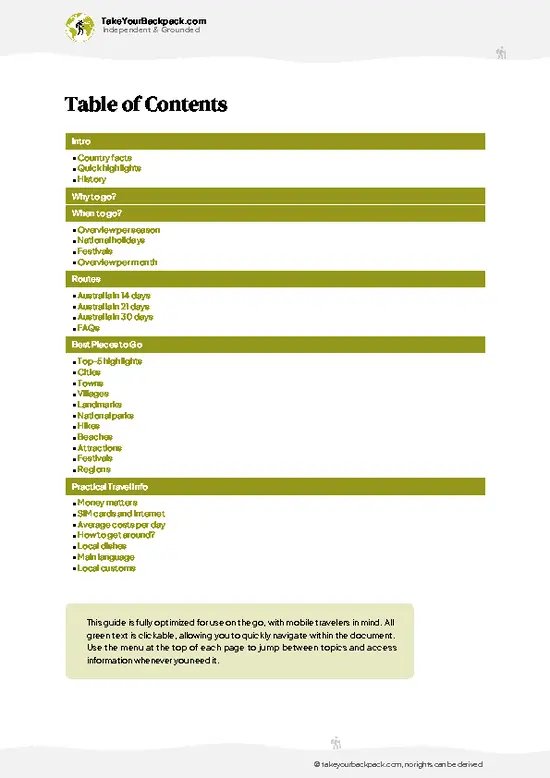
The digital guide (414 pages) contains:
✅ 143 highlights, ranked by travel appeal
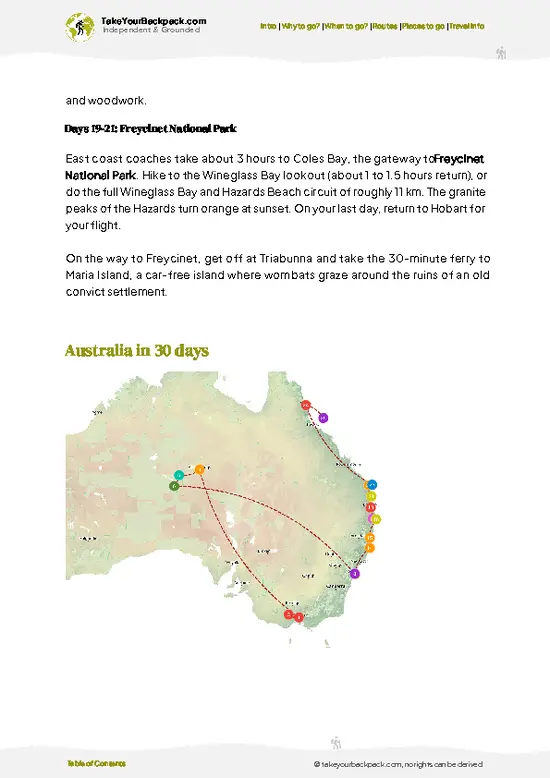
✅ Optimized 14, 21 & 30-day travel routes
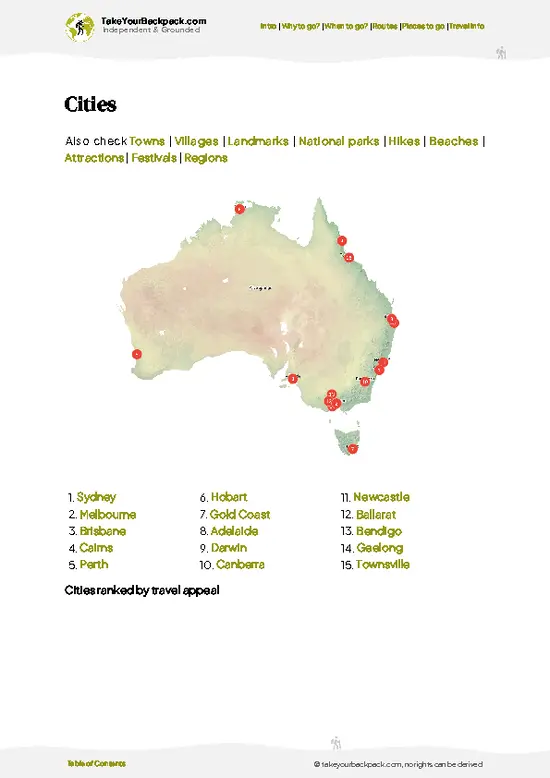
✅ Cities, national parks, landmarks, beaches
✅ How to get around
✅ Offline-friendly for travel without Wi-Fi
👉 Click to see all 30+ guide features

📅 Plan smarter in minutes, not weeks
✅ Month by month travel advice
✅ Festivals & national holidays
✅ Budget expectations

🗺️ Go to the right places, skip the overrated ones
✅ Honest pros & cons of destinations
✅ Top hikes, parks & viewpoints
✅ Lesser-known places most travelers miss
✅ Clear “worth it vs skip it” guidance

🛏️ Travel smoothly without rookie mistakes
✅ Best areas to stay
✅ Transport systems explained simply
✅ Common scams & safety advice
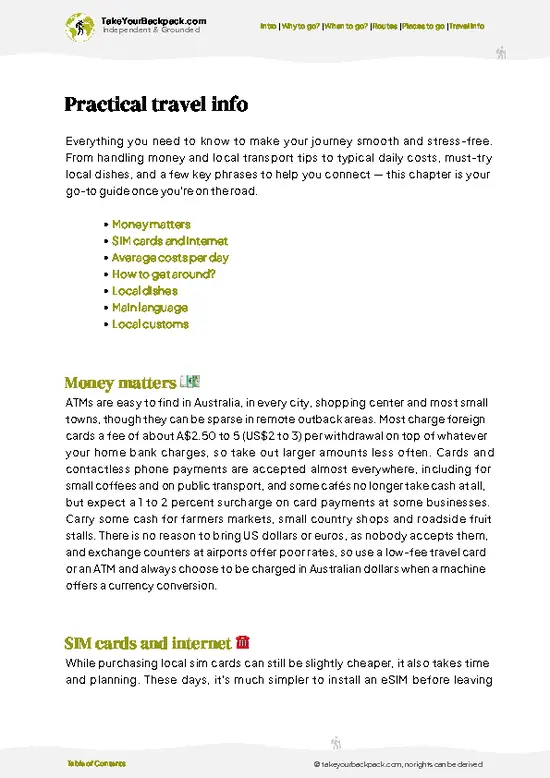
✅ SIM cards, money & practical tips

🌍 Understand the country, not just visit it
✅ Culture & traditions
✅ Local customs
✅ Festivals worth planning around
✅ Traveler-friendly historical context
✅ Insights that make places more meaningful

📱 Built for real travel conditions
✅ Fully downloadable PDF
✅ Works completely offline
✅ Optimized for phone use
✅ Useful in remote areas & buses
✅ Everything in one place
Stop searching, start planning
Get instant access to your full guide. 30‑day money-back guarantee.
+ Add another guide for just

By proceeding you agree to our terms.
Sent to your inbox immediately after payment • 100% Secure Checkout
Best Backpacking Travel Advisor 2025 tourism awardBest Backpacking
Travel Advisor
2025
What others say about Take Your Backpack Guides:
⭐⭐⭐⭐⭐
Fantastic, amazing amount of information!
⭐⭐⭐⭐⭐
My goodness this is amazing, it's what I've been looking for hats off too you!
⭐⭐⭐⭐⭐
I think this is absolutely BRILLIANT
⭐⭐⭐⭐
Very complete and informative. It's still missing places, but I gotta to commend you
⭐⭐⭐⭐⭐
This is truly amazing, thank you, can't wait to explore it with my kids!
⭐⭐⭐⭐⭐
Awesome resource, thank you!
⭐⭐⭐⭐⭐
This is amazing! Can't wait to explore the ones I haven't seen
⭐⭐⭐⭐
I love this! Well done, great idea.
⭐⭐⭐⭐⭐
Thanks for taking the time to make this gem!
⭐⭐⭐⭐⭐
This might be the best website I've ever seen.
⭐⭐⭐⭐⭐
Congratulations, and thank you so much for your work; it's incredibly valuable.
⭐⭐⭐⭐
In all seriousness I think you did a great job pointing out the important spots
⭐⭐⭐⭐⭐
10/10 very good
⭐⭐⭐⭐⭐
As someone who's only just starting to visit regularly this is awesome, thank you.
⭐⭐⭐⭐
Thank you very much! I'm going to visit my dad, it's going to be very useful!
⭐⭐⭐⭐⭐
This is really cool! We'll be travelling for the first time and this definitely come in handy.
⭐⭐⭐⭐⭐
You are now our minister of culture, congratulations 👨‍💼
⭐⭐⭐⭐⭐
Just wanted to tell you that this is a pearl! Going to follow your recommendations.
⭐⭐⭐⭐⭐
This is so cool. I'll definitely be using the resource for my travels soon.
⭐⭐⭐⭐⭐
This is very impressive! Good work.
⭐⭐⭐⭐⭐
This is an amazing and informative site. Very well done!

🛏️ Where to stay?Top Places to Consider Staying

Australia has hostels in every major city and backpacker hub, with dorm beds typically A$35 to 60 (US$23 to 39) a night and private doubles from about A$100 (US$65). In Sydney, Kings Cross and Potts Point put you a short train ride from the CBD and in the middle of late-night bars, though the main strip gets rowdy after dark, while Bondi and Coogee trade a 30 to 45 minute bus ride for sand at your doorstep and a beach-party crowd. In Melbourne, the CBD is the most central base for trams and laneway food, St Kilda mixes a seafront with a lively and occasionally rough-edged nightlife, and Brisbane splits between Fortitude Valley (club central, loud on weekends) and quieter South Brisbane, within … read more 👉
Australia has hostels in every major city and backpacker hub, with dorm beds typically A$35 to 60 (US$23 to 39) a night and private doubles from about A$100 (US$65). In Sydney, Kings Cross and Potts Point put you a short train ride from the CBD and in the middle of late-night bars, though the main strip gets rowdy after dark, while Bondi and Coogee trade a 30 to 45 minute bus ride for sand at your doorstep and a beach-party crowd. In Melbourne, the CBD is the most central base for trams and laneway food, St Kilda mixes a seafront with a lively and occasionally rough-edged nightlife, and Brisbane splits between Fortitude Valley (club central, loud on weekends) and quieter South Brisbane, within walking distance of South Bank and the museums.

If you enjoy meeting fellow travelers, consider choosing hostels with high ratings for atmosphere. On the other hand, if you prefer having your own space, a hotel might be a better option.

AustraliaMore Places Across Australia

👋 Meet the founderWho’s Behind Take Your Backpack?

Johan, backpacker and founder of TakeYourBackpackHi, I’m Johan (Netherlands 🇳🇱), the creator of TakeYourBackpack. Over the past 3 decades, I’ve backpacked through 90+ countries across six continents, gaining extensive experience with independent travel, long-term trips, and overland routes.

This site is built on a combination of firsthand travel experience and carefully curated insights from other backpackers. Many guides are based on places I’ve personally visited, while others bring together tips, observations, and practical advice shared by trusted travelers I’ve met along the way.

The goal is to provide realistic, experience-driven guidance — not generic itineraries — so you can explore destinations with better context, clearer expectations, and more confidence.