×

Bangladesh🇧🇩 | best townsWhere to Find the 4 Best towns in Bangladesh

Towns in Bangladesh are loud, flat, river-braided and packed with people, and that is exactly where the appeal sits. Expect rickshaw bells in a constant jangle, tea stalls steaming at every corner, the smell of frying singara mixing with diesel and river mud. Differences across the country are real. The northwest and Dhaka-adjacent towns are easy to reach by bus or train, cheap, and fairly relaxed about foreigners, though you will draw stares and selfie requests. The southwest delta runs on boats and ferries, so slower, greener and quieter. The northeast tea country and the Chittagong hills add rolling green slopes and cooler air, with more permits and checkpoints in the hills. Independent travelers will find costs low and tourists few, which means every guesthouse owner wants to talk to you. Come ready for heat, crowds and patience.

By Johan Kruseman 🇳🇱 | Updated October 18, 2026
Explore the best landmarks in Bangladesh

Why go?What Makes Them Special

Bangladesh is one of the most densely populated countries on earth, and that single fact shapes every town you will visit. Nearly all of the country sits on the Ganges-Brahmaputra delta, a plain of silt and water where towns grew around river ports, markets and old trade crossings rather than around hills or coastlines. The result is a country of working towns, not resort towns. Streets are a flow of cycle rickshaws, CNG auto-rickshaws and bright painted buses, and you feel the delta in the soft green light over paddy fields, the smell of wet earth and smoke, the heavy air before rain.

History sits in layers. Sultanate mosques, Hindu terracotta temples, zamindar palaces and British-era colonial buildings stand within a short ride of one another, often with crumbling brick and moss rather … read more 👉
Bangladesh is one of the most densely populated countries on earth, and that single fact shapes every town you will visit. Nearly all of the country sits on the Ganges-Brahmaputra delta, a plain of silt and water where towns grew around river ports, markets and old trade crossings rather than around hills or coastlines. The result is a country of working towns, not resort towns. Streets are a flow of cycle rickshaws, CNG auto-rickshaws and bright painted buses, and you feel the delta in the soft green light over paddy fields, the smell of wet earth and smoke, the heavy air before rain.

History sits in layers. Sultanate mosques, Hindu terracotta temples, zamindar palaces and British-era colonial buildings stand within a short ride of one another, often with crumbling brick and moss rather than ticket booths. Tourist infrastructure is thin. Foreign visitors are rare outside Dhaka, English is limited in smaller places, and signs are usually in Bangla. Hotels with proper foreigner registration are fewer than you might expect, and card payments are unreliable, so cash in taka is the norm.

Before choosing Bangladesh for its towns, accept that monsoon, floods and traffic control the pace. A 100 kilometer journey can swallow four to five hours. Rivers are crossed by ferry, and delays are normal. In return you get genuine hospitality, tea offered by strangers, and almost no tourist crowds. Women travelers should dress modestly and expect extra attention. Everyone should expect to be a curiosity, and the best response is a smile and a few words of Bangla.
How the List Was Created
The list of best towns in Bangladesh is created based on charm, local culture, atmosphere, hidden gems, and visitor appeal. If you feel a town is missing in this list, please let us know.

When to go?Timing Your Visit for the Best Experience

Best months for towns: The best months for towns in Bangladesh are November to February, when daytime temperatures sit around 20 to 29°C, humidity drops and skies run clear and dry. Rain is almost absent, with only 5 to 20 mm a month, so unpaved lanes stay firm and long walks through markets are comfortable. Mornings can carry thin fog and a smoky smell of burning wood and rice husks, especially in the north, where nights can fall to 8 to 12°C.

Shoulder seasons: March and early April, then October, work as shoulder months. March climbs to 30 to 35°C and the light turns hard and white by midday, so plan for early starts and afternoon rests. Occasional thunderstorms, known as kalbaishakhi, can hit the north and Dhaka region with little warning in April. October still has leftover rain, but … read more 👉
Best months for towns: The best months for towns in Bangladesh are November to February, when daytime temperatures sit around 20 to 29°C, humidity drops and skies run clear and dry. Rain is almost absent, with only 5 to 20 mm a month, so unpaved lanes stay firm and long walks through markets are comfortable. Mornings can carry thin fog and a smoky smell of burning wood and rice husks, especially in the north, where nights can fall to 8 to 12°C.

Shoulder seasons: March and early April, then October, work as shoulder months. March climbs to 30 to 35°C and the light turns hard and white by midday, so plan for early starts and afternoon rests. Occasional thunderstorms, known as kalbaishakhi, can hit the north and Dhaka region with little warning in April. October still has leftover rain, but green fields and clean air make up for it.

Monsoon and heat: From June to September, expect 300 to 600 mm of rain a month in most areas and far more in the northeast and the Chittagong region. Roads flood, ferries are delayed, and humidity sits near 85 to 90 percent. Temperatures of 30 to 35°C feel heavier than the numbers suggest. The delta looks lush and the sky is dramatic, but moving between towns is slow. Cyclone risk along the southern coast peaks in May and again from October to November.

Crowds and prices: Foreign tourist crowds are small year-round, so winter adds little pressure beyond slightly higher guesthouse rates, perhaps 10 to 20 percent in popular places. Eid periods and Durga Puja bring packed buses and trains, with tickets selling out days ahead and fares jumping. Avoid traveling the days directly around Eid, and book transport early.

town hoppingOptimizing Your Multi-Stop Itinerary

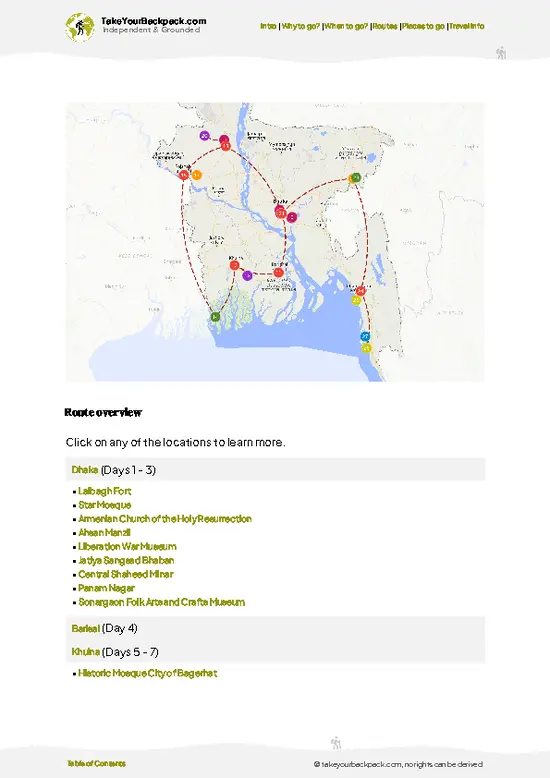
How many days to plan: A trip combining several towns in Bangladesh needs 10 to 14 days, and 7 days is the minimum if you stay within one or two regions. Dhaka works as the hub, with its Kamalapur train station, Gabtoli and Sayedabad bus terminals, and Sadarghat river terminal.

Grouping regions: The country clusters in three loops. The northwest (Rajshahi and Rangpur divisions) links by train and bus and suits a slow arc of 3 to 5 days. The southwest delta (Khulna and Barisal) connects by road and river launch, and suits 3 to 4 days. The northeast and southeast (Sylhet and Chittagong) pair with each other poorly, since they lie on opposite sides of the country, so choose one per trip unless you have two weeks. A sensible direction is to start with the region nearest Dhaka, loop back through … read more 👉
How many days to plan: A trip combining several towns in Bangladesh needs 10 to 14 days, and 7 days is the minimum if you stay within one or two regions. Dhaka works as the hub, with its Kamalapur train station, Gabtoli and Sayedabad bus terminals, and Sadarghat river terminal.

Grouping regions: The country clusters in three loops. The northwest (Rajshahi and Rangpur divisions) links by train and bus and suits a slow arc of 3 to 5 days. The southwest delta (Khulna and Barisal) connects by road and river launch, and suits 3 to 4 days. The northeast and southeast (Sylhet and Chittagong) pair with each other poorly, since they lie on opposite sides of the country, so choose one per trip unless you have two weeks. A sensible direction is to start with the region nearest Dhaka, loop back through the capital to reset, then head out again. Going clockwise from the northwest to the southwest keeps backtracking low.

Time per stop and travel times: Allow 1 to 2 nights per town. Dhaka to Rajshahi by train takes roughly 5 to 7 hours, Dhaka to Sylhet 6 to 8 hours, Dhaka to Chittagong 5 to 7 hours by train or bus, and the overnight launch from Dhaka to Barisal about 8 to 12 hours. Add buffer for traffic, since Dhaka exits can take two hours alone.

Planning mistakes: The classic error is packing in too many stops and assuming road distances predict time. Fix it by cutting the list and doubling your estimates. Another is leaving trains until the same day. Intercity tickets, especially AC and first-class seats, sell out, so buy them 1 to 5 days early at the station or through the official rail app. Travel on Fridays is crowded, and rain can close ferries, so keep a spare day. Finally, arriving at night is tiring when streets are dark and hotels are hard to find, so aim to arrive by mid-afternoon.

The ListThe Best towns of Bangladesh

1 Paharpur

archaeological ruins, monastery complex, red brick mounds

Step among ancient structures and weathered bricks, exploring a UNESCO-listed site that reveals layers of Buddhist monastic life.

2 Chandraganj

bazaar hub, rice paddies, roadside tea stalls

Pause at busy crossroads where traders gather, surrounded by green fields and the constant presence of small, bustling tea shops.

3 Srimangal

tea plantations, rainforests, wildlife sanctuaries

Hike through tea estates, spot rare monkeys in Lawachara forest, and enjoy the region’s cool, green landscape.

4 Puthia

temple cluster, palace grounds, ornamental ponds

Stroll through a compact area dotted with ornate temples and water features, where architectural detail rewards slow exploration.

bangladesh-city-puthia
© Google |
Loading the map 🌍

Expert viewInsights from Locals and Experts

How many towns to visit: Visit four to six towns on a trip of one to two weeks. That number allows two nights in most places, which matters because transport eats half of each travel day, and because the best moments in Bangladeshi towns come slowly: a chai stall conversation that turns into an invitation, the sound of a evening call to prayer drifting over a river, the smell of fish frying at dusk. Pack in ten and you will see the inside of buses and little else.

Choosing between kinds of towns: Backpackers on a tight schedule should favor historic towns with old brick mosques and temples for easy walking, cheap rickshaw hops and quiet. Those who want atmosphere should pick river and port towns, where mornings begin with the shouting of fish traders and the thud of loading boats. Nature-minded … read more 👉
How many towns to visit: Visit four to six towns on a trip of one to two weeks. That number allows two nights in most places, which matters because transport eats half of each travel day, and because the best moments in Bangladeshi towns come slowly: a chai stall conversation that turns into an invitation, the sound of a evening call to prayer drifting over a river, the smell of fish frying at dusk. Pack in ten and you will see the inside of buses and little else.

Choosing between kinds of towns: Backpackers on a tight schedule should favor historic towns with old brick mosques and temples for easy walking, cheap rickshaw hops and quiet. Those who want atmosphere should pick river and port towns, where mornings begin with the shouting of fish traders and the thud of loading boats. Nature-minded travelers should lean toward the tea hills and forest edges, where air is cooler and cleaner and the walks are green and soft underfoot. Hill tracts towns demand more paperwork and some areas need permits, so first-timers are better off leaving them for a second trip.

What it costs: Budget US$20 to 35 a day (about 2,400 to 4,200 taka) for backpacking with a private room, local meals and buses. Rooms in simple guesthouses run roughly 1,000 to 2,500 taka, a plate of rice with curry 100 to 250 taka, and a rickshaw ride across town 50 to 150 taka. Entry to archaeological sites is typically a few dozen taka for locals and several hundred for foreigners, so allow 100 to 600 taka per site. A local guide for a half day costs 1,500 to 3,000 taka. Intercity buses cost around 300 to 900 taka depending on distance and AC, trains similar or slightly more. Carry cash, since ATMs are common in district centers but fail often, and cards are rarely accepted outside upscale hotels.

Safety on the ground: Towns are generally safe for visitors, and the main dangers are traffic, pickpocketing in packed bus stations and stomach trouble. Drink only bottled or filtered water, and eat at busy stalls where food is cooked fresh and hot. Crossing streets takes confidence: move steadily and let rickshaws flow around you. Political rallies, hartals (strikes) and election periods can close roads and turn tense, so check local news and avoid crowds. Some hotels may not accept foreigners, so confirm before hauling your bag across town.

Cultural considerations: Bangladesh is a Muslim-majority country with significant Hindu, Buddhist and Christian communities, and modest dress is the sign of respect everywhere. Both men and women should cover shoulders and knees, and women will feel more comfortable in loose long tops and a scarf. Remove shoes before entering mosques and temples, and ask before photographing people, especially women. Use your right hand for eating and handing things over. Alcohol is hard to find and public displays of affection draw attention. During Ramadan, eat and drink discreetly in public, and expect many daytime restaurants to be closed. The reward is warm hospitality: accept a cup of tea, answer the usual questions about your country and family, and doors open fast.

✈️ The backpacker research shortcutBangladesh Travel Guide

An offline-friendly backpacking guide with optimized travel routes, ranked highlights, transport advice, and the best areas to stay.
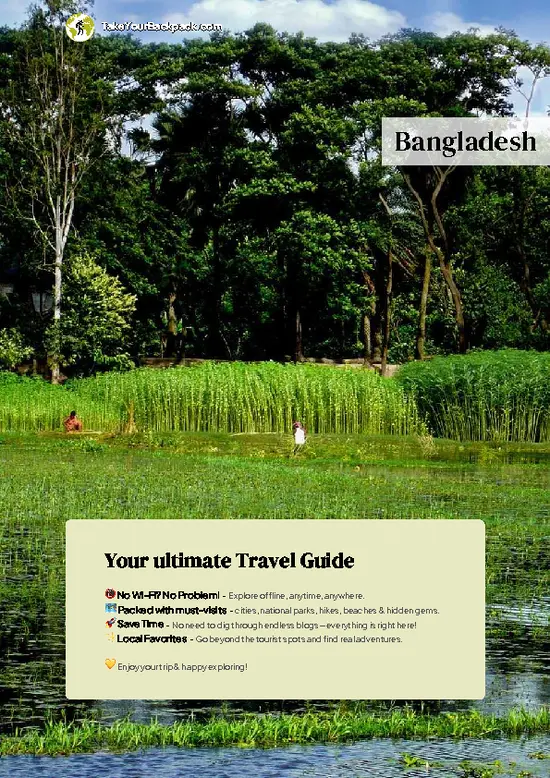
example page 0 from our offline Travel Guide for Bangladesh
example page 1 from our offline Travel Guide for Bangladesh
example page 2 from our offline Travel Guide for Bangladesh
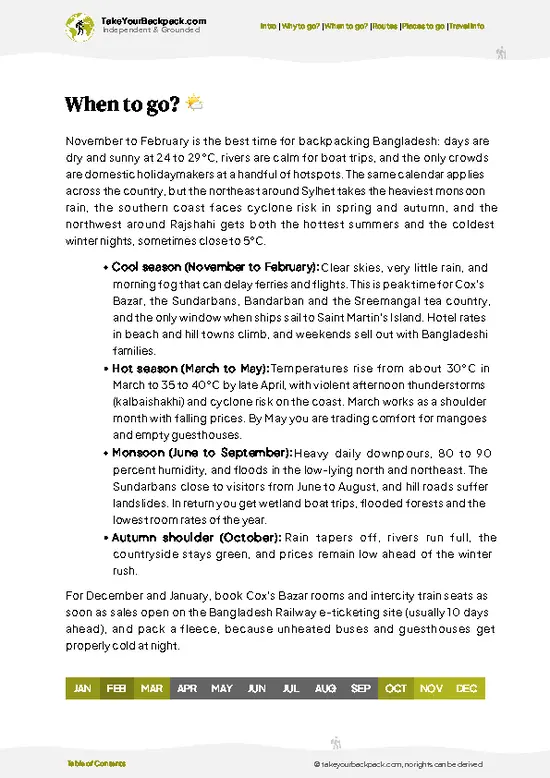
example page 3 from our offline Travel Guide for Bangladesh
example page 4 from our offline Travel Guide for Bangladesh
example page 5 from our offline Travel Guide for Bangladesh
example page 6 from our offline Travel Guide for Bangladesh
example page 7 from our offline Travel Guide for Bangladesh
The digital guide (355 pages) contains:
✅ 102 highlights, ranked by travel appeal
✅ Optimized 7, 14 & 21-day travel routes
✅ Cities, national parks, landmarks, beaches
✅ How to get around
✅ Offline-friendly for travel without Wi-Fi
👉 Click to see all 30+ guide features

📅 Plan smarter in minutes, not weeks
✅ Month by month travel advice
✅ Festivals & national holidays
✅ Budget expectations

🗺️ Go to the right places, skip the overrated ones
✅ Honest pros & cons of destinations
✅ Top hikes, parks & viewpoints
✅ Lesser-known places most travelers miss
✅ Clear “worth it vs skip it” guidance

🛏️ Travel smoothly without rookie mistakes
✅ Best areas to stay
✅ Transport systems explained simply
✅ Common scams & safety advice
✅ SIM cards, money & practical tips

🌍 Understand the country, not just visit it
✅ Culture & traditions
✅ 52 Essential phrases & customs
✅ Festivals worth planning around
✅ Traveler-friendly historical context
✅ Insights that make places more meaningful

📱 Built for real travel conditions
✅ Fully downloadable PDF
✅ Works completely offline
✅ Optimized for phone use
✅ Useful in remote areas & buses
✅ Everything in one place
Stop searching, start planning
Get instant access to your full guide. 30‑day money-back guarantee.
+ Add another guide for just

By proceeding you agree to our terms.
Sent to your inbox immediately after payment • 100% Secure Checkout
Best Backpacking Travel Advisor 2025 tourism awardBest Backpacking
Travel Advisor
2025
What others say about Take Your Backpack Guides:
⭐⭐⭐⭐⭐
Fantastic, amazing amount of information!
⭐⭐⭐⭐⭐
My goodness this is amazing, it's what I've been looking for hats off too you!
⭐⭐⭐⭐⭐
I think this is absolutely BRILLIANT
⭐⭐⭐⭐
Very complete and informative. It's still missing places, but I gotta to commend you
⭐⭐⭐⭐⭐
This is truly amazing, thank you, can't wait to explore it with my kids!
⭐⭐⭐⭐⭐
Awesome resource, thank you!
⭐⭐⭐⭐⭐
This is amazing! Can't wait to explore the ones I haven't seen
⭐⭐⭐⭐
I love this! Well done, great idea.
⭐⭐⭐⭐⭐
Thanks for taking the time to make this gem!
⭐⭐⭐⭐⭐
This might be the best website I've ever seen.
⭐⭐⭐⭐⭐
Congratulations, and thank you so much for your work; it's incredibly valuable.
⭐⭐⭐⭐
In all seriousness I think you did a great job pointing out the important spots
⭐⭐⭐⭐⭐
10/10 very good
⭐⭐⭐⭐⭐
As someone who's only just starting to visit regularly this is awesome, thank you.
⭐⭐⭐⭐
Thank you very much! I'm going to visit my dad, it's going to be very useful!
⭐⭐⭐⭐⭐
This is really cool! We'll be travelling for the first time and this definitely come in handy.
⭐⭐⭐⭐⭐
You are now our minister of culture, congratulations 👨‍💼
⭐⭐⭐⭐⭐
Just wanted to tell you that this is a pearl! Going to follow your recommendations.
⭐⭐⭐⭐⭐
This is so cool. I'll definitely be using the resource for my travels soon.
⭐⭐⭐⭐⭐
This is very impressive! Good work.
⭐⭐⭐⭐⭐
This is an amazing and informative site. Very well done!

🛏️ Where to stay?Best Stay Options in Bangladesh

True backpacker hostels are rare in Bangladesh, with only a handful of dorm-style places in Dhaka, but budget guesthouses and basic hotels with private rooms for roughly Tk 1,200 to 3,000 (US$10 to 25) are easy to find in every city. In Dhaka, Gulshan and Banani are the safest and quietest bases, with the best cafes and the few hostels, though they cost more and sit an hour or more in traffic from Old Dhaka; Paltan and Motijheel have the cheapest hotels close to Old Dhaka, Sadarghat and Kamalapur station, at the price of round-the-clock noise and rougher rooms. Outside the capital, look at Kolatoli in Cox’s Bazar for beachfront budget hotels (packed on holiday weekends), Zindabazar in Sylhet … read more 👉
True backpacker hostels are rare in Bangladesh, with only a handful of dorm-style places in Dhaka, but budget guesthouses and basic hotels with private rooms for roughly Tk 1,200 to 3,000 (US$10 to 25) are easy to find in every city. In Dhaka, Gulshan and Banani are the safest and quietest bases, with the best cafes and the few hostels, though they cost more and sit an hour or more in traffic from Old Dhaka; Paltan and Motijheel have the cheapest hotels close to Old Dhaka, Sadarghat and Kamalapur station, at the price of round-the-clock noise and rougher rooms. Outside the capital, look at Kolatoli in Cox’s Bazar for beachfront budget hotels (packed on holiday weekends), Zindabazar in Sylhet for central, walkable options, and the town center of Sreemangal for cheap guesthouses near the tea estates, keeping in mind that nightlife anywhere in the country is close to nonexistent.

If you enjoy meeting fellow travelers, consider choosing hostels with high ratings for atmosphere. On the other hand, if you prefer having your own space, a hotel might be a better option.

BangladeshWhere to Go Next

👋 Meet the founderWho’s Behind Take Your Backpack?

Johan, backpacker and founder of TakeYourBackpackHi, I’m Johan (Netherlands 🇳🇱), the creator of TakeYourBackpack. Over the past 3 decades, I’ve backpacked through 90+ countries across six continents, gaining extensive experience with independent travel, long-term trips, and overland routes.

This site is built on a combination of firsthand travel experience and carefully curated insights from other backpackers. Many guides are based on places I’ve personally visited, while others bring together tips, observations, and practical advice shared by trusted travelers I’ve met along the way.

The goal is to provide realistic, experience-driven guidance — not generic itineraries — so you can explore destinations with better context, clearer expectations, and more confidence.