

×

Bolivia🇧🇴 | citiesOruromining heritage, windswept plateau, festival city | things to do and best time to go

Explore La PazExplore Potosi

Backpacking in Oruro
👌 Worth visitingcity ranked #7
By Johan Kruseman 🇳🇱 | Updated June 7, 2026

Most people only realize after leaving that Oruro is the cheapest, least chaotic place in Bolivia to understand Andean mining culture before heading to the tourist circus of Uyuni. The city sits on the high plateau between La Paz and Uyuni, a dusty, work-first hub that feels more functional than pretty. For backpackers, that’s both the charm and the catch: low prices, almost no scams, but also fewer hostels and less built-in social life than La Paz or Sucre. The carnival museum, the Virgen del Socavón sanctuary, and the mining-themed murals around the center are genuinely worth a slow wander, and Plaza 10 de Febrero is solid for people-watching. Nights are quiet outside festival season, safety is decent if you keep it low-key, and the whole place feels like “real Bolivia” rather than a backpacker bubble.

Discover everything you want to know in the 📖 Bolivia Travel Guide.


Get your Bolivia guide
82 ranked highlights, routes & tips, works offline (350 pages)
Loading the map 🌍
CLICK TO FILTER
cities
towns
landmarks
national parks
hikes
beaches
attractions
festivals
regions
SHOW COUNTRY’S BESTSHOW ALL

✨ Why go?
Ranked #7 city in Bolivia
Why visitors keep coming back

Oruro is a strategic stop for backpackers weaving through Bolivia. It’s not just a pit stop; it’s a basecamp for day trips to stunning landscapes and cultural experiences. The city itself offers a blend of affordable hostels and local eateries that keep your budget in check while satisfying your cravings for authentic Bolivian cuisine.

You’ll find Oruro’s walkability refreshing. The compact layout makes it easy to explore on foot, allowing you to soak in the local vibe without the hassle of transport. When the sun sets, the nightlife kicks in, with lively bars and music that invite you to mingle with fellow travelers and locals alike.

Plus, Oruro’s transport links are solid, making onward travel to places like La Paz or Uyuni a breeze. If you’re looking for a city that balances comfortread more 👉
Oruro is a strategic stop for backpackers weaving through Bolivia. It’s not just a pit stop; it’s a basecamp for day trips to stunning landscapes and cultural experiences. The city itself offers a blend of affordable hostels and local eateries that keep your budget in check while satisfying your cravings for authentic Bolivian cuisine.

You’ll find Oruro’s walkability refreshing. The compact layout makes it easy to explore on foot, allowing you to soak in the local vibe without the hassle of transport. When the sun sets, the nightlife kicks in, with lively bars and music that invite you to mingle with fellow travelers and locals alike.

Plus, Oruro’s transport links are solid, making onward travel to places like La Paz or Uyuni a breeze. If you’re looking for a city that balances comfort and value, Oruro fits the bill, whether you’re staying for a few days or just passing through.
Want to include Oruro in your Bolivia route?
Create a personalized Bolivia itinerary that includes Oruro and the places that fit your trip — based on your travel style, budget, and available time. Get your route in seconds.

Generate my trip

💡 HighlightsWhat this place is best known for

  • Basílica del Socavón — The spiritual heart of Oruro and the anchor of the Carnaval: dramatic baroque facade, richly decorated interior, and murals tying the city’s mining culture to the Virgen del Socavón. Don’t miss the views from the steps and the miner-devotee votive art inside.
  • Museo del Carnaval de Oruro — Small but essential: costumes, masks, and choreography notes from the diablada and other dances. Seeing the actual regalia puts the massive street spectacle into context—great for timing a future carnival visit.
  • Plaza 10 de Febrero & Catedral — The city’s main square, lined with municipal buildings, cafes and the cathedral; it’s the best spot to feel Oruro’s daily life, watch markets set up, and see civic ceremonies up close.
  • Mercado Central — A working Andean market where you
read more 👉
  • Basílica del Socavón — The spiritual heart of Oruro and the anchor of the Carnaval: dramatic baroque facade, richly decorated interior, and murals tying the city’s mining culture to the Virgen del Socavón. Don’t miss the views from the steps and the miner-devotee votive art inside.
  • Museo del Carnaval de Oruro — Small but essential: costumes, masks, and choreography notes from the diablada and other dances. Seeing the actual regalia puts the massive street spectacle into context—great for timing a future carnival visit.
  • Plaza 10 de Febrero & Catedral — The city’s main square, lined with municipal buildings, cafes and the cathedral; it’s the best spot to feel Oruro’s daily life, watch markets set up, and see civic ceremonies up close.
  • Mercado Central — A working Andean market where you can eat cheap, strong local food, buy coca leaves, and watch vendors sell everything from spices to traditional textiles. It’s noisy, colorful, and real—perfect for people-watching and honest street food.
  • Estadio Jesús Bermúdez — More than a sports venue: match days are local theater. Catch a Bolivian league game if you can—fans, music, and the raw energy give a true slice of contemporary local culture.
  • Teatro Municipal — Historic theater building that hosts local music, dance and occasional touring shows. Architecture and programs are modest but genuine; check the bulletin board for performances or folkloric recitals.
  • Estación Central de Ferrocarril — Oruro’s old railway station and yards tell the story of the city as a transport and mining hub. Walk the platforms, see vintage rolling stock, and feel the industrial heritage that shaped the place.
  • Museo Antropológico e Histórico (Museo de la Ciudad) — The local anthropology/history museum that gathers artifacts from the region: indigenous textiles, ceramics, and exhibits on mining and carnival traditions. Small museums here are compact knowledge—ask staff for context.
  • Museo Minero / Exhibits on Mining Culture — Whether a formal museum or rotating exhibits in civic halls, Oruro’s mining history is omnipresent. Look for displays of tools, miner devotionals, and explanations of the mining economy that built the city.
  • Mirador / Cerro de la Cruz (City Viewpoints) — A short climb up a local hill or viewpoint gives sweeping views over the high-altitude grid of Oruro, the surrounding salt-scarred valleys, and the patchwork roofs—great at sunset for photos and orientation.
A few nearby day-trip highlights: Lake Poopó (for raw lakeshore landscapes and birdlife), the lesser-visited Salar de Coipasa, and Sajama National Park with hot springs and spectacular volcano views — Sajama is my personal favorite.
Spotted a mistake or missing something? Contact us.

🏘️ NeighborhoodsUnderstanding the local layout

Oruro is a vibrant hub of culture and history, perfect for backpackers looking to dive deep into Bolivian life. Here’s how the neighborhoods stack up:

Centro Histórico: This is the heart of Oruro, where colonial architecture meets bustling markets. It’s walkable, with plenty of cheap eats and shops. The nightlife is lively but not overwhelming. Perfect for short stays, you can soak up the local vibe without straying far from your base.

Zona Sur: A bit quieter, this area offers a more residential feel. It’s less touristy, which means you’ll find authentic local experiences. Transport options are decent, but you might need to rely on taxis for late-night adventures. Ideal for longer stays if you want to blend in and explore at a relaxed pace.

La Joya: Known for its artisan shops and local … read more 👉
Oruro is a vibrant hub of culture and history, perfect for backpackers looking to dive deep into Bolivian life. Here’s how the neighborhoods stack up:

Centro Histórico: This is the heart of Oruro, where colonial architecture meets bustling markets. It’s walkable, with plenty of cheap eats and shops. The nightlife is lively but not overwhelming. Perfect for short stays, you can soak up the local vibe without straying far from your base.

Zona Sur: A bit quieter, this area offers a more residential feel. It’s less touristy, which means you’ll find authentic local experiences. Transport options are decent, but you might need to rely on taxis for late-night adventures. Ideal for longer stays if you want to blend in and explore at a relaxed pace.

La Joya: Known for its artisan shops and local eateries, La Joya is a treasure trove for those seeking unique souvenirs. The vibe is laid-back, making it suitable for both short and extended visits. Walkability is good, but be prepared for some uphill treks.

El Socavón: Famous for its mining history, this area is a must-see. It’s a bit off the main tourist path, which means fewer crowds. While nightlife is limited, the cultural significance makes it worth the trip. Great for a day visit, but not ideal for longer stays.

Choose wisely, and you’ll unlock the best of Oruro!

⌛️ 1 daySeeing the highlights in 24 hours

Oruro, Bolivia, is a city that pulses with culture and history, known for its vibrant Carnival and rich mining heritage. Nestled in the highlands, it offers a unique blend of indigenous traditions and colonial architecture, making it a fascinating stop for any traveler.

Start your day in the bustling Mercado Manuel de Castro, where the aroma of fresh bread and local produce fills the air. Grab a hearty breakfast of salteñas, a savory pastry that’s a local favorite. As you savor each bite, soak in the lively atmosphere; vendors call out, and locals barter with enthusiasm.

After breakfast, stroll over to the stunning Basilica de Socavón. This iconic church, with its intricate facade and colorful interior, is a testament to Oruro’s mining history and spiritual depth. Spend some time here reflecting … read more 👉
Oruro, Bolivia, is a city that pulses with culture and history, known for its vibrant Carnival and rich mining heritage. Nestled in the highlands, it offers a unique blend of indigenous traditions and colonial architecture, making it a fascinating stop for any traveler.

Start your day in the bustling Mercado Manuel de Castro, where the aroma of fresh bread and local produce fills the air. Grab a hearty breakfast of salteñas, a savory pastry that’s a local favorite. As you savor each bite, soak in the lively atmosphere; vendors call out, and locals barter with enthusiasm.

After breakfast, stroll over to the stunning Basilica de Socavón. This iconic church, with its intricate facade and colorful interior, is a testament to Oruro’s mining history and spiritual depth. Spend some time here reflecting on the craftsmanship and the stories embedded in the walls.

In the afternoon, head to the lesser-known neighborhood of San José. Here, you’ll find the Museo de la Diablada, dedicated to the famous Carnival dance. It’s a bit off the beaten path, but the vibrant costumes and history of the dance are captivating. Plus, it’s a great way to connect with the local culture beyond the usual tourist spots.

As evening approaches, make your way to the Plaza 10 de Febrero. This lively square is perfect for people-watching. Grab a seat at one of the nearby cafés and enjoy a cup of mate de coca while you watch the sunset paint the sky.

Oruro may not be the first city that comes to mind, but its authentic experiences and warm locals will leave you feeling enriched and inspired.
Turn your Oruro visit into an Bolivia adventure
Build a complete Bolivia route with Oruro, hidden gems, must-see destinations, and realistic travel times included.

Generate my trip

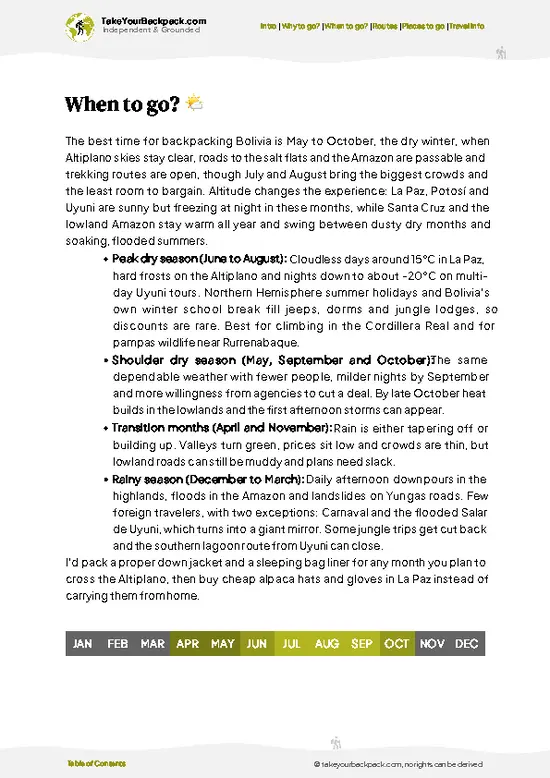
🌤️ When to go?Best time to visit Oruro


  • Weather: Oruro sits high at 3,700 meters, so expect dry, crisp air most of the year. The rainy season runs from November to March, bringing muddy trails and fewer hiking options. April to October is your dry window—clear skies and stable conditions.

  • Temperature: Daytime highs hover around 15–20°C (59–68°F) in the dry season, but nights plunge below freezing, often down to -5°C (23°F). Pack layers; warmth at night is non-negotiable.

  • Daylight Hours: Near the equator, daylight is steady year-round, about 11 to 12 hours. This means consistent hiking and sightseeing windows, no drastic shifts to plan around.

  • Crowds: The biggest influx hits during the Carnival in late February or early March. It’s a spectacle but expect packed hostels and higher prices. Outside carnival, Oruro is quiet,
read more 👉

  • Weather: Oruro sits high at 3,700 meters, so expect dry, crisp air most of the year. The rainy season runs from November to March, bringing muddy trails and fewer hiking options. April to October is your dry window—clear skies and stable conditions.

  • Temperature: Daytime highs hover around 15–20°C (59–68°F) in the dry season, but nights plunge below freezing, often down to -5°C (23°F). Pack layers; warmth at night is non-negotiable.

  • Daylight Hours: Near the equator, daylight is steady year-round, about 11 to 12 hours. This means consistent hiking and sightseeing windows, no drastic shifts to plan around.

  • Crowds: The biggest influx hits during the Carnival in late February or early March. It’s a spectacle but expect packed hostels and higher prices. Outside carnival, Oruro is quiet, giving you space to explore without elbowing through tourists.

  • Seasonal Activities: Carnival is the crown jewel—colorful, chaotic, and culturally rich. If you want authentic local energy, this is your moment. Otherwise, the dry season offers trekking and cultural tours without the crush.

  • Price Fluctuations: Expect a sharp spike during Carnival—accommodation and transport costs can double or triple. The dry season outside carnival is wallet-friendly, with deals on lodging and tours.


Pro-tip: If you want to balance comfort, cost, and culture, aim for the shoulder months—April or October—when the weather is good, crowds thin, and prices stay reasonable.


source: climatestotravel.comJANJanuary: fair for travelingFEBFebruary: good for travelingMARMarch: good for travelingAPRApril: highly recommended for travelingMAYMay: excellent for travelingJUNJune: excellent for travelingJULJuly: excellent for travelingAUGAugust: excellent for travelingSEPSeptember: excellent for travelingOCTOctober: highly recommended for travelingNOVNovember: fair for travelingDECDecember: fair for traveling

✈️ The backpacker research shortcutBolivia Travel Guide

An offline-friendly backpacking guide with optimized travel routes, ranked highlights, transport advice, and the best areas to stay.
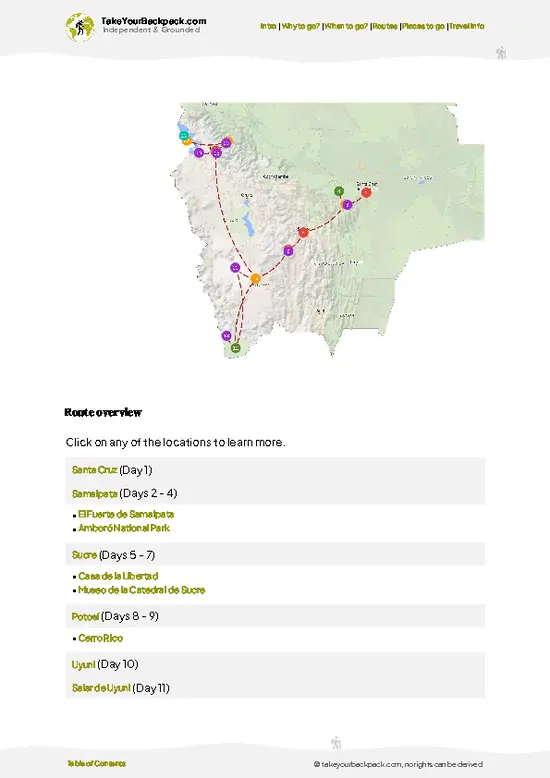
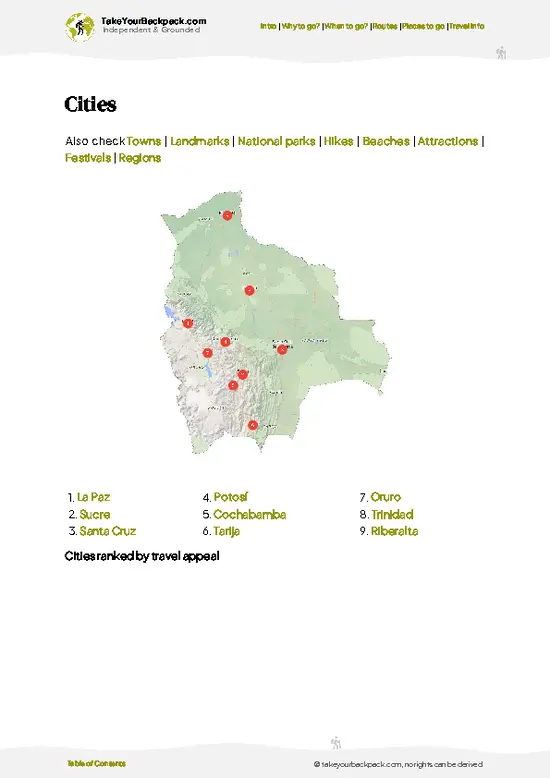
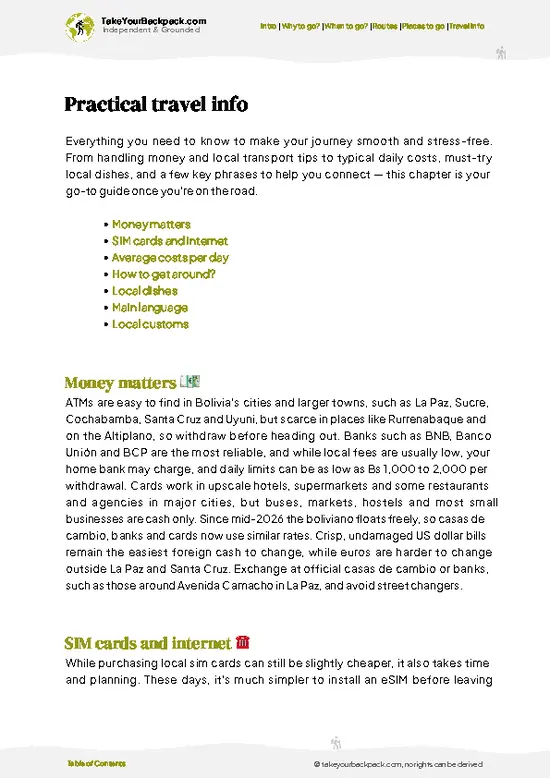
example page 0 from our offline Travel Guide for Boliviaexample page 1 from our offline Travel Guide for Boliviaexample page 2 from our offline Travel Guide for Boliviaexample page 3 from our offline Travel Guide for Boliviaexample page 4 from our offline Travel Guide for Boliviaexample page 5 from our offline Travel Guide for Boliviaexample page 6 from our offline Travel Guide for Boliviaexample page 7 from our offline Travel Guide for Bolivia
The digital guide (350 pages) contains:
82 highlights, ranked by travel appeal
Optimized 7, 14 & 21-day travel routes
Cities, national parks, landmarks, beaches
How to get around
Offline-friendly for travel without Wi-Fi
👉 Click to see all 30+ guide features

📅 Plan smarter in minutes, not weeks
Month by month travel advice
Festivals & national holidays
Budget expectations

🗺️ Go to the right places, skip the overrated ones
Honest pros & cons of destinations
Top hikes, parks & viewpoints
Lesser-known places most travelers miss
Clear “worth it vs skip it” guidance

🛏️ Travel smoothly without rookie mistakes
Best areas to stay
Transport systems explained simply
Common scams & safety advice
SIM cards, money & practical tips

🌍 Understand the country, not just visit it
Culture & traditions
52 Essential phrases & customs
Festivals worth planning around
Traveler-friendly historical context
Insights that make places more meaningful

📱 Built for real travel conditions
Fully downloadable PDF
Works completely offline
Optimized for phone use
Useful in remote areas & buses
Everything in one place
Save weeks of stressful planning
Get instant access to your full guide. 30‑day money-back guarantee.


By proceeding you agree to our terms.
Sent to your inbox immediately after payment • 100% Secure Checkout
Best Backpacking Travel Advisor 2025 tourism awardBest Backpacking
Travel Advisor
2025
What others say about Take Your Backpack Guides:
⭐⭐⭐⭐⭐
Fantastic, amazing amount of information!
⭐⭐⭐⭐⭐
My goodness this is amazing, it's what I've been looking for hats off too you!
⭐⭐⭐⭐⭐
I think this is absolutely BRILLIANT
⭐⭐⭐⭐
Very complete and informative. It's still missing places, but I gotta to commend you
⭐⭐⭐⭐⭐
This is truly amazing, thank you, can't wait to explore it with my kids!
⭐⭐⭐⭐⭐
Awesome resource, thank you!
⭐⭐⭐⭐⭐
This is amazing! Can't wait to explore the ones I haven't seen
⭐⭐⭐⭐
I love this! Well done, great idea.
⭐⭐⭐⭐⭐
Thanks for taking the time to make this gem!
⭐⭐⭐⭐⭐
This might be the best website I've ever seen.
⭐⭐⭐⭐⭐
Congratulations, and thank you so much for your work; it's incredibly valuable.
⭐⭐⭐⭐
In all seriousness I think you did a great job pointing out the important spots
⭐⭐⭐⭐⭐
10/10 very good
⭐⭐⭐⭐⭐
As someone who's only just starting to visit regularly this is awesome, thank you.
⭐⭐⭐⭐
Thank you very much! I'm going to visit my dad, it's going to be very useful!
⭐⭐⭐⭐⭐
This is really cool! We'll be travelling for the first time and this definitely come in handy.
⭐⭐⭐⭐⭐
You are now our minister of culture, congratulations 👨‍💼
⭐⭐⭐⭐⭐
Just wanted to tell you that this is a pearl! Going to follow your recommendations.
⭐⭐⭐⭐⭐
This is so cool. I'll definitely be using the resource for my travels soon.
⭐⭐⭐⭐⭐
This is very impressive! Good work.
⭐⭐⭐⭐⭐
This is an amazing and informative site. Very well done!

🛏️ Where to stay?Best areas to stay in Bolivia

Oruro’s sweet spot for backpackers is the area around the city center, especially near the Plaza 10 de Febrero. This neighborhood nails the balance between safety and social buzz without the inflated prices you’ll find elsewhere. It’s where budget travelers naturally gravitate because it’s walkable, packed with affordable hostels, and lined with eateries that won’t drain your wallet. The vibe here is low-key but lively—think local markets, street vendors, and a steady stream of fellow backpackers swapping stories over cheap beer.

Compared to the outskirts or newer residential zones, the city … read more 👉
Oruro’s sweet spot for backpackers is the area around the city center, especially near the Plaza 10 de Febrero. This neighborhood nails the balance between safety and social buzz without the inflated prices you’ll find elsewhere. It’s where budget travelers naturally gravitate because it’s walkable, packed with affordable hostels, and lined with eateries that won’t drain your wallet. The vibe here is low-key but lively—think local markets, street vendors, and a steady stream of fellow backpackers swapping stories over cheap beer.

Compared to the outskirts or newer residential zones, the city center offers a clear advantage: you’re plugged into the pulse of Oruro’s culture and nightlife without needing a taxi or risking sketchy streets after dark. It’s not luxury, but it’s comfortable enough for a good night’s rest and social enough to meet others. If you want to maximize your time and budget, this area is your strategic base. You trade a bit of quiet for convenience and connection, which is exactly the kind of trade-off that turns a trip from “just visiting” into truly experiencing the city.

🚌 Getting aroundGetting around like a local

Oruro moves at its own rhythm—a blend of stubborn tradition and the occasional burst of modern hustle. It’s not a city where you’ll find a clockwork precision to transit schedules, but neither is it a free-for-all chaos. Instead, the flow here is a dance between fixed routes and the street-smart intuition of locals who know when to jump on a bus or wait for the next one. If you want to win at getting around Oruro, you need to read the signals: the honks, the stops, the crowd shifts. Time, money, and comfort are constantly in play, and your choices reveal what you value most.


  • Walking: The most straightforward and zero-cost option. Oruro’s compact center means many key spots are within a 20-30 minute stroll. Walking gives you full control over your schedule and lets you soak in the city’s
read more 👉
Oruro moves at its own rhythm—a blend of stubborn tradition and the occasional burst of modern hustle. It’s not a city where you’ll find a clockwork precision to transit schedules, but neither is it a free-for-all chaos. Instead, the flow here is a dance between fixed routes and the street-smart intuition of locals who know when to jump on a bus or wait for the next one. If you want to win at getting around Oruro, you need to read the signals: the honks, the stops, the crowd shifts. Time, money, and comfort are constantly in play, and your choices reveal what you value most.


  • Walking: The most straightforward and zero-cost option. Oruro’s compact center means many key spots are within a 20-30 minute stroll. Walking gives you full control over your schedule and lets you soak in the city’s gritty textures—just be ready for uneven sidewalks and occasional dust.


  • Minibuses: The backbone of Oruro’s public transit. These shared vans run frequently from early morning (around 6:00 AM) until about 9:00 PM. Fares hover around 2-3 BOB (Bolivianos), making them a budget-friendly choice. They’re fast enough but can get cramped and noisy, so comfort takes a backseat to price and speed.


  • Taxi Colectivos: A hybrid between a taxi and a bus, these shared taxis follow set routes but leave when full. They operate roughly from 6:00 AM to 10:00 PM. Expect to pay about 5-7 BOB per ride. They’re quicker than minibuses and a bit more comfortable, but you sacrifice some predictability since departure depends on filling seats.


  • Regular Taxis: Available 24/7, these offer door-to-door service and the highest comfort level. Prices start around 15 BOB for short trips but can climb quickly. Ideal if you’re tight on time or carrying heavy gear, but they’re the most expensive option and less budget-friendly.


Understanding these options is your key to mastering Oruro’s transit game. You’re constantly balancing how much time you want to spend waiting or moving, how much cash you’re willing to part with, and how much comfort you need to keep your energy up. Pick your moves wisely, and you’ll turn what feels like a logistical puzzle into a smooth, rewarding flow.

👛 Costs (as of 2 March 2026)Travel costs and budget guide for Oruro

Backpacking in Oruro, Bolivia, is a study in balancing modest costs with the occasional splurge for comfort or convenience. Here’s how your daily budget breaks down in practical terms:
  • Dorm Accommodation (High Season): Expect to pay around $8-$12 per night. High season, usually around carnival time, pushes prices up as demand spikes, but you still get basic, clean dorms with shared facilities.
  • Dorm Accommodation (Off-Season): Dropping to $5-$8 per night, off-season rates offer a quieter stay with the same essential amenities. It’s a good time to negotiate directly with hostels for a better deal.
  • Meals: Street food and local markets keep your food budget tight at about $3-$6 per day. A hearty plate of salteñas or a bowl of sopa can fill you up without draining your wallet. Eating at small
read more 👉
Backpacking in Oruro, Bolivia, is a study in balancing modest costs with the occasional splurge for comfort or convenience. Here’s how your daily budget breaks down in practical terms:
  • Dorm Accommodation (High Season): Expect to pay around $8-$12 per night. High season, usually around carnival time, pushes prices up as demand spikes, but you still get basic, clean dorms with shared facilities.
  • Dorm Accommodation (Off-Season): Dropping to $5-$8 per night, off-season rates offer a quieter stay with the same essential amenities. It’s a good time to negotiate directly with hostels for a better deal.
  • Meals: Street food and local markets keep your food budget tight at about $3-$6 per day. A hearty plate of salteñas or a bowl of sopa can fill you up without draining your wallet. Eating at small local eateries rather than tourist spots is key.
  • Local Transport: Short rides on minibuses or shared taxis cost around $0.30-$0.50 each. It’s cheap but can be crowded and slow, so factor in some patience for the trade-off.
  • City Transport Pass: Oruro doesn’t have a formal city transport pass system, so budgeting for daily rides individually is necessary. If you plan multiple trips, $1.50-$2 per day is a safe estimate.
  • Basic Activities/Entry Fees: Museums and cultural sites typically charge $1-$3. The Carnaval de Oruro, if you time it right, offers free street access but paid entry for official events ranges higher, around $10-$20.
  • Miscellaneous Expenses: This covers water, snacks, occasional coffee, or small souvenirs, usually around $2-$4 daily. Always good to have a buffer for unexpected needs or a treat.

All told, you’re looking at roughly $15 to $30 per day, depending on how much you lean into comfort or convenience. Oruro rewards those who keep it simple but allows room for a few splurges, especially during carnival season. Knowing where to save and where to spend turns your budget into a strategic advantage, not a limitation.
⚠️ Prices can change and everyone travels differently, so take this as a rough guide. Hope it helps you plan your adventure!

🚌 Day tripsExploring the surroundings

Oruro, Bolivia, is a backpacker’s dream base for day trips, offering a blend of culture, nature, and adventure without the hassle of overnight stays.

Salar de Uyuni
A trip to the world’s largest salt flat is a must. From Oruro, it’s about a 5-hour bus ride, but the surreal landscape is worth every minute. You’ll witness endless white horizons and, if you time it right, a mirror-like effect during the rainy season. Expect to spend around $30 for a day tour, which typically includes transport and lunch. Just remember, many first-timers underestimate the chill—bring layers!
👉 Explore Salar de Uyuni

Potosí
Just a 3-hour bus ride from Oruro, Potosí is rich in history and mining culture. The city sits at over 4,000 meters, so acclimatization is key. You can explore the Casa de la Moneda … read more 👉
Oruro, Bolivia, is a backpacker’s dream base for day trips, offering a blend of culture, nature, and adventure without the hassle of overnight stays.

Salar de Uyuni
A trip to the world’s largest salt flat is a must. From Oruro, it’s about a 5-hour bus ride, but the surreal landscape is worth every minute. You’ll witness endless white horizons and, if you time it right, a mirror-like effect during the rainy season. Expect to spend around $30 for a day tour, which typically includes transport and lunch. Just remember, many first-timers underestimate the chill—bring layers!
👉 Explore Salar de Uyuni

Potosí
Just a 3-hour bus ride from Oruro, Potosí is rich in history and mining culture. The city sits at over 4,000 meters, so acclimatization is key. You can explore the Casa de la Moneda and learn about the silver mining that once fueled empires. Budget around $15 for transport and a meal. A common mistake is not allowing enough time to explore; aim for a full day to soak it all in.


Lake Poopó
Only about 1.5 hours away, Lake Poopó offers a tranquil escape. This once-thriving lake is now a shadow of its former self, but the surrounding landscapes and local communities are vibrant. You can rent a bike to explore the area for around $10. The best time to visit is during the dry season when the weather is more stable. Don’t miss the chance to interact with local fishermen; it’s a unique experience.


Tuni Condoriri
For a taste of the Andes, head to Tuni Condoriri, about 3 hours from Oruro. This area is perfect for hiking, with stunning views of snow-capped peaks. A day trip can cost around $25, including transport and a guide. First-timers often underestimate the altitude; take it slow and enjoy the scenery.


Oruro Carnival
If you’re in town during February, the Oruro Carnival is an experience like no other. While it’s not a day trip per se, the festivities are worth planning your schedule around. Expect to see vibrant parades and traditional dances. Just be prepared for crowds and book accommodations early.
👉 Explore Oruro Carnival
Want to know what more Bolivia offers?
The Bolivia Travel Guide describes 82 highlights, from cities to national parks, from beaches to hikes

Get the Travel Guide -

🍲 FoodLocal Flavors for Backpackers

In Oruro, food is a vibrant tapestry of flavors that tells the story of its culture. You can’t leave without trying salteñas, a savory pastry filled with meat, potatoes, and spices—perfect for a quick snack while exploring. Pair that with a cup of api, a warm, sweet drink made from corn, often enjoyed in the morning. The aroma alone is enough to draw you in.

Backpackers will find their culinary adventures in bustling markets and on lively street corners. Vendors serve up anticuchos, skewered beef heart marinated in spices, sizzling on grills that fill the air with mouthwatering scents. Casual eateries offer hearty portions of pique macho, a mix of beef, sausage, and fries, ideal for sharing after a long day of hiking.

When dining, embrace the local custom of sharing food. It’s a way to connect … read more 👉
In Oruro, food is a vibrant tapestry of flavors that tells the story of its culture. You can’t leave without trying salteñas, a savory pastry filled with meat, potatoes, and spices—perfect for a quick snack while exploring. Pair that with a cup of api, a warm, sweet drink made from corn, often enjoyed in the morning. The aroma alone is enough to draw you in.

Backpackers will find their culinary adventures in bustling markets and on lively street corners. Vendors serve up anticuchos, skewered beef heart marinated in spices, sizzling on grills that fill the air with mouthwatering scents. Casual eateries offer hearty portions of pique macho, a mix of beef, sausage, and fries, ideal for sharing after a long day of hiking.

When dining, embrace the local custom of sharing food. It’s a way to connect with others, so don’t hesitate to invite a fellow traveler or local to join you. And remember, meals are often leisurely affairs—take your time to savor each bite and soak in the vibrant atmosphere.

🛡️ SafetyStaying Safe: What Travelers Should Know

Oruro is generally safe, but like any city, it has its quirks. Stay alert in crowded markets, especially around the Plaza 10 de Febrero. Pickpockets can be crafty, so keep your valuables close and avoid flashy displays of wealth.

If you’re traveling solo, especially at night, stick to well-lit areas and avoid wandering too far from the main streets. The vibe is friendly, but it’s smart to trust your instincts.

Scams are rare, but be cautious with unofficial taxi services. Always opt for registered cabs or ride-sharing apps.

Annoyances can include persistent street vendors; a polite “no, gracias” usually does the trick. Embrace the local culture, but keep your wits about you. With a little awareness, you can navigate Oruro smoothly and enjoy its unique charm.

Other Bolivian cities near Oruro

Explore more nearby:

  • Cochabamba—mountain valley, street food, bustling markets| 116 km away
  • La Paz—steep streets, cable cars, high-altitude sprawl| 198 km away
  • Sucre—whitewashed buildings, university town, gentle hills| 227 km away

💡 Not sure where to go next?
Create a personalized itinerary for Bolivia including Oruro and the places that fit your trip.

Generate my itinerary

👉 Discover all cities

Or checkout all Bolivia has to offer (think cities, towns, villages, national parks, hikes, beaches, festivals)
Country photo of Bolivia

We 💚 feedbackParting advice and final tips

Oruro is a vibrant hub of culture, especially during Carnival when the streets explode with color and music. The energy is infectious, and you’ll feel like part of something bigger. But be ready for altitude sickness; at over 12,000 feet, it can hit hard. Take it slow, hydrate, and embrace the local pace. The experience is worth the adjustment, but don’t underestimate the altitude—it’s no joke.

✈️ When did I visit Bolivia?
Bolivia I visited during my half year trip through South and Central America back in 2003

✍️ Help improve this page!
The information on this page is based on my own backpacking experience in Bolivia, supplemented with up-to-date research and feedback from other travelers. Travel details can change, so if you notice anything outdated or incomplete, feel free to let me know.


🙋‍♂️ Give feedback

👋 Meet the founderWho’s Behind Take Your Backpack?

Johan, backpacker and founder of TakeYourBackpackHi, I’m Johan (Netherlands 🇳🇱), the creator of TakeYourBackpack. Over the past decade, I’ve backpacked through 80+ countries across six continents, gaining extensive experience with independent travel, long-term trips, and overland routes.

This site is built on a combination of firsthand travel experience and carefully curated insights from other backpackers. Many guides are based on places I’ve personally visited, while others bring together tips, observations, and practical advice shared by trusted travelers I’ve met along the way.

The goal is to provide realistic, experience-driven guidance — not generic itineraries — so you can explore destinations with better context, clearer expectations, and more confidence.

Get full Bolivia guide •
Instant download • 82 highlights • Full Offline guide