×

Croatia🇭🇷 | best festivalsExplore the 11 Best festivals in Croatia

Festivals in Croatia are mostly a summer affair, and the coast sets the pace. On the Dalmatian coast and islands, electronic and open-air events pull big, young crowds, and beds get pricey and scarce fast. In Istria and Zagreb, the mood turns toward food, wine, film and music, with smaller crowds and easier logistics. Inland Slavonia keeps folk traditions that rarely see a tourist. If you’re backpacking or traveling independently, book beds early for the coast, and consider camping or day-tripping from a cheaper base. Pick your region first, and the right festival follows.

By Johan Kruseman 🇳🇱 | Updated October 18, 2026
Explore the best regions in Croatia

Why go?Key Factors That Shape the Experience

Croatia works for festivals because of its geography and a long Mediterranean season. Reliable summer sun, warm seas and a coastline of more than 1,200 islands give organizers natural stages, from fortress walls to beaches and stone squares. Centuries of Venetian, Austro-Hungarian and Ottoman influence left a patchwork of regional traditions, so a Zagreb event feels nothing like a Slavonian village gathering or a Dalmatian town celebration. Catholic saints’ days and carnival season (roughly February) still anchor local life, and these are often free and unpolished in the best way.

There are limits worth knowing. Croatia is not a one-big-capital country, so distances between regions are long and public transport thins out in summer off the main coastal corridor. Ferries and buses run less … read more 👉
Croatia works for festivals because of its geography and a long Mediterranean season. Reliable summer sun, warm seas and a coastline of more than 1,200 islands give organizers natural stages, from fortress walls to beaches and stone squares. Centuries of Venetian, Austro-Hungarian and Ottoman influence left a patchwork of regional traditions, so a Zagreb event feels nothing like a Slavonian village gathering or a Dalmatian town celebration. Catholic saints’ days and carnival season (roughly February) still anchor local life, and these are often free and unpolished in the best way.

There are limits worth knowing. Croatia is not a one-big-capital country, so distances between regions are long and public transport thins out in summer off the main coastal corridor. Ferries and buses run less often to smaller islands, and last services can leave before an event ends. Prices climb sharply in July and August, and accommodation near the biggest events can cost two or three times the shoulder-season rate. Tickets for major events often sell out months ahead. Cash is handy at village festivals, since small vendors may not take cards. Plan transport home before you go, and you’ll feel like a local rather than a stranded visitor.
Our Approach to Ranking
The list of best festivals in Croatia is created based on energy, traditions, crowd experience, activities, and overall excitement. If you feel a festival is missing in this list, please let us know.

When to go?When to Plan Your Trip

Best months: The best months for festivals in Croatia are June to early September, because the coast is reliably warm and dry and open-air programs run at full tilt. Along the Adriatic, daytime highs sit around 26 to 31°C in July and August, with sea temperatures near 24 to 26°C and very little rain, often under 50 mm a month.
Shoulder seasons: May and late September to October are the smart picks for a calmer, cheaper trip. Days run about 18 to 24°C, and rain is more likely (60 to 100 mm a month in autumn), but accommodation can cost 30 to 50 percent less than in peak weeks. Many island ferries and restaurants also keep a reduced schedule until May and after October, so check timetables.
Peak and off-season: July and August are the crunch, especially mid-August around the 15th holiday, when … read more 👉
Best months: The best months for festivals in Croatia are June to early September, because the coast is reliably warm and dry and open-air programs run at full tilt. Along the Adriatic, daytime highs sit around 26 to 31°C in July and August, with sea temperatures near 24 to 26°C and very little rain, often under 50 mm a month.
Shoulder seasons: May and late September to October are the smart picks for a calmer, cheaper trip. Days run about 18 to 24°C, and rain is more likely (60 to 100 mm a month in autumn), but accommodation can cost 30 to 50 percent less than in peak weeks. Many island ferries and restaurants also keep a reduced schedule until May and after October, so check timetables.
Peak and off-season: July and August are the crunch, especially mid-August around the 15th holiday, when beds on the coast fill and dorm prices can double. Inland Zagreb and Slavonia run on a continental climate, with hot summers up to 30°C and cold winters that drop below freezing. Winter events are mostly indoors and city-based, and many coastal towns close down from November to March. Carnival season in late winter is the exception, with lively street parades in places like Rijeka. Book at least two to three months ahead for any summer weekend.

festival hoppingOptimizing Your Multi-Stop Itinerary

How long you need: A trip linking several festivals in Croatia needs 10 to 14 days to feel relaxed, and 7 days works if you stick to one region. Croatia is long and thin, so the main decision is which stretch of coast to focus on.
Grouping regions and direction: Zagreb and Istria pair well, with roughly 3 to 4 hours by bus or car between them. Split, Hvar, Brač and Dubrovnik form the logical southern cluster. Going north to south, ending in Dubrovnik, avoids backtracking against the main coastal bus line. Ferries from Split reach the central islands in 1 to 2 hours, while Split to Dubrovnik is about 4 to 5 hours by bus. Zagreb to Split is roughly 5 to 6 hours.
Pacing and common mistakes: Allow 2 to 4 nights per stop, with a buffer day after any late event. A common mistake is trying to cover … read more 👉
How long you need: A trip linking several festivals in Croatia needs 10 to 14 days to feel relaxed, and 7 days works if you stick to one region. Croatia is long and thin, so the main decision is which stretch of coast to focus on.
Grouping regions and direction: Zagreb and Istria pair well, with roughly 3 to 4 hours by bus or car between them. Split, Hvar, Brač and Dubrovnik form the logical southern cluster. Going north to south, ending in Dubrovnik, avoids backtracking against the main coastal bus line. Ferries from Split reach the central islands in 1 to 2 hours, while Split to Dubrovnik is about 4 to 5 hours by bus. Zagreb to Split is roughly 5 to 6 hours.
Pacing and common mistakes: Allow 2 to 4 nights per stop, with a buffer day after any late event. A common mistake is trying to cover Istria, Zagreb and Dalmatia in one week, which leaves most of the trip on buses. Another is booking a ferry the morning after an all-night party, when delays and sold-out boats are common. Fix both by building in a rest day, buying ferry tickets ahead in July and August, and leaving the north-to-south gap days free rather than packed. Inland Slavonia deserves its own separate trip, since public transport there is slow and sparse.

The ListThe Best festivals of Croatia

1 Ultra Europe

stadium mainstage, global DJs, dance crowds

Join thousands in Split for a multi-day electronic music event, where headline acts and light shows dominate the city’s summer nights.

2 INmusic Festival

island campsite, rock and indie, lakeside stages

Camp on an island in Zagreb’s lake, catching international bands and discovering new artists in a relaxed, open-air setting.

3 Dubrovnik Summer Festival

historic fortresses, classical music, open-air theater

Attend performances in ancient courtyards and city walls, where music and drama unfold against the backdrop of the Adriatic coast.

4 Hideout Festival

Zrće Beach, club parties, boat events

Join crowds on Pag Island for days of non-stop electronic music, with parties spilling from beach clubs to the Adriatic’s open water.

5 Outlook Festival

bass music, fortress stages, sound system culture

Dive into a celebration of bass-heavy genres, where DJs and MCs perform in moats, towers, and courtyards near the sea.

6 Špancirfest

street performers, artisan stalls, Varaždin old town

Roam pedestrian lanes filled with music, theater, and crafts, as Varaždin transforms into a lively open-air festival for all ages.

7 Motovun Film Festival

hilltop village, open-air screenings, late-night gatherings

Experience films under the stars in a medieval Istrian town, with hillside views and a festival atmosphere that lasts into the night.

8 Pula Film Festival

Roman amphitheater, national cinema, seaside city

See Croatian and international films projected inside a 2,000-year-old arena, blending ancient architecture with contemporary storytelling.

9 Zagreb Film Festival

independent cinema, city venues, autumn screenings

Watch new international films in Zagreb’s theaters and pop-up spaces, where audiences and filmmakers mingle over shared discoveries.

10 Sinjska Alka

medieval tournament, traditional costumes, horseback competition

Witness a centuries-old knightly contest as riders in ceremonial dress compete for honor in the heart of inland Dalmatia.

11 Rapska Fjera

medieval crafts, island procession, archery contests

Step into a living history event on Rab, with costumed locals, artisan markets, and traditional games filling the old town’s streets.

Loading the map 🌍

Expert viewExpert Commentary on festivals

How many to attend: I’d advise two to three festivals on a single trip. Croatian events tend to run several days, and the logistics of beds, ferries and recovery eat time fast. Any more and you spend more on transport and tickets than you do enjoying the places between them. Two lets you build a rest day around each.
Choosing by travel style: If you travel for nightlife, the coastal electronic events deliver scale, but you’ll compete for beds with thousands of others. If food, wine and culture drive you, pick an Istrian or Zagreb event, where crowds are friendlier and prices are lower. If you want something real and unpolished, look inland to Slavonia or to saints’ day gatherings in small coastal towns. Many are free and run on local energy rather than ticket sales. Mix one big event with one … read more 👉
How many to attend: I’d advise two to three festivals on a single trip. Croatian events tend to run several days, and the logistics of beds, ferries and recovery eat time fast. Any more and you spend more on transport and tickets than you do enjoying the places between them. Two lets you build a rest day around each.
Choosing by travel style: If you travel for nightlife, the coastal electronic events deliver scale, but you’ll compete for beds with thousands of others. If food, wine and culture drive you, pick an Istrian or Zagreb event, where crowds are friendlier and prices are lower. If you want something real and unpolished, look inland to Slavonia or to saints’ day gatherings in small coastal towns. Many are free and run on local energy rather than ticket sales. Mix one big event with one small one, and the trip balances out.
What it costs: Budget about US$55 to 90 a day in July and August on the coast, covering a dorm bed (US$35 to 70 at peak), meals, local buses and drinks. Shoulder season and inland areas drop that to roughly US$40 to 65. Croatia uses the euro, so keep to that when you plan. Entry to large music events usually runs about €50 to 150 for multi-day passes, while local and folk events are often free or under €10. Add €15 to 40 for ferry rides to islands and €10 to 25 for camping or event transfers. Food at festival stalls runs €6 to 15 a plate, and a beer is around €4 to 7.
Safety and etiquette: Croatia is safe, but the real risks are heat, dehydration and sea swimming after drinking. Carry water in July and August, use sunscreen, and stay out of the water at night after alcohol. Watch for overpriced taxis and unofficial transfers after big events, and book rides through apps or official stands. Keep your phone and passport secure in dense crowds. Respect local custom at religious festivals by dressing modestly in churches and not blocking processions. Bring a passport or ID, since police checks happen. Wild camping is illegal, so use official campsites. Finally, noise rules in town centers are enforced after midnight, so respect quiet hours in residential areas. A little planning keeps a good trip from turning expensive.

✈️ The backpacker research shortcutCroatia Travel Guide

An offline-friendly backpacking guide with optimized travel routes, ranked highlights, transport advice, and the best areas to stay.
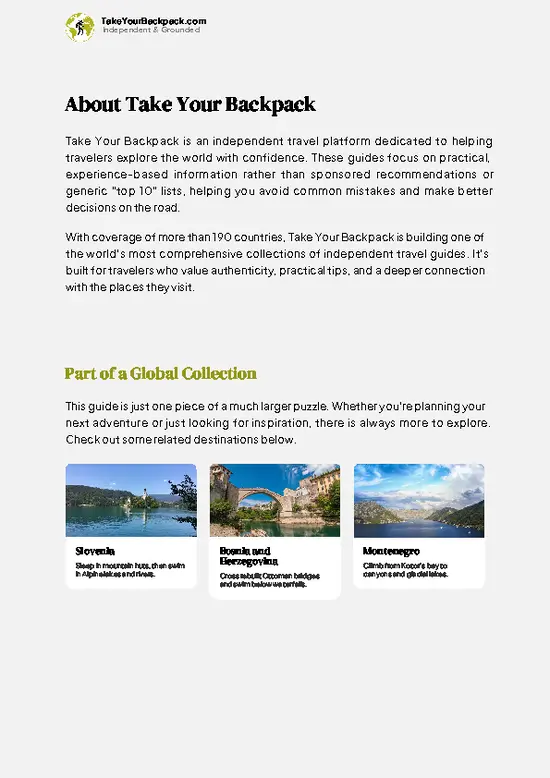
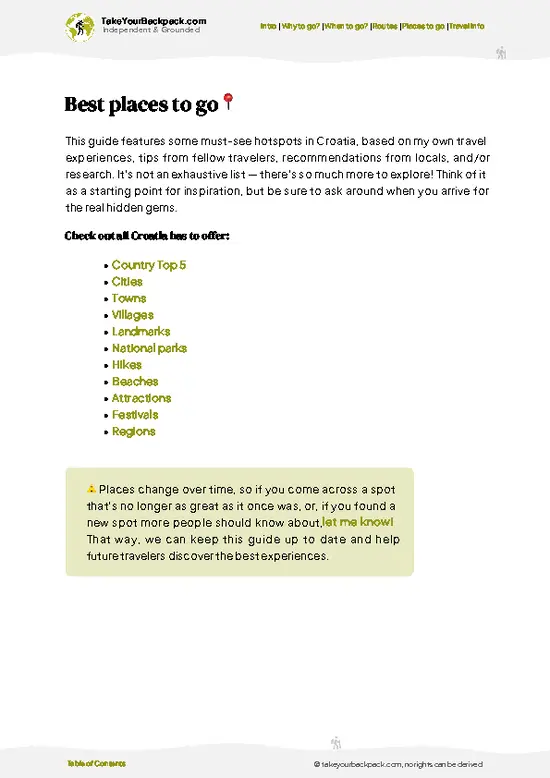
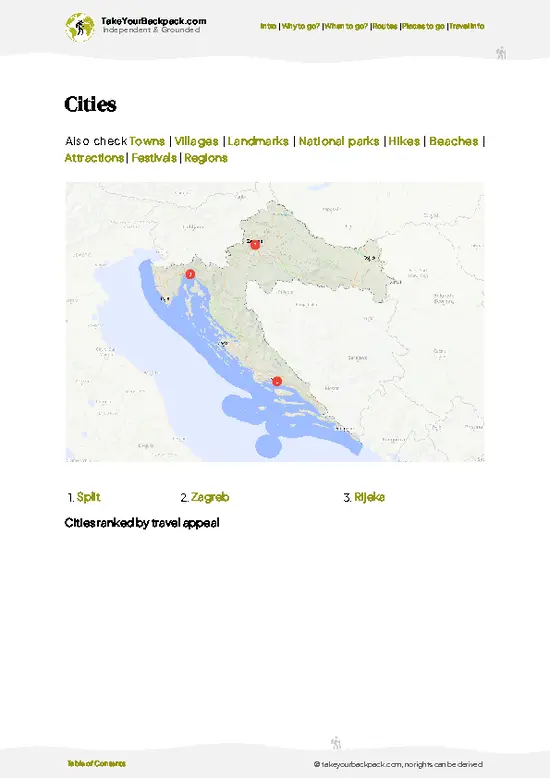
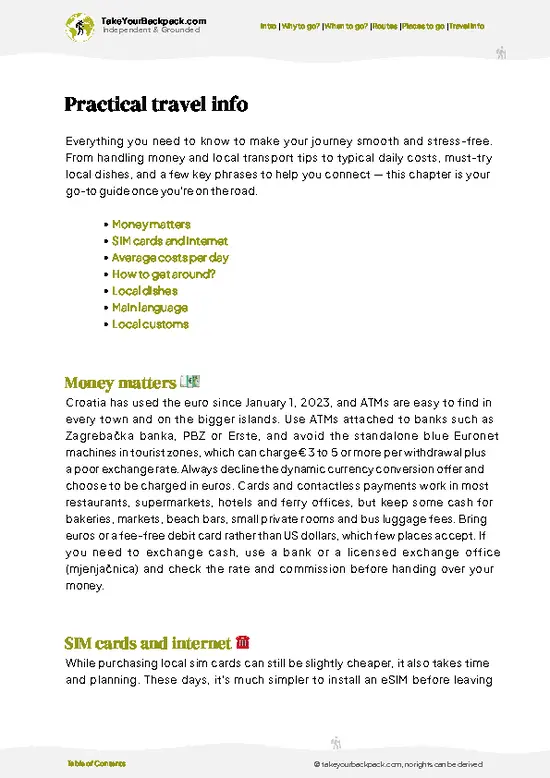
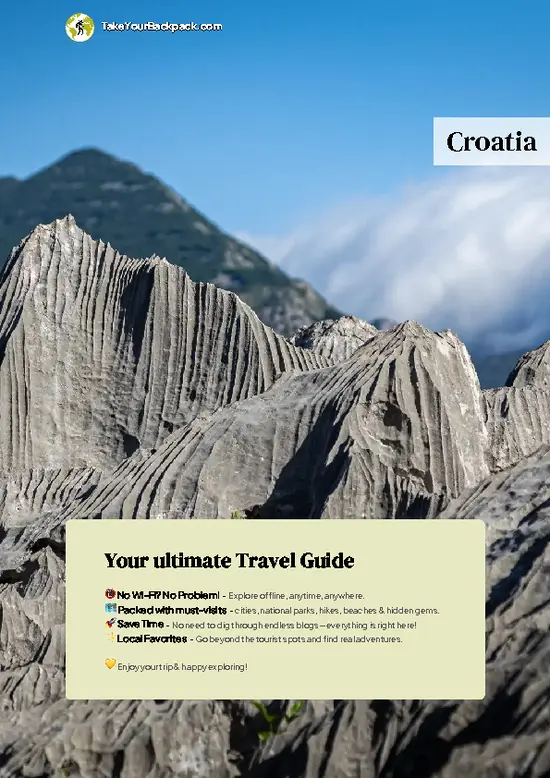
example page 0 from our offline Travel Guide for Croatia
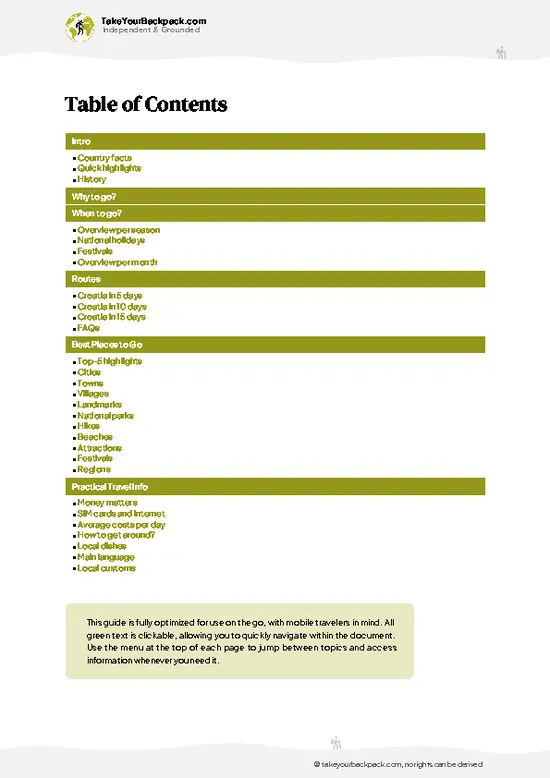
example page 1 from our offline Travel Guide for Croatia
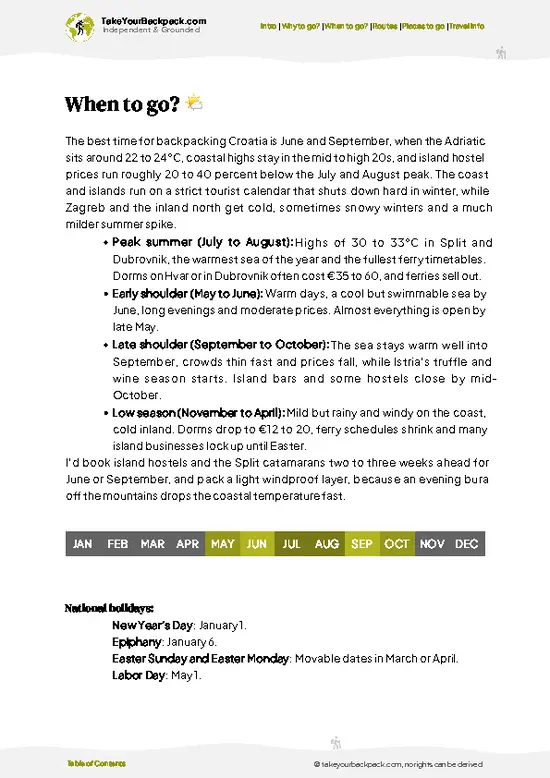
example page 2 from our offline Travel Guide for Croatia
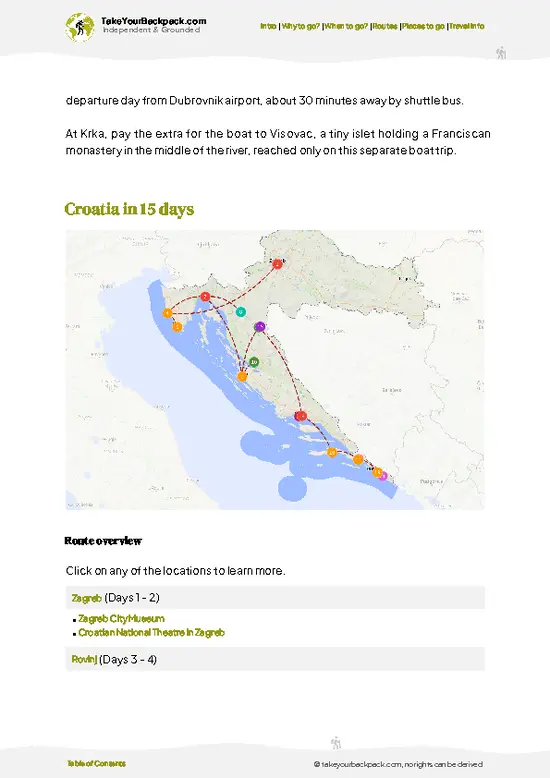
example page 3 from our offline Travel Guide for Croatia
example page 4 from our offline Travel Guide for Croatia
example page 5 from our offline Travel Guide for Croatia
example page 6 from our offline Travel Guide for Croatia
example page 7 from our offline Travel Guide for Croatia
The digital guide (407 pages) contains:
✅ 109 highlights, ranked by travel appeal
✅ Optimized 5, 10 & 15-day travel routes
✅ Cities, national parks, landmarks, beaches
✅ How to get around
✅ Offline-friendly for travel without Wi-Fi
👉 Click to see all 30+ guide features

📅 Plan smarter in minutes, not weeks
✅ Month by month travel advice
✅ Festivals & national holidays
✅ Budget expectations

🗺️ Go to the right places, skip the overrated ones
✅ Honest pros & cons of destinations
✅ Top hikes, parks & viewpoints
✅ Lesser-known places most travelers miss
✅ Clear “worth it vs skip it” guidance

🛏️ Travel smoothly without rookie mistakes
✅ Best areas to stay
✅ Transport systems explained simply
✅ Common scams & safety advice
✅ SIM cards, money & practical tips

🌍 Understand the country, not just visit it
✅ Culture & traditions
✅ 52 Essential phrases & customs
✅ Festivals worth planning around
✅ Traveler-friendly historical context
✅ Insights that make places more meaningful

📱 Built for real travel conditions
✅ Fully downloadable PDF
✅ Works completely offline
✅ Optimized for phone use
✅ Useful in remote areas & buses
✅ Everything in one place
Stop searching, start planning
Get instant access to your full guide. 30‑day money-back guarantee.
+ Add another guide for just

By proceeding you agree to our terms.
Sent to your inbox immediately after payment • 100% Secure Checkout
Best Backpacking Travel Advisor 2025 tourism awardBest Backpacking
Travel Advisor
2025
What others say about Take Your Backpack Guides:
⭐⭐⭐⭐⭐
Fantastic, amazing amount of information!
⭐⭐⭐⭐⭐
My goodness this is amazing, it's what I've been looking for hats off too you!
⭐⭐⭐⭐⭐
I think this is absolutely BRILLIANT
⭐⭐⭐⭐
Very complete and informative. It's still missing places, but I gotta to commend you
⭐⭐⭐⭐⭐
This is truly amazing, thank you, can't wait to explore it with my kids!
⭐⭐⭐⭐⭐
Awesome resource, thank you!
⭐⭐⭐⭐⭐
This is amazing! Can't wait to explore the ones I haven't seen
⭐⭐⭐⭐
I love this! Well done, great idea.
⭐⭐⭐⭐⭐
Thanks for taking the time to make this gem!
⭐⭐⭐⭐⭐
This might be the best website I've ever seen.
⭐⭐⭐⭐⭐
Congratulations, and thank you so much for your work; it's incredibly valuable.
⭐⭐⭐⭐
In all seriousness I think you did a great job pointing out the important spots
⭐⭐⭐⭐⭐
10/10 very good
⭐⭐⭐⭐⭐
As someone who's only just starting to visit regularly this is awesome, thank you.
⭐⭐⭐⭐
Thank you very much! I'm going to visit my dad, it's going to be very useful!
⭐⭐⭐⭐⭐
This is really cool! We'll be travelling for the first time and this definitely come in handy.
⭐⭐⭐⭐⭐
You are now our minister of culture, congratulations 👨‍💼
⭐⭐⭐⭐⭐
Just wanted to tell you that this is a pearl! Going to follow your recommendations.
⭐⭐⭐⭐⭐
This is so cool. I'll definitely be using the resource for my travels soon.
⭐⭐⭐⭐⭐
This is very impressive! Good work.
⭐⭐⭐⭐⭐
This is an amazing and informative site. Very well done!

🛏️ Where to stay?Accommodation Highlights

Croatia has plenty of hostels and private rooms (“sobe”), with dorm beds running roughly €20 to €45 a night in peak summer and far less off-season. In Zagreb, Donji Grad puts you near the bars of Tkalčićeva and the main squares, while in Split beds inside Diocletian’s Palace sit right on the sights but come with late-night noise, and Bačvice trades that for beach access and its own club scene. Dubrovnik’s Old Town is the priciest and busiest base, so Lapad and Gruž are the quieter, cheaper picks a short bus ride from the walls, near the ferry port in Gruž’s case.

If you enjoy meeting fellow travelers, consider choosing hostels with high ratings for atmosphere. On the other hand, if you prefer … read more 👉
Croatia has plenty of hostels and private rooms (“sobe”), with dorm beds running roughly €20 to €45 a night in peak summer and far less off-season. In Zagreb, Donji Grad puts you near the bars of Tkalčićeva and the main squares, while in Split beds inside Diocletian’s Palace sit right on the sights but come with late-night noise, and Bačvice trades that for beach access and its own club scene. Dubrovnik’s Old Town is the priciest and busiest base, so Lapad and Gruž are the quieter, cheaper picks a short bus ride from the walls, near the ferry port in Gruž’s case.

If you enjoy meeting fellow travelers, consider choosing hostels with high ratings for atmosphere. On the other hand, if you prefer having your own space, a hotel might be a better option.

CroatiaSee More of Croatia

👋 Meet the founderWho’s Behind Take Your Backpack?

Johan, backpacker and founder of TakeYourBackpackHi, I’m Johan (Netherlands 🇳🇱), the creator of TakeYourBackpack. Over the past 3 decades, I’ve backpacked through 90+ countries across six continents, gaining extensive experience with independent travel, long-term trips, and overland routes.

This site is built on a combination of firsthand travel experience and carefully curated insights from other backpackers. Many guides are based on places I’ve personally visited, while others bring together tips, observations, and practical advice shared by trusted travelers I’ve met along the way.

The goal is to provide realistic, experience-driven guidance — not generic itineraries — so you can explore destinations with better context, clearer expectations, and more confidence.