×

Croatia🇭🇷 | best hikesExplore the 8 Best hikes in Croatia

Hikes in Croatia come in three distinct flavors, and picking the right one saves you money and elbow room. The Dalmatian coast gives you karst ridges above the Adriatic, with buses and ferries to the trailheads, but shade is scarce and summer crowds are real. Istria and Kvarner are greener, quieter and easy by rental car. The Dinaric interior (Velebit, Plitvice, Gorski Kotar) is cooler and cheaper. For independent travelers, my trick is to start early, around 6:30 a.m., and be down before the heat and the tour buses arrive.

By Johan Kruseman 🇳🇱 | Updated October 18, 2026
Explore the best beaches in Croatia

Why go?Key Factors That Shape the Experience

Croatia packs an unusual amount of terrain into a country you can cross by road in a day. The Dinaric Alps run parallel to the coast, so you can stand on limestone peaks with the sea below, then be on a beach by afternoon. That is rare in Europe, and it is why hikers here can mix mountains with swimming without a long transfer.

The landscape is karst: porous limestone, little surface water and sharp, rocky paths. Trails are often exposed, so water and sun protection matter more than the distances suggest. Marked routes are maintained by local mountaineering clubs, with red-and-white circle blazes, and they are generally reliable. Maps and signs can be thinner than in the Alps, so download offline maps before you go.

Before choosing Croatia, know that the 1990s war left some inland areas, … read more 👉
Croatia packs an unusual amount of terrain into a country you can cross by road in a day. The Dinaric Alps run parallel to the coast, so you can stand on limestone peaks with the sea below, then be on a beach by afternoon. That is rare in Europe, and it is why hikers here can mix mountains with swimming without a long transfer.

The landscape is karst: porous limestone, little surface water and sharp, rocky paths. Trails are often exposed, so water and sun protection matter more than the distances suggest. Marked routes are maintained by local mountaineering clubs, with red-and-white circle blazes, and they are generally reliable. Maps and signs can be thinner than in the Alps, so download offline maps before you go.

Before choosing Croatia, know that the 1990s war left some inland areas, notably parts of Lika and the Dalmatian hinterland, with leftover mines. Stay on marked paths. Mountain weather also changes fast, especially when the cold bora wind blows from the northeast and can shut down exposed ridges and coastal roads. Public transport to trailheads is sparse outside the coast, so many hikers rent a car or hitch with local hosts.
Why These Made the Cut
The list of best hikes in Croatia is created based on scenery, challenge, trail quality, landmarks, and overall enjoyment. If you feel a hike is missing in this list, please let us know.

When to go?When to Plan Your Trip

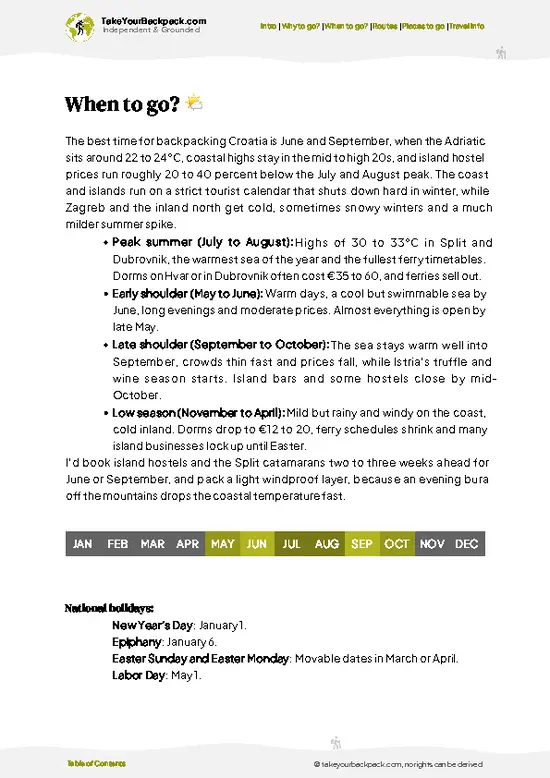
Best months for hiking: May, June, September and early October are the best months for hiking in Croatia, because daytime temperatures sit around 18 to 26°C and the trails are neither baked nor snowy. Mid-May and mid-September are especially good, with warm sea for a post-hike swim.

Summer and the shoulder seasons: July and August push the Dalmatian coast to 30 to 38°C, with little shade on limestone slopes. Accommodation along the coast can cost 40 to 100 percent more than in May or late September, and ferries and parking fill up. If you hike in summer, start at dawn or head inland and uphill, where mountains such as Velebit and Gorski Kotar stay several degrees cooler. In the shoulder months, expect more rain in October and November, when the Adriatic coast gets its heaviest rainfall, often … read more 👉
Best months for hiking: May, June, September and early October are the best months for hiking in Croatia, because daytime temperatures sit around 18 to 26°C and the trails are neither baked nor snowy. Mid-May and mid-September are especially good, with warm sea for a post-hike swim.

Summer and the shoulder seasons: July and August push the Dalmatian coast to 30 to 38°C, with little shade on limestone slopes. Accommodation along the coast can cost 40 to 100 percent more than in May or late September, and ferries and parking fill up. If you hike in summer, start at dawn or head inland and uphill, where mountains such as Velebit and Gorski Kotar stay several degrees cooler. In the shoulder months, expect more rain in October and November, when the Adriatic coast gets its heaviest rainfall, often 100 to 150 mm a month.

Winter and snow: From November to April, higher inland and mountain routes can carry snow, and some mountain huts and seasonal national park services reduce hours or close. Istria and the southern coast stay mild, often 5 to 12°C, which makes them workable for winter walking on shorter days. The bora can arrive suddenly in winter, so check the forecast before committing to a ridge.

hike hoppingOptimizing Your Multi-Stop Itinerary

How many days to plan: A trip combining several hikes in Croatia works best over 10 to 14 days, which allows time for travel and a spare day for weather.

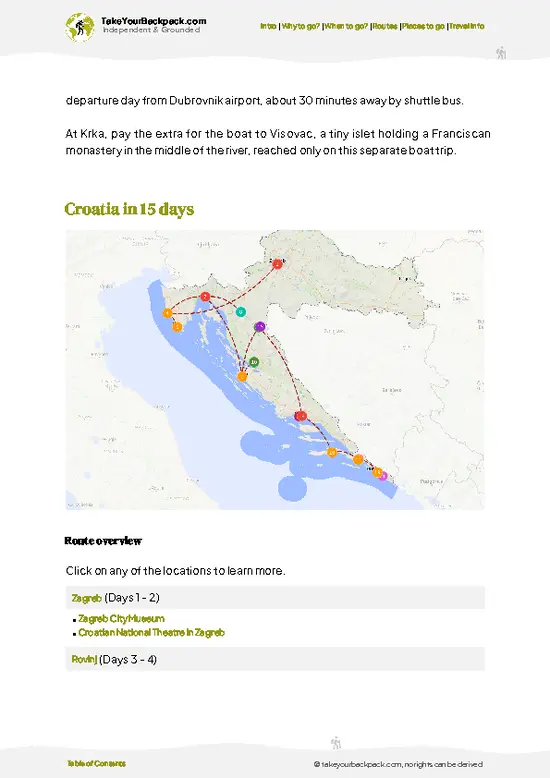
Grouping regions: Link places by geography rather than by a list. The coast and islands cluster around Split, with Dubrovnik about 4 to 5 hours away by bus. The northern uplands link well through Zagreb, which is 2 to 3 hours from Plitvice and Gorski Kotar by bus or car. Istria sits about 3 hours from Zagreb. A simple direction is to fly into Zagreb, work south through the interior and Velebit, and finish on the Dalmatian coast, where flights and ferries are frequent.

Pacing and common mistakes: Allow one to two nights per region, and two to three if you want a full-day hike plus recovery. Typical transfers between regions run 2 to 5 hours, … read more 👉
How many days to plan: A trip combining several hikes in Croatia works best over 10 to 14 days, which allows time for travel and a spare day for weather.

Grouping regions: Link places by geography rather than by a list. The coast and islands cluster around Split, with Dubrovnik about 4 to 5 hours away by bus. The northern uplands link well through Zagreb, which is 2 to 3 hours from Plitvice and Gorski Kotar by bus or car. Istria sits about 3 hours from Zagreb. A simple direction is to fly into Zagreb, work south through the interior and Velebit, and finish on the Dalmatian coast, where flights and ferries are frequent.

Pacing and common mistakes: Allow one to two nights per region, and two to three if you want a full-day hike plus recovery. Typical transfers between regions run 2 to 5 hours, longer when buses are infrequent. The usual mistake is to squeeze in a long hike on the same day as a long transfer, then arrive late and miss the cool early hours. Another is to assume buses reach trailheads. Many do not, so plan a taxi, a shared ride or a rental car. Finally, avoid booking too tightly in summer, when ferries and coastal buses sell out. Leave a flexible day for bora closures or storms.

The ListThe Best hikes of Croatia

1 Premužić Trail

stone-paved path, highland meadows, Velebit panoramas

Walk a historic route engineered for mountain travel, winding through open grasslands and offering long-range views inland and to the sea.

2 Velika Paklenica Canyon Trail

limestone canyons, climbing cliffs, mountain huts

Traverse dramatic gorges with sheer rock faces, passing climbers and stopping at rustic shelters deep in the national park.

croatia-hike-velika-paklenica-canyon-trail
© Google |

3 Velebit Mountain

remote peaks, karst plateaus, endemic wildlife

Navigate rugged uplands with sparse vegetation, encountering unique animal species and broad, open horizons far from settlements.

croatia-hike-velebit-mountain
© Google | Mariusz Turoboś

4 Biokovo Mountain

karst ridges, panoramic Adriatic views, alpine flora

Ascend through limestone slopes and exposed plateaus, passing rare plant life and open vistas above the Dalmatian coast.

croatia-hike-biokovo-mountain
© Google | József Ipsics

5 Sljeme Trail

forest tracks, ski slopes, summit tower

Hike wooded routes to the peak above Zagreb, sharing the trail with locals and reaching open areas used for winter sports.

croatia-hike-sljeme-trail
© Google |

6 Lungomare

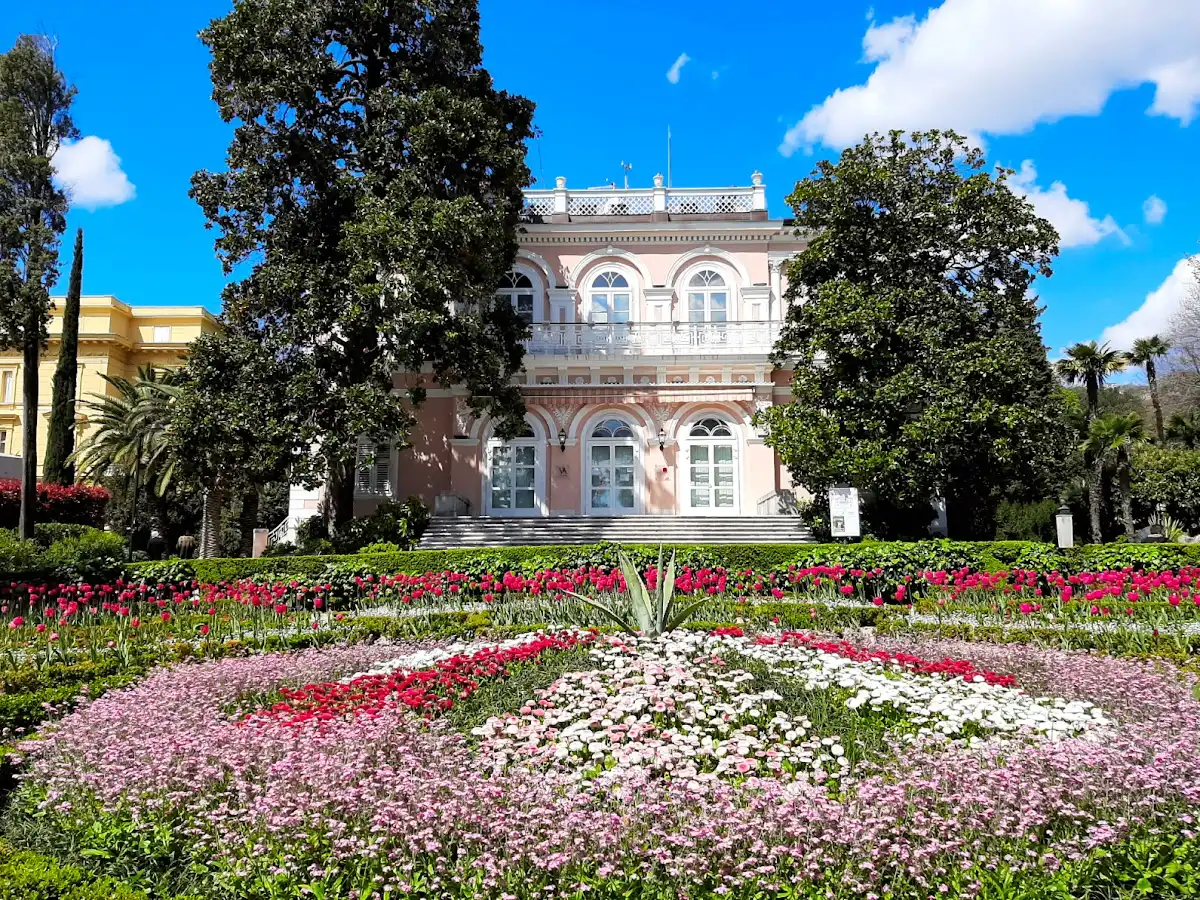
seaside walkway, Belle Époque villas, urban beaches

Stroll a paved route linking historic resorts, lively bathing spots, and shaded benches with constant sea access.

croatia-hike-lungomare
© Google |

7 Kamačnik Canyon

narrow gorge, wooden walkways, clear river pools

Follow a winding path along the river’s edge, crossing bridges and shaded forest as the canyon walls close in overhead.

croatia-hike-kamacnik-canyon
© Google |

8 The 4 Karlovac Rivers Trail

river confluences, city parks, pedestrian bridges

Circle the town by footpaths along four distinct rivers, passing green spaces and crossing frequent bridges in a loop.

Loading the map 🌍

Expert viewExpert Commentary on hikes

How many hikes to do: I would advise four to six hikes in a two-week trip. That gives you a hike every two or three days, which leaves room for recovery, weather swaps and the beach days that make Croatia a particular pleasure. More than that and the karst heat and rocky ground start to wear you down.

Choosing the kind of hike: If you love sea views, prioritize coastal and island trails, but go early and carry plenty of water. If you want shade, cooler air and fewer people, choose the forested interior and mountain routes. If you are traveling on a tight budget, favor the inland routes, where guesthouses and food are cheaper. Mix one famous national park with several lesser-known trails, because the popular parks have timed entry and crowds, while quieter areas give you solitude.

Costs: … read more 👉
How many hikes to do: I would advise four to six hikes in a two-week trip. That gives you a hike every two or three days, which leaves room for recovery, weather swaps and the beach days that make Croatia a particular pleasure. More than that and the karst heat and rocky ground start to wear you down.

Choosing the kind of hike: If you love sea views, prioritize coastal and island trails, but go early and carry plenty of water. If you want shade, cooler air and fewer people, choose the forested interior and mountain routes. If you are traveling on a tight budget, favor the inland routes, where guesthouses and food are cheaper. Mix one famous national park with several lesser-known trails, because the popular parks have timed entry and crowds, while quieter areas give you solitude.

Costs: Budget about US$55 to 110 a day (roughly €50 to 100) in summer on the coast, covering dorms or simple rooms, food and local transport. Inland and in shoulder months, US$40 to 70 a day is realistic. National park entry fees vary a lot: the biggest parks charge roughly €10 to 40 per person depending on season, with the highest prices in summer. Smaller nature parks cost less, often €5 to 12. A local guide for a day runs about €80 to 200 per group. Car rental is about €30 to 80 a day in season, plus fuel and parking, and buses between regions typically cost €10 to 30.

Safety: Carry 2 to 3 liters of water per person on exposed routes, as springs are rare on limestone. Start early to avoid afternoon heat and thunderstorms. Stay on marked trails, because some inland areas still have landmines from the 1990s, usually signed with yellow warning markers. The bora can make ridges dangerous, so check the forecast with the national weather service (DHMZ). The emergency number is 112, and mountain rescue is run by HGSS, so register your route with your accommodation. Also note that mobile coverage can drop in the mountains.

Cultural etiquette: Greet people with a simple “dobar dan” and you will be met warmly. Mountain huts are run by local clubs, so book ahead and bring cash, since card machines are not guaranteed. Take your trash out, avoid wild camping (it is illegal in most places, including national parks), and ask before using private land, because olive groves and fields are often family property.

✈️ The backpacker research shortcutCroatia Travel Guide

An offline-friendly backpacking guide with optimized travel routes, ranked highlights, transport advice, and the best areas to stay.
example page 0 from our offline Travel Guide for Croatia
example page 1 from our offline Travel Guide for Croatia
example page 2 from our offline Travel Guide for Croatia
example page 3 from our offline Travel Guide for Croatia
example page 4 from our offline Travel Guide for Croatia
example page 5 from our offline Travel Guide for Croatia
example page 6 from our offline Travel Guide for Croatia
example page 7 from our offline Travel Guide for Croatia
The digital guide (407 pages) contains:
✅ 109 highlights, ranked by travel appeal
✅ Optimized 5, 10 & 15-day travel routes
✅ Cities, national parks, landmarks, beaches
✅ How to get around
✅ Offline-friendly for travel without Wi-Fi
👉 Click to see all 30+ guide features

📅 Plan smarter in minutes, not weeks
✅ Month by month travel advice
✅ Festivals & national holidays
✅ Budget expectations

🗺️ Go to the right places, skip the overrated ones
✅ Honest pros & cons of destinations
✅ Top hikes, parks & viewpoints
✅ Lesser-known places most travelers miss
✅ Clear “worth it vs skip it” guidance

🛏️ Travel smoothly without rookie mistakes
✅ Best areas to stay
✅ Transport systems explained simply
✅ Common scams & safety advice
✅ SIM cards, money & practical tips

🌍 Understand the country, not just visit it
✅ Culture & traditions
✅ 52 Essential phrases & customs
✅ Festivals worth planning around
✅ Traveler-friendly historical context
✅ Insights that make places more meaningful

📱 Built for real travel conditions
✅ Fully downloadable PDF
✅ Works completely offline
✅ Optimized for phone use
✅ Useful in remote areas & buses
✅ Everything in one place
Stop searching, start planning
Get instant access to your full guide. 30‑day money-back guarantee.
+ Add another guide for just

By proceeding you agree to our terms.
Sent to your inbox immediately after payment • 100% Secure Checkout
Best Backpacking Travel Advisor 2025 tourism awardBest Backpacking
Travel Advisor
2025
What others say about Take Your Backpack Guides:
⭐⭐⭐⭐⭐
Fantastic, amazing amount of information!
⭐⭐⭐⭐⭐
My goodness this is amazing, it's what I've been looking for hats off too you!
⭐⭐⭐⭐⭐
I think this is absolutely BRILLIANT
⭐⭐⭐⭐
Very complete and informative. It's still missing places, but I gotta to commend you
⭐⭐⭐⭐⭐
This is truly amazing, thank you, can't wait to explore it with my kids!
⭐⭐⭐⭐⭐
Awesome resource, thank you!
⭐⭐⭐⭐⭐
This is amazing! Can't wait to explore the ones I haven't seen
⭐⭐⭐⭐
I love this! Well done, great idea.
⭐⭐⭐⭐⭐
Thanks for taking the time to make this gem!
⭐⭐⭐⭐⭐
This might be the best website I've ever seen.
⭐⭐⭐⭐⭐
Congratulations, and thank you so much for your work; it's incredibly valuable.
⭐⭐⭐⭐
In all seriousness I think you did a great job pointing out the important spots
⭐⭐⭐⭐⭐
10/10 very good
⭐⭐⭐⭐⭐
As someone who's only just starting to visit regularly this is awesome, thank you.
⭐⭐⭐⭐
Thank you very much! I'm going to visit my dad, it's going to be very useful!
⭐⭐⭐⭐⭐
This is really cool! We'll be travelling for the first time and this definitely come in handy.
⭐⭐⭐⭐⭐
You are now our minister of culture, congratulations 👨‍💼
⭐⭐⭐⭐⭐
Just wanted to tell you that this is a pearl! Going to follow your recommendations.
⭐⭐⭐⭐⭐
This is so cool. I'll definitely be using the resource for my travels soon.
⭐⭐⭐⭐⭐
This is very impressive! Good work.
⭐⭐⭐⭐⭐
This is an amazing and informative site. Very well done!

🛏️ Where to stay?Best Places to Stay in Croatia

Croatia has plenty of hostels and private rooms (“sobe”), with dorm beds running roughly €20 to €45 a night in peak summer and far less off-season. In Zagreb, Donji Grad puts you near the bars of Tkalčićeva and the main squares, while in Split beds inside Diocletian’s Palace sit right on the sights but come with late-night noise, and Bačvice trades that for beach access and its own club scene. Dubrovnik’s Old Town is the priciest and busiest base, so Lapad and Gruž are the quieter, cheaper picks a short bus ride from the walls, near the ferry port in Gruž’s case.

If you enjoy meeting fellow travelers, consider choosing hostels with high ratings for atmosphere. On the other hand, if you prefer … read more 👉
Croatia has plenty of hostels and private rooms (“sobe”), with dorm beds running roughly €20 to €45 a night in peak summer and far less off-season. In Zagreb, Donji Grad puts you near the bars of Tkalčićeva and the main squares, while in Split beds inside Diocletian’s Palace sit right on the sights but come with late-night noise, and Bačvice trades that for beach access and its own club scene. Dubrovnik’s Old Town is the priciest and busiest base, so Lapad and Gruž are the quieter, cheaper picks a short bus ride from the walls, near the ferry port in Gruž’s case.

If you enjoy meeting fellow travelers, consider choosing hostels with high ratings for atmosphere. On the other hand, if you prefer having your own space, a hotel might be a better option.

CroatiaExplore Croatia

👋 Meet the founderWho’s Behind Take Your Backpack?

Johan, backpacker and founder of TakeYourBackpackHi, I’m Johan (Netherlands 🇳🇱), the creator of TakeYourBackpack. Over the past 3 decades, I’ve backpacked through 90+ countries across six continents, gaining extensive experience with independent travel, long-term trips, and overland routes.

This site is built on a combination of firsthand travel experience and carefully curated insights from other backpackers. Many guides are based on places I’ve personally visited, while others bring together tips, observations, and practical advice shared by trusted travelers I’ve met along the way.

The goal is to provide realistic, experience-driven guidance — not generic itineraries — so you can explore destinations with better context, clearer expectations, and more confidence.