×

Croatia🇭🇷 | best attractionsExplore the 10 Best attractions in Croatia

Attractions in Croatia split along the coast. Dalmatia has the big-name walled towns and island ferries, with the highest prices and the thickest crowds from June to August. Istria and Kvarner are quieter and cheaper, with hill villages that need a car or a patient bus timetable. Inland, Zagreb and the national parks are easy on the wallet. For independent travelers, the trick is early starts: be at a gate by 8 a.m. and the tour groups arrive after you leave. Book park tickets online, and carry euros in cash for small museums and village chapels.

By Johan Kruseman 🇳🇱 | Updated October 18, 2026
Explore the best festivals in Croatia

Why go?Key Factors That Shape the Experience

Croatia packs an unusual amount into a small country because of its geography. A coastline of roughly 1,800 kilometers on the mainland, plus more than a thousand islands, sits against limestone mountains and river valleys, so landscapes change within a couple of hours' drive. History adds the layers: Roman emperors, Venetian merchants, Habsburg administrators and Ottoman borderlands each left a distinct stamp, which is why a coastal town and an inland one can feel like different countries.

The climate shapes everything. Mediterranean summers on the coast are hot and dry, while the interior is continental, with cold winters. Much of the best sightseeing is outdoors, so weather and daylight matter more than opening hours.

Before choosing Croatia, know that popularity has a price. The most … read more 👉
Croatia packs an unusual amount into a small country because of its geography. A coastline of roughly 1,800 kilometers on the mainland, plus more than a thousand islands, sits against limestone mountains and river valleys, so landscapes change within a couple of hours' drive. History adds the layers: Roman emperors, Venetian merchants, Habsburg administrators and Ottoman borderlands each left a distinct stamp, which is why a coastal town and an inland one can feel like different countries.

The climate shapes everything. Mediterranean summers on the coast are hot and dry, while the interior is continental, with cold winters. Much of the best sightseeing is outdoors, so weather and daylight matter more than opening hours.

Before choosing Croatia, know that popularity has a price. The most famous places now use timed tickets, visitor caps and, in some towns, rules on groups and behavior. Prices climbed after the switch to the euro in 2023. Public transport is decent along main coastal and Zagreb routes but thin to islands and small villages outside summer, so plan around ferry and bus schedules. Quieter regions repay the extra effort with lower costs and far fewer people.
Our Approach to Ranking
The list of best attractions in Croatia is created based on cultural significance or entertainment value. If you feel a attraction is missing in this list, please let us know.

When to go?When to Plan Your Trip

Best months for attractions: May, June and September are the best months for attractions in Croatia: the sea is warm enough to swim (about 18 to 24°C), days are long, and the crowds and prices of high summer have not arrived or have already faded. Daytime highs sit around 22 to 27°C on the coast, comfortable for walking old towns and climbing viewpoints.

Peak season and its costs: July and August bring 30 to 35°C heat on the Adriatic, packed ferries and the highest prices. Accommodation on the coast can run 50 to 100 percent above shoulder-season rates, and the midday sun makes walls and stairs punishing. If you come then, do your sightseeing before 10 a.m. and after 5 p.m., and give the middle of the day to the water.

Shoulder and off-season: April and October are mild (15 to 20°C) with … read more 👉
Best months for attractions: May, June and September are the best months for attractions in Croatia: the sea is warm enough to swim (about 18 to 24°C), days are long, and the crowds and prices of high summer have not arrived or have already faded. Daytime highs sit around 22 to 27°C on the coast, comfortable for walking old towns and climbing viewpoints.

Peak season and its costs: July and August bring 30 to 35°C heat on the Adriatic, packed ferries and the highest prices. Accommodation on the coast can run 50 to 100 percent above shoulder-season rates, and the midday sun makes walls and stairs punishing. If you come then, do your sightseeing before 10 a.m. and after 5 p.m., and give the middle of the day to the water.

Shoulder and off-season: April and October are mild (15 to 20°C) with more rain, especially in autumn, when Kvarner and Dalmatia get their heaviest showers. Between November and March, many island ferries run reduced timetables and some seasonal sites and restaurants close, while the coast stays around 8 to 13°C. Zagreb and the continental interior get cold, often near or below freezing in winter, but city museums stay open and prices drop sharply. Inland national parks are lovely in autumn color, though some boat and shuttle services stop outside the main season.

attraction hoppingOptimizing Your Multi-Stop Itinerary

How long you need: A trip combining several of Croatia's attractions needs 10 to 14 days; a week lets you cover one or two regions properly without rushing.

Which regions pair well: The simplest shape is a line from north to south: start in Zagreb, drop to the inland parks, reach the coast, then follow Dalmatia down to Dubrovnik, or run it in reverse if your flight lands there. Istria pairs with Zagreb or Rijeka and works as a separate loop, especially with a rental car. Split, Zadar and Dubrovnik are the main bus and ferry hubs.

Time and travel between stops: Give big old towns and park areas a full day, smaller villages a half day, and islands at least two nights, since ferry timing eats a day each way. Typical bus journeys: Zagreb to Zadar 3.5 to 4.5 hours, Zagreb to Split 5 to 6, Split … read more 👉
How long you need: A trip combining several of Croatia's attractions needs 10 to 14 days; a week lets you cover one or two regions properly without rushing.

Which regions pair well: The simplest shape is a line from north to south: start in Zagreb, drop to the inland parks, reach the coast, then follow Dalmatia down to Dubrovnik, or run it in reverse if your flight lands there. Istria pairs with Zagreb or Rijeka and works as a separate loop, especially with a rental car. Split, Zadar and Dubrovnik are the main bus and ferry hubs.

Time and travel between stops: Give big old towns and park areas a full day, smaller villages a half day, and islands at least two nights, since ferry timing eats a day each way. Typical bus journeys: Zagreb to Zadar 3.5 to 4.5 hours, Zagreb to Split 5 to 6, Split to Dubrovnik 4 to 5, depending on border queues at the short Bosnia stretch near Neum.

Planning mistakes: The classic error is stacking too many one-night stops, which leaves you living on buses. Pick fewer bases and use day trips. Another is ignoring ferry schedules, which thin out dramatically off-season, so check them before booking beds. Finally, travelers underestimate summer traffic on the coastal road. Leave early, and book buses in July and August.

The ListThe Best attractions of Croatia

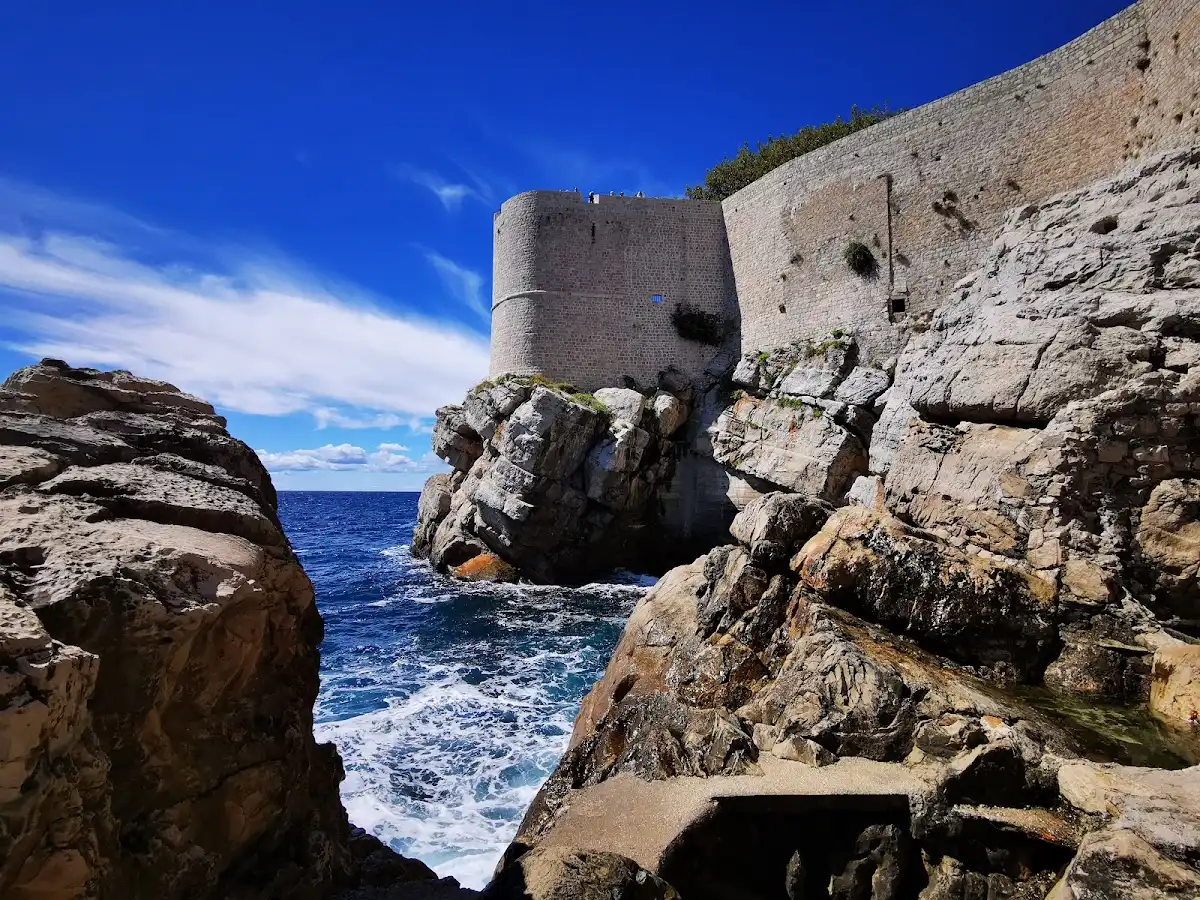
1 Dubrovnik City Walls and Fortresses

medieval ramparts, Adriatic views, defensive towers

Circle the old town atop massive walls, gaining perspective on centuries of maritime defense and panoramic coastal scenery.

croatia-attraction-dubrovnik-city-walls-and-fortresses
© Google |

2 Diocletian’s Palace Substructures

Roman cellars, stone vaults, Game of Thrones filming

Descend beneath Split’s streets to walk through atmospheric chambers that reveal the city’s Roman origins and cinematic legacy.

3 Pula Arena

Roman amphitheater, limestone arches, gladiator history

Stand inside a remarkably preserved arena that once hosted ancient spectacles, now used for concerts and public events.

croatia-attraction-pula-arena
© Google |

4 Museum of Broken Relationships

personal stories, donated objects, emotional narratives

Reflect on human connections through a collection of everyday items, each accompanied by a brief account of separation or loss.

croatia-attraction-museum-of-broken-relationships
© Google |

5 Rector’s Palace and Cultural History Museum

Gothic-Renaissance palace, period rooms, Dubrovnik artifacts

Tour furnished chambers and curated exhibits that reveal the administrative and daily life of Dubrovnik’s former republic.

croatia-attraction-rectors-palace-and-cultural-history-museum
© Google |

6 Croatian National Theatre in Zagreb

opera house, ornate interiors, cultural performances

Attend a performance or tour the lavish halls to experience the city’s artistic traditions and architectural grandeur in a single visit.

croatia-attraction-croatian-national-theatre-in-zagreb
© Google |

7 Kuterevo Bear Sanctuary

rescued bears, mountain village, volunteer projects

Observe brown bears in a natural setting while learning about conservation efforts and rural life in the Velebit foothills.

croatia-attraction-kuterevo-bear-sanctuary
© Google |

9 Nikola Tesla Technical Museum

science exhibits, Tesla inventions, interactive displays

Engage with hands-on demonstrations and original machines that highlight Croatia’s contributions to technology and innovation.

croatia-attraction-nikola-tesla-technical-museum
© Google |

10 Archaeological Museum in Zagreb

ancient artifacts, Egyptian mummies, numismatic collections

Trace the evolution of civilizations through rare relics, intricate coins, and preserved objects spanning millennia of regional history.

croatia-attraction-archaeological-museum-in-zagreb
© Google |

12 Zagreb City Museum

urban history, multimedia exhibits, medieval artifacts

Follow the city’s transformation from medieval settlement to modern capital through interactive displays and local relics.

13 Nehaj Fortress

hilltop stronghold, 16th-century walls, panoramic lookout

Climb to a commanding fortress where exhibits and sweeping views illustrate the region’s military past and strategic importance.

14 Goli Otok

former prison, barren landscape, political history

Visit a stark island site where remnants of a notorious labor camp offer insight into Yugoslav-era repression and isolation.

Think you know Croatia?

Prove you’re a true local — uncover 4 lesser-known attractions in Croatia that locals tend to keep to themselves.
Loading the map 🌍

Expert viewExpert Commentary on attractions

How many to visit: Aim for one major attraction per day, with a quieter one alongside it, and cap the whole trip at roughly 8 to 12 paid visits over two weeks. Croatia's headline sites are crowded and timed, so seeing three in a day means queuing more than looking. Free pleasures such as old-town lanes, hill villages and sunset viewpoints fill the gaps and cost nothing.

Prioritizing by travel style: If you love history, put the Roman and Venetian old towns first and visit them early or late. Nature seekers should choose the waterfall and lake parks, plus a hike in the Velebit or Biokovo mountains. Beach-minded travelers can treat attractions as a rainy-day extra and focus on islands. Budget travelers get the best value inland and in Istria, where entry is cheaper and queues shorter.

What … read more 👉
How many to visit: Aim for one major attraction per day, with a quieter one alongside it, and cap the whole trip at roughly 8 to 12 paid visits over two weeks. Croatia's headline sites are crowded and timed, so seeing three in a day means queuing more than looking. Free pleasures such as old-town lanes, hill villages and sunset viewpoints fill the gaps and cost nothing.

Prioritizing by travel style: If you love history, put the Roman and Venetian old towns first and visit them early or late. Nature seekers should choose the waterfall and lake parks, plus a hike in the Velebit or Biokovo mountains. Beach-minded travelers can treat attractions as a rainy-day extra and focus on islands. Budget travelers get the best value inland and in Istria, where entry is cheaper and queues shorter.

What it costs: Expect roughly €45 to 80 a day in summer including a hostel bed, food and local transport, with attractions on top, and €30 to 55 off-season. Entry fees vary widely: small museums and churches cost €2 to 8, city wall walks and major monuments often €15 to 40, and the most visited national parks about €10 to 40 depending on season (highest July and August). Guided tours run about €15 to 50 for a few hours. Many places offer student discounts, and some towns sell combined passes that save money if you plan several visits. Intercity buses cost around €10 to 25 per leg, and island ferries €5 to 15 for foot passengers. Parking near popular sites can add €5 to 15 a day.

Safety and culture: Croatia is safe, with low violent crime, so your main risks are sun, heat and slippery limestone. Carry 2 liters of water in summer, wear shoes with grip, and swim only where it is permitted. Some mountain areas still contain landmine remnants from the 1990s war, so stay on marked trails, particularly near former front lines in Lika, Slavonia and parts of the hinterland. Dress modestly in churches, with shoulders and knees covered. Several historic towns fine people for walking around in swimwear or behaving rowdily, and drinking in public streets can be penalized. Respect quiet hours in residential old towns. Book popular tickets online a few days ahead in summer, since walk-up slots sell out, and keep some cash for small sites.

✈️ The backpacker research shortcutCroatia Travel Guide

An offline-friendly backpacking guide with optimized travel routes, ranked highlights, transport advice, and the best areas to stay.
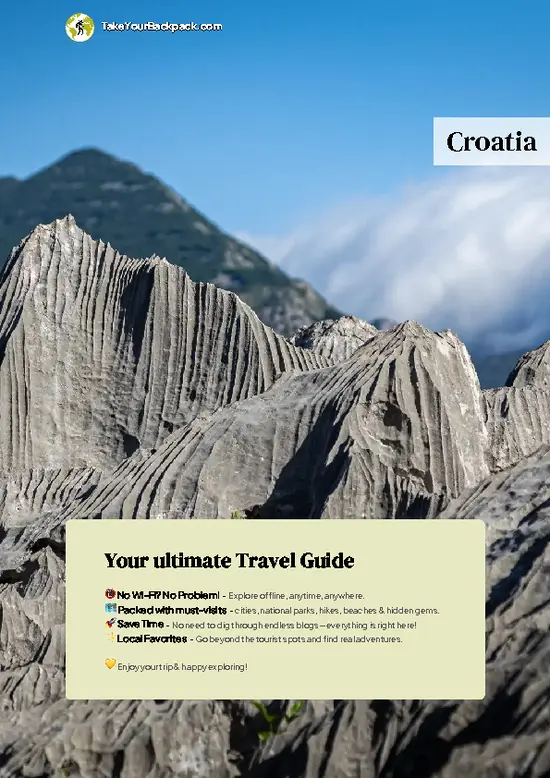
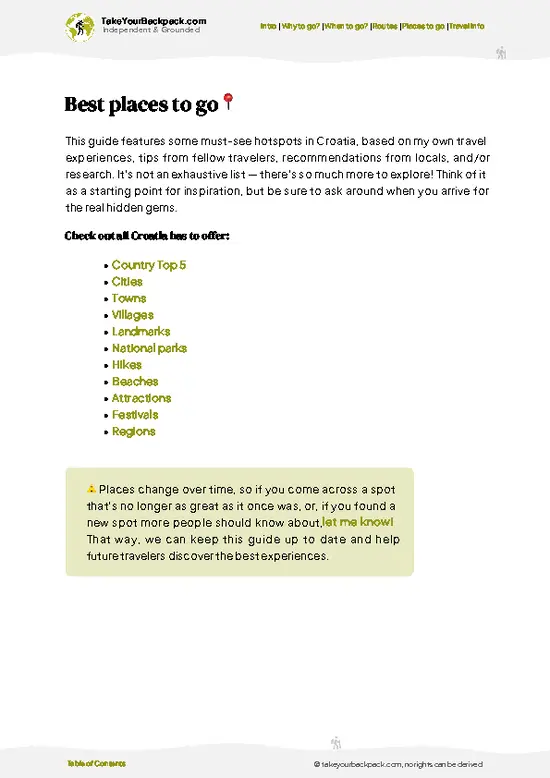
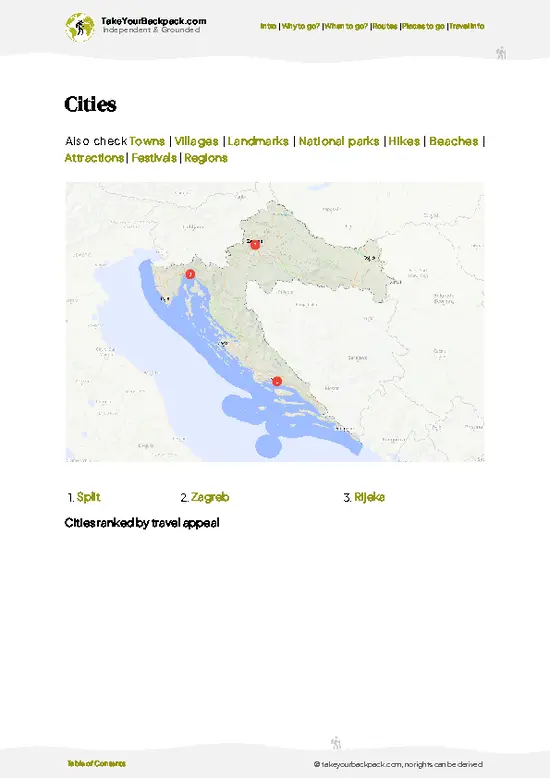
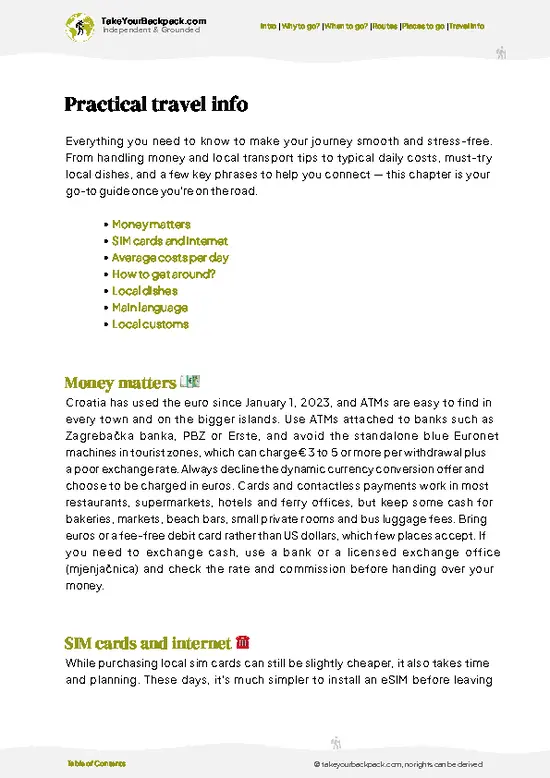
example page 0 from our offline Travel Guide for Croatia
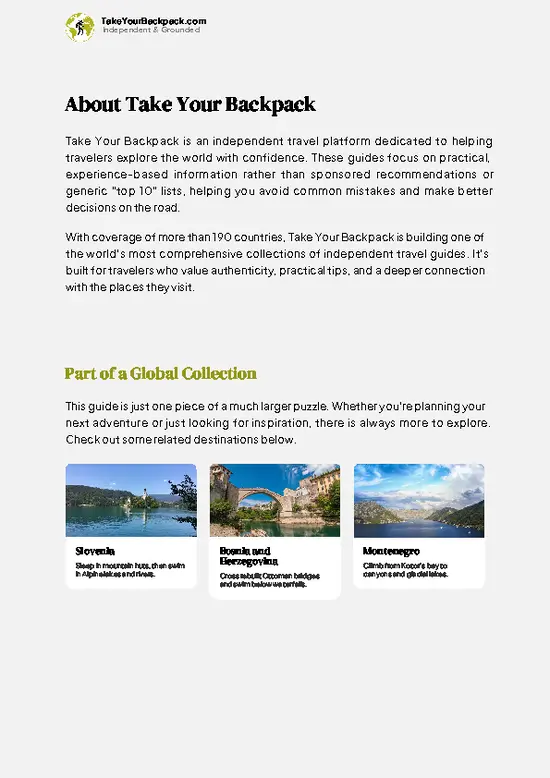
example page 1 from our offline Travel Guide for Croatia
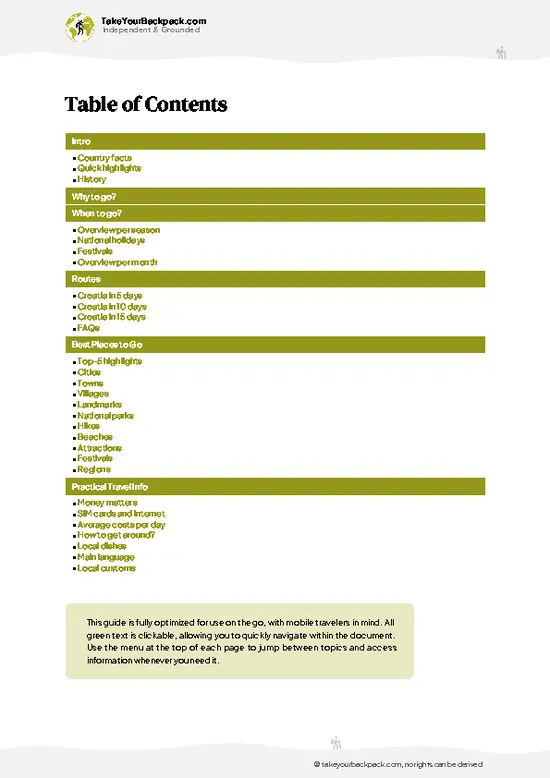
example page 2 from our offline Travel Guide for Croatia
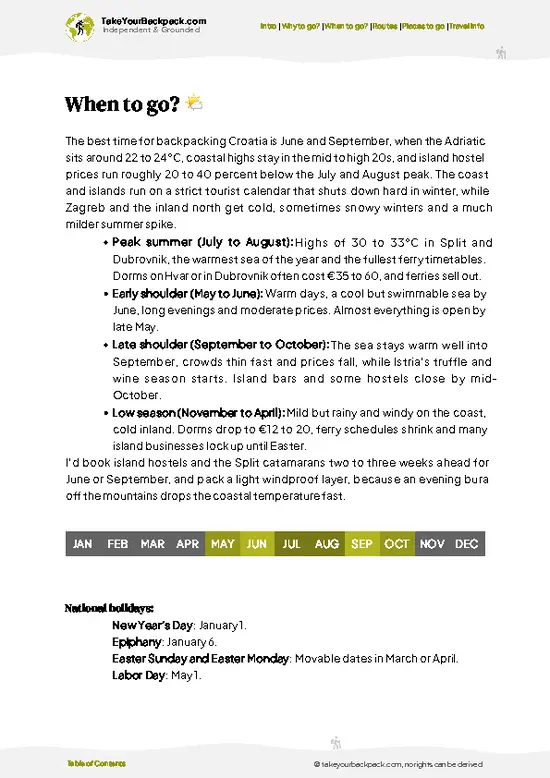
example page 3 from our offline Travel Guide for Croatia
example page 4 from our offline Travel Guide for Croatia
example page 5 from our offline Travel Guide for Croatia
example page 6 from our offline Travel Guide for Croatia
example page 7 from our offline Travel Guide for Croatia
The digital guide (407 pages) contains:
✅ 109 highlights, ranked by travel appeal
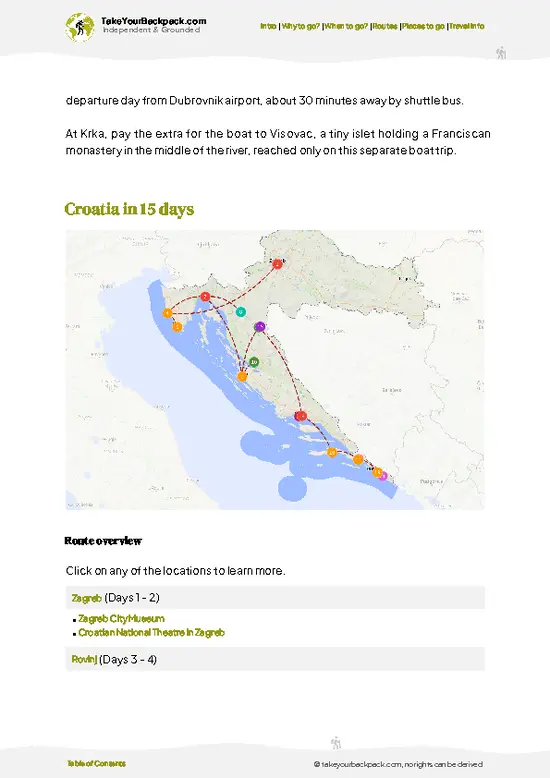
✅ Optimized 5, 10 & 15-day travel routes
✅ Cities, national parks, landmarks, beaches
✅ How to get around
✅ Offline-friendly for travel without Wi-Fi
👉 Click to see all 30+ guide features

📅 Plan smarter in minutes, not weeks
✅ Month by month travel advice
✅ Festivals & national holidays
✅ Budget expectations

🗺️ Go to the right places, skip the overrated ones
✅ Honest pros & cons of destinations
✅ Top hikes, parks & viewpoints
✅ Lesser-known places most travelers miss
✅ Clear “worth it vs skip it” guidance

🛏️ Travel smoothly without rookie mistakes
✅ Best areas to stay
✅ Transport systems explained simply
✅ Common scams & safety advice
✅ SIM cards, money & practical tips

🌍 Understand the country, not just visit it
✅ Culture & traditions
✅ 52 Essential phrases & customs
✅ Festivals worth planning around
✅ Traveler-friendly historical context
✅ Insights that make places more meaningful

📱 Built for real travel conditions
✅ Fully downloadable PDF
✅ Works completely offline
✅ Optimized for phone use
✅ Useful in remote areas & buses
✅ Everything in one place
Stop searching, start planning
Get instant access to your full guide. 30‑day money-back guarantee.
+ Add another guide for just

By proceeding you agree to our terms.
Sent to your inbox immediately after payment • 100% Secure Checkout
Best Backpacking Travel Advisor 2025 tourism awardBest Backpacking
Travel Advisor
2025
What others say about Take Your Backpack Guides:
⭐⭐⭐⭐⭐
Fantastic, amazing amount of information!
⭐⭐⭐⭐⭐
My goodness this is amazing, it's what I've been looking for hats off too you!
⭐⭐⭐⭐⭐
I think this is absolutely BRILLIANT
⭐⭐⭐⭐
Very complete and informative. It's still missing places, but I gotta to commend you
⭐⭐⭐⭐⭐
This is truly amazing, thank you, can't wait to explore it with my kids!
⭐⭐⭐⭐⭐
Awesome resource, thank you!
⭐⭐⭐⭐⭐
This is amazing! Can't wait to explore the ones I haven't seen
⭐⭐⭐⭐
I love this! Well done, great idea.
⭐⭐⭐⭐⭐
Thanks for taking the time to make this gem!
⭐⭐⭐⭐⭐
This might be the best website I've ever seen.
⭐⭐⭐⭐⭐
Congratulations, and thank you so much for your work; it's incredibly valuable.
⭐⭐⭐⭐
In all seriousness I think you did a great job pointing out the important spots
⭐⭐⭐⭐⭐
10/10 very good
⭐⭐⭐⭐⭐
As someone who's only just starting to visit regularly this is awesome, thank you.
⭐⭐⭐⭐
Thank you very much! I'm going to visit my dad, it's going to be very useful!
⭐⭐⭐⭐⭐
This is really cool! We'll be travelling for the first time and this definitely come in handy.
⭐⭐⭐⭐⭐
You are now our minister of culture, congratulations 👨‍💼
⭐⭐⭐⭐⭐
Just wanted to tell you that this is a pearl! Going to follow your recommendations.
⭐⭐⭐⭐⭐
This is so cool. I'll definitely be using the resource for my travels soon.
⭐⭐⭐⭐⭐
This is very impressive! Good work.
⭐⭐⭐⭐⭐
This is an amazing and informative site. Very well done!

🛏️ Where to stay?Accommodation Highlights

Croatia has plenty of hostels and private rooms (“sobe”), with dorm beds running roughly €20 to €45 a night in peak summer and far less off-season. In Zagreb, Donji Grad puts you near the bars of Tkalčićeva and the main squares, while in Split beds inside Diocletian’s Palace sit right on the sights but come with late-night noise, and Bačvice trades that for beach access and its own club scene. Dubrovnik’s Old Town is the priciest and busiest base, so Lapad and Gruž are the quieter, cheaper picks a short bus ride from the walls, near the ferry port in Gruž’s case.

If you enjoy meeting fellow travelers, consider choosing hostels with high ratings for atmosphere. On the other hand, if you prefer … read more 👉
Croatia has plenty of hostels and private rooms (“sobe”), with dorm beds running roughly €20 to €45 a night in peak summer and far less off-season. In Zagreb, Donji Grad puts you near the bars of Tkalčićeva and the main squares, while in Split beds inside Diocletian’s Palace sit right on the sights but come with late-night noise, and Bačvice trades that for beach access and its own club scene. Dubrovnik’s Old Town is the priciest and busiest base, so Lapad and Gruž are the quieter, cheaper picks a short bus ride from the walls, near the ferry port in Gruž’s case.

If you enjoy meeting fellow travelers, consider choosing hostels with high ratings for atmosphere. On the other hand, if you prefer having your own space, a hotel might be a better option.

CroatiaSee More of Croatia

👋 Meet the founderWho’s Behind Take Your Backpack?

Johan, backpacker and founder of TakeYourBackpackHi, I’m Johan (Netherlands 🇳🇱), the creator of TakeYourBackpack. Over the past 3 decades, I’ve backpacked through 90+ countries across six continents, gaining extensive experience with independent travel, long-term trips, and overland routes.

This site is built on a combination of firsthand travel experience and carefully curated insights from other backpackers. Many guides are based on places I’ve personally visited, while others bring together tips, observations, and practical advice shared by trusted travelers I’ve met along the way.

The goal is to provide realistic, experience-driven guidance — not generic itineraries — so you can explore destinations with better context, clearer expectations, and more confidence.