×

Cuba🇨🇺 | townsBanesTaíno pottery, sugar-era museum, plaza evenings | things to do and best time to go

Explore JatibonicoExplore San Luis (Santiago de Cuba)

Backpacking in Banes
🌟 Highlighttown ranked #9
By Johan Kruseman 🇳🇱 | Updated October 23, 2026

Banes asks for a decision about time: a half day covers the town, but the beaches and Taíno sites around it need a full day or a night. I’d give the town itself only a morning. It sits in the north of Cuba, in Holguín province, a flat sugarcane and coastal area. The Museo Indocubano is the one stop that matters, and the leafy main square is pleasant but quiet. Casas particulares are few and the nightlife is a plaza and a few music spots, so meeting other backpackers happens mostly over breakfast. Reaching it takes some effort, which keeps the crowds away. I’d spend the real time at Guardalavaca. A fried pork sandwich and a cold Bucanero on the plaza came to about US$3, and the evening hum of horse carts and bicycles on the Parque Central is the best soundtrack in town.

Discover everything you want to know in the 📖 Cuba Travel Guide.


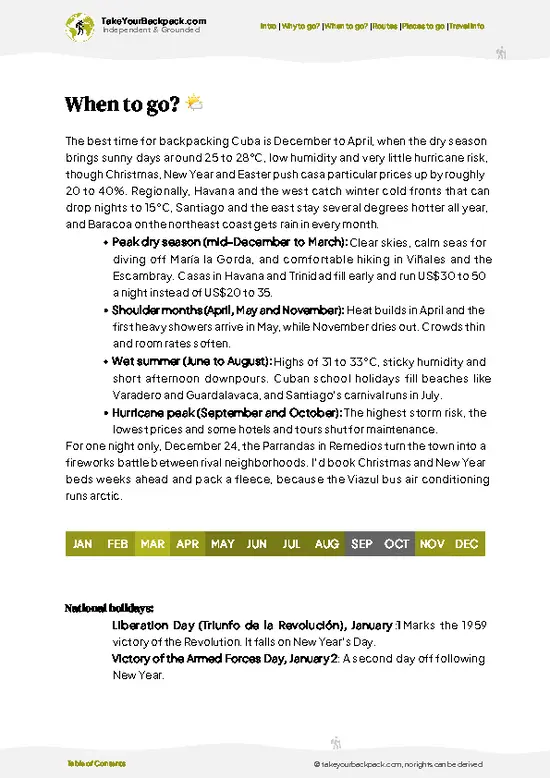
example page 0 from our offline Travel Guide for Cuba
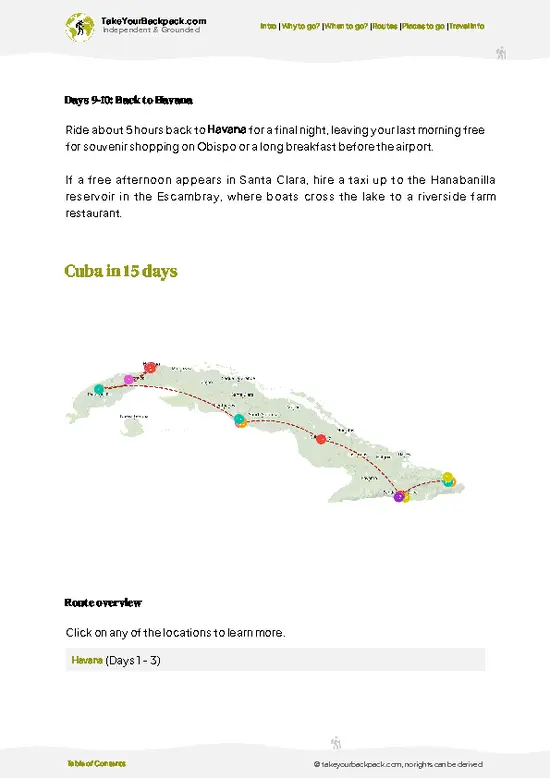
example page 1 from our offline Travel Guide for Cuba
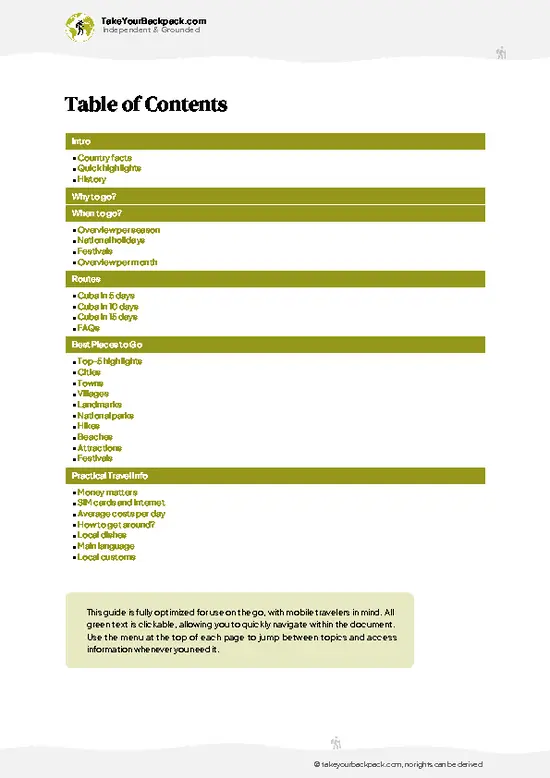
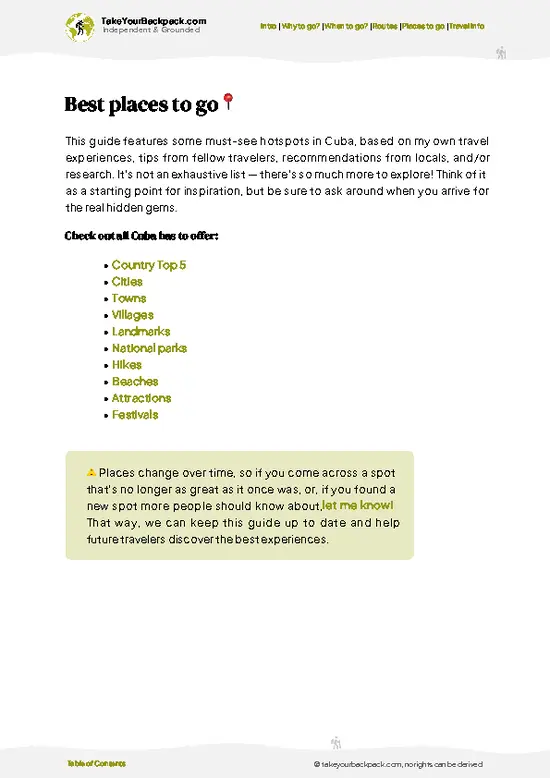
example page 2 from our offline Travel Guide for Cuba
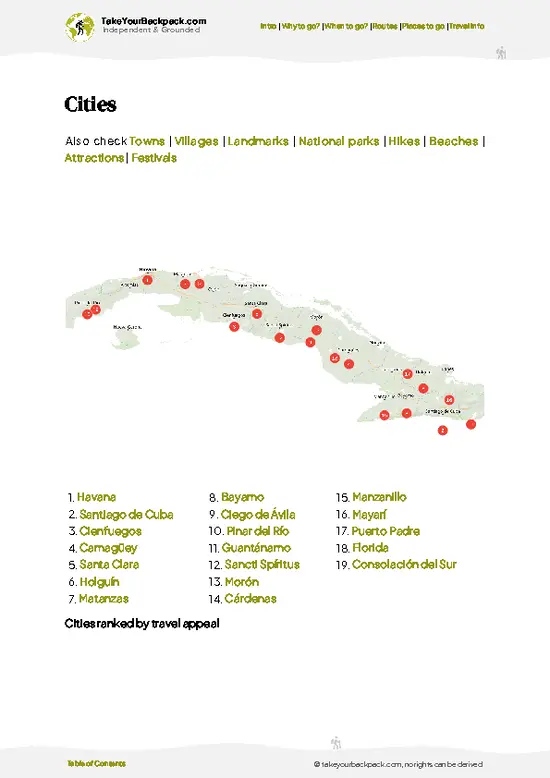
example page 3 from our offline Travel Guide for Cuba
example page 4 from our offline Travel Guide for Cuba
example page 5 from our offline Travel Guide for Cuba
example page 6 from our offline Travel Guide for Cuba
example page 7 from our offline Travel Guide for Cuba
Loading the map 🌍
CLICK TO FILTER
cities
towns
villages
landmarks
national parks
hikes
beaches
attractions
festivals
SHOW COUNTRY’S BESTSHOW ALL

✨ Why go?
Ranked #9 town in Cuba
Reasons people choose to visit here

Banes works for backpackers who like their Cuba unpolished and their history layered. The town holds the best collection of Taíno artifacts in the country at the Museo Indocubano Baní, and it is the birthplace of Fulgencio Batista and was an early home of Fidel Castro’s first wife’s family, so the political stories run deep. It also sits a short ride from the beaches of Guardalavaca and the Chorro de Maíta burial site, which makes it a calm alternative to the resort strip. Most travelers stay one night, and slow travelers or history-minded solo travelers can stretch that to two. The social scene is low-key, with a few casas particulares where hosts cook dinner and swap tips, and evenings revolve around the Parque Central and its occasional live music. Party seekers should look elsewhere. Small-group … read more 👉
Banes works for backpackers who like their Cuba unpolished and their history layered. The town holds the best collection of Taíno artifacts in the country at the Museo Indocubano Baní, and it is the birthplace of Fulgencio Batista and was an early home of Fidel Castro’s first wife’s family, so the political stories run deep. It also sits a short ride from the beaches of Guardalavaca and the Chorro de Maíta burial site, which makes it a calm alternative to the resort strip. Most travelers stay one night, and slow travelers or history-minded solo travelers can stretch that to two. The social scene is low-key, with a few casas particulares where hosts cook dinner and swap tips, and evenings revolve around the Parque Central and its occasional live music. Party seekers should look elsewhere. Small-group travelers who rent a bici-taxi or a shared car for the surrounding sites get the most from it, and the Iglesia de Nuestra Señora de la Caridad is a nice quiet stop between rides.

💡 HighlightsPlaces and moments you shouldn't skip

  1. Museo Indocubano Baní: The town’s headline sight, with one of Cuba’s richest collections of Taíno pottery, tools and ceremonial objects from the surrounding sites. Go in the morning when it is cool. Entry runs about US$2 to 3, and you need 1 to 1.5 hours.
  2. Parque Central: The main square, shaded by trees, is where locals gather after sunset to chat and listen to music. Evening is best. It is free, and 30 to 45 minutes is enough.
  3. Iglesia de Nuestra Señora de la Caridad: A modest church on the square with a calm interior, easy to pair with a stroll. Morning is quietest. Entry is free or a small donation, and 15 to 20 minutes is plenty.
  4. Museo Municipal de Banes: Local history from the sugar era and the United Fruit Company years, with pieces tied to the town’s early twentieth-century boom. Visit
… read more 👉
  1. Museo Indocubano Baní: The town’s headline sight, with one of Cuba’s richest collections of Taíno pottery, tools and ceremonial objects from the surrounding sites. Go in the morning when it is cool. Entry runs about US$2 to 3, and you need 1 to 1.5 hours.
  2. Parque Central: The main square, shaded by trees, is where locals gather after sunset to chat and listen to music. Evening is best. It is free, and 30 to 45 minutes is enough.
  3. Iglesia de Nuestra Señora de la Caridad: A modest church on the square with a calm interior, easy to pair with a stroll. Morning is quietest. Entry is free or a small donation, and 15 to 20 minutes is plenty.
  4. Museo Municipal de Banes: Local history from the sugar era and the United Fruit Company years, with pieces tied to the town’s early twentieth-century boom. Visit midday. Expect about US$1 to 2 and 45 minutes.
  5. Banes Cemetery and Batista-era sites: A walk through the old cemetery and nearby streets shows the American-influenced architecture of the plantation period. Late afternoon light works well. It is free, and 45 minutes to an hour covers it.
Banes also sets you up for day trips to the Chorro de Maíta burial site, the beaches at Guardalavaca and the Bay of Bariay. For a first visit, start with the Museo Indocubano Baní, because it explains everything else you will see in the area.
Spotted a mistake or missing something? Contact us.

🏘️ NeighborhoodsHow different areas shape the experience

Banes is small enough to cover on foot, so the choice is about where to spend your hours, and a few spots deserve far more than others.
  • Parque Central and the center: Start here. The Iglesia de San Antonio de Padua faces the square, and the streets around it hold the peso pizza counters, state cafeterias and the few places where you can sit with a cold Bucanero. Evenings bring locals to the benches and live music some nights. Fully walkable, worth a few hours.
  • Museo Indocubano Bani area: The best reason to come to Banes. The museum holds a strong collection of Taíno artifacts, including the gold Ídolo de oro. Allow an hour and a half. Nearby streets are quiet residential blocks, pleasant but with little else to do.
  • Fomento and Cuba Bank district: The old United Fruit Company quarter has wooden
… read more 👉
Banes is small enough to cover on foot, so the choice is about where to spend your hours, and a few spots deserve far more than others.
  • Parque Central and the center: Start here. The Iglesia de San Antonio de Padua faces the square, and the streets around it hold the peso pizza counters, state cafeterias and the few places where you can sit with a cold Bucanero. Evenings bring locals to the benches and live music some nights. Fully walkable, worth a few hours.
  • Museo Indocubano Bani area: The best reason to come to Banes. The museum holds a strong collection of Taíno artifacts, including the gold Ídolo de oro. Allow an hour and a half. Nearby streets are quiet residential blocks, pleasant but with little else to do.
  • Fomento and Cuba Bank district: The old United Fruit Company quarter has wooden houses and the Fomento neighborhood feel. Pass through on a short stroll, since there is little to see beyond the architecture.
  • Playa Morales and Guardalavaca direction: Not in town, but where most nightlife and beach time happens. Skip the idea of a night out in Banes proper; it is early to bed.

⌛️ 1 dayA smart one-day plan

A museum-and-plaza day that moves slowly and leaves room for the coast. 8:00 AM, Casa breakfast: Start with fruit, eggs and coffee at your casa particular, and ask your host about the day’s transport.
9:00 AM, Museo Indocubano Baní: Walk over and spend an hour or more with the Taíno collection. It explains the sites you will see later.
11:00 AM, Parque Central and Iglesia de Nuestra Señora de la Caridad: Stroll the square, step inside the church, and watch town life unfold at an easy pace.
12:30 PM, Lunch: Find a paladar or street counter for a pork sandwich or a plate of rice, beans and pork.
2:00 PM, Museo Municipal de Banes: A short walk takes you to the local history museum, where the plantation era becomes clear.
4:00 PM, Old company-era streets and cemetery: Wander the less-visited residential … read more 👉
A museum-and-plaza day that moves slowly and leaves room for the coast. 8:00 AM, Casa breakfast: Start with fruit, eggs and coffee at your casa particular, and ask your host about the day’s transport.
9:00 AM, Museo Indocubano Baní: Walk over and spend an hour or more with the Taíno collection. It explains the sites you will see later.
11:00 AM, Parque Central and Iglesia de Nuestra Señora de la Caridad: Stroll the square, step inside the church, and watch town life unfold at an easy pace.
12:30 PM, Lunch: Find a paladar or street counter for a pork sandwich or a plate of rice, beans and pork.
2:00 PM, Museo Municipal de Banes: A short walk takes you to the local history museum, where the plantation era becomes clear.
4:00 PM, Old company-era streets and cemetery: Wander the less-visited residential blocks where wooden houses with porches recall the American period. Few travelers come here, and it gives the best sense of the town as it was.
6:30 PM, Parque Central: Return for dusk, when families gather and a cold beer is cheap. Stay for live music if any is playing.

🌤️ When to go?When to go for the best experience

November to April is the easiest window for Banes, with dry, sunny days and little rain.
  • Dry Season (Nov to Apr): Highs of 27 to 30°C (81 to 86°F), cooler nights near 20°C (68°F), and about 11 hours of daylight. Beach trips to the coast are at their best. Casas particulares raise prices and book up around December and January.
  • Hot, Wet Season (May to Oct): Highs of 31 to 34°C (88 to 93°F), humid air and afternoon downpours, with about 13 hours of daylight. Crowds thin and rooms are cheaper, but hurricane risk peaks from August to October.
  • Carnival and events: The Fiesta de la Cultura Banense, which celebrates local culture, usually falls around late October to November. Expect music and street activity then.
Visit in February or March for sun without the holiday-season prices.

source: climatestotravel.comJANJanuary: highly recommended for travelingFEBFebruary: highly recommended for travelingMARMarch: highly recommended for travelingAPRApril: highly recommended for travelingMAYMay: good for travelingJUNJune: fair for travelingJULJuly: fair for travelingAUGAugust: fair for travelingSEPSeptember: good for travelingOCTOctober: good for travelingNOVNovember: excellent for travelingDECDecember: excellent for traveling
when-to-go

✈️ The backpacker research shortcutCuba Travel Guide

An offline-friendly backpacking guide with optimized travel routes, ranked highlights, transport advice, and the best areas to stay.
example page 0 from our offline Travel Guide for Cuba
example page 1 from our offline Travel Guide for Cuba
example page 2 from our offline Travel Guide for Cuba
example page 3 from our offline Travel Guide for Cuba
example page 4 from our offline Travel Guide for Cuba
example page 5 from our offline Travel Guide for Cuba
example page 6 from our offline Travel Guide for Cuba
example page 7 from our offline Travel Guide for Cuba
The digital guide (327 pages) contains:
✅ 113 highlights, ranked by travel appeal
✅ Optimized 5, 10 & 15-day travel routes
✅ Cities, national parks, landmarks, beaches
✅ How to get around
✅ Offline-friendly for travel without Wi-Fi
👉 Click to see all 30+ guide features

📅 Plan smarter in minutes, not weeks
✅ Month by month travel advice
✅ Festivals & national holidays
✅ Budget expectations

🗺️ Go to the right places, skip the overrated ones
✅ Honest pros & cons of destinations
✅ Top hikes, parks & viewpoints
✅ Lesser-known places most travelers miss
✅ Clear “worth it vs skip it” guidance

🛏️ Travel smoothly without rookie mistakes
✅ Best areas to stay
✅ Transport systems explained simply
✅ Common scams & safety advice
✅ SIM cards, money & practical tips

🌍 Understand the country, not just visit it
✅ Culture & traditions
✅ 52 Essential phrases & customs
✅ Festivals worth planning around
✅ Traveler-friendly historical context
✅ Insights that make places more meaningful

📱 Built for real travel conditions
✅ Fully downloadable PDF
✅ Works completely offline
✅ Optimized for phone use
✅ Useful in remote areas & buses
✅ Everything in one place
Stop searching, start planning
Get instant access to your full guide. 30‑day money-back guarantee.
+ Add another guide for just

By proceeding you agree to our terms.
Sent to your inbox immediately after payment • 100% Secure Checkout
Best Backpacking Travel Advisor 2025 tourism awardBest Backpacking
Travel Advisor
2025
What others say about Take Your Backpack Guides:
⭐⭐⭐⭐⭐
Fantastic, amazing amount of information!
⭐⭐⭐⭐⭐
My goodness this is amazing, it's what I've been looking for hats off too you!
⭐⭐⭐⭐⭐
I think this is absolutely BRILLIANT
⭐⭐⭐⭐
Very complete and informative. It's still missing places, but I gotta to commend you
⭐⭐⭐⭐⭐
This is truly amazing, thank you, can't wait to explore it with my kids!
⭐⭐⭐⭐⭐
Awesome resource, thank you!
⭐⭐⭐⭐⭐
This is amazing! Can't wait to explore the ones I haven't seen
⭐⭐⭐⭐
I love this! Well done, great idea.
⭐⭐⭐⭐⭐
Thanks for taking the time to make this gem!
⭐⭐⭐⭐⭐
This might be the best website I've ever seen.
⭐⭐⭐⭐⭐
Congratulations, and thank you so much for your work; it's incredibly valuable.
⭐⭐⭐⭐
In all seriousness I think you did a great job pointing out the important spots
⭐⭐⭐⭐⭐
10/10 very good
⭐⭐⭐⭐⭐
As someone who's only just starting to visit regularly this is awesome, thank you.
⭐⭐⭐⭐
Thank you very much! I'm going to visit my dad, it's going to be very useful!
⭐⭐⭐⭐⭐
This is really cool! We'll be travelling for the first time and this definitely come in handy.
⭐⭐⭐⭐⭐
You are now our minister of culture, congratulations 👨‍💼
⭐⭐⭐⭐⭐
Just wanted to tell you that this is a pearl! Going to follow your recommendations.
⭐⭐⭐⭐⭐
This is so cool. I'll definitely be using the resource for my travels soon.
⭐⭐⭐⭐⭐
This is very impressive! Good work.
⭐⭐⭐⭐⭐
This is an amazing and informative site. Very well done!

🛏️ Where to stay?Where staying makes the most sense

Stay in the center of Banes near Parque Central, where casas particulares cost roughly US$15 to 30 a night for a double room. Hostels in the backpacker sense do not exist here, so private rooms in family homes are the standard, often with breakfast for US$3 to 5 extra. The center is quiet and safe after dark, walkable to the museum and cafeterias, and taxis find you easily. Noise is mild, mostly roosters and music from neighbors.

The other option is Guardalavaca, about 30 minutes away, where you pay more (US$25 to 50) but get beach access, restaurants and more nightlife. It suits those who prefer … read more 👉
Stay in the center of Banes near Parque Central, where casas particulares cost roughly US$15 to 30 a night for a double room. Hostels in the backpacker sense do not exist here, so private rooms in family homes are the standard, often with breakfast for US$3 to 5 extra. The center is quiet and safe after dark, walkable to the museum and cafeterias, and taxis find you easily. Noise is mild, mostly roosters and music from neighbors.

The other option is Guardalavaca, about 30 minutes away, where you pay more (US$25 to 50) but get beach access, restaurants and more nightlife. It suits those who prefer sand over history. Transport links from there to Banes are by taxi only, so the town center is better for anyone wanting a cheaper, quieter base.

🚌 Getting aroundHow to get around Banes

Banes is compact, and a short shared ride in the town costs a few cents to US$1, paid in cash in pesos to the driver. Most backpackers walk the center and use a bici-taxi or taxi for anything farther. Public transport is sparse and unreliable, so plan ahead.
  • Walking: The best option for the center, museum and Parque Central, all within 10 to 15 minutes of each other. Streets are flat and traffic is light.
  • Bici-taxi: Pedal-powered tricycles run around town for roughly US$0.50 to 1 per short ride. Slow but fun and worth it when it is hot.
  • Shared and private taxis: To Playa Morales or Guardalavaca expect around US$10 to 20 for the car, 20 to 40 minutes. Agree on the fare before you get in. Colectivos, when running, cost less.
  • Viazul and regional buses: Banes is not on the main Viazul line, so intercity
… read more 👉
Banes is compact, and a short shared ride in the town costs a few cents to US$1, paid in cash in pesos to the driver. Most backpackers walk the center and use a bici-taxi or taxi for anything farther. Public transport is sparse and unreliable, so plan ahead.
  • Walking: The best option for the center, museum and Parque Central, all within 10 to 15 minutes of each other. Streets are flat and traffic is light.
  • Bici-taxi: Pedal-powered tricycles run around town for roughly US$0.50 to 1 per short ride. Slow but fun and worth it when it is hot.
  • Shared and private taxis: To Playa Morales or Guardalavaca expect around US$10 to 20 for the car, 20 to 40 minutes. Agree on the fare before you get in. Colectivos, when running, cost less.
  • Viazul and regional buses: Banes is not on the main Viazul line, so intercity buses are not a reliable choice. Taxis to Holguín (about 1.5 hours) run US$25 to 40 per car, and sharing splits the cost.

👛 Costs (as of 23 October 2026)Typical daily expenses

Banes costs about US$38 to 73 per day for a backpacker, with a total of US$55 in the table below.
CategoryBudget RangeLocal Reality
Dorm accommodationUS$15 to 25Private casa rooms, no dorms; high season about US$20
MealsUS$12 to 20Casa dinners US$6 to 10, street snacks and peso pizza for less; about US$15
Local transportUS$3 to 8Bici-taxis and shared rides; about US$5
Basic activities/entry feesUS$3 to 8Museum around US$2 to 3, Chorro de Maíta US$3 to 5; about US$5
Miscellaneous expensesUS$5 to 12Drinks, water, tips; about US$10
Total Daily BudgetUS$38 to 73About US$55
Eat at your casa particular and carry cash, since card use is limited and exchange rates are better with local cash.

source: cubatravel.cu
⚠️ Prices can change and everyone travels differently, so take this as a rough guide. Hope it helps you plan your adventure!

🚌 Day tripsBest day trips from Banes

Banes works well as a base for day trips, since beaches, ruins and a historic city are within an hour or two by taxi.Playa Morales: Closest and cheapest, this stretch is quiet and sandy, with few vendors and often few people. Taxis cost around US$10 to 15 each way, and 20 minutes gets you there. Go on weekdays in the dry season. First-timers often forget water and snacks, which are scarce on site.
Guardalavaca: The main resort beach has clear water, reef snorkeling and cafes. Expect around US$10 to 20 by taxi each way and 30 to 40 minutes. Go early to enjoy the beach before the resort crowds, from November to April.
👉 Explore GuardalavacaHolguín: The provincial capital has plazas, museums and the Loma de la Cruz viewpoint with its 458 steps. It takes about 1.5 hours each way by shared taxi, … read more 👉
Banes works well as a base for day trips, since beaches, ruins and a historic city are within an hour or two by taxi.Playa Morales: Closest and cheapest, this stretch is quiet and sandy, with few vendors and often few people. Taxis cost around US$10 to 15 each way, and 20 minutes gets you there. Go on weekdays in the dry season. First-timers often forget water and snacks, which are scarce on site.
Guardalavaca: The main resort beach has clear water, reef snorkeling and cafes. Expect around US$10 to 20 by taxi each way and 30 to 40 minutes. Go early to enjoy the beach before the resort crowds, from November to April.
👉 Explore GuardalavacaHolguín: The provincial capital has plazas, museums and the Loma de la Cruz viewpoint with its 458 steps. It takes about 1.5 hours each way by shared taxi, with a total of about US$30 to 50. Leave early to fit it in.
👉 Explore HolguínChorro de Maíta: This is one of the Caribbean's most significant aboriginal burial sites, with skeletons in situ and a small museum. It is about 20 minutes from Banes by taxi, roughly US$10 to 15 round-trip plus an entry of about US$3 to 5.

🛡️ SafetySafety Tips and Common Scams in Banes

Banes is calm and low in violent crime, and most problems are small annoyances. Street hustlers, called jineteros, may offer cigars, rides or restaurant tips that carry commissions, so politely decline and book directly. Prices for taxis should be agreed before riding. At night the center is quiet and fine for solo travelers, but dim streets mean carrying a flashlight and keeping valuables out of sight. Petty theft happens on beaches, so keep bags with you. Keep a copy of your passport and carry cash in several places, since ATMs can be unreliable. Mosquitoes in the wet season are a bigger nuisance than people.

FAQFrequently asked questions about Banes

Banes is worth a short visit rather than just a stopover, mainly for the Museo Indocubano Bani and its Taíno artifacts. The nearby Chorro de Maíta burial site is about 20 minutes away, and Guardalavaca beach is 30 minutes by taxi at roughly US$10 to 20. The town itself is quiet, so it suits travelers who like local life over nightlife.
Banes needs one to two days: one for the town and museum, and a second for Chorro de Maíta and Playa Morales. Add a third day if you want to spend time at Guardalavaca, about US$10 to 20 by taxi each way. Nights in a casa particular run roughly US$15 to 30.
Banes can be done as a day trip from Holguín, about 1.5 hours each way by taxi at around US$25 to 40 per car (shared cuts the cost). That leaves roughly four hours on the ground, enough for the museum and Parque Central. Staying overnight lets you also reach Chorro de Maíta and the beaches without rushing.
⚠️ Things can change over time, so always validate details locally before you go.

Other Cuban towns near Banes

Explore more nearby:

  • Gibara—Laurel square, Spanish forts, bay seawall, shell museum| 46 km away
  • San Luis (Santiago de Cuba)—La Mejorana, sugar and coffee past, Museo 29 de Abril, rail line| 87 km away
  • Las Guasimas—battlefield site, rural hamlet, open savanna| 107 km away

💡 Not sure where to go next?
Create a personalized itinerary for Cuba including Banes and the places that fit your trip.

Generate my itinerary

👉 Discover all towns

Or checkout all Cuba has to offer (think cities, towns, villages, national parks, hikes, beaches, festivals)
Country photo of Cuba

We 💚 feedbackSumming up the experience

Banes deserves one night, two if you want to reach the coast and the Taíno sites without rushing. I’d arrive in the morning, see the museum, and keep the afternoon free for a ride out to the sea. Skip it if you only have a few days and crave big nightlife.

✈️ When did I visit Cuba?
As part of my 1.5 year travel around the world trip, I visited Cuba for 6 weeks in February, March 2016, being extremely lucky that that coincided with the free concert of The Rolling Stones.

✍️ Help improve this page!
The information on this page is based on my own backpacking experience in Cuba, supplemented with up-to-date research and feedback from other travelers. Travel details can change, so if you notice anything outdated or incomplete, feel free to let me know.


🙋‍♂️ Give feedback

👋 Meet the founderWho’s Behind Take Your Backpack?

Johan, backpacker and founder of TakeYourBackpackHi, I’m Johan (Netherlands 🇳🇱), the creator of TakeYourBackpack. Over the past 3 decades, I’ve backpacked through 90+ countries across six continents, gaining extensive experience with independent travel, long-term trips, and overland routes.

This site is built on a combination of firsthand travel experience and carefully curated insights from other backpackers. Many guides are based on places I’ve personally visited, while others bring together tips, observations, and practical advice shared by trusted travelers I’ve met along the way.

The goal is to provide realistic, experience-driven guidance — not generic itineraries — so you can explore destinations with better context, clearer expectations, and more confidence.