×

Djibouti🇩🇯 | best attractionsThe 8 Top attractions in Djibouti

Attractions in Djibouti are mostly natural and geological: salt lakes, volcanic desert, coral reefs and highland forest, with few built monuments. The capital and the Gulf of Tadjoura coast are easiest to reach and priciest. The interior, around Lake Assal and Lake Abbe, means long drives on rough tracks. For independent travelers, access and heat shape the trip more than crowds, which are almost absent.

By Johan Kruseman 🇳🇱 | Updated October 23, 2026
Explore the best festivals in Djibouti

Why go?Understanding Their Importance

Djibouti sits on the meeting point of three tectonic plates, where the Red Sea and Gulf of Aden meet the Afar Depression. That geology produces landscapes found almost nowhere else: land below sea level, active rifting, mineral lakes and hot springs. The same position gives the Gulf of Tadjoura marine life that draws seasonal visitors. Tourism infrastructure is thin. Public transport is limited, few sites have signage or facilities, and most places outside the capital need a 4x4 and a driver. Prices are high for the region because almost everything is imported, and the country uses the Djibouti franc. Foreign military bases shape the economy more than tourism does, so expect small numbers of visitors and few services. Travelers should arrive expecting heat, distance and planning, with rewards in space and silence rather than polish.
How the List Was Created
The list of best attractions in Djibouti is created based on cultural significance or entertainment value. If you feel a attraction is missing in this list, please let us know.

When to go?Best Time to Visit Djibouti for attractions

Best months for Djibouti’s attractions: The best months are November to February, when daytime highs on the coast sit around 28 to 32°C instead of the 38 to 42°C of summer. Rain is rare everywhere, with the capital receiving roughly 150 mm a year, mostly in short winter downpours. Inland sites around Lake Assal and Lake Abbe run hotter than the coast and can pass 45°C from June to August.
Shoulder and low season: March, April and October are workable, though heat builds and midday outdoor activity becomes difficult. From May to September the coast is humid and very hot, and many visitors skip it. Whale sharks gather in the Gulf of Tadjoura roughly from October to February, which makes that window the busiest. Even then crowds stay small. Accommodation and guide prices change little by season, … read more 👉
Best months for Djibouti’s attractions: The best months are November to February, when daytime highs on the coast sit around 28 to 32°C instead of the 38 to 42°C of summer. Rain is rare everywhere, with the capital receiving roughly 150 mm a year, mostly in short winter downpours. Inland sites around Lake Assal and Lake Abbe run hotter than the coast and can pass 45°C from June to August.
Shoulder and low season: March, April and October are workable, though heat builds and midday outdoor activity becomes difficult. From May to September the coast is humid and very hot, and many visitors skip it. Whale sharks gather in the Gulf of Tadjoura roughly from October to February, which makes that window the busiest. Even then crowds stay small. Accommodation and guide prices change little by season, but 4x4 availability tightens in winter, so book early.

attraction hoppingHow to Combine attractions Into One Trip

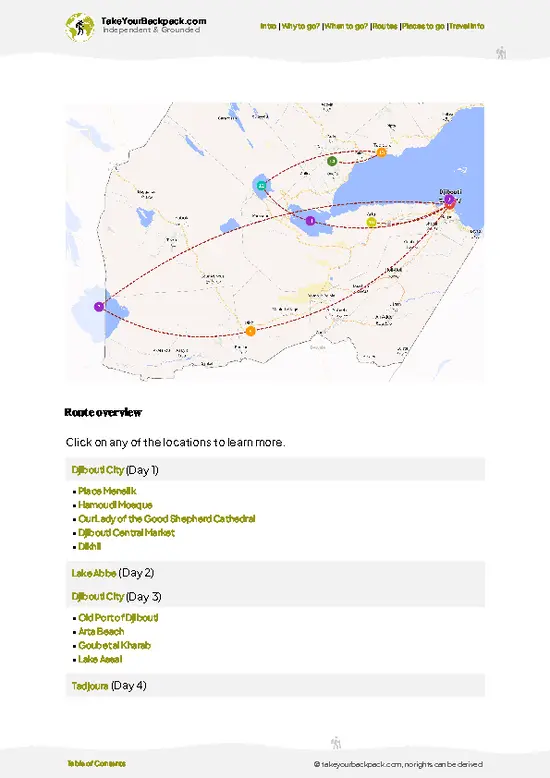
How many days to allow: A trip linking several attractions in Djibouti needs 5 to 8 days, mostly because of driving distances and heat-limited daylight. Djibouti City is the logical hub for arrival, supplies and tour arrangements. A sensible direction is to head out to the interior first, toward the salt lakes and the Afar region, then finish on the northern Gulf of Tadjoura coast for slower days.
Time per stop and transfers: Allow one full day for most inland stops and one to two days on the coast. Djibouti City to Lake Assal takes about 2 to 3 hours by road, to Tadjoura by ferry about 1 to 2 hours, and to Lake Abbe roughly 5 to 7 hours by 4x4 with a night nearby.
Common planning errors: Travelers often pack too many stops into a day and drive in midday heat. Start by 6 a.m., rest at noon, … read more 👉
How many days to allow: A trip linking several attractions in Djibouti needs 5 to 8 days, mostly because of driving distances and heat-limited daylight. Djibouti City is the logical hub for arrival, supplies and tour arrangements. A sensible direction is to head out to the interior first, toward the salt lakes and the Afar region, then finish on the northern Gulf of Tadjoura coast for slower days.
Time per stop and transfers: Allow one full day for most inland stops and one to two days on the coast. Djibouti City to Lake Assal takes about 2 to 3 hours by road, to Tadjoura by ferry about 1 to 2 hours, and to Lake Abbe roughly 5 to 7 hours by 4x4 with a night nearby.
Common planning errors: Travelers often pack too many stops into a day and drive in midday heat. Start by 6 a.m., rest at noon, and keep a buffer day for delayed ferries or track conditions.

The ListThe Best attractions of Djibouti

1 Place Menelik

Arcaded square, wrought-iron balconies, shaded cafés, Somali-Afar-French talk

Sit in the colonnade shade with coffee and study the peeling arcades while four languages drift across the square.

2 Hamoudi Mosque

Slender minaret, Friday prayer, market lanes, grilled fish stalls

Admire the tall minaret from the street, then follow the lanes to the market, strong sweet tea and sambusas.

djibouti-attraction-hamoudi-mosque
© Google |

3 Djibouti Central Market

Qat bundles, frankincense lanes, bolts of cotton, fresh-caught fish

Wander covered lanes where the city buys its spices, cloth and fish, and bargain calmly for handicrafts and fresh fruit.

djibouti-attraction-djibouti-central-market
© Google |

4 Port de Pêche de Djibouti

Fish landing quay, charcoal-grilled catch, wooden skiffs, harbor promenade

Watch boats unload barracuda and snapper at the quay, then eat the catch grilled whole and stroll the breezy waterfront.

djibouti-attraction-port-de-peche-de-djibouti
© Google |

5 Djibouti Aquarium

Red Sea reef fish, moray tanks, reef sharks and rays, coral displays

Study the reef fish, eels and rays of the Gulf of Tadjoura behind glass, then go looking for them in the water yourself.

djibouti-attraction-djibouti-aquarium
© Google |

6 Our Lady of the Good Shepherd Cathedral

Striped facade, Romanesque arches, cool nave, Sunday Mass

Step into a quiet, cool nave behind a banded stone facade, and watch the parish arrive on Sunday.

djibouti-attraction-our-lady-of-the-good-shepherd-cathedral
© Google |

7 Djibouti Railway Station

Colonial terminus, Ethiopia line, port-side tracks, old European quarter

Look over the faded terminus of the Ethiopia line, then loop through nearby squares, a mosque and a cathedral on foot.

8 El Hadj Hassan Gouled Aptidon Stadium

Match-day stands, 15,000-seat bowl, national team qualifiers, Ambouli

Time a visit for a fixture and sit among local supporters, with the national team drawing the largest crowds and flags.

Loading the map 🌍

Expert viewInsights from Locals and Experts

How many attractions to plan: Four is the number I would advise for a first visit, five at most. Distances are long, roads outside the capital are rough, and midday heat often passes 40°C, so most days hold one major stop and not much else. Pack in more and you spend the trip inside a vehicle with the windows up, watching salt flats and black lava fields go by as a blur.
Choosing between kinds: Landscape sites suit travelers who want the strangest ground they have ever walked on: crusted salt, steaming vents, cracked basalt that gives off heat through your soles. Water-based excursions suit anyone who wants cool relief and a close look at marine life in clear, warm sea. Town and market time suits slow travelers on a tight budget, with grilled fish, strong coffee and the chance to talk with … read more 👉
How many attractions to plan: Four is the number I would advise for a first visit, five at most. Distances are long, roads outside the capital are rough, and midday heat often passes 40°C, so most days hold one major stop and not much else. Pack in more and you spend the trip inside a vehicle with the windows up, watching salt flats and black lava fields go by as a blur.
Choosing between kinds: Landscape sites suit travelers who want the strangest ground they have ever walked on: crusted salt, steaming vents, cracked basalt that gives off heat through your soles. Water-based excursions suit anyone who wants cool relief and a close look at marine life in clear, warm sea. Town and market time suits slow travelers on a tight budget, with grilled fish, strong coffee and the chance to talk with locals over a plastic table. If you only have time for one kind, choose landscape, because nothing else in the region looks like it.
What it costs: Djibouti is among the pricier places in East Africa. A realistic backpacker budget is US$60 to 120 a day (roughly 10,500 to 21,000 Djiboutian francs), with a basic room taking US$25 to 50 of that. Entry fees are minor. The real costs are transport and guides: a 4x4 with driver runs about US$150 to 250 a day, shared between up to six people, and guided boat or snorkeling outings usually cost US$50 to 150 a person. Splitting vehicles at guesthouses is the easiest way to cut the bill, and you end up with company on long, quiet drives.
Safety and manners: Djibouti is calm by regional standards, but the border areas toward Eritrea and Ethiopia are not casual hiking country. Use a licensed local driver for anything remote. Carry more water than seems reasonable, at least 3 to 5 liters a person per day, and start early so the hottest hours are spent in shade. Djibouti is a Muslim country, so cover shoulders and knees away from the beach, and ask before photographing people. Do not photograph ports, bases or checkpoints. During Ramadan, eat and drink discreetly in public, and expect some cafes to open only after sunset, when the whole town comes alive.

✈️ The backpacker research shortcutDjibouti Travel Guide

An offline-friendly backpacking guide with optimized travel routes, ranked highlights, transport advice, and the best areas to stay.
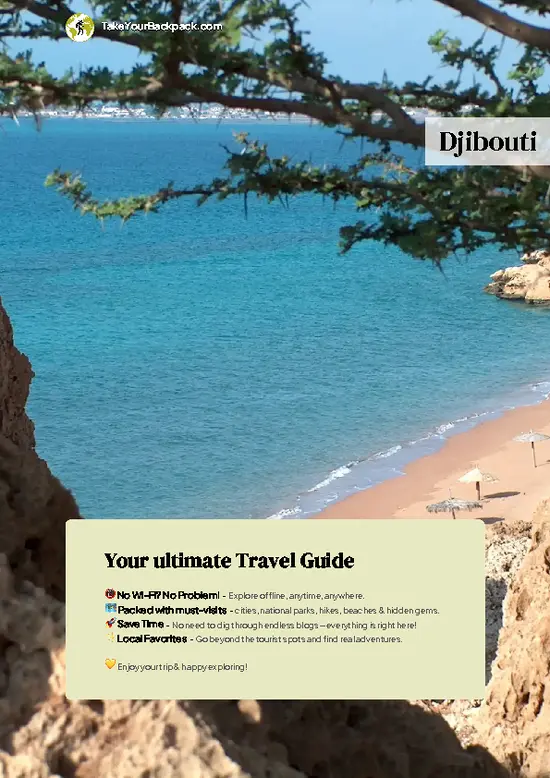
example page 0 from our offline Travel Guide for Djibouti
example page 1 from our offline Travel Guide for Djibouti
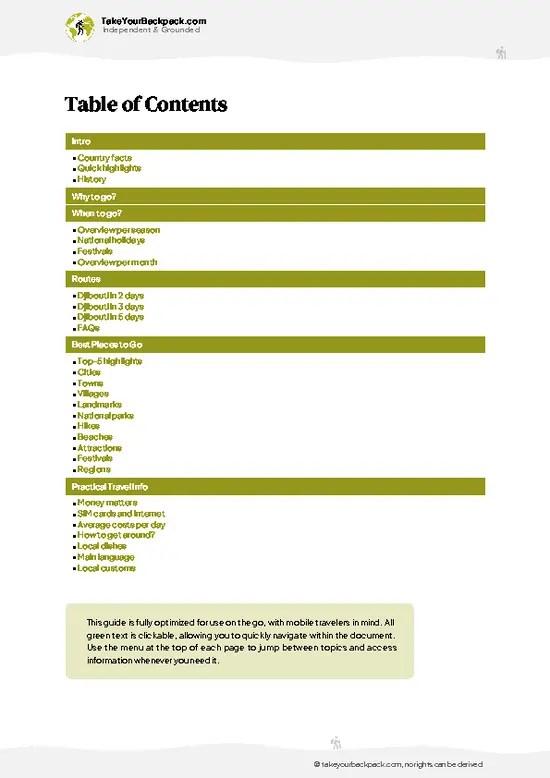
example page 2 from our offline Travel Guide for Djibouti
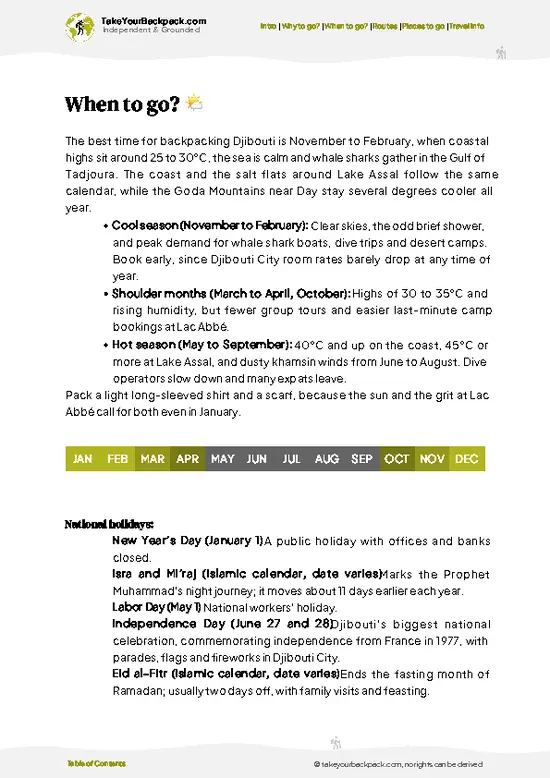
example page 3 from our offline Travel Guide for Djibouti
example page 4 from our offline Travel Guide for Djibouti
example page 5 from our offline Travel Guide for Djibouti
example page 6 from our offline Travel Guide for Djibouti
example page 7 from our offline Travel Guide for Djibouti
The digital guide (186 pages) contains:
✅ 44 highlights, ranked by travel appeal
✅ Optimized 2, 3 & 5-day travel routes
✅ Cities, national parks, landmarks, beaches
✅ How to get around
✅ Offline-friendly for travel without Wi-Fi
👉 Click to see all 30+ guide features

📅 Plan smarter in minutes, not weeks
✅ Month by month travel advice
✅ Festivals & national holidays
✅ Budget expectations

🗺️ Go to the right places, skip the overrated ones
✅ Honest pros & cons of destinations
✅ Top hikes, parks & viewpoints
✅ Lesser-known places most travelers miss
✅ Clear “worth it vs skip it” guidance

🛏️ Travel smoothly without rookie mistakes
✅ Best areas to stay
✅ Transport systems explained simply
✅ Common scams & safety advice
✅ SIM cards, money & practical tips

🌍 Understand the country, not just visit it
✅ Culture & traditions
✅ 52 Essential phrases & customs
✅ Festivals worth planning around
✅ Traveler-friendly historical context
✅ Insights that make places more meaningful

📱 Built for real travel conditions
✅ Fully downloadable PDF
✅ Works completely offline
✅ Optimized for phone use
✅ Useful in remote areas & buses
✅ Everything in one place
Stop searching, start planning
Get instant access to your full guide. 30‑day money-back guarantee.
+ Add another guide for just

By proceeding you agree to our terms.
Sent to your inbox immediately after payment • 100% Secure Checkout
Best Backpacking Travel Advisor 2025 tourism awardBest Backpacking
Travel Advisor
2025
What others say about Take Your Backpack Guides:
⭐⭐⭐⭐⭐
Fantastic, amazing amount of information!
⭐⭐⭐⭐⭐
My goodness this is amazing, it's what I've been looking for hats off too you!
⭐⭐⭐⭐⭐
I think this is absolutely BRILLIANT
⭐⭐⭐⭐
Very complete and informative. It's still missing places, but I gotta to commend you
⭐⭐⭐⭐⭐
This is truly amazing, thank you, can't wait to explore it with my kids!
⭐⭐⭐⭐⭐
Awesome resource, thank you!
⭐⭐⭐⭐⭐
This is amazing! Can't wait to explore the ones I haven't seen
⭐⭐⭐⭐
I love this! Well done, great idea.
⭐⭐⭐⭐⭐
Thanks for taking the time to make this gem!
⭐⭐⭐⭐⭐
This might be the best website I've ever seen.
⭐⭐⭐⭐⭐
Congratulations, and thank you so much for your work; it's incredibly valuable.
⭐⭐⭐⭐
In all seriousness I think you did a great job pointing out the important spots
⭐⭐⭐⭐⭐
10/10 very good
⭐⭐⭐⭐⭐
As someone who's only just starting to visit regularly this is awesome, thank you.
⭐⭐⭐⭐
Thank you very much! I'm going to visit my dad, it's going to be very useful!
⭐⭐⭐⭐⭐
This is really cool! We'll be travelling for the first time and this definitely come in handy.
⭐⭐⭐⭐⭐
You are now our minister of culture, congratulations 👨‍💼
⭐⭐⭐⭐⭐
Just wanted to tell you that this is a pearl! Going to follow your recommendations.
⭐⭐⭐⭐⭐
This is so cool. I'll definitely be using the resource for my travels soon.
⭐⭐⭐⭐⭐
This is very impressive! Good work.
⭐⭐⭐⭐⭐
This is an amazing and informative site. Very well done!

🛏️ Where to stay?Where to Stay: Djibouti Edition

Djibouti has no real hostel scene, so budget travel here means simple guesthouses and basic hotels in Djibouti City, where a double typically costs 7,000 to 12,000 DJF (US$40 to 70) a night. The European Quarter around Place Ménélik holds the most options, with cafés, restaurants and the few late-night bars within walking distance, though rooms there run noisier and pricier. The African Quarter just south, near the market streets, offers the cheapest rooms and lively street food but feels chaotic after dark, while Plateau du Héron is quiet and safe near the embassies and the waterfront, with few budget beds and a taxi ride to anything.

If you enjoy meeting fellow travelers, consider choosing … read more 👉
Djibouti has no real hostel scene, so budget travel here means simple guesthouses and basic hotels in Djibouti City, where a double typically costs 7,000 to 12,000 DJF (US$40 to 70) a night. The European Quarter around Place Ménélik holds the most options, with cafés, restaurants and the few late-night bars within walking distance, though rooms there run noisier and pricier. The African Quarter just south, near the market streets, offers the cheapest rooms and lively street food but feels chaotic after dark, while Plateau du Héron is quiet and safe near the embassies and the waterfront, with few budget beds and a taxi ride to anything.

If you enjoy meeting fellow travelers, consider choosing hostels with high ratings for atmosphere. On the other hand, if you prefer having your own space, a hotel might be a better option.

DjiboutiExplore Beyond This Category

👋 Meet the founderWho’s Behind Take Your Backpack?

Johan, backpacker and founder of TakeYourBackpackHi, I’m Johan (Netherlands 🇳🇱), the creator of TakeYourBackpack. Over the past 3 decades, I’ve backpacked through 90+ countries across six continents, gaining extensive experience with independent travel, long-term trips, and overland routes.

This site is built on a combination of firsthand travel experience and carefully curated insights from other backpackers. Many guides are based on places I’ve personally visited, while others bring together tips, observations, and practical advice shared by trusted travelers I’ve met along the way.

The goal is to provide realistic, experience-driven guidance — not generic itineraries — so you can explore destinations with better context, clearer expectations, and more confidence.