×

Dominican Republic🇩🇴 | best beachesDiscover the 10 Best beaches Across Dominican Republic

Dominican Republic has more than 1,500 kilometers of coastline, and almost every kilometer will try to sell you a sun lounger. The country sorts itself into three beach personalities. The east (Punta Cana, Bávaro) is all-inclusive resorts with raked sand and wristbands. The north coast around Puerto Plata, Sosúa and Cabarete brings wind, waves and a hostel scene. The Samaná Peninsula and the southwest are wilder, cheaper and slower to reach. For independent travel, guaguas (minibuses) and motoconchos (motorbike taxis) get you almost anywhere, though the best sand tends to sit at the end of the worst road.

By Johan Kruseman 🇳🇱 | Updated October 20, 2026
Explore the best attractions in Dominican Republic

Why go?Key Factors That Shape the Experience

Dominican Republic shares Hispaniola with Haiti and faces two seas: the Caribbean to the south and the Atlantic to the north. That geography gives you calm turquoise water on one side and surf, kitesurfing wind and big swells on the other, sometimes within a three-hour drive. Tourism has been a national priority for decades, so infrastructure is deep: international airports on several coasts, paved highways between the main resort zones and plenty of guesthouses at every price.

The flip side is that the best-known coastline is largely private. Big resort developments in the east often fence off long stretches, and the public access points that remain get crowded at weekends, when Dominican families arrive with coolers, speakers and serious domino equipment. Expect music everywhere. Silence … read more 👉
Dominican Republic shares Hispaniola with Haiti and faces two seas: the Caribbean to the south and the Atlantic to the north. That geography gives you calm turquoise water on one side and surf, kitesurfing wind and big swells on the other, sometimes within a three-hour drive. Tourism has been a national priority for decades, so infrastructure is deep: international airports on several coasts, paved highways between the main resort zones and plenty of guesthouses at every price.

The flip side is that the best-known coastline is largely private. Big resort developments in the east often fence off long stretches, and the public access points that remain get crowded at weekends, when Dominican families arrive with coolers, speakers and serious domino equipment. Expect music everywhere. Silence is a rare commodity and usually found only where the road gives up.

Before choosing the country for its beaches, know that hurricane season is real, that sargassum seaweed can pile up on eastern and southern shores in warm months, and that vendors will approach you. A polite “no, gracias” repeated with a smile works better than a lecture. Budget travelers can eat well on local food, but resort-zone prices can shock anyone expecting a cheap Caribbean.
Why These Made the Cut
The list of best beaches in Dominican Republic is created based on beauty, vibe, water quality, activities, and surrounding scenery. If you feel a beach is missing in this list, please let us know.

When to go?Timing Your Visit for the Best Experience

Best months for the beach: The best months for beaches in Dominican Republic are December to April, when the dry season brings sunshine on most days, low humidity and daytime highs of roughly 28 to 31°C (82 to 88°F). Sea temperatures hover around 26 to 28°C (79 to 82°F), so nobody needs a wetsuit, apart from the kitesurfers who want one for other reasons.

Shoulder and wet seasons: May to June and November are the shoulder months. Expect afternoon downpours, hotter air near 32°C (90°F) and noticeably lower prices, with hotel rates often 20 to 40 percent below winter peaks. Rain tends to arrive as a short, dramatic soak and then leaves, like a guest who knows when to go home.

July and August are hot and busy with Dominican and diaspora families on holiday, yet they are also good for wind sports … read more 👉
Best months for the beach: The best months for beaches in Dominican Republic are December to April, when the dry season brings sunshine on most days, low humidity and daytime highs of roughly 28 to 31°C (82 to 88°F). Sea temperatures hover around 26 to 28°C (79 to 82°F), so nobody needs a wetsuit, apart from the kitesurfers who want one for other reasons.

Shoulder and wet seasons: May to June and November are the shoulder months. Expect afternoon downpours, hotter air near 32°C (90°F) and noticeably lower prices, with hotel rates often 20 to 40 percent below winter peaks. Rain tends to arrive as a short, dramatic soak and then leaves, like a guest who knows when to go home.

July and August are hot and busy with Dominican and diaspora families on holiday, yet they are also good for wind sports on the north coast, where the breeze peaks. Hurricane season runs June to November, with the highest risk from August to October. The south and east tend to take the brunt, while the north coast sees heavier rain from November to January.

Peak pricing: Christmas to New Year and Semana Santa (Holy Week) are the most expensive and crowded windows. Book rooms weeks ahead then, and expect prices up 30 to 60 percent.

beach hoppingSuggested Travel Strategies

How many days you need: A trip combining several beaches in Dominican Republic works best with 10 to 14 days, and 7 days if you limit yourself to two regions. The country is small on a map, yet roads slow down fast once the highway ends.

Which regions pair well: The north coast (Puerto Plata, Sosúa, Cabarete) and the Samaná Peninsula make a natural pair, about 3 to 4 hours apart by bus or shared taxi. The southwest (Barahona and Pedernales) is a separate adventure and needs its own days. The east (Punta Cana, Bayahíbe) links easily with Santo Domingo, around 2 to 3 hours by express bus. A sensible direction is to land in Santo Domingo or Puerto Plata, travel to the north and Samaná, then loop back through the capital toward the east or south, and fly out from there.

Time per stop and common … read more 👉
How many days you need: A trip combining several beaches in Dominican Republic works best with 10 to 14 days, and 7 days if you limit yourself to two regions. The country is small on a map, yet roads slow down fast once the highway ends.

Which regions pair well: The north coast (Puerto Plata, Sosúa, Cabarete) and the Samaná Peninsula make a natural pair, about 3 to 4 hours apart by bus or shared taxi. The southwest (Barahona and Pedernales) is a separate adventure and needs its own days. The east (Punta Cana, Bayahíbe) links easily with Santo Domingo, around 2 to 3 hours by express bus. A sensible direction is to land in Santo Domingo or Puerto Plata, travel to the north and Samaná, then loop back through the capital toward the east or south, and fly out from there.

Time per stop and common mistakes: Give each coastal base 3 to 4 nights. Anything less turns the trip into a long series of bus seats. The classic mistake is trying to hit the north, east and southwest in one week, which means more time on roads than on sand. Another is trusting a map distance: 100 kilometers can take 3 hours. Instead, choose two or three bases, use day trips from each, and leave a buffer before any flight.

The ListMust-Visit beaches in Dominican Republic

1 Bahía de las Águilas

Jaragua National Park, 4x4 or boat access, empty white sand, no facilities

Bring your own water and shade for a day on a wide, nearly empty bay with clear shallows and reef fish close to shore.

dominican-republic-beach-bahia-de-las-aguilas
© Google | Jean Castillo

2 Playa Rincón

Palm-backed crescent, shallow warm water, whale boats, horse rides

Walk a long curve of white sand, snorkel the rocky points, and join a short boat run for whales in season.

dominican-republic-beach-playa-rincon
© Google | Ariel Giraldez

3 Cayo Levantado

Samaná Bay islet, horseshoe lagoon, whale-season tours, boat-only

Arrive by boat to a crescent of shallow, calm water, with a short hill climb for bay views and winter whale sightings.

4 Playa Macao

Punta Cana side, dune buggies, shore break, horseback rides

Take a lesson on a real beach break, ride horses through the shallows, and eat fried fish at family-run grills.

dominican-republic-beach-playa-macao
© Google |

5 Playa Bonita

Las Terrenas edge, kite winds, tide pools, beach bonfires

Watch kiters work the steady breeze, poke through rocky tide pools, and join small fires and guitar sessions after dark.

dominican-republic-beach-playa-bonita
© Google |

6 Playa Grande

Big rollers, sea caves, limestone cliffs, Río San Juan coast

Paddle into caves and coves along the limestone shore, then walk the long low-tide sand hunting shells.

dominican-republic-beach-playa-grande
© Google | Iva Müller

7 Playa Sosúa

Horseshoe bay, shore dives, promenade stalls, beach nightlife

Wade out to the reef, book an easy shore dive, then follow live bachata along the beachfront as evening falls.

8 Playa Las Galeras

Samaná tip, village roosters, Mirador hike, whale season

Hike steeply to a view over the horseshoe bay, then take a skiff to Frontón or secluded coves for snorkeling.

9 Playa Frontón

Boat-only cove, boulders and cliffs, reef-break surf, dark skies

Round the headland by boat into a sheltered cove, snorkel around the boulders, and scramble up the rocks for views.

dominican-republic-beach-playa-fronton
© Google |

10 Playa Encuentro

Beach-break peaks, surf schools, hostels, wave-watching headland

Paddle out from the sand with local instructors, then watch the peaks from the cliff and refuel at shacks on the beach.

dominican-republic-beach-playa-encuentro
© Google |

11 Playa Alicia

Sosúa cliffs, shallow reef, fishing landing, sunset headland

Step off the sand onto coral patches, then watch small boats land their catch before walking the headland at dusk.

12 Playa La Ensenada

Punta Rucia cove, step-in snorkeling, fishing skiffs, bonfire evenings

Walk into calm water over nearby reef, paddle to small rocky inlets, and buy the morning’s catch from returning fishermen.

13 Punta Rucia

Cayo Arena sandbar, fishing port, mangrove channels, skiff tours

Ride a village skiff to a shallow sandbank for snorkeling, then kayak the mangroves and eat the day’s catch ashore.

dominican-republic-beach-punta-rucia
© Google | Tomofumi Masuoka

14 Playa Los Patos

Barahona riverbank, pebbly cove, crashing shorebreak, local picnics

Photograph heavy swell against craggy headlands, explore low-tide rock pools, and watch fishermen push off at dawn.

15 Playa Diamante

Horseshoe cove, ankle-deep water, Cabrera, scruffy and local

Float in shallows that stay calm all day, then eat at cheap food shacks where Dominican families outnumber visitors.

16 Playa Caletón

Río San Juan cove, rock pools, fishing boats, family swimming

Snorkel the reefs just off the sand, wade among starfish in the rocks, and order grilled catch from nearby cooks.

dominican-republic-beach-playa-caleton
© Google |

17 Playa Caribe

Juan Dolio coast, fishermen’s landing, local crowd, rocky coves

Time an early visit for boats hauling nets onto the shore, then snorkel the sheltered coves and walk the headland at sunset.

18 Playa Boca Chica

Waist-deep bay, coral rim, beach grills, merengue evenings

Wade far out in warm, flat water, eat fish fried beside your towel, and stay as local dance music takes over the sand.

19 Cabo Rojo

Red cliffs, far southwest, windswept shore, basic comedores

Climb the rocky headland for coastal panoramas, then snorkel the calm bays below or hop a local launch to remote coves.

dominican-republic-beach-cabo-rojo
© Google | Tomofumi Masuoka

20 Playa El Valle

Samaná north coast, jungle cliffs, village fishing, estuary paddling

Climb the headland for a bay panorama, paddle the mangrove channels nearby, and buy fish grilled by the roadside.

dominican-republic-beach-playa-el-valle
© Google |

Think you know Dominican Republic?

Prove you’re a true local — uncover 10 lesser-known beaches in Dominican Republic that locals tend to keep to themselves.
Loading the map 🌍

Expert viewInsights from Locals and Experts

How many beaches to visit: I advise four to six beaches across a two-week trip, no more. Beyond that you start to see the same palms, the same plastic chairs and the same vendor selling the same coconut. Fewer, longer stays give you time for local conversations, a proper lunch and an afternoon where nothing happens.

Which kind to prioritize: For first-timers who want ease, pick one resort-zone beach in the east: wide sand, calm water and good facilities, though you pay for the tidy look in both money and atmosphere. For social travelers and active types, the north coast is the best use of time, since hostels, surf and kite schools and a younger crowd cluster there. For quiet and scenery, the Samaná Peninsula and the southwest are worth the longer bus rides. I would skip the heavily developed … read more 👉
How many beaches to visit: I advise four to six beaches across a two-week trip, no more. Beyond that you start to see the same palms, the same plastic chairs and the same vendor selling the same coconut. Fewer, longer stays give you time for local conversations, a proper lunch and an afternoon where nothing happens.

Which kind to prioritize: For first-timers who want ease, pick one resort-zone beach in the east: wide sand, calm water and good facilities, though you pay for the tidy look in both money and atmosphere. For social travelers and active types, the north coast is the best use of time, since hostels, surf and kite schools and a younger crowd cluster there. For quiet and scenery, the Samaná Peninsula and the southwest are worth the longer bus rides. I would skip the heavily developed strips if your goal is solitude, because crowded loungers and loud music are standard there.

What it costs: A realistic backpacker budget is US$35 to 60 a day outside resort zones: dorm bed or basic room US$12 to 30, local meals US$4 to 8, and guagua rides US$1 to 6 per leg. Many public beaches are free. Some private beach clubs charge entry or a minimum spend, roughly US$5 to 20. Boat trips to offshore spots usually run US$30 to 80, and a surf or kite lesson US$50 to 90. Prices are quoted in Dominican pesos (about 60 per US$1), though tourist businesses often quote US dollars.

Safety and etiquette: Swim only where locals do, and respect red flags, since rip currents and heavy surf are common on Atlantic-facing shores. Lifeguards are scarce. Keep phones and cash out of sight on the sand, and never leave bags unattended while you swim. Beach vendors are persistent but usually harmless, so a friendly refusal works. Negotiate motoconcho and boat prices before you set off. Dress modestly away from the sand, and cover up in towns. Topless sunbathing is not the norm. Ask before photographing people, and take your trash with you. Sun is the most reliable hazard: apply reef-safe sunscreen every two hours, since the Caribbean sun is strong even under cloud.

✈️ The backpacker research shortcutDominican Republic Travel Guide

An offline-friendly backpacking guide with optimized travel routes, ranked highlights, transport advice, and the best areas to stay.
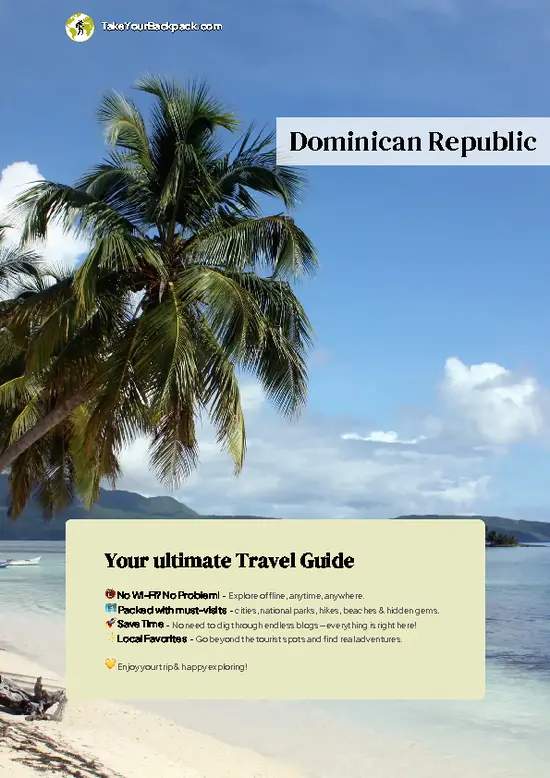
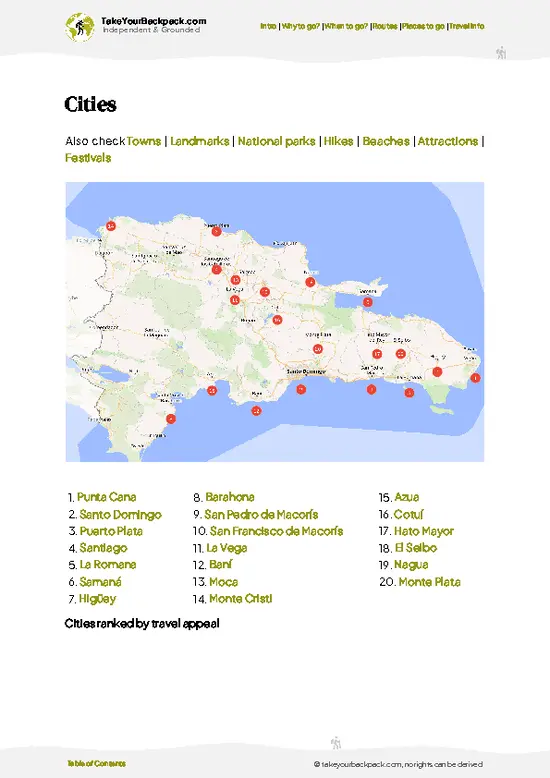
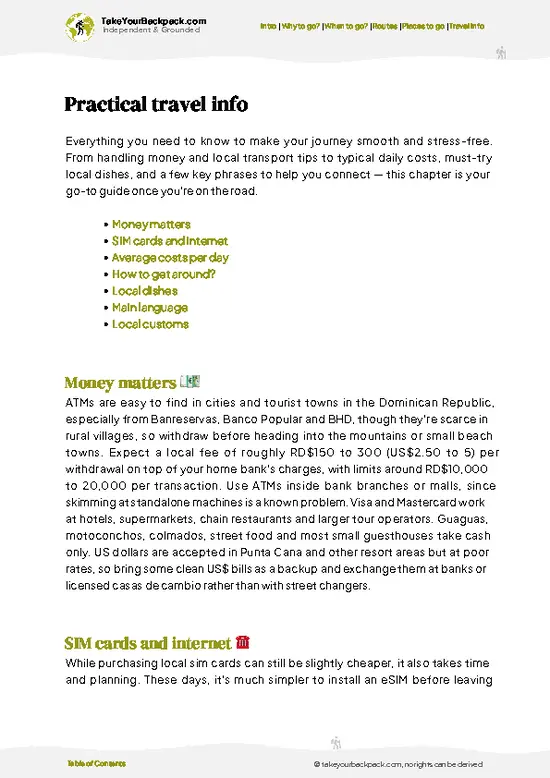
example page 0 from our offline Travel Guide for Dominican Republic
example page 1 from our offline Travel Guide for Dominican Republic
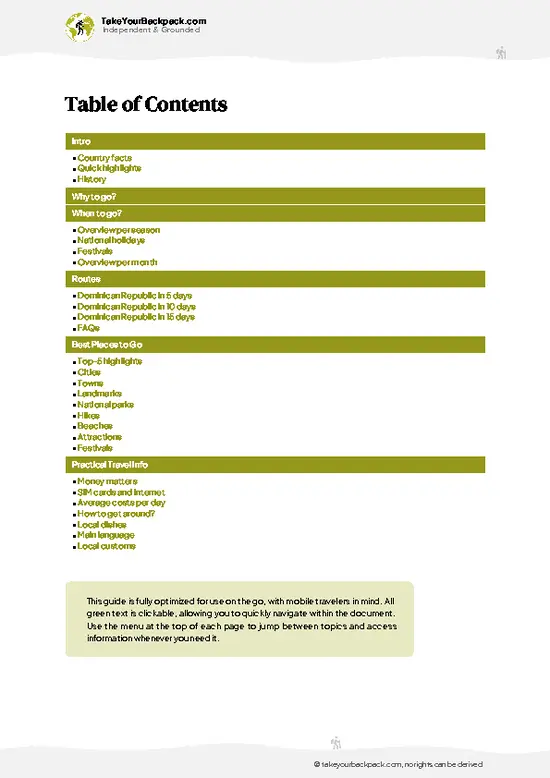
example page 2 from our offline Travel Guide for Dominican Republic
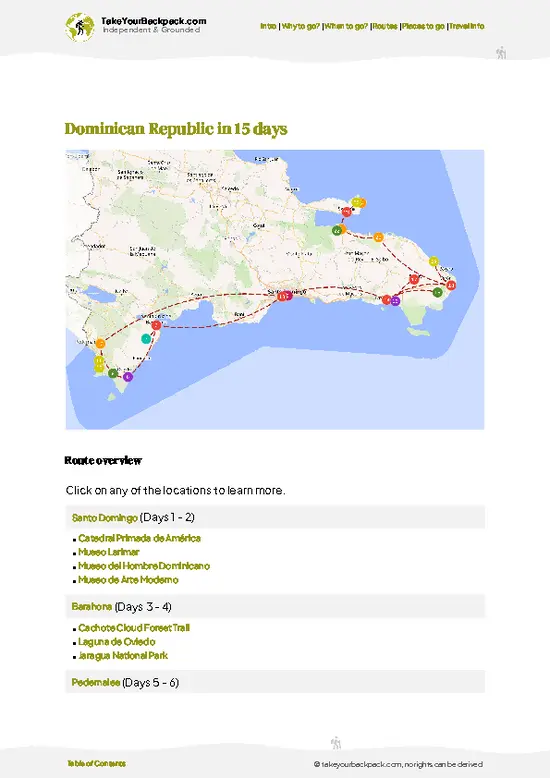
example page 3 from our offline Travel Guide for Dominican Republic
example page 4 from our offline Travel Guide for Dominican Republic
example page 5 from our offline Travel Guide for Dominican Republic
example page 6 from our offline Travel Guide for Dominican Republic
example page 7 from our offline Travel Guide for Dominican Republic
The digital guide (336 pages) contains:
✅ 112 highlights, ranked by travel appeal
✅ Optimized 5, 10 & 15-day travel routes
✅ Cities, national parks, landmarks, beaches
✅ How to get around
✅ Offline-friendly for travel without Wi-Fi
👉 Click to see all 30+ guide features

📅 Plan smarter in minutes, not weeks
✅ Month by month travel advice
✅ Festivals & national holidays
✅ Budget expectations

🗺️ Go to the right places, skip the overrated ones
✅ Honest pros & cons of destinations
✅ Top hikes, parks & viewpoints
✅ Lesser-known places most travelers miss
✅ Clear “worth it vs skip it” guidance

🛏️ Travel smoothly without rookie mistakes
✅ Best areas to stay
✅ Transport systems explained simply
✅ Common scams & safety advice
✅ SIM cards, money & practical tips

🌍 Understand the country, not just visit it
✅ Culture & traditions
✅ 52 Essential phrases & customs
✅ Festivals worth planning around
✅ Traveler-friendly historical context
✅ Insights that make places more meaningful

📱 Built for real travel conditions
✅ Fully downloadable PDF
✅ Works completely offline
✅ Optimized for phone use
✅ Useful in remote areas & buses
✅ Everything in one place
Stop searching, start planning
Get instant access to your full guide. 30‑day money-back guarantee.
+ Add another guide for just

By proceeding you agree to our terms.
Sent to your inbox immediately after payment • 100% Secure Checkout
Best Backpacking Travel Advisor 2025 tourism awardBest Backpacking
Travel Advisor
2025
What others say about Take Your Backpack Guides:
⭐⭐⭐⭐⭐
Fantastic, amazing amount of information!
⭐⭐⭐⭐⭐
My goodness this is amazing, it's what I've been looking for hats off too you!
⭐⭐⭐⭐⭐
I think this is absolutely BRILLIANT
⭐⭐⭐⭐
Very complete and informative. It's still missing places, but I gotta to commend you
⭐⭐⭐⭐⭐
This is truly amazing, thank you, can't wait to explore it with my kids!
⭐⭐⭐⭐⭐
Awesome resource, thank you!
⭐⭐⭐⭐⭐
This is amazing! Can't wait to explore the ones I haven't seen
⭐⭐⭐⭐
I love this! Well done, great idea.
⭐⭐⭐⭐⭐
Thanks for taking the time to make this gem!
⭐⭐⭐⭐⭐
This might be the best website I've ever seen.
⭐⭐⭐⭐⭐
Congratulations, and thank you so much for your work; it's incredibly valuable.
⭐⭐⭐⭐
In all seriousness I think you did a great job pointing out the important spots
⭐⭐⭐⭐⭐
10/10 very good
⭐⭐⭐⭐⭐
As someone who's only just starting to visit regularly this is awesome, thank you.
⭐⭐⭐⭐
Thank you very much! I'm going to visit my dad, it's going to be very useful!
⭐⭐⭐⭐⭐
This is really cool! We'll be travelling for the first time and this definitely come in handy.
⭐⭐⭐⭐⭐
You are now our minister of culture, congratulations 👨‍💼
⭐⭐⭐⭐⭐
Just wanted to tell you that this is a pearl! Going to follow your recommendations.
⭐⭐⭐⭐⭐
This is so cool. I'll definitely be using the resource for my travels soon.
⭐⭐⭐⭐⭐
This is very impressive! Good work.
⭐⭐⭐⭐⭐
This is an amazing and informative site. Very well done!

🛏️ Where to stay?Where to Stay in Dominican Republic

Hostels and budget guesthouses exist across the Dominican Republic, with dorm beds typically running RD$700 to 1,500 (US$12 to 25) and simple private rooms from about RD$1,800 (US$30). The densest cluster is in Santo Domingo’s Zona Colonial, where you can walk to the main historic sights and weekend bars but should expect street noise and take care on quieter side streets after dark. Elsewhere, Cabarete has surfer and kiter hostels in a lively beach-bar strip, Las Terrenas is calmer with good guesthouse value, Jarabacoa suits quiet mountain stays, and Bávaro’s Los Corales area offers the few budget beds near Punta Cana’s resort beaches.

If you enjoy meeting fellow travelers, consider choosing … read more 👉
Hostels and budget guesthouses exist across the Dominican Republic, with dorm beds typically running RD$700 to 1,500 (US$12 to 25) and simple private rooms from about RD$1,800 (US$30). The densest cluster is in Santo Domingo’s Zona Colonial, where you can walk to the main historic sights and weekend bars but should expect street noise and take care on quieter side streets after dark. Elsewhere, Cabarete has surfer and kiter hostels in a lively beach-bar strip, Las Terrenas is calmer with good guesthouse value, Jarabacoa suits quiet mountain stays, and Bávaro’s Los Corales area offers the few budget beds near Punta Cana’s resort beaches.

If you enjoy meeting fellow travelers, consider choosing hostels with high ratings for atmosphere. On the other hand, if you prefer having your own space, a hotel might be a better option.

Dominican RepublicMore of Dominican Republic

👋 Meet the founderWho’s Behind Take Your Backpack?

Johan, backpacker and founder of TakeYourBackpackHi, I’m Johan (Netherlands 🇳🇱), the creator of TakeYourBackpack. Over the past 3 decades, I’ve backpacked through 90+ countries across six continents, gaining extensive experience with independent travel, long-term trips, and overland routes.

This site is built on a combination of firsthand travel experience and carefully curated insights from other backpackers. Many guides are based on places I’ve personally visited, while others bring together tips, observations, and practical advice shared by trusted travelers I’ve met along the way.

The goal is to provide realistic, experience-driven guidance — not generic itineraries — so you can explore destinations with better context, clearer expectations, and more confidence.