×

Dominican Republic🇩🇴 | best hikesDiscover the 5 Best hikes Across Dominican Republic

Hiking in the Dominican Republic means the Caribbean without the sunscreen-and-cocktail script. The country holds the highest peak in the Caribbean, cloud forest, pine ridges, waterfall canyons and dry coastal cliffs, all within a few hours of each other by road. The Cordillera Central around Jarabacoa and Constanza is cool, cheap and busy with Dominican weekenders. The north coast and the Samaná peninsula lean toward tourist-priced guided outings. The southwest is drier, emptier and slower to reach. Independent backpackers can do most of it by guagua (minibus) and motoconcho (motorbike taxi), though trailheads often come with a mandatory local guide and a mildly baffling price negotiation.

By Johan Kruseman 🇳🇱 | Updated October 18, 2026
Explore the best beaches in Dominican Republic

Why go?Key Factors That Shape the Experience

The Dominican Republic shares Hispaniola with Haiti and packs an unreasonable amount of relief into a country smaller than Costa Rica. Four mountain ranges run through it, and the Cordillera Central climbs above 3,000 meters, so a single day can swing from tropical heat to near-freezing mornings. That vertical variety is the real draw: rainforest, pine forest, dry scrub and coast are close enough that you rarely spend a whole day just getting somewhere.

The country is also unusually practical. Tourism infrastructure is built around beach resorts, which means airports, buses and basic lodging are easy to find, and local guide associations run most of the popular trails. The flip side is that trail culture is guide-first. Many routes are poorly signed, and park rules or common sense steer you … read more 👉
The Dominican Republic shares Hispaniola with Haiti and packs an unreasonable amount of relief into a country smaller than Costa Rica. Four mountain ranges run through it, and the Cordillera Central climbs above 3,000 meters, so a single day can swing from tropical heat to near-freezing mornings. That vertical variety is the real draw: rainforest, pine forest, dry scrub and coast are close enough that you rarely spend a whole day just getting somewhere.

The country is also unusually practical. Tourism infrastructure is built around beach resorts, which means airports, buses and basic lodging are easy to find, and local guide associations run most of the popular trails. The flip side is that trail culture is guide-first. Many routes are poorly signed, and park rules or common sense steer you toward hiring someone, so solo wandering is less of a thing here than in the Andes or the Alps.

Before choosing the country for hiking, know that distances are short but roads can be slow, that humidity turns moderate climbs into sweaty negotiations, and that Dominicans treat the outdoors as a social event, so expect company, music and snacks on popular trails. Come for variety and good-natured chaos rather than wilderness solitude.
Evaluating the Top Choices
The list of best hikes in Dominican Republic is created based on scenery, challenge, trail quality, landmarks, and overall enjoyment. If you feel a hike is missing in this list, please let us know.

When to go?Timing Your Visit for the Best Experience

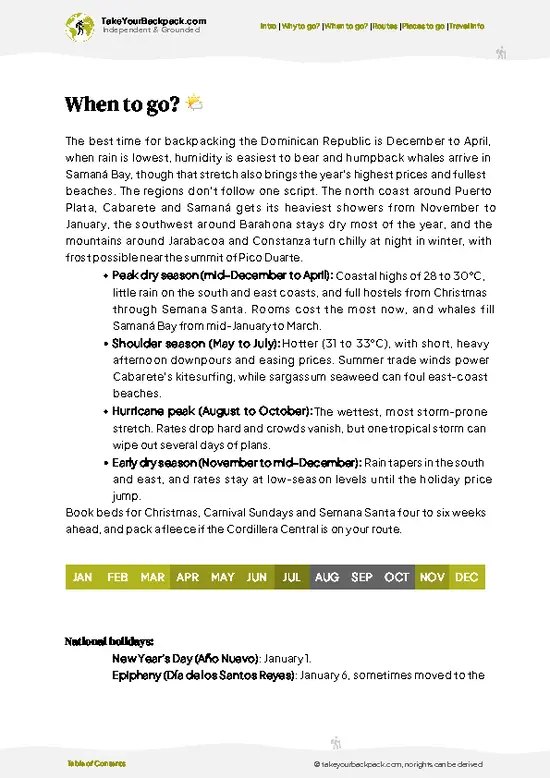
Best months for hiking: The best months are December to April, when the dry season brings the least rain and the clearest views across most of the country. Daytime temperatures on the coast sit around 28 to 32°C, while the high Cordillera Central is far cooler, with highs of 15 to 22°C and nights that can drop to near or below freezing on the highest summit.
Shoulder seasons and the wet months: May to June and November are shoulder months: fewer visitors, lower prices and afternoon showers that usually arrive after lunch, so an early start solves most problems. July to October is wet and hot, with the heaviest rain in August to October, muddy trails, swollen river crossings and a real chance of hurricane disruption. Dry-season rain does not exempt the north coast and the Samaná peninsula, which … read more 👉
Best months for hiking: The best months are December to April, when the dry season brings the least rain and the clearest views across most of the country. Daytime temperatures on the coast sit around 28 to 32°C, while the high Cordillera Central is far cooler, with highs of 15 to 22°C and nights that can drop to near or below freezing on the highest summit.
Shoulder seasons and the wet months: May to June and November are shoulder months: fewer visitors, lower prices and afternoon showers that usually arrive after lunch, so an early start solves most problems. July to October is wet and hot, with the heaviest rain in August to October, muddy trails, swollen river crossings and a real chance of hurricane disruption. Dry-season rain does not exempt the north coast and the Samaná peninsula, which stay wetter than the rest of the country through winter.
Crowds and prices: Peak pressure comes at Christmas, New Year, Semana Santa (Holy Week) and the long summer holiday weekends, when Dominican families flood mountain towns and prices for rooms and guides can rise 20 to 40 percent. The southwest, around Barahona and Pedernales, is drier and hotter year-round, so go there in the cooler months and start before sunrise.

hike hoppingSuggested Travel Strategies

How many days to plan: A trip combining several hikes in the Dominican Republic needs 10 to 14 days, which leaves room for travel days and for the weather having opinions. The country is small, but mountain roads are slow, and a 150-kilometer transfer can easily eat four to five hours.
Which regions group well: Santo Domingo is the natural hub, with the main international airport and bus companies such as Metro and Caribe Tours running to most regions. The Cordillera Central (Jarabacoa, Constanza) and the north coast (Puerto Plata, Cabarete) pair easily, since Santiago connects them. The Samaná peninsula sits further east, and the southwest (Barahona, Pedernales) is its own world. A sensible direction runs from Santo Domingo into the mountains, down to the north coast, then east or back south, … read more 👉
How many days to plan: A trip combining several hikes in the Dominican Republic needs 10 to 14 days, which leaves room for travel days and for the weather having opinions. The country is small, but mountain roads are slow, and a 150-kilometer transfer can easily eat four to five hours.
Which regions group well: Santo Domingo is the natural hub, with the main international airport and bus companies such as Metro and Caribe Tours running to most regions. The Cordillera Central (Jarabacoa, Constanza) and the north coast (Puerto Plata, Cabarete) pair easily, since Santiago connects them. The Samaná peninsula sits further east, and the southwest (Barahona, Pedernales) is its own world. A sensible direction runs from Santo Domingo into the mountains, down to the north coast, then east or back south, saving the southwest for last or as a separate trip.
Time per stop and travel between regions: Give each region 2 to 4 nights. Typical transfers run 2 to 3 hours from Santo Domingo to Jarabacoa, 1 to 2 hours from Jarabacoa to Santiago, 1 to 1.5 hours from Santiago to Puerto Plata, and 4 to 5 hours from Santo Domingo to Barahona.
Common planning mistakes: The classic error is stacking a summit day right after an overnight bus, or hopping between all four regions in a week. Pick two or three bases, and schedule a rest day after any long climb. Also avoid relying on late afternoon guaguas, which tend to leave when full rather than when planned.

The ListMust-Visit hikes in Dominican Republic

1 Pico Duarte

highest peak, multi-day trek, alpine forest

Undertake a demanding ascent through changing ecosystems, camping en route to the summit of the Caribbean’s tallest mountain.

dominican-republic-hike-pico-duarte
© Google | Anderson Dominguez

2 Cachote Cloud Forest Trail

misty forest, endemic flora, cool highlands

Ascend through dense cloud forest where shifting fog reveals rare plant life and cooler air, offering a distinct contrast to the coast.

3 Salto de Jimenoa Trail

waterfall plunge pool, suspension bridge, pine woods

Follow a forested path that leads to a dramatic waterfall, crossing a swaying bridge and passing through stands of Caribbean pine.

dominican-republic-hike-salto-de-jimenoa-trail
© Google |

4 Loma Isabel de Torres

botanical gardens, cable car, Atlantic views

Ride or hike up a lush mountain, exploring cultivated gardens and enjoying sweeping vistas over the city and coastline below.

dominican-republic-hike-loma-isabel-de-torres
© Google | Barbara L.

5 Sendero de la Cueva de los Indios

petroglyphs, underground chambers, river crossing

Descend into a cave system marked by ancient carvings, navigating damp passages and a shallow river at the entrance.

Loading the map 🌍

Expert viewInsights from Locals and Experts

How many hikes to do: I would advise 4 to 6 hikes over a two-week trip. That is enough to see the range of terrain (mountain, waterfall canyon, coast) without every day dissolving into a blur of mud and motoconcho rides. More than that and you spend most of your energy on logistics, and the Dominican Republic is a place where logistics already like to improvise. Fewer than four and you are mostly leaving the country's best asset unused.
Which kinds to prioritize: If you have limited time, the high mountain routes of the Cordillera Central are worth the effort. They offer the biggest contrast to the beach image and the cooler air makes real hiking pleasant. For a relaxed schedule, pick waterfall and river walks, which are shorter and often include swimming. Coastal and southwest hikes suit anyone … read more 👉
How many hikes to do: I would advise 4 to 6 hikes over a two-week trip. That is enough to see the range of terrain (mountain, waterfall canyon, coast) without every day dissolving into a blur of mud and motoconcho rides. More than that and you spend most of your energy on logistics, and the Dominican Republic is a place where logistics already like to improvise. Fewer than four and you are mostly leaving the country's best asset unused.
Which kinds to prioritize: If you have limited time, the high mountain routes of the Cordillera Central are worth the effort. They offer the biggest contrast to the beach image and the cooler air makes real hiking pleasant. For a relaxed schedule, pick waterfall and river walks, which are shorter and often include swimming. Coastal and southwest hikes suit anyone chasing quiet, with dramatic dry landscapes and far fewer people. I would skip the heavily packaged tours that bundle a short walk with a long bus ride and a buffet lunch. They cost more and show you less.
What it costs: Budget US$30 to 60 a day for a backpacker mixing hikes with rest days. Park entry fees are usually modest, around US$2 to 10 (roughly RD$100 to 600). Local guides cost about US$25 to 60 per group for a day hike, and multi-day summit trips with mules and camping can reach US$100 to 200 per person. Motoconcho rides run US$1 to 4, and guaguas between towns cost US$2 to 8. A full hiking visit to one region typically adds up to US$60 to 150 including guide, entry and transport.
Safety and culture: Hire a local guide where the trail is poorly marked, as many are, since guides know the weather, the river levels and the shortcuts. Carry cash in pesos, because small trailhead businesses rarely take cards. Start early, since afternoon storms build quickly and rivers rise fast. Bring more water than seems sensible, plus insect repellent and a warm layer for high elevations, where it can be genuinely cold at night. Respect private farmland, ask before photographing people and tip guides, typically 10 to 20 percent. Petty theft happens in cities, so leave valuables at your lodging. A few words of Spanish go a long way.

✈️ The backpacker research shortcutDominican Republic Travel Guide

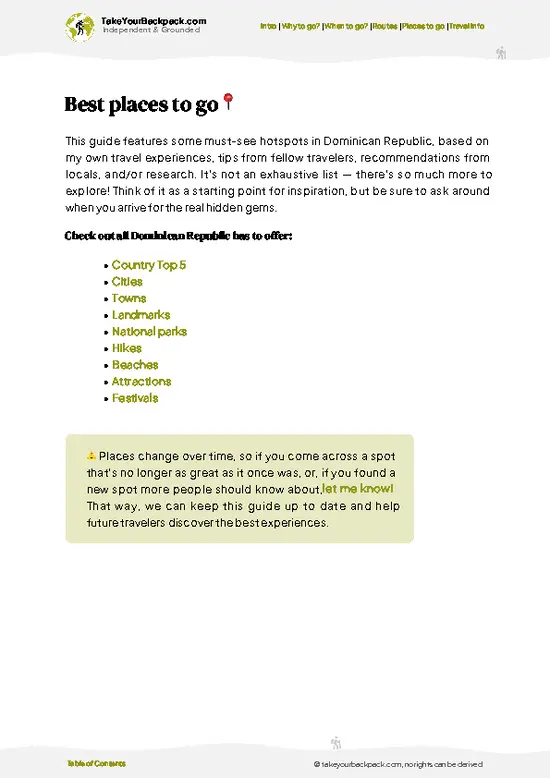
An offline-friendly backpacking guide with optimized travel routes, ranked highlights, transport advice, and the best areas to stay.
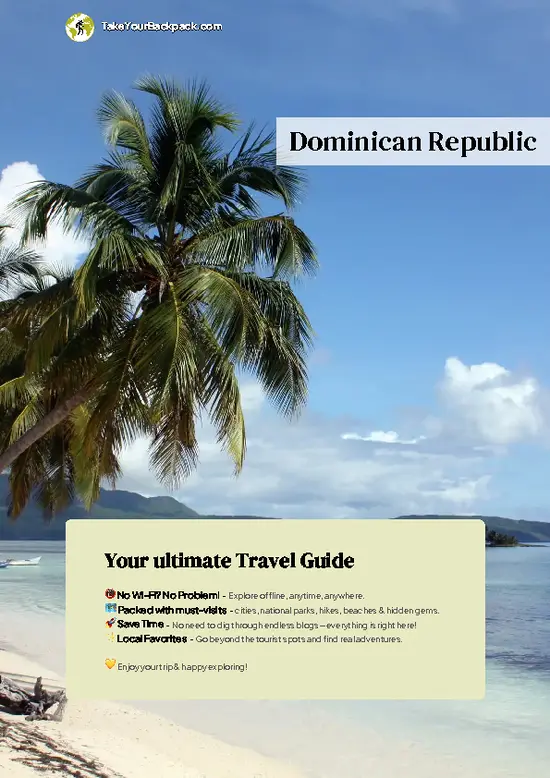
example page 0 from our offline Travel Guide for Dominican Republic
example page 1 from our offline Travel Guide for Dominican Republic
example page 2 from our offline Travel Guide for Dominican Republic
example page 3 from our offline Travel Guide for Dominican Republic
example page 4 from our offline Travel Guide for Dominican Republic
example page 5 from our offline Travel Guide for Dominican Republic
example page 6 from our offline Travel Guide for Dominican Republic
example page 7 from our offline Travel Guide for Dominican Republic
The digital guide (407 pages) contains:
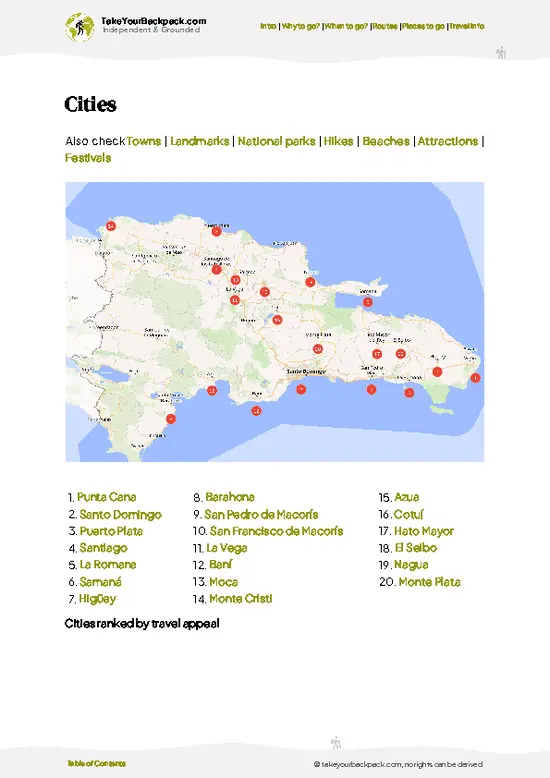
✅ 112 highlights, ranked by travel appeal
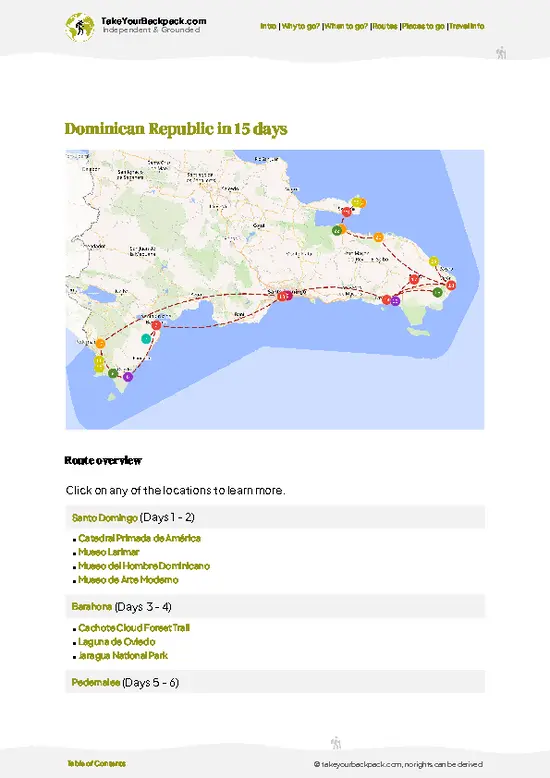
✅ Optimized 5, 10 & 15-day travel routes
✅ Cities, national parks, landmarks, beaches
✅ How to get around
✅ Offline-friendly for travel without Wi-Fi
👉 Click to see all 30+ guide features

📅 Plan smarter in minutes, not weeks
✅ Month by month travel advice
✅ Festivals & national holidays
✅ Budget expectations

🗺️ Go to the right places, skip the overrated ones
✅ Honest pros & cons of destinations
✅ Top hikes, parks & viewpoints
✅ Lesser-known places most travelers miss
✅ Clear “worth it vs skip it” guidance

🛏️ Travel smoothly without rookie mistakes
✅ Best areas to stay
✅ Transport systems explained simply
✅ Common scams & safety advice
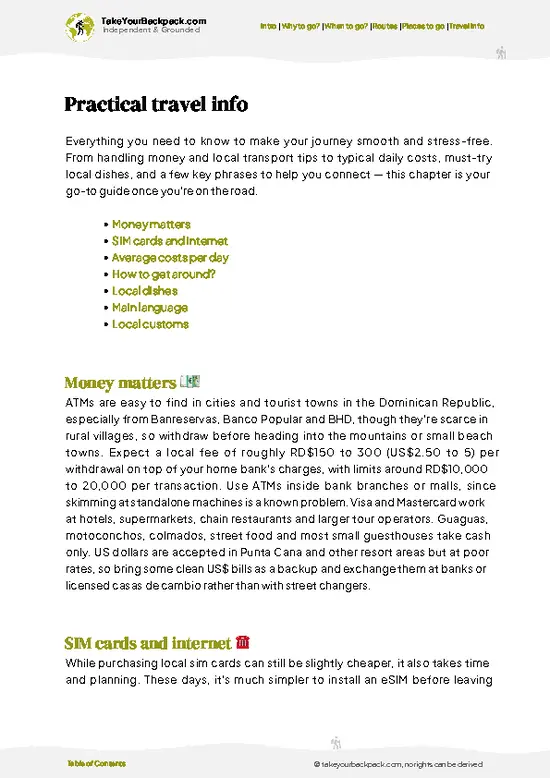
✅ SIM cards, money & practical tips

🌍 Understand the country, not just visit it
✅ Culture & traditions
✅ 52 Essential phrases & customs
✅ Festivals worth planning around
✅ Traveler-friendly historical context
✅ Insights that make places more meaningful

📱 Built for real travel conditions
✅ Fully downloadable PDF
✅ Works completely offline
✅ Optimized for phone use
✅ Useful in remote areas & buses
✅ Everything in one place
Stop searching, start planning
Get instant access to your full guide. 30‑day money-back guarantee.
+ Add another guide for just

By proceeding you agree to our terms.
Sent to your inbox immediately after payment • 100% Secure Checkout
Best Backpacking Travel Advisor 2025 tourism awardBest Backpacking
Travel Advisor
2025
What others say about Take Your Backpack Guides:
⭐⭐⭐⭐⭐
Fantastic, amazing amount of information!
⭐⭐⭐⭐⭐
My goodness this is amazing, it's what I've been looking for hats off too you!
⭐⭐⭐⭐⭐
I think this is absolutely BRILLIANT
⭐⭐⭐⭐
Very complete and informative. It's still missing places, but I gotta to commend you
⭐⭐⭐⭐⭐
This is truly amazing, thank you, can't wait to explore it with my kids!
⭐⭐⭐⭐⭐
Awesome resource, thank you!
⭐⭐⭐⭐⭐
This is amazing! Can't wait to explore the ones I haven't seen
⭐⭐⭐⭐
I love this! Well done, great idea.
⭐⭐⭐⭐⭐
Thanks for taking the time to make this gem!
⭐⭐⭐⭐⭐
This might be the best website I've ever seen.
⭐⭐⭐⭐⭐
Congratulations, and thank you so much for your work; it's incredibly valuable.
⭐⭐⭐⭐
In all seriousness I think you did a great job pointing out the important spots
⭐⭐⭐⭐⭐
10/10 very good
⭐⭐⭐⭐⭐
As someone who's only just starting to visit regularly this is awesome, thank you.
⭐⭐⭐⭐
Thank you very much! I'm going to visit my dad, it's going to be very useful!
⭐⭐⭐⭐⭐
This is really cool! We'll be travelling for the first time and this definitely come in handy.
⭐⭐⭐⭐⭐
You are now our minister of culture, congratulations 👨‍💼
⭐⭐⭐⭐⭐
Just wanted to tell you that this is a pearl! Going to follow your recommendations.
⭐⭐⭐⭐⭐
This is so cool. I'll definitely be using the resource for my travels soon.
⭐⭐⭐⭐⭐
This is very impressive! Good work.
⭐⭐⭐⭐⭐
This is an amazing and informative site. Very well done!

🛏️ Where to stay?Top Areas to Stay

Hostels and budget guesthouses exist across the Dominican Republic, with dorm beds typically running RD$700 to 1,500 (US$12 to 25) and simple private rooms from about RD$1,800 (US$30). The densest cluster is in Santo Domingo’s Zona Colonial, where you can walk to the main historic sights and weekend bars but should expect street noise and take care on quieter side streets after dark. Elsewhere, Cabarete has surfer and kiter hostels in a lively beach-bar strip, Las Terrenas is calmer with good guesthouse value, Jarabacoa suits quiet mountain stays, and Bávaro’s Los Corales area offers the few budget beds near Punta Cana’s resort beaches.

If you enjoy meeting fellow travelers, consider choosing … read more 👉
Hostels and budget guesthouses exist across the Dominican Republic, with dorm beds typically running RD$700 to 1,500 (US$12 to 25) and simple private rooms from about RD$1,800 (US$30). The densest cluster is in Santo Domingo’s Zona Colonial, where you can walk to the main historic sights and weekend bars but should expect street noise and take care on quieter side streets after dark. Elsewhere, Cabarete has surfer and kiter hostels in a lively beach-bar strip, Las Terrenas is calmer with good guesthouse value, Jarabacoa suits quiet mountain stays, and Bávaro’s Los Corales area offers the few budget beds near Punta Cana’s resort beaches.

If you enjoy meeting fellow travelers, consider choosing hostels with high ratings for atmosphere. On the other hand, if you prefer having your own space, a hotel might be a better option.

Dominican RepublicDiscover the Country

👋 Meet the founderWho’s Behind Take Your Backpack?

Johan, backpacker and founder of TakeYourBackpackHi, I’m Johan (Netherlands 🇳🇱), the creator of TakeYourBackpack. Over the past 3 decades, I’ve backpacked through 90+ countries across six continents, gaining extensive experience with independent travel, long-term trips, and overland routes.

This site is built on a combination of firsthand travel experience and carefully curated insights from other backpackers. Many guides are based on places I’ve personally visited, while others bring together tips, observations, and practical advice shared by trusted travelers I’ve met along the way.

The goal is to provide realistic, experience-driven guidance — not generic itineraries — so you can explore destinations with better context, clearer expectations, and more confidence.