×

Dominican Republic🇩🇴 | best attractionsDiscover the 11 Best attractions Across Dominican Republic

Dominican Republic sells itself as one long beach, and the country is quietly annoyed about it. The Caribbean coast hands you all-inclusive wristbands and a lot of sunscreen. The north coast trades that for surf towns, waterfalls and cheaper beds. The Cordillera Central goes cold enough at night to make you unpack a sweater you packed as a joke. Colonial Santo Domingo sits in the middle with the oldest European streets in the Americas. Independent travel works fine here, since guaguas (minibuses) reach most places for a few dollars, but the east is built for resorts and the west for the stubborn.

By Johan Kruseman 🇳🇱 | Updated October 20, 2026
Explore the best festivals in Dominican Republic

Why go?Key Factors That Shape the Experience

The Dominican Republic shares the island of Hispaniola with Haiti, and it packs an unreasonable amount of variety into roughly 48,000 square kilometers. Pico Duarte tops out near 3,100 meters, the highest point in the Caribbean, while Lago Enriquillo sits below sea level and hosts crocodiles. Few islands let you swing from cloud forest to desert scrub in a morning of driving.

History adds a second layer. Columbus landed in 1492 and the Spanish built their first fortress, cathedral and university in the New World here, so colonial heritage sits alongside Taíno, African and Spanish influence in food, music and speech. Merengue and bachata are not museum pieces, they come out of passing cars.

The catch is infrastructure. Tourism is mature and well organized on the coasts, but it is designed … read more 👉
The Dominican Republic shares the island of Hispaniola with Haiti, and it packs an unreasonable amount of variety into roughly 48,000 square kilometers. Pico Duarte tops out near 3,100 meters, the highest point in the Caribbean, while Lago Enriquillo sits below sea level and hosts crocodiles. Few islands let you swing from cloud forest to desert scrub in a morning of driving.

History adds a second layer. Columbus landed in 1492 and the Spanish built their first fortress, cathedral and university in the New World here, so colonial heritage sits alongside Taíno, African and Spanish influence in food, music and speech. Merengue and bachata are not museum pieces, they come out of passing cars.

The catch is infrastructure. Tourism is mature and well organized on the coasts, but it is designed around package visitors, so independent travelers often pay a premium for the easy options and must work for the cheap ones. Roads between major towns are decent, rural ones less so, and a motoconcho (motorbike taxi) ride is an experience in faith. Know that Spanish helps far more than English once you leave resort zones, and that some of the best natural sites need a guide or a long, bumpy transfer.
Evaluating the Top Choices
The list of best attractions in Dominican Republic is created based on cultural significance or entertainment value. If you feel a attraction is missing in this list, please let us know.

When to go?Timing Your Visit for the Best Experience

Best months and weather: The best months are December to April, when the Dominican Republic is dry, with highs of 28 to 31°C, lower humidity and calm seas for the coastal and mountain outings alike. Nights in the highlands around Jarabacoa and Constanza drop to near freezing at times in winter, so the mountains reward a jacket.

Shoulder seasons and rain: May to June and November are the shoulder months. Afternoon downpours show up, crowds thin, and room rates fall noticeably, often by 20 to 30 percent outside the holiday rush. July and August are hot (often 32°C or more) and humid, and local holidays fill beaches and buses. The north coast, including Samaná, gets its heaviest rain from November to January, so a dry-season forecast does not apply to everything. The southwest around Barahona … read more 👉
Best months and weather: The best months are December to April, when the Dominican Republic is dry, with highs of 28 to 31°C, lower humidity and calm seas for the coastal and mountain outings alike. Nights in the highlands around Jarabacoa and Constanza drop to near freezing at times in winter, so the mountains reward a jacket.

Shoulder seasons and rain: May to June and November are the shoulder months. Afternoon downpours show up, crowds thin, and room rates fall noticeably, often by 20 to 30 percent outside the holiday rush. July and August are hot (often 32°C or more) and humid, and local holidays fill beaches and buses. The north coast, including Samaná, gets its heaviest rain from November to January, so a dry-season forecast does not apply to everything. The southwest around Barahona and Pedernales is drier year-round.

Hurricanes and peaks: Hurricane season runs June to November, with peak risk in August to October. Storms cause sporadic cancellations of boat trips and washed-out mountain roads, though most days remain ordinary. Peak prices land at Christmas, New Year and Semana Santa, when beds can cost 30 to 50 percent more and book out. February brings Carnival, a good excuse to tolerate the crowds, and humpback whales visit Samaná Bay from mid-January to March.

attraction hoppingSuggested Travel Strategies

How many days to plan: A trip linking several of the country’s main attractions needs 10 to 14 days, and 7 days only works if you accept leaving a region out. The Dominican Republic looks small on a map, but roads wind, traffic around cities snarls, and distances take longer than they should.

Regions and direction: Three clusters work well. Santo Domingo and the south coast pair easily, the north coast with Samaná pairs well, and the central mountains sit between them. A loop starting in Santo Domingo, heading north through the mountains to the Atlantic coast, then looping back east or south, keeps backtracking low. Allow 2 to 3 days in the capital, 2 to 4 days in mountain and nature areas, and 3 to 5 days on the north coast or Samaná. Typical transfers run 2 to 3 hours from Santo Domingo … read more 👉
How many days to plan: A trip linking several of the country’s main attractions needs 10 to 14 days, and 7 days only works if you accept leaving a region out. The Dominican Republic looks small on a map, but roads wind, traffic around cities snarls, and distances take longer than they should.

Regions and direction: Three clusters work well. Santo Domingo and the south coast pair easily, the north coast with Samaná pairs well, and the central mountains sit between them. A loop starting in Santo Domingo, heading north through the mountains to the Atlantic coast, then looping back east or south, keeps backtracking low. Allow 2 to 3 days in the capital, 2 to 4 days in mountain and nature areas, and 3 to 5 days on the north coast or Samaná. Typical transfers run 2 to 3 hours from Santo Domingo to the mountains and the east coast, 3 to 4 hours to the Samaná Peninsula, and 5 to 6 hours to the far southwest. Long-distance buses such as Caribe Tours and Metro connect the main hubs.

Planning mistakes: The most common error is scheduling a different town every night, which turns the trip into a rotating bus seat. Stay at least two nights in each base and use day trips. Another is underestimating travel after dark, when potholes, unlit vehicles and animals turn a 2-hour drive into a long evening. Travel in daylight, and leave a buffer before flights.

The ListMust-Visit attractions in Dominican Republic

1 Catedral Primada de América

Oldest cathedral in the Americas, Gothic vaults, Plateresque portal, Parque Colón

Step into cool ribbed vaults behind a coral-limestone front, then trace fourteen side chapels, mahogany carving and a silver-fronted altar.

dominican-republic-attraction-catedral-primada-de-america
© Google |

2 Alcázar de Colón

Coral-limestone loggia, viceroy’s rooms, Ozama views, Plaza de España

Walk through the early 1500s residence of Diego Colón, where carved furniture, armor and tapestries sit above a river and the plaza below.

dominican-republic-attraction-alcazar-de-colon
© Google |

3 Museo de las Casas Reales

Royal Audiencia, conquest armor, navigation charts, Calle Las Damas

Trace how the Spanish crown governed the Americas from a 1500s palace, through old maps, weapons and rebuilt colonial rooms.

dominican-republic-attraction-museo-de-las-casas-reales
© Google |

4 Amber World Museum

Insect inclusions, blue amber, fake-versus-real test, colonial house

Peer through magnifiers at ants, a lizard and other creatures sealed in resin, then learn a quick test to spot plastic fakes.

5 Museo del Ámbar Dominicano

Victorian mansion, Puerto Plata amber, whole-lizard inclusion, polishing bench

Examine ancient ants, spiders and a lizard in resin inside a merchant’s house, and watch blue amber change color in daylight.

dominican-republic-attraction-museo-del-ambar-dominicano
© Google |

6 Museo Larimar

Larimar from Bahoruco, lapidary workshop, silver settings, Zona Colonial

Compare raw and polished sky-blue stones, see artisans shape pendants, and learn why this gem comes from a single southwestern range.

dominican-republic-attraction-museo-larimar
© Google |

7 Museo del Hombre Dominicano

Taíno zemí figures, duho seats, African heritage, diablo masks

Compare ritual stone and shell objects of the Taíno with African-rooted traditions and horned carnival costumes, all within one cultural complex.

dominican-republic-attraction-museo-del-hombre-dominicano
© Google |

8 Museo de Arte Moderno

Yoryi Morel landscapes, Bidó faces, rotating shows, cultural plaza

Follow twentieth-century Dominican painting from rural canvases to abstraction, then check the evening program at the theaters next door.

dominican-republic-attraction-museo-de-arte-moderno
© Google |

9 Centro León

Carnival masks, cigar workshop, Cibao tobacco, Santiago hilltop

Study horned diablo cojuelo masks, watch cigars being rolled and follow Taíno, Spanish and African threads through Dominican culture above Santiago.

10 Museo Bellapart

Private art collection, Jaime Colson, Taíno pieces, guided tours

Book ahead for a guided pass from carved Taíno objects through colonial canvases to modernist and contemporary Dominican painters in Piantini.

11 Teatro Nacional Eduardo Brito

Sala Carlos Piantini, national ballet, symphony nights, marble lobby

Catch an evening of symphony, ballet or chamber music in a blocky 1970s hall, then take in the lit facade.

Loading the map 🌍

Expert viewInsights from Locals and Experts

How many attractions to do: I would advise 8 to 12 attractions on a two-week trip, which means roughly one real outing per day with room for slow mornings. Push past that and you spend your time in vans rather than at the places. The country’s distances are not large, but guaguas, traffic and tours that leave at odd hours eat daylight. Fewer, longer visits beat a checklist.

What to prioritize: Prioritize by travel style. Culture seekers should put the colonial and historic sites first, since they are compact, walkable and cheap. Outdoor travelers get the best value from the mountains, rivers and waterfalls, where guided activities are the real draw. Beach-first travelers should pick one or two quieter beaches and skip the crowded resort-adjacent ones, which charge for chairs, drinks and sometimes … read more 👉
How many attractions to do: I would advise 8 to 12 attractions on a two-week trip, which means roughly one real outing per day with room for slow mornings. Push past that and you spend your time in vans rather than at the places. The country’s distances are not large, but guaguas, traffic and tours that leave at odd hours eat daylight. Fewer, longer visits beat a checklist.

What to prioritize: Prioritize by travel style. Culture seekers should put the colonial and historic sites first, since they are compact, walkable and cheap. Outdoor travelers get the best value from the mountains, rivers and waterfalls, where guided activities are the real draw. Beach-first travelers should pick one or two quieter beaches and skip the crowded resort-adjacent ones, which charge for chairs, drinks and sometimes access. The catamaran party boats and most of the packaged island excursions are worth skipping on a budget: loud, crowded, overpriced. A good waterfall hike with a local guide is a better afternoon.

What it costs: A backpacker can manage on US$40 to 70 a day (about RD$2,400 to 4,200), counting a hostel dorm at US$12 to 25, local meals at US$4 to 8 and transport. Entry fees to museums and colonial sites are typically US$2 to 8, national park fees run US$3 to 10, and guided canyon, river or mountain days cost US$30 to 80 depending on the activity and group size. Boat or whale trips usually cost US$50 to 100. Intercity buses run US$4 to 12, guaguas are cheaper, and private transfers cost much more. Carry pesos, because many smaller sites and vendors do not take cards.

Safety and etiquette: Most visits are trouble-free, but standard care applies: keep phones tucked away in crowded areas, avoid walking on empty beaches or streets at night, and use registered taxis or apps in cities. At beaches and tourist sites, touts and unofficial guides are persistent. A polite “no, gracias” and a smile settle most of it, and agreeing a price before you start avoids awkward arguments afterward. Use licensed guides for the mountains, caves and rivers, since trails are poorly marked and conditions change after rain. Check weather before any water-based trip.

Dress modestly in churches, and ask before photographing people. A little Spanish goes a long way, and greeting with “buenos días” before asking for anything is simply good manners.

✈️ The backpacker research shortcutDominican Republic Travel Guide

An offline-friendly backpacking guide with optimized travel routes, ranked highlights, transport advice, and the best areas to stay.
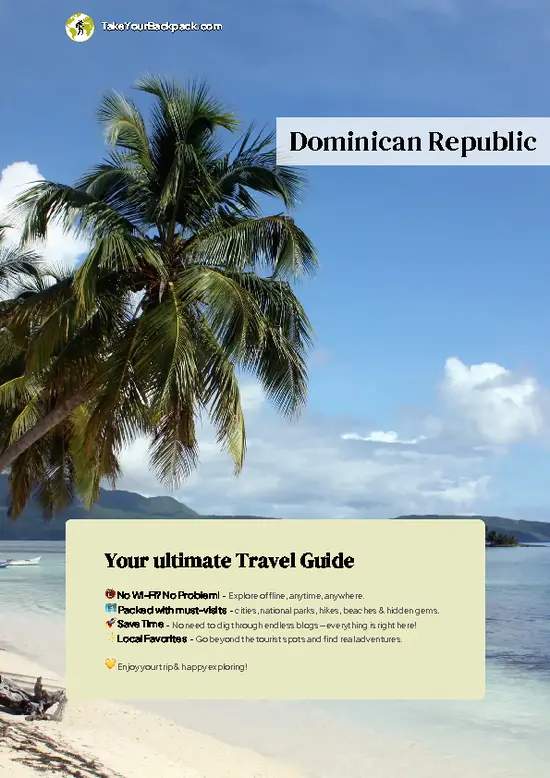
example page 0 from our offline Travel Guide for Dominican Republic
example page 1 from our offline Travel Guide for Dominican Republic
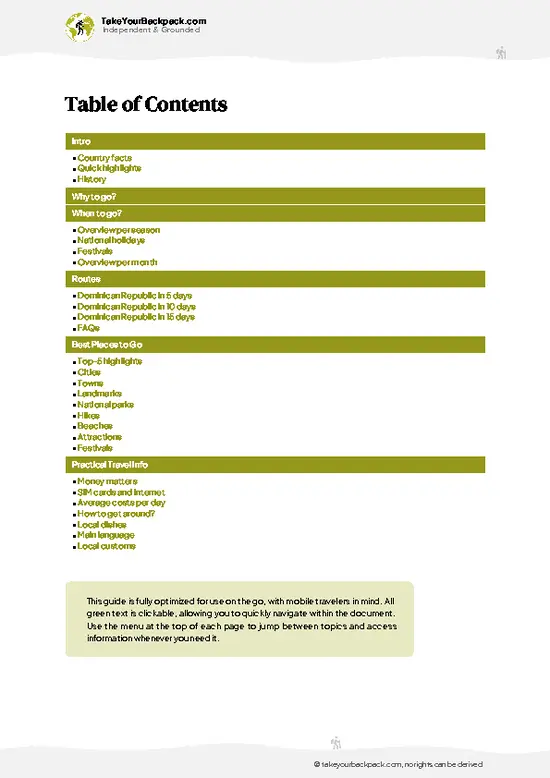
example page 2 from our offline Travel Guide for Dominican Republic
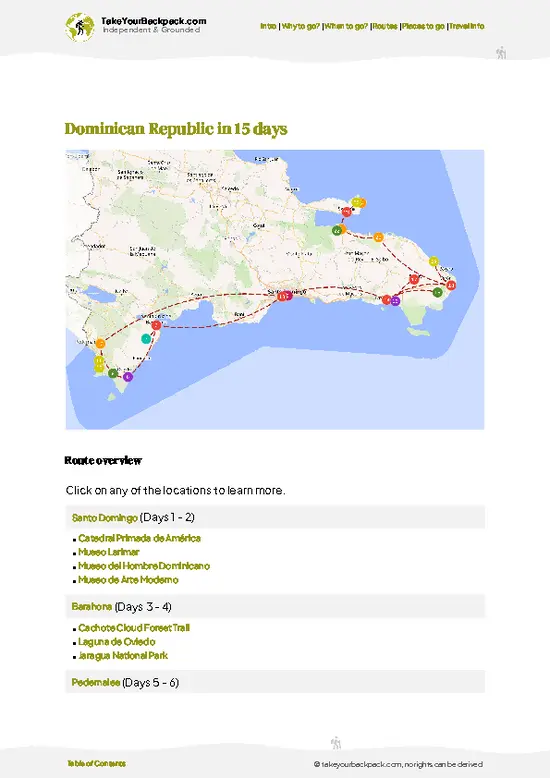
example page 3 from our offline Travel Guide for Dominican Republic
example page 4 from our offline Travel Guide for Dominican Republic
example page 5 from our offline Travel Guide for Dominican Republic
example page 6 from our offline Travel Guide for Dominican Republic
example page 7 from our offline Travel Guide for Dominican Republic
The digital guide (336 pages) contains:
✅ 112 highlights, ranked by travel appeal
✅ Optimized 5, 10 & 15-day travel routes
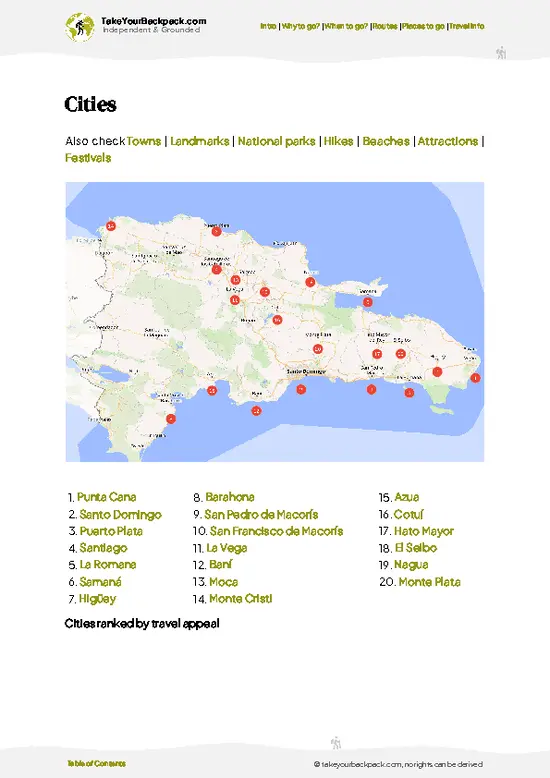
✅ Cities, national parks, landmarks, beaches
✅ How to get around
✅ Offline-friendly for travel without Wi-Fi
👉 Click to see all 30+ guide features

📅 Plan smarter in minutes, not weeks
✅ Month by month travel advice
✅ Festivals & national holidays
✅ Budget expectations

🗺️ Go to the right places, skip the overrated ones
✅ Honest pros & cons of destinations
✅ Top hikes, parks & viewpoints
✅ Lesser-known places most travelers miss
✅ Clear “worth it vs skip it” guidance

🛏️ Travel smoothly without rookie mistakes
✅ Best areas to stay
✅ Transport systems explained simply
✅ Common scams & safety advice
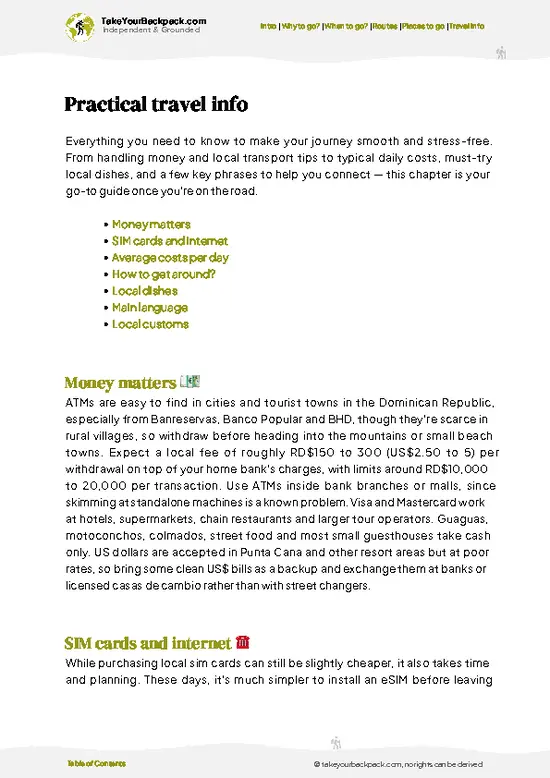
✅ SIM cards, money & practical tips

🌍 Understand the country, not just visit it
✅ Culture & traditions
✅ 52 Essential phrases & customs
✅ Festivals worth planning around
✅ Traveler-friendly historical context
✅ Insights that make places more meaningful

📱 Built for real travel conditions
✅ Fully downloadable PDF
✅ Works completely offline
✅ Optimized for phone use
✅ Useful in remote areas & buses
✅ Everything in one place
Stop searching, start planning
Get instant access to your full guide. 30‑day money-back guarantee.
+ Add another guide for just

By proceeding you agree to our terms.
Sent to your inbox immediately after payment • 100% Secure Checkout
Best Backpacking Travel Advisor 2025 tourism awardBest Backpacking
Travel Advisor
2025
What others say about Take Your Backpack Guides:
⭐⭐⭐⭐⭐
Fantastic, amazing amount of information!
⭐⭐⭐⭐⭐
My goodness this is amazing, it's what I've been looking for hats off too you!
⭐⭐⭐⭐⭐
I think this is absolutely BRILLIANT
⭐⭐⭐⭐
Very complete and informative. It's still missing places, but I gotta to commend you
⭐⭐⭐⭐⭐
This is truly amazing, thank you, can't wait to explore it with my kids!
⭐⭐⭐⭐⭐
Awesome resource, thank you!
⭐⭐⭐⭐⭐
This is amazing! Can't wait to explore the ones I haven't seen
⭐⭐⭐⭐
I love this! Well done, great idea.
⭐⭐⭐⭐⭐
Thanks for taking the time to make this gem!
⭐⭐⭐⭐⭐
This might be the best website I've ever seen.
⭐⭐⭐⭐⭐
Congratulations, and thank you so much for your work; it's incredibly valuable.
⭐⭐⭐⭐
In all seriousness I think you did a great job pointing out the important spots
⭐⭐⭐⭐⭐
10/10 very good
⭐⭐⭐⭐⭐
As someone who's only just starting to visit regularly this is awesome, thank you.
⭐⭐⭐⭐
Thank you very much! I'm going to visit my dad, it's going to be very useful!
⭐⭐⭐⭐⭐
This is really cool! We'll be travelling for the first time and this definitely come in handy.
⭐⭐⭐⭐⭐
You are now our minister of culture, congratulations 👨‍💼
⭐⭐⭐⭐⭐
Just wanted to tell you that this is a pearl! Going to follow your recommendations.
⭐⭐⭐⭐⭐
This is so cool. I'll definitely be using the resource for my travels soon.
⭐⭐⭐⭐⭐
This is very impressive! Good work.
⭐⭐⭐⭐⭐
This is an amazing and informative site. Very well done!

🛏️ Where to stay?Accommodation Highlights

Hostels and budget guesthouses exist across the Dominican Republic, with dorm beds typically running RD$700 to 1,500 (US$12 to 25) and simple private rooms from about RD$1,800 (US$30). The densest cluster is in Santo Domingo’s Zona Colonial, where you can walk to the main historic sights and weekend bars but should expect street noise and take care on quieter side streets after dark. Elsewhere, Cabarete has surfer and kiter hostels in a lively beach-bar strip, Las Terrenas is calmer with good guesthouse value, Jarabacoa suits quiet mountain stays, and Bávaro’s Los Corales area offers the few budget beds near Punta Cana’s resort beaches.

If you enjoy meeting fellow travelers, consider choosing … read more 👉
Hostels and budget guesthouses exist across the Dominican Republic, with dorm beds typically running RD$700 to 1,500 (US$12 to 25) and simple private rooms from about RD$1,800 (US$30). The densest cluster is in Santo Domingo’s Zona Colonial, where you can walk to the main historic sights and weekend bars but should expect street noise and take care on quieter side streets after dark. Elsewhere, Cabarete has surfer and kiter hostels in a lively beach-bar strip, Las Terrenas is calmer with good guesthouse value, Jarabacoa suits quiet mountain stays, and Bávaro’s Los Corales area offers the few budget beds near Punta Cana’s resort beaches.

If you enjoy meeting fellow travelers, consider choosing hostels with high ratings for atmosphere. On the other hand, if you prefer having your own space, a hotel might be a better option.

Dominican RepublicSee More of Dominican Republic

👋 Meet the founderWho’s Behind Take Your Backpack?

Johan, backpacker and founder of TakeYourBackpackHi, I’m Johan (Netherlands 🇳🇱), the creator of TakeYourBackpack. Over the past 3 decades, I’ve backpacked through 90+ countries across six continents, gaining extensive experience with independent travel, long-term trips, and overland routes.

This site is built on a combination of firsthand travel experience and carefully curated insights from other backpackers. Many guides are based on places I’ve personally visited, while others bring together tips, observations, and practical advice shared by trusted travelers I’ve met along the way.

The goal is to provide realistic, experience-driven guidance — not generic itineraries — so you can explore destinations with better context, clearer expectations, and more confidence.